
Life, 1917-03-15 · page 21 of 42
Life — March 15, 1917 — page 21: what you’re looking at
What you’re looking at
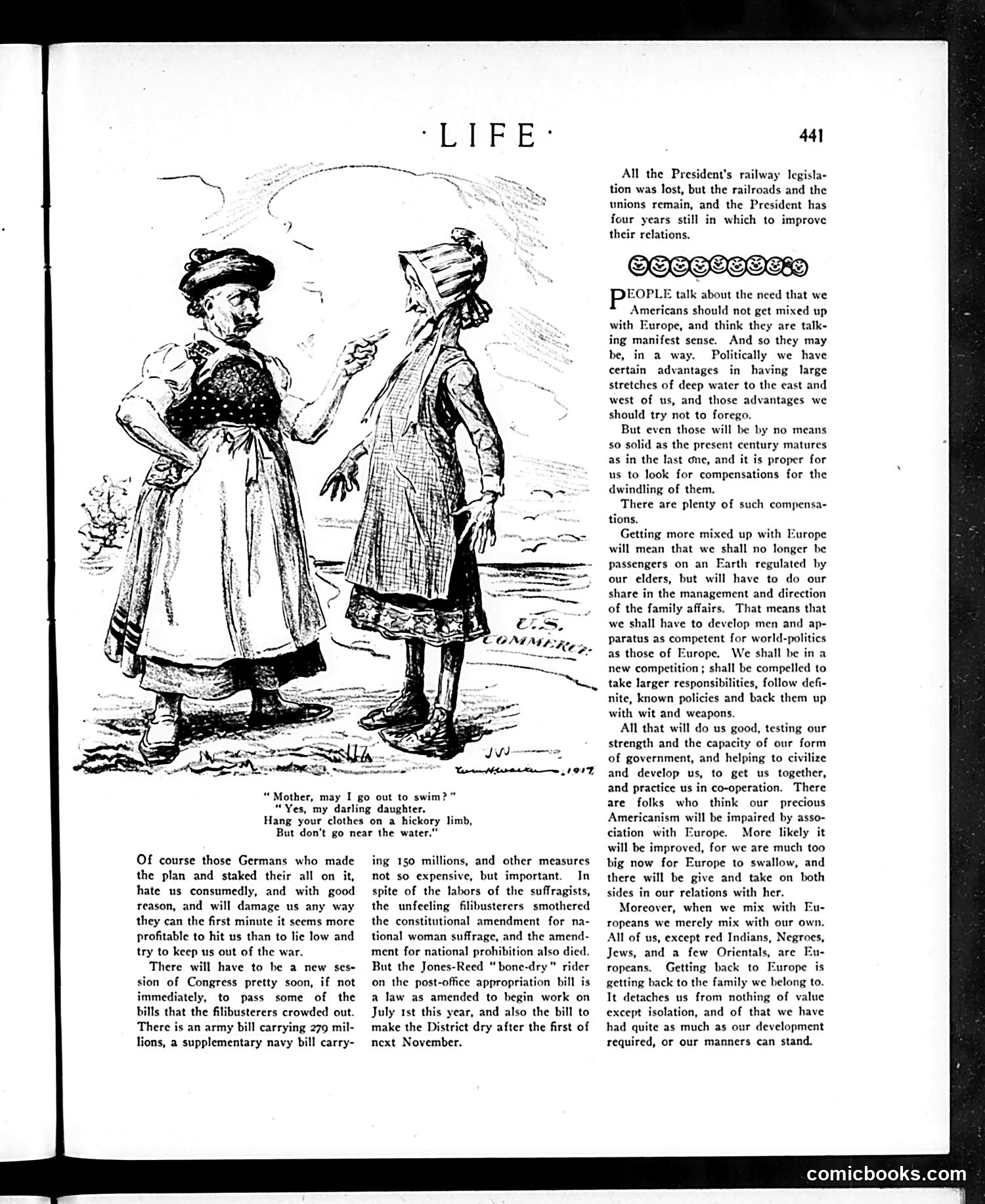
The cartoon depicts two women in conversation, illustrating the nursery rhyme "Mother, may I go out to swim?" with the cautionary response about not going near water—a metaphor for America's isolationist debate during the World War I era. The accompanying essay argues against American isolationism, contending that increased European engagement is inevitable and beneficial. The author asserts Americans share European heritage (dismissively excepting "red Indians, Negroes, Jews, and a few Orientals") and that isolation is no longer viable or desirable. The text also references congressional gridlock: filibusterers blocked woman suffrage and national prohibition amendments, though a "bone-dry" rider passed and military appropriations bills remain pending. The piece suggests President Wilson's legislative agenda suffered significant defeats, requiring a new congressional session. The overall message frames growing American-European entanglement as natural, strengthening, and civilizing—a pro-interventionist position characteristic of 1917 discourse.
📄 Transcribed text from this page (OCR, searchable)
Machine-transcribed from the original scan — historical spelling and the odd misread are preserved.
“Mother, may I go out to swim?” “Yes, my darling daughter. Hang your clothes on a hickory limb, But don’t go near the water.” Of course those Germans who made the plan and staked their all on it, hate us consumedly, and with good reason, and will damage us any way they can the first minute it seems more Profitable to hit us than to lie low and try to keep us out of the war. There will have to be a new ses- sion of Congress pretty soon, if not immediately, to pass some of the bills that the filibusterers crowded out. There is an army bill carrying 279 mil- lions, a supplementary navy bill carry- ing 150 millions, and other measures not so expensive, but important. In spite of the labors of the suffragists, the unfeeling filibusterers smothered the constitutional amendment for na- tional woman suffrage, and the amend- ment for national prohibition also died. But the Jones-Reed “bone-dry” rider on the post-office appropriation bill is a law as amended to begin work on July 1st this year, and also the bill to make the District dry after the first of next November. 441 All the President's railway legisla- tion was lost, but the railroads and the unions remain, and the President has four years still in which to improve their relations. SOCCOCOE.5 EOPLE talk about the need that we Americans should not get mixed up with Europe, and think they are talk- ing manifest sense. And so they may be, in a way. Politically we have certain advantages in having large stretches of deep water to the east and west of us, and those advantages we should try not to forego. But even those will be by no means so solid as the present century matures as in the last one, and it is proper for us to look for compensations for the dwindling of them. There are plenty of such compensa- tions. Getting more mixed up with Europe will mean that we shall no longer be passengers on an Earth regulated by our elders, but will have to do our share in the management and direction of the family affairs. That means that we shall have to develop men and ap- paratus as competent for world-politics as those of Europe. We shall be in a new competition ; shall be compelled to take larger responsibilities, follow defi- nite, known policies and back them up with wit and weapons. All that will do us good, testing our strength and the capacity of our form of government, and helping to civilize and develop us, to get us together, and practice us in co-operation. There are folks who think our precious Americanism will be impaired by asso- ciation with Europe. More likely it will be improved, for we are much too big now for Europe to swallow, and there will be give and take on both sides in our relations with her. Moreover, when we mix with Eu- ropeans we merely mix with our own. All of us, except red Indians, Negroes, Jews, and a few Orientals, are Eu- ropeans. Getting back to Europe is getting hack to the family we belong to. It detaches us from nothing of value except isolation, and of that we have had quite as much as our development required, or our manners can stand. comicbooks.com