
Life, 1917-03-15 · page 24 of 42
Life — March 15, 1917 — page 24: what you’re looking at
What you’re looking at
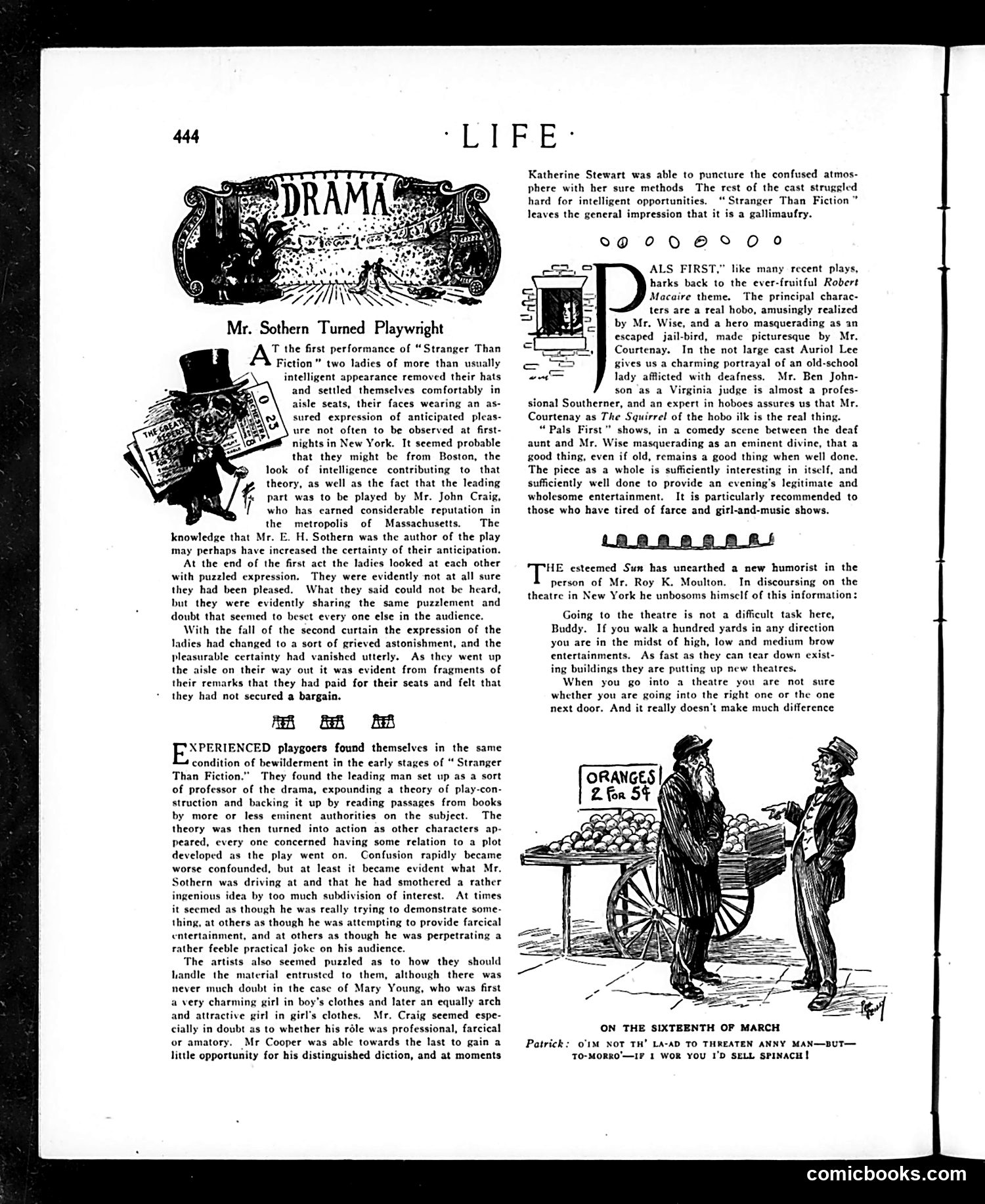
This page reviews E.H. Sothern's play "Stranger Than Fiction," starring John Craig. The main article describes audience confusion at the premiere: two intelligent Boston women arrived expectant but left disappointed, having paid for seats without getting value. The satirical critique explains the play's failure: Sothern attempted to theoretically demonstrate play-construction principles through dialogue and action simultaneously, creating bewildering confusion rather than coherent drama. The cast—including Mary Young and Katherine Stewart—struggled to understand whether they were performing serious drama, farce, or practical jokes on the audience. The cartoon (bottom right) is unrelated advertising for oranges at "2 for 5¢," featuring a street vendor—typical period commercial content. The review's overall point: ambitious theatrical experimentation without clear execution produces neither enlightenment nor entertainment.
📄 Transcribed text from this page (OCR, searchable)
Machine-transcribed from the original scan — historical spelling and the odd misread are preserved.
*LPF-E - Mr. Sothern Turned Playwright T the first performance of “Stranger Than Fiction” two ladies of more than usually intelligent appearance removed their hats and settled themselves comfortably in aisle seats, their faces wearing an as- sured expression of anticipated pleas- ure not often to be observed at first- nights in New York. It seemed probable that they might be from Boston, the look of intelligence contributing to that theory, as well as the fact that the leading part was to be played by Mr. John Craig, who has earned considerable reputation in the metropolis of Massachusetts. The knowledge that Mr. E. H. Sothern was the author of the play may perhaps have increased the certainty of their anticipation. At the end of the first act the ladies looked at each other with puzzled expression. They were evidently not at all sure they had been pleased. What they said could not be heard, but they were evidently sharing the same puzzlement and doubt that seemed to beset every one else in the audience. With the fall of the second curtain the expression of the ladies had changed to a sort of grieved astonishment, and the pleasurable certainty had vanished utterly. As they went up the aisle on their way out it was evident from fragments of their remarks that they had paid for their seats and felt that they had not secured a bargain. i Gi MB XPERIENCED playgoers found themselves in the same condition of bewilderment in the early stages of “ Stranger Than Fiction.” They found the leading man set up as a sort of professor of the drama, expounding a theory of play-con- struction and backing it up by reading passages from books by more or less eminent authorities on the subject. The theory was then turned into action as other characters ap- peared, every one concerned having some relation to a plot developed as the play went on. Confusion rapidly became worse confounded, but at least it became evident what Mr. Sothern was driving at and that he had smothered a rather ingenious idea by too much subdivision of intere: At times it seemed as though he was really trying to demonstrate some- thing, at others as though he was attempting to provide farcical entertainment, and at others as though he was perpetrating a rather feeble practical joke on his audience. The artists also seemed puzzled as to how they should Landle the material entrusted to them, although there was never much doubt in the case of Mary Young, who was first a very charming girl in boy's clothes and later an equally arch and attractive girl in girl's clothes, Mr. Craig seemed espe- cially in doubt as to whether his réle was professional, farcical or amatory. Mr Cooper was able towards the last to gain a little opportunity for his distinguished diction, and at moments Katherine Stewart was able to puncture the confused atmos- phere with her sure methods The rest of the cast struggled hard for intelligent opportunities. ‘Stranger Than Fiction ” leaves the general impression that it is a gallimaufry. °g000 60200 ALS FIRST,” like many recent plays, harks back to the ever-fruitful Robert Macaire theme. The principal charac- ters are a real hobo, amusingly realized by Mr. Wise, and a hero masquerading as an escaped jail-bird, made picturesque by Mr. Courtenay. In the not large cast Auriol Lee gives us a charming portrayal of an old-school lady afficted with deafness, Mr. Ben John- son as a Virginia judge is almost a profes- sional Southerner, and an expert in hoboes assures us that Mr. Courtenay as The Squirrel of the hobo ilk is the real thing. “Pals First shows, in a comedy scene between the deaf aunt and Mr. Wise masquerading as an eminent divine, that a good thing, even if old, remains a good thing when well done. The piece as a whole is sufficiently interesting in itself, and sufficiently well done to provide an evening's legitimate and wholesome entertainment. It is particularly recommended to those who have tired of farce and gitl-and-music shows. LAA OO 8 A Af HE esteemed Sun has unearthed a new humorist in the person of Mr. Roy K. Moulton. In discoursing on the theatre in New York he unbosoms himself of this information: Going to the theatre is not a difficult task here, Buddy. If you walk a hundred yards in any direction you are in the midst of high, low and medium brow entertainments. As fast as they can tear down exist- ing buildings they are putting up new theatres. When you go into a theatre you are not sure whether you are going into the right one or the one next door. And it really doesn't make much difference ON THE SIXTEENTH OF MARCH Patrick: o'1M NOT TH’ LA-AD TO THREATEN ANNY MAN—BUT— TO-MORRO'—IF 1 WOR YOU I'D SELL SPINACH! comicbooks.com