
Life, 1917-03-15 · page 10 of 42
Life — March 15, 1917 — page 10: what you’re looking at
What you’re looking at
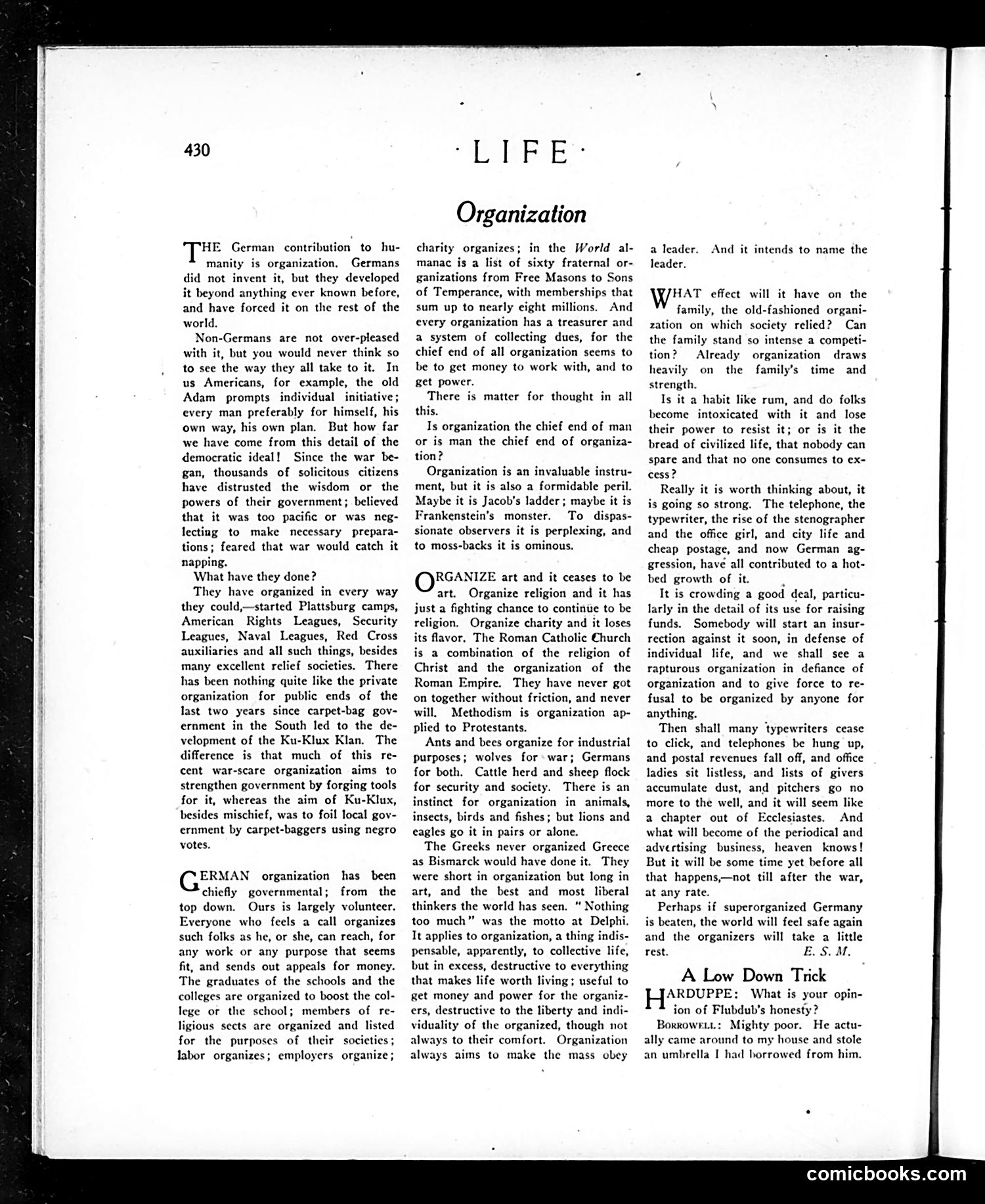
This page is primarily text-based editorial content with no visible cartoons. The article discusses German organizational culture, arguing that while Germans developed organizational systems effectively, over-organization threatens individual liberty and family life. The piece critiques excessive bureaucratization—suggesting organizations like the telephone, typewriter, and office work have created a "hotbed growth" of organizational excess. It warns that superorganization makes life "destructive to everything that makes life worth living." The satirical point appears to be that German efficiency, while impressive, comes at the cost of personal freedom—a timely concern given the article references Bismarck and industrial organization. The final section includes an unrelated joke ("A Low Trick") about borrowed umbrellas.
📄 Transcribed text from this page (OCR, searchable)
Machine-transcribed from the original scan — historical spelling and the odd misread are preserved.
'HE German contribution to hu- manity is organization, Germans did not invent it, but they developed it beyond anything ever known before, and have forced it on the rest of the world. Non-Germans are not over-pleased with it, but you would never think so to see the way they all take to it. In us Americans, for example, the old Adam prompts individual initiative; every man preferably for himself, his own way, his own plan. But how far we have come from this detail of the democratic ideal! Since the war be- gan, thousands of solicitous citizens have distrusted the wisdom or the powers of their government; believed that it was too pacific or was neg- lecting to make necessary prepara- tions; feared that war would catch it napping. What have they done? They have organized in every way they could,—started Plattsburg camps, American Rights Leagues, Security Leagues, Naval Leagues, Red Cross auxiliaries and all such things, besides many excellent relief societies. There has been nothing quite like the private organization for public ends of the last two years since carpet-bag gov- ernment in the South led to the de- velopment of the Ku-Klux Klan. The difference is that much of this re- cent war-scare organization aims to strengthen government by forging tools for it, whereas the aim of Ku-Klux, besides mischief, was to foil local gov- ernment by carpet-baggers using negro votes. ERMAN organization has been chiefly governmental; from the top down. Ours is largely volunteer. Everyone who feels a call organizes such folks as he, or she, can reach, for any work or any purpose that seems fit, and sends out appeals for money. The graduates of the schools and the colleges are organized to boost the col- lege or the school; members of re- ligious sects are organized and listed for the purposes of their societies; labor organizes; employers organize; Organization charity organizes; in the World al- manac is a list of sixty fraternal or- ganizations from Free Masons to Sons of Temperance, with memberships that sum up to nearly eight millions. And every organization has a treasurer and a system of collecting dues, for the chief end of all organization seems to be to get money to work with, and to get power. There is matter for thought in all this. Is organization the chief end of man or is man the chief end of organiza- tion? Organization is an invaluable instru- ment, but it is also a formidable peril. Maybe it is Jacob's ladder; maybe it is Frankenstein's monster. To dispas- sionate observers it is perplexing, and to moss-backs it is ominous. RGANIZE art and it ceases to be art. Organize religion and it has just a fighting chance to continue to be religion. Organize charity and it loses its flavor, The Roman Catholic Church is a combination of the religion of Christ and the organization of the Roman Empire. They have never got on together without friction, and never will, Methodism is organization ap- plied to Protestants. Ants and bees organize for industrial purposes; wolves for war; Germans for both. Cattle herd and sheep flock for security and society. There is an instinct for organization in animals, insects, birds and fishes; but lions and eagles go it in pairs or alone. The Greeks never organized Greece as Bismarck would have done it. They were short in organization but long in art, and the best and most liberal thinkers the world has seen. “ Nothing too much” was the motto at Delphi. It applies to organization, a thing indis- pensable, apparently, to collective life, but in excess, destructive to everything that makes life worth living; useful to get money and power for the organiz- ers, destructive to the liberty and indi- viduality of the organized, though not always to their comfort. Organization always aims to make the mass obey a leader, And it intends to name the leader. HAT effect will it have on the family, the old-fashioned organi- zation on which society relied? Can the family stand so intense a competi- tion? Already organization draws heavily on the family’s time and strength. Is it a habit like rum, and do folks become intoxicated with it and lose their power to resist it; or is it the bread of civilized life, that nobody can spare and that no one consumes to ex- cess? Really it is worth thinking about, it is going so strong. The telephone, the typewriter, the rise of the stenographer and the office girl, and city life and cheap postage, and now German ag- gression, have all contributed to a hot- bed growth of it. A; It is crowding a good deal, particu- larly in the detail of its use for raising funds. Somebody will start an insur- rection against it soon, in defense of individual life, and we shall see a rapturous organization in defiance of organization and to give force to re- fusal to be organized by anyone for anything, Then shall many typewriters cease to click, and telephones be hung up, and postal revenues fall off, and office ladies sit listless, and lists of givers accumulate dust, and pitchers go no more to the well, and it will seem like a chapter out of Ecclesiastes. And what will become of the periodical and advertising business, heaven knows! But it will be some time yet before all that happens,—not till after the war, at any rate. Perhaps if superorganized Germany is beaten, the world will feel safe again and the organizers will take a little rest. E.S.M. A Low Down Trick HHARDUPPE: What is your opin- ion of Flubdub’s honesty? Borrowrit: Mighty poor. He actu- ally came around to my house and stole an umbrella I had borrowed from him. comicbooks.com