
Life, 1917-03-15 · page 28 of 42
Life — March 15, 1917 — page 28: what you’re looking at
What you’re looking at
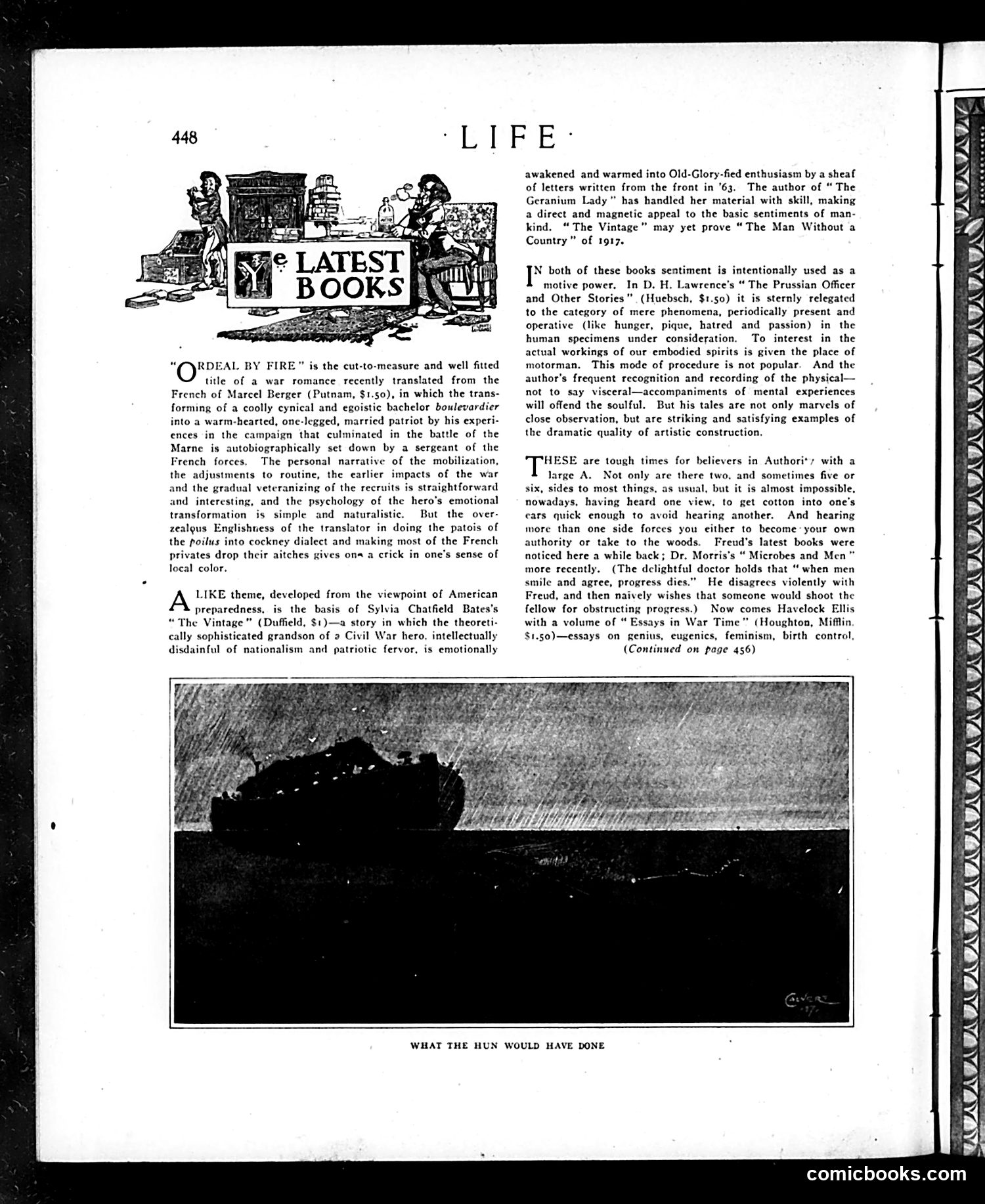
This page reviews recent books, primarily war-related fiction published around 1917. The reviews discuss three novels: 1. **"Ordeal by Fire"** by Marcel Berger—a French soldier's autobiography about transforming from a cynical bachelor into a patriotic amputee during WWI's Battle of the Marne. 2. **"The Vintage"** by Sylvia Chatfield Bates—about an American grandson of a Civil War veteran who becomes patriotically enthusiastic after reading letters from the front (apparently the 1863 Civil War era, based on context). 3. **D.H. Lawrence's "The Prussian Officer"**—short stories treating emotion as biological phenomenon rather than sentiment. The page criticizes overreliance on sentiment as motivation while praising artistic construction. The silhouette illustration captioned "WHAT THE HUN WOULD HAVE DONE" appears darkly satirical regarding German military action, likely referencing contemporary WWI propaganda about German atrocities.
📄 Transcribed text from this page (OCR, searchable)
Machine-transcribed from the original scan — historical spelling and the odd misread are preserved.
“ETRE “C)RDEAL BY FIRE” is the cut-to-measure and well fitted title of a war romance recently translated from the French of Marcel Berger (Putnam, $1.50), in which the trans- forming of a coolly cynical and egoistic bachelor boulevardier into a warm-hearted, one-legged, married patriot by his experi- ences in the campaign that culminated in the battle of the Marne is autobiographically set down by a sergeant of the French forces. The personal narrative of the mobilization, the adjustments to routine, the earlier impacts of the war and the gradual veteranizing of the recruits is straightforward and interesting, and the psychology of the hero's emotional transformation is simple and naturalistic. But the over- zealous Englishness of the translator in doing the patois of the poilus into cockney dialect and making most of the French privates drop their aitches gives ona crick in one’s sense of local color. LIKE theme, developed from the viewpoint of American preparedness, is the basis of Sylvia Chatfield Bates's “The Vintage" (Duffield, $1)—a story which the theoreti- cally sophisticated grandson of a Civil War hero. intellectually disdainful of nationalism and patriotic fervor, is emotionally awakened and warmed into Old-Glory-fied enthusiasm by a sheaf of letters written from the front in ‘63. The author of “ The Geranium Lady” has handled her material with skill, making a direct and magnetic appeal to the basic sentiments of man- kind. “The Vintage” may yet prove “The Man Without a Country” of 1917. I both of these books sentiment is intentionally used as a motive power. In D. H. Lawrence's “ The Prussian Officer and Other Stories” (Huebsch, $1.50) it is sternly relegated to the category of mere phenomena, periodically present and operative (like hunger, pique, hatred and passion) in the human specimens under consideration. To interest in the actual workings of our embodied spirits is given the place of motorman. This mode of procedure is not popular. And the author's frequent recognition and recording of the physical— not to say visceral—accompaniments of mental experiences will offend the soulful. But his tales are not only marvels of close observation, but are striking and satisfying examples of the dramatic quality of artistic construction. 'HESE are tough times for believers in Authori*; with a large A. Not only are there two, and sometimes five or six, sides to most things, as usual, but it is almost impossible, nowadays, having heard one view, to get cotton into one’s cars quick enough to avoid hearing another. And hearing more than one side forces you either to become: your own authority or take to the woods. Freud's latest books were noticed here a while back; Dr. Morris's “ Microbes and Men” more recently. (The delightful doctor holds that “when men smile and agree, progress dies.” He disagrees violently with Freud, and then naively wishes that someone would shoot the fellow for obstructing progress.) Now comes Havelock Ellis with a volume of “ Essays in War Time” (Houghton, Mifflin. $1.50)—essays on genius, eugenics, feminism, birth control, (Continued on page 456) oie WHAT THE HUN WOULD HAVE DONE comicbooks.com