
A complete issue · 52 pages · 1916
Life — May 4, 1916
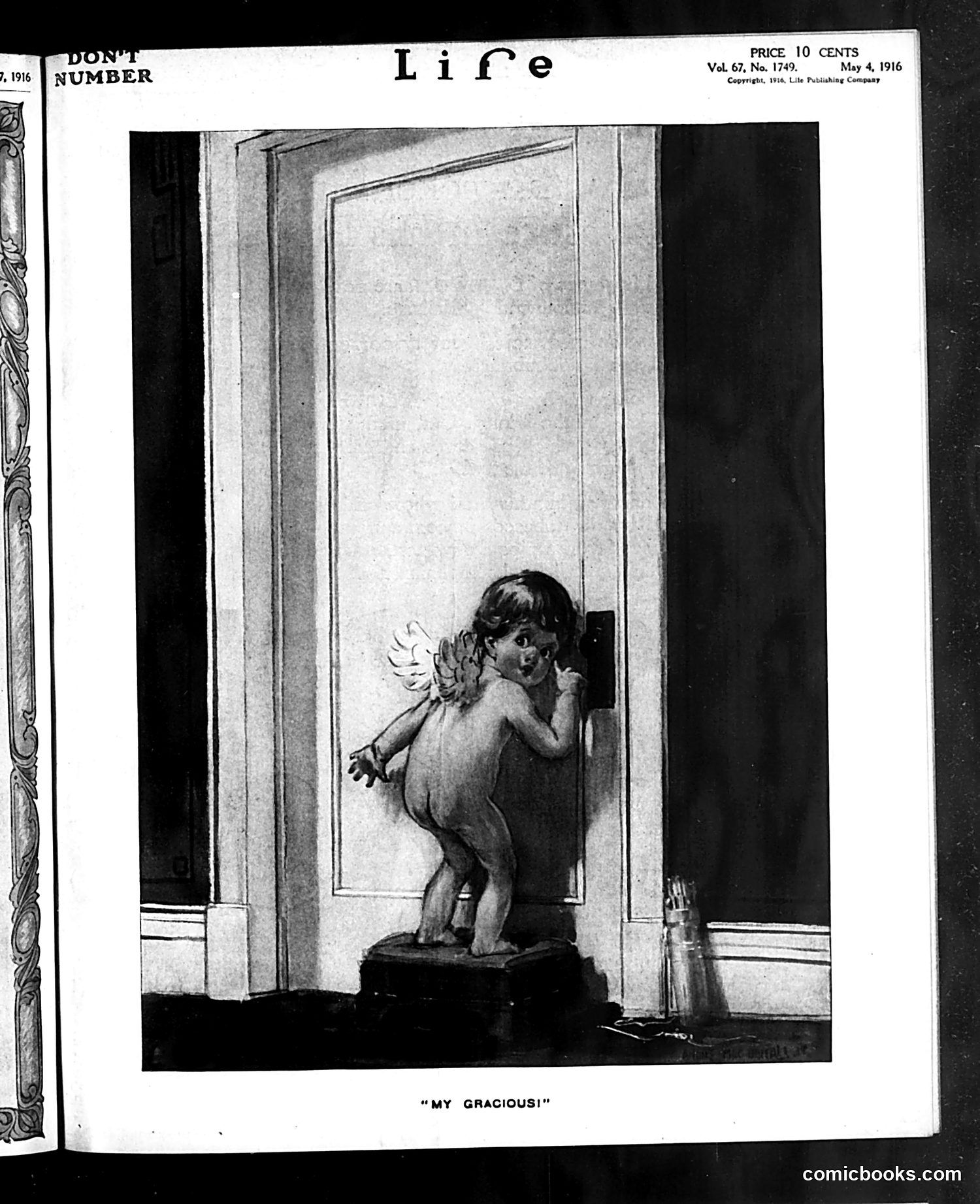
This satirical illustration depicts a cherubic, winged figure (likely representing a cupid or cherub) standing on a pedestal in a doorway, appearing surprised or flustered. The caption "MY GRACIOUS!" suggests an expression of shock or indignation. Without additional context from surrounding articles on this page, the specific satirical target is unclear. However, given Life's tradition of social commentary, this likely mocks either pretentious artistic taste, naive sentimentality about classical sculpture, or perhaps commentary on romantic/social conventions of the era. The cherub's dramatic pose and emotional expression suggest ironic commentary on affected reactions to art or propriety. The precise political or social reference requires additional contextual information not visible in this isolated image.
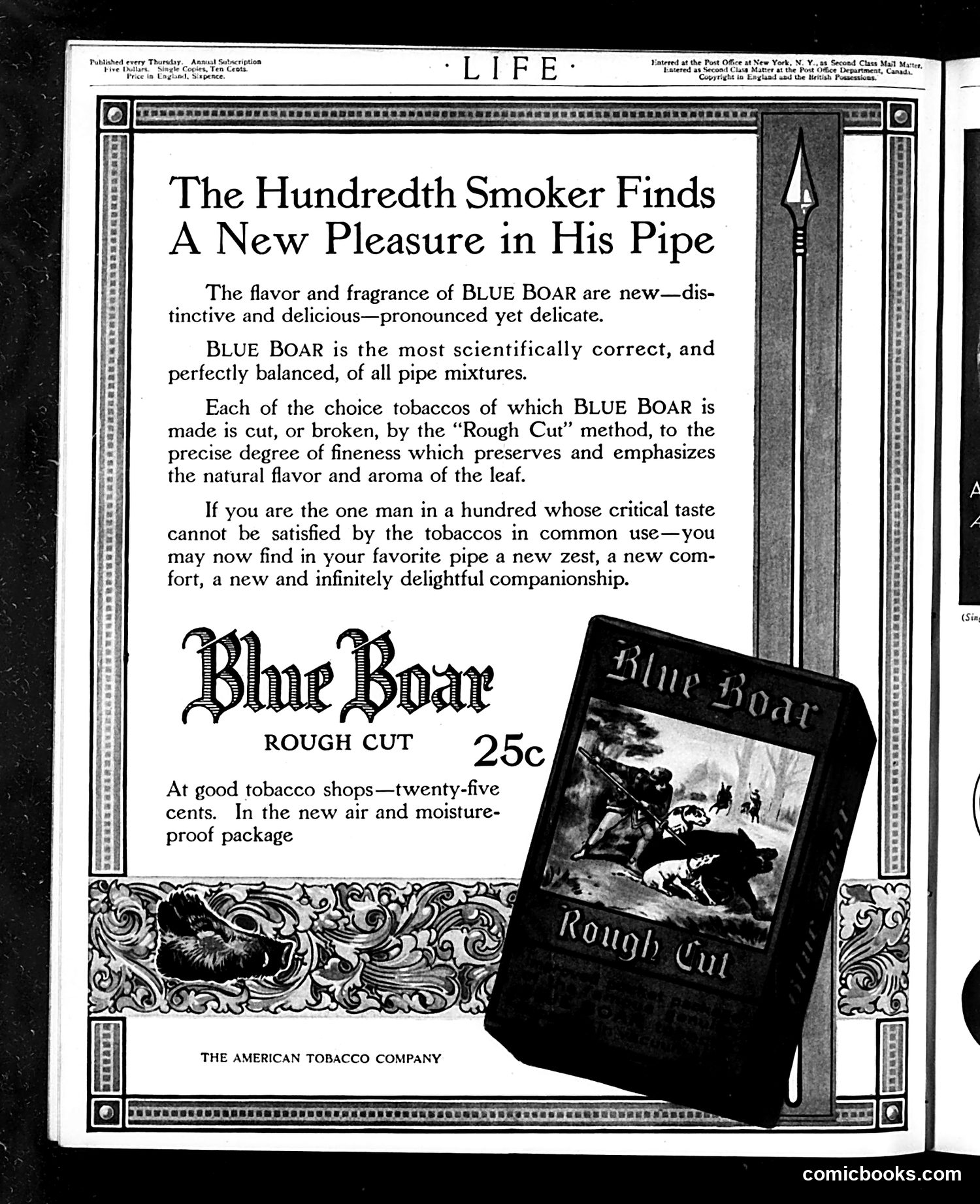
This is not a political cartoon or satirical content—it's a **straightforward tobacco advertisement** for Blue Boar pipe tobacco, published in *Life* magazine. The ad appeals to discerning smokers by marketing Blue Boar as superior to "common" tobacco brands. The phrase "the one man in a hundred whose critical taste cannot be satisfied" suggests exclusivity and refinement. The product uses a "Rough Cut" method claimed to preserve natural flavor and aroma. The only visual element beyond text is a product package image showing what appears to be a hunting scene (fitting the "boar" branding). At 25 cents, this represents vintage advertising strategy: positioning a premium product for affluent consumers who value quality over price.
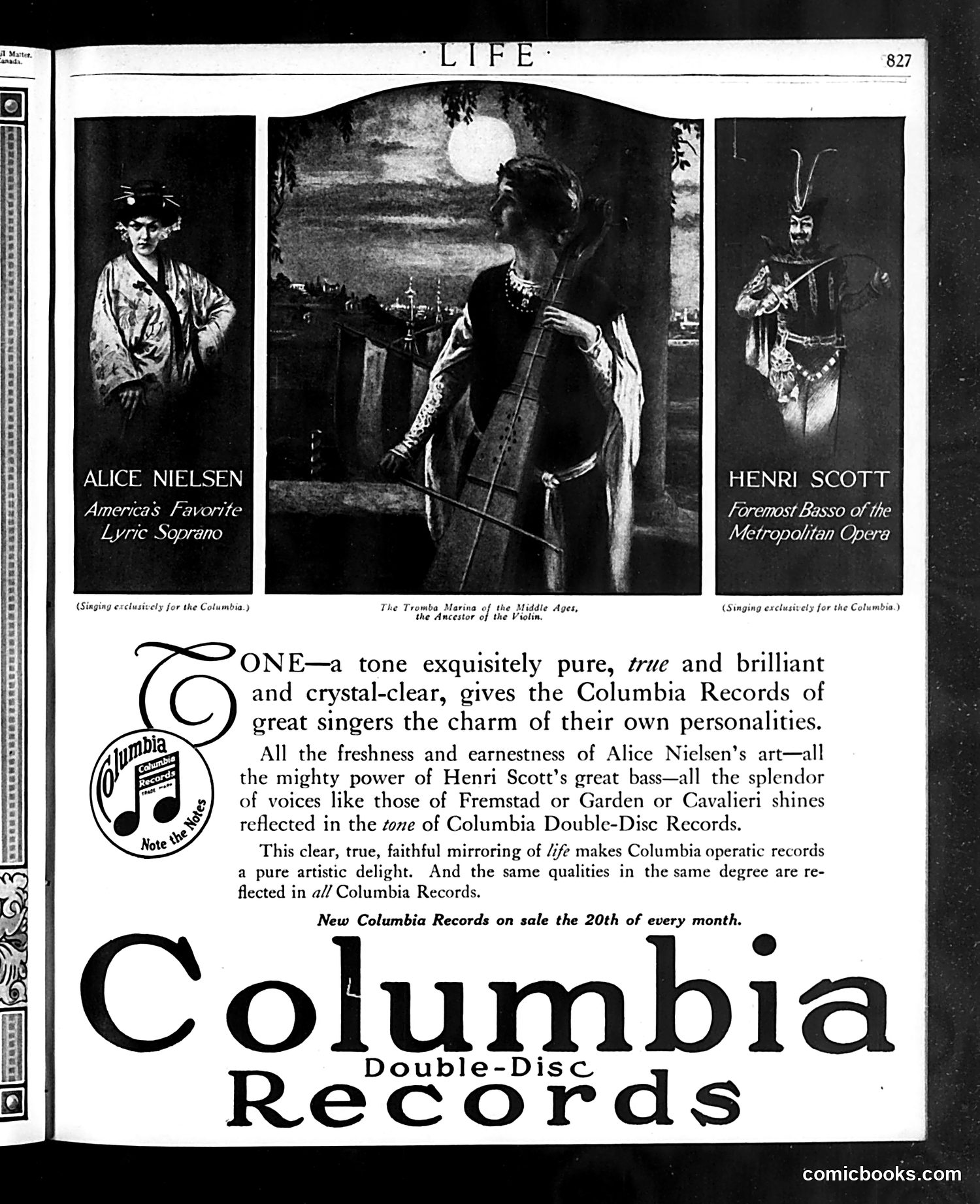
This page is primarily **advertising**, not satire or political commentary. It's a Columbia Records advertisement from *Life* magazine promoting their Double-Disc Records featuring opera singers. The page displays three photographs: Alice Nielsen (labeled "America's Favorite Lyric Soprano"), a central image labeled "The Trombla Marina of the Middle Ages, the Ancestor of the Violin," and Henri Scott ("Foremost Basso of the Metropolitan Opera"). The advertisement emphasizes Columbia Records' superior sound quality—describing their tone as "pure, true and brilliant and crystal-clear." It references other famous singers (Fremstad, Garden, Cavalieri) to establish artistic credibility, and notes new records are released on the 20th of each month. There is no political satire present on this page.
This page is primarily **advertising copy** for an automobile, not political satire. The headline "There Are Go and Gumption in this Long-" refers to a car model (likely a Chalmers, mentioned in the text). The text promotes the vehicle's performance specifications: its 3400 RPM engine capacity, fuel economy, safety features, and ability to reach 80 miles per hour. The advertisement emphasizes practical virtues—"go and gumption"—appealing to buyers seeking reliable, economical transportation. The small illustration at top appears to be a simple line drawing of the car itself. There is no political cartoon or social satire present on this page; it's a straightforward early automotive advertisement, likely from the 1910s-1920s era based on the styling and performance metrics cited.
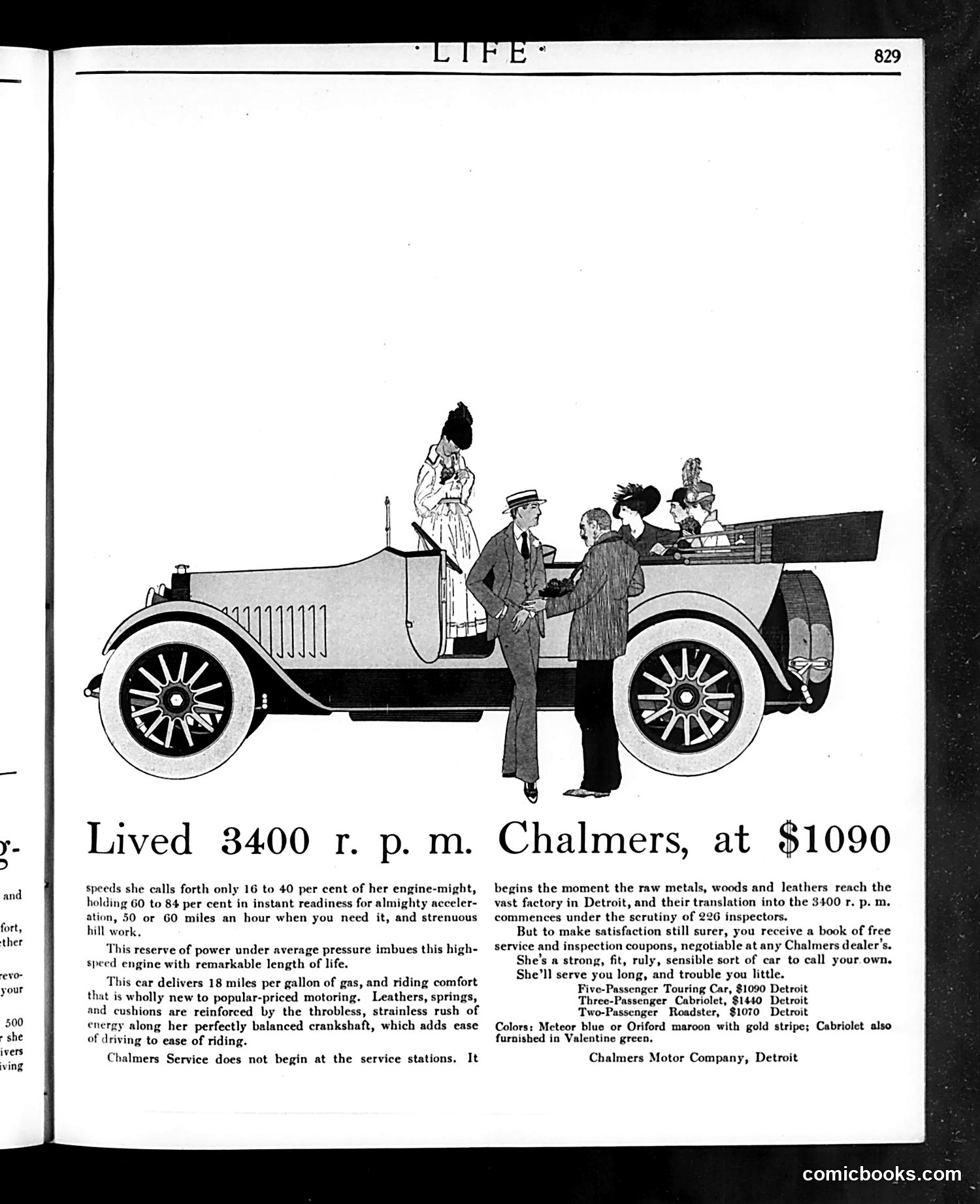
This page is **not political satire** but rather a **vintage automobile advertisement** from Life magazine (page 829). The image advertises the Chalmers Motor Company's 3400 r.p.m. model, priced at $1090. It depicts an elegantly dressed couple and their chauffeur with the vehicle, representing the aspirational lifestyle of early automotive ownership. The accompanying text emphasizes the car's practical features: fuel efficiency (18 miles per gallon), power reserve, and riding comfort—luxury details marketed to wealthy buyers. The ad lists various Chalmers models with prices and color options. This represents typical 1920s automobile marketing, positioning the vehicle as a status symbol for the affluent classes, with emphasis on both performance specifications and social prestige.
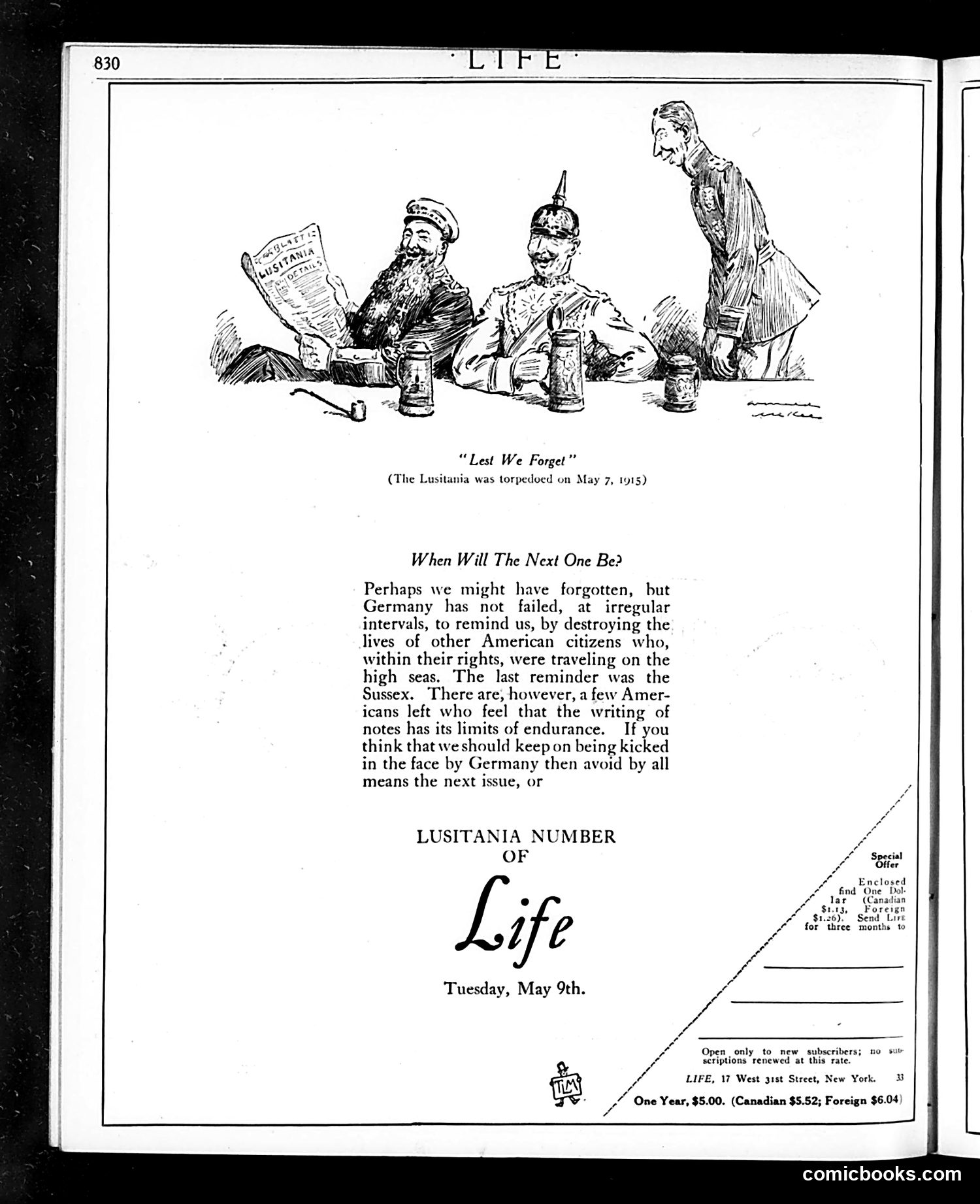
This page commemorates the **Lusitania sinking (May 7, 1915)**, a German U-boat attack on a British passenger liner that killed 128 American citizens. The cartoon "Lest We Forget" shows four figures—likely representing different nations or perspectives—toasting over drinks, with one holding a "Lusitania" newspaper. The implicit message: don't forget this atrocity. The text below sarcastically addresses American readers who might want to "avoid being kicked in the face by Germany" by not subscribing to the next issue. This mocks pacifist sentiment, arguing that appeasement won't prevent further attacks. The advertisement promotes a special "Lusitania Number" of Life magazine for May 9th—capitalizing on public outrage over the tragedy to boost subscriptions.
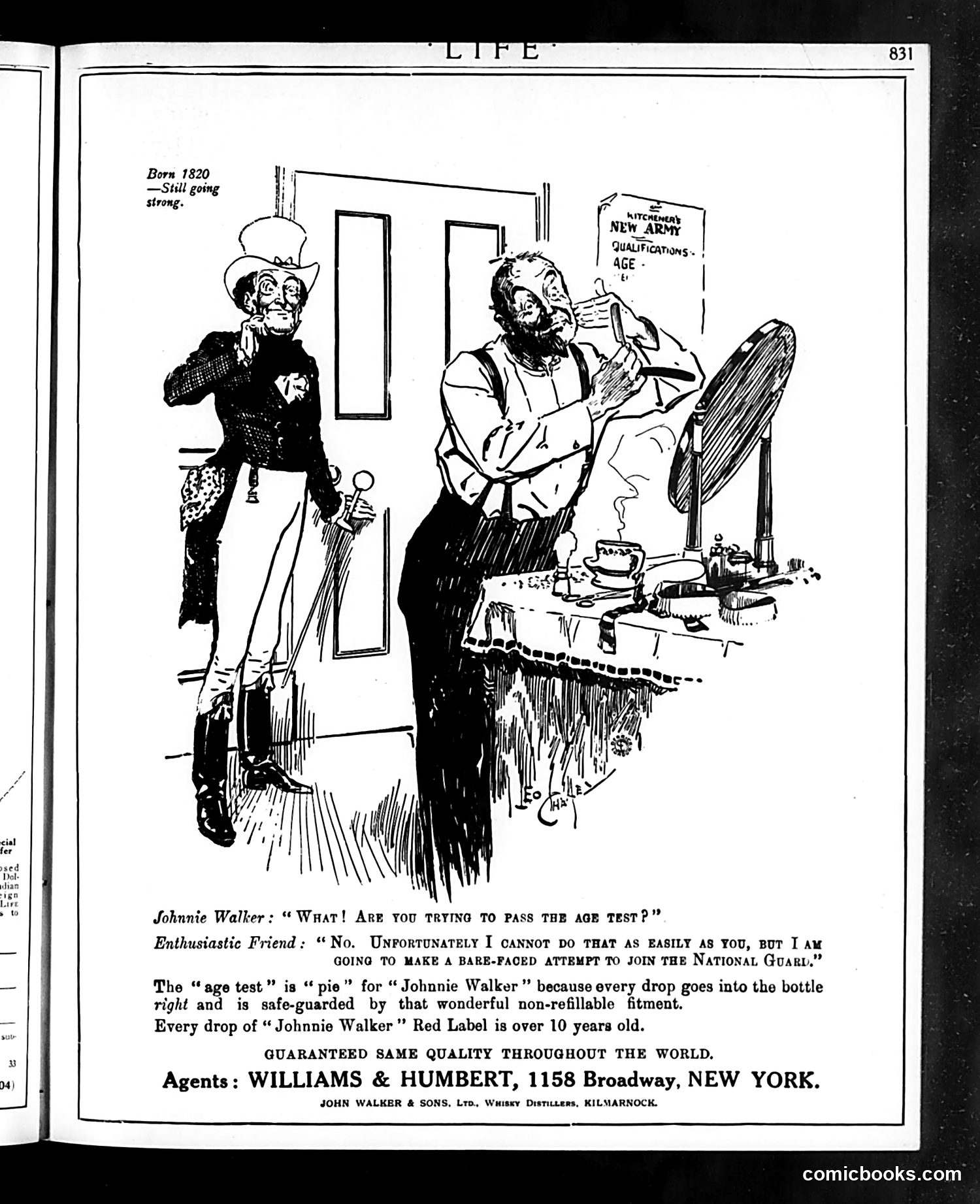
This is a **Johnnie Walker whisky advertisement** disguised as political satire. The cartoon depicts an elderly man labeled "Born 1820—Still going strong" (representing the brand's longevity) encountering a younger military recruit attempting to join the National Guard. The recruit claims he's trying to "pass the age test," suggesting he's underage. The joke plays on Johnnie Walker whisky's reputation for enduring quality: just as the brand stays strong despite its age, the recruit humorously references the product's famous durability. The advertisement emphasizes that Johnnie Walker Red Label has maintained consistent quality for over 10 years and guarantees "same quality throughout the world." The agents are listed as Williams & Humbert in New York.
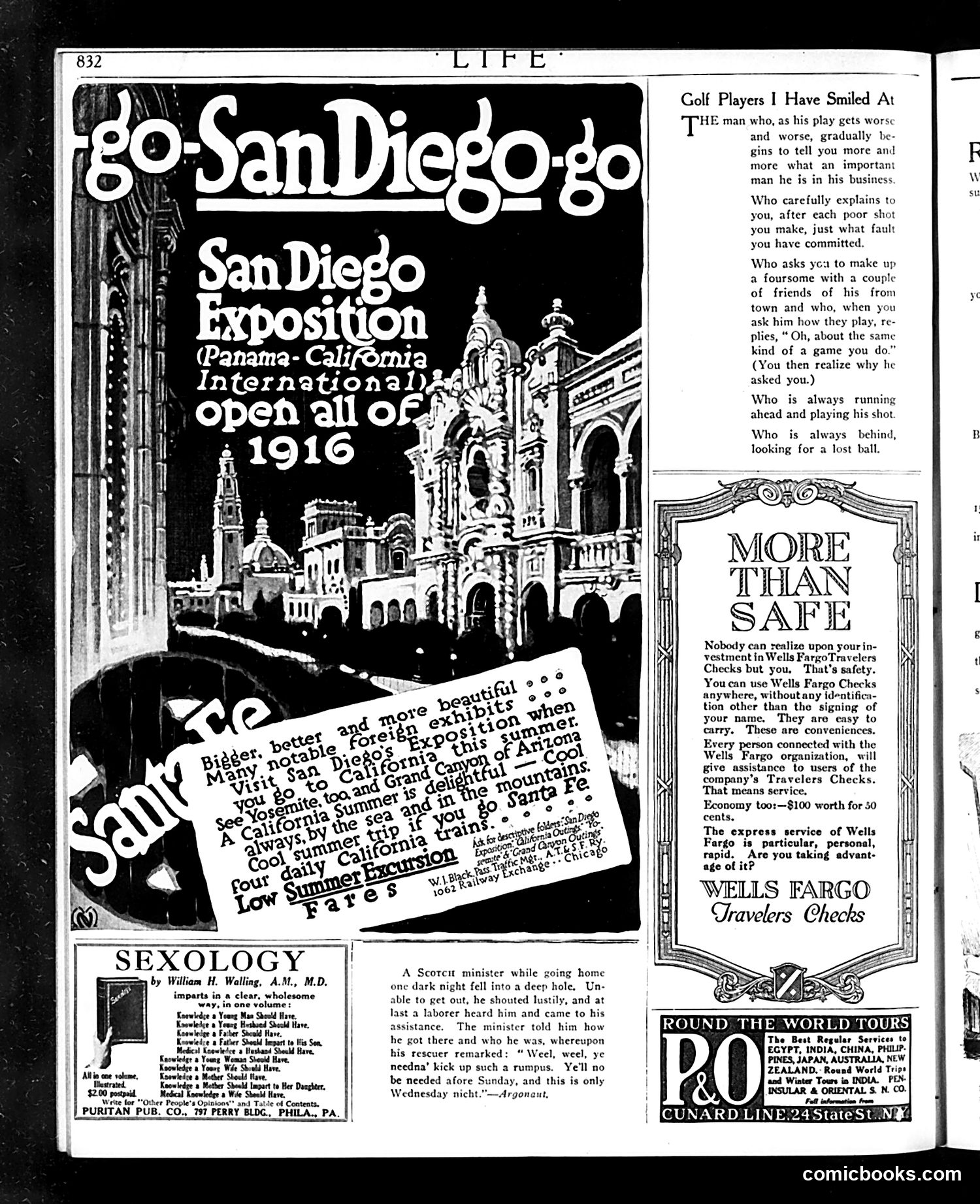
This page is primarily **advertising and filler content** from 1916 Life magazine, not political satire. The main advertisement promotes the **San Diego Exposition (Panama-California International)**, opening in 1916, featuring ornate architectural renderings. It encourages summer travel to Southern California with "low summer fares." Below that is a **Sexology** book advertisement by William H. Walling, M.D., promising health guidance on various topics—typical early-20th-century self-help marketing. The right side contains: - A brief humor piece titled "Golf Players I Have Smiled At" (gentle satire of golfer behavior) - A **Wells Fargo Travelers Checks** advertisement emphasizing safety and convenience - A **Cunard Line** advertisement for world tours There is **no political cartoon or significant satire** on this page—it's a standard magazine layout mixing light humor with commercial content.
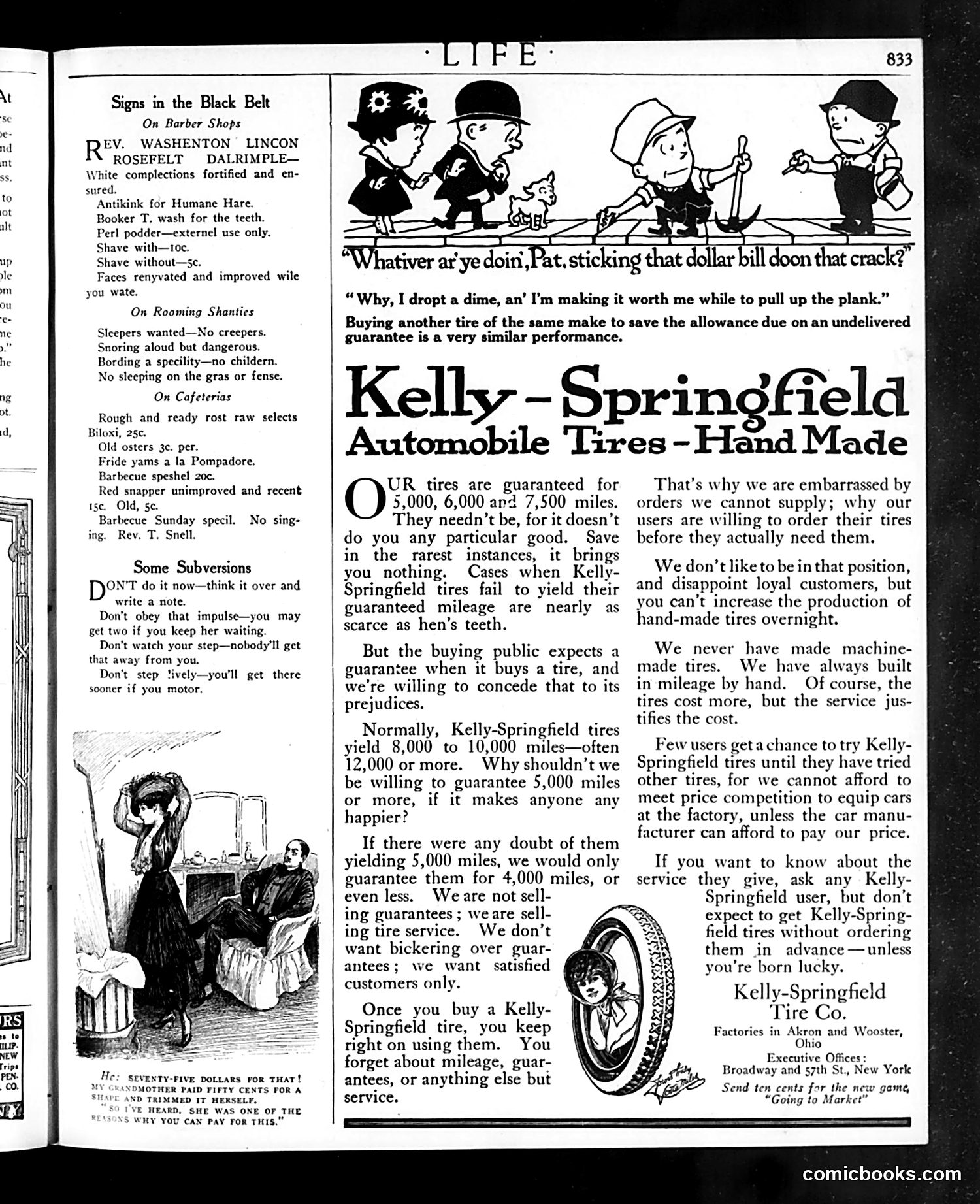
**Left side:** Comic strips and advice columns titled "Signs in the Black Belt" (likely referring to African American neighborhoods). These include humorous notices for barber shops, rooming shanties, and cafeterias—satirizing local business practices and social conditions. **Top cartoon:** A scene showing a child asking an adult ("Pat") why he's using a dollar bill to patch a crack instead of fixing it properly. The adult replies he's "making it worth" by pulling up a plank—satirizing penny-pinching and false economy. **Main content:** A Kelly-Springfield Tire Company advertisement defending their conservative 5,000-mile guarantee against competitors offering higher mileage guarantees. The ad argues their hand-made tires are superior quality, justifying the limited warranty and higher cost.
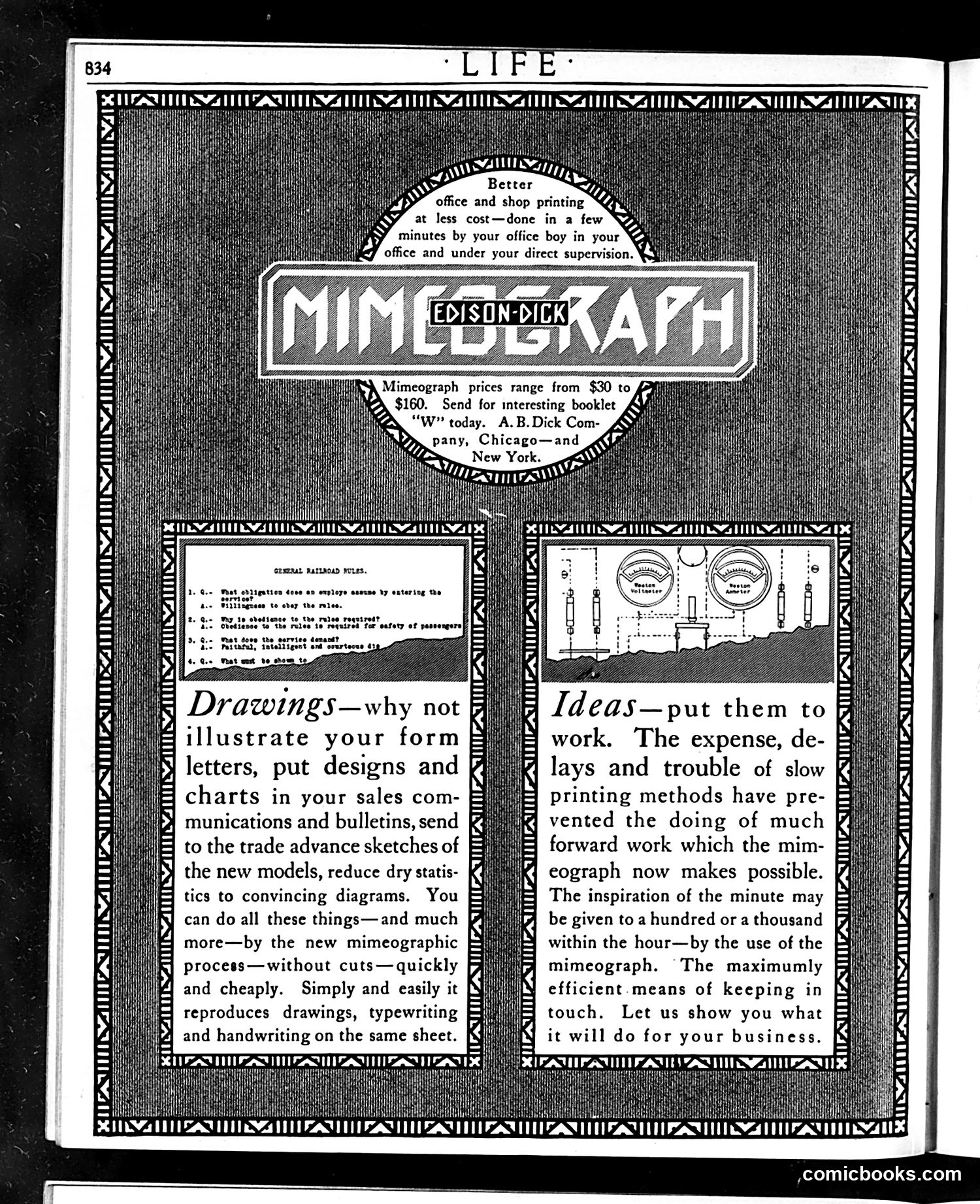
This page is primarily **advertising**, not editorial content or cartoons. It promotes the Edison-Dick Mimeograph machine, a duplicating device for offices. The ad emphasizes the mimeograph's business utility: it can quickly reproduce drawings, typewritten text, and handwriting on the same sheet without expensive traditional printing. This was revolutionary office technology for the early 20th century. The two illustrated panels show practical applications—using technical drawings and diagrams in business communications. The copy stresses speed, low cost, and the ability to distribute ideas rapidly within an organization or to clients. There is no political satire or social commentary here; this is straightforward commercial promotion appearing in *Life* magazine, which carried advertising alongside editorial content.
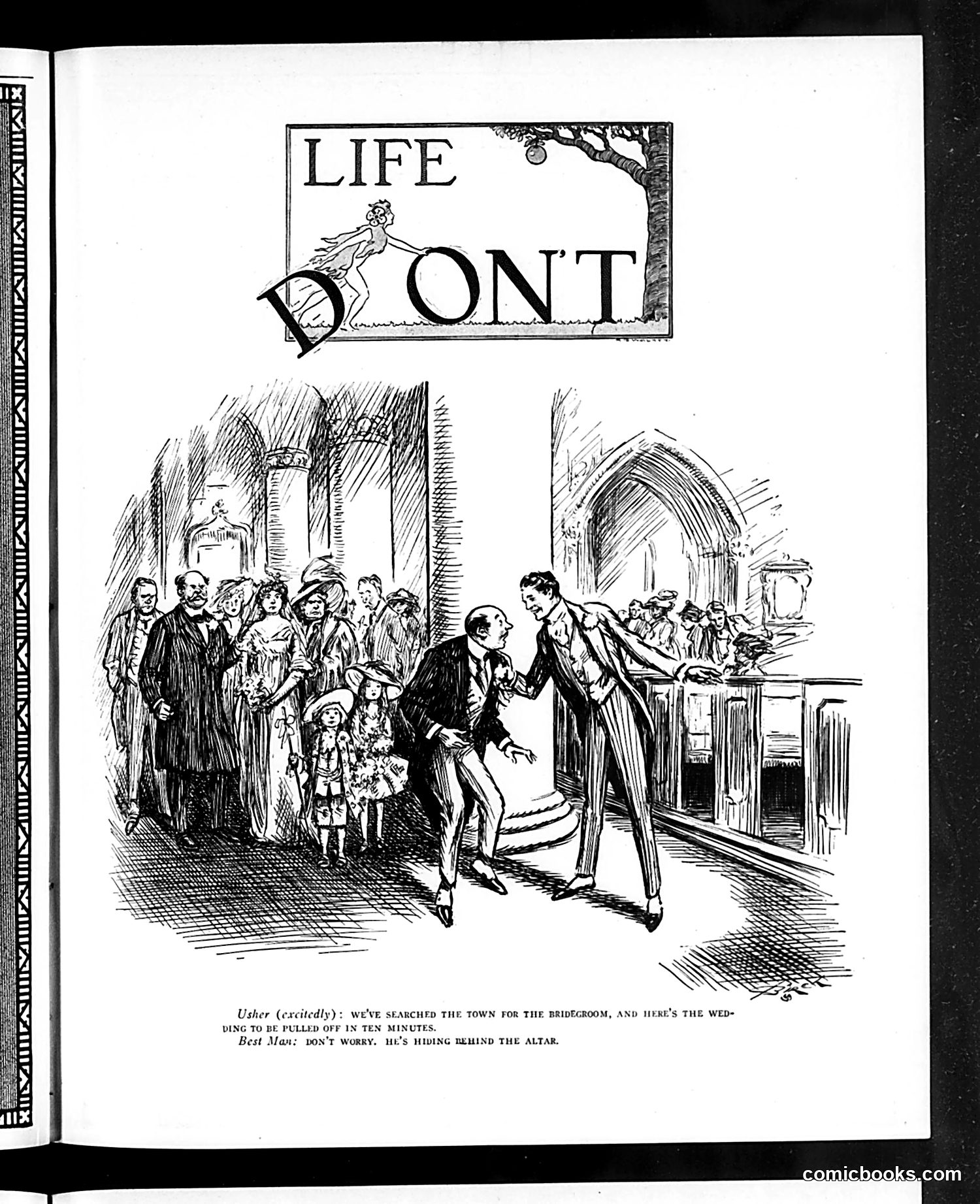
This is a satirical cartoon from *Life* magazine titled "Life Don't" with an illustrated header featuring a cherub and decorative border. The main scene depicts a church interior where a wedding has apparently been delayed. An usher (center) is speaking to the best man, explaining they've searched the town for the bridegroom who was supposed to arrive ten minutes ago. The best man reassures him: "don't worry. he's hiding behind the altar." The satire mocks cold feet and reluctant grooms—a common comedic theme. The joke plays on the anxiety of wedding day jitters, suggesting the groom is literally hiding rather than facing marriage. The caption's casual tone ("don't worry") heightens the absurdity of this excuse. The architectural setting and formal dress emphasize how the groom's cowardice undermines an important social occasion.
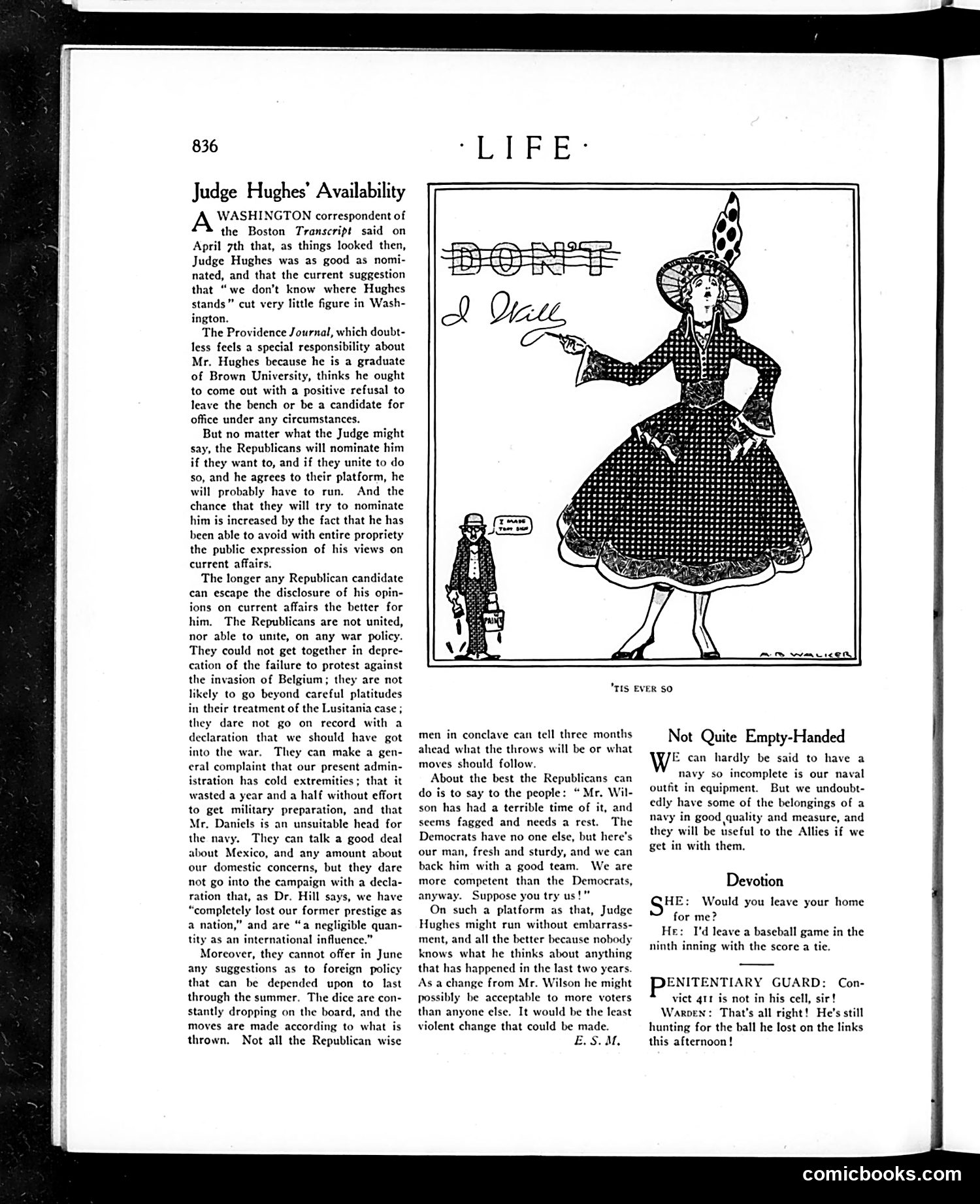
This page discusses Republican political strategy regarding **Judge Charles Evans Hughes**, a Brown University graduate and Supreme Court justice. The article argues that Republicans will likely nominate Hughes for office despite his reluctance, because he hasn't publicly refused—and they can exploit his silence as tacit acceptance. The main cartoon (signed "A.D. Walter") satirizes this by depicting a fashionable woman labeled "Don't I Still" wielding a feather duster, representing the Republicans attempting to "dust off" or rehabilitate Hughes as a political candidate. The small figure beside her appears to represent Hughes himself, diminished and reluctant. The piece critiques Republican disunity on war, military preparedness, and foreign policy, suggesting Hughes offers them a safer, less controversial alternative to their current leadership.
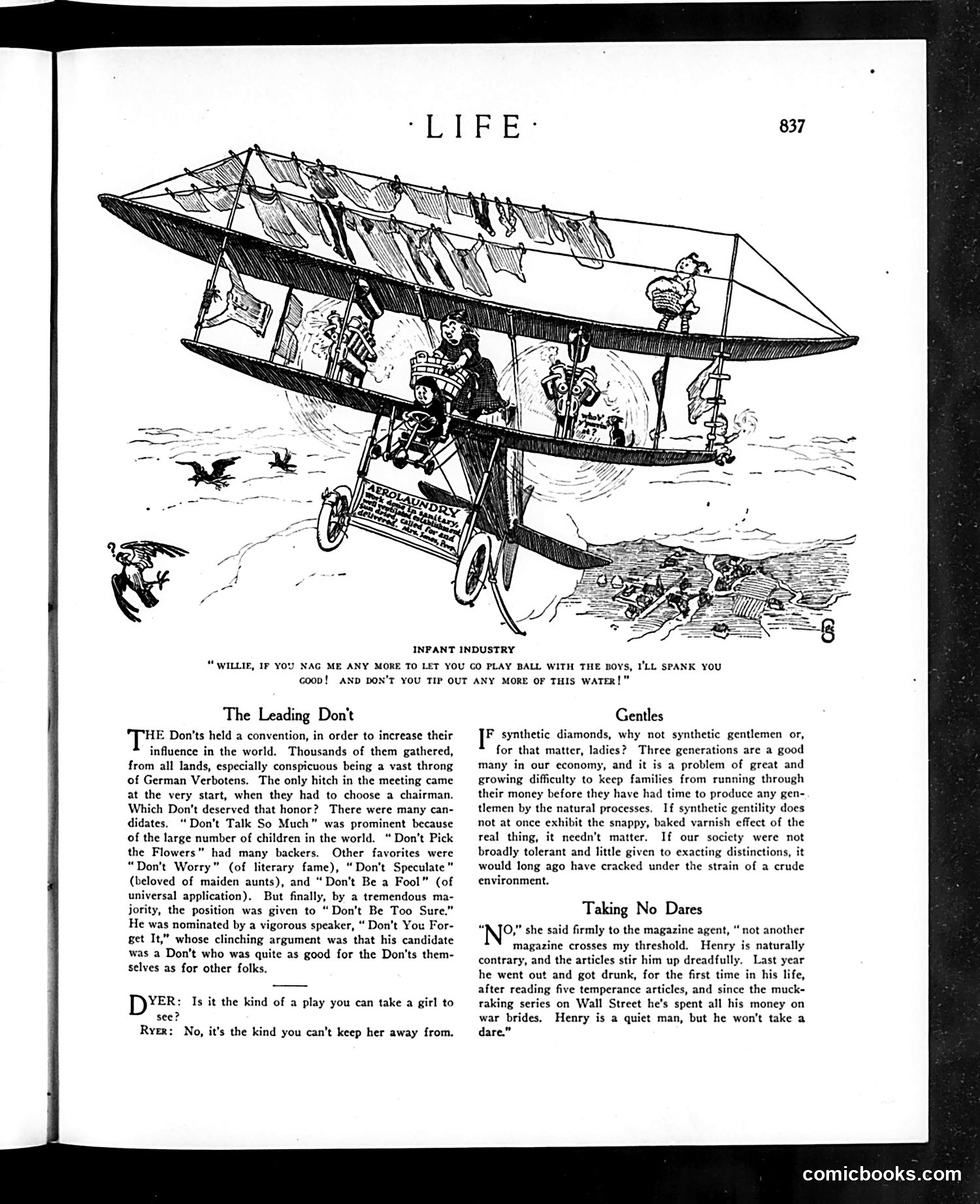
The main cartoon depicts an absurd flying contraption—a blimp-like airship with propellers carrying multiple passengers and cargo, labeled "Infant Industry." This appears to satirize government protectionism and subsidies for struggling American businesses, depicting them as artificially kept aloft by public support rather than genuine economic viability. Below are three brief satirical pieces: "The Leading Don't" mocks societal rules and conventions (the "Don'ts" represent behavioral expectations); "Gentles" critiques synthetic alternatives and questions whether society values artificial substitutes over authentic character; and "Taking No Dares" humorously suggests that excessive moralistic articles (particularly temperance literature) have made people overly cautious. The overall tone is early 20th-century social commentary through absurdist humor.
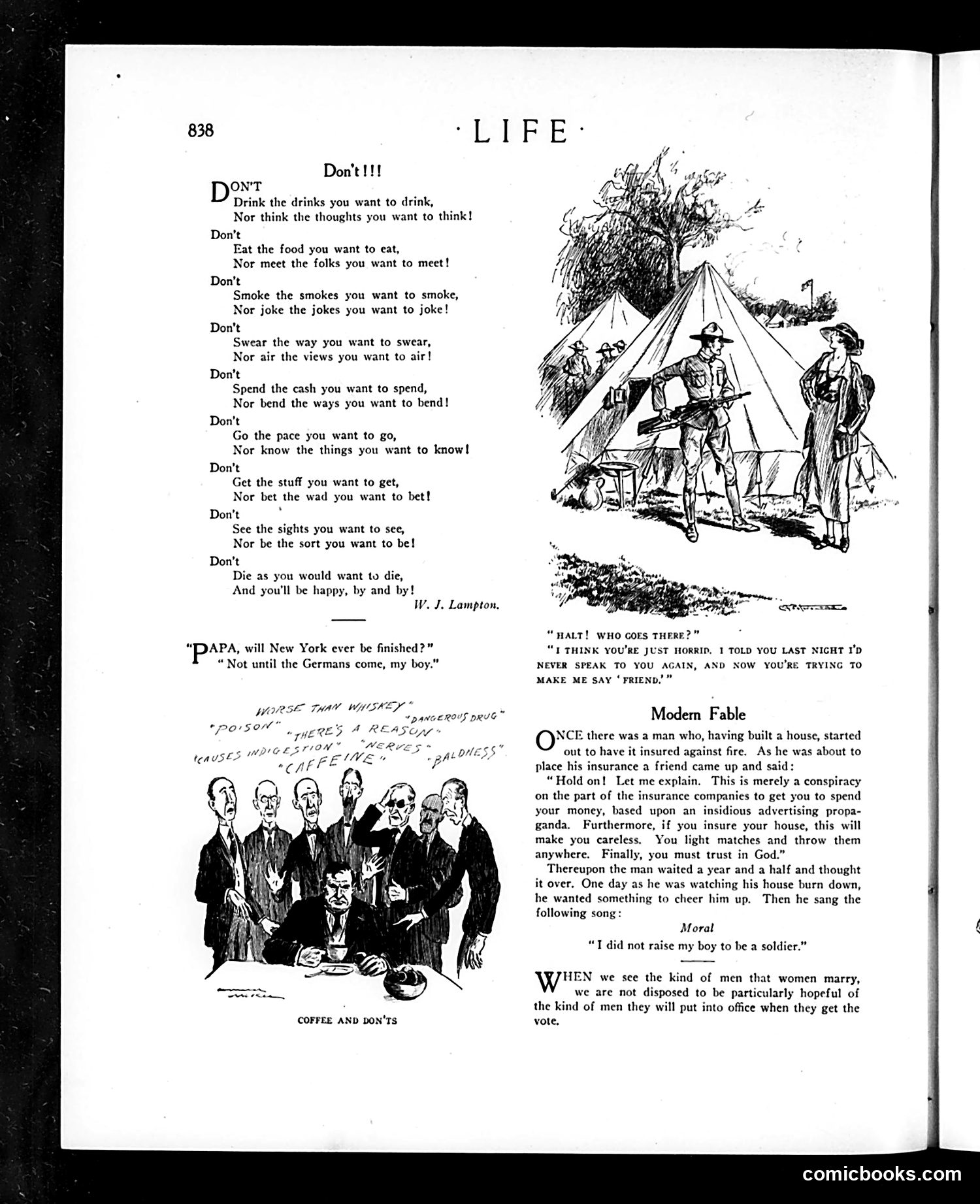
**"Don't!!!" Poem** (by W.J. Lampton): A satirical list of restrictive prohibitions—don't drink, eat, smoke, swear, spend money, go places, or pursue desires. The punchline warns that following all these restrictions leads to happiness "by and by" (after death), mocking excessive puritanical moralism and life-denying social rules of the era. **"Coffee and Don'ts" Cartoon**: Shows several men discussing health warnings, with visible text fragments about "poison," "dangerous drug," and "caffeine." This satirizes the proliferation of health scares and dietary restrictions that contradicted each other, creating absurd anxiety among the public. **"Modern Fable"**: A man insures his house but it burns down anyway—a critique of insurance industry deception and false advertising promises of protection.
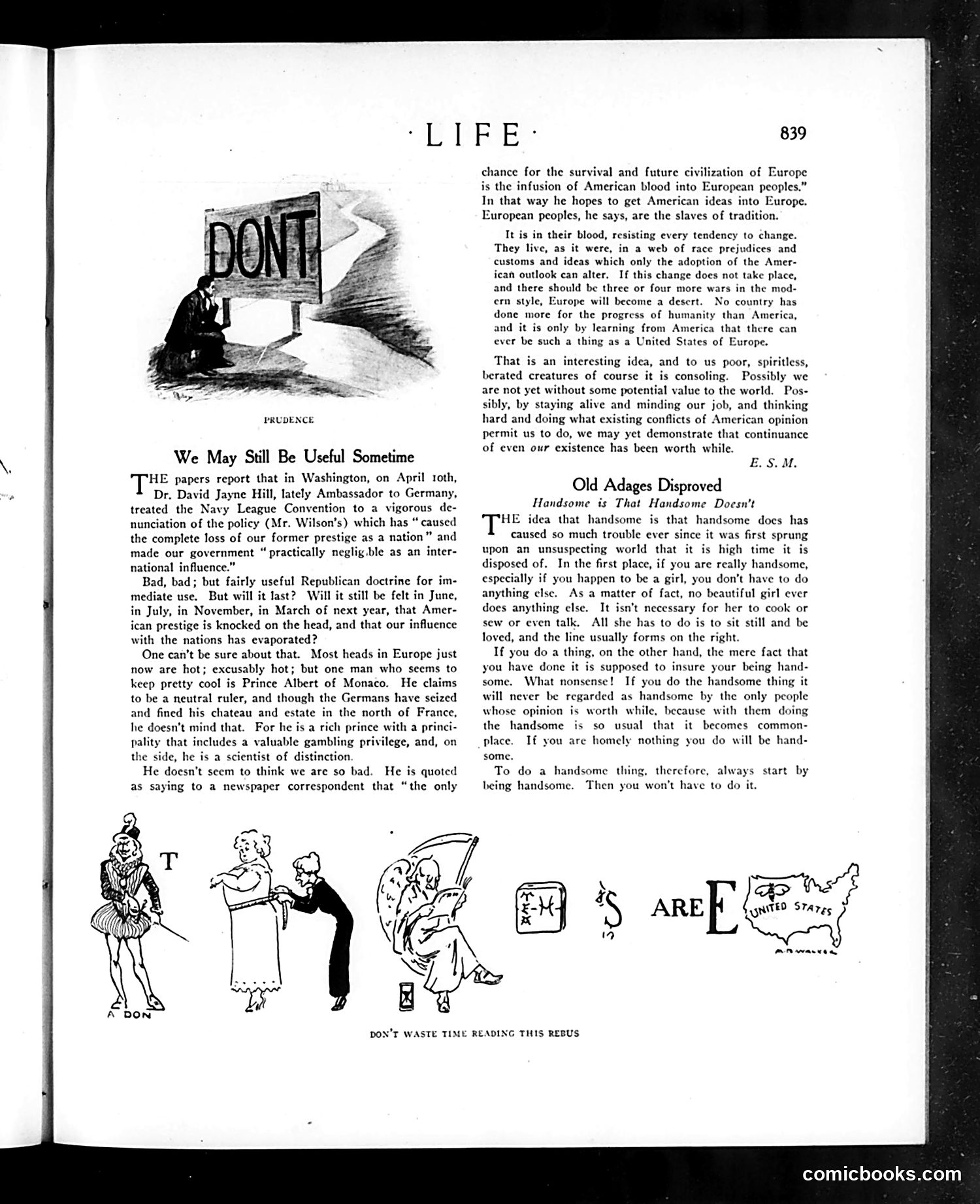
This page contains two distinct pieces of political commentary from Life magazine. **"We May Still Be Useful Sometime"** discusses David Jayne Hill, U.S. Ambassador to Germany, who criticized Navy League Convention policy as damaging American prestige abroad. The article sarcastically suggests that despite the U.S. losing international influence, America might still prove useful to Europe eventually—a backhanded jab at American diplomatic fumbling. **"Old Adages Disproved"** is a humorous essay arguing that the saying "handsome is as handsome does" is nonsense. It claims that merely *being* handsome requires no action, and that attractive people needn't accomplish anything to be valued. The bottom cartoon—"THE ARE [of the] UNITED STATES"—appears to be an acrostic puzzle using letters spelling out American geography, labeled "DON'T WASTE TIME READING THIS REBUS."
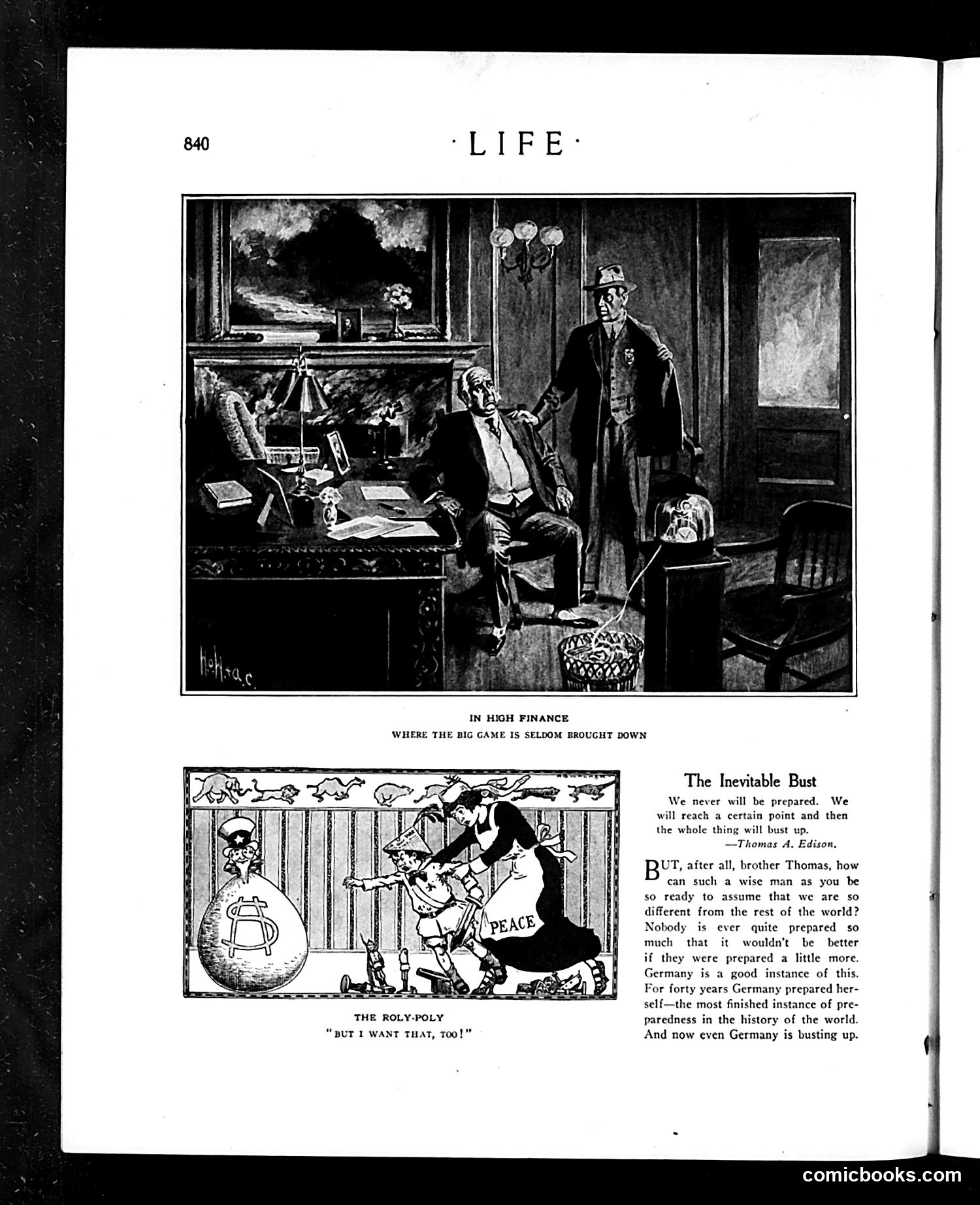
The top cartoon, "In High Finance," depicts wealthy financiers in an office, with one standing figure appearing to lecture seated men. It illustrates the caption about "the big game" in finance—referring to stock speculation and high-stakes gambling with money. Below, "The Roly-Poly" shows a rotund figure labeled "PEACE" being pulled apart by various hands, with a speech bubble saying "BUT I WANT THAT, TOO!"—satirizing competing interests fighting over the spoils of peace. The accompanying text quotes Thomas Edison's pessimistic prediction that civilization will inevitably "bust up," then argues against his fatalism using Germany as counterexample. The satire is pointed: Germany spent 40 years preparing meticulously for war, yet still "busted up" (lost World War I). The implication is biting—even the most thoroughly prepared nation failed, so Edison's doom-saying about unprepared people seems naive.
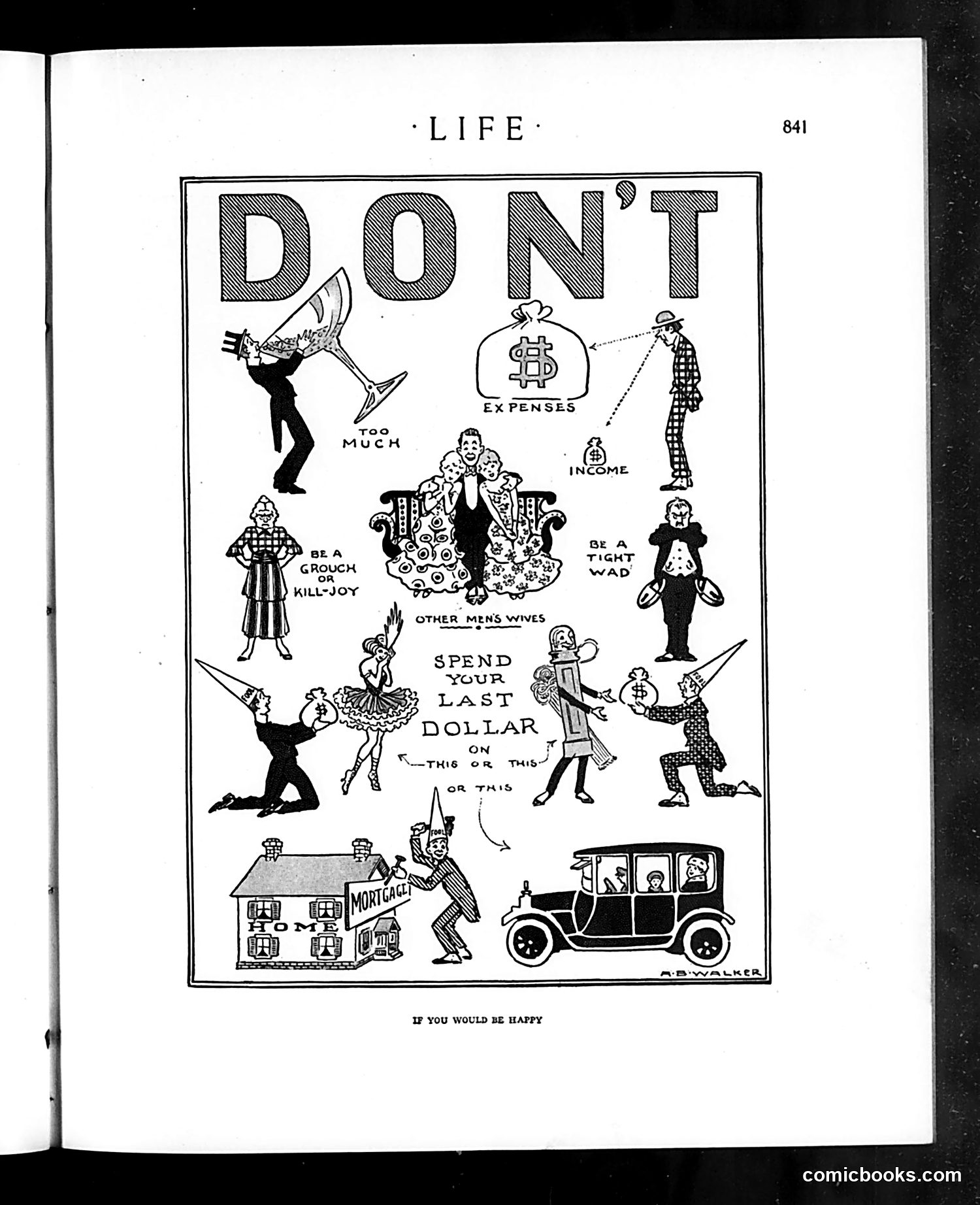
This is a satirical advice cartoon titled "Don't—If You Would Be Happy," offering ironic guidance on financial management and domestic life. The cartoon warns against various spending habits and lifestyle choices: - Don't drink excessively ("too much") - Don't be a "grouch or kill-joy" - Don't let expenses exceed income - Don't be a "tight wad" - Don't spend your last dollar on luxuries (homes, cars, entertainment) - Don't associate with "other men's wives" The cartoon reflects early-20th-century middle-class anxieties about budgeting, morality, and social respectability. It satirizes both excessive indulgence and stinginess, suggesting the "happy" life requires financial prudence and moral restraint—though the cartoon's ironic tone implies these warnings were frequently ignored by its readers.
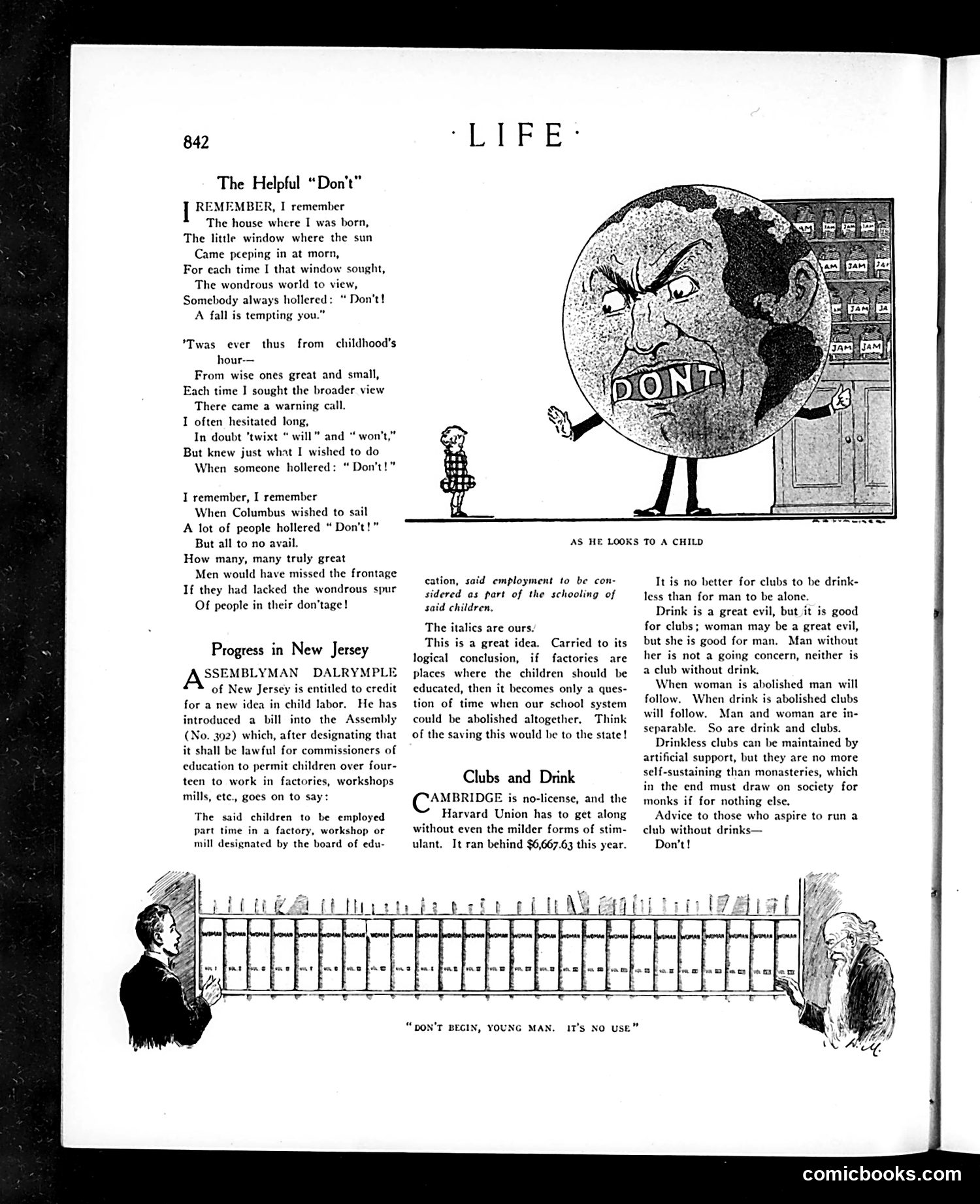
This page contains three satirical pieces critiquing excessive caution and prohibition: **"The Helpful 'Don't'"** (poem): A nostalgic critique of how authority figures constantly discourage ambition. It invokes Columbus as an example—great achievers succeed *despite* warnings, not because of them. The satire targets the paralyzing effect of constant "don'ts" from parents and elders. **"Progress in New Jersey"**: Sarcastically mocks Assemblyman Dalrymple's child labor bill permitting factory work as "education." The satire is deadpan: if factories educate children, why have schools at all? This exposes the absurdity of disguising labor exploitation as schooling. **"Clubs and Drink"**: The unnamed author argues that prohibiting alcohol from clubs (like Harvard's no-license policy) undermines their viability, drawing a parallel to how women are "necessary" for men. The final cartoon shows shelves of bottles with the caption "Don't begin, young man." All three pieces attack prohibition-era policies and the culture of restriction, written during or shortly after the 1920 implementation of Prohibition in America.
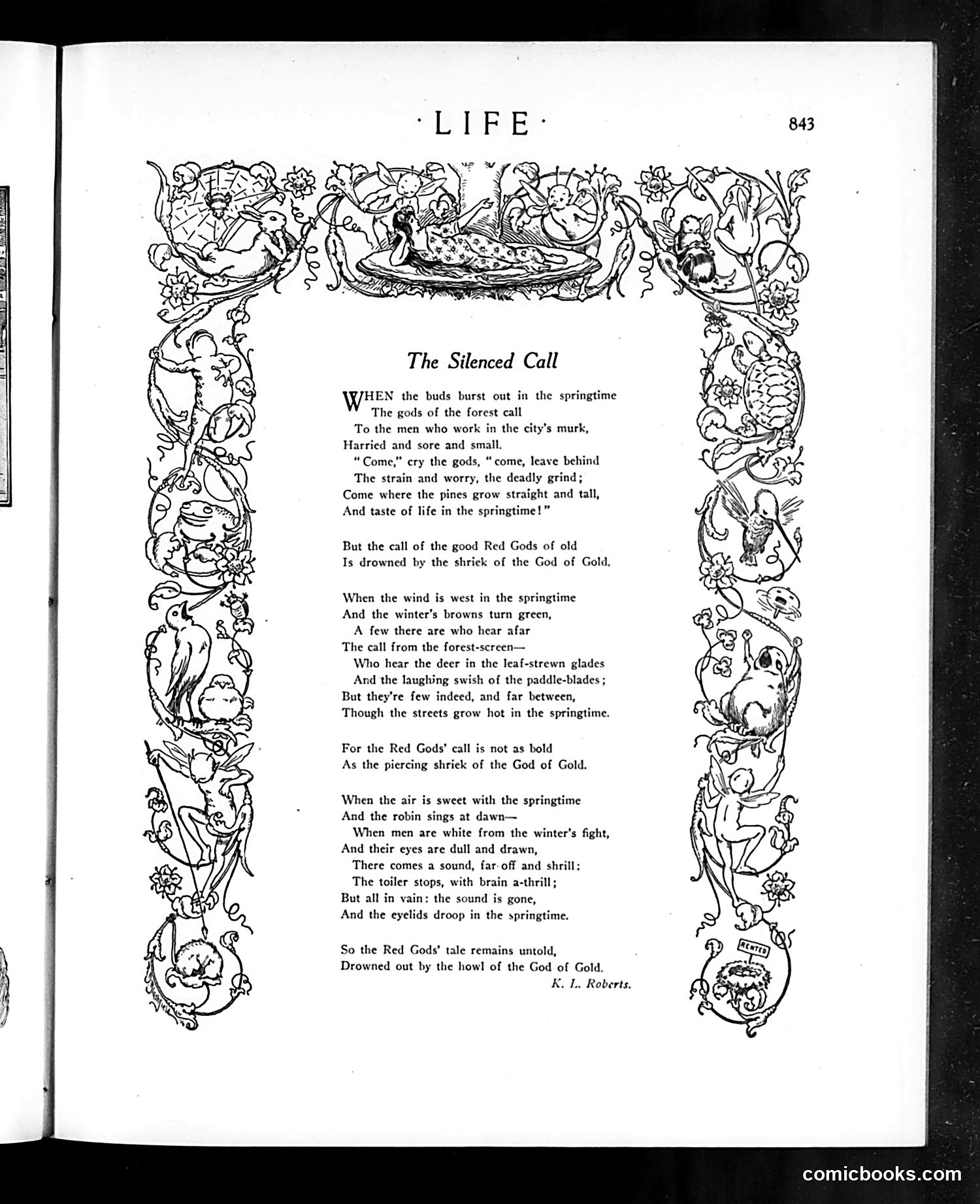
This is a poem, not a cartoon, appearing in *Life* magazine (page 843). It critiques industrial capitalism's dominance over nature and human wellbeing. The "Red Gods" represent nature's call—springtime, forests, outdoor freedom—appealing to urban workers exhausted by city labor. The "God of Gold" symbolizes the profit motive and economic compulsion that silences this natural urge. The poem's central complaint: working-class men cannot heed nature's seasonal invitation because economic necessity ("the shriek," "the howl") drowns it out. Even when they momentarily hear nature's call, they cannot act on it—their eyes "droop" and they remain trapped in urban toil. This reflects Progressive Era anxieties about industrial life's dehumanizing effects and the loss of connection to nature, positioning greed as the villain preventing workers' spiritual and physical renewal.
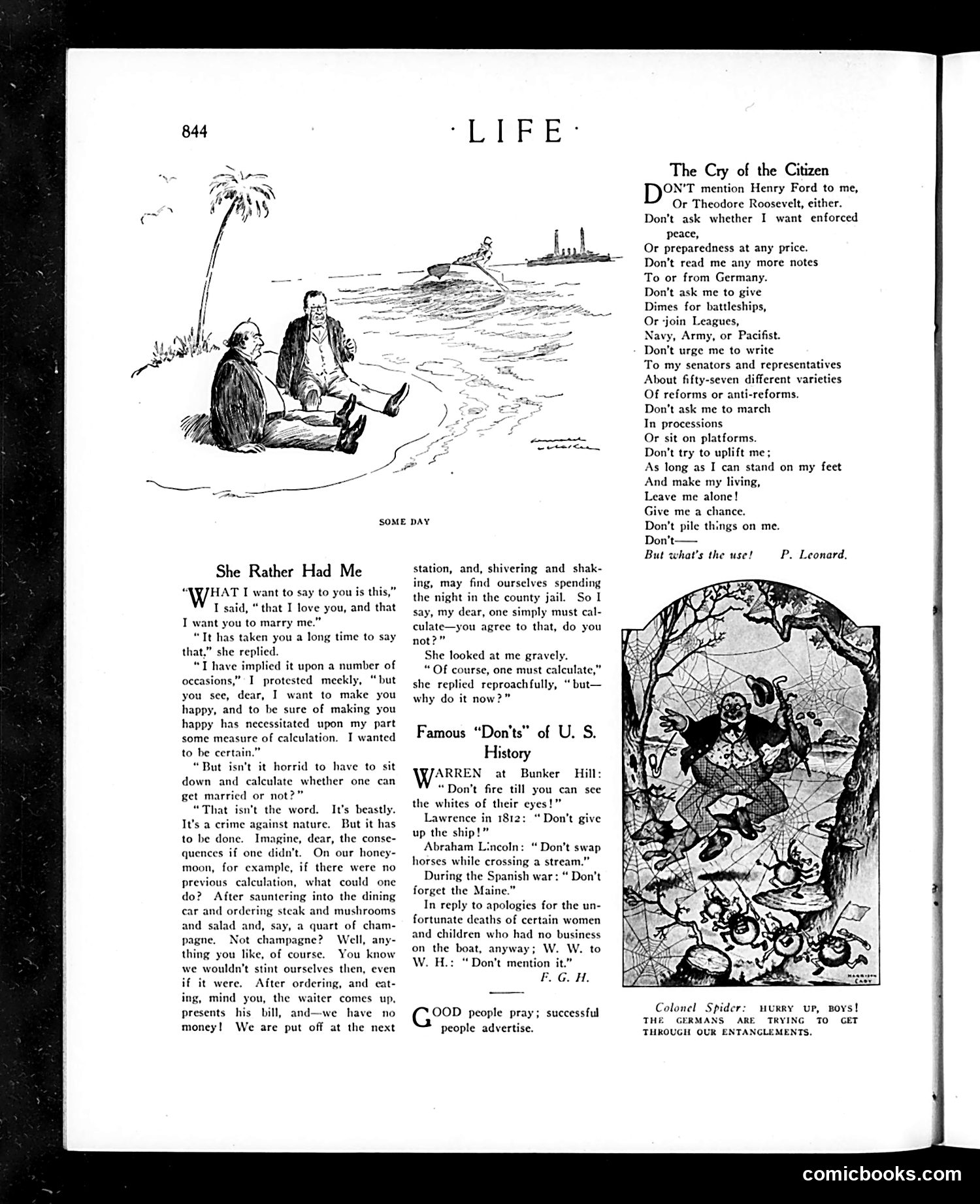
This page contains two distinct pieces of early 20th-century American satire: **"The Cry of the Citizen"** (top right) is a poem by P. Leonard expressing exhaustion with political activism. It attacks prominent figures—Henry Ford and Theodore Roosevelt—and protests being pressured to support various causes: military preparedness, German diplomatic notes, warship funding, reform movements, and public demonstrations. The speaker demands simply to work and be left alone, capturing widespread American fatigue with Progressive Era activism and foreign policy debates (likely pre-WWI). **"She Rather Had Me"** (left) is a humorous story about a man who delayed proposing due to "calculation" of financial consequences. The woman finds this unromantic, though she admits practical planning is necessary—satirizing how even love requires bourgeois financial consideration. **"Famous 'Don'ts' of U.S. History"** (right column) lists historical military/political commands alongside Colonel Snider's WWI reference about Germans trying to penetrate American "entanglements"—likely referencing isolationist concerns about U.S. involvement in World War I.
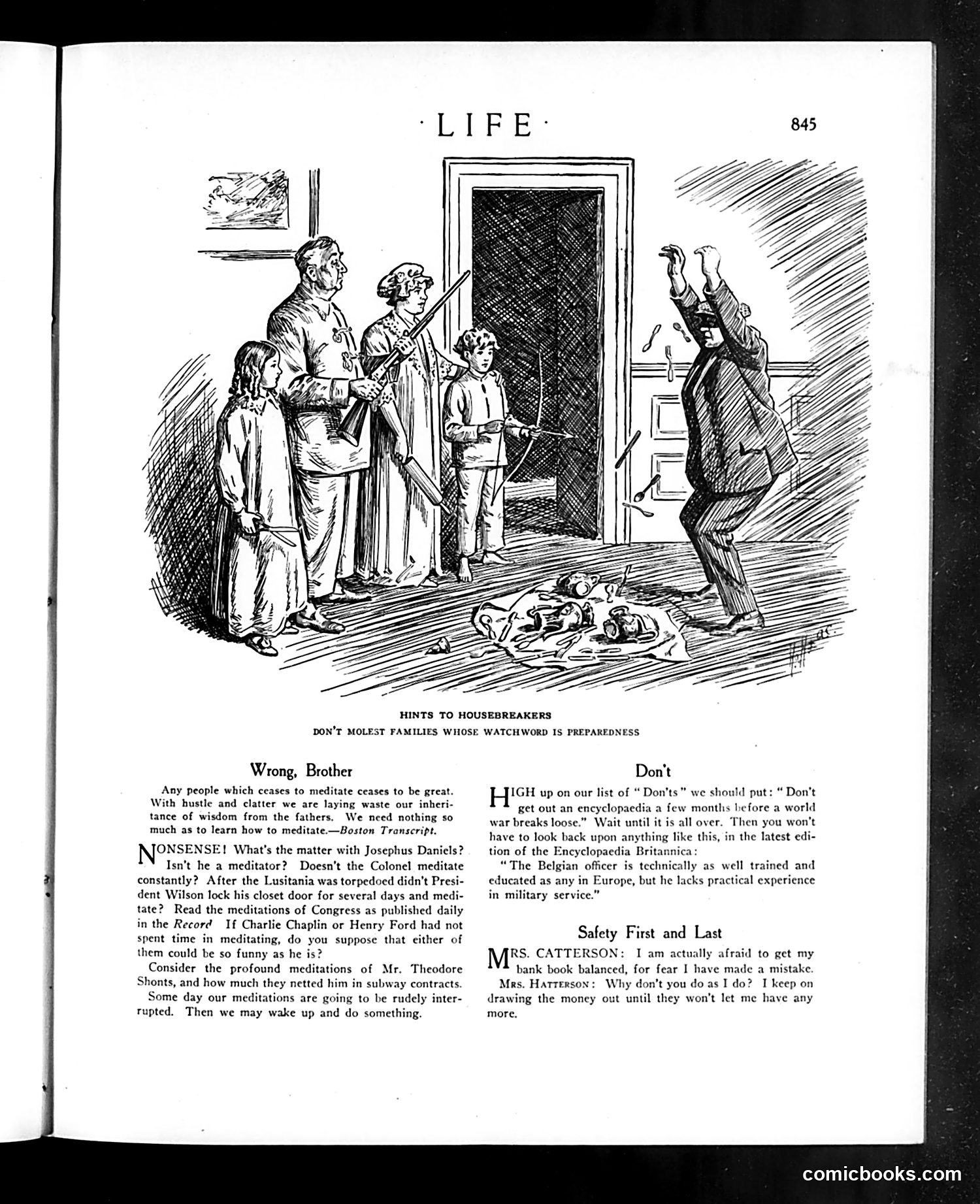
The main cartoon depicts a burglar confronting a family at their home, illustrating the header "Don't molest families whose watchword is preparedness"—a sardonic warning to criminals to avoid homes that are ready to defend themselves. The text sections below mock American complacency before World War I. "Wrong, Brother" sarcastically criticizes the notion that meditation and reflection are virtuous, pointing out that even President Wilson meditated after the *Lusitania* sinking (1915) rather than act decisively. It implies American leaders were too passive amid global conflict. "Don't" mocks the *Encyclopaedia Britannica* for publishing outdated information about Belgian military readiness before the war exposed their weakness—a critique of publishing encyclopedias during wartime. "Safety First and Last" is a brief joke about financial irresponsibility. The overall message: America needs action and preparedness, not passive contemplation, given the urgent threat of war.
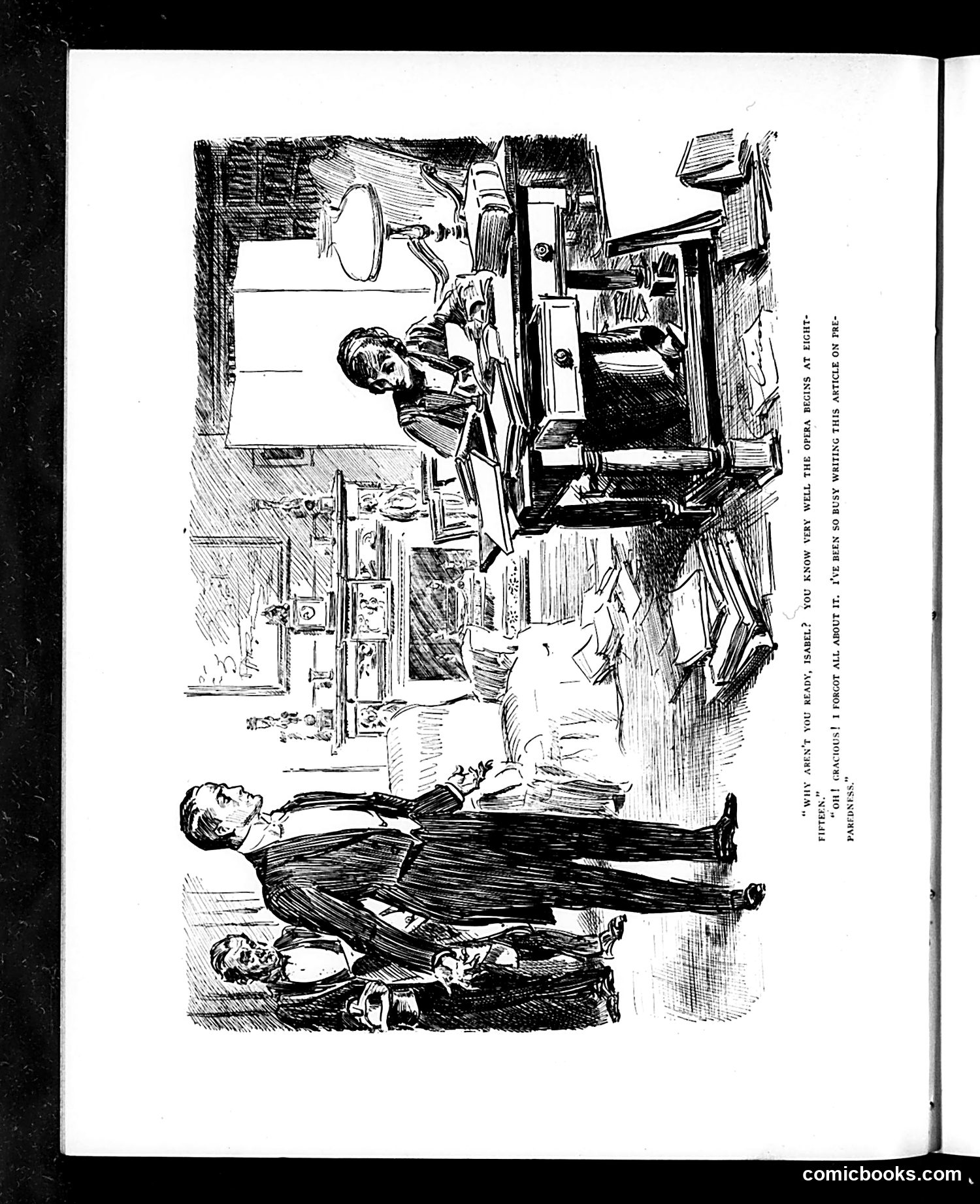
This appears to be a satirical cartoon from *Life* magazine showing a domestic scene. The image depicts what seems to be a man at a desk or writing surface, while a woman (likely his wife) stands nearby. The caption reads: "FORGOT ALL ABOUT IT. I'VE BEEN SO BUSY WRITING THIS ARTICLE ON PRE-" The satire appears to target a writer or intellectual who has become so absorbed in his work—specifically writing an article on some topic beginning with "pre-"—that he has neglected domestic responsibilities or social obligations. The humor lies in the contrast between intellectual preoccupation and everyday life's demands. The unfinished caption suggests the punch line was cut off or continues on another page. Without seeing the complete text or knowing the specific historical context, the exact target of the satire remains unclear, though it likely critiques academic or journalistic self-absorption.
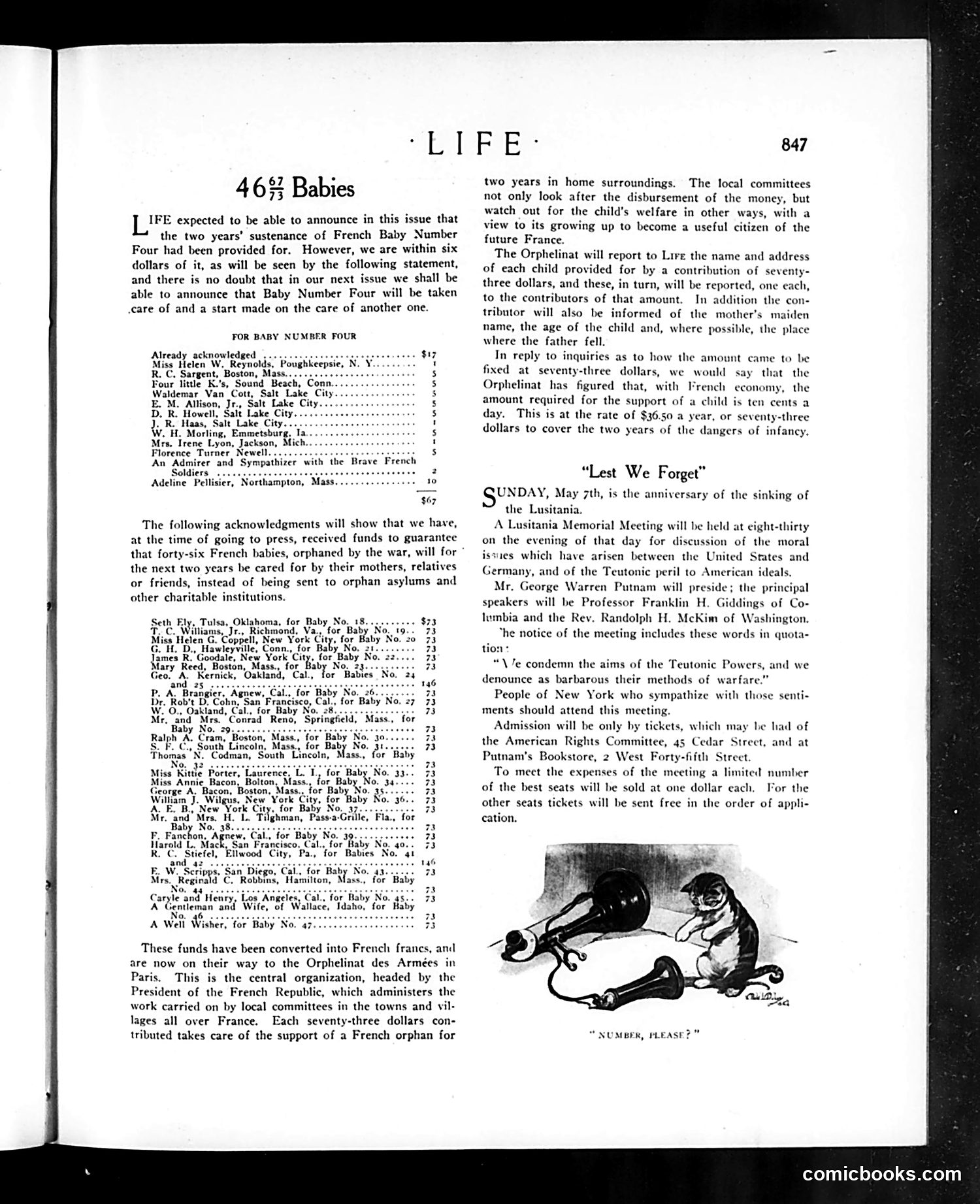
This page documents Life magazine's charitable fundraising campaign to support French orphans created by World War I. The publication solicited donations of $73 from readers—sufficient to support one French child for two years through the Orphelinat des Armées (Army Orphans organization) in Paris. The page lists donors who contributed to support 46+ babies, with funds converted to French francs and distributed through local French committees overseeing the children's welfare and upbringing. Life promised to report each child's details (name, address, parentage, father's casualty information) back to American donors. The small cartoon at bottom—showing a child with a large gun—appears to satirically comment on the war's impact on French youth, though its specific meaning is unclear from context alone. This represents American progressives' humanitarian response to WWI devastation.
This page discusses President Woodrow Wilson's firm diplomatic note to Germany regarding submarine warfare, specifically the Sussex incident. The U.S. threatens to sever relations unless Germany abandons attacking passenger vessels. The satire questions Wilson's character and resolve. References to "Marse Henry" (likely Henry Watterson, a Kentucky editor) and Theodore Roosevelt contrast Wilson's diplomatic approach with Roosevelt's more aggressive, theatrical style—mocking Roosevelt's ability to "wrap the flag around him" and "rattle the drumsticks." The cartoons appear to satirize political uncertainty: whether Wilson will maintain his tough stance or revert to pacifism, and whether Republicans might support him despite partisan divisions. The text suggests Wilson's actions depend on his "brains and his character"—qualities the author finds enigmatic. Bryan's opposition to war measures is noted, as is Republican Mann's partisan complaints. The overall tone questions whether Wilson's words will translate into decisive action.
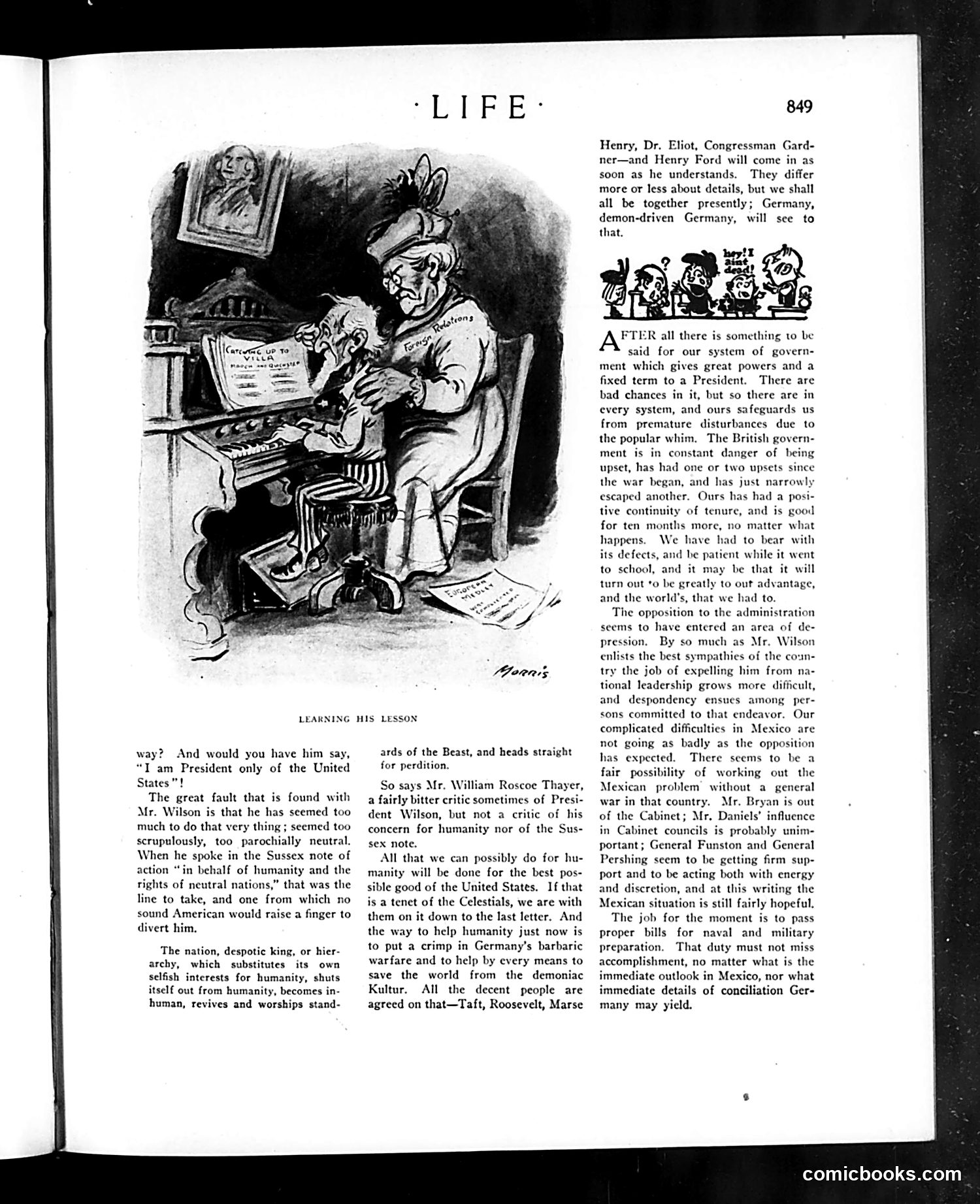
The cartoon depicts President Woodrow Wilson at his desk, apparently being instructed or corrected—"learning his lesson" about American leadership during World War I. The accompanying text criticizes Wilson for appearing too neutral and insufficiently committed to humanity's cause against Germany. The article argues Wilson should abandon strict neutrality and actively oppose German "barbaric warfare" and "demoniac Kultur." The piece invokes prominent figures (Taft, Roosevelt, Congressman Gardner, Henry Ford) to suggest broad consensus that America should take stronger action against Germany. It defends Wilson's presidential system while noting opposition to his administration is losing momentum—ironically, because his humanistic appeals are resonating with the public, making it harder for critics to remove him. The overall message: Wilson needs to abandon neutrality and embrace American intervention to truly serve humanity. This reflects pre-1917 American debate over intervention in WWI, with Life magazine advocating for stronger anti-German stance.
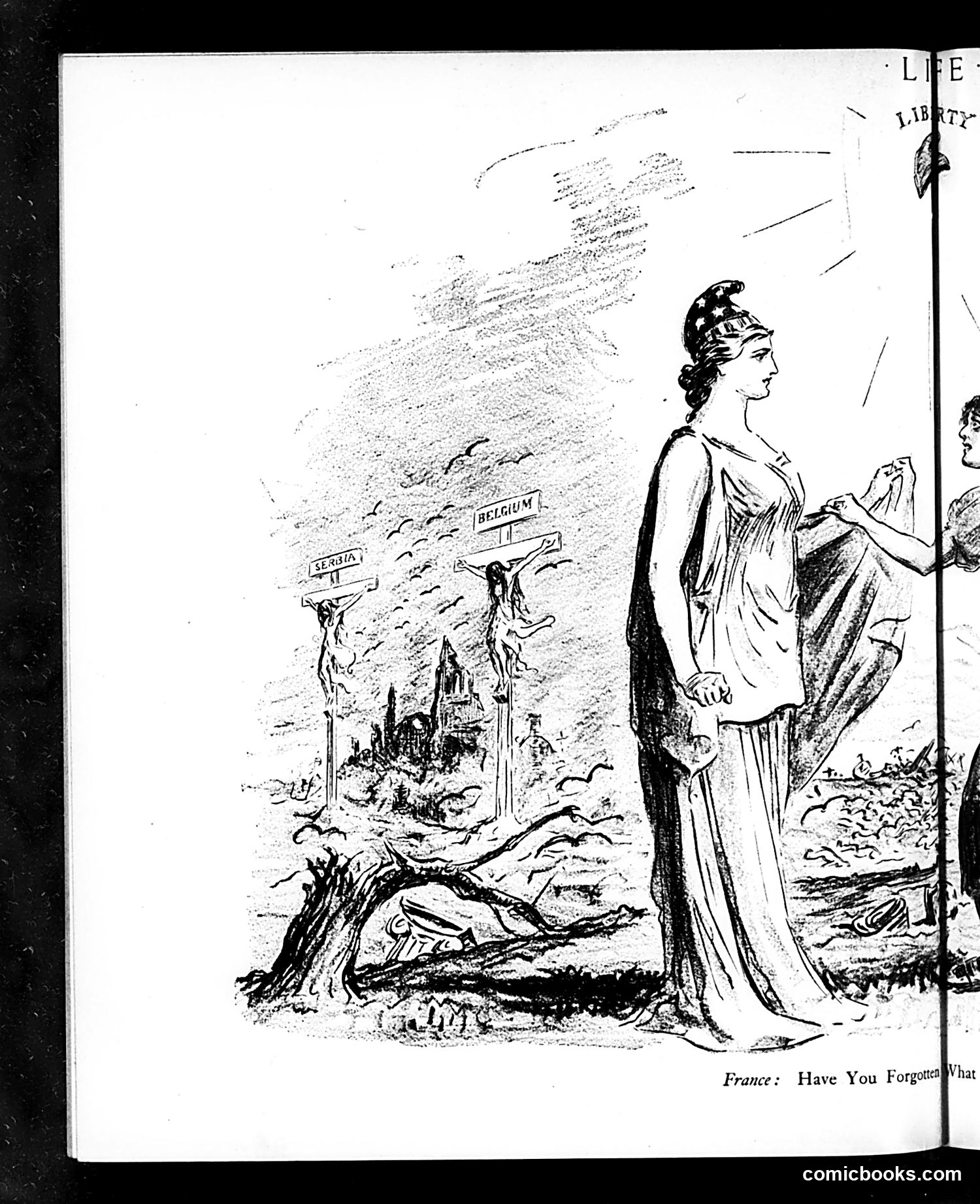
This appears to be a WWI-era satirical cartoon from *Life* magazine showing a classical female figure (likely representing France) standing amid devastation. In the background, crosses mark graves or casualties, and banners labeled "Serbia" and "Belgium" are visible—nations that suffered invasion and occupation during World War I. The incomplete caption "France: Have You Forgotten What" suggests the cartoon is asking France to remember the suffering of allied nations. The allegorical female figure in classical dress represents France as a nation-state, a common convention in political illustration of this period. The satire likely critiques either French war weariness, diplomatic negotiations, or perceived indifference to Allied suffering—urging remembrance of shared sacrifice among allied powers during the conflict.
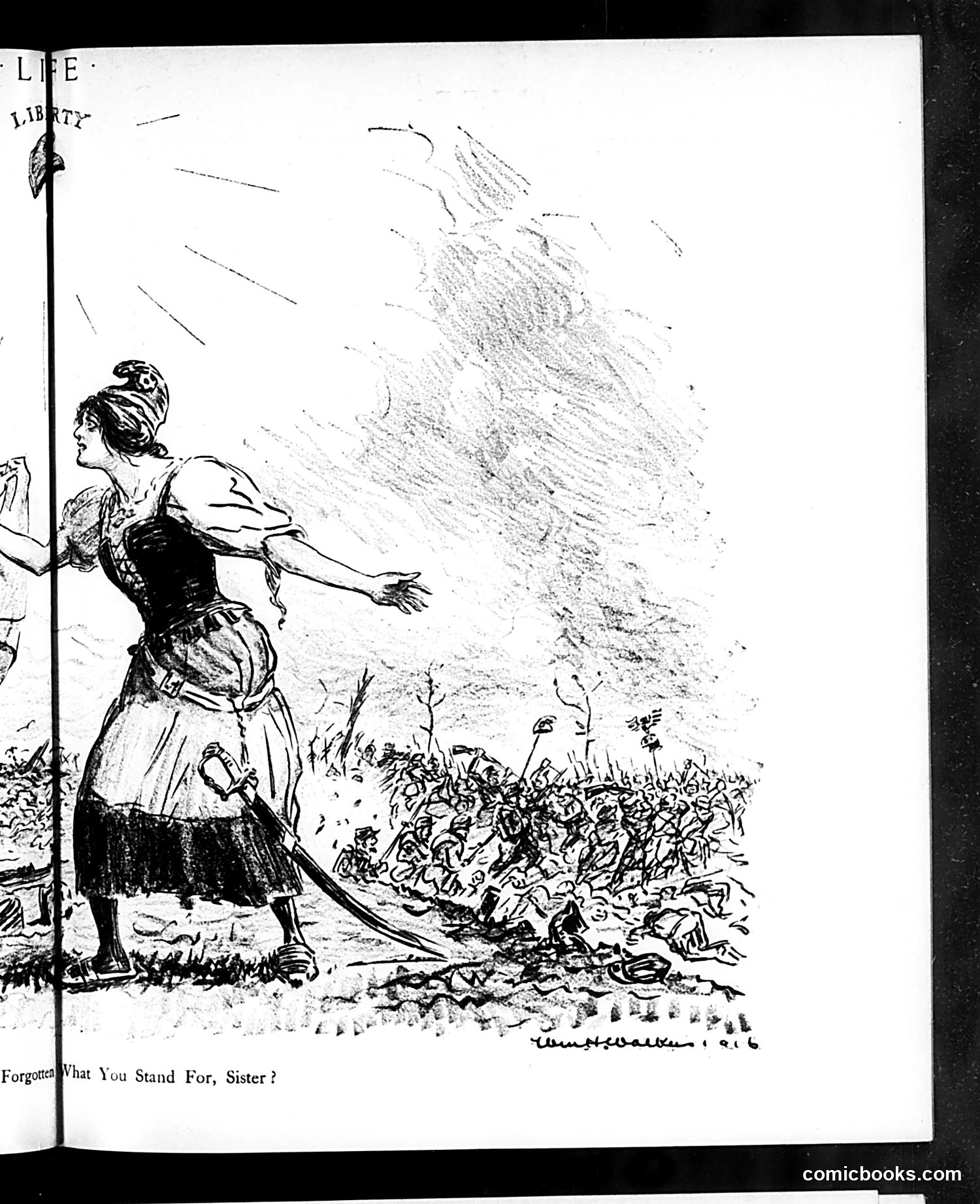
This political cartoon from Life magazine depicts Lady Liberty (identified by the liberty pole and cap on the left) wielding a scythe over a mass of small figures below. The caption asks pointedly: "Forgotten What You Stand For, Sister?" The satire appears to critique Liberty herself—suggesting she has betrayed her principles by violently suppressing or eliminating a crowd of people, possibly representing laborers, protesters, or a marginalized group. The cartoon's message is that Liberty, the nation's founding ideal, has abandoned her moral purpose through oppressive action against ordinary citizens. The artist (signature appears to read "Cesare Walker" or similar, dated 1916) is using sharp irony: the symbol of American freedom is shown committing violence, implying hypocrisy between national ideals and actual treatment of people. This likely reflects labor unrest or social upheaval of the 1910s-era Progressive period.
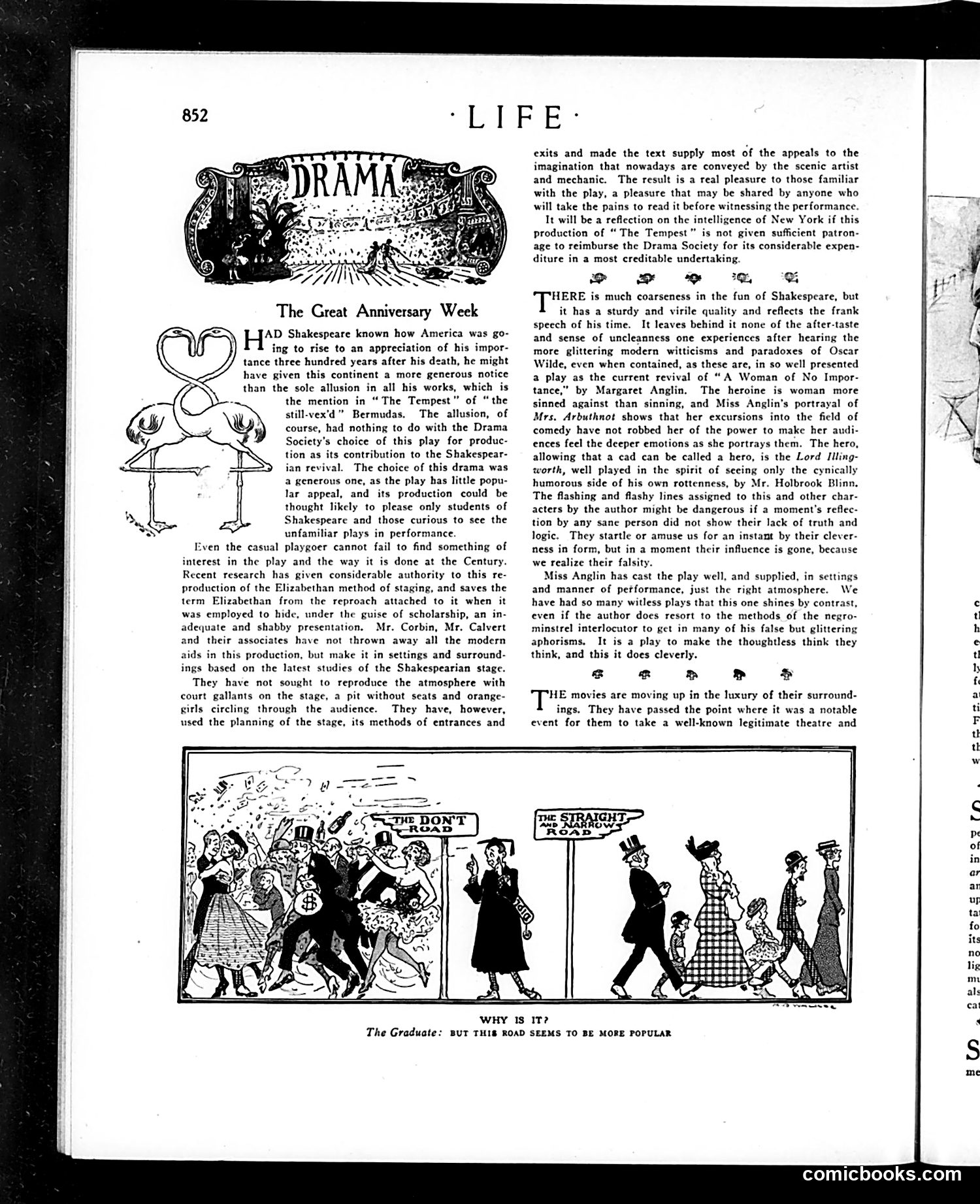
This cartoon satirizes public transportation preferences in early 20th-century America. The three panels contrast two roads: "The Don't Road" (left, crowded and chaotic with many pedestrians) versus "The Straight Road" (right, orderly and less populated). The joke's point: despite the "Straight Road" being clearly superior—safer, more organized, less congested—people inexplicably prefer the inferior "Don't Road." The caption "Why Is It?" underscores this human irrationality. This likely reflects broader social commentary about why people make poor choices when better alternatives exist, or possibly critiques how society gravitates toward sensationalism and disorder over sensible, straightforward paths. The cartoon uses visual contrast to mock human illogic and poor decision-making.
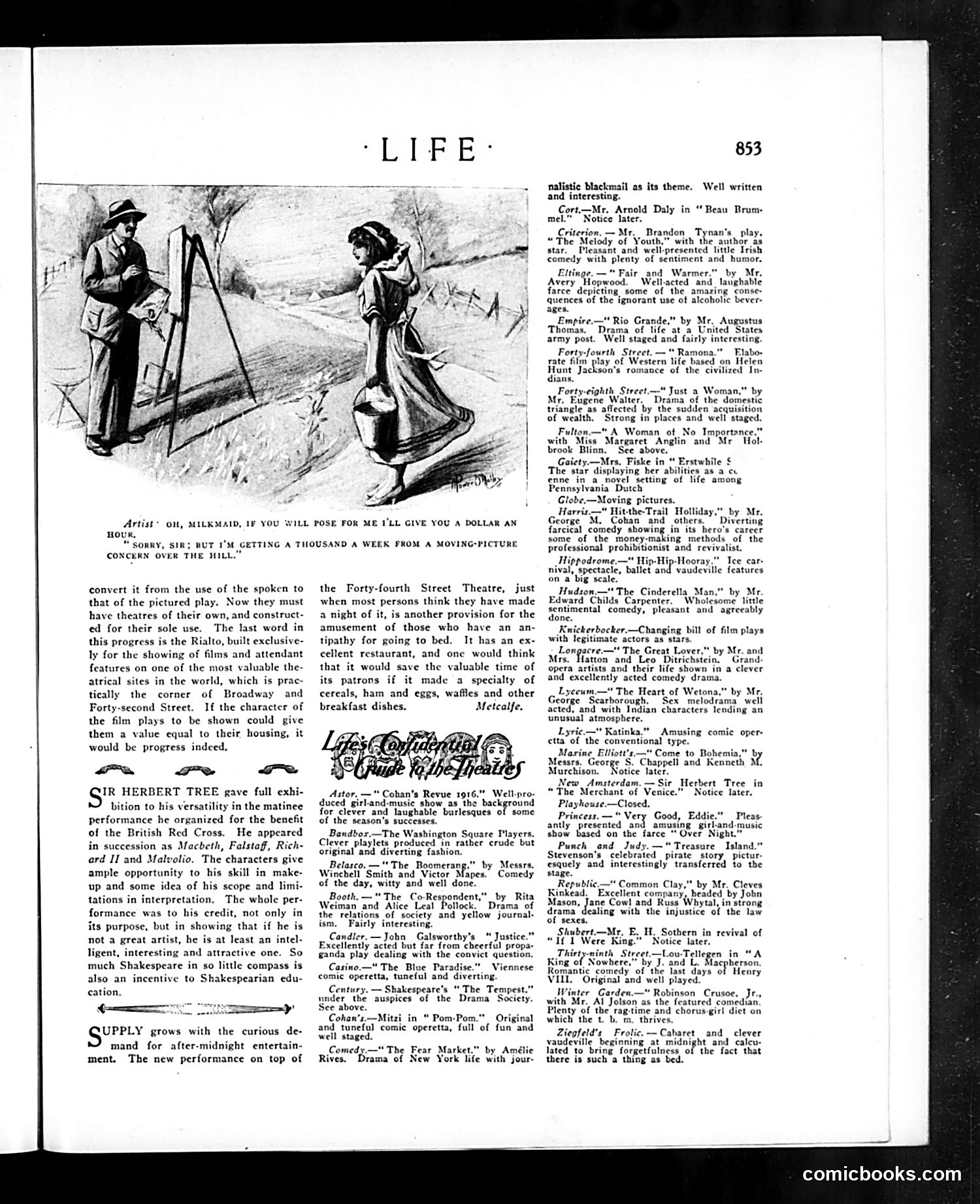
The cartoon depicts a **moving-picture cameraman** negotiating with a rural milkmaid. The cameraman offers her a dollar to pose, boasting he earns a thousand dollars weekly from his film work. The milkmaid's skeptical response—"Sorry, sir; but I'm getting a thousand a week from a moving-picture concern over the hill"—delivers the joke: even rural, unsophisticated workers are now profiting from the booming film industry. **Context**: This satirizes the rapid expansion of cinema in the 1910s. Film production was becoming so lucrative and widespread that it reached even remote areas, creating unexpected economic opportunities. The humor mocks the cameraman's presumption that a country girl would be impressed by or need his modest offer, when she's already securing better wages in this new industry.
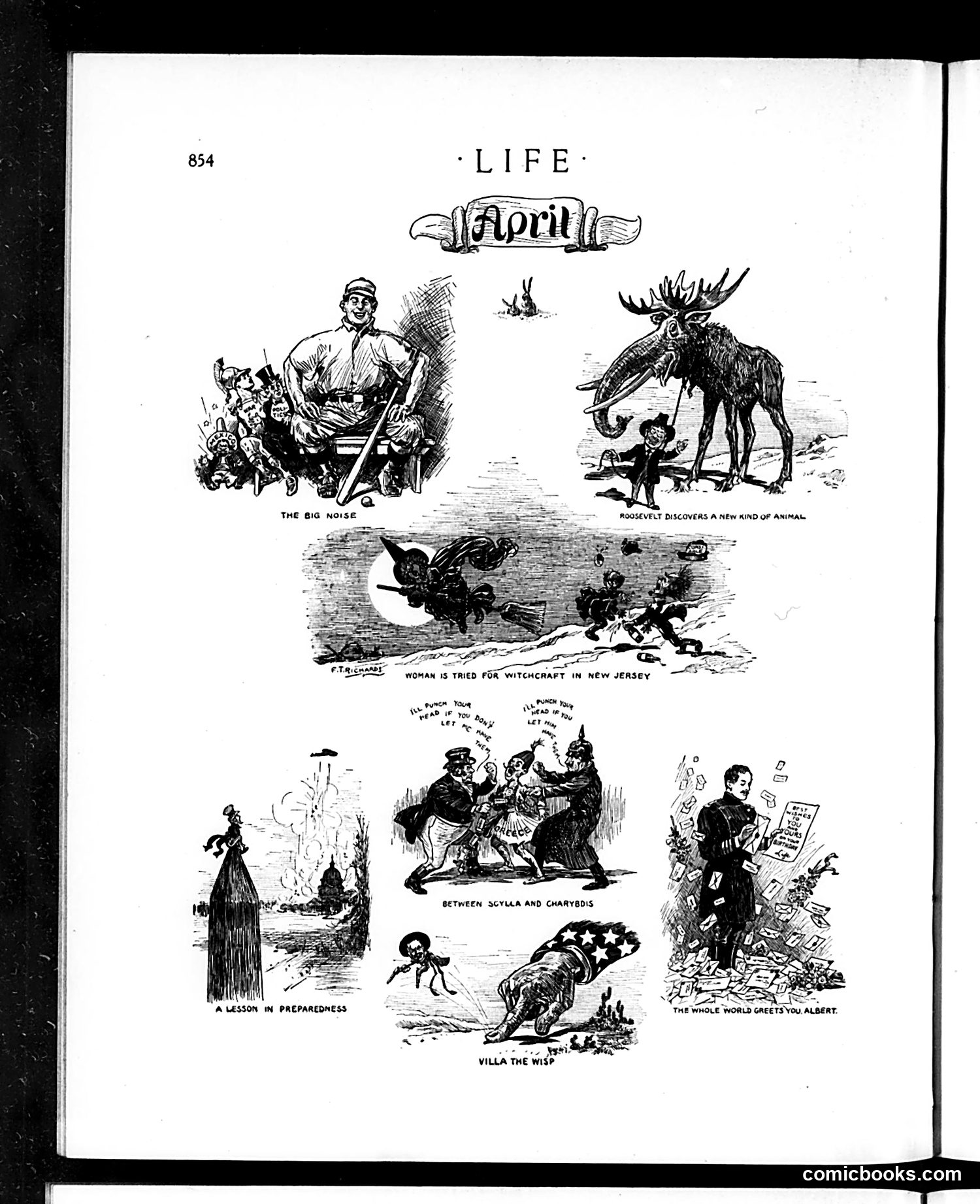
This page contains seven April Fool's-themed satirical cartoons mocking contemporary figures and events: **"The Big Noise"** depicts a man with loud construction equipment, likely satirizing sensational public figures. **"Roosevelt Discovers a New Kind of Animal"** references Theodore Roosevelt's African safari, showing him with an absurd creature—mocking his famous expeditions. **"Woman Tried for Witchcraft in New Jersey"** ridicules superstitious legal proceedings. **"Between Scylla and Charybdis"** and other panels contain political commentary, though specific references are unclear without additional context. **"The Whole World Greets You, Albert"** likely refers to Einstein's recent fame in America (circa 1921), showing adulation for the physicist. **"Villa the Wisp"** appears to mock Mexican general Pancho Villa, depicting him as insubstantial or elusive. The cartoons use exaggeration and visual absurdity typical of Life's satirical humor targeting public figures, scientific discoveries, and current events.
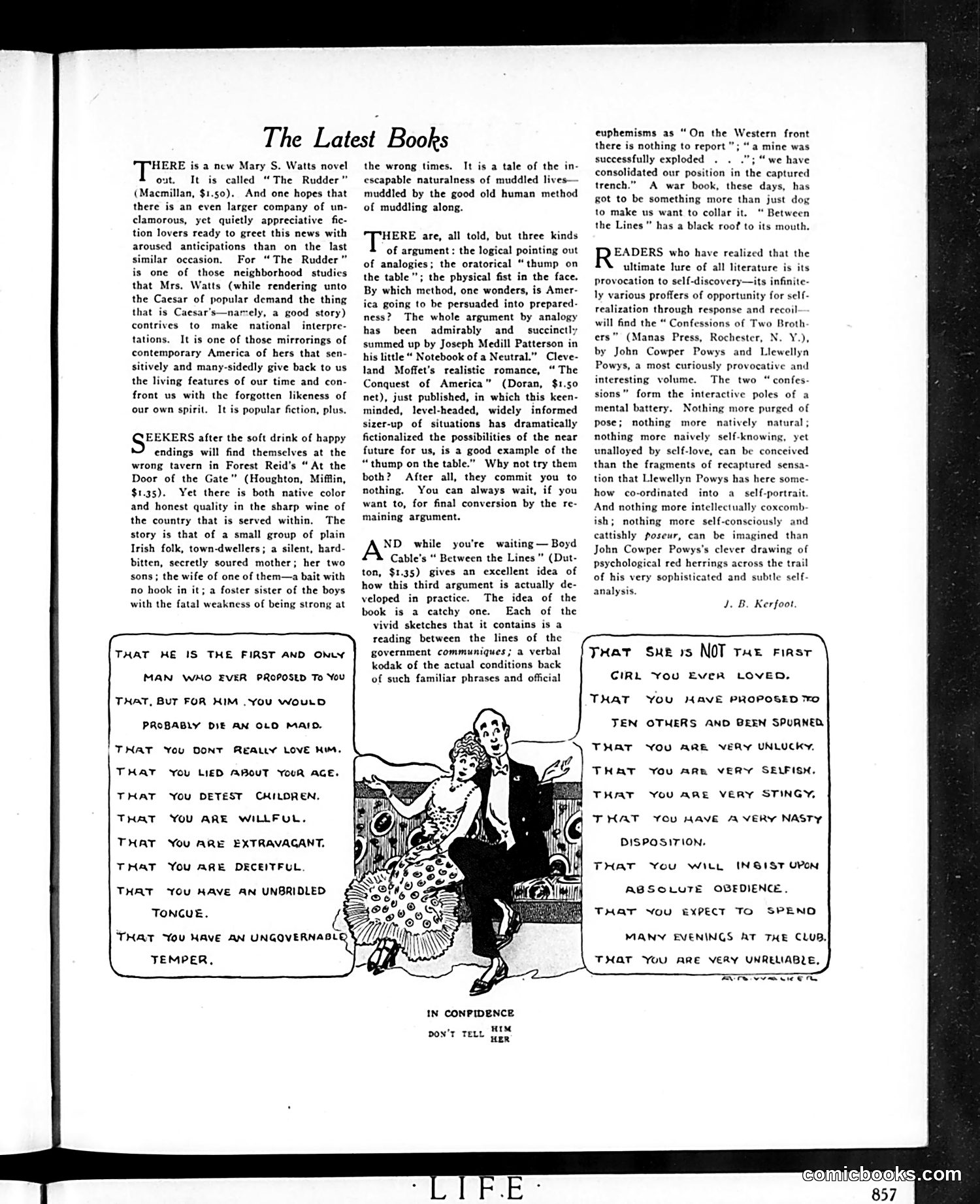
This page combines book reviews with a humorous cartoon about marriage proposals. The cartoon depicts a couple in conversation, with the man listing reasons why the woman should marry him—all insulting accusations (she's unlucky, selfish, stingy, unreliable, etc.). The woman responds with her own damning list about him (he's the "first and only" to propose her, she doesn't really love him, she lied about her age). The satire mocks the desperation of unmarried women in this era: the man essentially says "marry me or die an old maid"—suggesting marriage on any terms was preferable to spinsterhood. The cartoon skewers both genders: his pathetic willingness to marry someone he clearly despises, and her acceptance of such a terrible proposal simply to avoid the social stigma of remaining single. The page's book reviews discuss contemporary American fiction (Mary S. Watts, Forest Reid) alongside commentary on American "preparedness" for World War I.
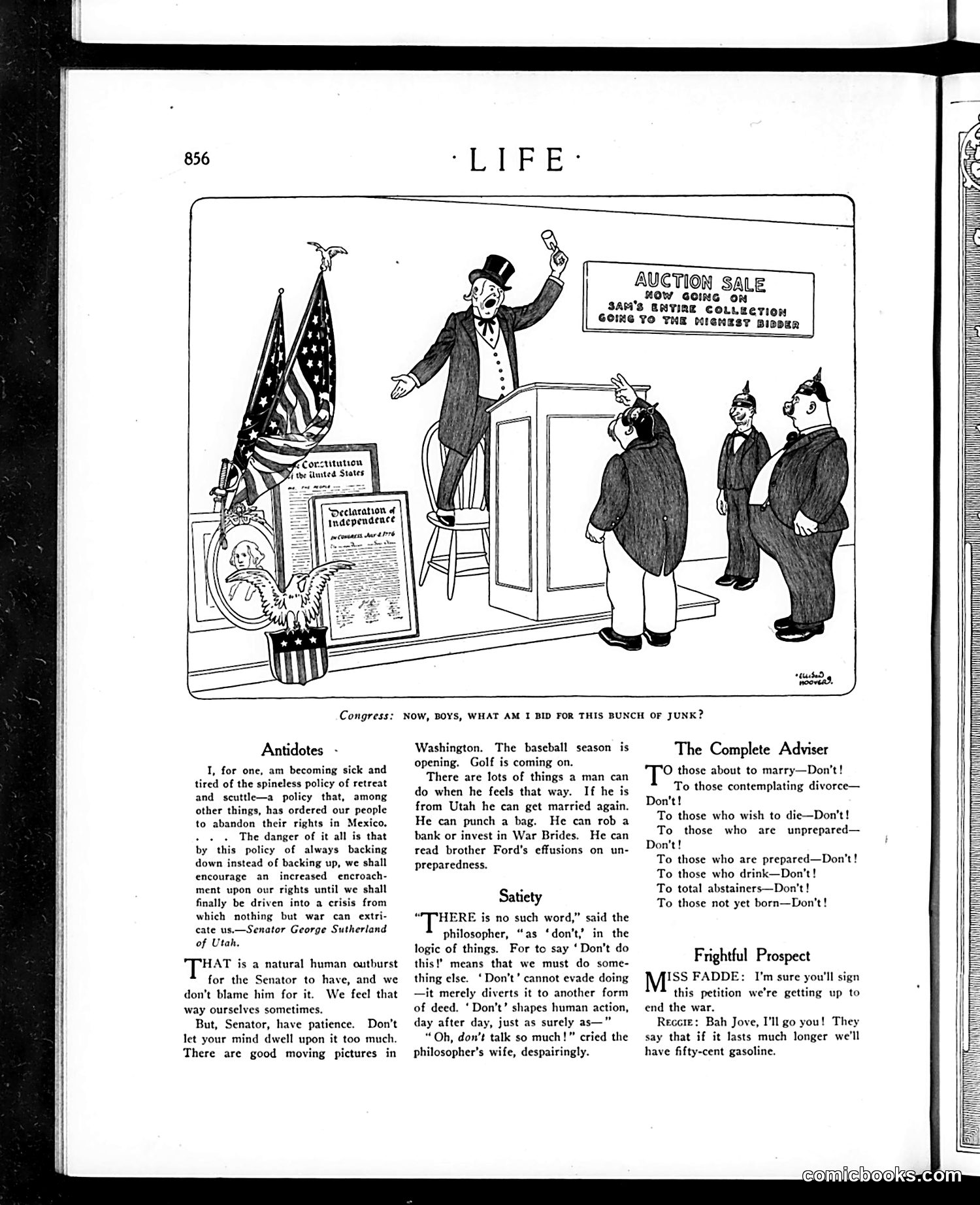
The main cartoon mocks American patriotism being "auctioned off." An auctioneer stands on a platform hawking the Constitution, Declaration of Independence, and American flags—labeled "Uncle Sam's entire collection"—to the "highest bidder." Three bidders in German military helmets (spiked Prussian style) observe. The satire suggests America is selling its democratic values to foreign (likely German) interests, presumably through military unpreparedness or diplomatic weakness. The accompanying text articles reinforce this theme: Senator Sutherland complains about America's "spineless policy of retreat" regarding Mexico, while the magazine sarcastically suggests distraction through entertainment rather than addressing national security. The cartoons collectively critique American complacency about threats to national sovereignty and democratic principles during what appears to be the WWI era.
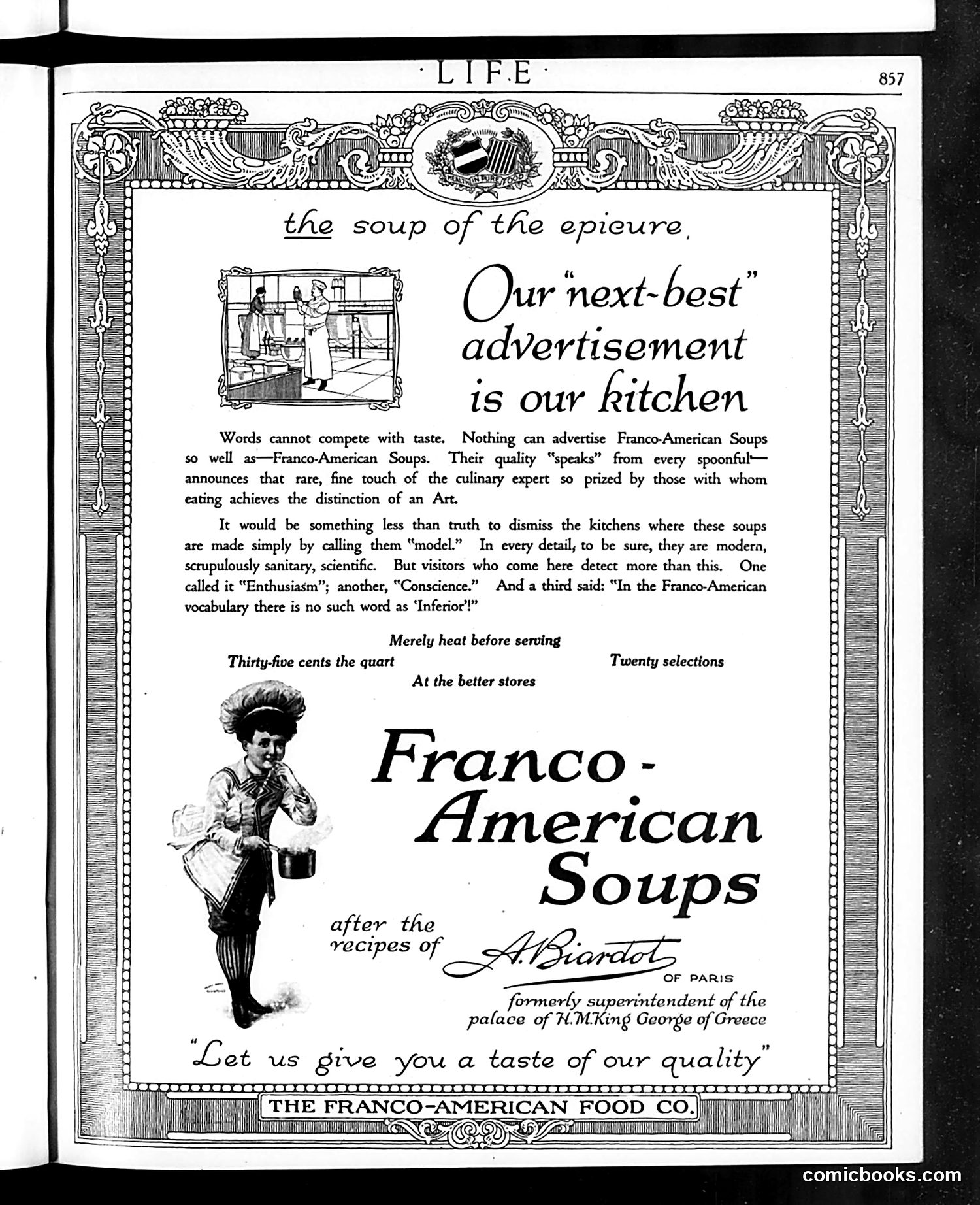
This is a **product advertisement**, not political satire. It promotes Franco-American Soups, a canned soup brand, using appeals to European culinary sophistication. The illustrated figure is a French chef (identifiable by the tall white chef's hat and continental styling), representing culinary expertise. The brand claims recipes developed by "A. Biardot of Paris," formerly a superintendent at the palace of King George of Greece—lending Old World prestige. The ad's appeal targets middle-class American consumers aspiring to refinement: soup quality reflects "the distinction of an Art," and the kitchens embody "Enthusiasm," "Conscience," and have no word for "Inferior." This positions canned soup as accessible luxury. The claim that "our kitchen" serves as the best advertisement is typical early-20th-century marketing—emphasizing hygiene and modern production methods while paradoxically celebrating French tradition.
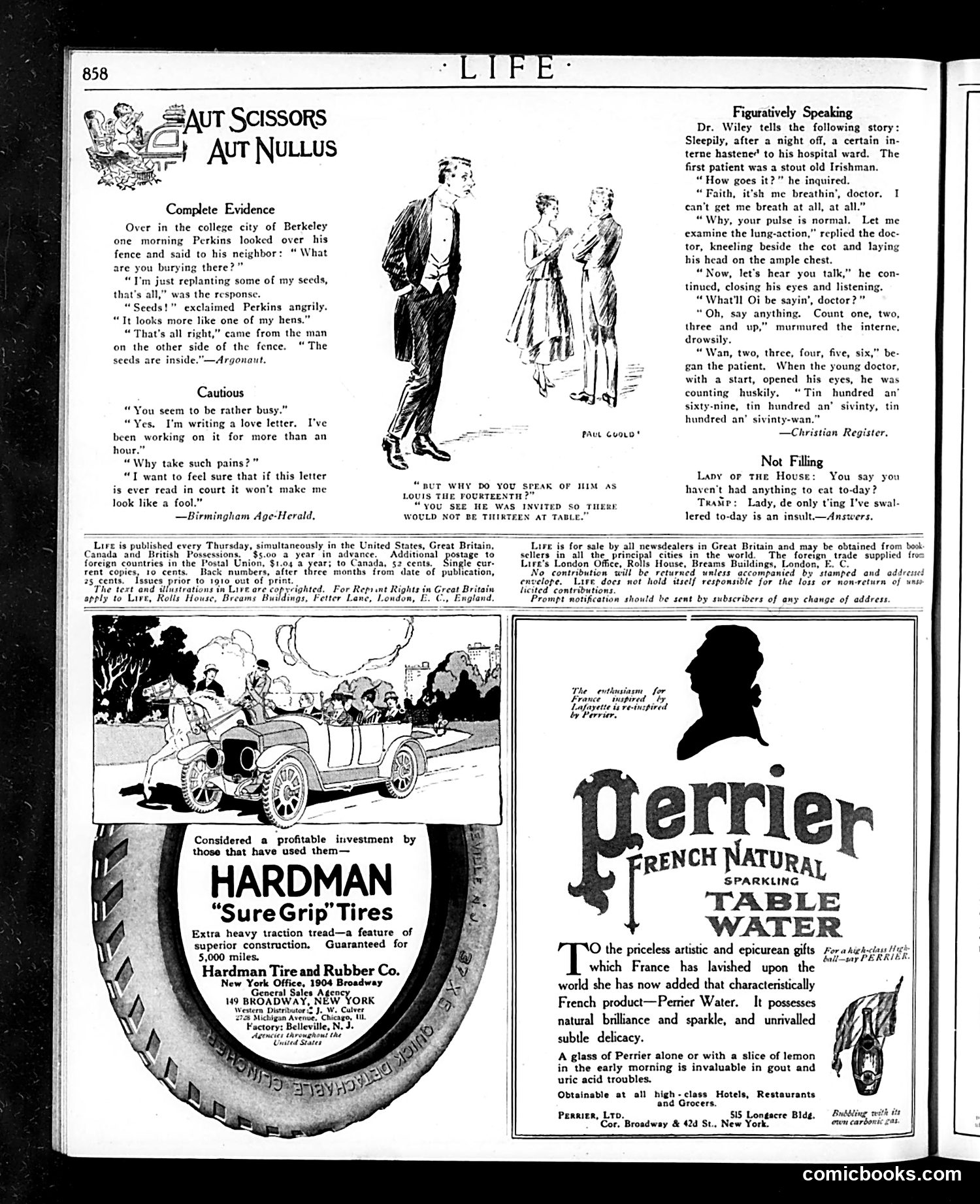
This page contains multiple short humorous anecdotes and advertisements typical of *Life* magazine's satirical format. **The cartoons/jokes:** - "Complete Evidence": A man buries his neighbor's hen and claims it's seeds. The absurdist humor plays on literal versus figurative language. - "Cautious": A man labors over a love letter to ensure it won't incriminate him in court—satirizing romantic insincerity and legalistic paranoia. - "But Why Do You Speak of Him as Louis the Fourteenth?": References the superstition about thirteen at table (the Last Supper), suggesting someone invited a guest merely to avoid bad luck. - "Figuratively Speaking": A drowsy intern mistakes an Irish patient's counting (in accent) for lung sounds, the humor deriving from miscommunication and the doctor's incompetence. - "Not Filing": A tramp claims the only thing he's swallowed today is an insult—commentary on poverty and dignity. The page is primarily **humor and advertising**, with no specific political content beyond gentle social satire.
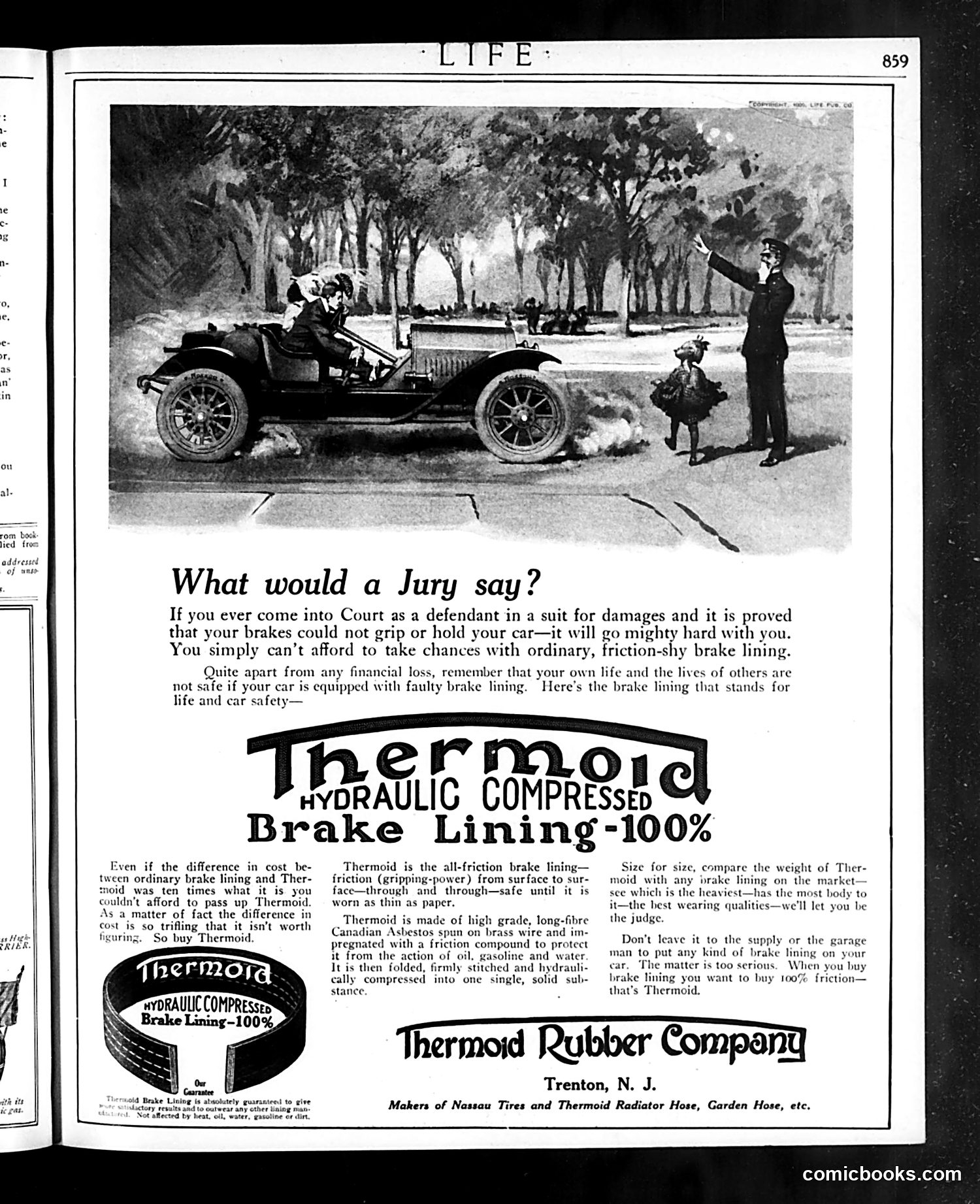
This is primarily a **product advertisement**, not a political cartoon. It appeared in *Life* magazine (page 859) promoting Thermoid brand brake lining. The image shows a vintage automobile with well-dressed occupants stopped on a tree-lined road, observed by a policeman and another figure—a staged scene suggesting respectability and safety. The advertisement's rhetorical strategy uses **legal fear**: it warns readers that if involved in a lawsuit for damages, faulty brakes will "go mighty hard with you." This appeals to both financial liability and personal safety concerns. The copy emphasizes that Thermoid's superior asbestos-based lining provides consistent friction, contrasting with "ordinary, friction-shy" competitors. The ad targets car owners who cannot afford brake failure—either legally or morally. It positions Thermoid as the responsible, premium choice, dismissing cost objections by claiming the price difference is "trifling." This is a straightforward early-20th-century product pitch combining legal anxiety, safety consciousness, and quality assurance.
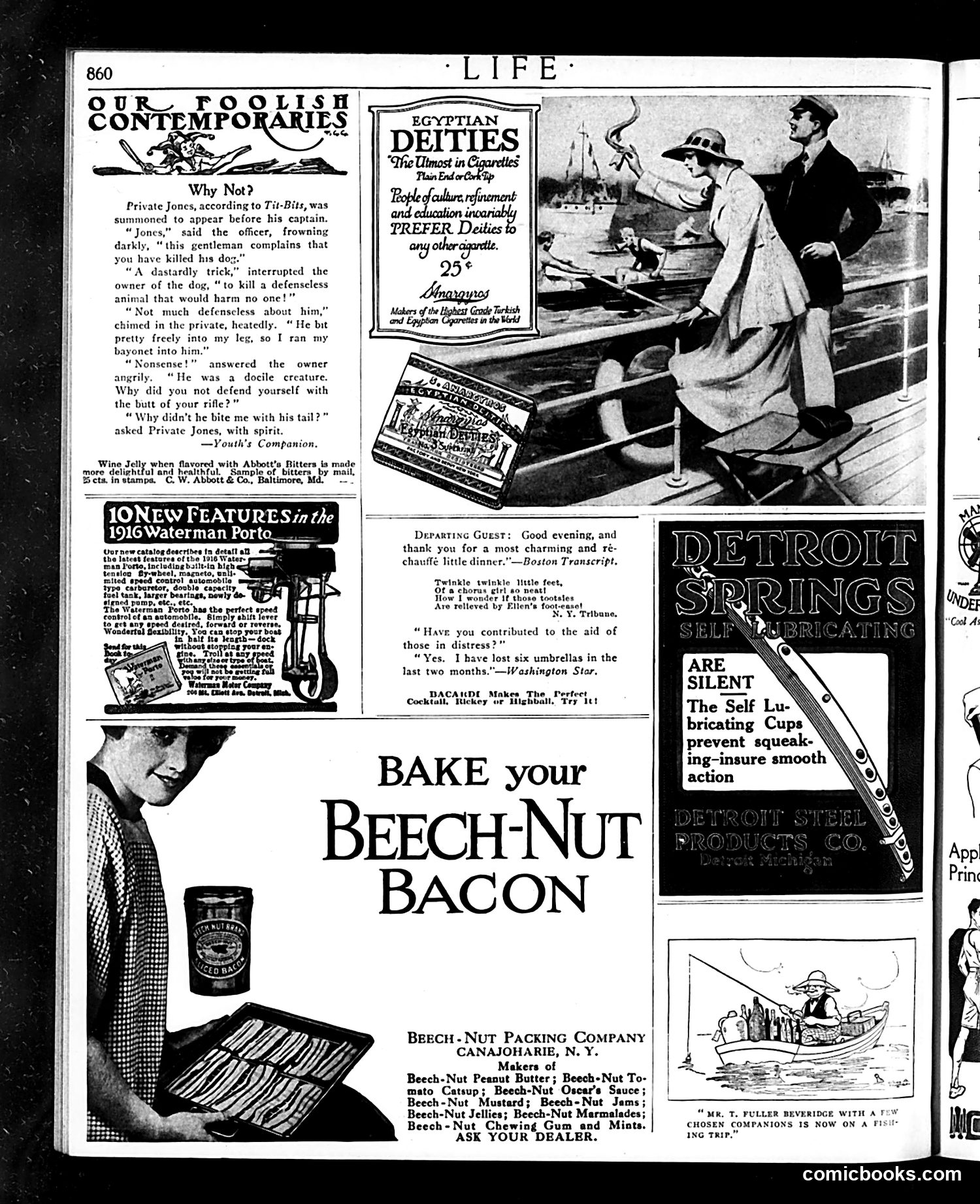
This page is primarily **advertising with brief humorous anecdotes**, typical of early 20th-century Life magazine format. The main cartoon segment, "Our Foolish Contemporaries: Why Not?", presents a military anecdote mocking excessive politeness. A soldier kills a dog in self-defense (it bit him), but the dog's owner complains. When questioned why he didn't use his rifle's butt instead of his bayonet, Private Jones sarcastically asks why the dog didn't bite him with its tail—absurdist logic highlighting the owner's unreasonable expectations. The humor targets **civilian detachment from military realities**: the owner's "docile creature" apparently bites freely, yet he expects gentlemanly restraint from a soldier under attack. The joke ridicules impractical civilian complaints about soldier conduct. The remainder consists of period advertisements (Egyptian cigarettes, Beech-Nut bacon, Detroit Springs, a Waterman pen), interspersed with brief witticisms about umbrella loss and dinner compliments—filler content typical of Life's mixed format.
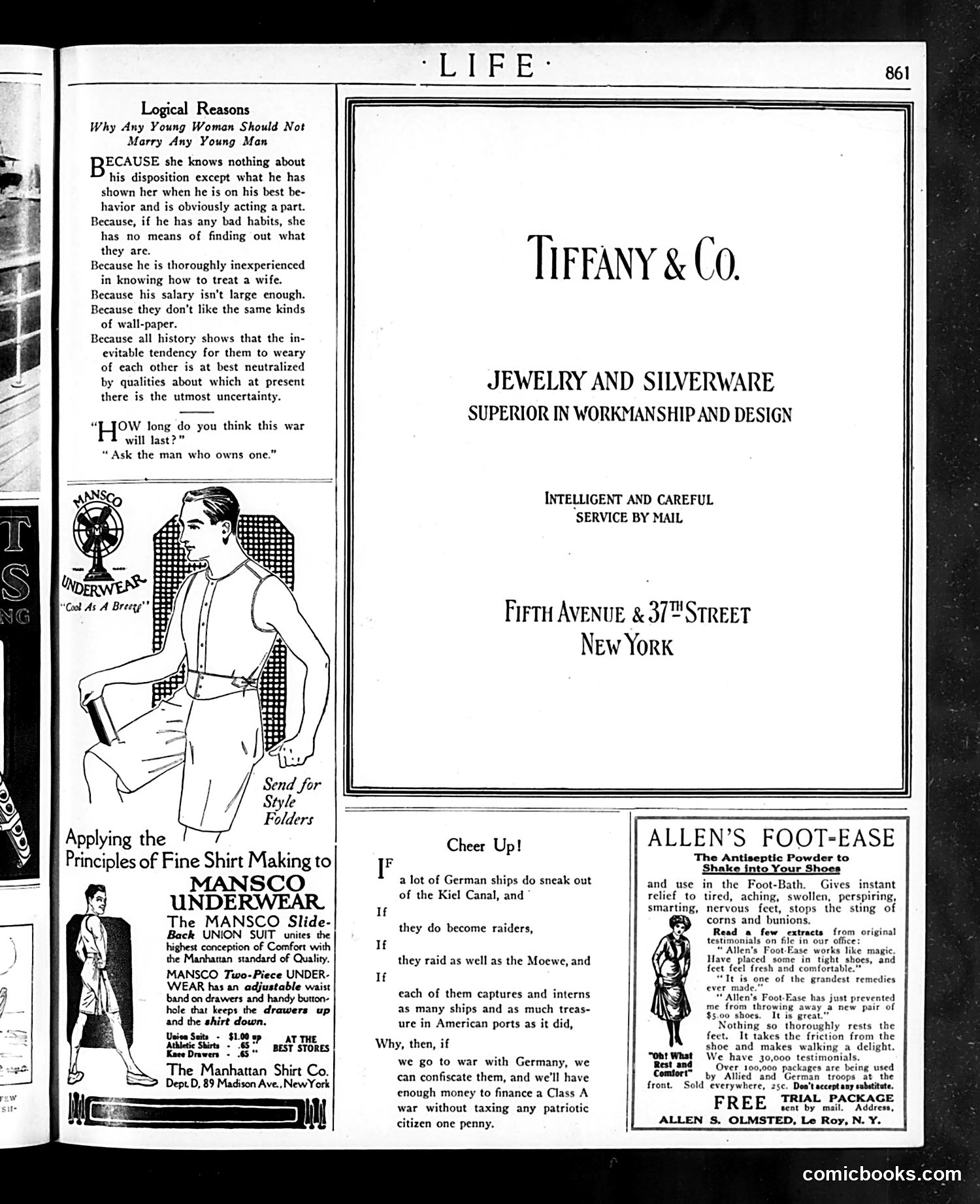
This page is primarily **advertising** with satirical editorial content alongside. **The Main Satire ("Cheer Up!"):** The central piece mocks American war profiteering against Germany. It presents a darkly humorous "logical" argument: if German ships raid American ports during a potential war with Germany, the U.S. could confiscate their vessels and use the proceeds to finance military operations without taxing citizens. The joke satirizes both American greed and naive optimism about war financing—suggesting citizens would support a war if they believed it would pay for itself through enemy seizures rather than personal sacrifice. **Context:** This appears to be from WWI era (references to German ships, the Kiel Canal, and the Moewe—a real German raider). The satire critiques the disconnect between wealthy interests and ordinary citizens' war burdens. **The Left Column:** A humorous list of reasons young women shouldn't marry young men—playful relationship satire with period concerns (mismatched wallpaper preferences, financial insecurity). **Advertisements:** Tiffany & Co., Mansco underwear, and Allen's Foot-Ease products fill the remaining space.
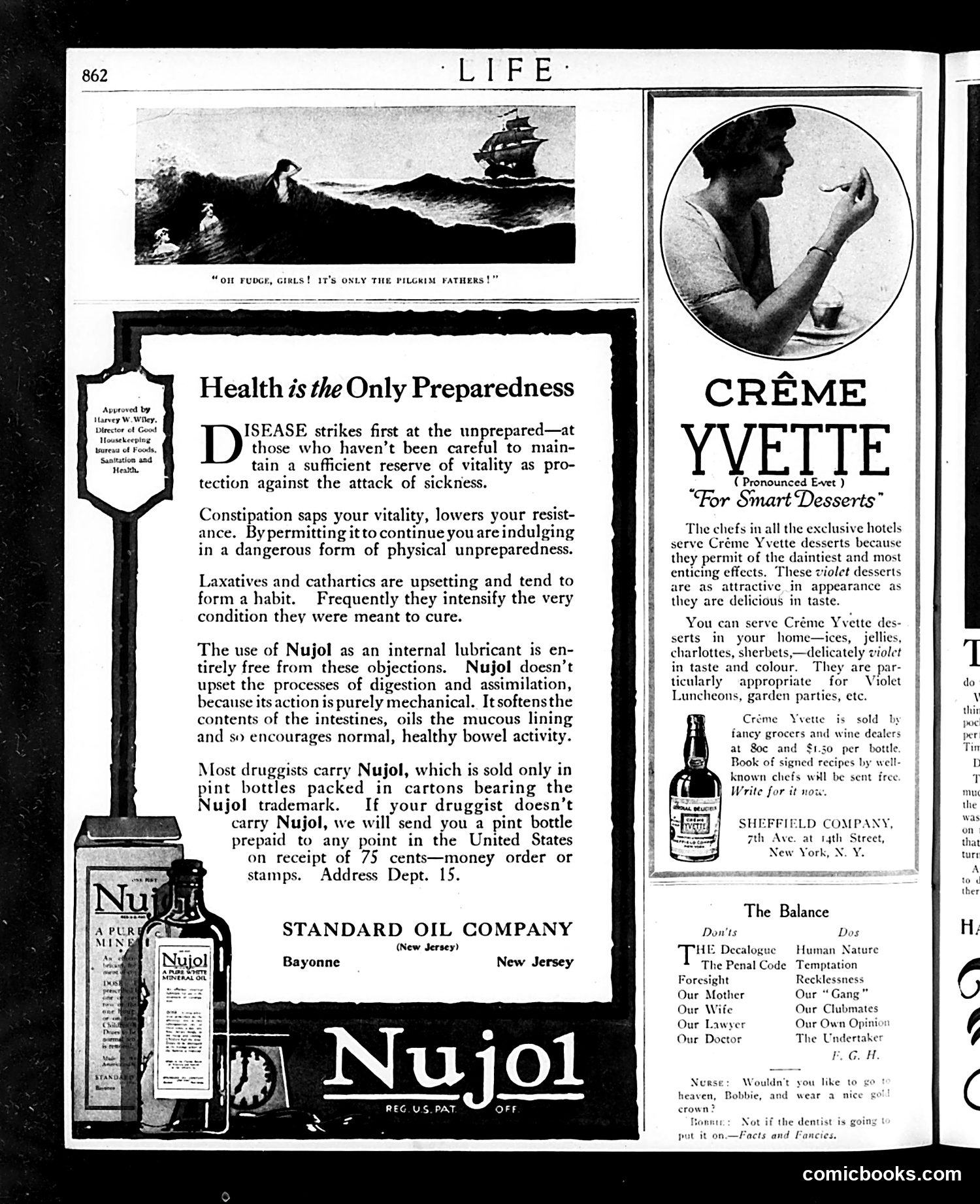
This page is primarily **advertising, not satire**. It contains three commercial advertisements: 1. **Top cartoon**: A humorous maritime scene with the caption "Oh fudge, girls! It's only the Pilgrim Fathers!" — a lighthearted joke about mistaking a ship for the historical Pilgrims, likely unrelated to the ads below. 2. **Nujol (left)**: An internal lubricant laxative ad emphasizing that it works mechanically without upsetting digestion, marketed as superior to habit-forming laxatives. Standard early-20th-century health product advertising. 3. **Crème Yvette (right)**: A liqueur advertisement promoting violet-flavored dessert liqueur for home entertaining. The page demonstrates how Life magazine mixed editorial humor with advertising revenue. No political commentary or satire is evident—these are straightforward period product advertisements.
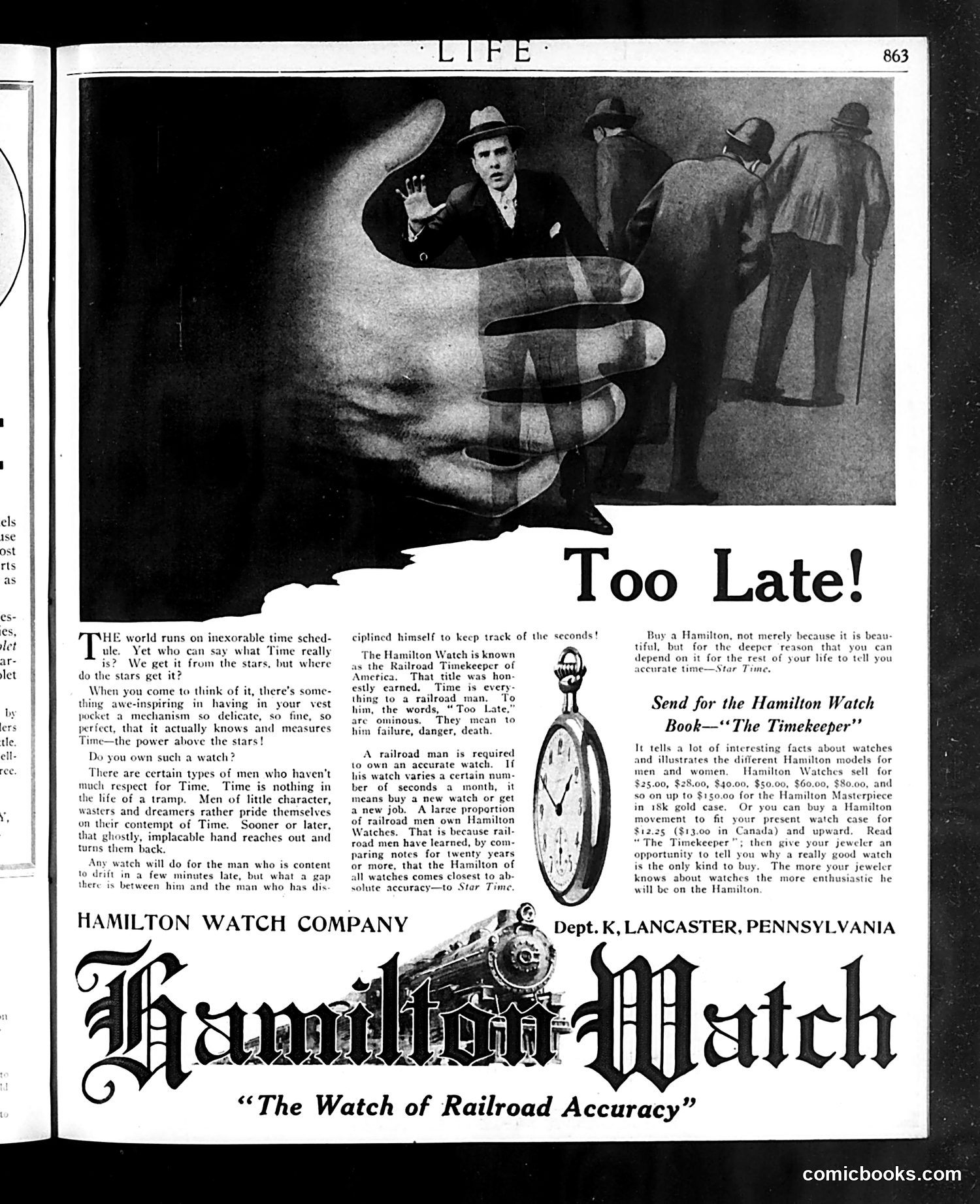
This is primarily a **product advertisement**, not political satire. The "Too Late!" headline uses dramatic imagery—a large face with an accusatory hand gesture and silhouettes of men in the background—to convey moral messaging about timekeeping. The ad contrasts two character types: those who lack "respect for Time" (described as tramps and "men of little character") versus disciplined individuals who keep precise time. This reflects early-20th-century values equating punctuality with moral virtue and success. The pitch targets **railroad workers specifically**, positioning Hamilton Watches as "The Railroad Timekeeper of America." Railroads required extreme accuracy; missing schedule deadlines meant "failure, danger, death." The ad leverages this professional requirement to sell luxury watches to working men by appealing to both practical need and aspirational status—suggesting a quality watch signals character and reliability. The moralizing tone about time as a force of judgment ("that ghostly, implacable hand") is typical period advertising rhetoric linking consumer goods to personal worth.
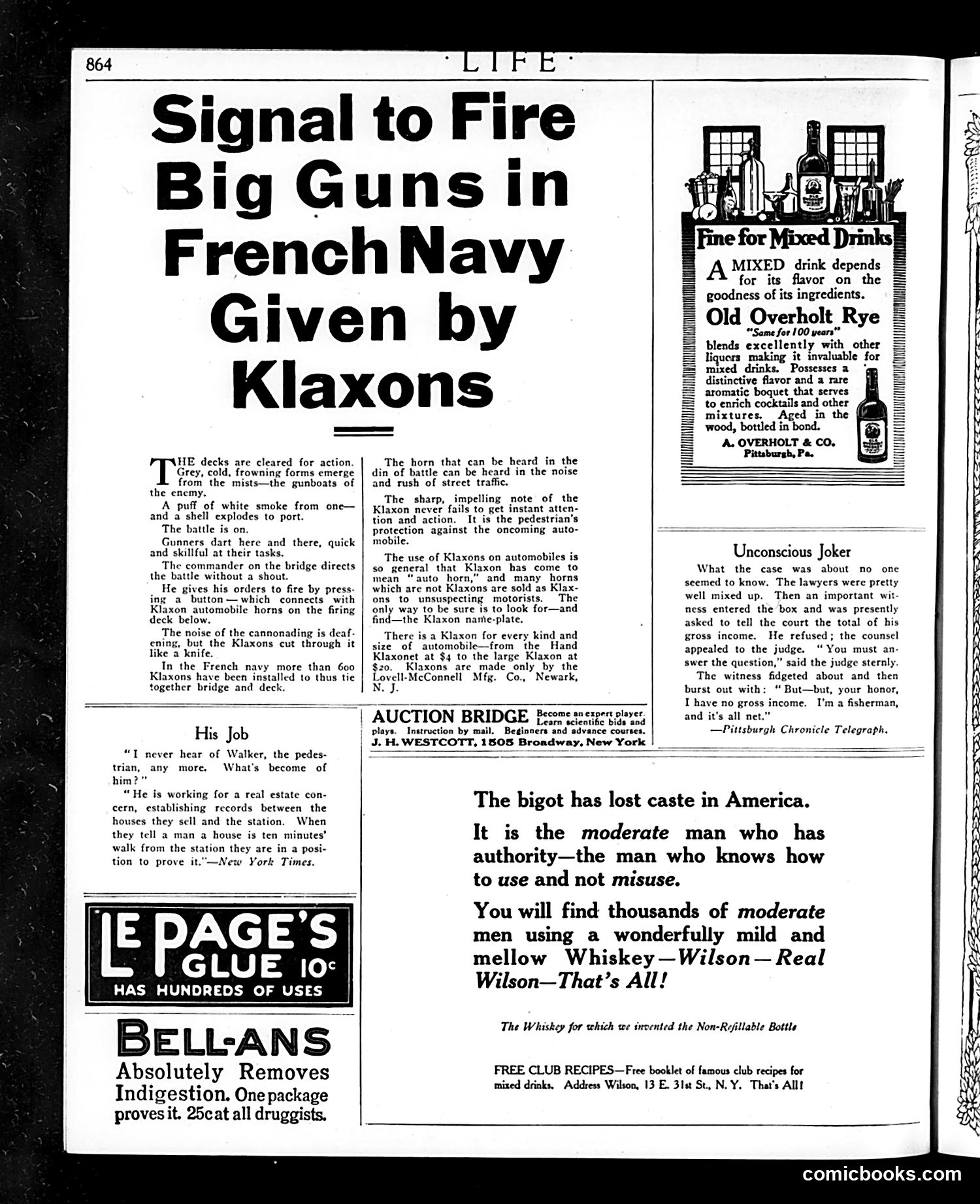
This page contains primarily **advertising and filler content** rather than political satire or editorial cartoons. The main article, "Signal to Fire Big Guns in French Navy Given by Klaxons," is **product promotion disguised as journalism**—essentially a lengthy advertisement for Klaxon automobile horns. It describes how the French Navy uses Klaxon horns to signal gunfire during naval combat, then pivots to marketing the same horns for automobiles as safety devices for pedestrians. The page also includes several unrelated advertisements (Old Overholt Rye whiskey, Le Page's Glue, Bell-Ans indigestion remedy, Auction Bridge lessons) and two brief humorous anecdotes: "His Job" and "Unconscious Joker"—light comedy filler typical of Life magazine's satirical format. There are **no political cartoons or caricatures** on this page. The content reflects early 1900s advertising practices where product placement and native advertising were woven into editorial content without clear distinction.
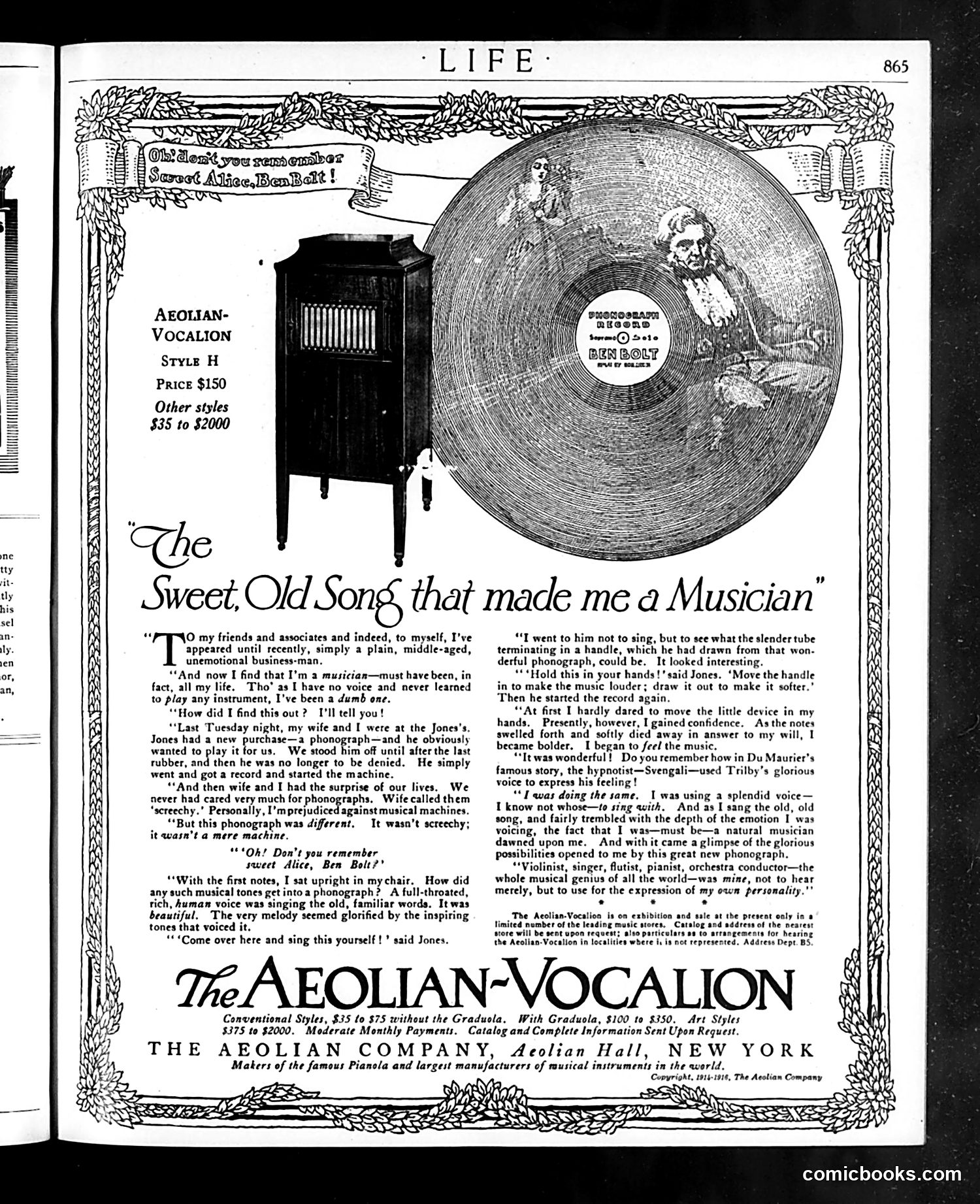
This is primarily a **phonograph advertisement** disguised as editorial content in *Life* magazine (circa 1914-1918, based on copyright). The narrative describes a middle-aged businessman who discovers he's "really" a musician when using an Aeolian-Vocalion phonograph. By manipulating the device's volume control (the "handle"), he can subtly influence playback, making him feel he's personally performing famous songs like "Sweet Alice, Ben Bolt." **The satire's appeal:** The ad exploits vanity and fantasies of hidden talent. The joke is that ordinary people could feel musically accomplished without actual skill—simply by controlling a machine's volume knob. References to Svengali (the hypnotist from *Trilby*) suggest the phonograph can manipulate emotion and create illusions of personal artistry. This reflects early 20th-century anxieties about mass-produced entertainment replacing authentic human performance, while simultaneously marketing that technology to aspirational consumers who wanted to feel cultured.
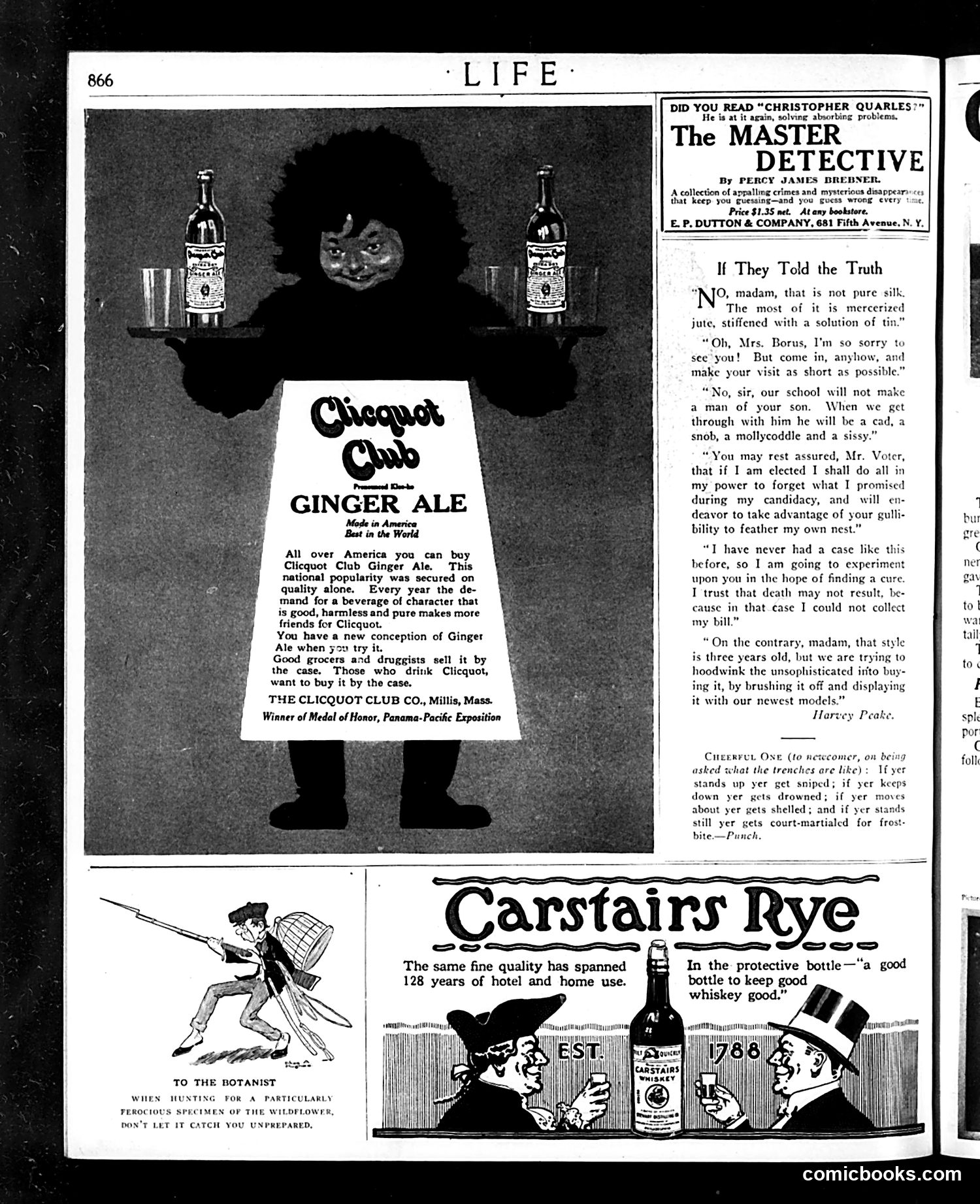
This page contains **primarily advertisements** for alcohol and books, interspersed with satirical content. The **Clicquot Club Ginger Ale ad** features an illustration of a figure holding bottles, appealing to American consumers with nationalist messaging ("Made in America, Best in the World"). The **"If They Told the Truth"** section is satirical commentary mocking various professions and institutions—schoolmasters who produce "cads" and "mollycoddles," politicians who break campaign promises, doctors who experiment on patients, salesmen who deceive customers. This reflects early 20th-century American skepticism toward established institutions. The **"To the Botanist"** cartoon shows a hunter with a net, joking about unprepared specimen collection. The **Carstairs Rye advertisement** emphasizes 128 years of "hotel and home use," with vintage imagery establishing the product's heritage and respectability. The **"Master Detective"** book advertisement promotes a mystery novel with the promise of misleading readers. Overall, this is typical Life magazine content: commercial advertising mixed with gentle social satire.
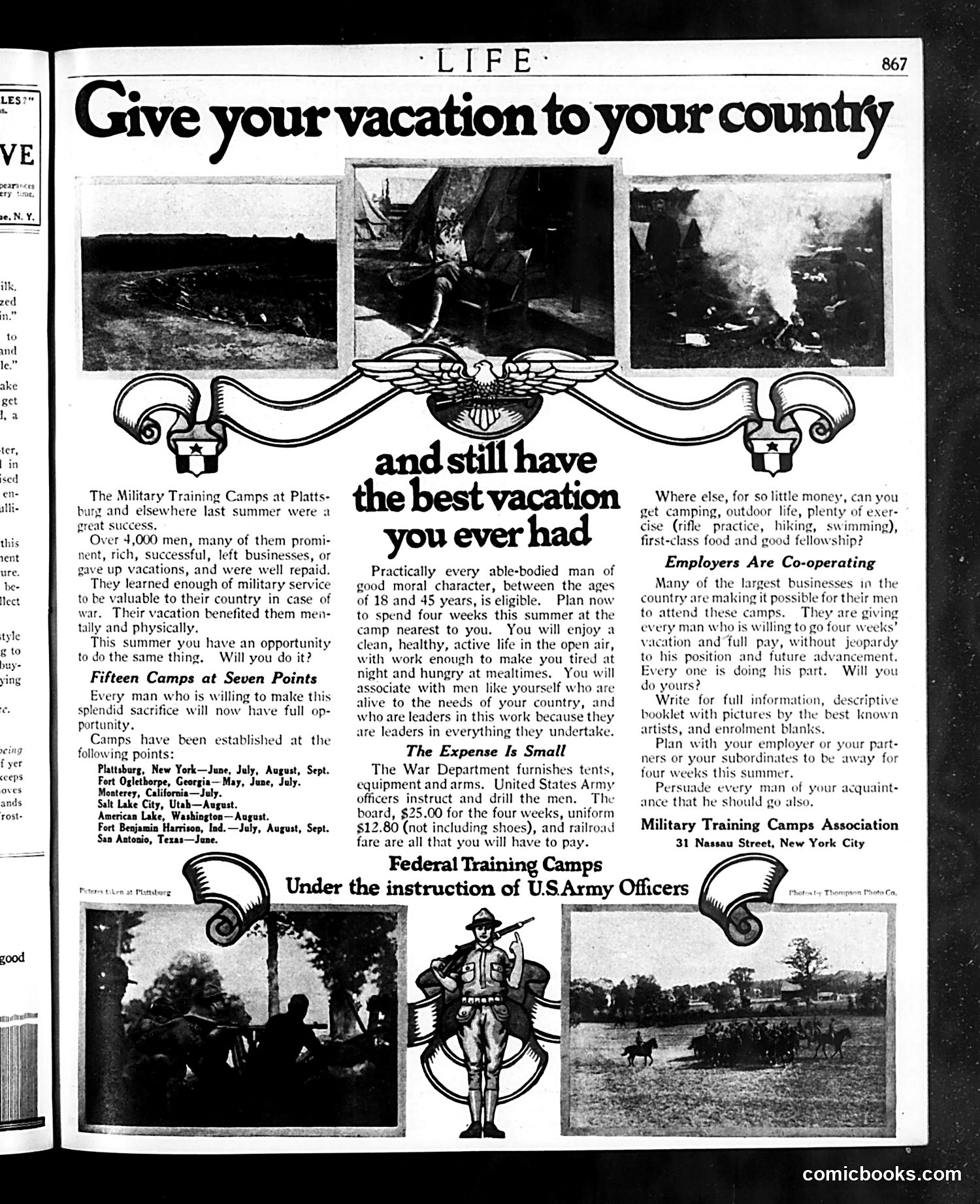
This is a recruitment advertisement for federal military training camps, not satire. The page promotes voluntary military preparation during peacetime—likely 1915-1916, before U.S. entry into World War I. **The appeal:** Men aged 18-45 are encouraged to spend four weeks at camps like Plattsburg, gaining military instruction while enjoying outdoor recreation. The pitch emphasizes patriotic duty ("give your vacation to your country") alongside personal benefits—camping, exercise, camaraderie, and minimal cost ($25 board plus uniform). **Key selling point:** Employers are cooperating by granting paid leave without jeopardizing jobs or advancement, removing financial barriers. **Historical context:** These camps trained "citizen soldiers" as preparedness during rising international tensions. The central eagle emblem and patriotic framing suggest mobilization sentiment before America's 1917 entry into WWI. There is no cartoon satire here—it's straightforward propaganda promoting voluntary military readiness as both patriotic service and wholesome vacation.
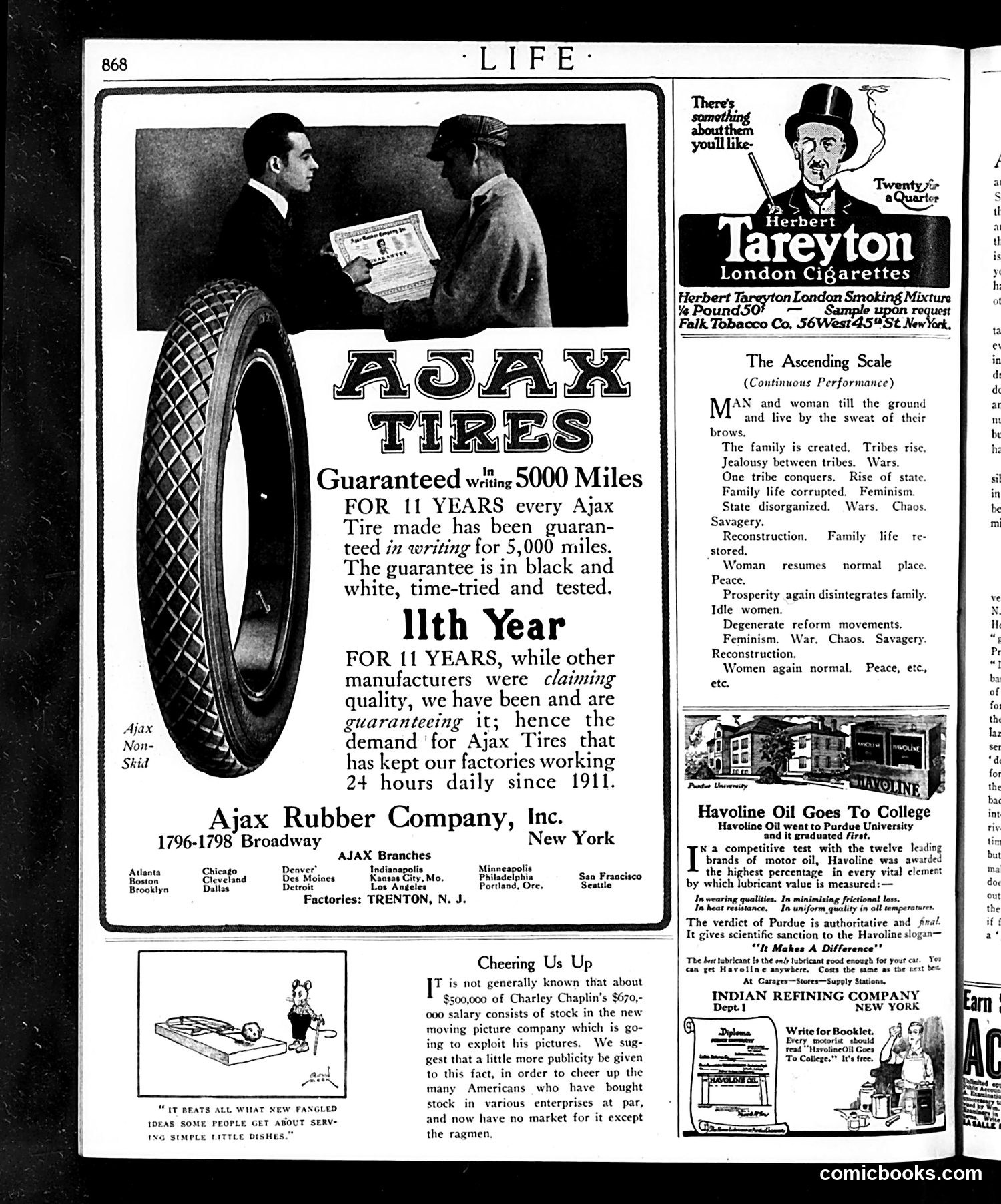
This is primarily an **advertising page** from an early 20th-century issue of Life magazine, dominated by commercial notices rather than editorial content. The main advertisements promote **Ajax Tires** (emphasizing an 11-year guarantee), **Tareyton London Cigarettes**, and **Havoline Motor Oil** (which claims victory in a Purdue University performance test). The small satirical section titled **"Cheering Us Up"** mocks wealthy investors during what appears to be a financial downturn. It notes that actor Charlie Chaplin's $500,000 salary consists partly of stock in his new film company—a fact the writer suggests should be publicized to comfort ordinary Americans who bought stock "at par" in various ventures and now cannot sell except to "ragmen" (scrap dealers). The satire targets the disconnect between celebrity wealth and common investor losses. **"The Ascending Scale"** appears to be a cyclical social commentary on civilization's rise and fall through family, war, and reconstruction—likely reflecting post-WWI anxieties about social order.
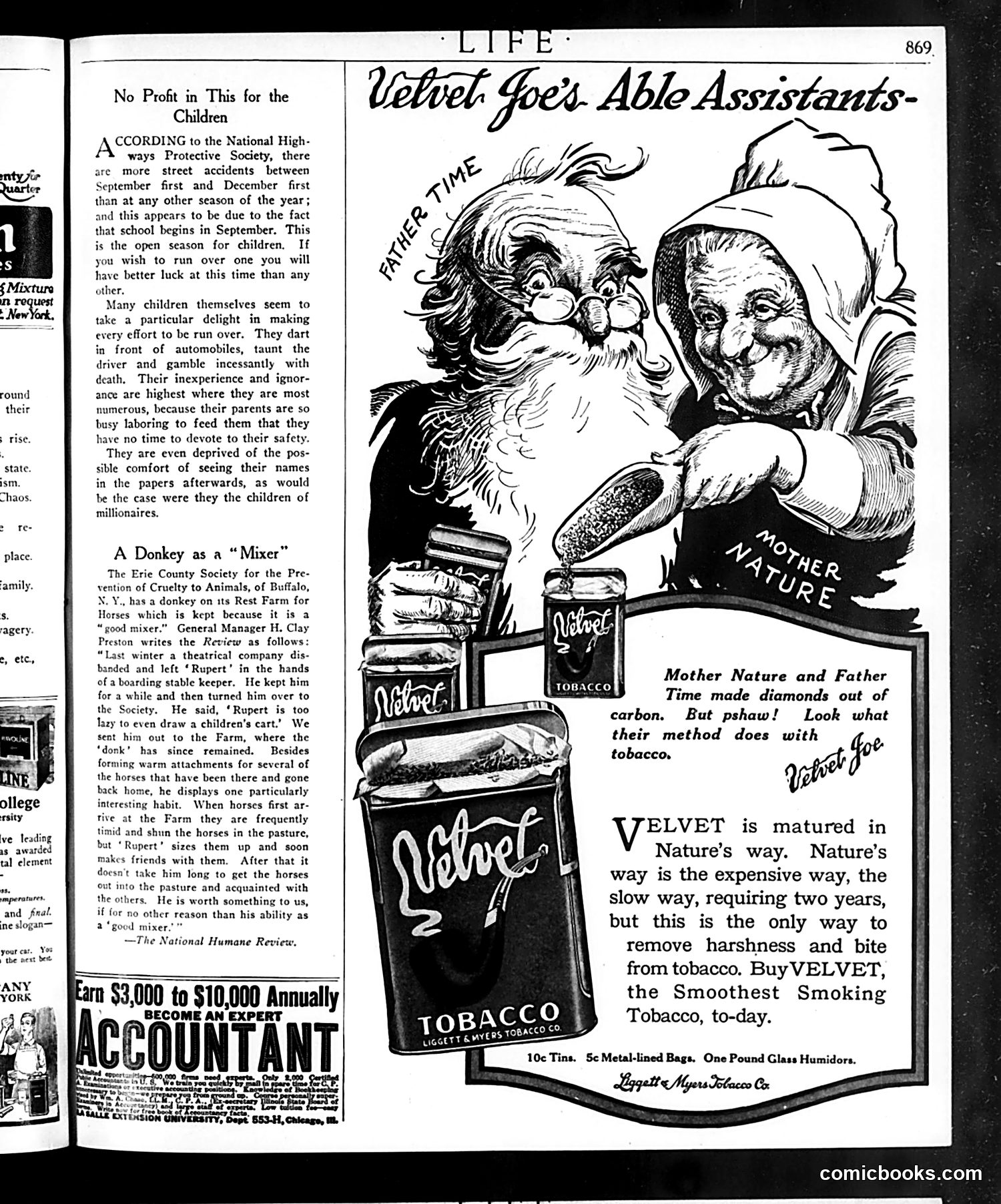
**Left Column - Editorial Content:** The page critiques child safety during back-to-school season. "No Profit in This for the Children" sardonically notes that poor children killed in traffic accidents receive no newspaper attention (unlike wealthy children), implying society ignores working-class child welfare. A separate piece praises a donkey at a farm sanctuary as a useful "mixer" who helps socialize anxious horses—seemingly innocent but likely a sarcastic jab at someone's social utility. **Right Side - Velvet Tobacco Advertisement:** The main image shows Santa Claus and an elderly woman (representing "Mother Nature" and "Father Time") endorsing Velvet tobacco. The ad's pitch is absurdist: Nature takes two years to create diamonds from carbon, but look what it does to tobacco—implying tobacco naturally becomes harsh. Velvet's "solution" is artificial aging to remove this harshness. The ad exemplifies early 20th-century tobacco marketing's disregard for health concerns, using whimsical personification and pseudo-scientific reasoning to sell smoking as refined and natural.
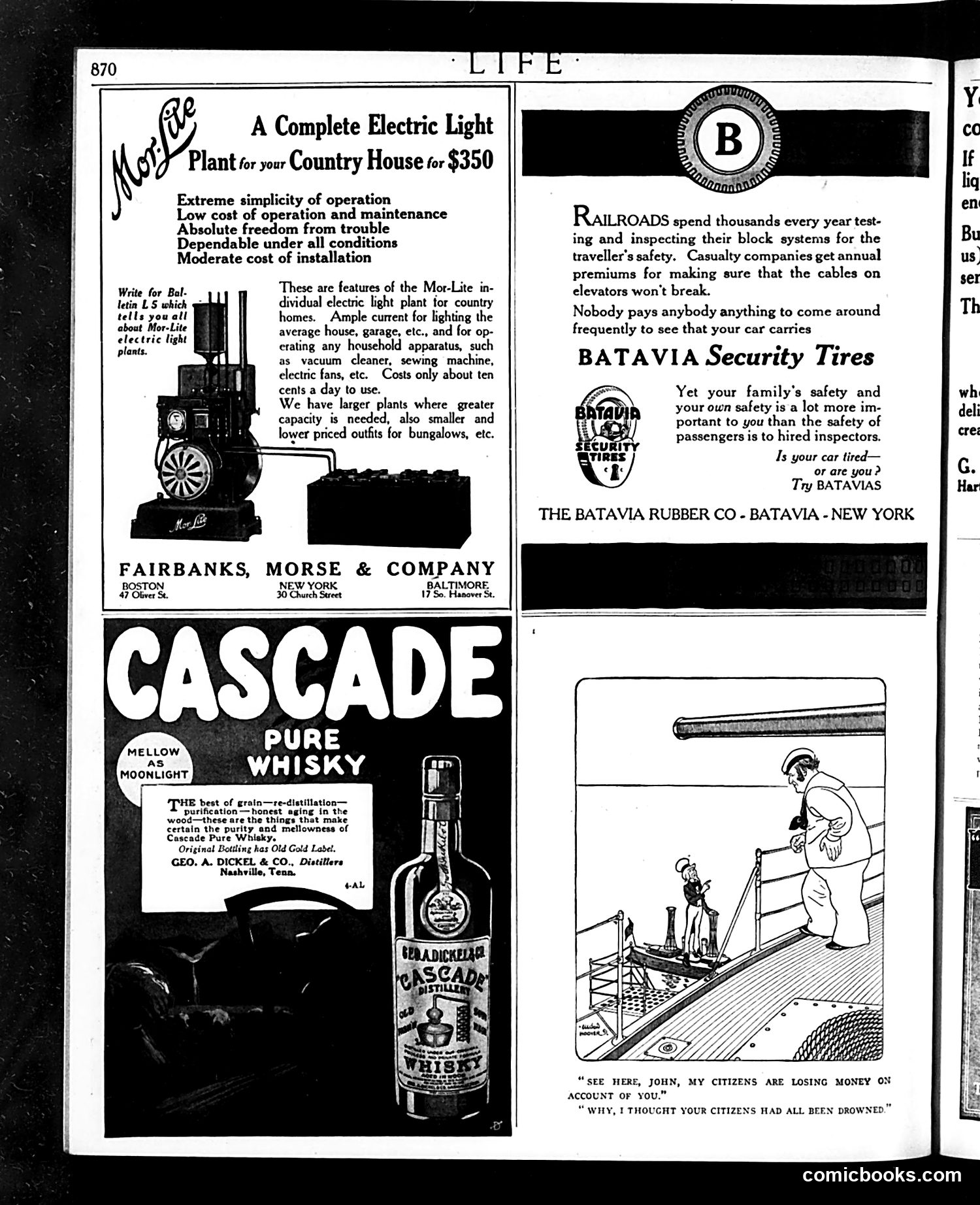
This page is primarily **advertising** from circa 1920s, with one political cartoon at the bottom. **The Cartoon:** A mayor or city official confronts a man (likely representing a ferry operator or transportation official) about citizens losing money. The official's response—"I thought your citizens had all been drowned"—is darkly satirical, suggesting a recent **ferry disaster or maritime accident** where many people died. The joke's bitter humor implies that if citizens are dead, they obviously can't lose money, thereby deflecting responsibility for financial losses. Without knowing the specific historical incident referenced, the cartoon appears to be **satirizing official incompetence or negligence** regarding public transportation safety, using grim humor to expose the absurdity of prioritizing financial concerns over the loss of life. The page otherwise features period product advertisements: Mor-Lite electric generators for country homes ($350), Batavia Safety Tires, and Cascade Pure Whisky—typical consumer goods marketed to affluent readers.
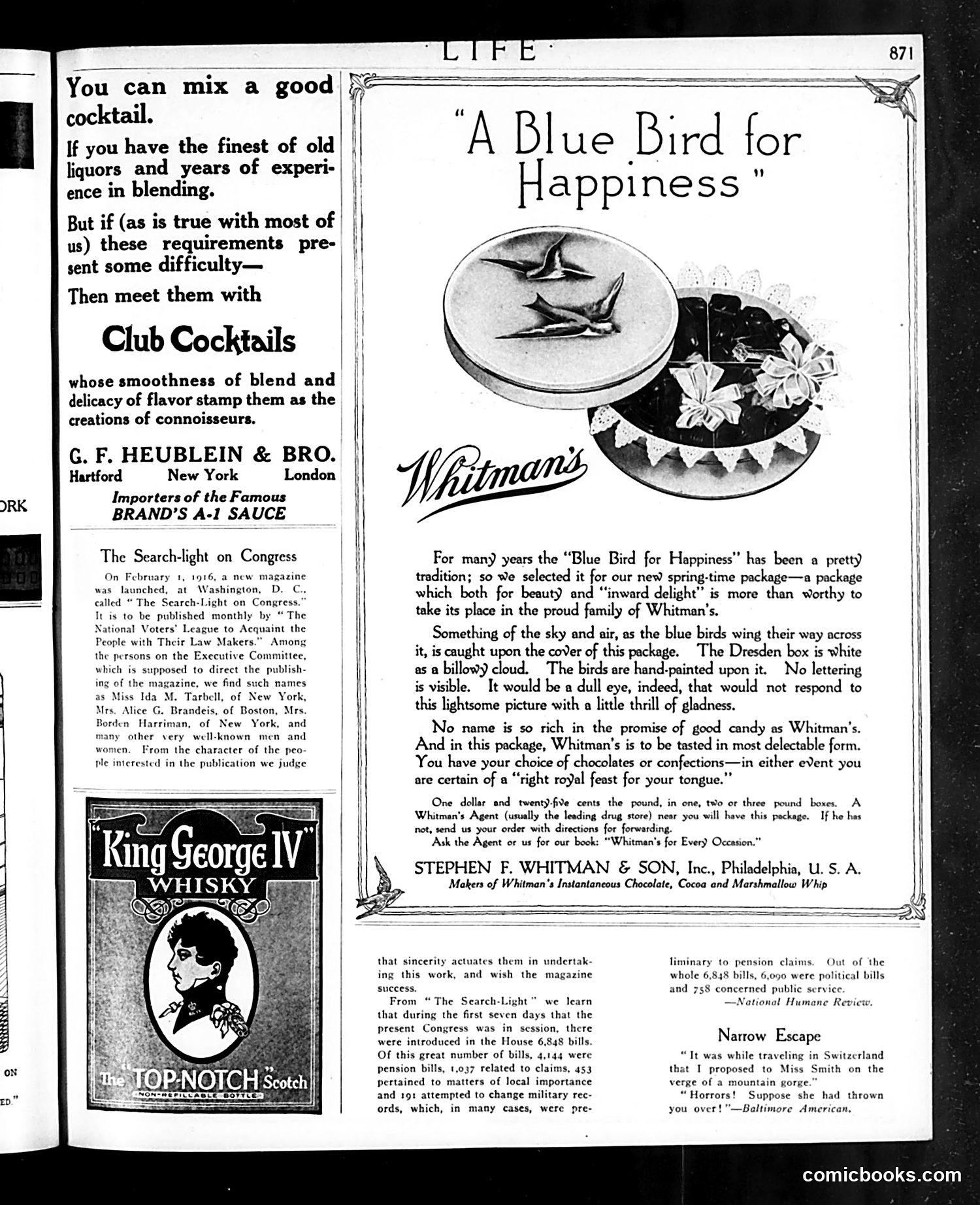
This page contains primarily **advertisements and brief news items** rather than political cartoons. The main content includes: 1. **Club Cocktails ad** (Heublein & Bro.) — a liquor advertisement offering pre-mixed cocktails for those lacking bartending skill. 2. **"Search-Light on Congress" item** — reports on a new 1916 magazine launched to inform citizens about lawmakers. Notes that prominent reformers (including Ida Tarbell, a famous muckraker) serve on its committee. The item humorously reports that of 6,848 bills introduced in Congress's first week, most were pension/personal claims rather than public service legislation—satirizing Congress's priorities. 3. **Whitman's Chocolates ad** — featuring a "Blue Bird for Happiness" package design with hand-painted birds. 4. **"Narrow Escape" joke** — a brief humorous anecdote about a marriage proposal near a Swiss gorge. The page reflects Progressive Era concerns about government accountability and consumer advertising common to this period.
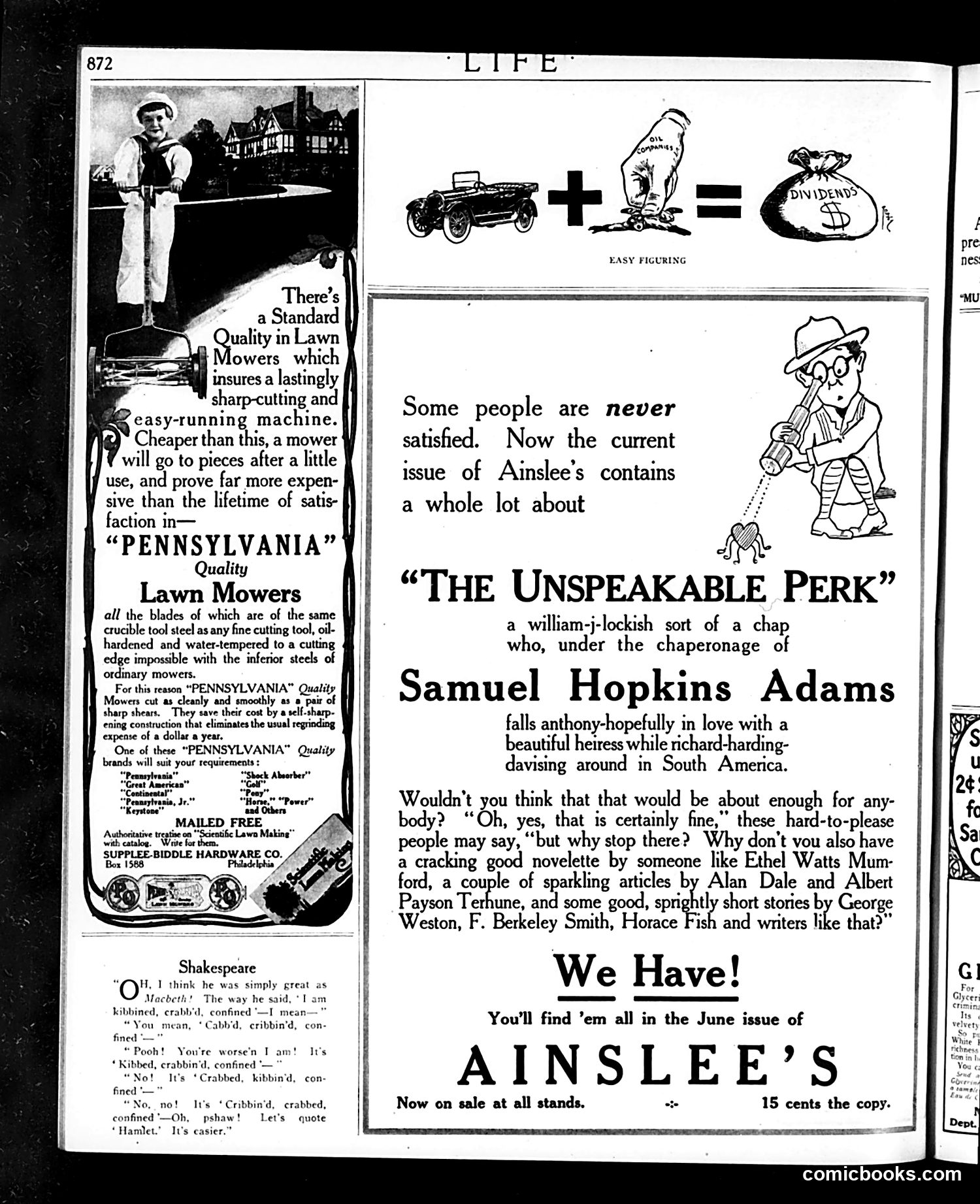
This page combines three distinct pieces of content: **Left side:** An advertisement for "Pennsylvania" Quality Lawn Mowers, emphasizing durability and value—a straightforward commercial pitch. **Bottom left:** A brief comedic sketch about two people attempting to quote Shakespeare's *Macbeth*. They repeatedly misremember or disagree on the exact wording of the line "cribbed, cabined, confined," each confidently "correcting" the other until they give up and switch to *Hamlet*, which they claim is easier to quote accurately. The joke satirizes people who pretend to deep literary knowledge while being imprecise with actual texts. **Right side:** An advertisement for *Ainslee's* magazine (June issue, 15 cents), promoting its fiction. It humorously depicts perpetually dissatisfied readers: the magazine offers a story by Samuel Hopkins Adams about romance in South America, yet imagines complaints that it should also include novelettes and short stories by other named authors (Ethel Watts Mumford, Alan Dale, Albert Payson Terhune, George Weston, F. Berkeley Smith, Horace Fish). The satire targets readers with insatiable demands for more content.
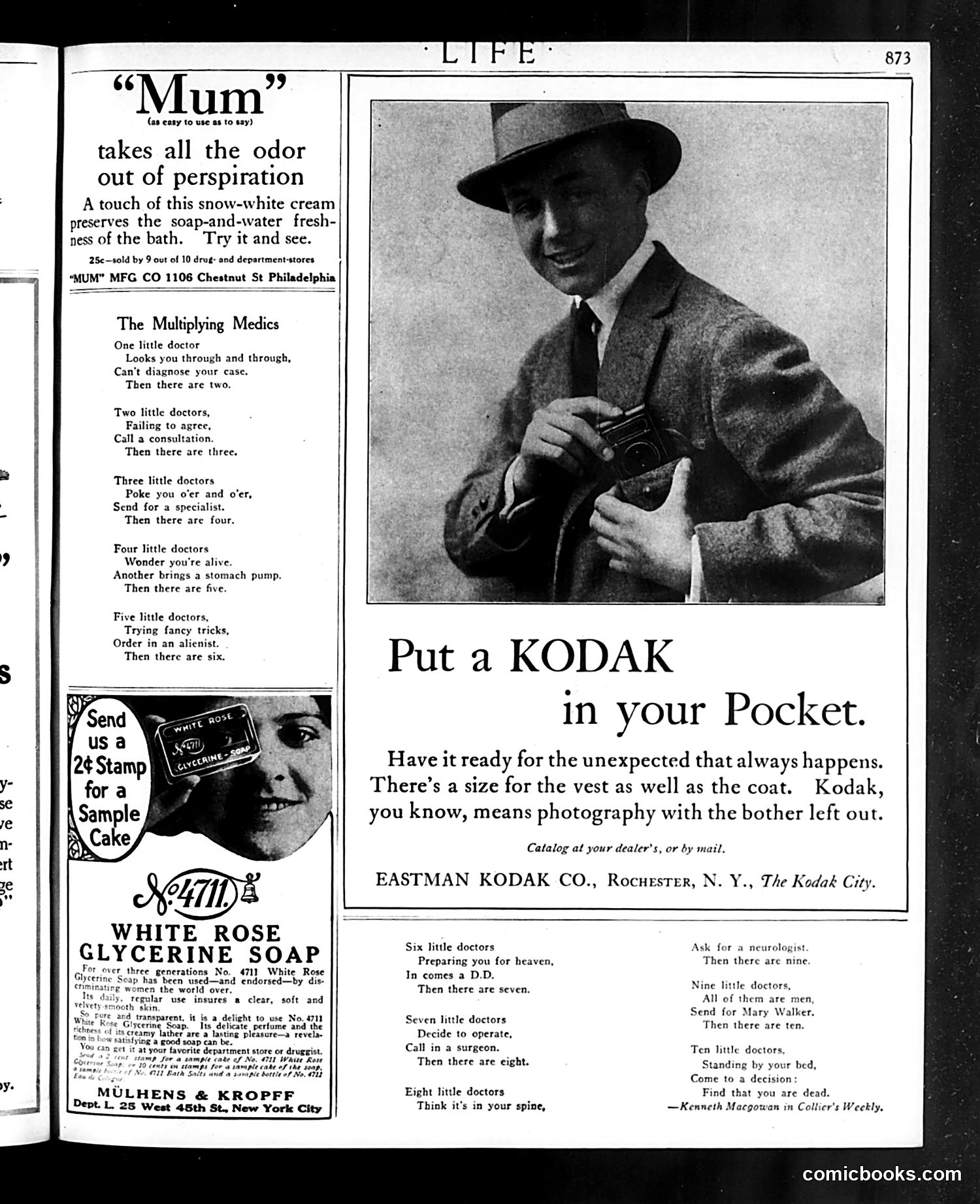
This poem mocks the medical profession's tendency toward unnecessary consultation and specialist referrals. Starting with one doctor unable to diagnose, each verse adds another physician, escalating from two disagreeing doctors calling a consultation, to three poking and prodding, to eventually nine male doctors (with a jab at Mary Walker, likely a female doctor of the era) before the patient dies anyway. The satire targets over-medicalization: doctors multiplying solutions rather than solving problems, each bringing competing opinions and unnecessary treatments (stomach pumps, "fancy tricks"). The darkly comic ending—"Find that you are dead"—suggests the patient expired despite or because of excessive medical intervention. This reflects early 20th-century skepticism about medical authority and the profit motive behind unnecessary specialist referrals, a concern that remains relevant today.
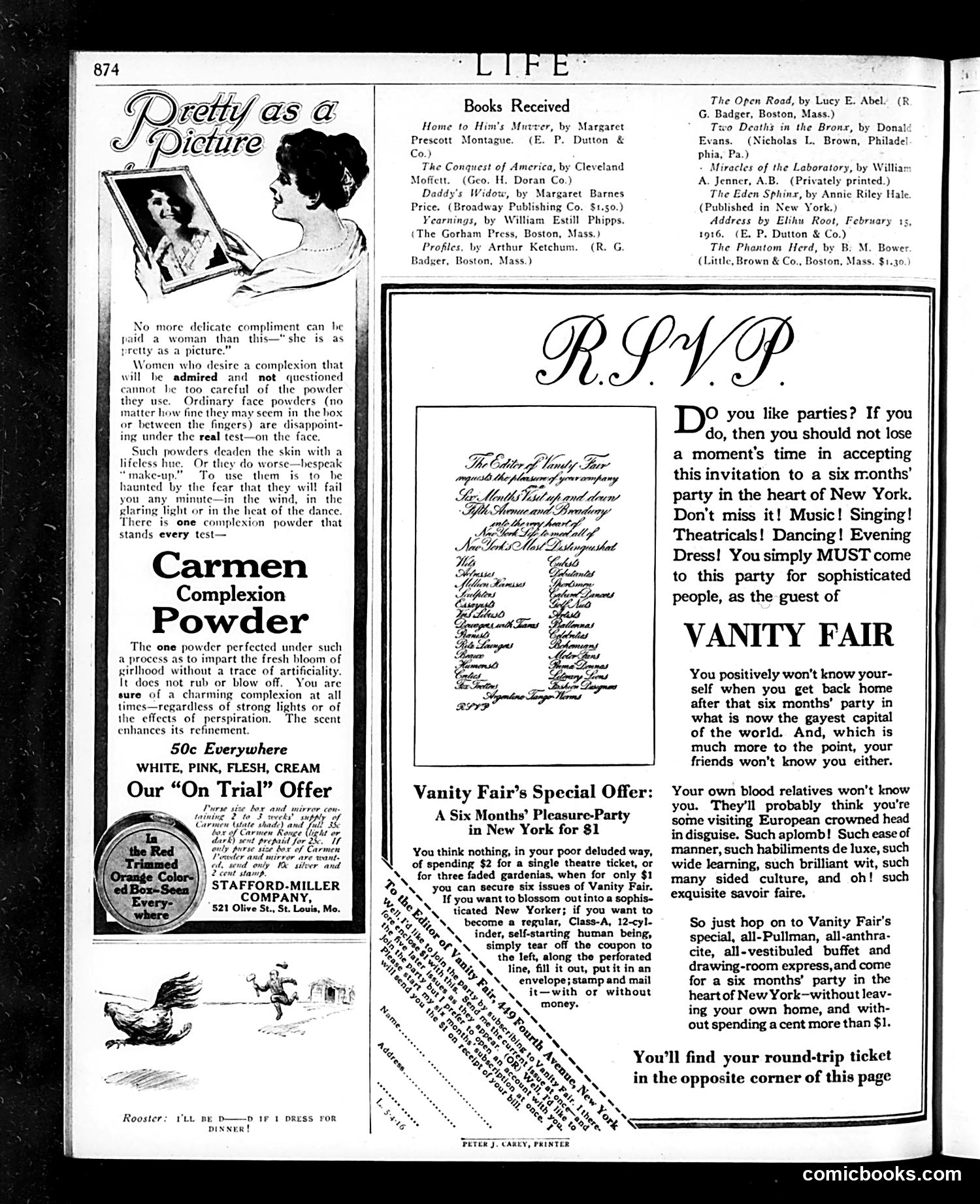
This page contains two main advertisements typical of 1910s Life magazine. **Left side: Carmen Complexion Powder ad.** A woman admires her reflection, illustrating the era's beauty ideal. The ad promises a powder that looks natural—"without a trace of artificiality"—addressing women's anxiety that visible makeup would appear improper or cheap. The small cartoon at bottom shows a rooster, likely a crude joke about dressing up (the rooster's comb). **Right side: Vanity Fair magazine subscription.** This is satirical advertising. It mocks aspirational New Yorkers by promising that a $1 subscription (six issues) will transform readers into "sophisticated people"—implying that merely reading about Manhattan's social scene grants social status. The humor lies in the exaggeration: relatives won't recognize you; you'll seem like "European crowned heads." It's gentle mockery of status-consciousness and the fantasy that consuming the right magazine makes one cultured. Both ads exploit early 20th-century anxieties about appearance and social standing.
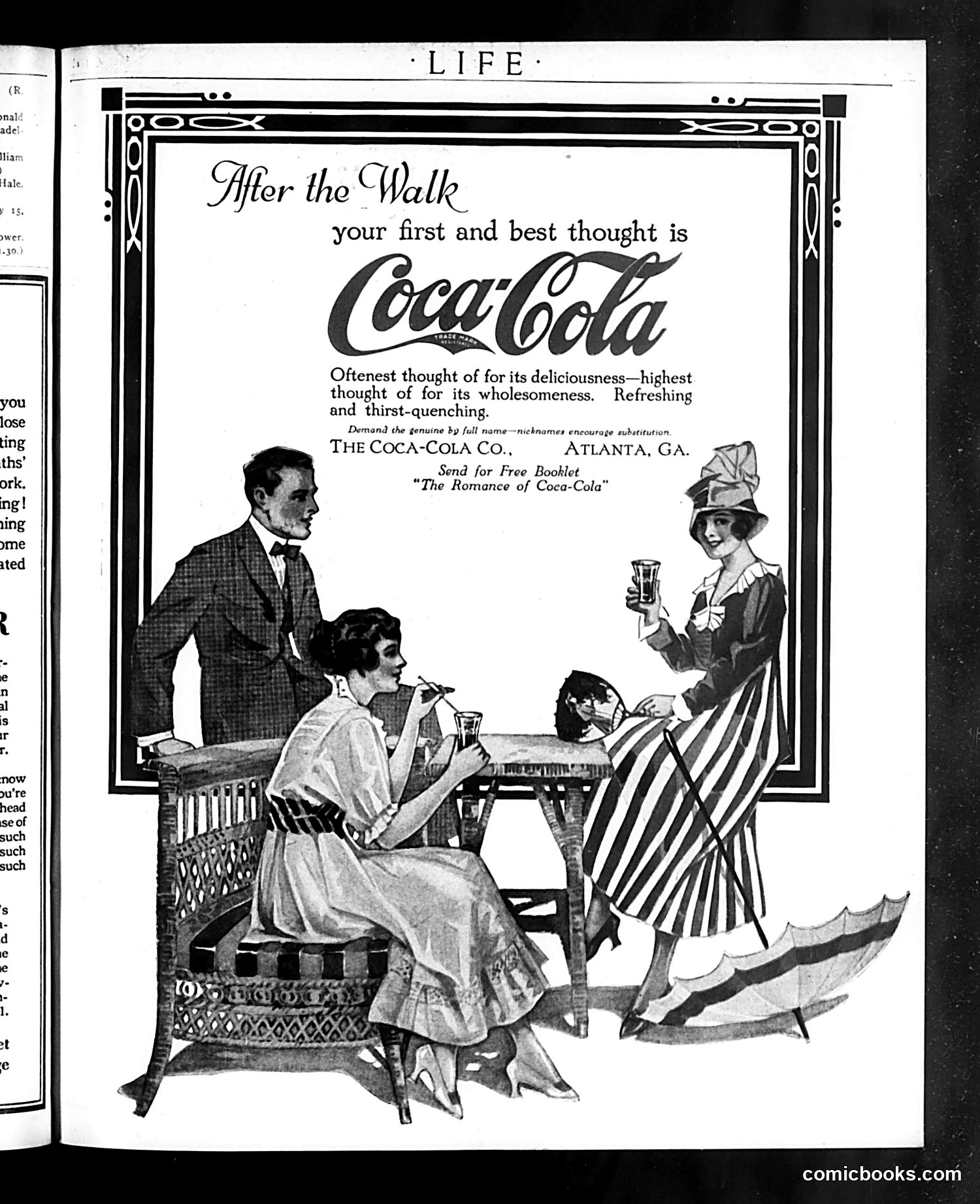
This is a **Coca-Cola advertisement**, not political satire. The page shows a social scene where well-dressed people enjoy Coca-Cola after "the Walk" (likely a social outing or promenade). The ad's message is straightforward: Coca-Cola should be your instinctive choice for refreshment due to its "deliciousness" and "wholesomeness." The text emphasizes demanding the "genuine by full name" to avoid counterfeit substitutes—a real concern in the early soft-drink era when imitations were common. The illustration depicts genteel social consumption, positioning Coca-Cola as appropriate for polite society. The ad offers a free booklet, "The Romance of Coca-Cola," typical early advertising strategy. This appears to be from Life magazine's advertising section, not editorial content or satire.
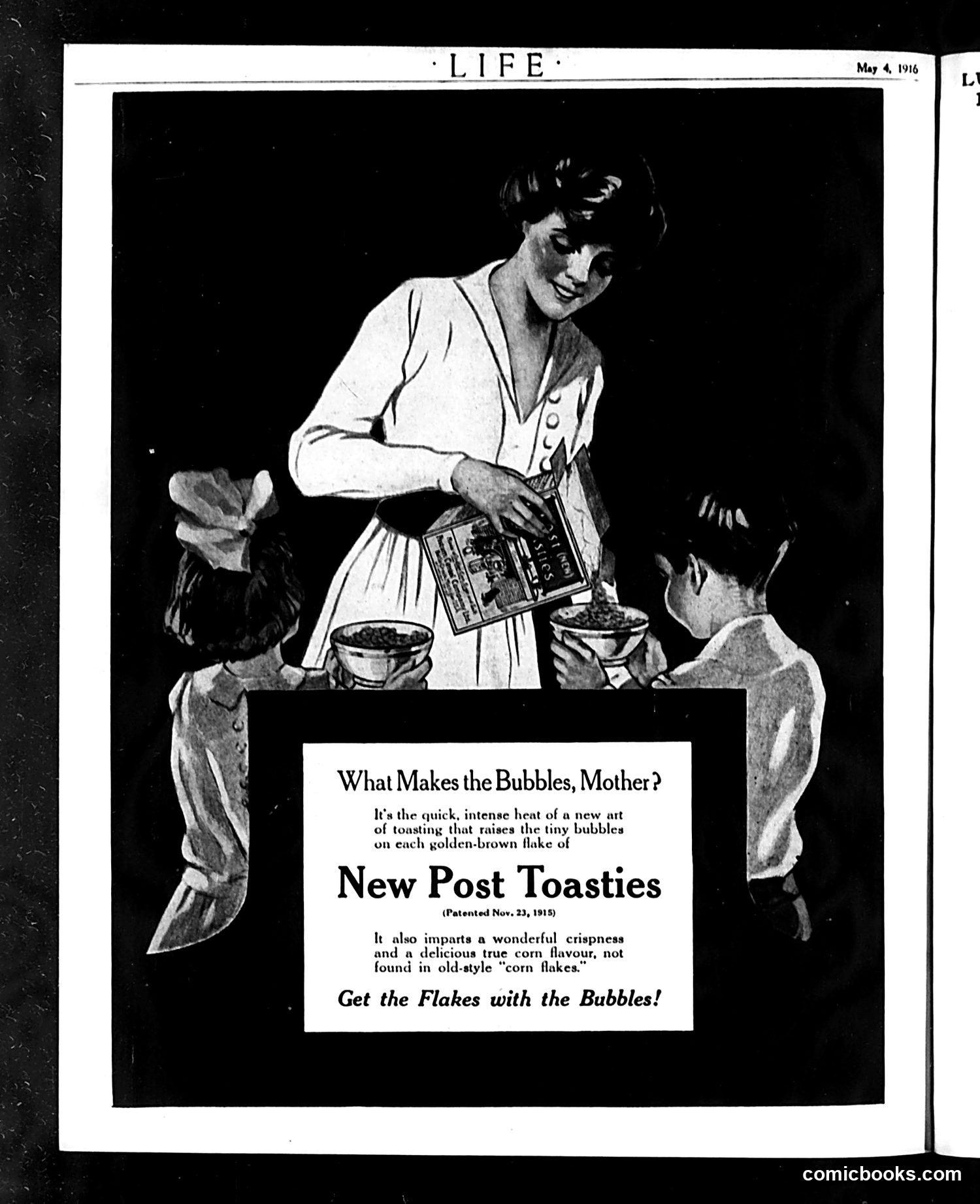
This is a **cereal advertisement**, not political satire or a cartoon. It appeared in Life magazine on May 4, 1916. The image shows a mother serving Post Toasties cereal to two children at a table. The ad's humor derives from a child asking "What Makes the Bubbles, Mother?"—a naive question that the advertisement then "answers" by explaining the patented toasting process. The appeal is nostalgic and domestic: positioning the product as a modern innovation ("new art of toasting") while emphasizing traditional family values (mother serving breakfast). The "bubbles" are presented as a quality marker distinguishing Post Toasties from competitor corn flakes. This represents early 20th-century advertising technique: using charming domestic scenes and pseudo-scientific claims ("patented") to market processed breakfast foods to American families.