
Life, 1916-05-04 · page 29 of 52
Life — May 4, 1916 — page 29: what you’re looking at
What you’re looking at
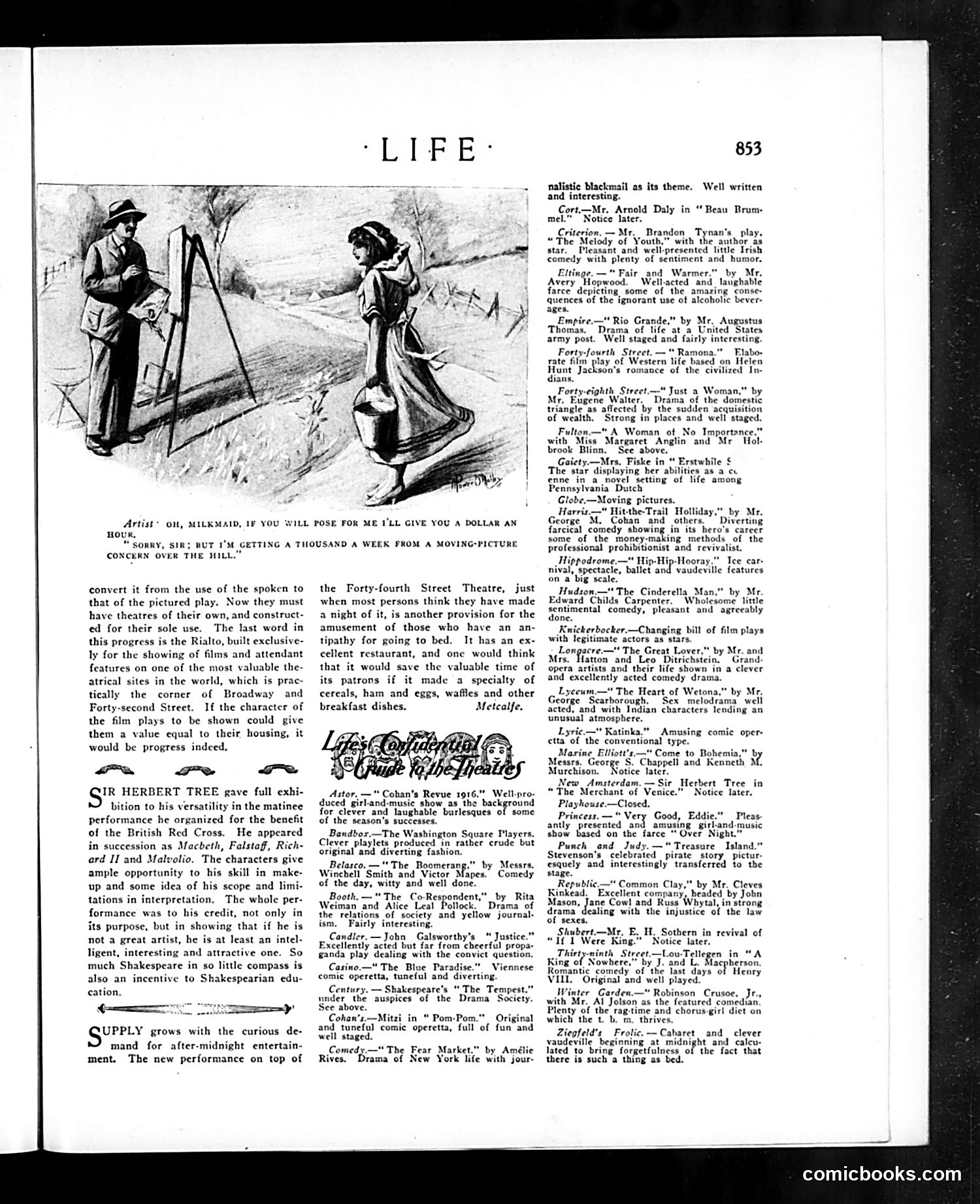
The cartoon depicts a **moving-picture cameraman** negotiating with a rural milkmaid. The cameraman offers her a dollar to pose, boasting he earns a thousand dollars weekly from his film work. The milkmaid's skeptical response—"Sorry, sir; but I'm getting a thousand a week from a moving-picture concern over the hill"—delivers the joke: even rural, unsophisticated workers are now profiting from the booming film industry. **Context**: This satirizes the rapid expansion of cinema in the 1910s. Film production was becoming so lucrative and widespread that it reached even remote areas, creating unexpected economic opportunities. The humor mocks the cameraman's presumption that a country girl would be impressed by or need his modest offer, when she's already securing better wages in this new industry.
📄 Transcribed text from this page (OCR, searchable)
Machine-transcribed from the original scan — historical spelling and the odd misread are preserved.
Artist HOUR, “SORRY, SIR; BUT I'M CONCERN OVER THE HLL.” convert it from the use of the spoken to that of the pictured play. Now they must have theatres of their own, and construct- ed for their sole use. The last word in this progress is the Rialto, built exclusive- ly for the showing of films and attendant features on one of the most valuable the- atrical sites in the world, which is prac- tically the corner of Broadway and Forty-second Street. If the character of the film plays to be shown could give them a value equal to their housing, it would be progress indeed, run Feo Kz IR HERBERT TREE gave full exhi- bition to his versatility in the matinee performance he organized for the benefit of the British Red Cross. He appeared in succession as Macbeth, Falstaff, Rich- ard II and Malvolio. The characters give ample opportunity to his skill in make up and some idea of his scope and limi tations in interpretation. The whole per- formance was to his credit, not only in its purpose, but in showing that if he is not a great artist, he is at least an intel- ligent, interesting and attractive one. So much Shakespeare in so little compass is also an incentive to Shakespearian edu- cation. UPPLY grows with the curious de- mand for after-midnight entertain- ment. The new performance on top of OM, MILKMAID, IF YOU WILL POSE FOR ME I'LL GIVE YOU A DOLLAR AN ETTING A THOUSAND A WEEK FROM A MOVING-PICTURE the Forty-fourth Street Theatre, just when most persons think they have made a night of it, is another provision for the amusement of those who have an an- tipathy for going to bed. It has an ex- cellent restaurant, and one would think that it would save the valuable time of its patrons if it made a specialty of cereals, ham and eggs, waffles and other breakfast dishes, Metcalfe, Astor. —" Cohan’s Revue 1916." Well-pro- duced girl-and-musie show as the background for clever and laughable burlesques of some of the season's successes. Bandbox.—The Washington Square Players. Clever playlets produced in rather crude but original and diverting fashion. Belasco. —"* The Boomerang,” by Messrs. Winchell Smith and Victor Mapes. Comedy of the day, witty and well done. Booth. —"The Co-Respondent,” by Rita Weiman and Alice Leal Pollock,’ Drama of the relations of society and yellow journal- ism. Fairly interesting. Candler. — John Galsworthy’s " Justice.” Excellently acted but far from cheerful propa ganda play dealing with the convict question. Casino.—" The Blue Paradise.” Viennese comic operetta, tuneful and diverting. Century. — Shakespeare's “The Tempest, under the auspices of the Drama Society. -¢ above. Cohan’s.—Mitzi in “ Pom-Pom.” Original and tuneful comic operetta, full of fun and well staged. Comedy.—** The Fear Market.” by Amélie Rives. Drama of New York life with jour- 853 nalistic blackmail as its theme, and interesting. Cort—Mr, Arnold Daly in ‘Beau Brum mel.” "Notice later. Criterion. — Mr, Brandon Tynan’s play. “The Melody of Youth,” with the author as star. Pleasant and well-presented little Irish comedy with plenty of sentiment and humor. Eltinge. —" Fair and Warmer.” by Mr. Avery Hopwood. Well-acted and laughable farce depicting some of the amazing canse- quences of the ignorant use of alcoholic bever- ages. Empire.—' Rio Grande,” by Mr. Augustus Thomas. Drama of life at a United States army post. Well staged and fairly interesting. Forty-fourth Street. —" Ramona.” Elabo- rate film play of Western life based on Helen Hunt Jackson's romance of the civilized In- dians. Forty-eighth Street.—“ Just a Woman,” by Mr. Eugene Walter. Drama of the domestic triangle as affected by the sudden acquisition of wealth, Strong in places and well staged, Fulton.—" A Woman of No Importance,” with Miss Margaret Anglin and Mr Uol- brook Blinn. See above, Gaicty.—Mrs, Fiske in “ Erstwhile § The star displaying her abilities as a cx enne in a novel setting of life among Pennsylvania Dutch Globe,—Moving pictures. Horris.—" Hit-the-Trail Holliday,” by Mr. George M. Cohan and others.’ Diverting farcical comedy showing in its hero's career some of the money-making methods of the professional probibitionist and revivalist. _Hippodrome.—"' Hip-Hip-Hooray.” Ice car- nival, spectacle, ballet and vaudeville features on a'big scale. Hudson.—" The Cinderella Man,” by Mr. Edward Childs Carpenter. Wholesome little sentimental comedy, pleasant and agreeably done. nickerbocker.—Changing bill of film plays with legitimate actors as stars. Longacre.—" The Great Lover.” by Mr. and Mrs. Hatton and Leo Ditrichstein. Grand- opera artists and their life shown in a clever and excellently acted comedy drama, Lyccum—" The Heart of Wetona,” by Mr. George Scarborough. Sex melodrama well acted, and with Indian characters lending an unusual atmosphere. Lyrie.—" Katinka.” Amusing comic oper- etta of the conventional type. Marine Elliott’s.—“ Come to Bohemia,” vy Messrs. George S. Chappell and Kenneth M. Murchison. Notice later. New Amsterdam. — Sir Herbert Tree in “The Merchant of Venice.” Notice later. Playhouse —Closed. Princess. — Very Good, Eddie. Pleas- antly presented and amusing girl-and-music show based on the farce “ Over Night.” Punch and Judy. —“ Treasure Island.” Stevenson's celebrated pirate story. pictur- esquely and interestingly transferred to the stage. _ Republic. Common Clay,” by Mr. Cleves Kinkead, Excellent company, headed by John Mason, Jane Cowl and Russ Whytal, in strong drama dealing with the injustice of the law of sexes. Shubert—Mr, E, H. Sothern in revival of “If 1 Were King.” Notice later. Thirty th Street.—Lou-Tellegen in “A King of Nowhere,” by J. and L. Macpherson. Romantic comedy of the last days o VII. Original and well played. Winter Garden.—" Robinson Crusoe. Jr., with Mr. Al Jolson as the featured comedian. Plenty of the rag-time and chorus-girl diet on which the t. b. m. thrives. Ziegfeld’s Frotic. —Caharet and clever vaudeville beginning at midnight and calcu lated to bring forgetfulness of the fact that there is such a thing as bed. Well written Henry comicbooks.com