
Life, 1916-05-04 · page 28 of 52
Life — May 4, 1916 — page 28: what you’re looking at
What you’re looking at
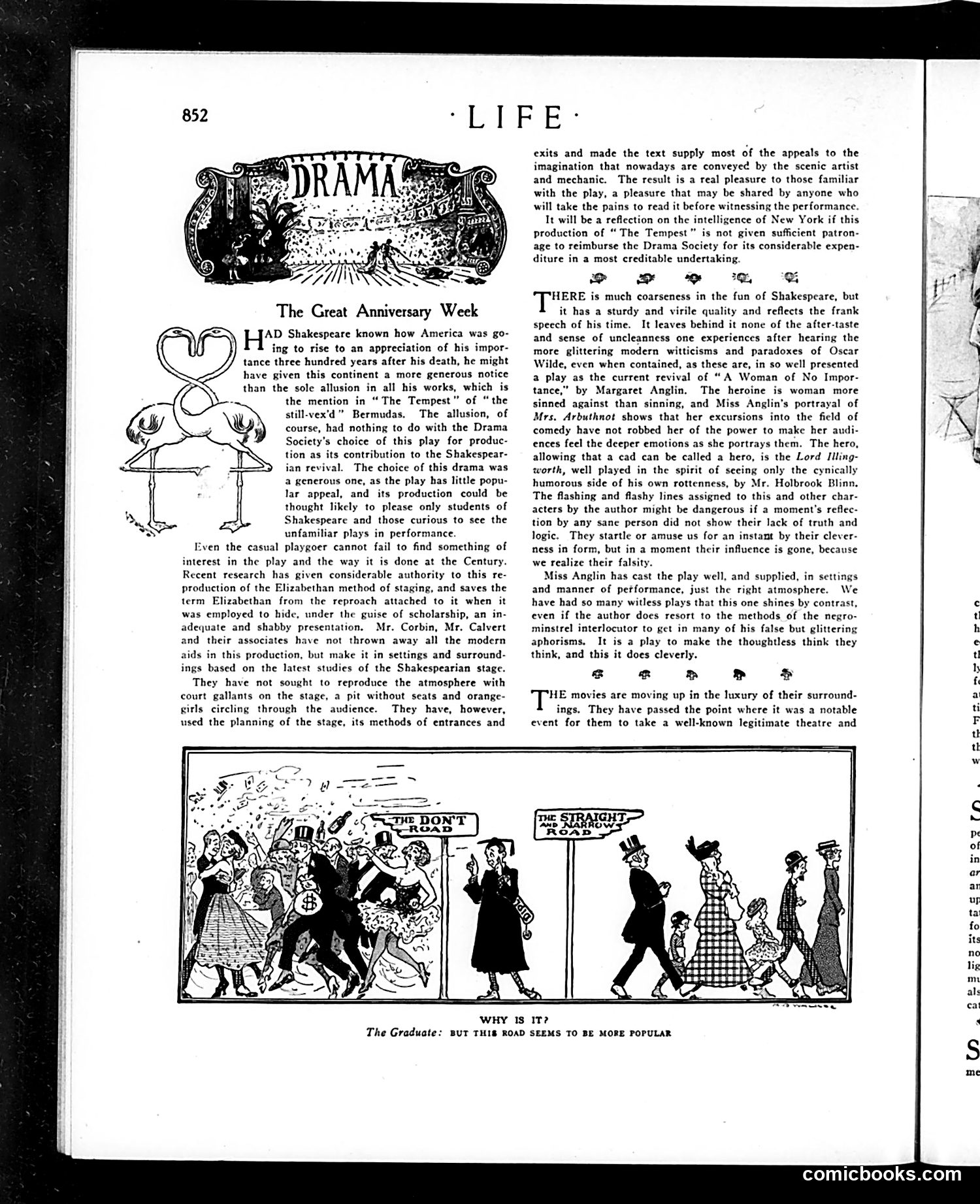
This cartoon satirizes public transportation preferences in early 20th-century America. The three panels contrast two roads: "The Don't Road" (left, crowded and chaotic with many pedestrians) versus "The Straight Road" (right, orderly and less populated). The joke's point: despite the "Straight Road" being clearly superior—safer, more organized, less congested—people inexplicably prefer the inferior "Don't Road." The caption "Why Is It?" underscores this human irrationality. This likely reflects broader social commentary about why people make poor choices when better alternatives exist, or possibly critiques how society gravitates toward sensationalism and disorder over sensible, straightforward paths. The cartoon uses visual contrast to mock human illogic and poor decision-making.
📄 Transcribed text from this page (OCR, searchable)
Machine-transcribed from the original scan — historical spelling and the odd misread are preserved.
‘LIFE: The Great Anniversary Week ‘AD Shakespeare known how America was go- ing to rise to an appreciation of his impor- tance three hundred years after his death, he might have given this continent a more generous notice than the sole allusion in all his works, which is . the mention in “The Tempest” of “the W still-vex'd "Bermudas. The allusion, of \ course, had nothing to do with the Drama Society’s choice of this play for produc- tion as its contribution to the Shakespear- ian revival. The choice of this drama was a generous one, as the play has little popu- lar appeal, and its production could be thought likely to please only students of Shakespeare and those curious to see the unfamiliar plays in performance. Even the casual playgoer cannot fail to find something of interest in the play and the way it is done at the Century. Recent research has given considerable authority to this re- production of the Elizabethan method of staging, and saves the term Elizabethan from the reproach attached to it when it was employed to hide, under the guise of scholarship, an in- adequate and shabby presentation. Mr. Corbin, Mr. Calvert and their associates have not thrown away all the modern aids in this production, but make it in settings and surround- ings based on the latest studies of the Shakespearian stage. They have not sought to reproduce the atmosphere with court gallants on the stage, a pit without seats and orange- girls circling through the audience. They have, however, used the planning of the stage, its methods of entrances and exits and made the text supply most of the appeals to the imagination that nowadays are conveyed by the scenic artist and mechanic. The result is a real pleasure to those familiar with the play, a pleasure that may be shared by anyone who will take the pains to read it before witnessing the performance. It will be a reftection on the intelligence of New York if this production of “The Tempest” is not given sufficient patron- age to reimburse the Drama Society for its considerable expen- diture in a most creditable undertaking. od o Sal a a 'HERE is much coarseness in the fun of Shakespeare, but it has a sturdy and virile quality and reflects the frank specch of his time. It leaves behind it none of the after-taste and sense of uncleanness one experiences after hearing the more glittering modern witticisms and paradoxes of Oscar Wilde, even when contained, as these are, in so well presented a play as the current revival of “A Woman of No Impor- tance,” by Margaret Anglin. The heroine is woman more sinned against than sinning, and Miss Anglin’s portrayal of Mrs. Arbuthnot shows that her excursions into the field of comedy have not robbed her of the power to make her audi ences feel the deeper emotions as she portrays them. The hero, allowing that a cad can be called a hero, is the Lord Illing- worth, well played in the spirit of seeing only the cynically humorous side of his own rottenness, by Mr. Holbrook Blinn. The flashing and flashy lines assigned to this and other char- acters by the author might be dangerous if a moment's reflec- tion by any sane person did not show their lack of truth and logic. They startle or amuse us for an instant by their clever- ness in form, but in a moment their influence is gone, because we realize their falsity. Miss Anglin has cast the play well, and supplied, in settings and manner of pefformance, just the right atmosphere. We have had so many witless plays that this one shines by contrast, even if the author does resort to the methods of the negro- minstrel interlocutor to get in many of his false but glittering aphorisms, It is a play to make the thoughtless think they think, and this it does cleverly. & R RB > 'HE movies are moving up in the luxury of their surround- ings. They have passed the point where it was a notable event for them to take a well-known legitimate theatre and WHY 18 IT? The Graduate: BUT THIS ROAD SEEMS TO BE MORE POPULAR comicbooks.com