
Life, 1916-05-04 · page 20 of 52
Life — May 4, 1916 — page 20: what you’re looking at
What you’re looking at
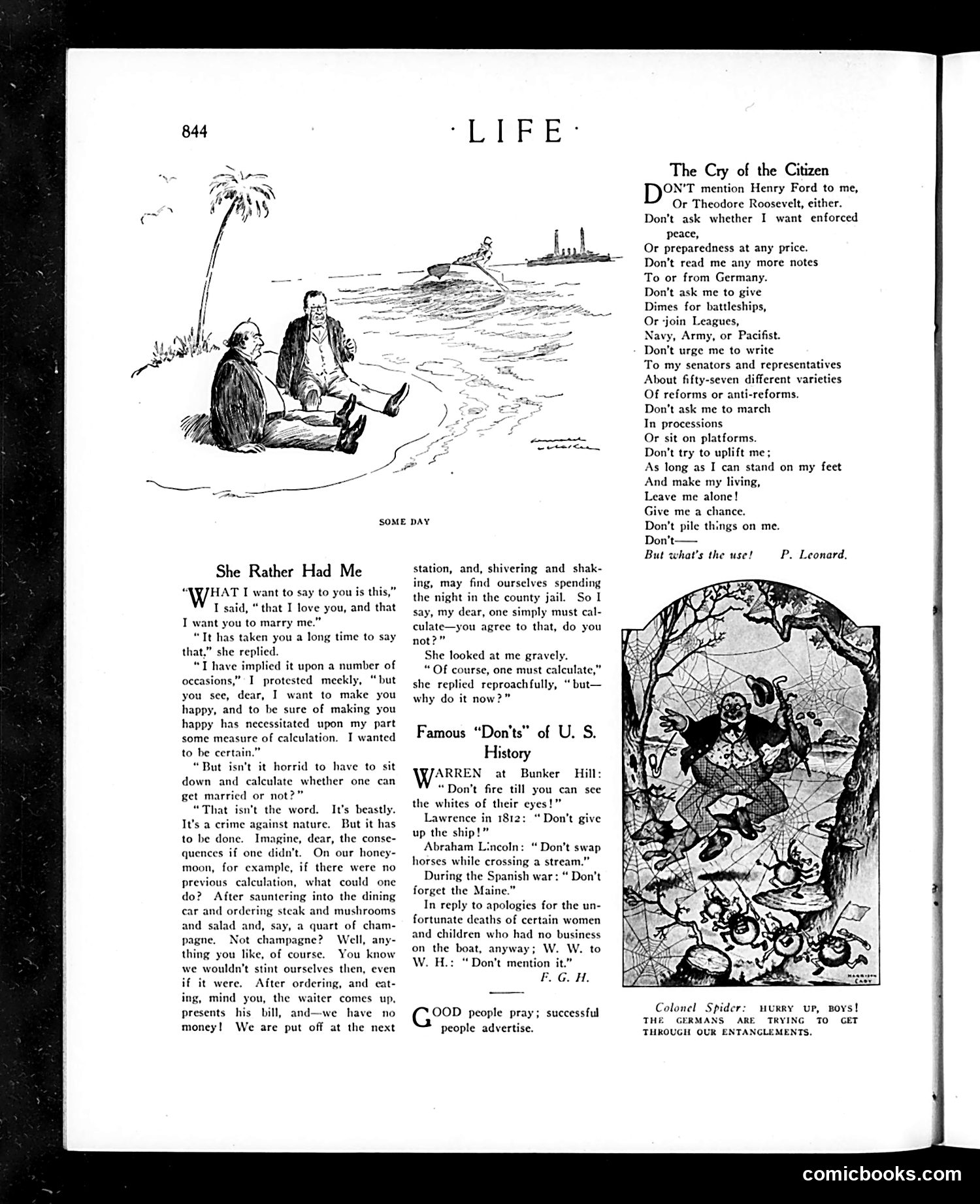
This page contains two distinct pieces of early 20th-century American satire: **"The Cry of the Citizen"** (top right) is a poem by P. Leonard expressing exhaustion with political activism. It attacks prominent figures—Henry Ford and Theodore Roosevelt—and protests being pressured to support various causes: military preparedness, German diplomatic notes, warship funding, reform movements, and public demonstrations. The speaker demands simply to work and be left alone, capturing widespread American fatigue with Progressive Era activism and foreign policy debates (likely pre-WWI). **"She Rather Had Me"** (left) is a humorous story about a man who delayed proposing due to "calculation" of financial consequences. The woman finds this unromantic, though she admits practical planning is necessary—satirizing how even love requires bourgeois financial consideration. **"Famous 'Don'ts' of U.S. History"** (right column) lists historical military/political commands alongside Colonel Snider's WWI reference about Germans trying to penetrate American "entanglements"—likely referencing isolationist concerns about U.S. involvement in World War I.
📄 Transcribed text from this page (OCR, searchable)
Machine-transcribed from the original scan — historical spelling and the odd misread are preserved.
The Cry of the Citizen ON’T mention Henry Ford to me, Or Theodore Roosevelt, either. Don’t ask whether I want enforced peace, Or preparedness at any price. Don’t read me any more notes To or from Germany. Don’t ask me to give Dimes for battleships, Or ‘join Leagues, Navy, Army, or Pacifist. Don't urge me to write To my senators and representatives About fifty-seven different varieties Of reforms or anti-reforms. Don't ask me to march In processions Or sit on platforms. Don’t try to uplift me; As long as I can stand on my feet And make my living, Leave me alone! Give me a chance. Don’t pile things on me. Don't: But what's the use! P. Leonard. SOME DAY She Rather Had Me station, and, shivering and. shak- ing, may find ourselves spending the night in the county jail. So I say, my dear, one simply must cal- T want you to marry me. culate—you agree to that, do you “Tt has taken you a long time to say poe?” that,” she replied. She looked at me gravely. “Thave implied it upon a number of OF course, one must calculat occasions,” I protested meekly, “but she replied reproachfully, “but-— you see, dear, I want to make you happy, and to be sure of making you happy has necessitated upon my part a ‘eee some measure of calculation. Twanted Famous “Don'ts” of U. S. History to be certain.” “But isn’t i id have to sit 7 . But isn’t it horrid to hav ARREN at Bunker Hill: down and calculate whether one can i , Don't fire till you can see the whites of their eyes!” get married or not?” “That isn’t the word. It’s beastly. ‘ x ¥- “Lawrence in 1812: “Don't give up the ship!” It's a crime against nature. But it has to be done. Imagine, dear, the conse- . Abraham Lincoln: “ Don’t swap horses while crossing a stream.” quences if one didn’t. On our honey- moon, for example, if there were no 5 fam" previous calculation, what could one, Durie the Sean war: “Don’t do? After sauntering into the dining 'OFS8et the Maine.” In reply to apologies for the un- fortunate deaths of certain women car and ordering steak and mushrooms Well, any. 284 children who had no business and salad and, s quart of cham- on the boat, anyway; W. W. to pagne, Not champagne? thing you like, of course. You know ; ey W. H.: “Don't mention it.” F.G.H. “VY/HAT I want to say to you is thi I said, “ that I love you, and that why do it now?” we wouldn't stint ourselves then, even if it were. After ordering, and eat- ing, mind you, the waiter comes up, ‘ - presents his bill, and—we have no (OOD people pray; successful Colonel Sbider:, MUMRY itr, ‘sovs] . THE GERMAN ARE TRY! TO GET money! We are put off at the next people advertise. THROUGH OUR ENTANGLEMENTS. comicbooks.com