
Life, 1916-05-04 · page 39 of 52
Life — May 4, 1916 — page 39: what you’re looking at
What you’re looking at
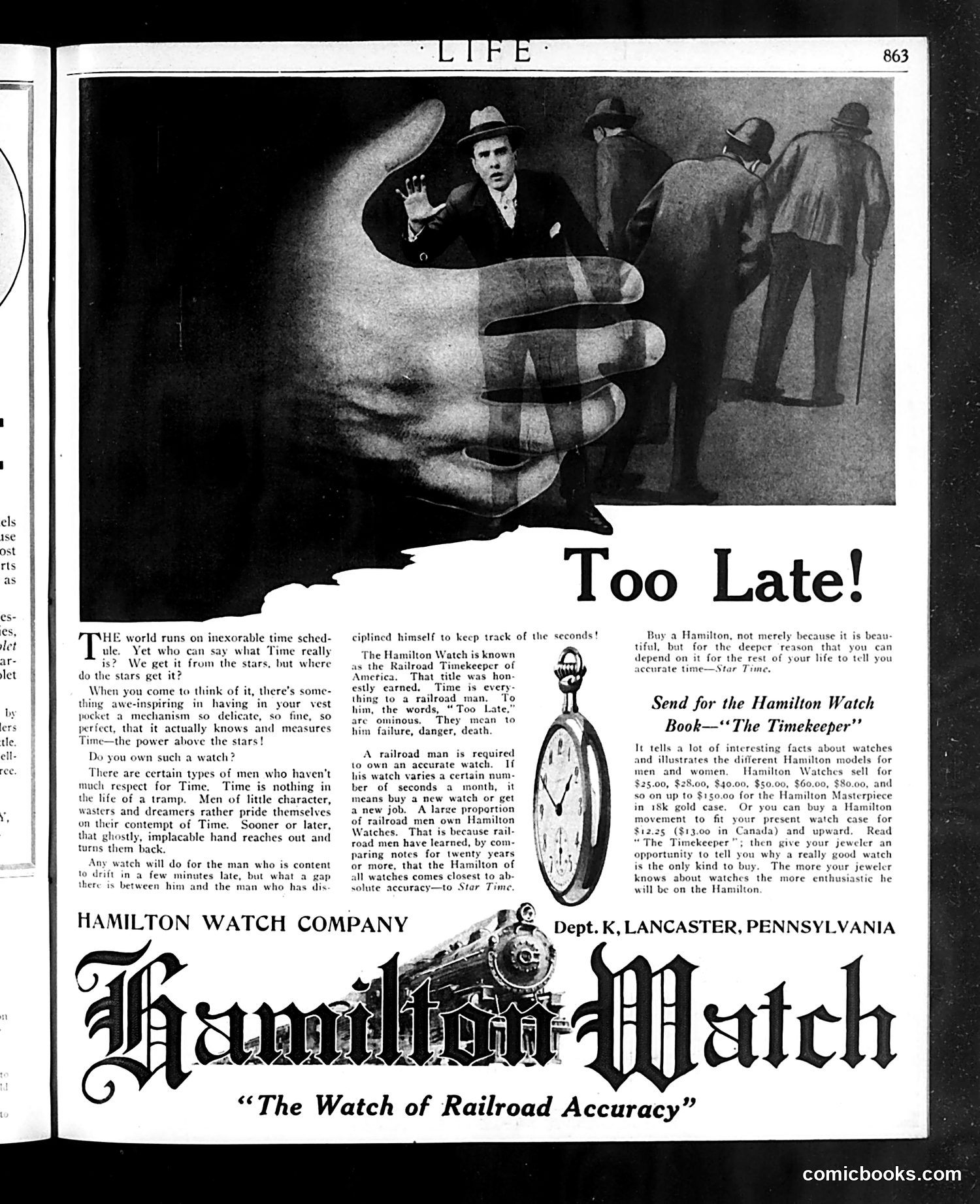
This is primarily a **product advertisement**, not political satire. The "Too Late!" headline uses dramatic imagery—a large face with an accusatory hand gesture and silhouettes of men in the background—to convey moral messaging about timekeeping. The ad contrasts two character types: those who lack "respect for Time" (described as tramps and "men of little character") versus disciplined individuals who keep precise time. This reflects early-20th-century values equating punctuality with moral virtue and success. The pitch targets **railroad workers specifically**, positioning Hamilton Watches as "The Railroad Timekeeper of America." Railroads required extreme accuracy; missing schedule deadlines meant "failure, danger, death." The ad leverages this professional requirement to sell luxury watches to working men by appealing to both practical need and aspirational status—suggesting a quality watch signals character and reliability. The moralizing tone about time as a force of judgment ("that ghostly, implacable hand") is typical period advertising rhetoric linking consumer goods to personal worth.
📄 Transcribed text from this page (OCR, searchable)
Machine-transcribed from the original scan — historical spelling and the odd misread are preserved.
= world runs on inexorable time sched- ule. Yet who can say what Time really is? We get it from the stars, but where do the stars get it? When you come to think of it, there’s some- thing awe-inspiring in having in your vest pocket mechanism so delicate, so fine, so perfect, that it actually knows and measures Time—the power above the stars! Do you own such a watch? There are certain types of men who haven't much respect for Time. Time is nothing in the life of a tramp. Men of little character, wasters and dreamers rather pride themselves on their contempt of Time. Sooner or later, that ghostly, implacable hand reaches out and turns them back. Any watch will do for the man who is content to drift in a few minutes late, but what a gap re is between him and the man who has dis Too Late! ciplined himself to keep track of the seconds! ‘The Hamilton Watch is known as the Railroad Timekeeper of Ametica, That title was hon- estly earned. Time is every- thing to a railroad man. To him, the words, “Too Late,” are ominous, They mean to him failure, danger, death. A railroad man is required to own an accurate watch. If his watch varies a certain num- ber of seconds a month, it means buy a new watch or get a new job. A large proportion of railroad men own Hamilton Watches. That is because rail- road men have learned, by com- paring notes for twenty years or more, that the Hamilton of all watches comes closest to ab. solute accuracy—to Star Time, MILTON WATCH COMPANY “The Watch of Railroad Accuracy” Buy a Hamilton, not merely because it is be: tiful, but for the deeper reason that you can depend on it for the rest of your life to tell you accurate time—Star Time. Send for the Hamilton Watch Book—‘‘The Timekeeper”’ It tells a lot of interesting fa bout watches and illustrates the different Hamilton models for men and women. Hamilton Watches sell for so on up to for the Hamilton Masterpiece in 18k gold case. Or you can buy a Hamilton movement to fit your present watch case for $12.25 ($13.00 in Canada) and upward. Read The Timekeeper"; then give your jeweler an opportunity to tell you why a really good watch is the only kind to buy. The more your jeweler knows about watches the more enthusiastic he will be on the Hamilton. atch comicbooks.com