
Life, 1916-05-04 · page 31 of 52
Life — May 4, 1916 — page 31: what you’re looking at
What you’re looking at
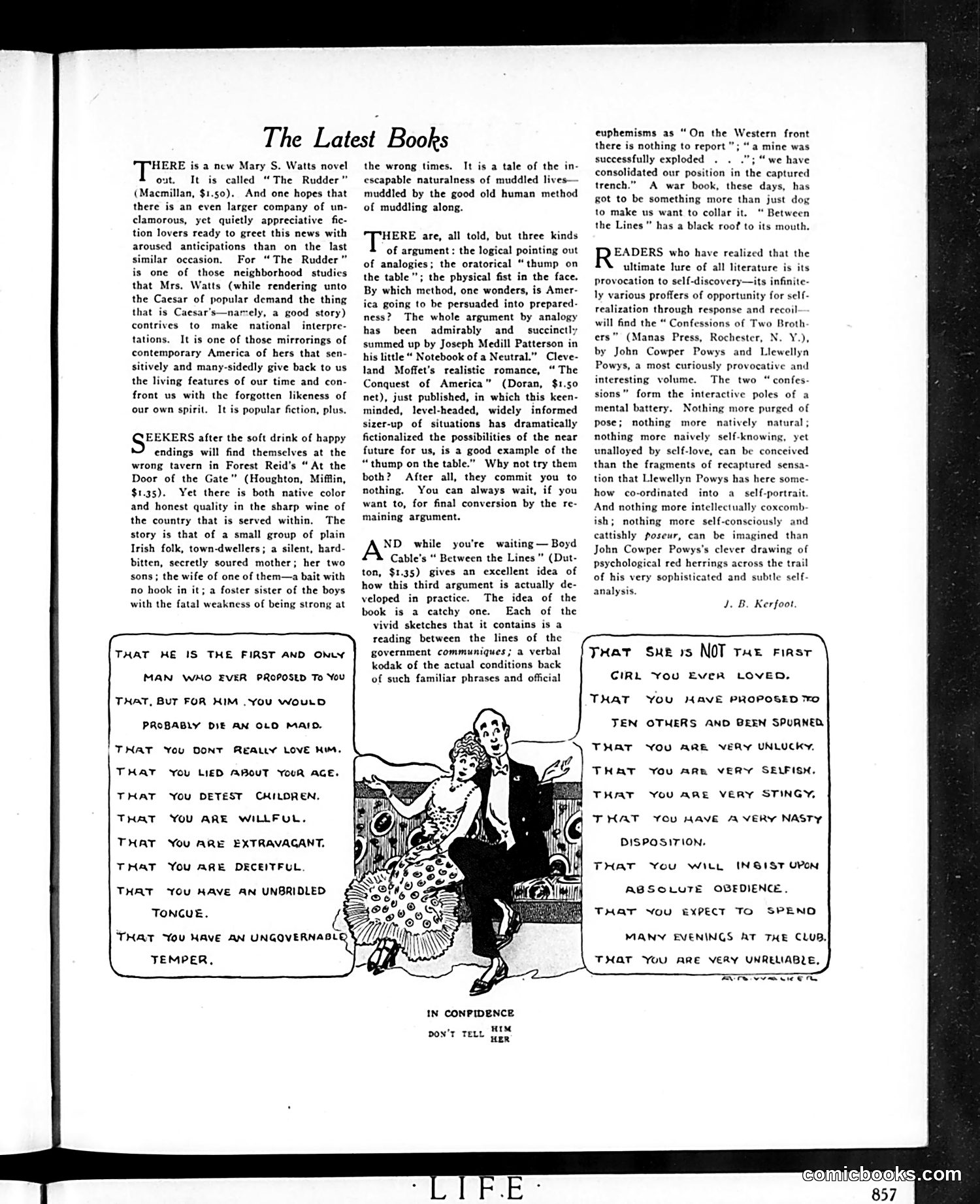
This page combines book reviews with a humorous cartoon about marriage proposals. The cartoon depicts a couple in conversation, with the man listing reasons why the woman should marry him—all insulting accusations (she's unlucky, selfish, stingy, unreliable, etc.). The woman responds with her own damning list about him (he's the "first and only" to propose her, she doesn't really love him, she lied about her age). The satire mocks the desperation of unmarried women in this era: the man essentially says "marry me or die an old maid"—suggesting marriage on any terms was preferable to spinsterhood. The cartoon skewers both genders: his pathetic willingness to marry someone he clearly despises, and her acceptance of such a terrible proposal simply to avoid the social stigma of remaining single. The page's book reviews discuss contemporary American fiction (Mary S. Watts, Forest Reid) alongside commentary on American "preparedness" for World War I.
📄 Transcribed text from this page (OCR, searchable)
Machine-transcribed from the original scan — historical spelling and the odd misread are preserved.
The Latest Books 'HERE is a new Mary S. Watts novel out. It is called “The Rudder” (Macmillan, $1.50). And one hopes that there is an even larger company of un- clamorous, yet quietly appreciative fic- tion lovers ready to greet this news with aroused anticipations than on the last similar occasion. For “The Rudder” is one of those neighborhood studies that Mrs. Watts (while rendering unto the Caesar of popular demand the thing that is Caesar’s—narely, a good story) contrives to make national interpre- tations. It is one of those mirrorings of contemporary America of hers that sen- sitively and many-sidedly give back to us the living features of our time and con- front us with the forgotten likeness of our own spirit. It is popular fiction, plus. EEKERS after the soft drink of happy endings will find themselves at the wrong tavern in Forest Reid's “At the Door of the Gate” (Houghton, Mifflin, $1.35). Yet there is both native color and honest quality in the sharp wine of the country that is served within. The story is that of a small group of plain Irish folk, town-dwellers; a silent, hard- bitten, secretly soured mother; her two sons; the wife of one of them—a bait with no hook in it; a foster sister of the boys with the fatal weakness of being strong at THAT HE IS THE FIRST AND ONLY MAN WHO EVER PROPOSED To You THAT, BUT FOR HIM You WouLDd PROBABLY DIE AN OLO MAID. THAT ‘You DONT REALLY LOVE HM. THAT ‘You LIED ABOUT YOUR Ace. THAT ‘You DETEST CHILDREN. THAT YOU ARE WILLFUL. THAT You ARE EXTRAVAGANT. THAT You ARE DECEITFUL. THRT YOU HAVE AN UNBRIDLED TONGUE. TEMPER, the wrong times. It is a tale of the in- escapable naturalness of muddled lives— muddled by the good old human method of muddling along. 'HERE are, all told, but three kinds of argument: the logical pointing out of analogies; the oratorical “thump on the table; the physical fist in the face. By which method, one wonders, is Amer- ica going to be persuaded into prepared- ness? The whole argument by analogy has been admirably and succinctly summed up by Joseph Medill Patterson in his little “ Notebook of a Neutral.” Cleve- land Moffet's realistic romance, “ The Conquest of America” (Doran, $1.50 net), just published, in which this keen- minded, level-headed, widely informed sizer-up of situations has dramatically fictionalized the possibilities of the near future for us, is a good example of the “thump on the table.” Why not try them both? After all, they commit you to nothing. You can always wait, if you want to, for final conversion by the re- maining argument. ND while you're waiting — Boyd Cable's “* Between the Lines” (Dut- ton, $1.35) gives an excellent idea of how this third argument is actually de- veloped in practice. The idea of the book is a catchy one. Each of the vivid sketches that it contains is a reading between the lines of the government communiques; a verbal kodak of the actual conditions back of such familiar phrases and official IN CONPIDENCE HIM DON'T TELL fee euphemisms as “On the Western front there is nothing to report"; “a mine was successfully exploded we have consolidated our position in the captured trench.” A war book, these days, has got to be something more than just dog to make us want to collar it. “ Between the Lines" has a black roof to its mouth. EADERS who have realized that the ultimate lure of all literature is its Provocation to self-discovery—its infinite- ly various proffers of opportunity for self- realization through response and recoil: will find the “ Confessions of Two Broth ers” (Manas Press, Rochester, N. Y.), by John Cowper Powys and Llewellyn Powys, a most curiously provocative and interesting volume. The two “ confes. sions” form the interactive poles of a mental battery. Nothing more purged of pose; nothing more natively natural; nothing more naively self-knowing, yet unalloyed by self-love, can be conceived than the fragments of recaptured sensa- tion that Llewellyn Powys has here some- how co-ordinated into a self-portrait. And nothing more intellectually coxcomb: ish; nothing more self-consciously and cattishly poseur, can be imagined than John Cowper Powys’s clever drawing of psychological red herrings across the trail of his very sophisticated and subtle self. analysis. J. B. Kerfoot. THat sueos NOT rae rirsr CIRL You EveR LOVED. THAT ‘YOU HAVE PROPOSED ro JEN OTHERS AND BEEN SPURNED THAT vou ARE VERY UNLUCKY. THAT You ARR VERY SELFISH, THAT You ARE VERY STINGY, THAT You HAVE AVERY NASTY DISPOSITION. THAT You Witt INSIST UPON ABSOLUTE OBEDIENCE. THAT You EXPECT TO SPENO MANY EVENINGS AT THE CLUB, THOT YoU ARE VERY UNRELIABLE,