
Life, 1916-05-04 · page 24 of 52
Life — May 4, 1916 — page 24: what you’re looking at
What you’re looking at
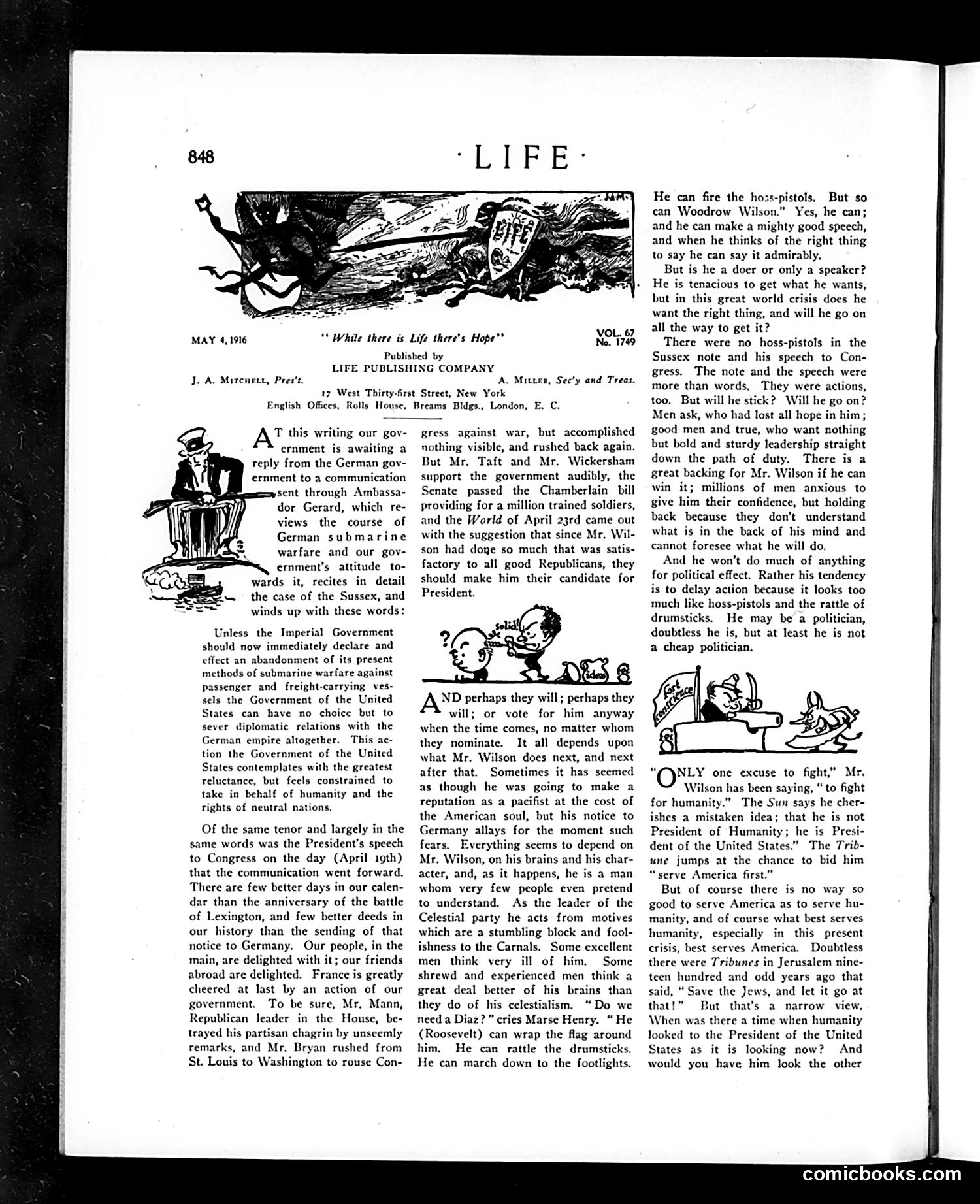
This page discusses President Woodrow Wilson's firm diplomatic note to Germany regarding submarine warfare, specifically the Sussex incident. The U.S. threatens to sever relations unless Germany abandons attacking passenger vessels. The satire questions Wilson's character and resolve. References to "Marse Henry" (likely Henry Watterson, a Kentucky editor) and Theodore Roosevelt contrast Wilson's diplomatic approach with Roosevelt's more aggressive, theatrical style—mocking Roosevelt's ability to "wrap the flag around him" and "rattle the drumsticks." The cartoons appear to satirize political uncertainty: whether Wilson will maintain his tough stance or revert to pacifism, and whether Republicans might support him despite partisan divisions. The text suggests Wilson's actions depend on his "brains and his character"—qualities the author finds enigmatic. Bryan's opposition to war measures is noted, as is Republican Mann's partisan complaints. The overall tone questions whether Wilson's words will translate into decisive action.
📄 Transcribed text from this page (OCR, searchable)
Machine-transcribed from the original scan — historical spelling and the odd misread are preserved.
MAY 4,1916 ‘* While there is Life there's Hope" No, 1749 Published by LIFE PUBLISHING COMPANY J. A. Mitcnett, Pres’t. A. Mutter, Sec’y ond Treas. 17 West Thirty-first Street, New York English Offices, Rolls House, Breams Bldgs., London, E. C. T this writing our gov- ernment is awaiting a reply from the German gov- ernment to a communication c= sent through Ambassa- dor Gerard, which re- views the course of German submarine warfare and our gov- ernment’s attitude to- wards it, recites in detail the case of the Sussex, and winds up with these words: Unless the Imperial Government should now immediately declare and effect an abandonment of its present methods of submarine warfare against passenger and freight-carrying ves- sels the Government of the United States can have no choice but to sever diplomatic relations with the German empire altogether. This ac- tion the Government of the United States contemplates with the greatest reluctance, but feels constrained to take in behalf of humanity and the rights of neutral nations. Of the same tenor and largely in the same words was the President's speech to Congress on the day (April 19th) that the communication went forward. There are few better days in our calen- dar than the anniversary of the battle of Lexington, and few better deeds in our history than the sending of that notice to Germany. Our people, in the main, are delighted with it; our friends abroad are delighted. France is greatly cheered at last by an action of our government. To be sure, Mr. Mann, Republican leader in the House, be- trayed his partisan chagrin by unseemly remarks, and Mr. Bryan rushed from St. Louis to Washington to rouse Con- gress against war, but accomplished nothing visible, and rushed back again. But Mr. Taft and Mr. Wickersham support the government audibly, the Senate passed the Chamberlain bill providing for a million trained soldiers, and the World of April 23rd came out with the suggestion that since Mr. Wil- son had doye so much that was satis- factory to all good Republicans, they should make him their candidate for President. A D perhaps they will ; perhaps they will; or vote for him anyway when the time comes, no matter whom they nominate. It all depends upon what Mr. Wilson does next, and next after that. Sometimes it has seemed as though he was going to make a reputation as a pacifist at the cost of the American soul, but his notice to Germany allays for the moment such fears, Everything seems to depend on Mr. Wilson, on his brains and his char- acter, and, as it happens, he is a man whom very few people even pretend to understand. As the leader of the Celestial party he acts from motives which are a stumbling block and fool- ishness to the Carnals. Some excellent men think very ill of him. Some shrewd and experienced men think a great deal better of his brains than they do of his celestialism. “Do we need a Diaz?” cries Marse Henry. “He (Roosevelt) can wrap the flag around him. He can rattle the drumsticks. He can march down to the footlights. He can fire the hoss-pistols. But so can Woodrow Wilson.” Yes, he can; and he can make a mighty good speech, and when he thinks of the right thing to say he can say it admirably. But is he a doer or only a speaker? He is tenacious to get what he wants, but in this great world crisis does he want the right thing, and will he go on all the way to get it? There were no hoss-pistols in the Sussex note and his speech to Con- gress. The note and the speech were more than words, They were actions, too. But will he stick? Will he go on? Men ask, who had lost all hope in him; good men and true, who want nothing but bold and sturdy leadership straight down the path of duty. There is a great backing for Mr. Wilson if he can win it; millions of men anxious to give him their confidence, but holding back because they don’t understand what is in the back of his mind and cannot foresee what he will do. And he won't do much of anything for political effect. Rather his tendency is to delay action because it looks too much like hoss-pistols and the rattle of drumsticks. He may be a politician, doubtless he is, but at least he is not a cheap politician. “CYNLY one excuse to fight,” Mr. Wilson has been saying, “to fight for humanity.” The Sun says he cher- ishes a mistaken idea; that he is not President of Humanity; he is Pri dent of the United State: une jumps at the chance to bid him “serve America first.” But of course there is no way so good to serve America as to serve hu- manity, and of course what best serves humanity, especially in this present crisis, best serves America. Doubtless there were Tribunes in Jerusalem nine- teen hundred and odd years ago that said, “Save the Jews, and let it go at that! But that’s a narrow view. When was there a time when humanity looked to the President of the United States as it is looking now? And would you have him look the other comicbooks.com