
Life, 1916-05-04 · page 41 of 52
Life — May 4, 1916 — page 41: what you’re looking at
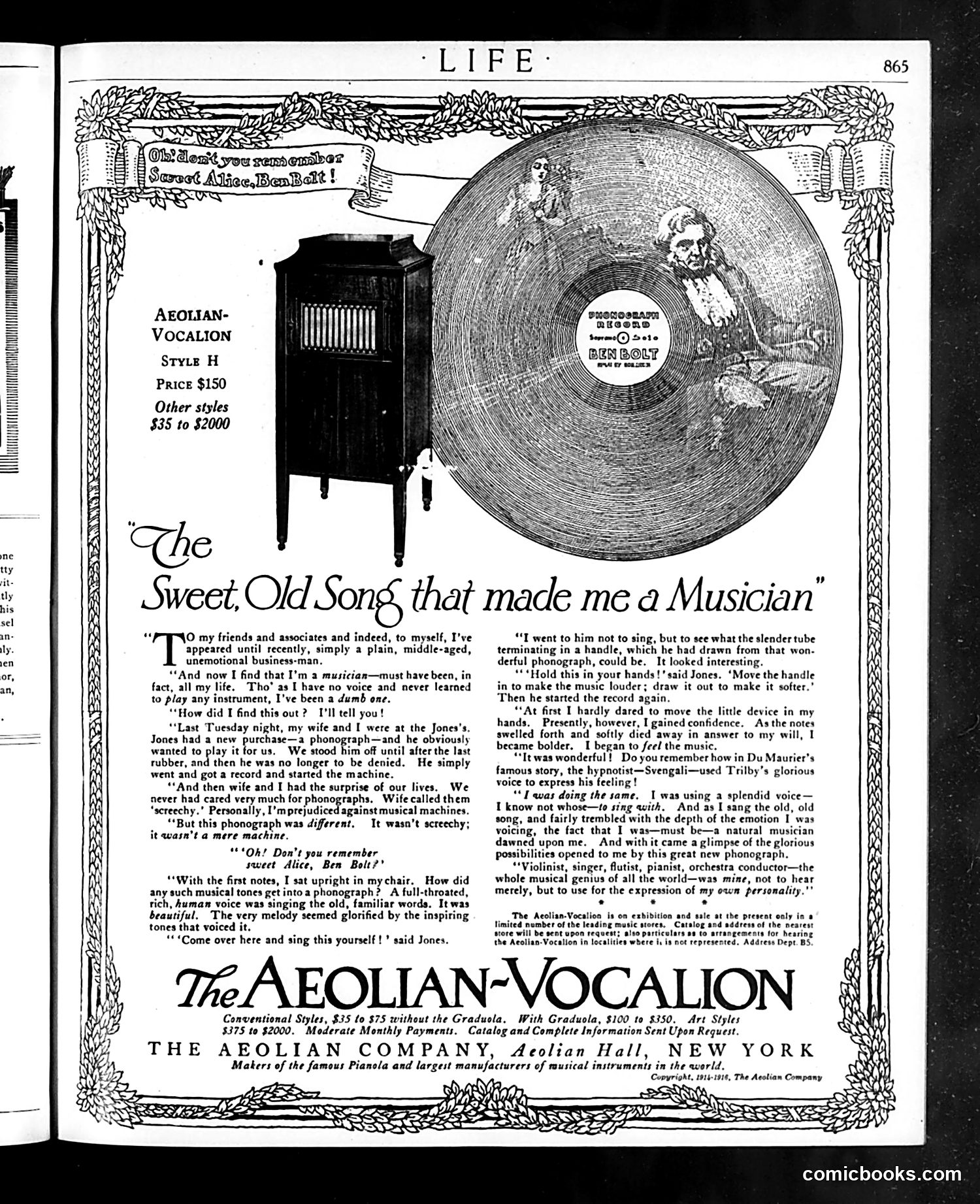
What you’re looking at
This is primarily a **phonograph advertisement** disguised as editorial content in *Life* magazine (circa 1914-1918, based on copyright). The narrative describes a middle-aged businessman who discovers he's "really" a musician when using an Aeolian-Vocalion phonograph. By manipulating the device's volume control (the "handle"), he can subtly influence playback, making him feel he's personally performing famous songs like "Sweet Alice, Ben Bolt." **The satire's appeal:** The ad exploits vanity and fantasies of hidden talent. The joke is that ordinary people could feel musically accomplished without actual skill—simply by controlling a machine's volume knob. References to Svengali (the hypnotist from *Trilby*) suggest the phonograph can manipulate emotion and create illusions of personal artistry. This reflects early 20th-century anxieties about mass-produced entertainment replacing authentic human performance, while simultaneously marketing that technology to aspirational consumers who wanted to feel cultured.
📄 Transcribed text from this page (OCR, searchable)
Machine-transcribed from the original scan — historical spelling and the odd misread are preserved.
865 CY ir ey y {2 << AEOLIAN- VOCALION Styte H Price $150 Other styles $35 to $2000 <= SEES ASM a ORS a Che Se Sweet, Old Song, that made me a Musician” “Ws “ O my friends and associates and indeed, to myself, I've appeared until recently, simply a plain, middle-aged, unemotional business-man. “And now I find that I’m a musician—must have been, in fact, all my life. Tho’ as I have no voice and never learned to play any instrument, I've been a dumb one. “*How did I find this out? I'll tell you! “Last Tuesday night, my wife and I were at the Jones's, Jones had a new purchase—a phonograph—and he obviously wanted to play it for us. We stood Fim off until after the last rubber, and thea he was tie longer to be denied. He simply went and got a record and started the machine. “And then wife and I had the surprise of our lives. We never had cared very much for phonographs. Wife called them “screechy.’ Personally, I’mprejudiced against musical machines. “But this phonograph was different. It wasn’t screechy; it wasn't a mere machine. “Oh! Don’t you remember sweet dlice, Ben Bolt?* “T went to him not to sing, but to see what the slender tube terminating in a handle, which he had drawn from that won- derful phonograph, could be. It looked interesting. ***Hold this in your hands!’ said Jones. ‘Move the handle in to make the music louder; draw it out to make it softer.’ ‘Then he started the record again. “At first I hardly dared to move the little device in my hands. Presently, however, I gained confidence. As the notes swelled forth and softly died away in answer to my will, I became bolder. I began to feel the music. “It was wonderful! Do you remember how in Du Maurier’s famous story, the hypnotist—Svengali—used Trilby’s glorious voice to express his feeling! “Twas doing the same. I was using a splendid voice— I know not whose—to sing with. And as I sang the old, old song, and fairly trembled with the depth of the emotion I was voicing, the fact that I was—must be—a natural musician dawned upon me. And with it came a glimpse of the glorious possibilities opened to me by this great new phonograph. “Violinist, singer, flutist, pianist, orchestra conductor—the SSS SS MoM: = whole musical genius of all the world—was mine, not to hear “With the first notes, I sat upright in my chair. How did r merely, but to use for the expression of my own personality.'" * * * any such musical tones get intoa phonograph? A full-throated, rich, Auman voice was singing the old, familiar words. It was beautiful. The very melody seemed glorified by the inspiring tones that voiced it. “¢Come over here and sing this yourself!’ said Jones. le at the present only ino ress of the nearest gemenis for hearing d. Address Dept. BS, The I\AEOLIAN-VOCALION Conventional Styles, $35 to $75 without the Graduela. With Graduola, $100 to $350. Art Styles $375 to $2000. Moderate Monthly Payments. Catalog and Complete Information Sent Upon Request. THE AEOLIAN COMPANY, Aeolian Hall, NEW YORK Maters of the famous Pianola and largest manufacturers of rausical instruments in the world. Copyright, 1914-1918, The Acotian Company gee SANK 4 TT TE ¢ 2, +4 PER SES Oe See os ae BOS een Se The Acolian-Vocalion is on exbidition and limited number of the le: i sore will be sent upon req: the Aeolian-Vocalion in loc IS AS comicbooks.com