
A complete issue · 52 pages · 1916
Life — April 20, 1916
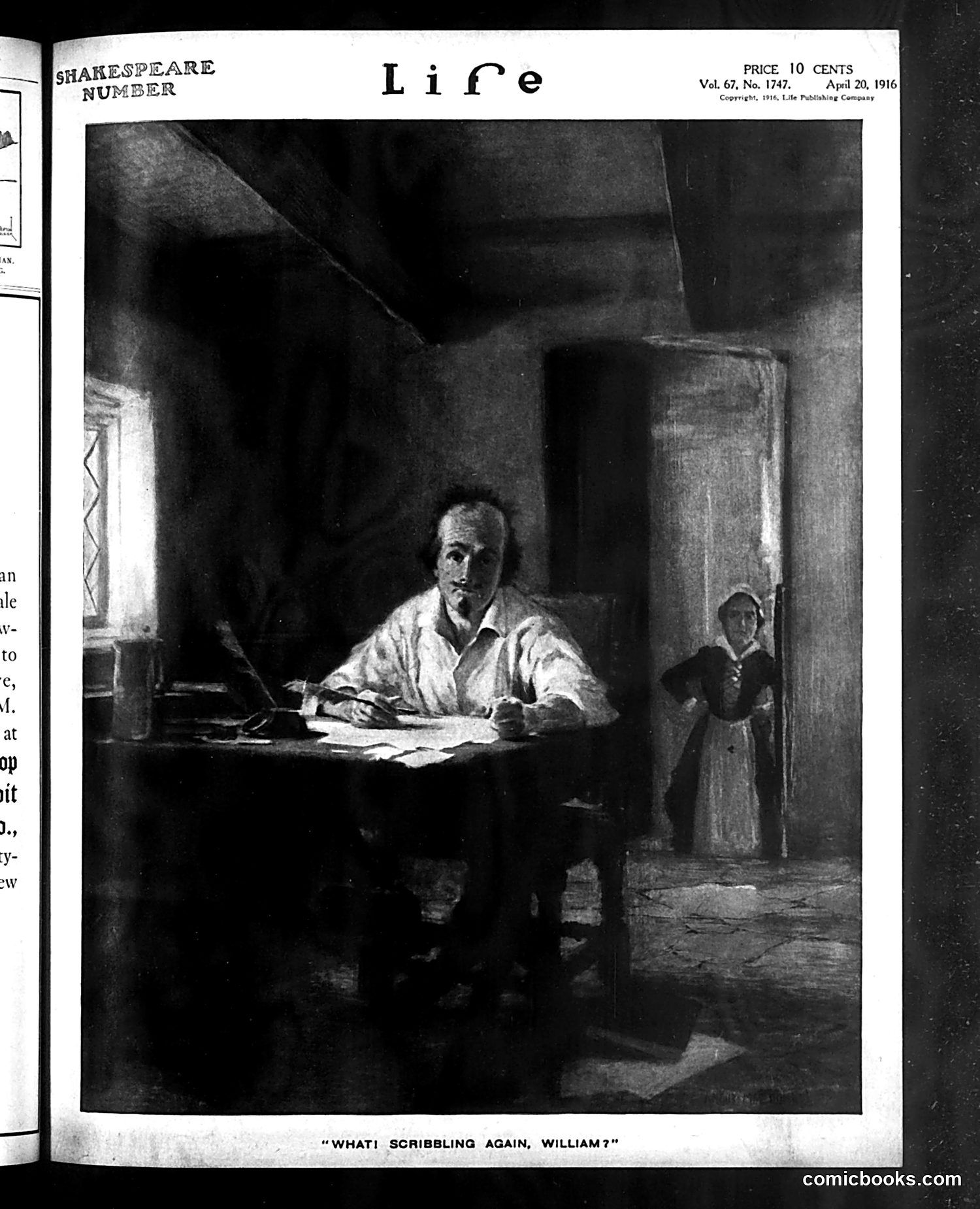
**Publication Details:** Life magazine, Vol. 67, No. 1747, April 20, 1916. Price: 10 cents. **Image Content:** The photograph shows a man seated at a desk writing or drawing, with a young child standing in a doorway behind him. The caption reads: "What! Scribbling again, William?" **Likely Meaning:** This appears to be a commentary on prolific creative output or compulsive writing/drawing habits, presenting it as almost obsessive behavior. The caption's exasperated tone—"again"—suggests criticism of constant productivity. **Historical Context:** Without additional text or identification, the specific identity of "William" remains unclear. Given the 1916 date and Life's Shakespeare-themed issue designation, this may reference a contemporary author, illustrator, or public figure known for excessive output, though the exact reference cannot be confirmed from this image alone.
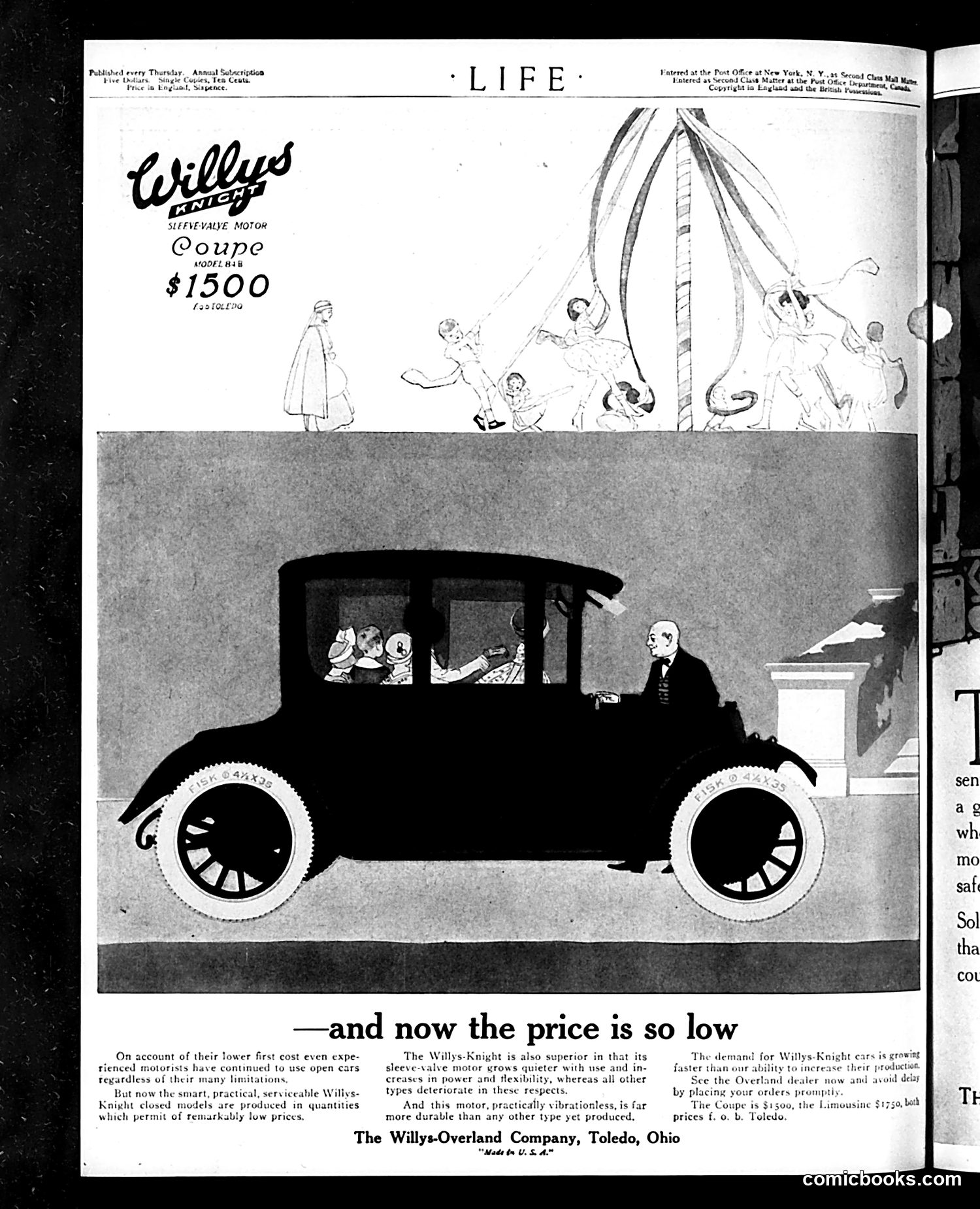
This page is primarily a **car advertisement** for the Willys-Knight Coupe ($1500), not political satire. The top illustration shows children playing with an enormous parachute or parasol—likely depicting carefree leisure, a common advertising motif of the era suggesting the car enables family recreation. The lower silhouette shows a well-dressed man and family in the automobile, emphasizing respectability and comfort. The advertising copy emphasizes the Willys-Knight's **sleeve-valve motor** technology—quieter and more reliable than competitors' engines. The phrase "and now the price is so low" highlights affordability despite quality, addressing consumers concerned about economy during the post-WWI period. This is commercial messaging, not editorial commentary.
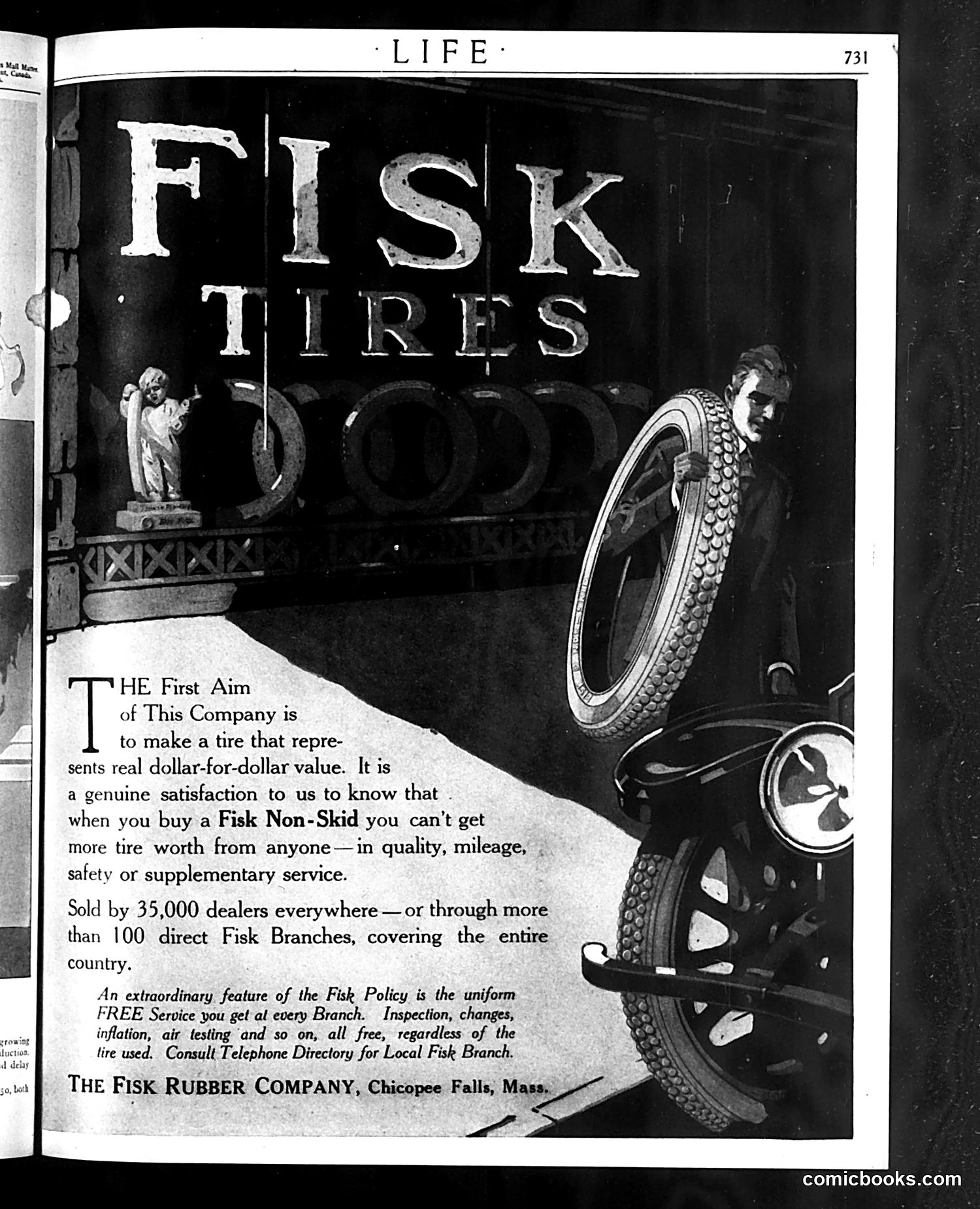
This is a **straightforward advertisement**, not satirical content. The Fisk Rubber Company is promoting its "Non-Skid" automobile tires in this Life magazine page (page 731). The ad features: - Large "FISK TIRES" text with decorative tire imagery - A classical cherub statue (the Fisk company mascot) - Display of actual tire products - Marketing claims about "real dollar-for-dollar value" The appeal emphasizes practical benefits: quality, mileage, safety, and nationwide distribution through 35,000 dealers plus 100+ direct branches. A notable feature highlighted is "FREE Service" at Fisk branches—inspection, changes, inflation, air testing—regardless of tire origin. This represents early-20th-century automotive commerce when tire quality was a significant consumer concern. The classical imagery conveyed prestige and reliability to period readers.
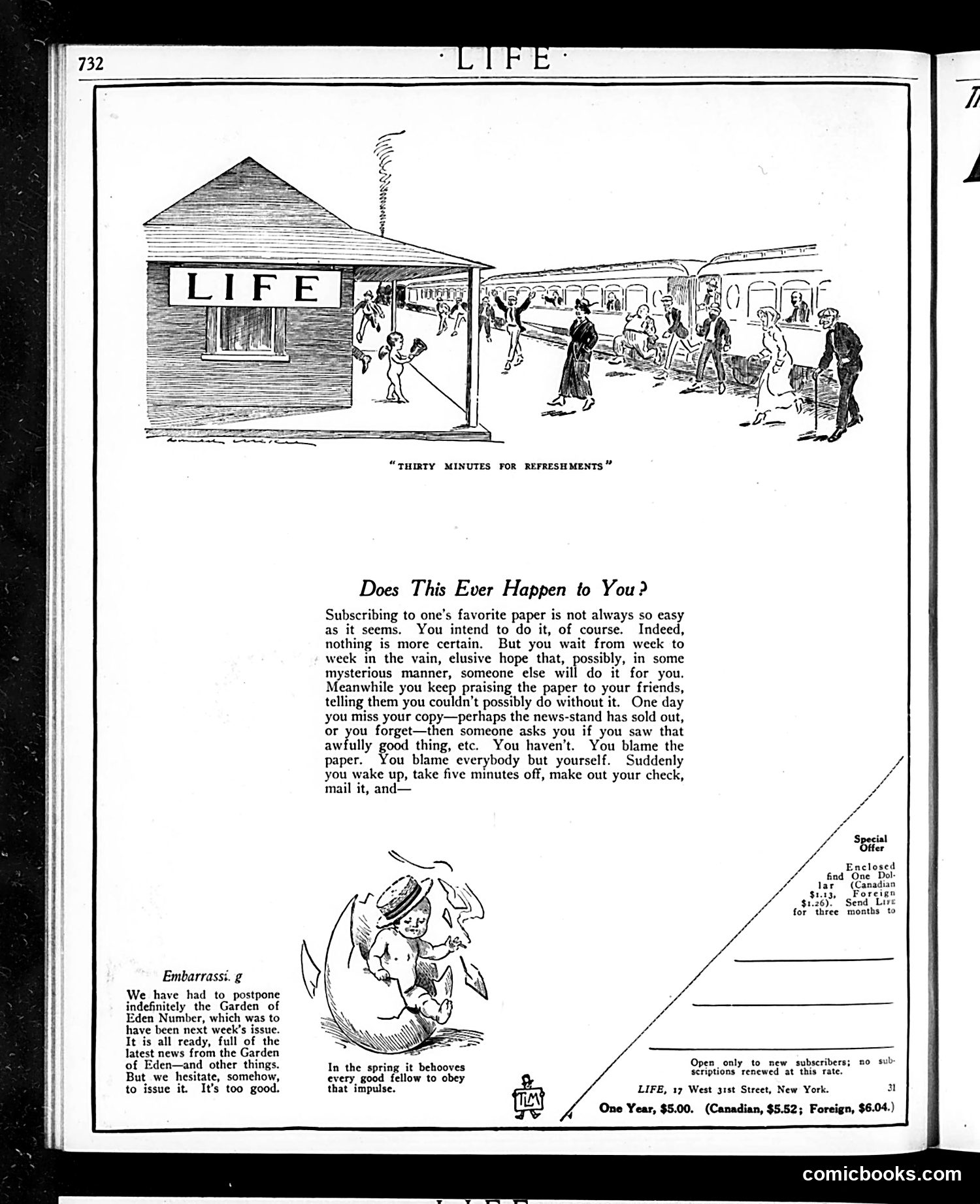
This page contains two elements: 1. **Top cartoon "Thirty Minutes for Refreshments"**: Shows a railway station kiosk labeled "LIFE" with passengers boarding a train. It's advertising the magazine as convenient reading material during travel stops—a common sales pitch when train travel was standard. 2. **Main article "Does This Ever Happen to You?"**: A relatable humor piece about newspaper subscription procrastination. The text describes someone intending to subscribe but repeatedly delaying, then being embarrassed when asked if they've seen a particular article. The illustrated figure (appearing flustered or guilty) reinforces the comedic awkwardness of the situation. The "Embarrassing" note at bottom references a postponed Eden Number issue. This reflects early-20th-century magazine marketing and social etiquette around reading subscriptions.
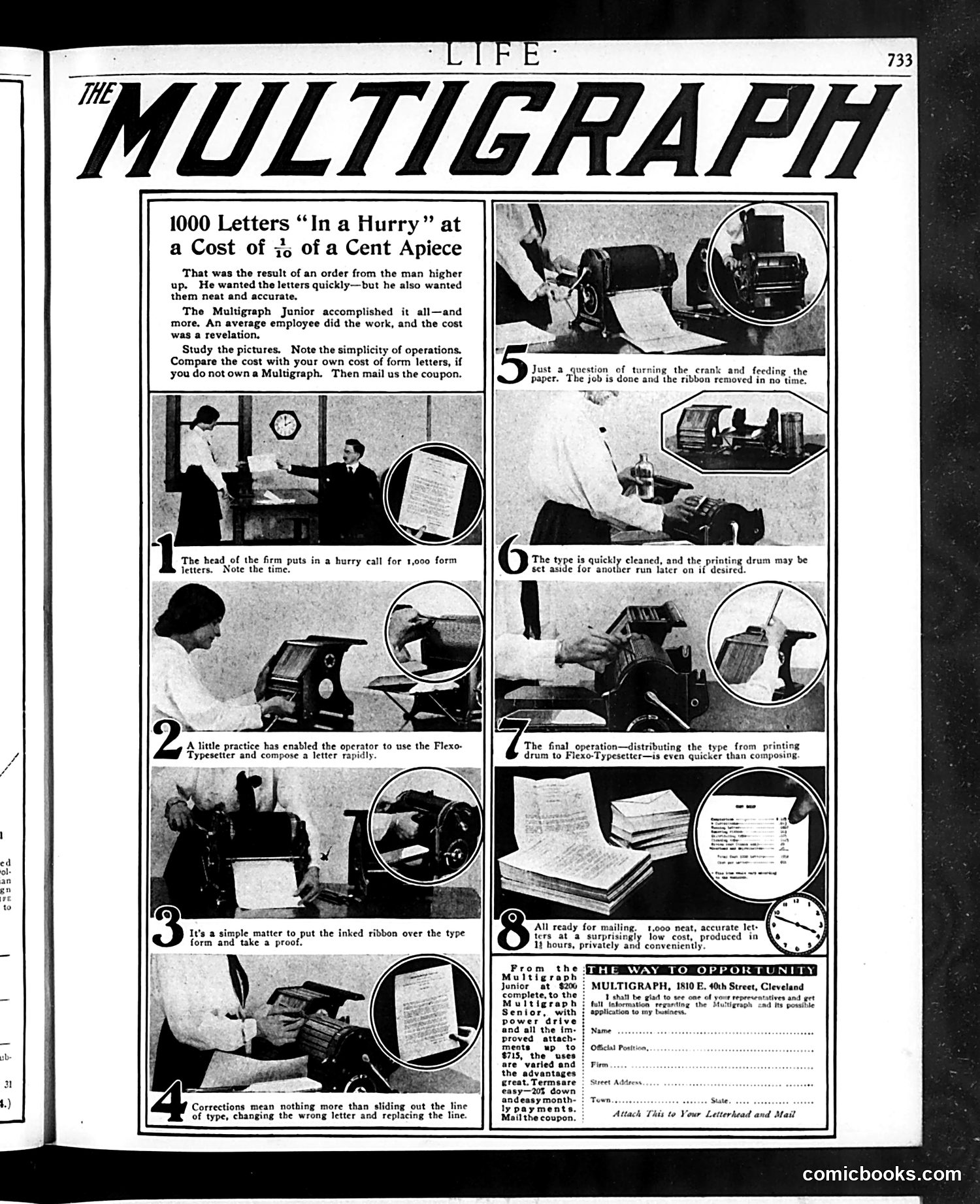
This page is primarily **advertising**, not satire or political commentary. It showcases the Multigraph machine, an early 20th-century duplicating device that produced multiple copies of letters and documents. The advertisement demonstrates how a business manager could order 1,000 form letters "in a hurry" at 1/10 cent per copy. Eight numbered photographs show the process: dictating the letter, composing it on a typewriter, inking the ribbon, making a proof, correcting errors, cleaning the type, distributing printed copies, and final mailing. The headline "The Way to Opportunity" frames this as a business solution. The Multigraph company offered both machines for sale and employment opportunities for operators. This represents practical industrial advertising of the era.
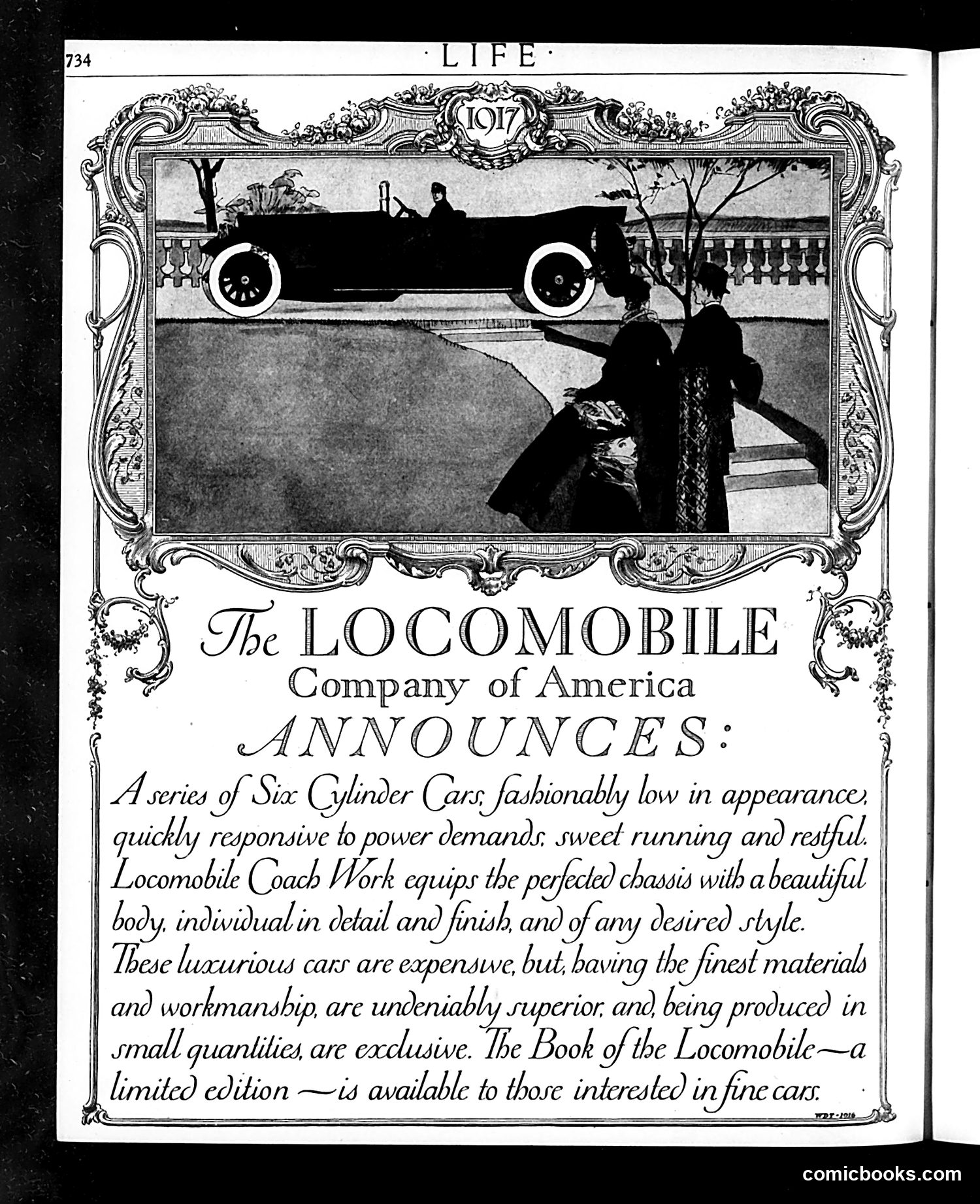
This page is **primarily an advertisement**, not satire or political commentary. It's a 1917 advertisement for the Locomobile Company of America announcing a new series of six-cylinder cars. The advertisement emphasizes luxury features: low profile design, responsive power, smooth performance, and custom coachwork. It stresses exclusivity through small production quantities and superior materials/craftsmanship, positioning these as expensive but worthwhile investments for affluent buyers. The illustration shows a well-dressed couple admiring a Locomobile automobile in what appears to be an elegant setting with classical architecture. There is no satirical commentary—this is straightforward luxury car marketing targeting wealthy consumers in the early 20th century.
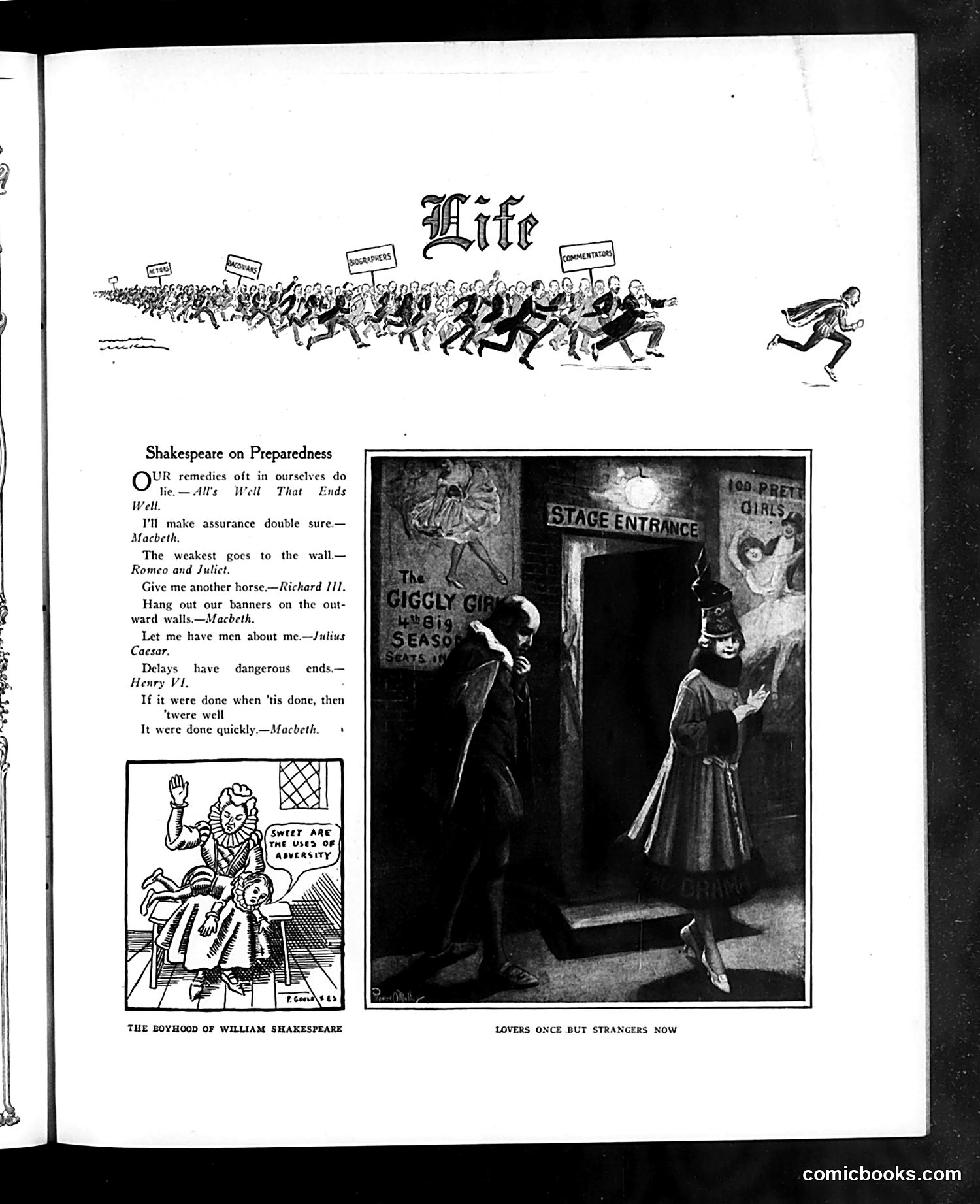
This page features Shakespeare-themed content with satirical commentary on preparedness and modern theater life. The top cartoon shows a large crowd of people carrying signs (labeled "CLUBS," "SOCIETIES," "COMMISSIONS") being chased by a single figure running ahead—a visual joke about how preparedness initiatives proliferate bureaucratically while actual action lags behind. Below, Shakespeare quotes humorously apply classical military wisdom to modern life, suggesting people cite high literature to justify everyday concerns. The left illustration depicts "The Boyhood of William Shakespeare" in a comic style, showing young Shakespeare with a nurse or caretaker—likely a humorous speculation on his upbringing. The right photograph, captioned "Lovers Once But Strangers Now," shows two figures at a theater stage entrance amid promotional posters, illustrating romantic disappointment in theatrical contexts—a commentary on transient show-business relationships.
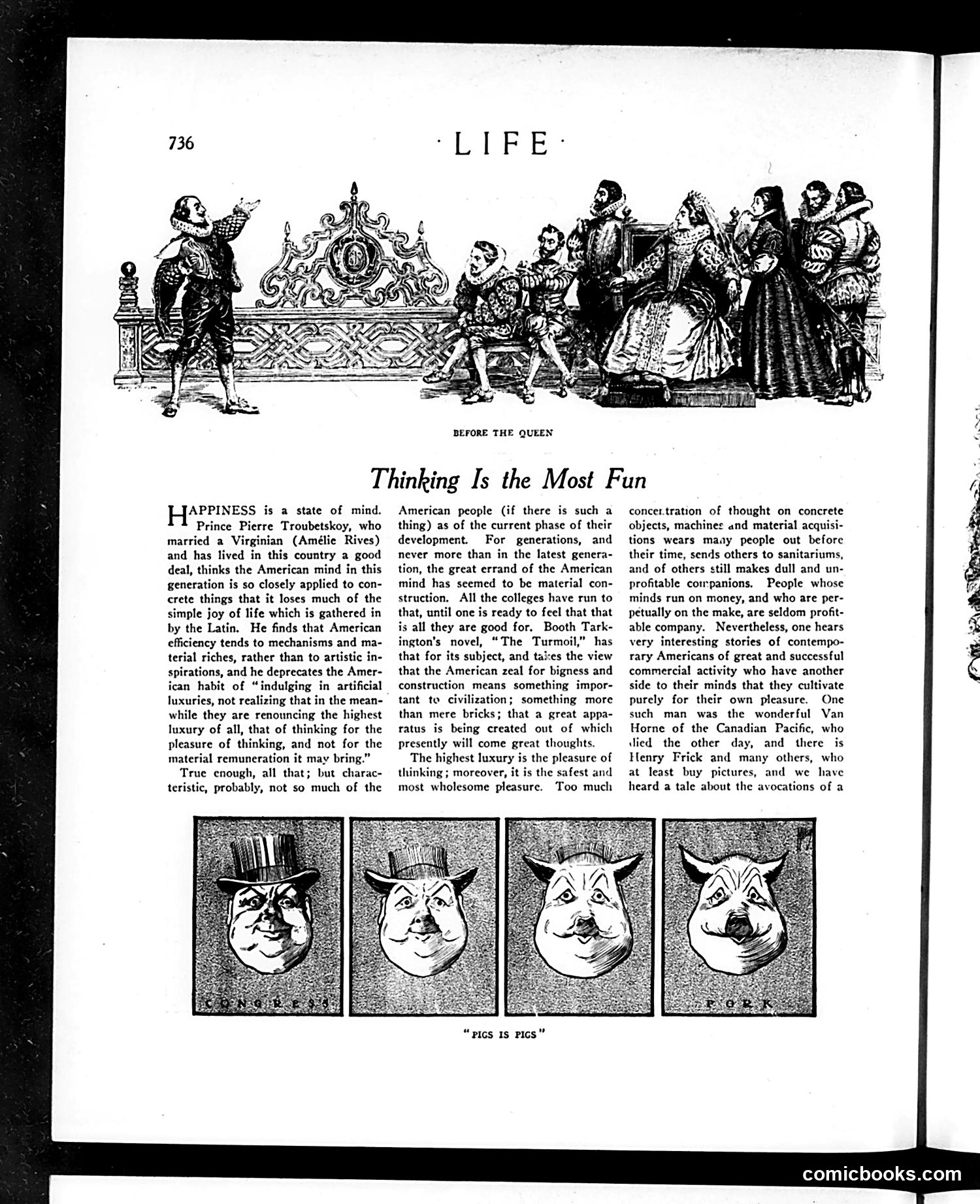
**Main Article: "Thinking Is the Most Fun"** This essay argues that American intellectual life has become overly focused on material construction rather than abstract thought. The author (Pierre Frobshesky, a Virginian) criticizes how American culture values concrete achievement over contemplation. He cites Tarkington's novel "The Turmoil" as evidence that Americans pursue "bigness and construction" at the expense of deeper civilization. **"Pigs Is Pigs" Cartoon** The four-panel sequence shows pig faces with changing expressions wearing different hats, apparently illustrating variations or transformations. The title is a phrase suggesting deceptive similarity or changeable appearances—possibly satirizing how superficial modifications mask underlying sameness, fitting the page's theme about substance versus appearance.
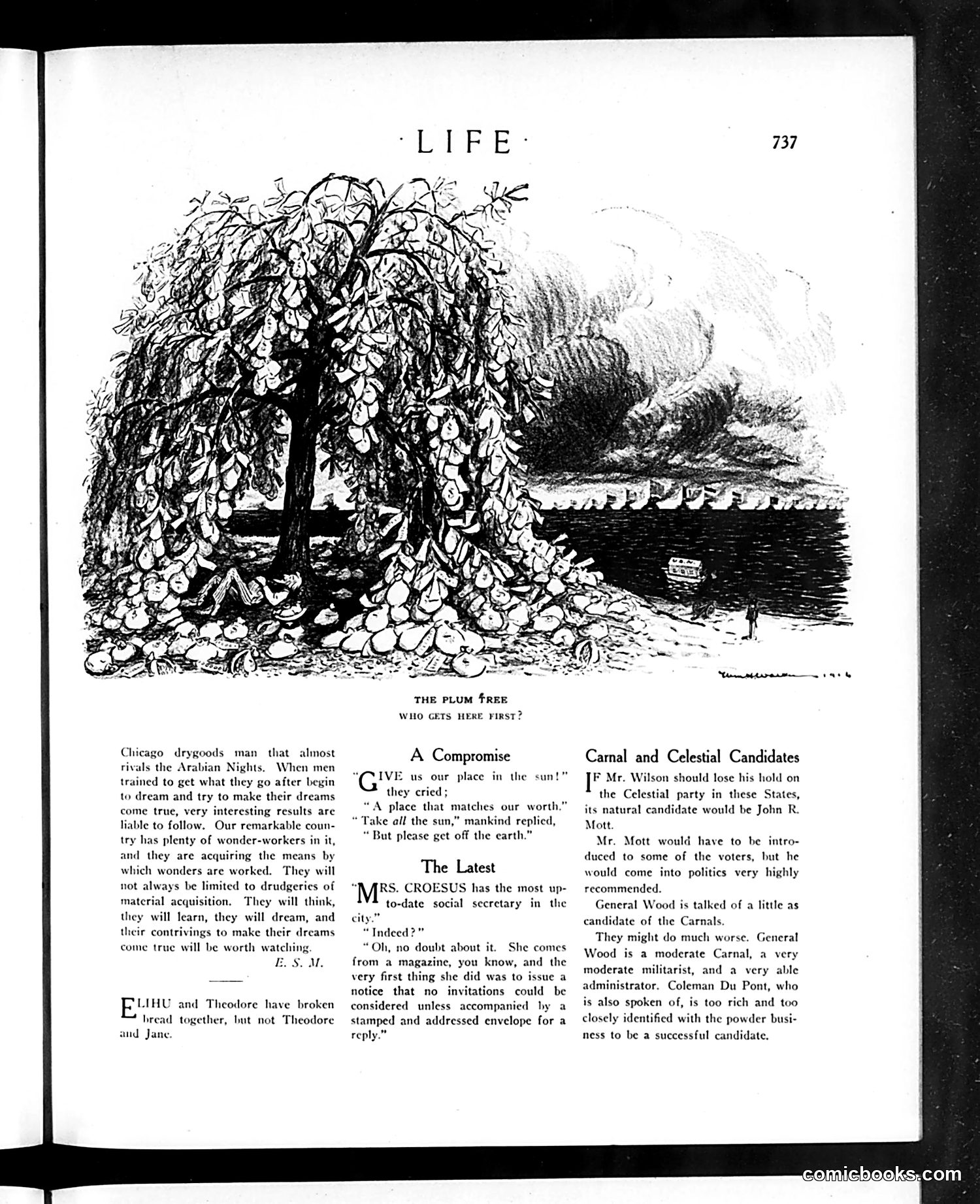
The main illustration is titled "The Plum Tree: Who Gets Here First?" and depicts a weeping willow laden with fruit, presumably "plums" (a metaphor for political patronage jobs). The accompanying text discusses **political candidacy**, specifically mentioning: - Mr. Wilson should hold onto his "Celestial party" nomination - Natural candidate would be **John R. Mott** - **General Wood** discussed as a Carnal candidate (likely "Canal," possibly referencing Theodore Roosevelt's Panama Canal involvement) - **Coleman Du Pont** mentioned as too wealthy and business-connected to be viable The satire critiques how politicians compete for desirable positions and patronage, with the "plums" representing government jobs. The cartoon mocks the scramble among candidates to secure these coveted posts, questioning who will "get here first" to claim them.
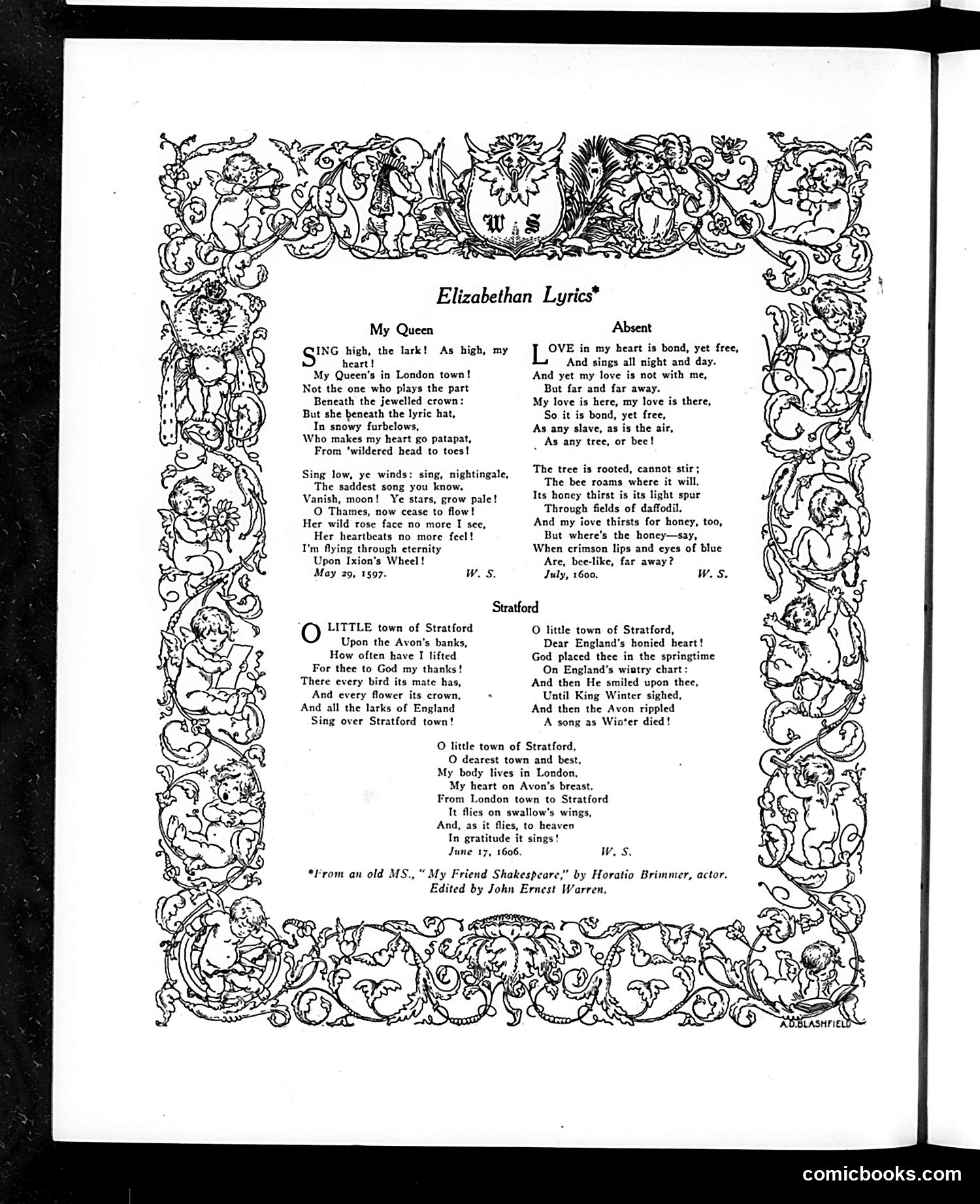
This page presents three poems attributed to the Elizabethan era, framed within ornate decorative borders typical of early Life magazine presentation. The poems are: 1. **"My Queen"** - dated May 29, 1592 2. **"Absent"** - dated July 1600 3. **"Stratford"** - dated June 17, 1606 A footnote indicates these are from "My Friend Shakespeare," edited by John Ernest Warren, sourced from an old manuscript by actor Horatio Brammer. Rather than satire, this appears to be a literary feature celebrating Renaissance poetry. The ornamental borders and careful typography suggest Life's approach to presenting cultural content for educated readers. The Stratford poem's references to England's countryside and the Avon river connect to Shakespeare's birthplace, though the attribution and authenticity remain unclear from this page alone.
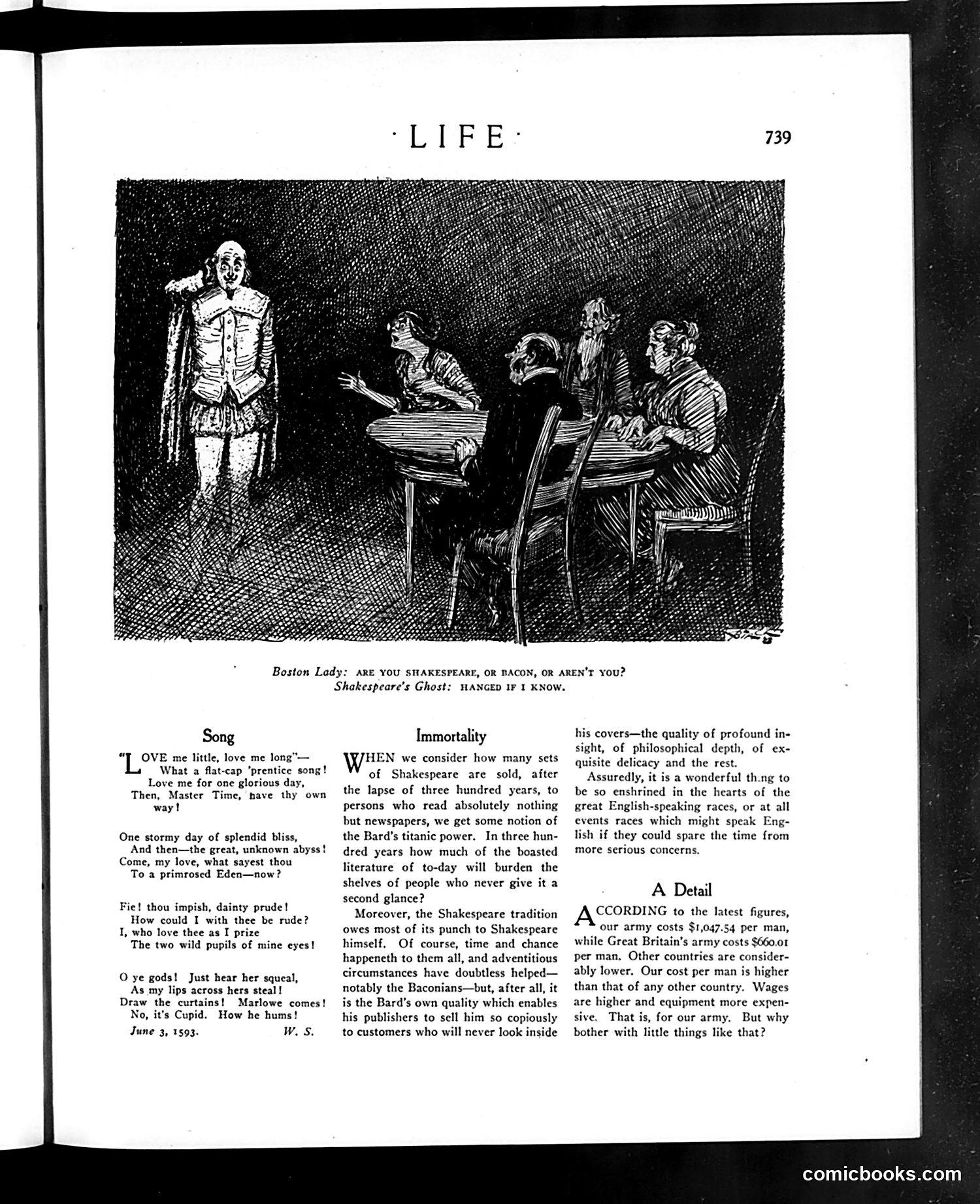
The main cartoon depicts a "Boston Lady" interrogating what appears to be Shakespeare's Ghost. The caption plays on a literary mystery: "ARE YOU SHAKESPEARE, OR BACON, OR AREN'T YOU?" This references the historical authorship debate—some scholars argued that Francis Bacon, not Shakespeare, wrote the plays. The joke satirizes Boston's intellectual pretensions: even encountering a literal ghost, a Boston intellectual would obsess over academic disputes rather than appreciate the work itself. The cartoon mocks pedantic literary criticism and the tendency of educated elites to prioritize scholarly debates over genuine engagement with art. The page's accompanying text discusses Shakespeare's enduring literary significance and compares British military costs to other nations, but these appear unrelated to the cartoon's satire.
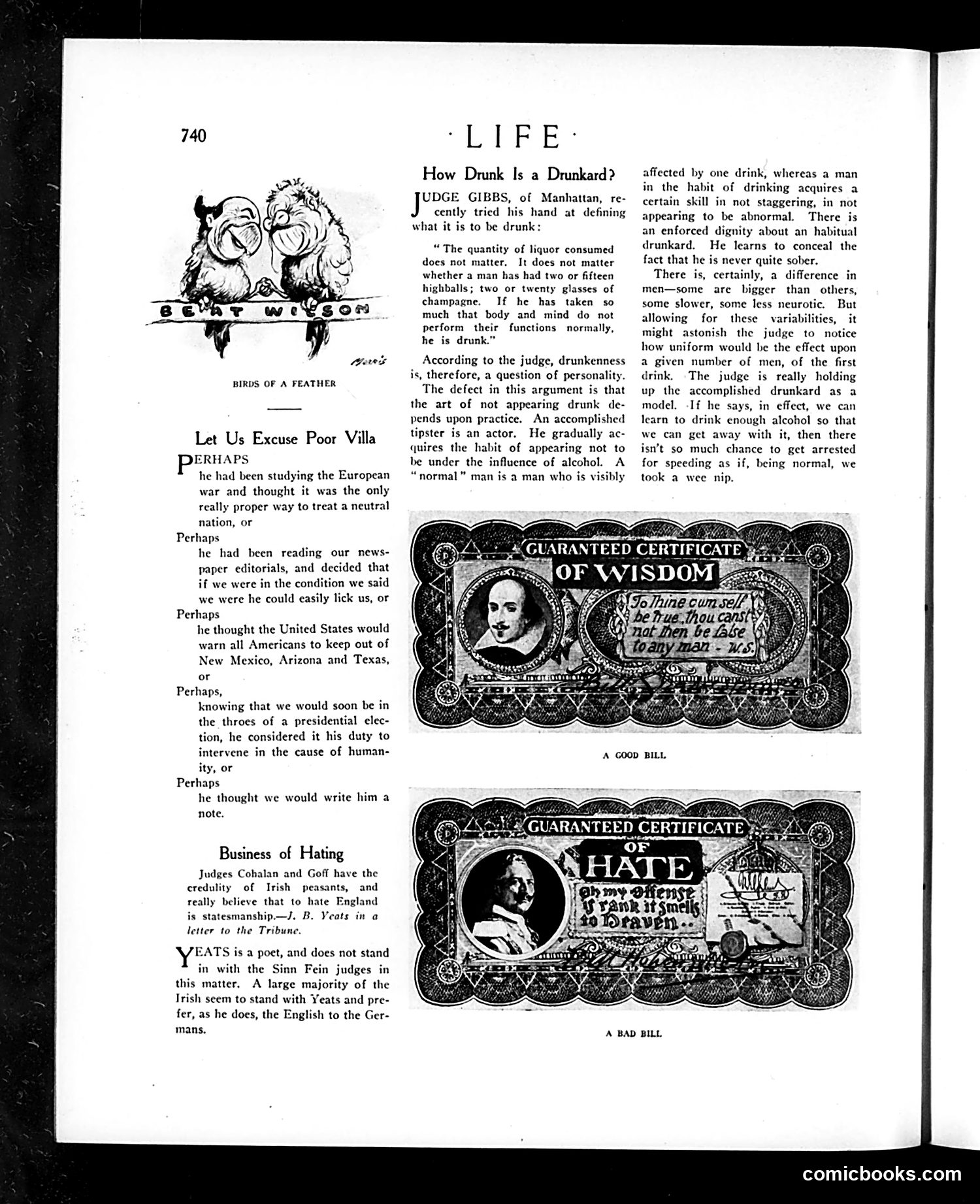
This page contains three satirical pieces. The opening article, "How Drunk Is a Drunkard?" features Judge Gibbs of Manhattan defining drunkenness by quantity consumed rather than visible impairment—a critique of subjective legal standards regarding intoxication. "Let Us Excuse Poor Villa" discusses European neutrality, apparently referencing Pancho Villa (Mexican Revolutionary figure), suggesting American debate over intervention in foreign conflicts. "Business of Hating" comments on Irish-English tensions, noting Irish preference for Yeats over English poets—a cultural/political jab at Anglo-Irish relations. The two "Guaranteed Certificates" are mock documents offering "Wisdom" and "Hate," appearing to satirize both self-improvement culture and nationalist sentiment. The overall page reflects early 20th-century American satirical commentary on politics, social behavior, and international relations.
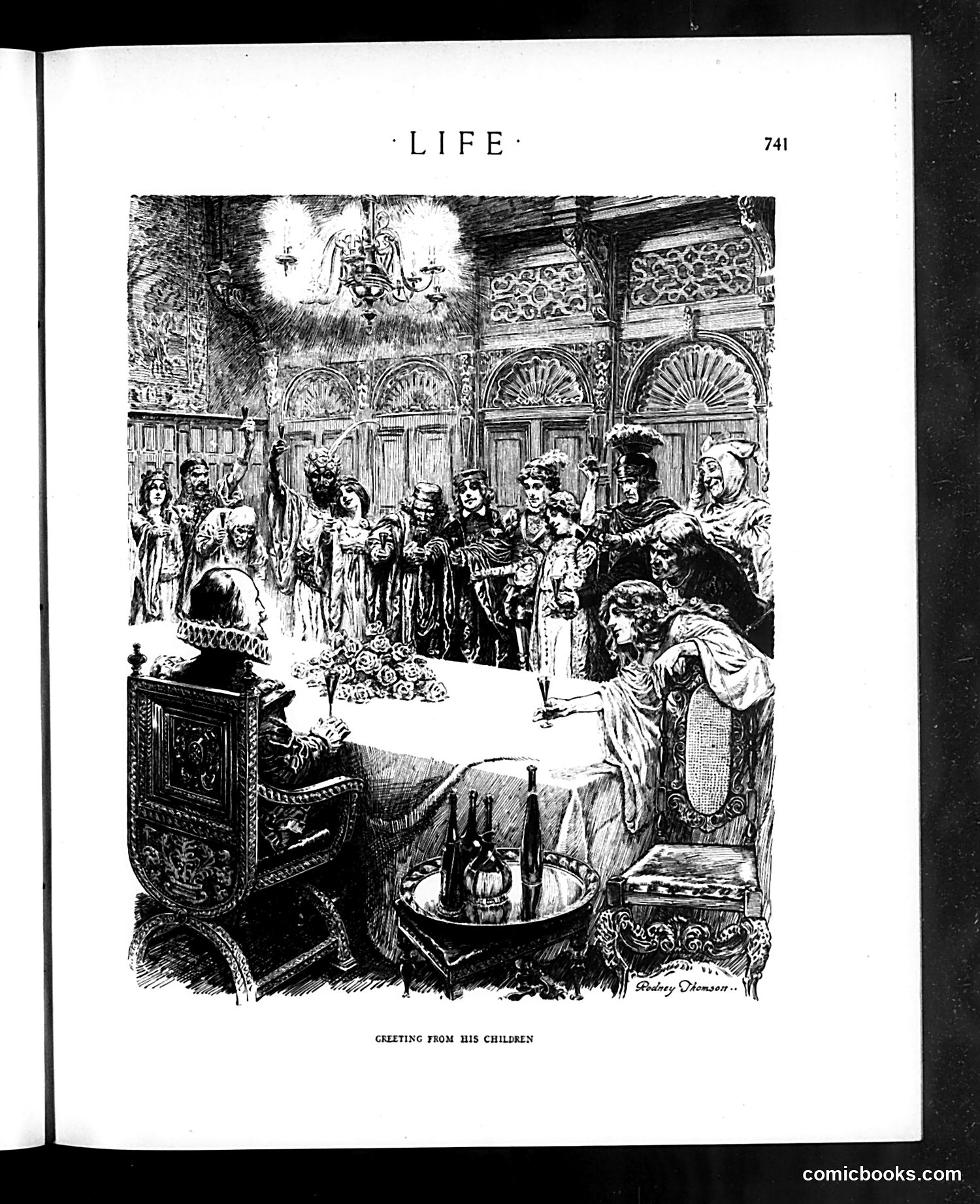
This illustration depicts a deathbed or formal farewell scene in an ornate palace or grand hall. A dying or deceased figure lies in state while numerous costumed courtiers and nobles gather around, appearing to pay respects or bid farewell. The caption "Greeting from His Children" suggests this satirizes a ruler receiving final visits from his offspring or successors. The elaborate period dress and architectural details indicate this references a historical or classical scenario, likely from European monarchy. Without additional context about Life magazine's publication date, I cannot identify the specific ruler or political situation being mocked. The satire appears to commentary on dynastic succession, court intrigue, or the pageantry surrounding a leader's death.
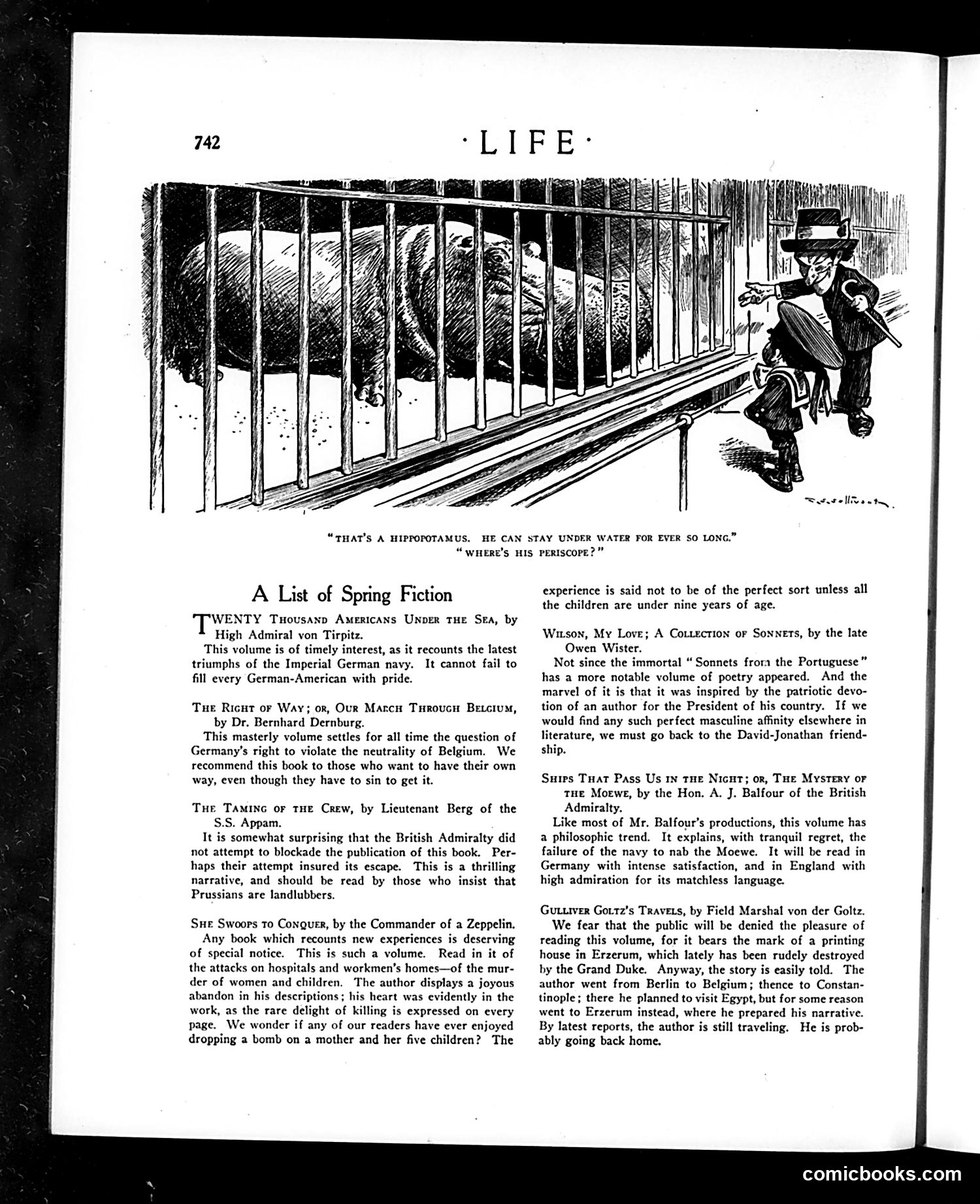
This page contains a cartoon and book reviews rather than political satire. The cartoon depicts a man in a top hat and coat standing outside a hippopotamus enclosure, asking "Where's his periscope?" in response to being told "That's a hippopotamus. He can stay under water for ever so long." The joke is a visual pun: the hippopotamus's ability to remain submerged is being humorously compared to a submarine's use of a periscope. This appears to reference World War I submarine warfare, which was a contemporary concern when this was published. The cartoon plays on the absurdity of mistaking an animal for military technology, or conversely, of expecting an animal to behave like a machine of war. The humor relies on the viewer understanding submarine warfare technology and its role in current events.
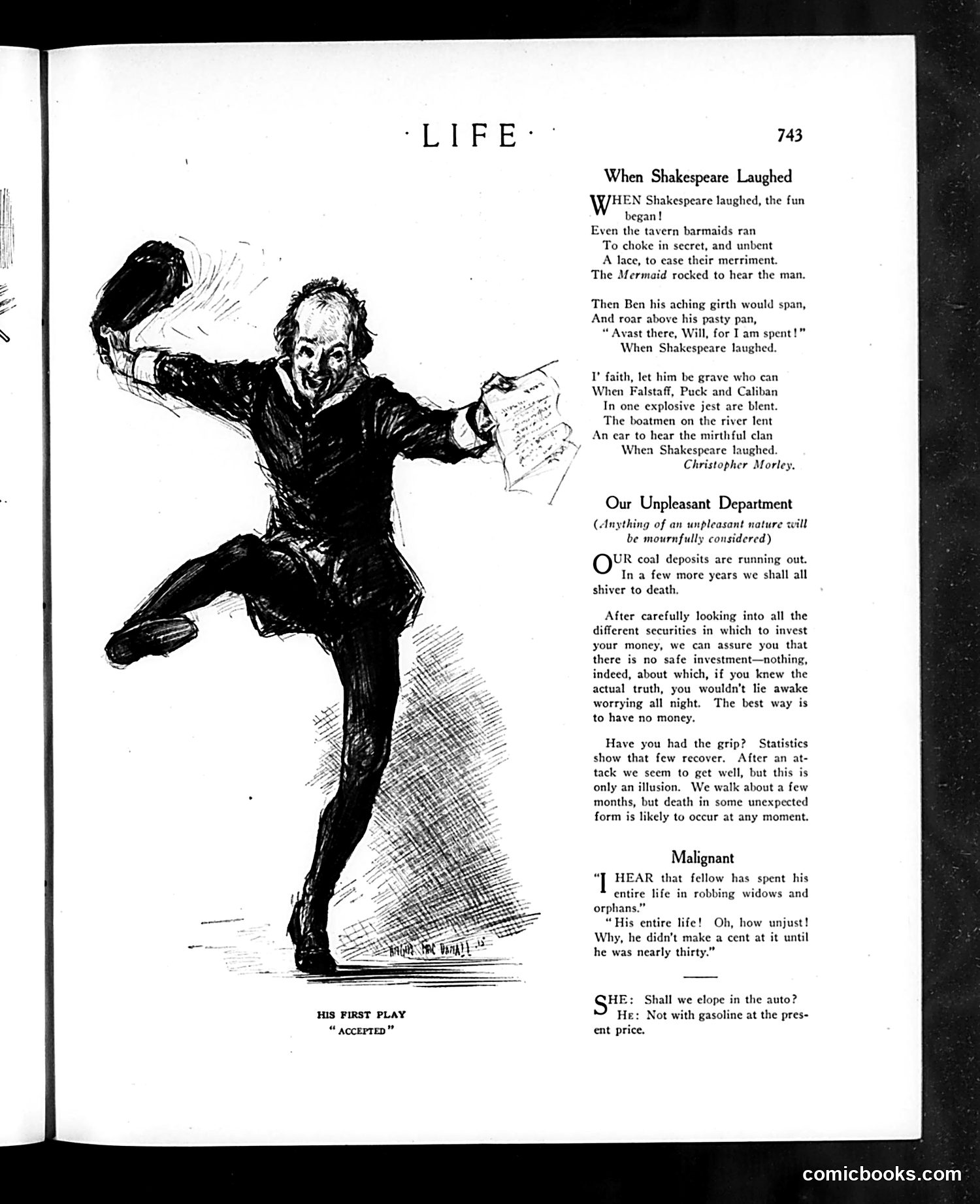
The main illustration shows a caricatured figure in theatrical pose labeled "HIS FIRST PLAY 'ACCEPTED'" — likely depicting an aspiring playwright or actor celebrating his initial success. The page features three separate pieces of satirical content: 1. **"When Shakespeare Laughed"** — a poem by Christopher Morley celebrating Shakespeare's comedic genius and the laughter his work inspired. 2. **"Our Unpleasant Department"** — dark satire on financial investment during economic hardship, arguing that having no money is the safest investment strategy, given coming economic collapse and death's inevitability. 3. **"Malignant"** — a brief joke about a man who robbed widows and orphans, with a closing dialogue about eloping by car during high gasoline prices. The overall tone is cynical humor about theater, economics, and modern life circa the early 20th century.
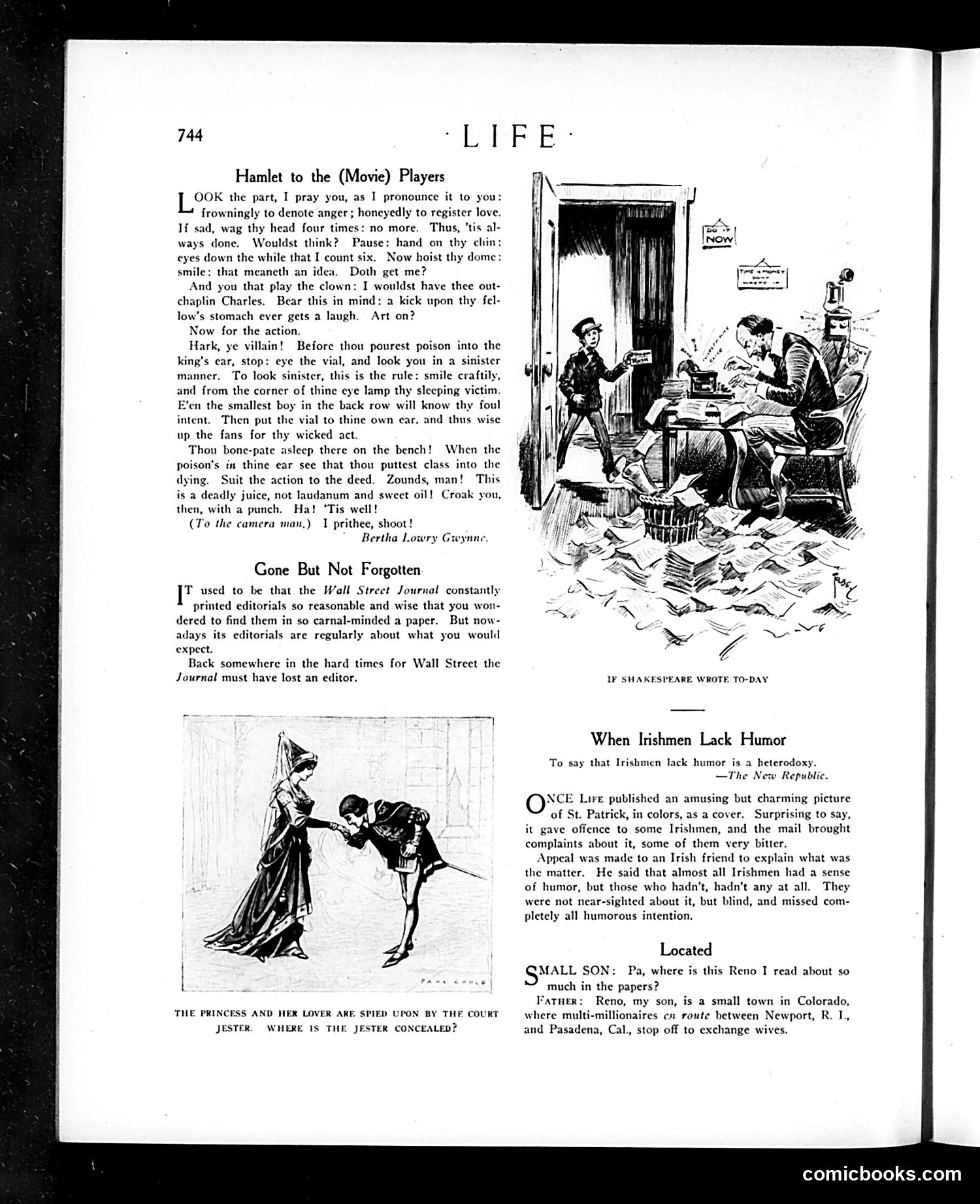
This page contains three satirical pieces: **"Hamlet to the (Movie) Players"** mocks early cinema acting conventions by having Shakespeare's Hamlet instruct actors on exaggerated, mechanical performance—frowning for anger, forced smiles for ideas, crafty grins for villainy. The satire targets silent film's crude emotional vocabulary, where actors overacted to compensate for lack of dialogue. The reference to "out-chaplin Charles" likely alludes to Charlie Chaplin's physical comedy style. **"Gone But Not Forgotten"** satirizes the *Wall Street Journal's* editorial decline, suggesting the publication lost its reasoned voice during financial hardship and now prints predictable content. **"When Irishmen Lack Humor"** notes that *Life* received angry complaints about a St. Patrick cover illustration. An Irish friend explained the complainers simply lacked humor themselves—a gentle irony suggesting humorless people miss jokes entirely. The cartoon below shows a court jester being discovered spying on a princess and her lover, illustrating physical comedy and intrigue themes.
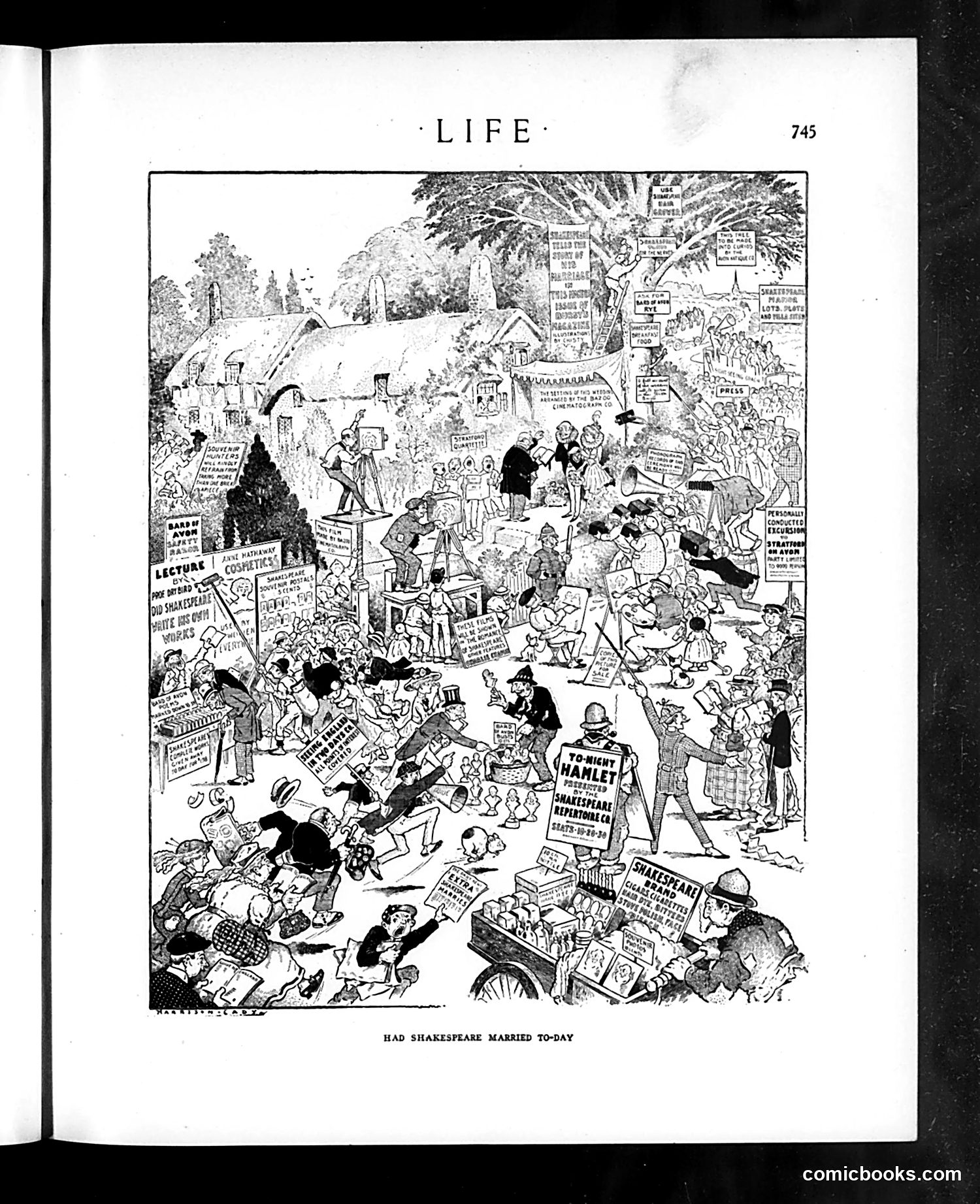
This satirical cartoon imagines Shakespeare's wedding if it occurred in the contemporary era (early 20th century). The chaotic scene depicts a modern carnival-like atmosphere rather than a solemn ceremony—featuring commercial vendors, promotional signs, crowds of onlookers, and various entertainments surrounding what appears to be the central wedding event. The satire critiques how modern commercialism and public spectacle would have corrupted a significant cultural moment. Rather than a dignified literary or historical occasion, it shows how contemporary society transforms everything into a commercialized, crowded spectacle. The numerous signs and vendors visible throughout suggest how modern marketing and entertainment industries would exploit even Shakespeare's personal life for profit and public consumption.
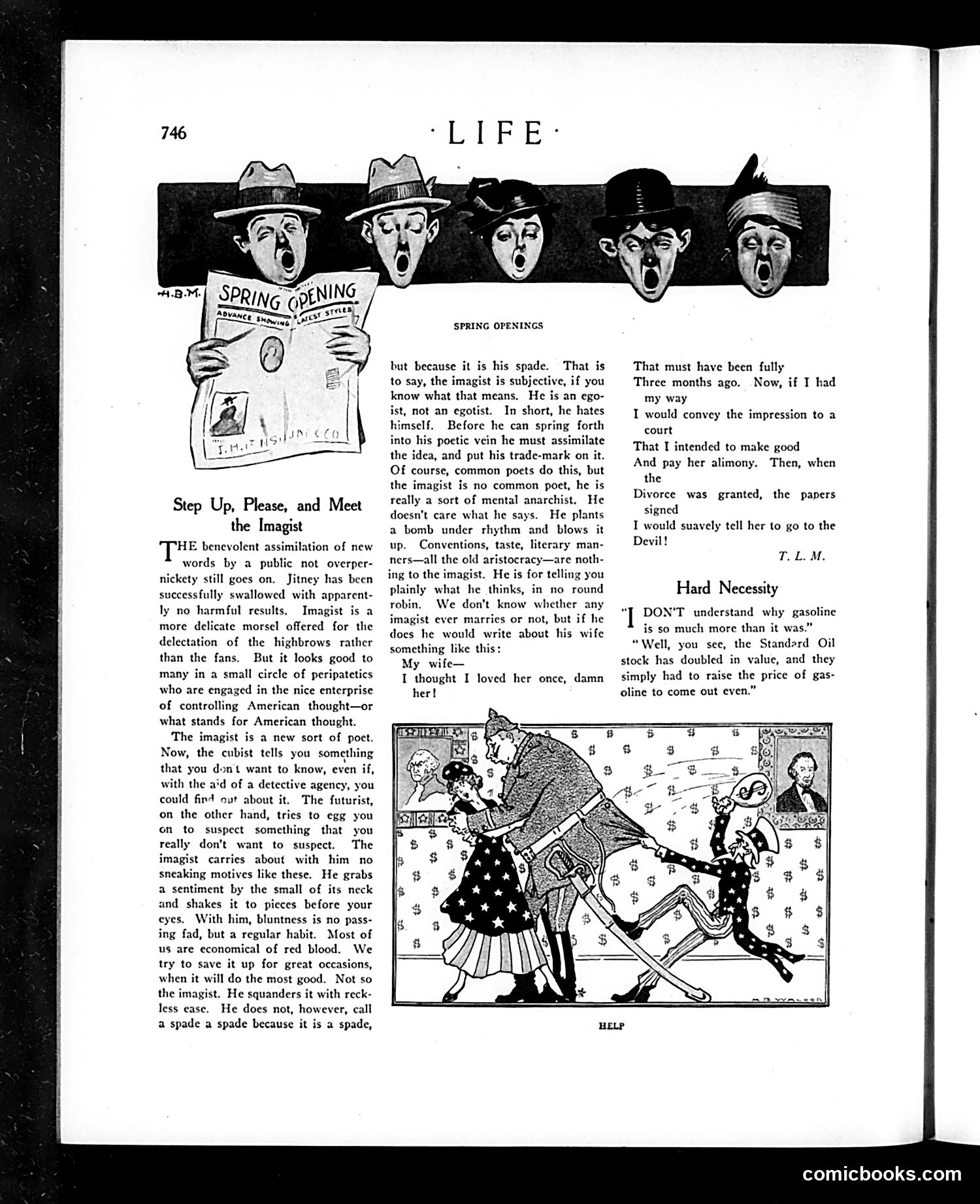
This page satirizes the "Imagist" poetry movement, a early 20th-century literary avant-garde style emphasizing precise imagery and free verse. The article mocks Imagists as pretentious egotists who reject traditional poetic conventions while claiming radical honesty—yet remain fundamentally self-centered and subjective. The five caricatured heads at top represent the movement's exaggerated emotionalism. The sample poem about divorce exemplifies the satire: an Imagist claiming blunt sincerity while actually indulging emotional excess and personal grievance. The cartoon "Help" (bottom) depicts a couple dancing, with dollar signs scattered around—illustrating the accompanying joke about gasoline prices. A Standard Oil shareholder justifies raising prices by claiming the stock's doubled value requires higher costs to "come out even"—obvious corporate doublespeak that Life ridicules as absurd logic masking profit-seeking. Both pieces target early 1900s American pretension: literary avant-gardism and corporate greed dressed in false justification.
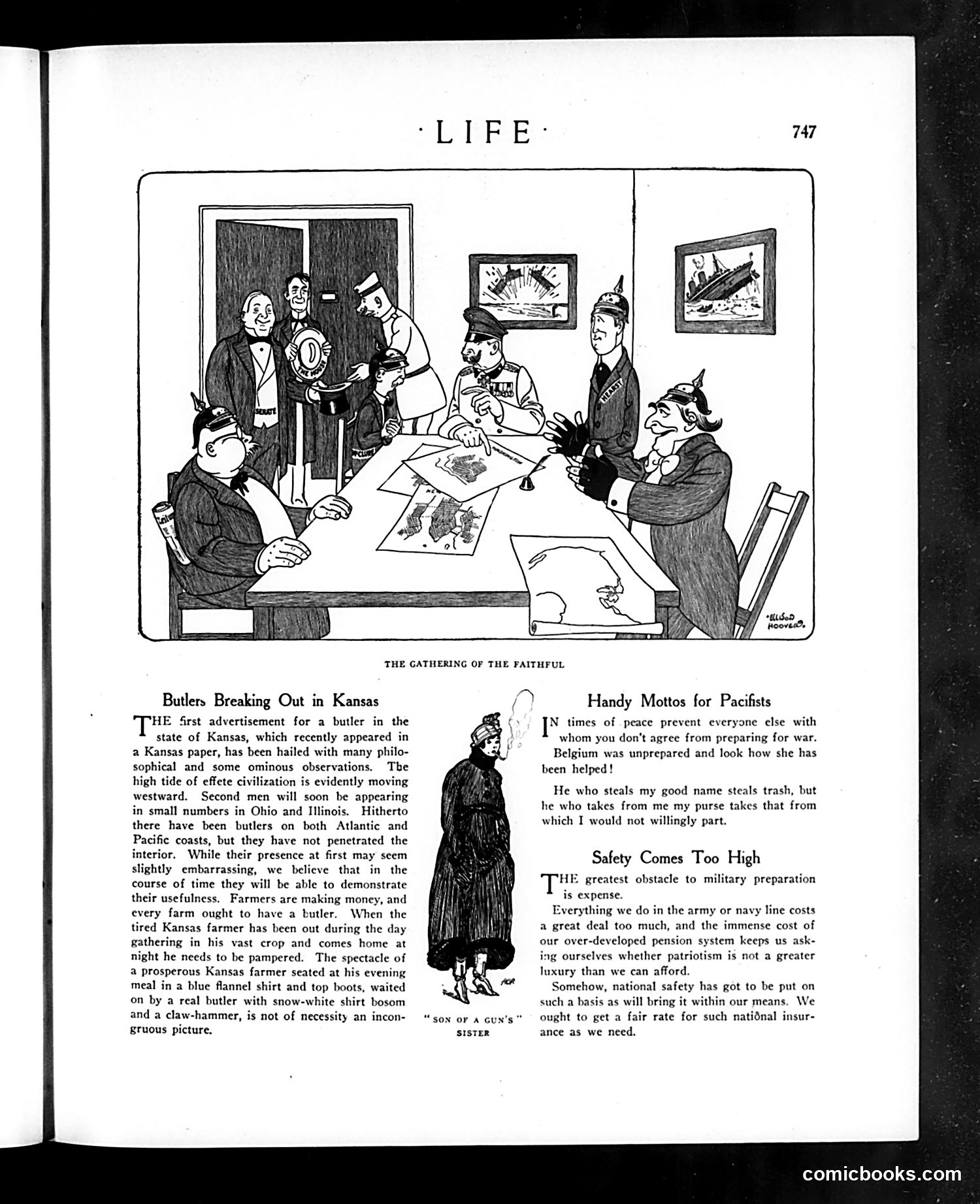
**The Main Cartoon** depicts military or government officials reviewing maps around a table—likely depicting military strategists or war planners meeting in an official capacity. The title's ironic reference to "the faithful" suggests these are committed believers in military preparedness. **The Three Text Sections** satirize different aspects of pre-WWI American society: 1. **"Butlers Breaking Out in Kansas"** mocks the spread of European refinement to the American heartland—wealthy Kansas farmers now hiring butlers, symbolizing either progress or absurd pretension depending on one's view. 2. **"Handy Mottos for Pacifists"** directly attacks pacifism by sarcastically quoting anti-war sentiments, then undercutting them with the example of Belgium's military unpreparedness leading to German invasion—implying pacifism is dangerously naive. 3. **"Safety Comes Too High"** critiques Americans who resist military spending on cost grounds, arguing that national defense is worth the expense. The page reflects American debate over military preparedness circa 1915-1917, with Life taking a **pro-military, anti-pacifist position**.
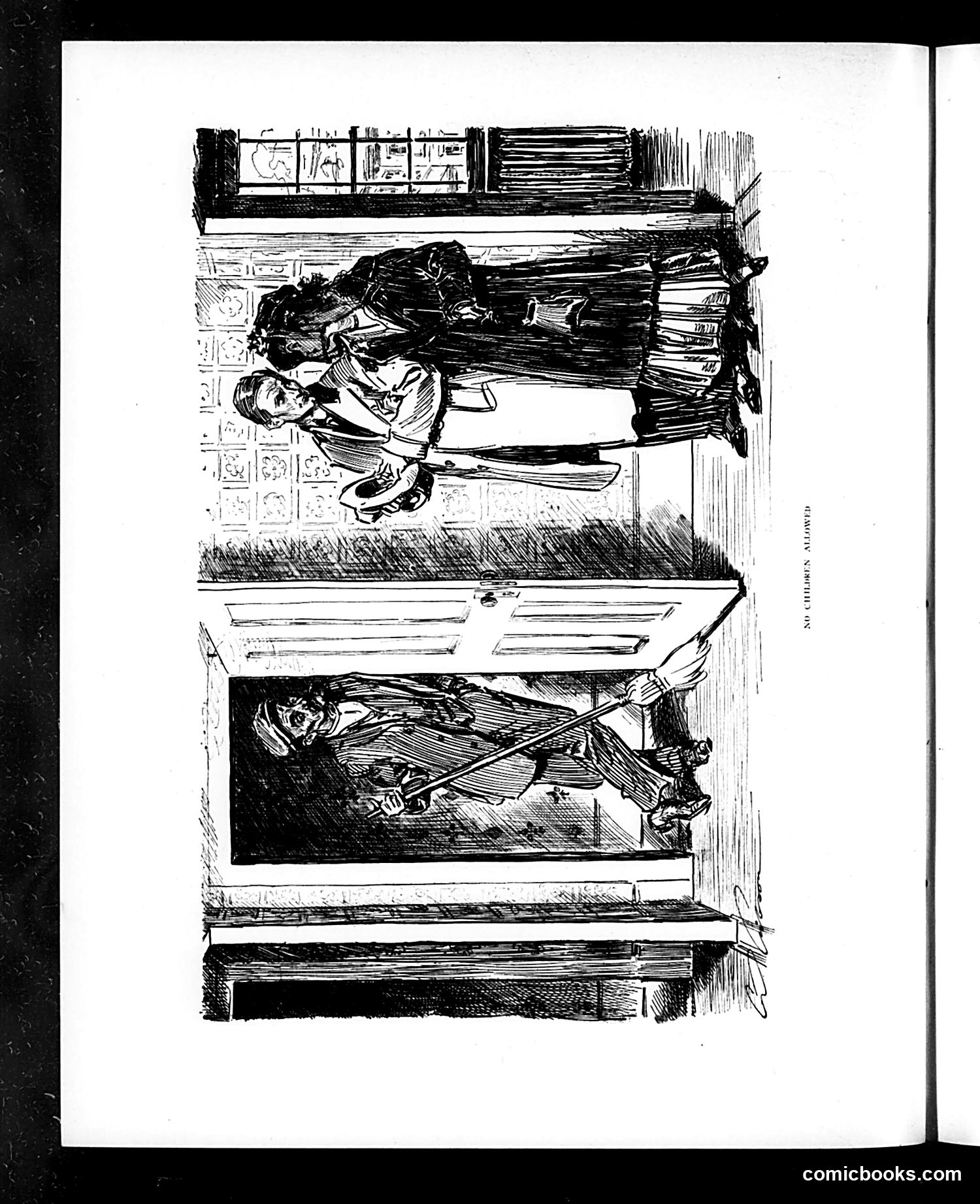
This page contains two ink sketches oriented vertically. The upper panel shows a woman in a long dress seated indoors, with decorative elements visible on the wall behind her. The lower panel depicts a figure in what appears to be period dress holding a long implement, possibly a fishing rod or similar object. Without clearer OCR text or visible captions identifying the specific political figures or events referenced, I cannot definitively explain the satire's meaning. The artistic style suggests late 19th or early 20th-century American satirical illustration. The domestic setting in the upper panel and the contrast with the lower scene suggests commentary on social behavior or gender roles, but the specific political or social critique remains unclear from this image alone.
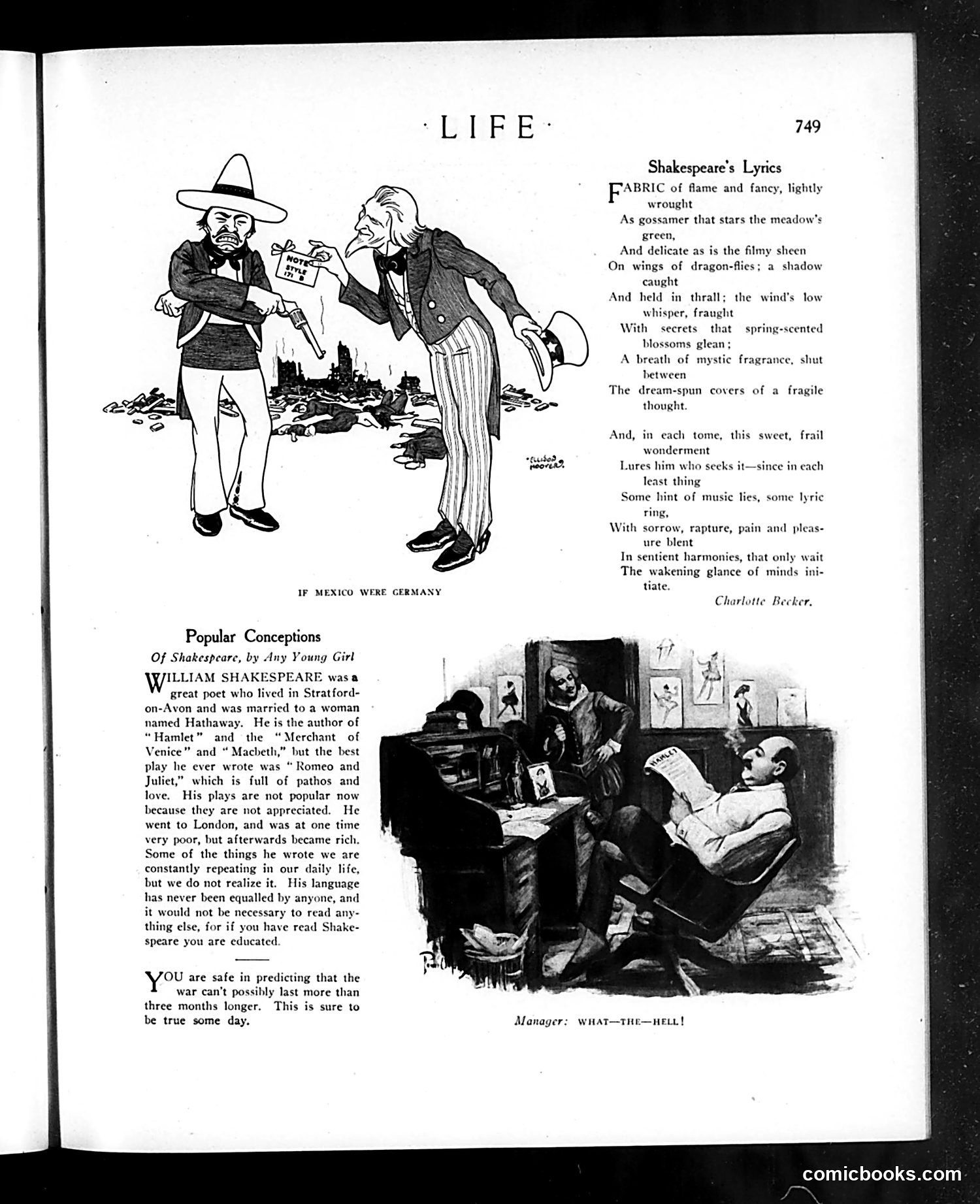
**Top Cartoon ("If Mexico Were Germany"):** A political cartoon showing two figures—one appearing to be a Mexican official (sombrero) and another in formal dress—exchanging a note. The title suggests this is commentary on American foreign policy concerns during WWI era, implying that if Mexico had aligned with Germany instead of remaining neutral, it would be a serious threat to the U.S. The cartoon satirizes anxieties about potential hostile alliances near American borders. **"Popular Conceptions of Shakespeare":** A humorous article mocking students' superficial understanding of Shakespeare. It presents a caricature of a "young girl's" knowledge—confusing plot details, overgeneralizing his importance, and making naive claims ("if you have read Shakespeare you are educated"). The satire targets inadequate literary education and the gap between Shakespeare's actual complexity and popular oversimplifications. **Bottom Cartoon ("Manager: What—the—Hell!"):** Appears to show theatrical frustration, likely satirizing backstage chaos or production mishaps, though specific context is unclear from the image alone.
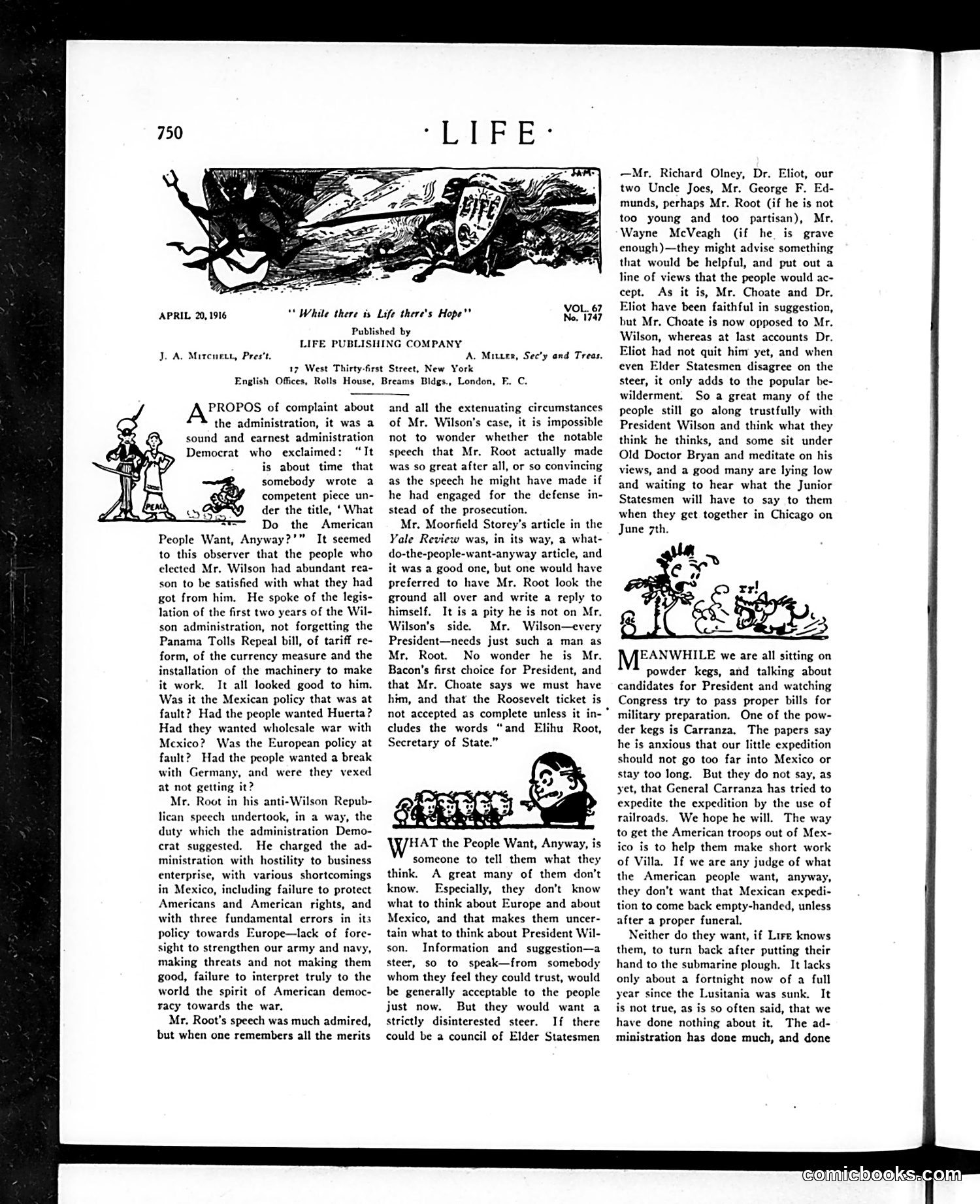
This editorial discusses criticisms of President Woodrow Wilson's administration and suggests the public needs trusted guidance on complex issues. **Key Figures Referenced:** - **President Wilson**: whose policies on Mexico and Europe are debated - **Elihu Root**: prominent Republican offering sharp criticism of Wilson's administration, particularly regarding military preparedness, business hostility, and European policy - **Moorfield Storey**: wrote a critical article in Yale Review **The Point:** The author argues Root's speech, while admired, is one-sided prosecution rather than balanced analysis. The piece suggests the American people need disinterested advice from respected "Elder Statesmen" (like Root, Charles Eliot, and others named) on foreign policy and Mexico—issues creating uncertainty about Wilson's leadership. **The Satire:** The irony is that Root—precisely the capable advisor Wilson needs—opposes him politically, making his criticism partisan rather than objective guidance for the confused public.
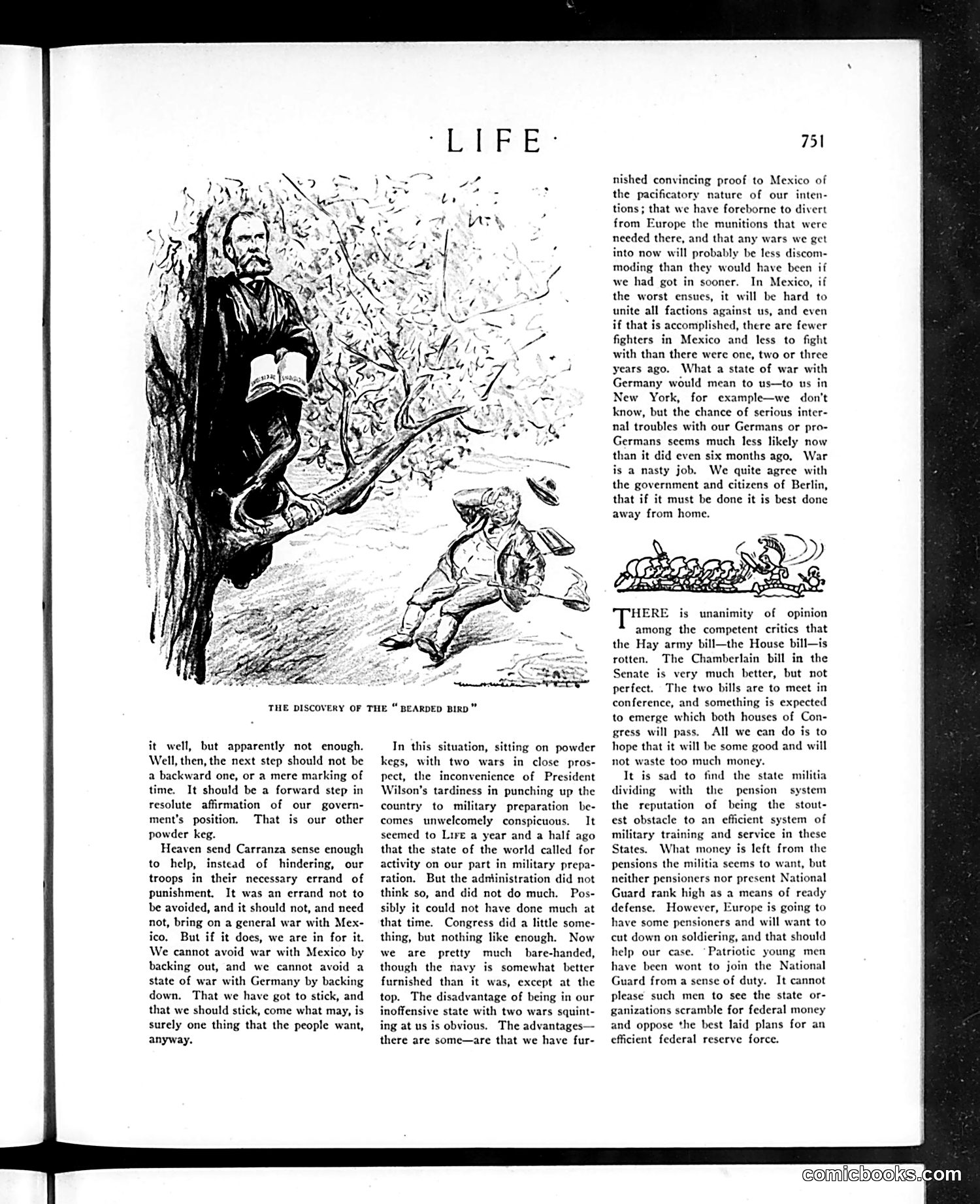
This cartoon satirizes American military unpreparedness amid potential conflicts with Mexico and Germany (circa 1916). The bearded figure in the tree appears to represent an unprepared American soldier or the U.S. military itself—caught off-guard, literally up a tree, as a child (possibly representing Germany or Mexico) approaches with what looks like a stick or weapon. The accompanying text criticizes President Wilson's delayed military preparations. The author argues that while avoiding earlier military buildup had some advantages—proving peaceful intent to Mexico and preserving munitions for Europe—America now faces "two wars in close prospect" while dangerously under-armed. The piece also condemns the "rotten" House military appropriations bill and criticizes state militia as obstacles to efficient defense. The cartoon's title suggests discovering something absurd or ridiculous in one's own position—America, unprepared, facing imminent threats.
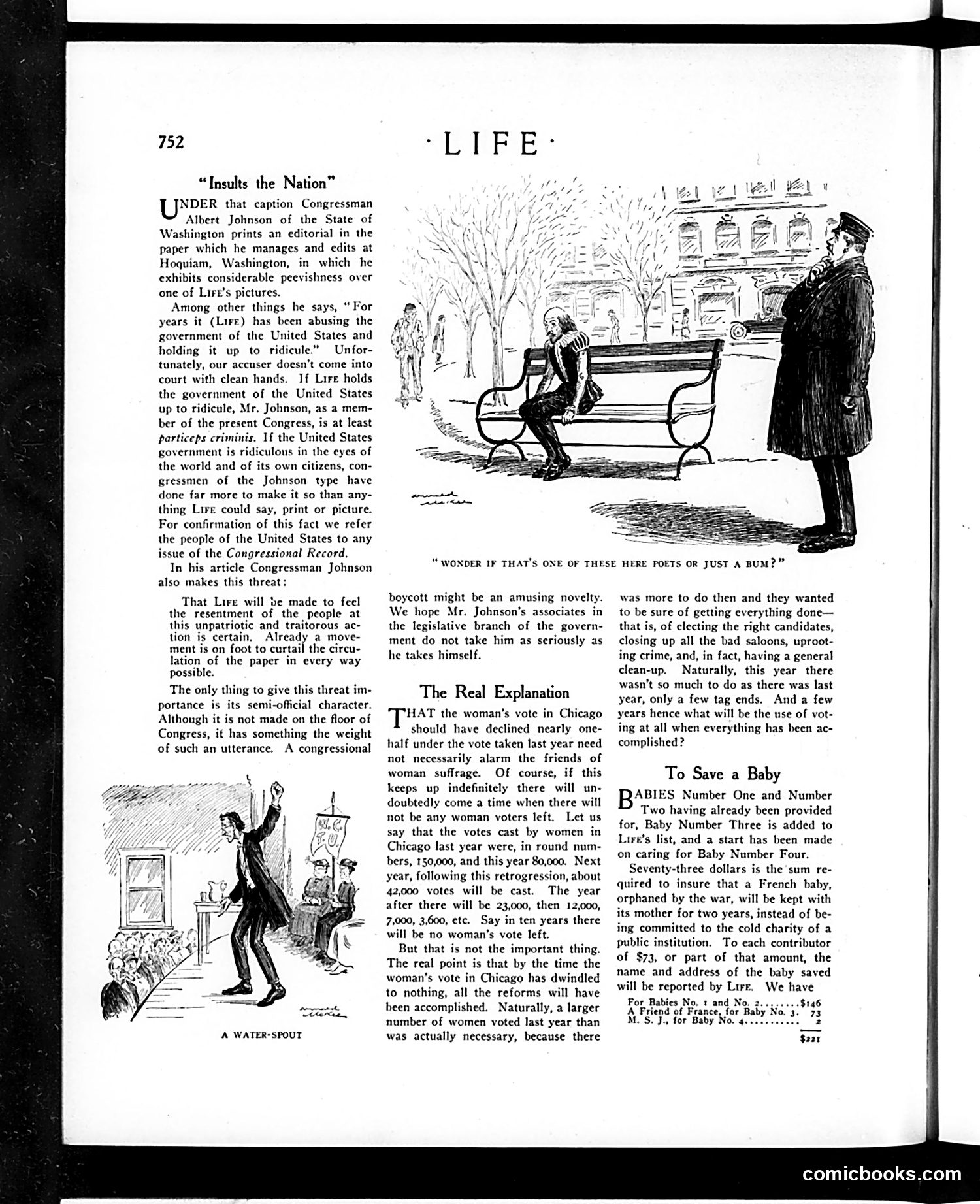
This page contains two separate satirical pieces attacking political and social hypocrisy: **"Insults the Nation"** (top): Life magazine responds to Congressman Albert Johnson of Washington, who criticized Life for mocking the U.S. government. Life argues Johnson himself—as a congressman—bears greater responsibility for making the government ridiculous. The cartoons mock Johnson: the top shows a well-dressed man on a park bench (likely Johnson), and the bottom depicts a "water-spout" (a person being ejected). Life suggests Johnson's threatened boycott is an empty bluff. **"The Real Explanation"** (middle): This sarcastically defends declining female voter turnout in Chicago by projecting it will mathematically approach zero—implying that once women have "fixed everything" (elected good candidates, closed saloons, eliminated crime), voting becomes unnecessary. It's heavy irony mocking the notion that reform work is nearly complete. **"To Save a Baby"** (bottom): A fundraising appeal for orphaned French children from WWI, inviting donors to sponsor babies at $73 each. The page satirizes political self-service and complacency about progressive reforms.
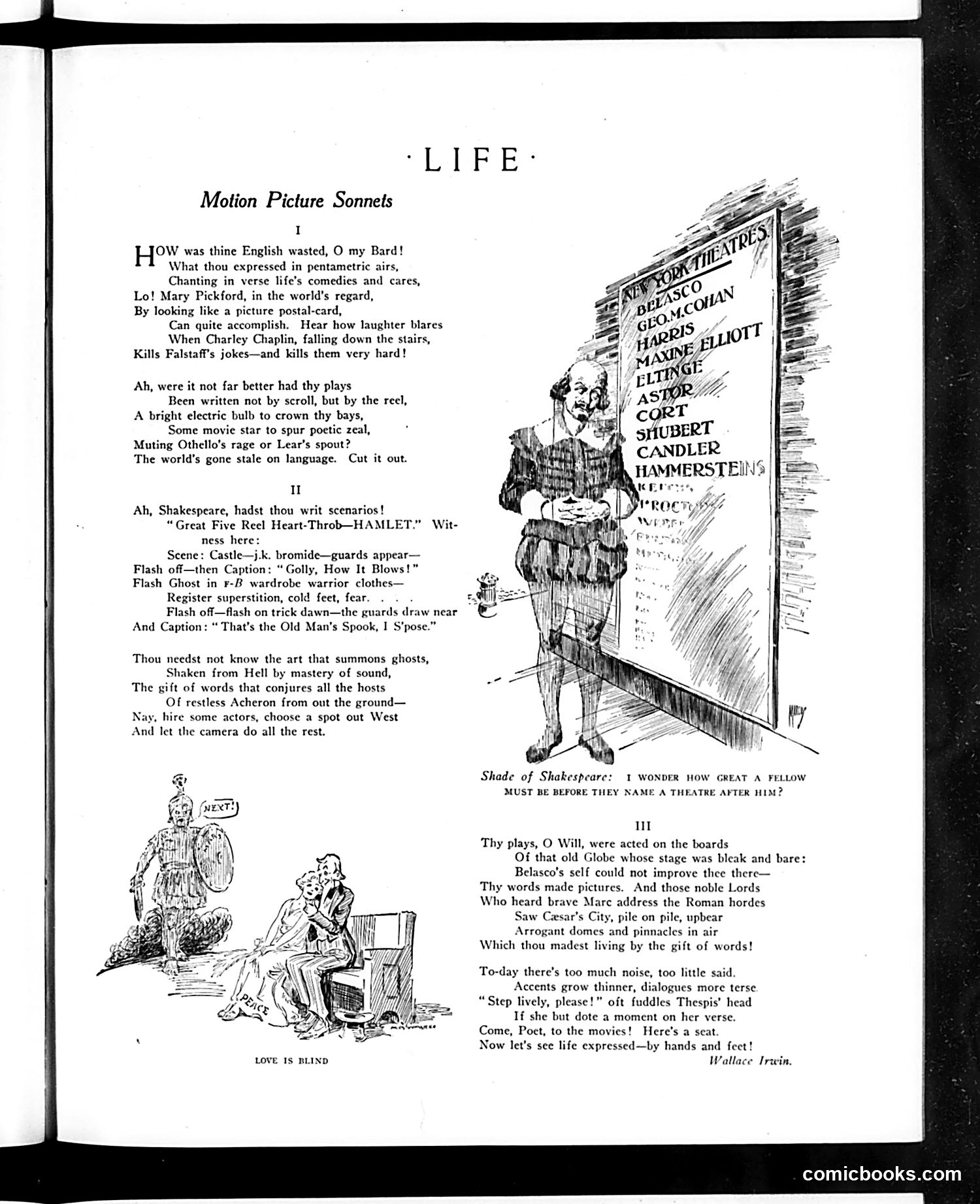
This page satirizes the decline of theatrical arts in favor of silent cinema. The author mocks how movies have replaced Shakespeare's language-driven drama with visual spectacle and physical comedy. The sonnets argue that silent film stars like Mary Pickford and Charlie Chaplin accomplish through pantomime and sight gags what Shakespeare achieved through verse. The satire suggests modern audiences prefer slapstick (Chaplin falling downstairs) to Shakespeare's linguistic richness—"The world's gone stale on language. Cut it out." Section II ridicules adapting *Hamlet* as a five-reel movie with captions like "Golly, How It Blows!" and "That's the Old Man's Spook, I S'pose"—reducing profound drama to cheap melodrama. The cartoon of Shakespeare's ghost at the theater marquee comments on how cinema now dominates entertainment. Section III concedes cinema has merit for visual storytelling but laments the loss of verbal artistry, urging Shakespeare to "come, Poet, to the movies"—a resigned acceptance that physical expression now trumps literary language.
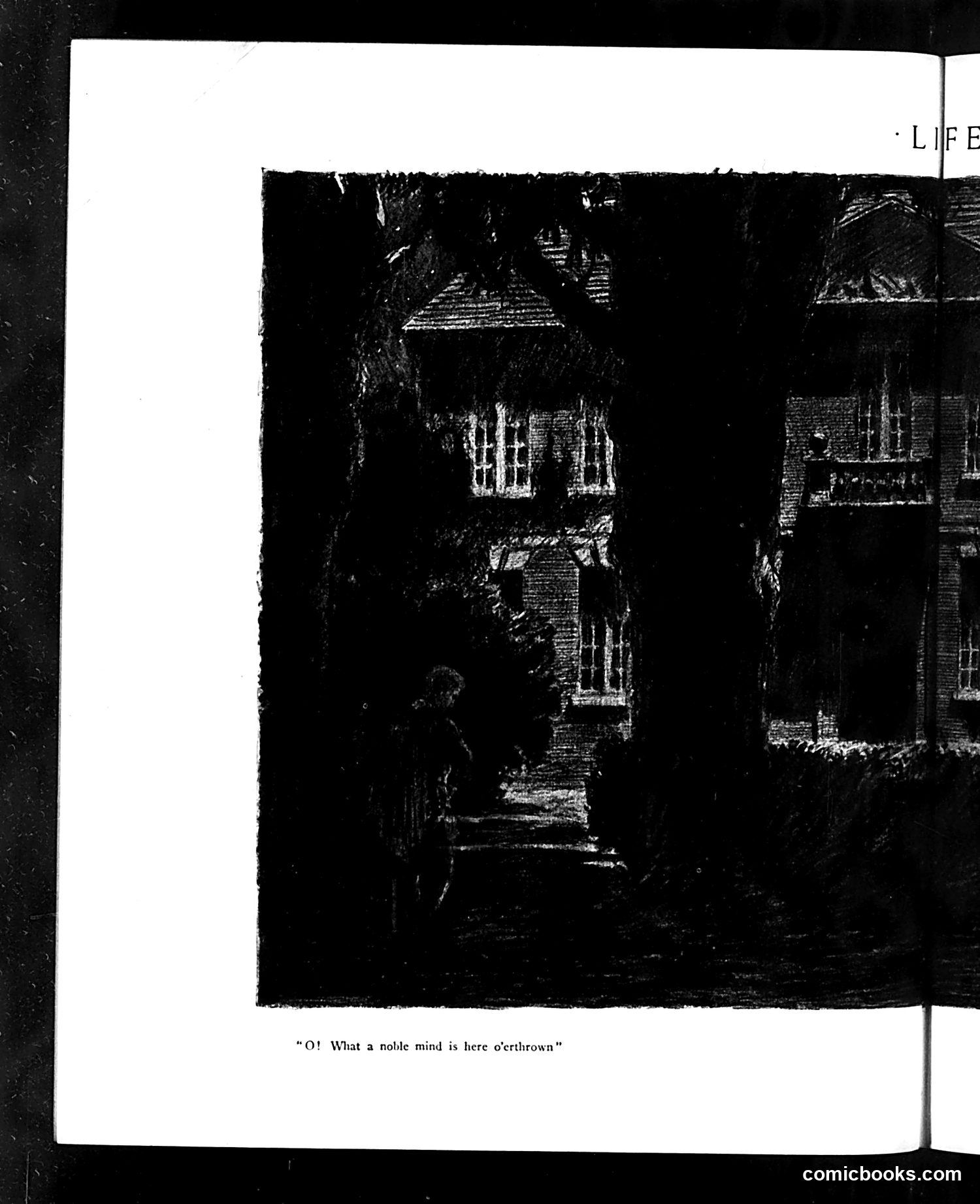
This appears to be a satirical illustration from Life magazine featuring a dark, shadowy scene of what looks like a classical or stately interior with brick buildings and windows visible through an archway or passage. The caption quotes Shakespeare's *Hamlet* ("O! What a noble mind is here o'erthrown"), suggesting the cartoon critiques someone's mental decline or loss of reason. The quote refers to Ophelia's lament over Hamlet's apparent madness. However, **without additional context about the date or visible identifying details of the figures**, I cannot definitively identify who this satirizes or what specific political/social event it references. The dramatic staging and Shakespearean reference suggest it mocks a prominent contemporary figure's perceived loss of mental faculties or judgment, but the specific target remains unclear from the image alone.
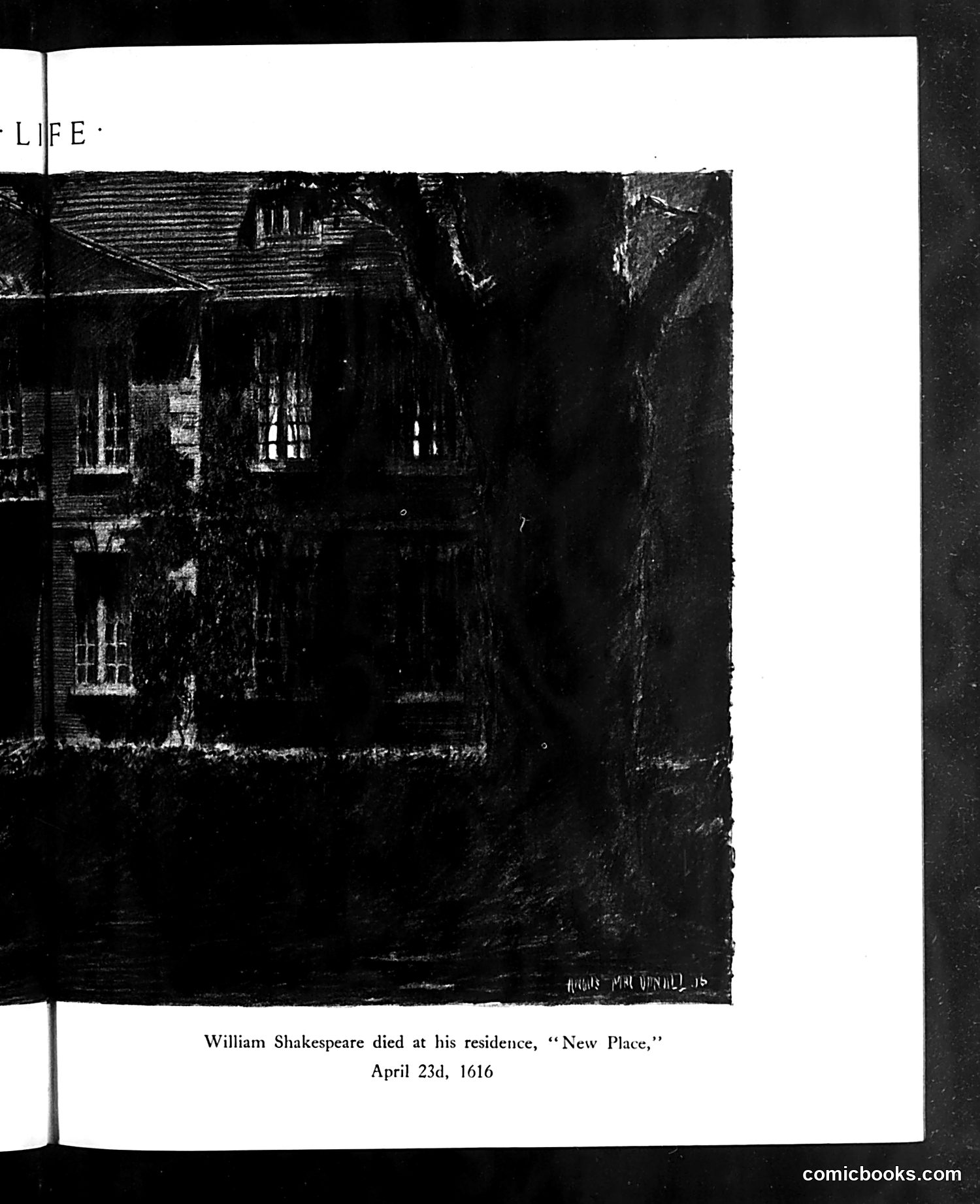
This is not a political cartoon or satirical content, but rather a **historical commemoration page** from *Life* magazine. The page features a dark, atmospheric photograph or engraving of "New Place," William Shakespeare's residence in Stratford-upon-Avon, England. The caption documents Shakespeare's death date: April 23rd, 1616. This appears to be a respectful memorial piece rather than satire—likely published around the 300th anniversary of his death (1916) or during another significant commemoration. The brick building shown appears to be a period structure, though the image quality is poor. The page's placement in *Life* (known for humor and social commentary) suggests the magazine occasionally published serious literary and historical tributes alongside its satirical content, demonstrating that 19th/early 20th-century American magazines served both entertainment and educational purposes.
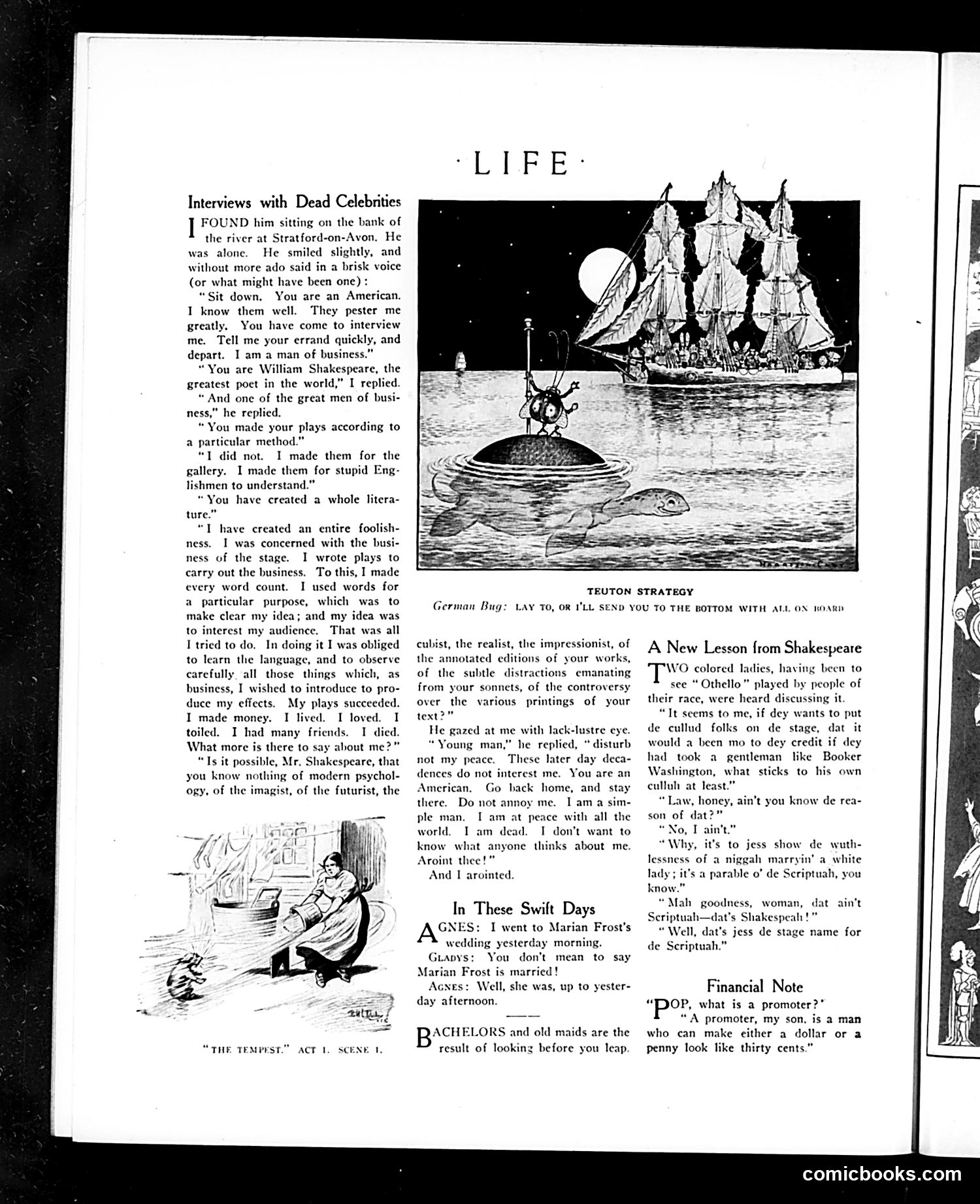
This page contains three satirical pieces from *Life* magazine: **"Interviews with Dead Celebrities"** presents Shakespeare as a no-nonsense businessman dismissing modern literary criticism (imagism, futurism, psychoanalysis). The joke: Shakespeare claims he wrote for "stupid Englishmen" to understand and make money—rejecting the notion that his work carries deep symbolic meaning. This satirizes over-intellectualization of literature. **"In These Swift Days"** is a brief joke about the speed of modern divorce ("up to yesterday afternoon"). **"A New Lesson from Shakespeare"** uses dialect humor (African American vernacular) to mock both the production of *Othello* with Black actors and the audiences' interpretations. One character misidentifies Shakespeare's themes as Biblical parables, confusing literature with scripture. The satire targets both racial stereotyping and audience ignorance. The accompanying illustrations show a ship ("Teuton Strategy") and a scene from *The Tempest*.
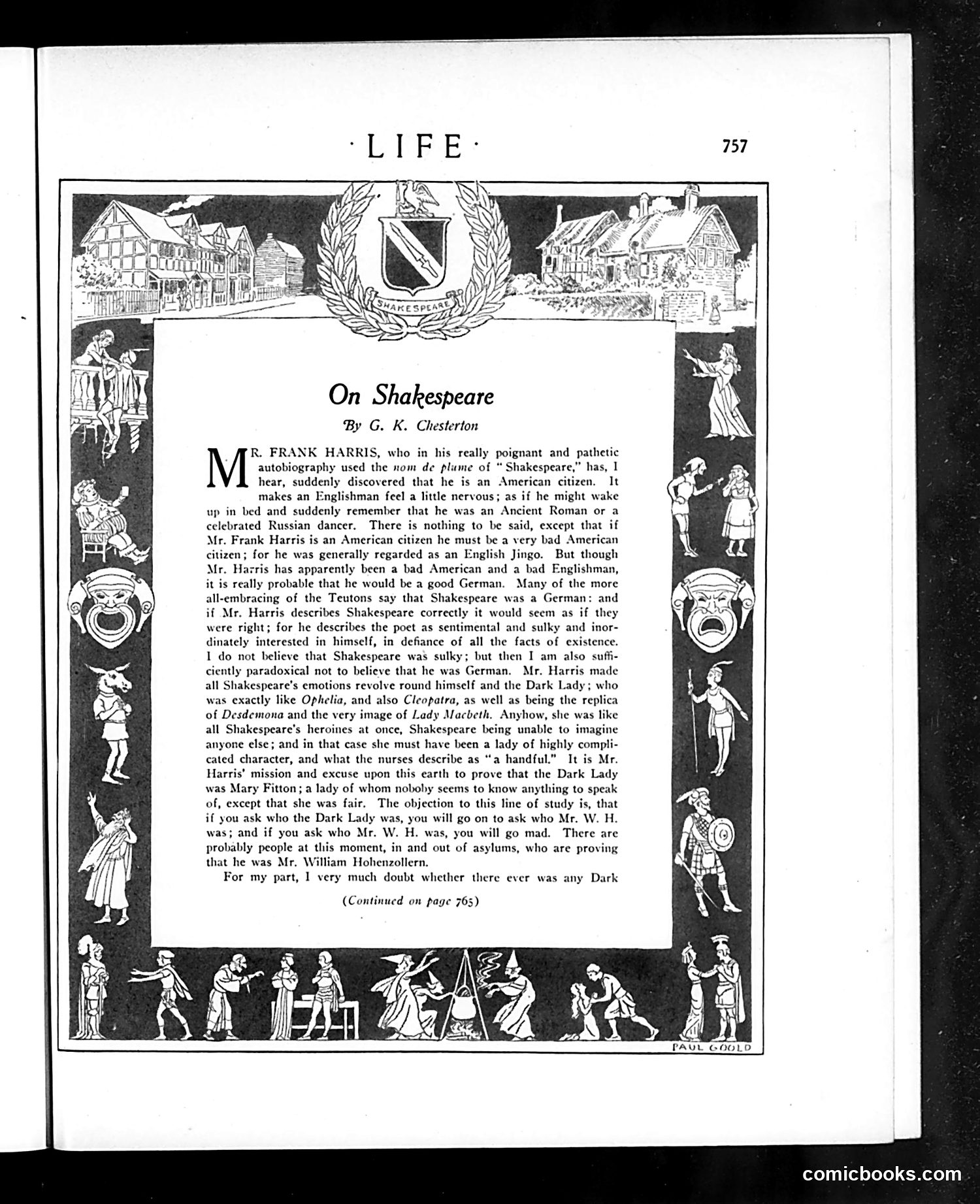
This is a literary essay satirizing Frank Harris, a controversial biographer who claimed Shakespeare used him as a pen name. Chesterton mocks Harris's shifting national identities (claiming American citizenship while previously regarded as English) and his obsessive theory that Shakespeare's works centered on a mysterious "Dark Lady" he identifies as Mary Fitton. The satire targets Harris's biographical method: imposing a single personal narrative onto Shakespeare's works and chasing unprovable historical details. Chesterton suggests this scholarly obsession leads to madness—comparing it to people claiming Shakespeare's mysterious patron "Mr. W.H." was Kaiser Wilhelm II (Hohenzollern). The decorated border contains Shakespearean theatrical scenes and Tudor-era imagery, reinforcing the classical subject matter being debated.
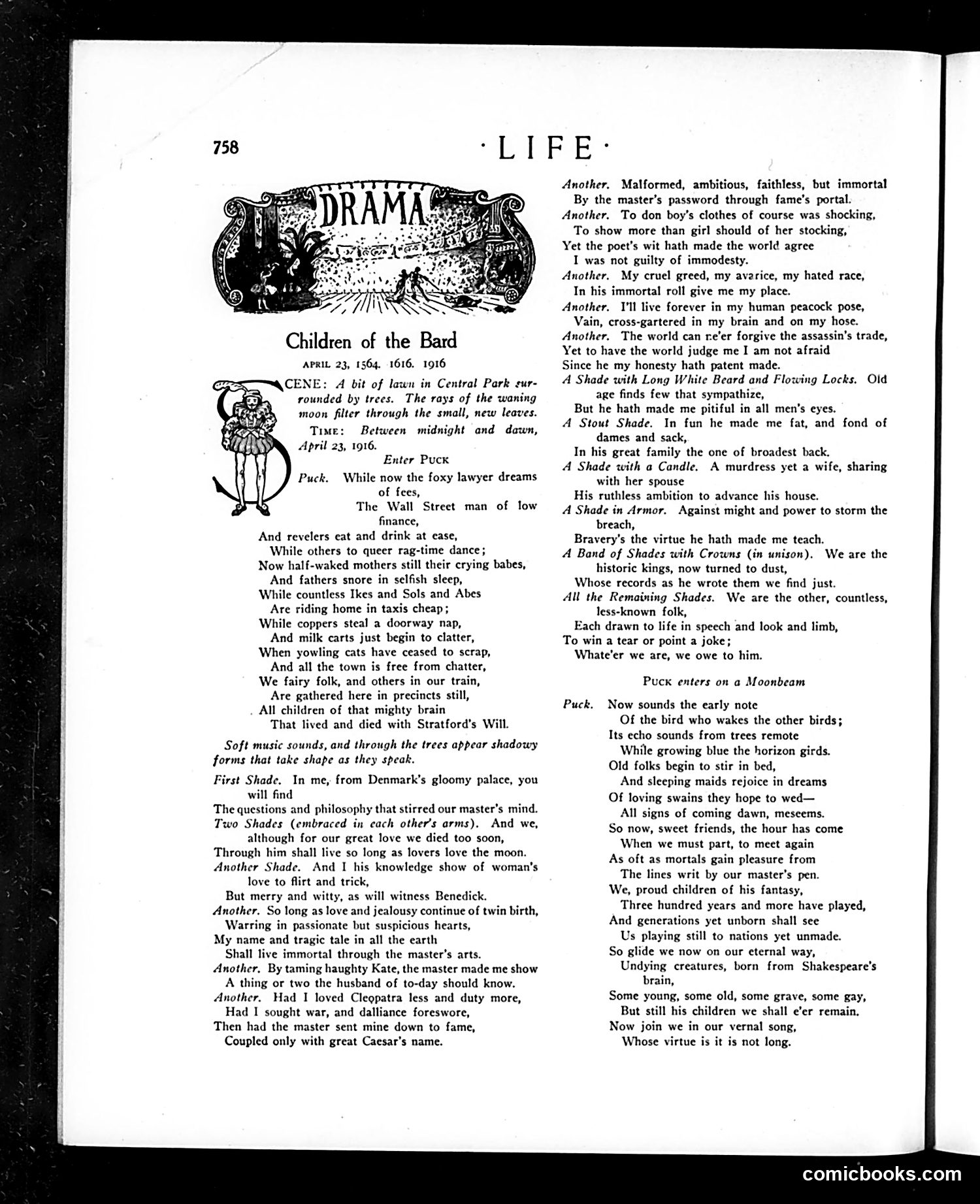
This is a commemorative theatrical piece celebrating the 300th anniversary of Shakespeare's death (April 23, 1616). The page presents a dramatic scene set in Central Park at midnight, where Puck—the fairy from *A Midsummer Night's Dream*—summons shadowy forms representing Shakespeare's most famous characters. Each character speaks, acknowledging their immortality through the playwright's genius. They include Hamlet (the melancholic Dane), Lady Macbeth (ambitious and murderous), Shylock (the moneylender, referencing "my hated race"), Rosalind (in disguise), Cleopatra, Katherina (the shrew), and various kings and minor figures. All celebrate how Shakespeare elevated them from fictional inventions into eternal, relatable human archetypes. The satire is affectionate: it's an elaborate tribute arguing that Shakespeare's characters remain more vivid and morally instructive than actual historical figures—they transcend time through art.
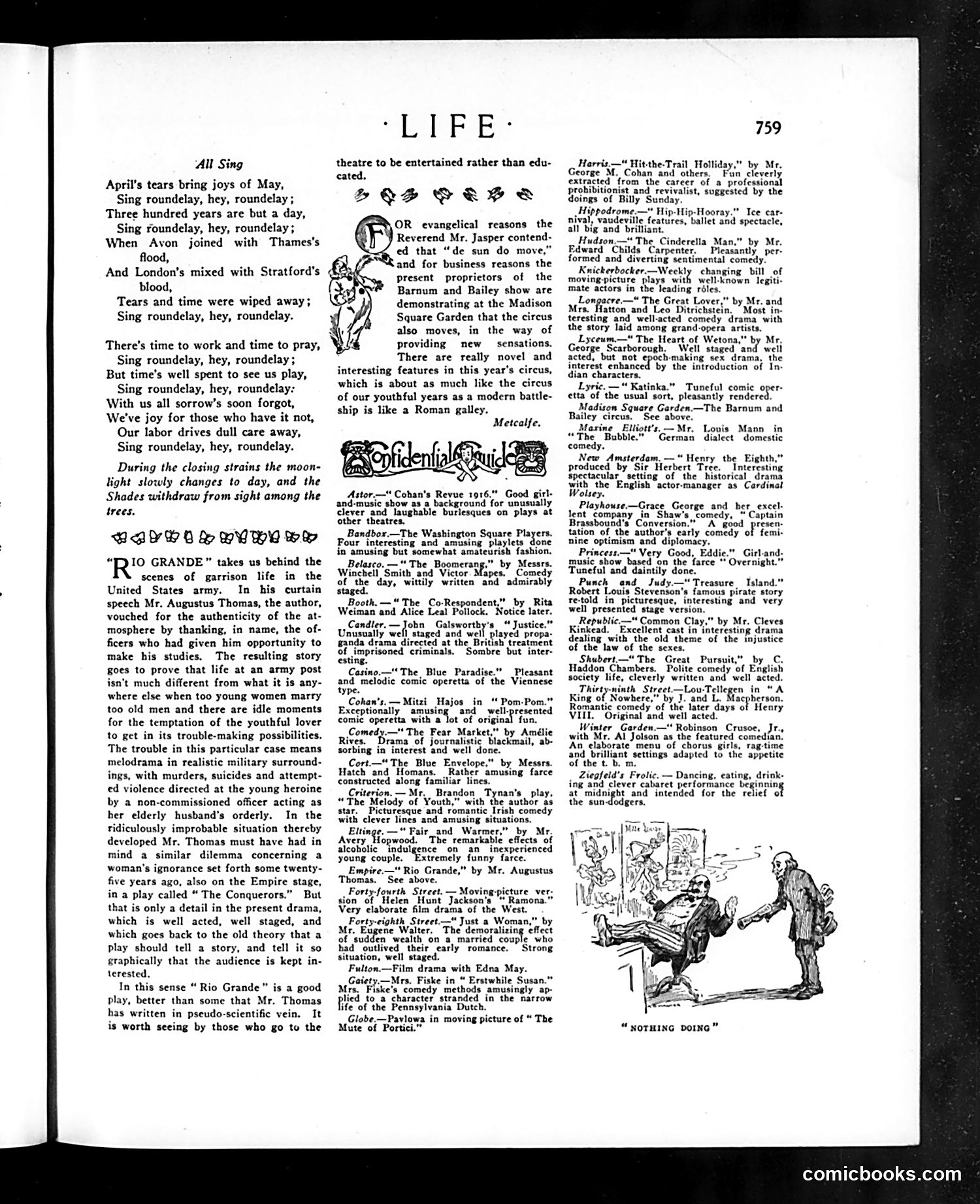
This page reviews theatrical productions on Broadway. The cartoon titled "NOTHING DOING" (bottom right) shows a man being forcibly ejected or thrown out, likely satirizing theatrical rejection or audience impatience with poor performances. The main text discusses Augustus Thomas's military melodrama "Rio Grande," which depicts garrison life with a plot involving a young woman married to an older officer and seduced by a younger soldier. The reviewer notes this echoes an earlier play called "The Conquerors" and critiques the melodramatic, implausible situations—yet admits it succeeds because it entertainingly tells a coherent story, which Thomas occasionally fails to do in his "pseudo-scientific" works. The page also lists other Broadway productions with brief reviews, including Galsworthy's "Justice" (praised as well-staged propaganda against British treatment of prisoners) and various comedies and operettas. The overall tone emphasizes that theatre should entertain audiences, not just educate them.
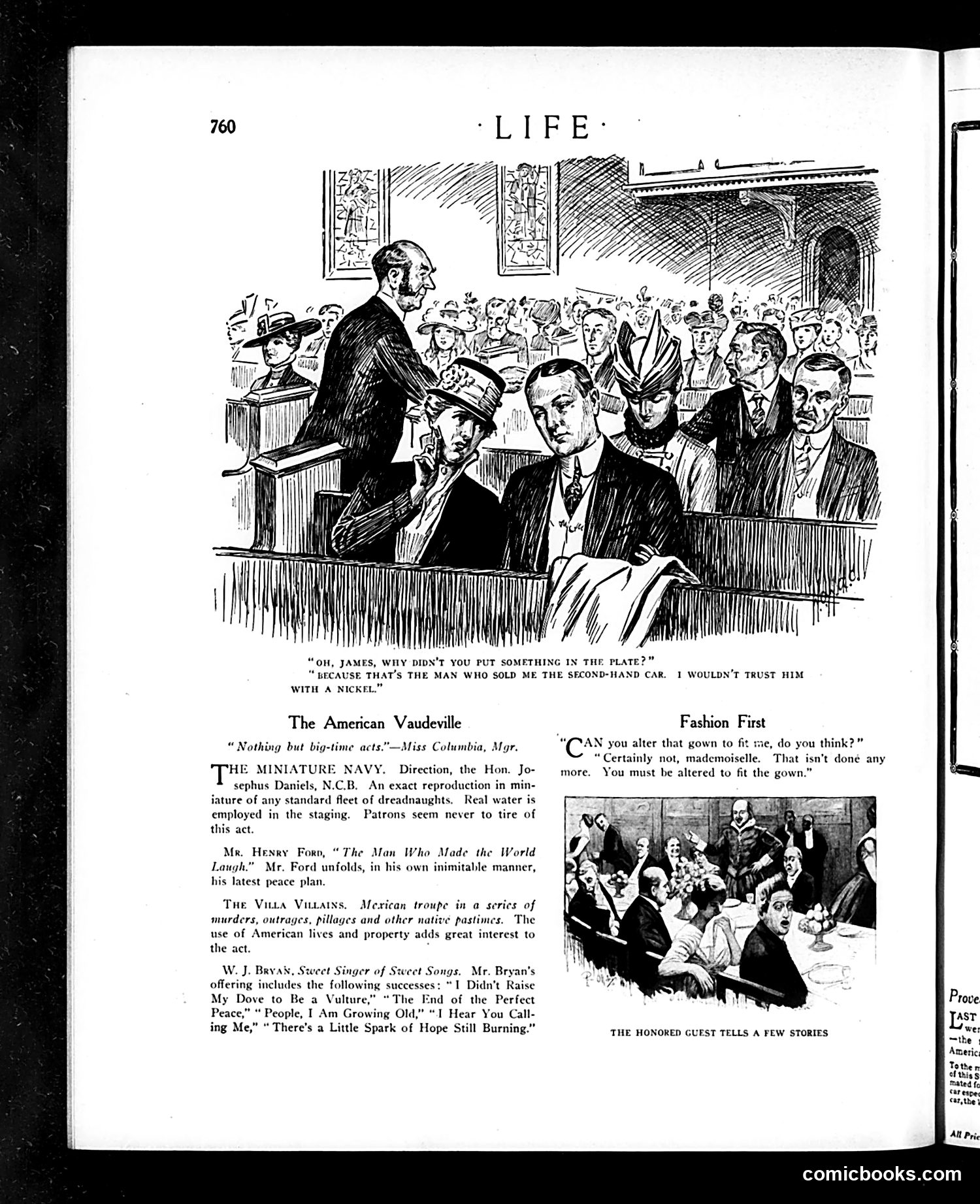
The main cartoon depicts a courtroom scene where a man refuses to contribute money to a church collection because the collector is someone who sold him a defective second-hand car. The joke satirizes the hypocrisy of people who distrust dishonest salesmen yet expect them to be trustworthy in other contexts—or conversely, the irony of encountering a known scoundrel in a sacred setting. Below, "The American Vaudeville" section parodies popular entertainments as theatrical acts, including: - Secretary Josephus Daniels' naval displays - Henry Ford's peace proposals - Mexican violence (likely referencing the Mexican Revolution) - William Jennings Bryan's political speeches These mockingly equate contemporary news and political figures with circus performers, suggesting their activities are spectacle rather than serious governance. The "Fashion First" sketch jokes about fashion's absurd priorities—altering a woman's body to fit a dress rather than vice versa.
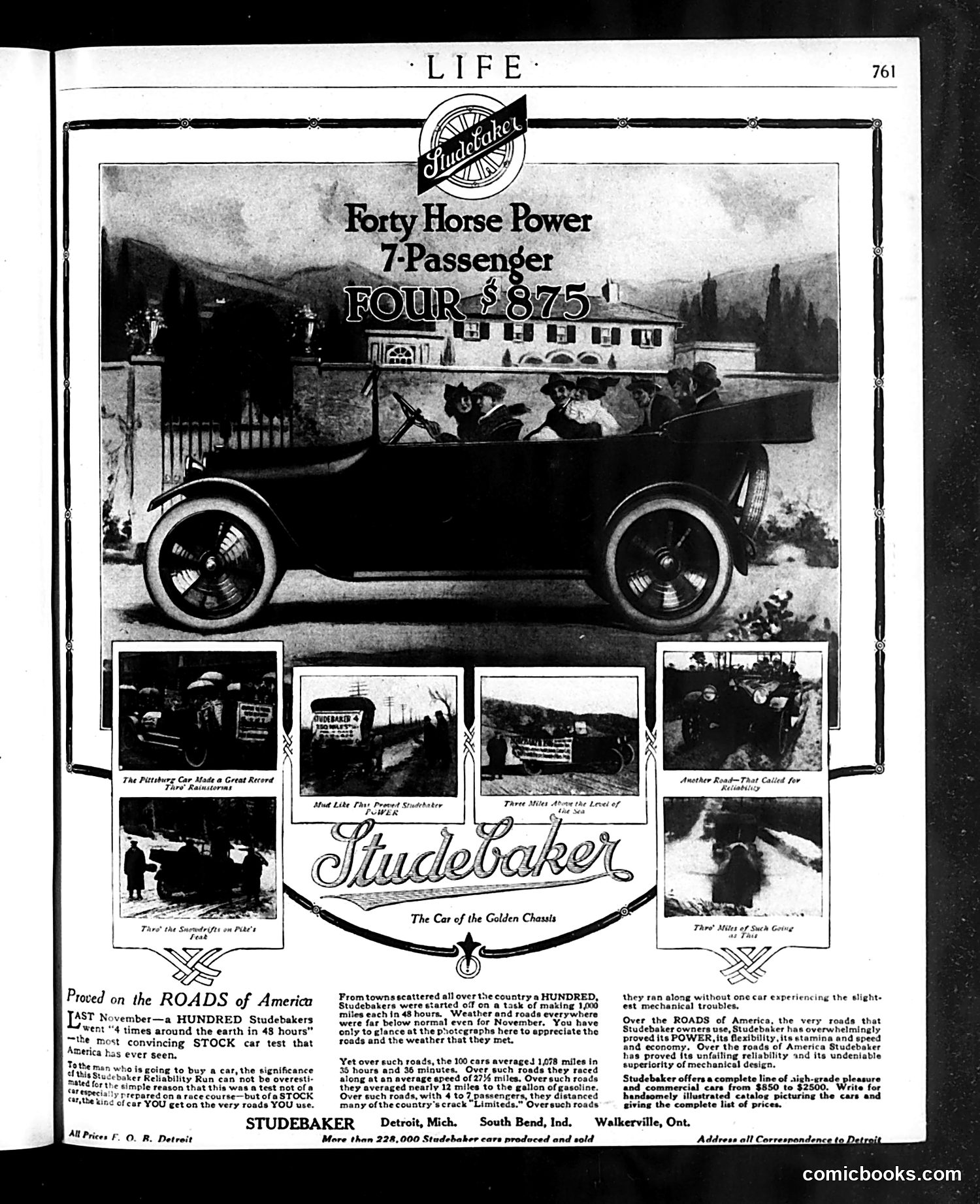
This is not satire or political commentary—it's a **straightforward automobile advertisement** from Life magazine. The page promotes the Studebaker "Four," a 7-passenger vehicle priced at $875. The central image shows the car in an idealized landscape setting. The advertisement's centerpiece is a publicity stunt: "a HUNDRED Studebakers went 4 times around the earth in 48 hours"—a reliability test conducted in November over actual American roads in poor weather conditions. The surrounding photographs document this test across various terrains (muddy roads, snow, mountains). The copy emphasizes that this was a test of **stock cars**, not specially modified racing vehicles, making it relevant to ordinary consumers. The advertisement's message is straightforward: Studebaker vehicles are reliable, powerful, and economical under real-world conditions. This represents early automotive advertising's shift toward data-driven claims rather than pure aesthetic appeal. The $850-$2500 price range indicates this was a mid-range manufacturer targeting middle-class buyers.
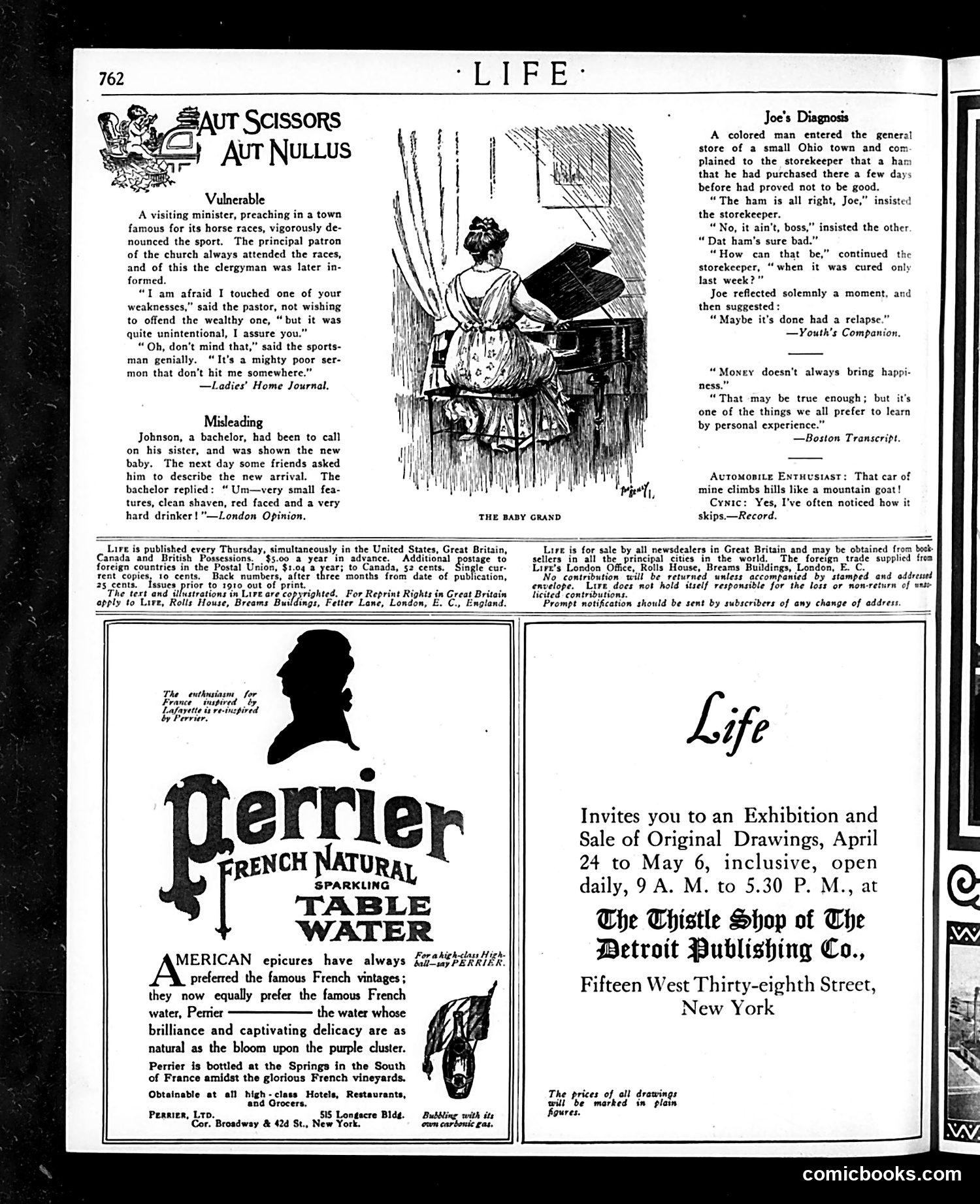
This page from *Life* magazine contains several brief humorous anecdotes and advertisements typical of early 20th-century American satirical journalism. **The Cartoons/Stories:** The page features four short comic pieces—"Vulnerable," "Misleading," "Joe's Diagnosis," and an untitled automobile joke—each illustrating common social situations. "The Baby Grand" illustration shows a domestic scene. These aren't political cartoons but rather gentle social humor: a clergyman's sermon accidentally hits a sportsman's weakness; a bachelor humorously misidentifies a baby as "hard drinking"; a Black man suggests a ham has had "a relapse" rather than admitting he stored it poorly; and an automobile enthusiast's car is mocked for "skipping" uphill. **The Advertisements:** The Perrier and Life magazine exhibition ads are standard period advertising, emphasizing French sophistication and art appreciation. The humor relies on light irony and misunderstanding rather than sharp satire—typical of early-20th-century *Life* magazine's genteel comedic approach.
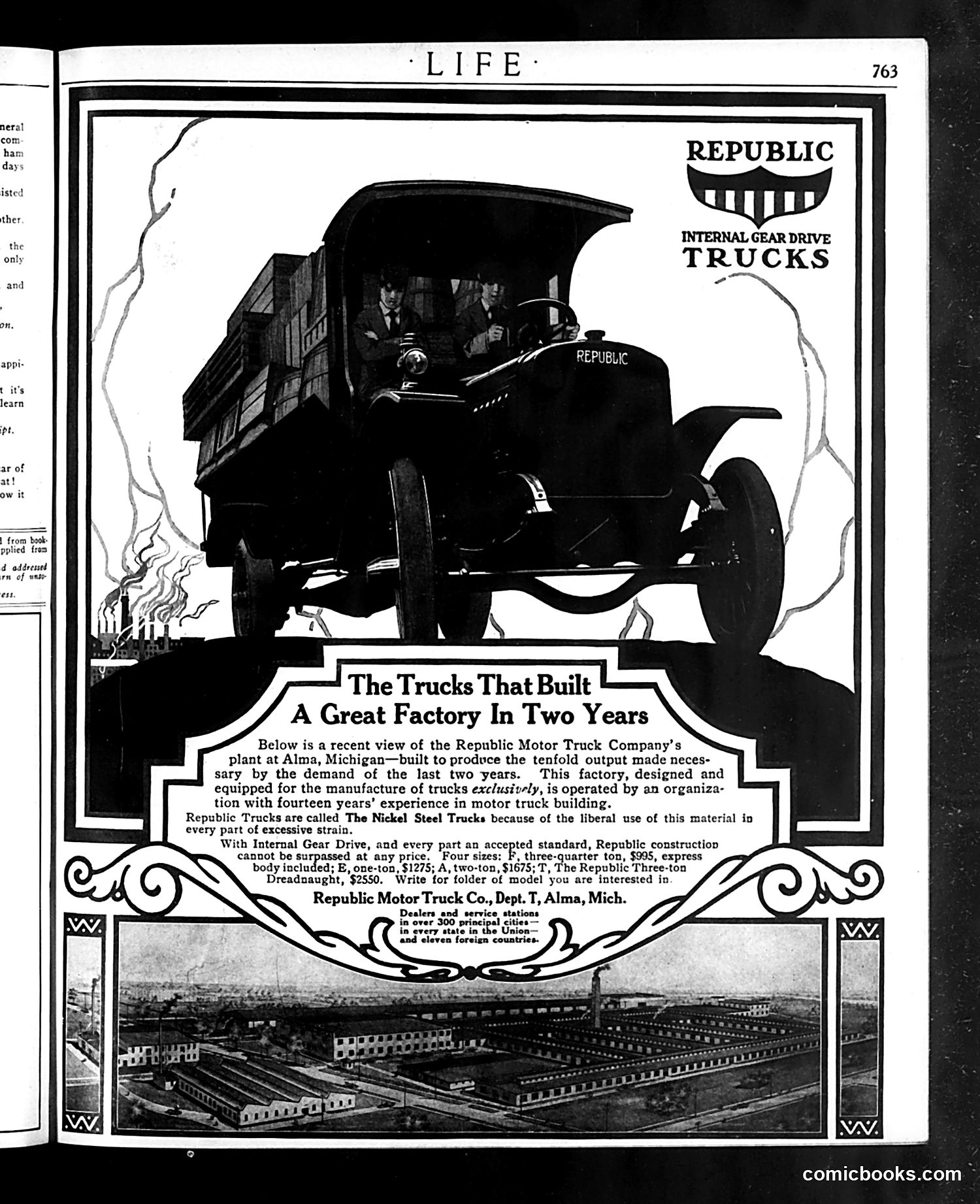
This is **not a cartoon or satire**—it's a straightforward **commercial advertisement** from Life magazine (page 763). The page promotes Republic Motor Trucks, manufactured in Alma, Michigan. The top illustration shows a truck actively hauling cargo, depicting the vehicle as practical and capable. Below is an aerial photograph of the company's factory, emphasizing its recent rapid expansion ("built...in two years") to meet wartime or postwar demand. The ad highlights technical features: "Nickel Steel" construction, "Internal Gear Drive," and standardized parts. Four truck sizes are listed with prices ranging from $995 to $2,550. The "Dreadnaught" model name (evoking the famous British warship) suggests this advertisement likely dates to the World War I era or immediately after, when industrial capacity and military-grade equipment were matters of national pride and commercial appeal. This represents typical early-20th-century trade advertising: emphasizing American manufacturing prowess, technical innovation, and rapid industrial growth.
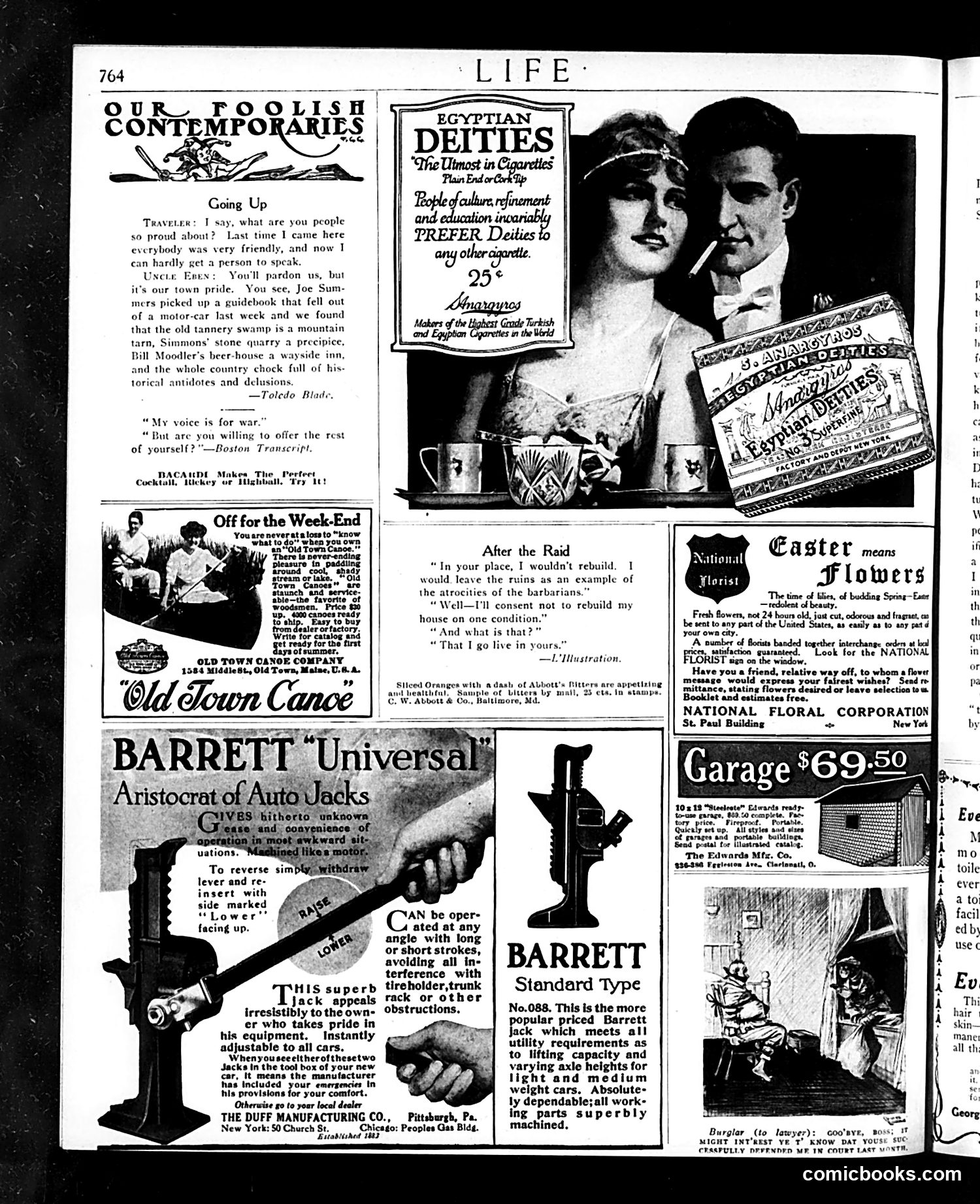
This LIFE magazine page contains satirical content about small-town pride and war sacrifice, alongside period advertisements. **The Main Cartoon ("Going Up"):** A traveler notices a small town's residents have suddenly become proud and unfriendly. The joke: they've discovered that their mundane local features—a swamp, quarry, beer house—match descriptions in a guidebook as "mountain tarn," "precipice," and "wayside inn." The satire mocks how people inflate their town's importance through rebranding. **"After the Raid":** This appears to reference WWI destruction. A man refuses to rebuild his home as a moral monument to "barbarian atrocities," but only if the critic will host him instead—satirizing performative moral posturing. **Other Elements:** Brief quotes mock war rhetoric ("My voice is for war" vs. "willing to offer the rest of yourself?"), suggesting hypocrisy among those supporting warfare without personal sacrifice. **The Advertisements:** Barrett auto jacks, Old Town Canoes, and National Floral Corporation dominate the page—typical commercial content of the era.
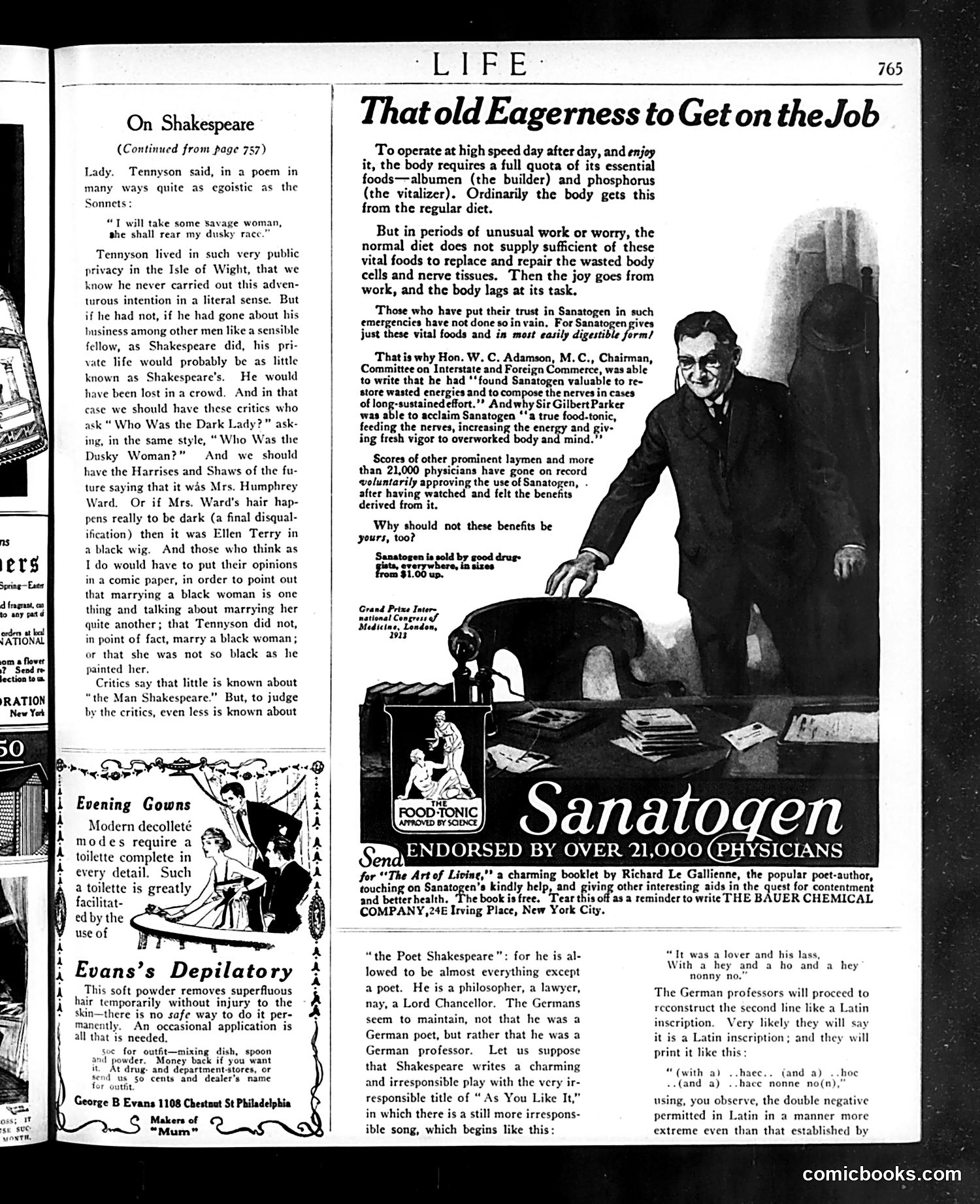
This page mixes literary criticism with period advertising. The left column continues a essay on Shakespeare, defending him against scholars who obsess over biographical details (like the "Dark Lady" of his sonnets). The author argues Shakespeare would be as obscure as Tennyson if he hadn't lived publicly—critics invented mysteries where none exist. The main content is a **Sanatogen advertisement**—a patent medicine/nutritional supplement popular in the early 20th century. The large illustration shows an energetic businessman at his desk, endorsed by "over 21,000 physicians." The ad claims Sanatogen restores energy during stressful work by providing essential proteins and phosphorus. Notable endorsers mentioned include U.S. Congressman W.C. Adamson and British author Sir Gilbert Parker, lending false credibility. The adjacent "Evans's Depilatory" ad addresses women's grooming. By modern standards, these "endorsed by doctors" health claims would be considered unsubstantiated marketing—typical of unregulated patent medicine advertising before FDA oversight.
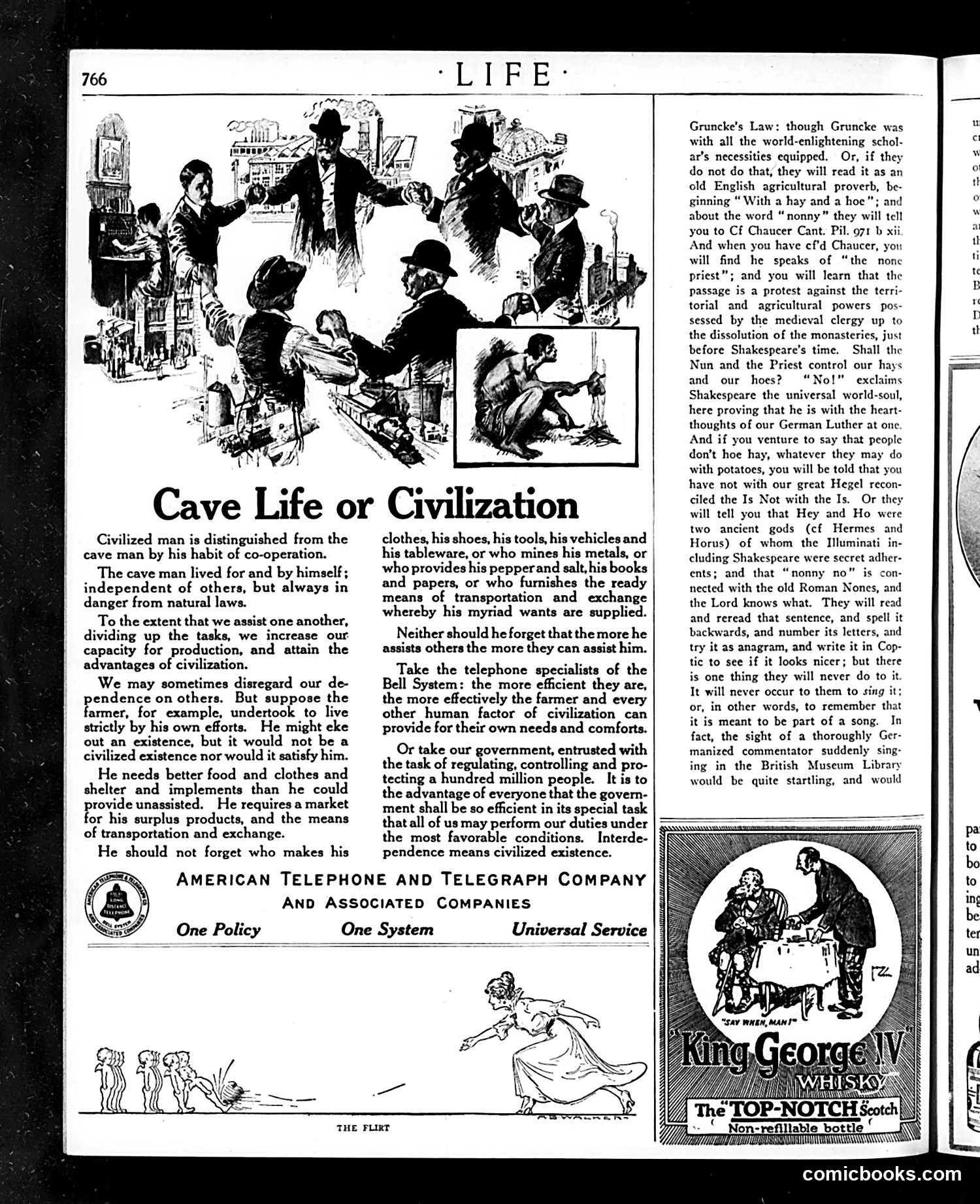
This is primarily an **advertisement for AT&T**, disguised as editorial content about civilization and interdependence. The cartoon illustrates the contrast between primitive "cave man" self-sufficiency and modern civilized cooperation. The accompanying text argues that civilization depends on specialization and mutual reliance—farmers need tools, transportation, communication systems, and government services. The advertisement's explicit purpose is to justify AT&T's monopoly by claiming telephone specialists' efficiency benefits everyone, including farmers. By framing the Bell System as essential infrastructure alongside government, it presents the company as performing a public service rather than pursuing profit. The ad reflects early 20th-century corporate messaging defending big business consolidation as beneficial to society. The "one system, one policy, universal service" slogan promoted AT&T's controlled network model as superior to competition. The King George IV whisky ad below is unrelated advertising filler.
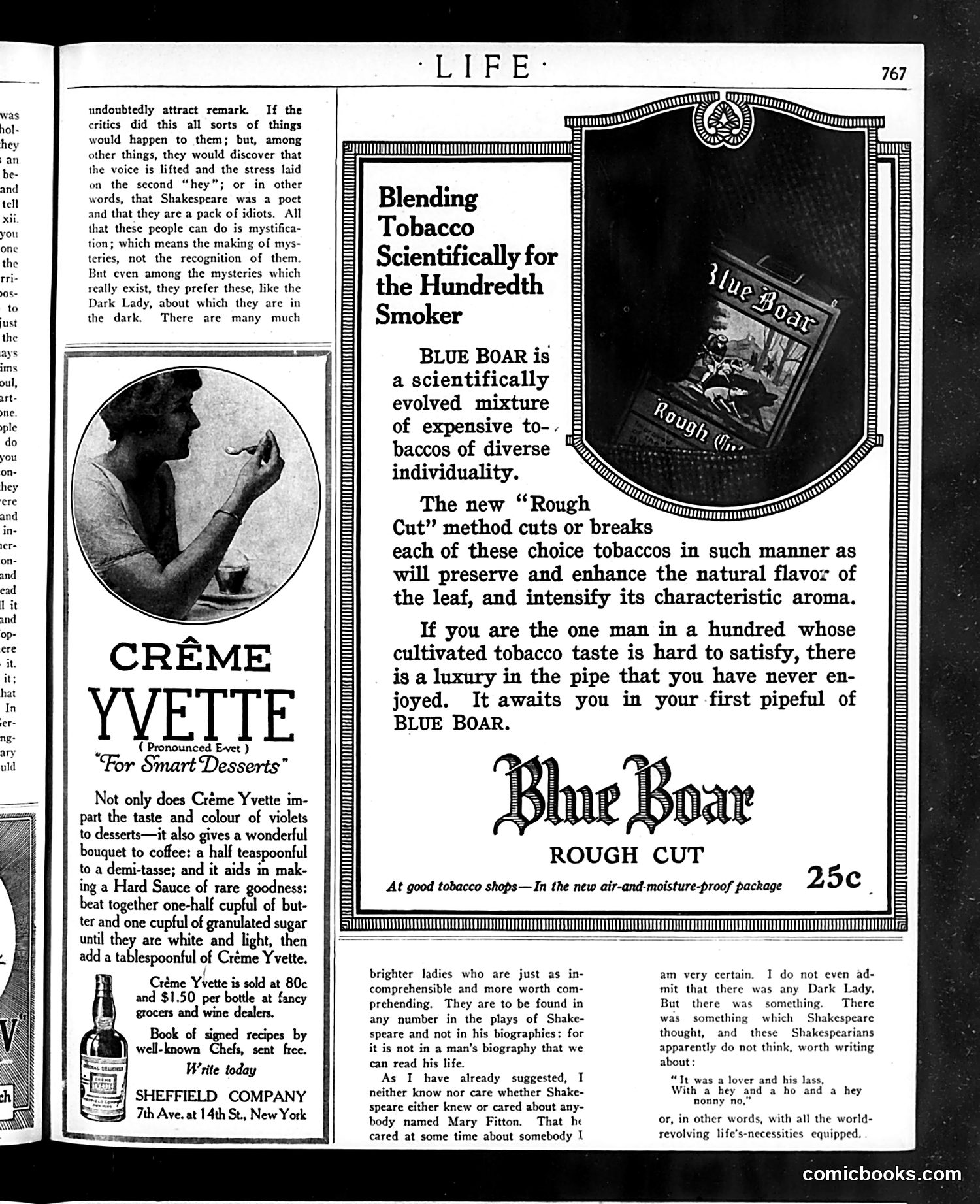
This is primarily **advertising**, not satire or editorial content. The page contains two product ads: 1. **Crème Yvette** (left): A violet-flavored liqueur marketed as an ingredient for desserts and coffee, sold by the Sheffield Company. 2. **Blue Boar Rough Cut tobacco** (right): Pipe tobacco advertised as scientifically blended for the "hundredth smoker"—targeting men with discriminating taste. The "Rough Cut" method supposedly preserves natural leaf flavor. The surrounding text discusses Shakespeare's poetry and biographical mysteries, particularly references to the "Dark Lady" of the sonnets—likely included as contextual magazine content rather than related to the advertisements. **For modern readers**: These ads reflect early 20th-century luxury product marketing targeting educated, affluent consumers. The tobacco ad is notable today primarily as a historical artifact of an era when tobacco was openly advertised without health warnings.
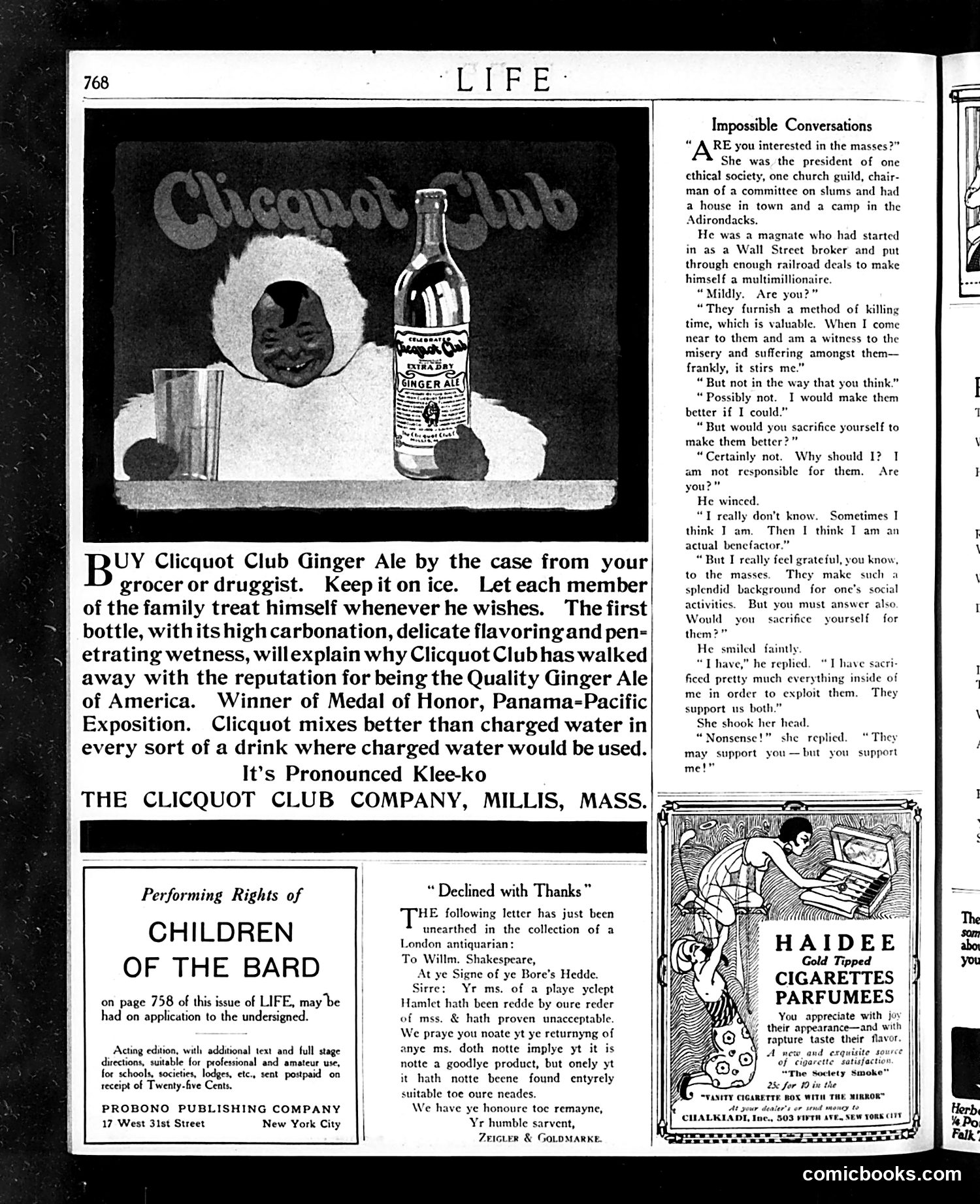
This page contains three distinct pieces of content: **Clicquot Club Ginger Ale Advertisement**: A full-page ad promoting the beverage as "Quality Ginger Ale of America," emphasizing its carbonation and mixing qualities. The image shows a bottle with decorative background. **"Declined with Thanks" Satire**: A humorous fake rejection letter to William Shakespeare regarding his play *Hamlet*, written in pseudo-archaic language. It mockingly mimics standard publisher rejection letters, implying even Shakespeare's masterpiece would be rejected by modern publishers—a joke about editorial gatekeeping and changing tastes. **"Impossible Conversations"**: A satirical dialogue between a wealthy philanthropist woman and a railroad magnate discussing their attitudes toward "the masses." The satire exposes their hypocrisy: she claims moral concern for the poor while maintaining social distance; he admits exploiting workers while claiming to be a "benefactor." The conversation reveals that both use the poor instrumentally—as backdrop for social activities or profit—rather than genuinely helping them. The page also advertises Haidee cigarettes and performing rights for "Children of the Bard."
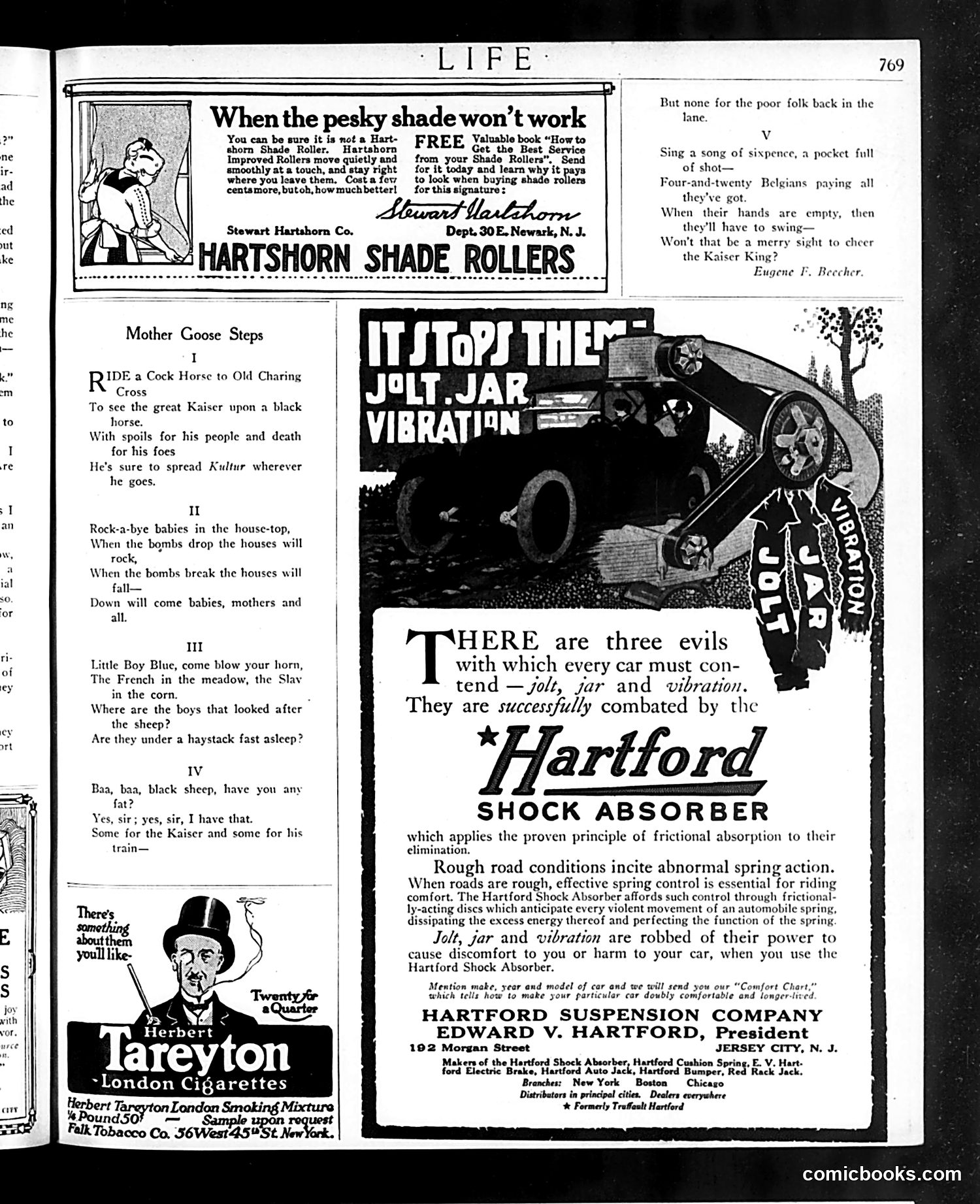
This page contains **anti-German WWI propaganda** disguised as nursery rhymes. The "Mother Goose Steps" section parodies traditional children's verses to mock Kaiser Wilhelm II and German militarism: - Verse I depicts the Kaiser as a conquering warmonger spreading "Kultur" (German culture/ideology) - Verse II uses the "Rock-a-bye Baby" format to darkly reference German bombing of civilian homes - Verse III references the war's human cost—missing soldiers ("boys") - Verse IV satirizes resource rationing, with supplies going to "the Kaiser and his train" The opening verse ("Sing a song of sixpence") mocks Belgian suffering and suggests the Kaiser won't stop until his resources are exhausted. This represents American anti-German sentiment during or around WWI, using familiar children's rhymes to make propaganda accessible and memorable to readers. The juxtaposition with mundane advertisements for shade rollers, cigarettes, and car parts creates absurdist contrast typical of Life's satirical approach.
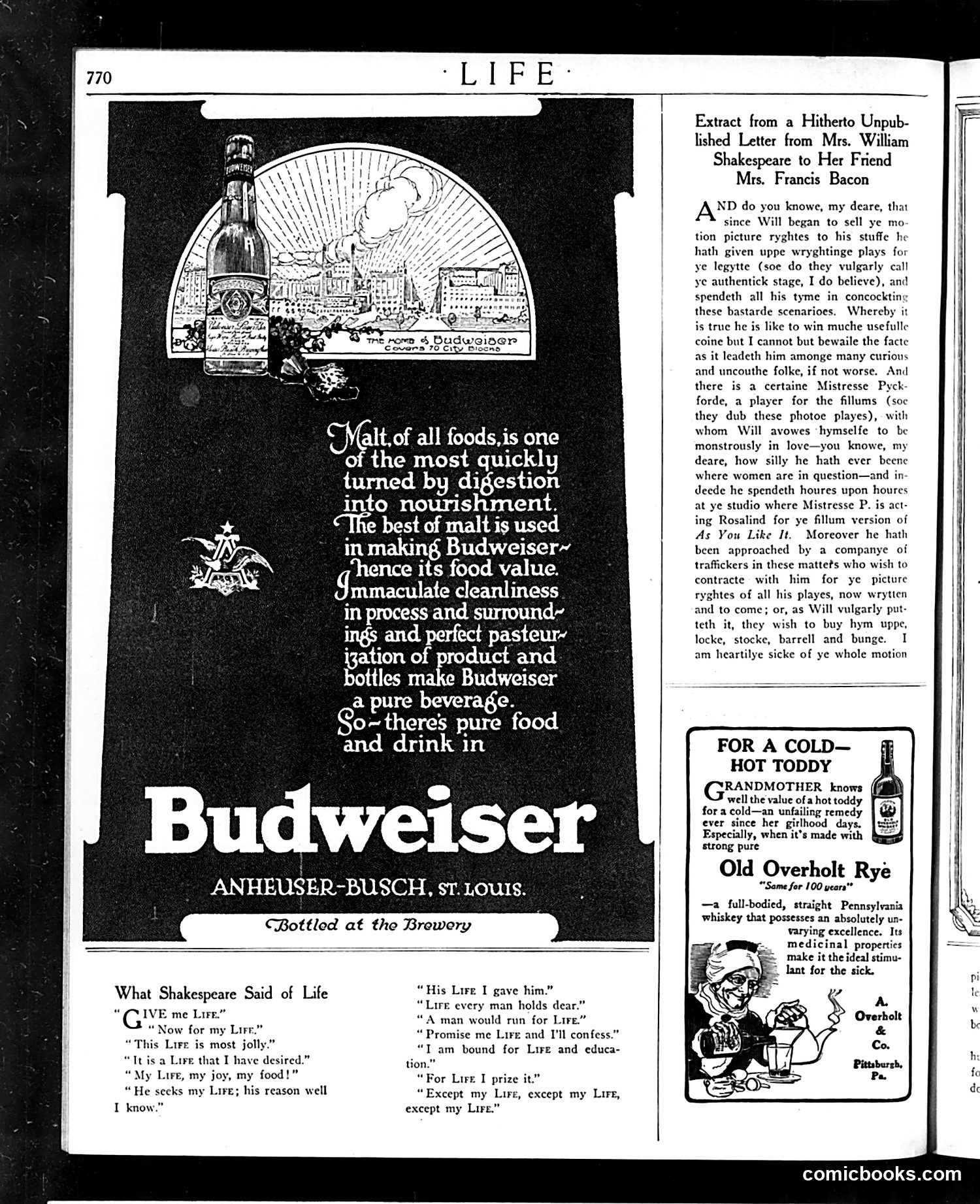
This page satirizes the early film industry's impact on established writers. The main humor targets William Shakespeare himself—presented as abandoning serious playwriting for lucrative movie contracts. The satirical "unpublished letter" from Mrs. Shakespeare complains that Will has stopped writing for the legitimate stage to sell film rights and spend time at studios with actress "Mistresse Pycforde" (likely a reference to Mary Pickford, a major silent film star). She laments that traffickers want to buy up all his plays "for ye picture ryghtes." The accompanying Shakespeare quotes about "Life" are clever—using actual Shakespearean text about life/livelihood to create absurdist humor about the playwright's obsession with cinema money. The satire reflects real anxieties of the 1910s-20s: that motion pictures were luring away serious artists and corrupting traditional theater. The mock-archaic language adds comedic distance while making the critique pointed—even the Bard himself cannot resist Hollywood's appeal.
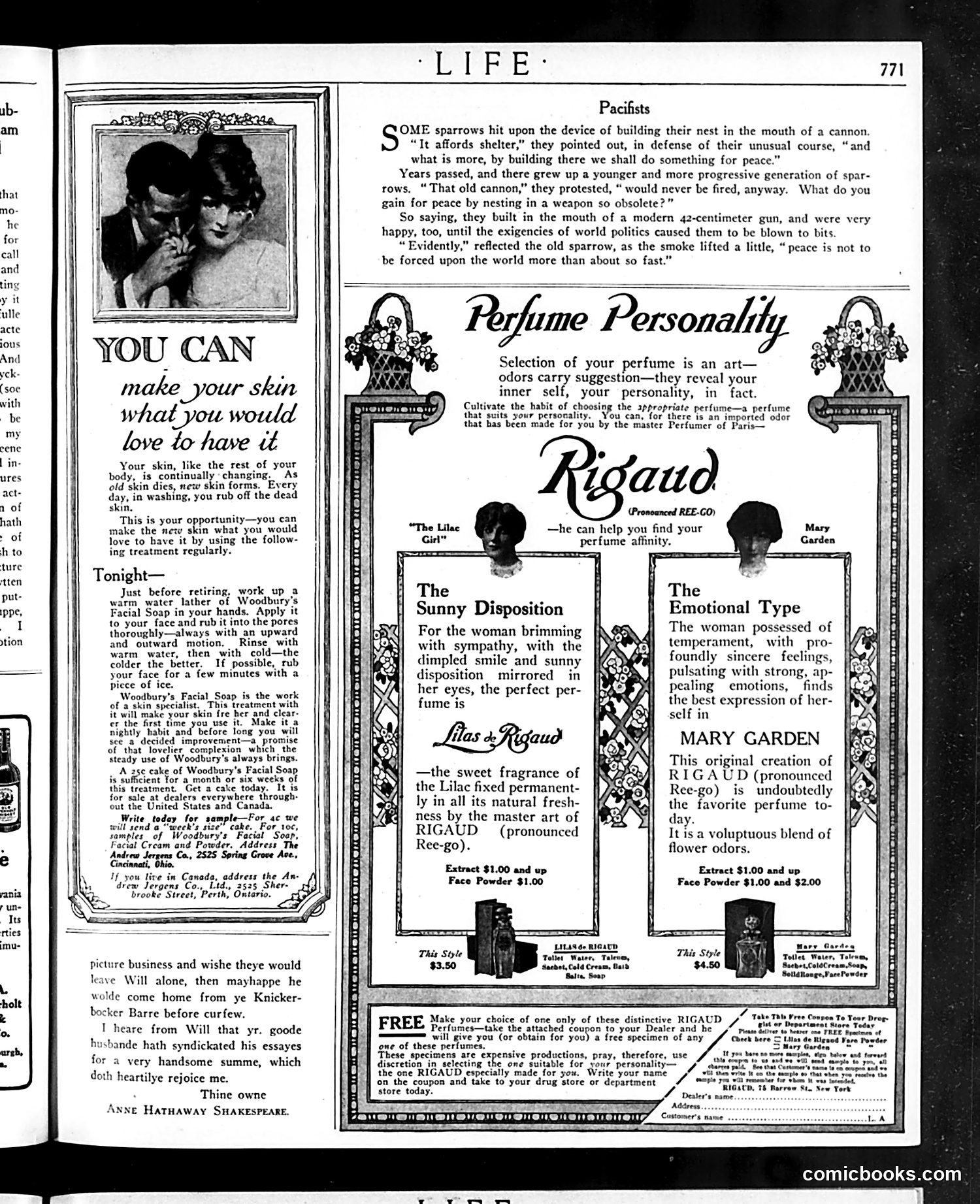
This page contains a satirical short story titled "Pacifists" alongside perfume advertisements. ## The Cartoon/Story The "Pacifists" fable mocks naive pacifism through an allegory: sparrows build nests in cannon barrels as a "peace gesture," believing weapons won't be used. A younger generation dismisses the old cannon as obsolete and nests in a modern 42-centimeter gun instead—only to be destroyed when the gun fires. The elderly sparrow's reflection concludes that peace cannot be forced on the world quickly. **The satire:** This likely references 1920s-1930s pacifist movements that believed disarmament or non-resistance would prevent war. Life's editors suggest such idealism is dangerously naive; ignoring military realities won't prevent conflict. The "obsolete" versus "modern" gun detail suggests technological advancement makes pacifism even more foolish. ## The Advertisements The remainder is commercial: Woodbury's Facial Soap and Rigaud perfume ads emphasizing how product selection reflects personality and femininity—typical 1920s-30s messaging linking consumption to identity. **Historical context needed:** This satirizes specific pacifist political movements of the interwar period.
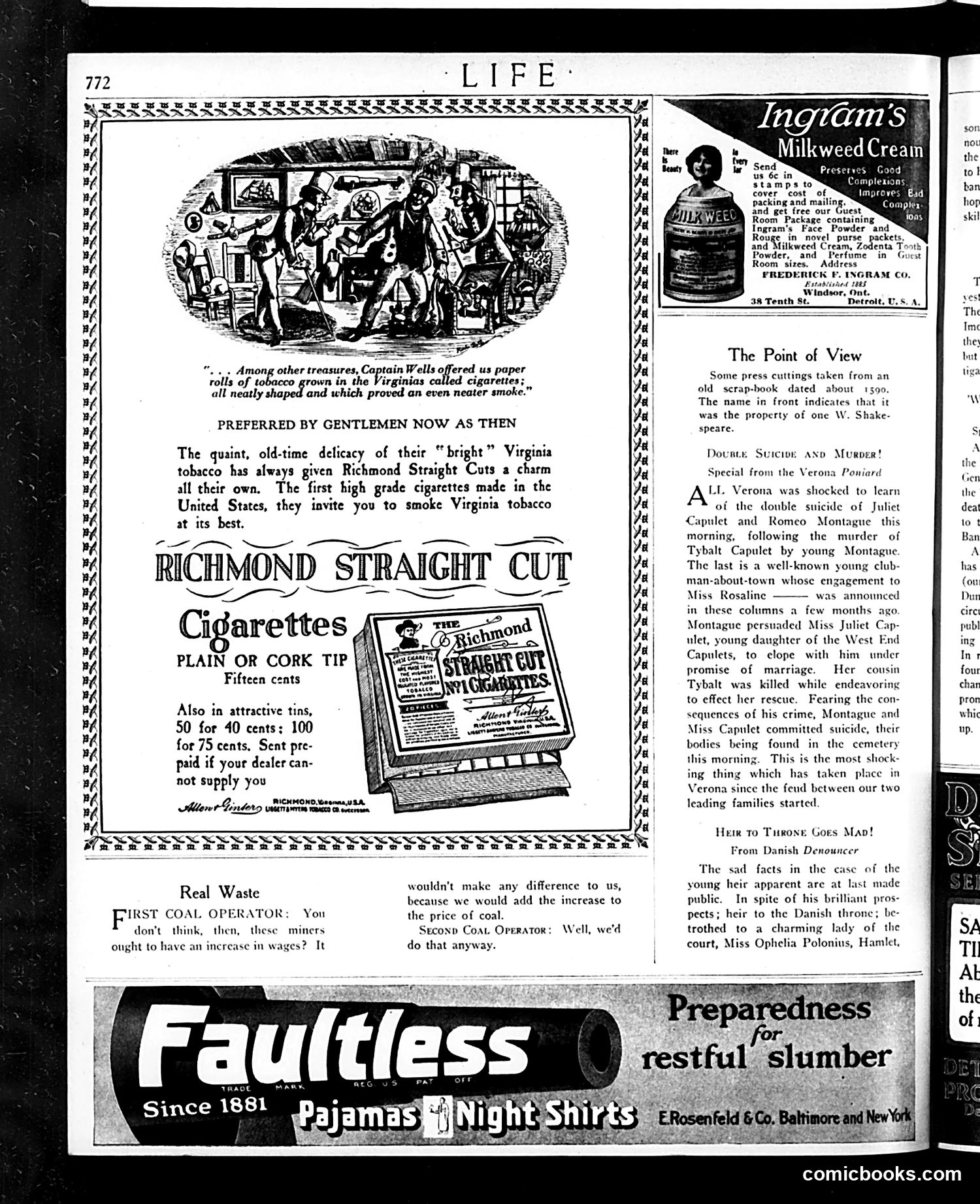
This page is primarily **advertising and filler content**, not political satire. The main items are: **Richmond Straight Cut Cigarettes ad**: A historical pitch claiming these were "the first high grade cigarettes made in the United States," appealing to gentlemen by invoking colonial-era tobacco tradition. The decorative vignette depicts early American scenes. **"Real Waste" dialogue**: A brief comic exchange between two coal operators, satirizing labor disputes. The first operator questions whether miners deserve wage increases; the second responds cynically that costs would simply be passed to consumers anyway—mocking both capitalist indifference to worker welfare and the inevitability of inflation. **"The Point of View"**: A humorous section presenting Shakespeare's *Romeo and Juliet* and Hamlet as if they were contemporary newspaper items from 1590 Verona and Denmark, treating fictional tragedies as local scandals. It's light literary humor for educated readers. The page also includes period advertisements for Ingram's Milkweed Cream and Faultless Pajamas. This is typical early 20th-century magazine filler blending commerce with gentle humor.
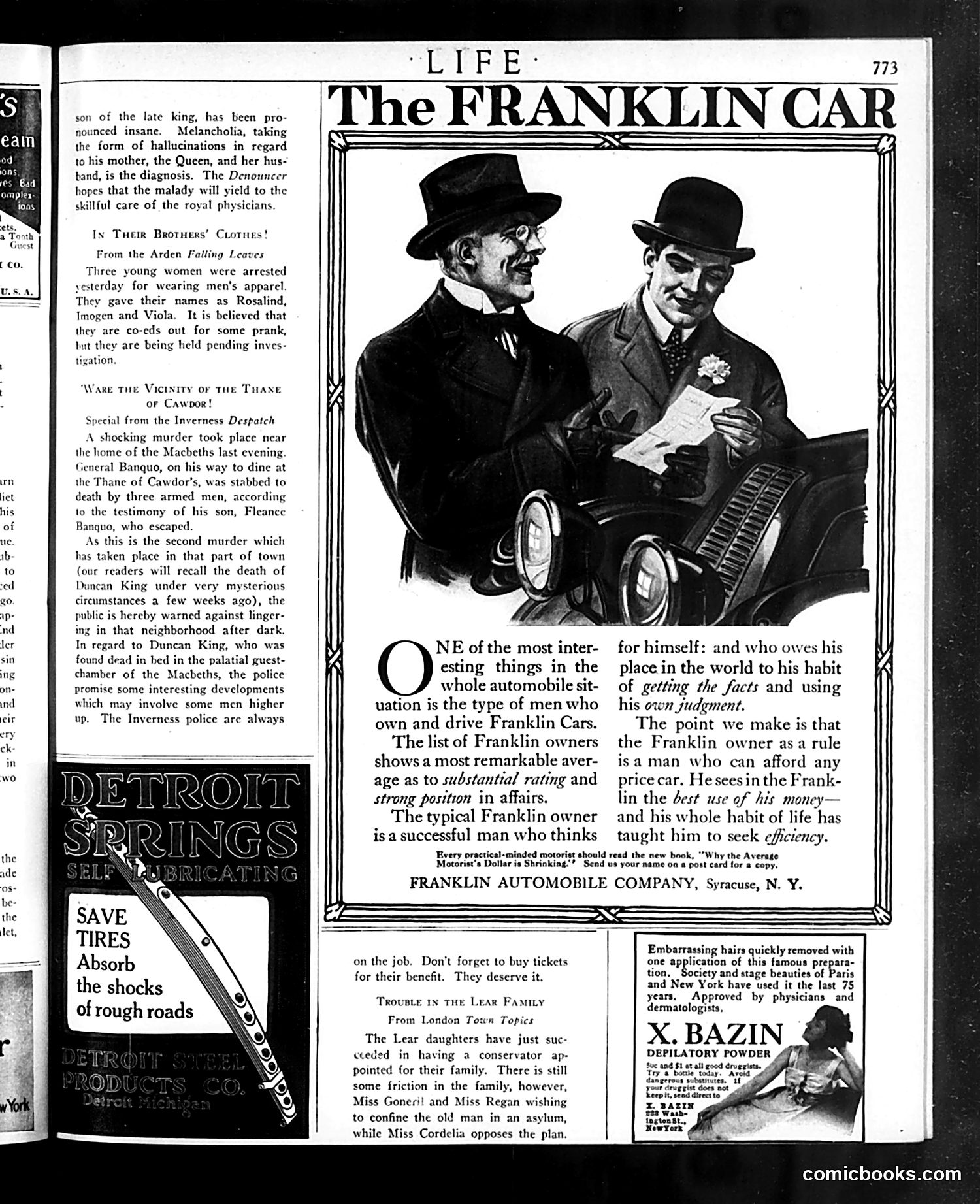
This Life magazine page combines a Franklin automobile advertisement with satirical news briefs referencing Shakespeare plays as if they were current events. **The Main Advertisement** features two well-dressed men examining a Franklin car. The copy emphasizes that Franklin owners are successful, practical men of means who choose the car for efficiency rather than ostentation—positioning the Franklin as the choice of intelligent, self-made businessmen. **The Satirical "News Briefs"** mock Shakespeare by treating his plots as contemporary scandals: - "In Their Brothers' Clothes" references *As You Like It* (women arrested for cross-dressing) - "Ware the Vicinity of the Thane of Cawdor" treats *Macbeth* as a crime report - "Trouble in the Lear Family" presents *King Lear* as a guardianship dispute The humor relies on readers recognizing these famous plays and finding amusement in their transposition into mundane modern newspaper language. This was a common Life magazine strategy: literary sophistication for educated readers.
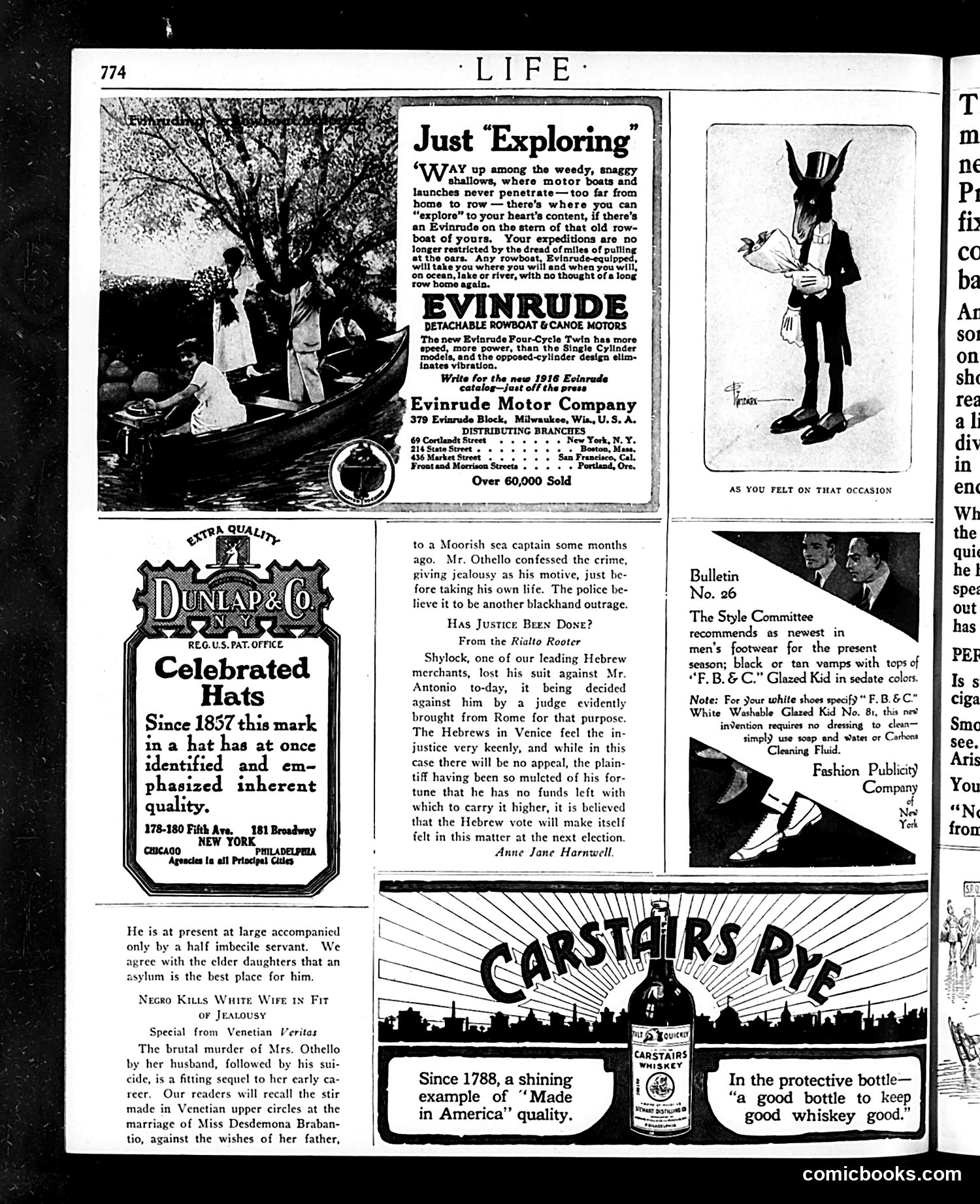
This page contains **literary satire disguised as news reports**. The "Rialto Rooter" and "Venetian Veritas" sections are fictionalized retellings of Shakespeare's *Othello* and *The Merchant of Venice*, presented as contemporary Venetian gossip. The satire works by treating classic literary tragedies as scandalous current events: Othello's murder-suicide becomes a "blackhand outrage," while Shylock's lost lawsuit is framed as evidence of anti-Semitic bias in the courts—with the darker implication that Venice's Jewish voters will seek revenge at elections. The cartoons mock both the fictional characters' circumstances and, implicitly, real prejudices. The upper cartoon labeled "As You Felt On That Occasion" appears to show a figure in formal dress, likely satirizing pretense or hypocrisy. The rest of the page is **period advertising** (Evinrude motors, Dunlap hats, Carstairs whiskey, shoe polish)—typical of Life's commercial content.
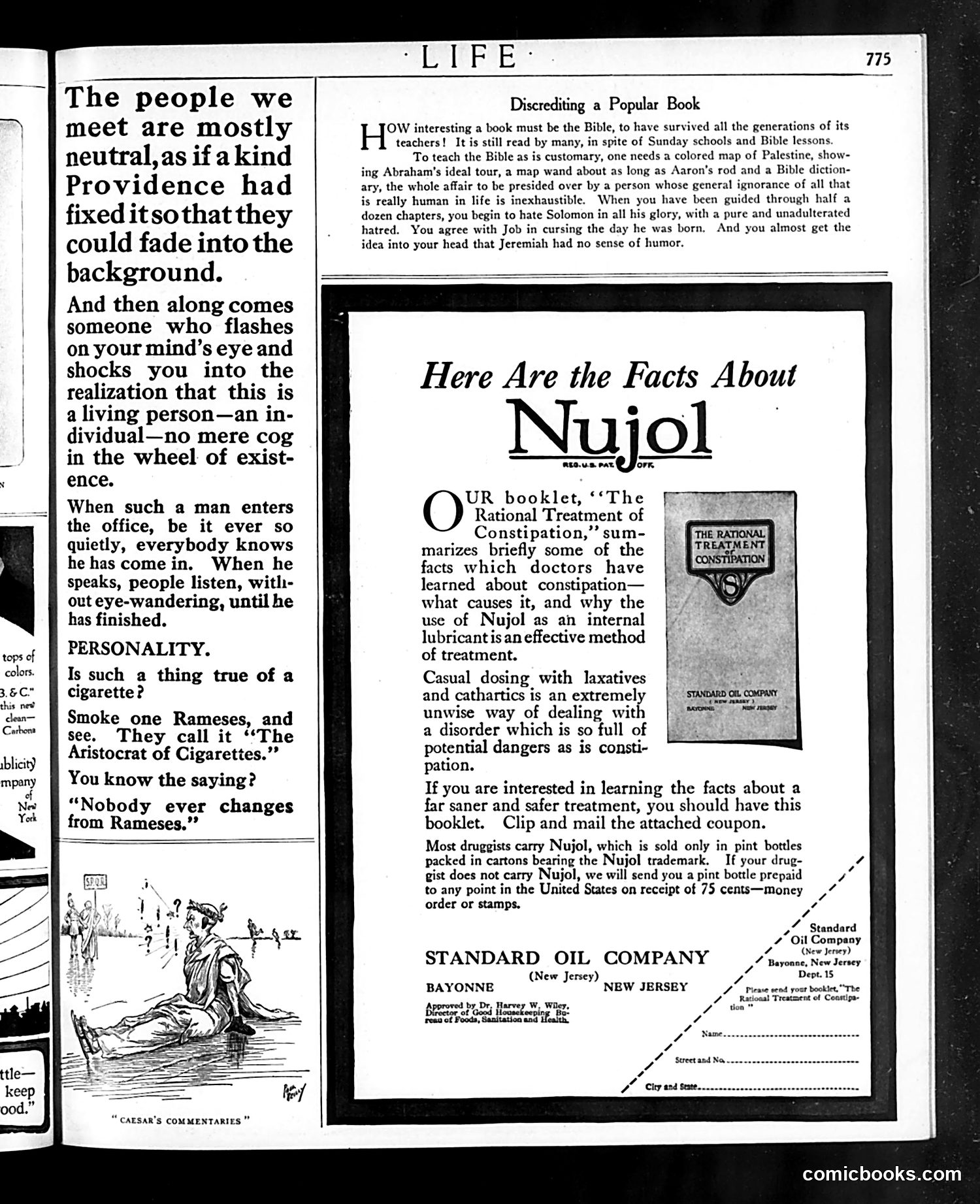
This page contains two distinct elements: **Left side:** A satirical essay on "Personality" contrasting forgettable neutral people with memorable individuals. It uses the Rameses cigarette as an example—someone who smokes them becomes distinctive, unforgettable ("Nobody ever changes from Rameses"). The accompanying sketch ("Caesar's Commentaries") shows a classical figure, likely illustrating timeless personality. **Right side:** A full-page advertisement for Nujol, a mineral oil laxative made by Standard Oil Company. The ad criticizes casual use of laxatives and cathartics as "unwise," positioning Nujol as a safer "internal lubricant" for constipation. It offers a free educational booklet. **Modern context:** This reflects early 20th-century advertising's shift toward pseudo-scientific claims and direct-mail marketing. The Nujol ad represents Standard Oil's diversification beyond fuel into consumer health products. Both elements typify *Life* magazine's blend of satirical commentary with paid advertising.
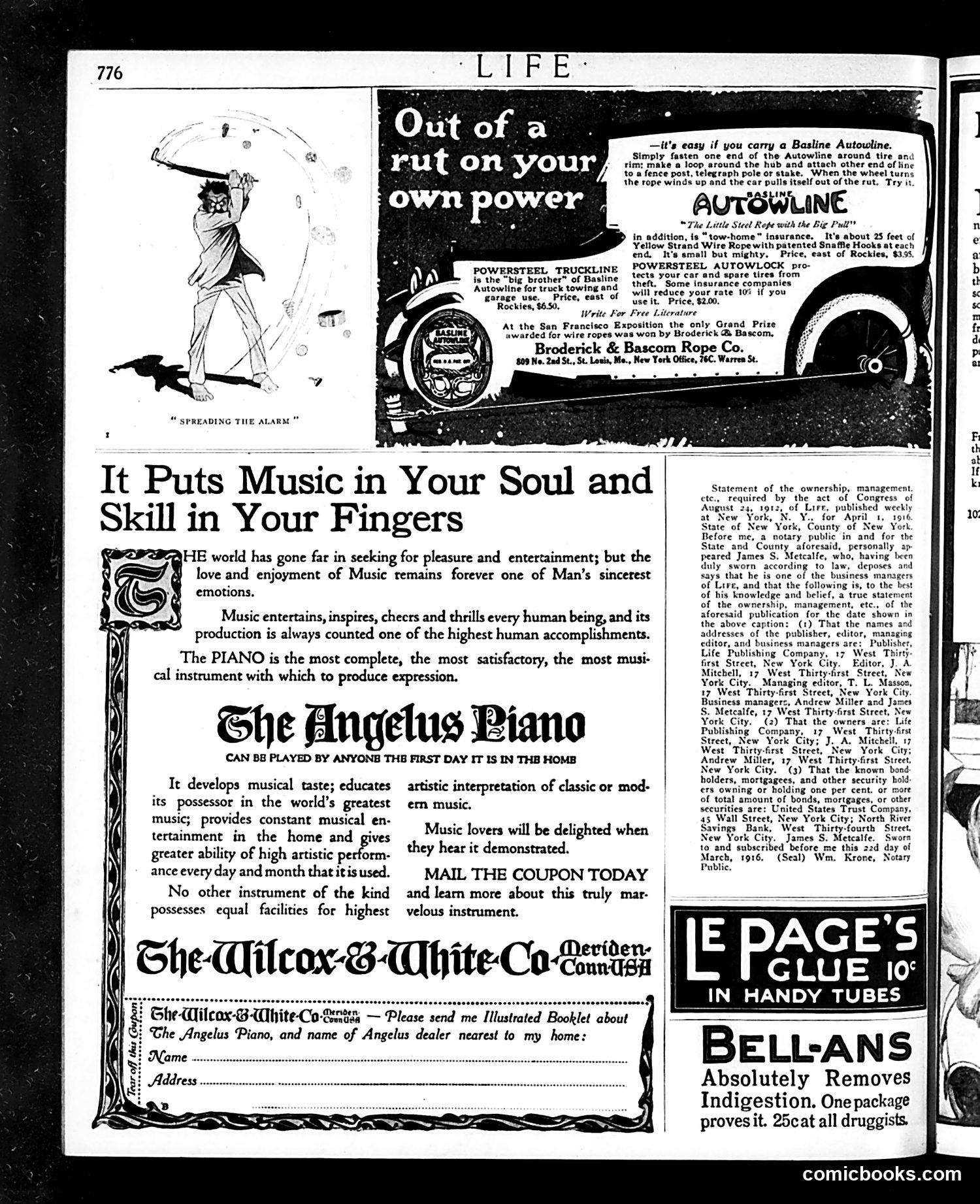
This page is primarily **advertising and publication notices** with one political cartoon. ## The Cartoon: "Spreading the Alarm" The sketch depicts a figure wielding an umbrella like a weapon during rain, appearing to fight back against the elements. The title suggests absurd defiance—attempting to combat weather itself. This appears to be satirical commentary on human futility or overconfidence, though the specific reference is unclear without additional context. ## Advertisements The page features three major ads: 1. **Autowline** (automotive towing equipment)—appeals to car owners stuck in ruts 2. **Angelus Piano**—promotes music as essential to human emotion and accomplishment 3. **Le Page's Glue** and **Bell-Ans** (digestive aid)—standard period products The philosophical copy about music's importance reflects early 20th-century cultural values emphasizing music's moral and spiritual elevation of humanity. The page also includes ownership/management declarations required by Congress (August 24, 1912 Act), standard legal notices for periodicals of this era.
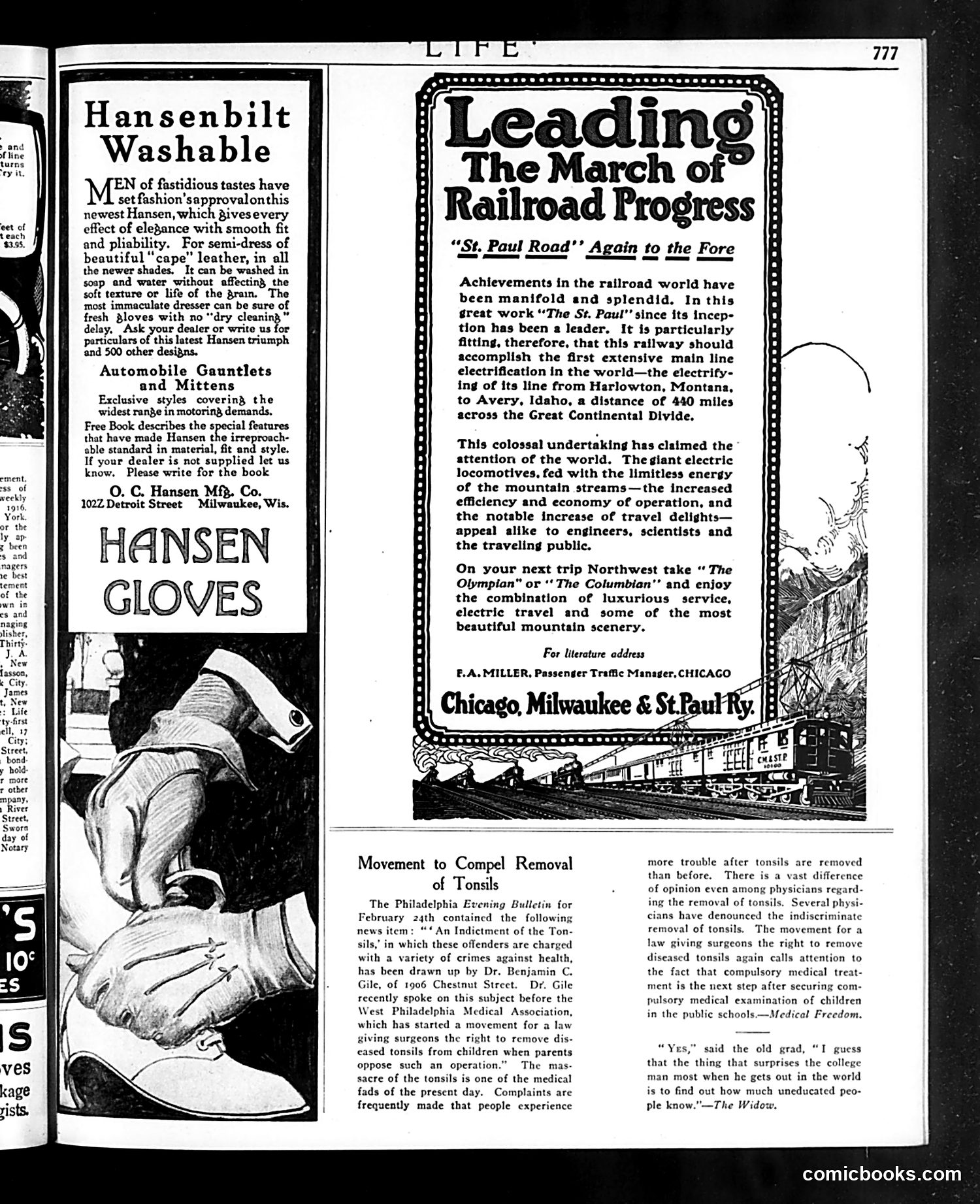
This page consists primarily of **period advertisements** rather than satirical cartoons. **Left side:** A Hansen Gloves advertisement featuring an illustration of a hand in a glove, promoting washable leather gloves for men of "fastidious tastes" — emphasizing that they can be cleaned with soap and water without dry cleaning. **Right side:** A Chicago, Milwaukee & St. Paul Railway advertisement celebrating the railroad's electrification of a 440-mile line from Montana to Idaho, touting modern electric locomotives and luxurious service on trains like "The Olympian." **Below:** An article about a Philadelphia medical movement seeking legal authority for surgeons to remove children's tonsils without parental consent — positioning this as a cautionary example of overreach in "compulsory medical treatment." The page reflects early-20th-century concerns: consumer anxiety about maintaining appearance/cleanliness, corporate pride in technological progress, and skepticism toward aggressive medical intervention.
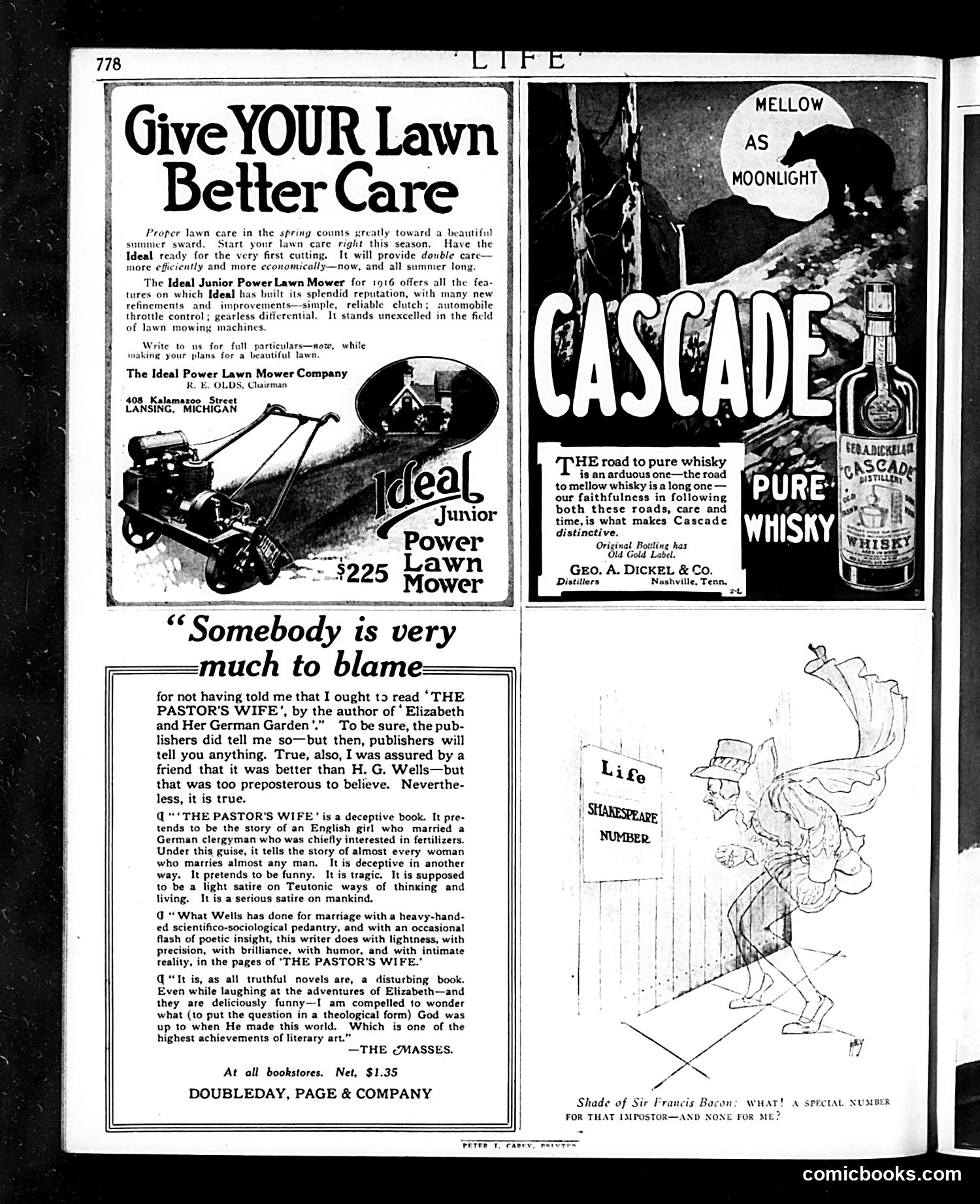
This page comprises primarily **advertisements** interspersed with literary commentary. **Top left**: The Ideal Junior Power Lawn Mower ad ($225) targets spring homeowners seeking efficient lawn maintenance. **Top right**: Cascade Pure Whisky advertisement emphasizes quality through "care and time"—marketing mellow whisky as superior to competitors. **Center**: A book review discusses "The Pastor's Wife" by Elizabeth von Arnim, praising it as a deceptively serious novel disguised as light satire about marriage and Teutonic life. The reviewer (quoting "The Masses") notes it raises profound questions about human existence. **Bottom right**: A satirical cartoon depicts a figure (appearing to be Sir Francis Bacon, based on the caption) offering whisky to an "impostor," suggesting themes of authenticity versus fraud—possibly commentary on counterfeit spirits or false intellectual authority. The page reflects early 20th-century Life magazine's mix of consumer advertising, literary criticism, and social satire aimed at educated, affluent readers.
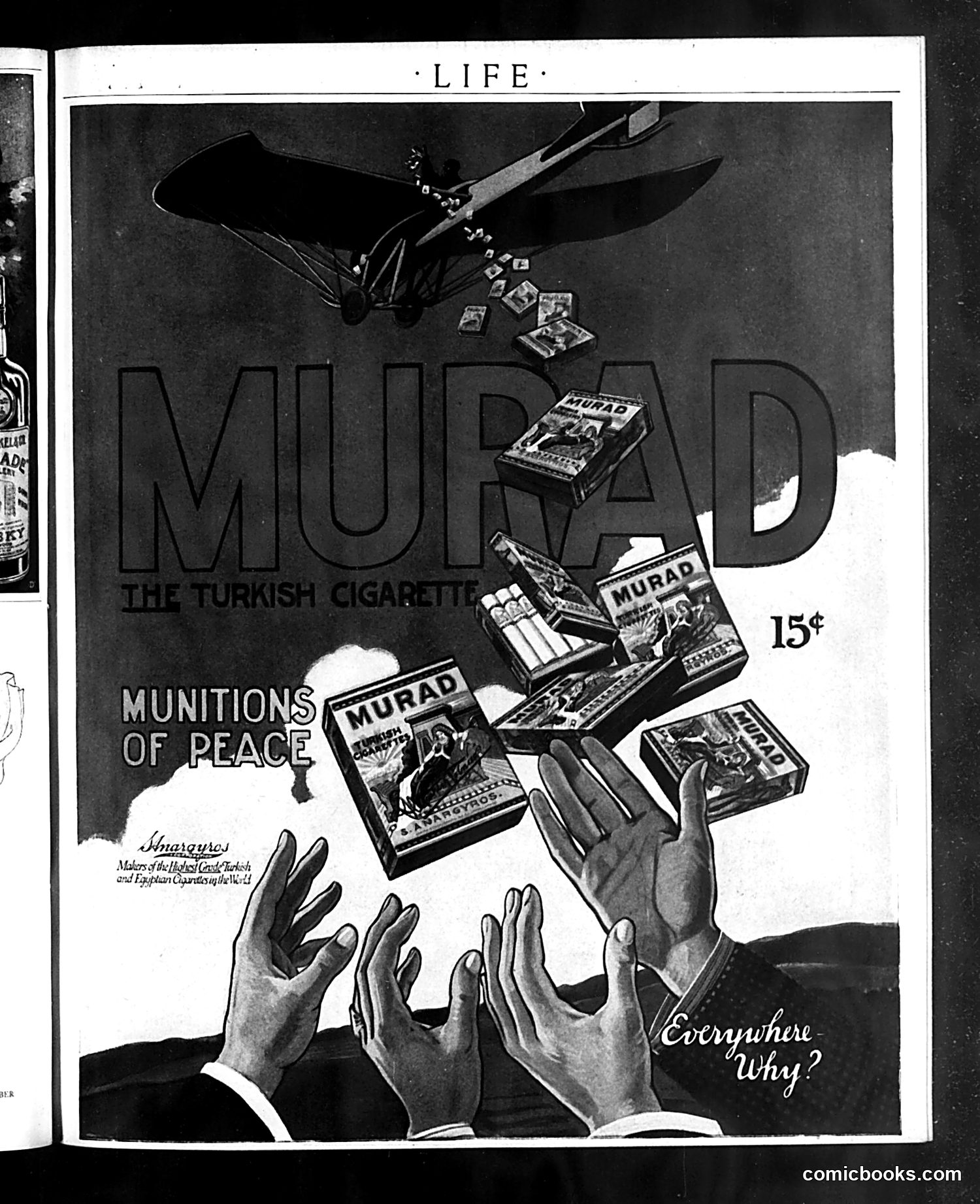
This is a cigarette advertisement for Murad Turkish cigarettes, priced at 15 cents. The ad uses the phrase "Munitions of Peace" with imagery of an airplane dropping cigarette packages like bombs, and multiple hands reaching upward to catch them. The satire plays on World War I messaging—using militaristic language ("munitions") to promote a consumer product. The "Everywhere—Why?" tagline suggests Murad cigarettes are ubiquitous. The small text credits "Muragyes" as "Makers of the finest [something] Turkish and Egyptian Cigarettes to the World." This represents early 20th-century advertising that conflated consumer goods with patriotic or militaristic themes, a common practice during and after WWI. The image equates cigarette distribution with beneficial aerial bombardment—dark humor by modern standards.
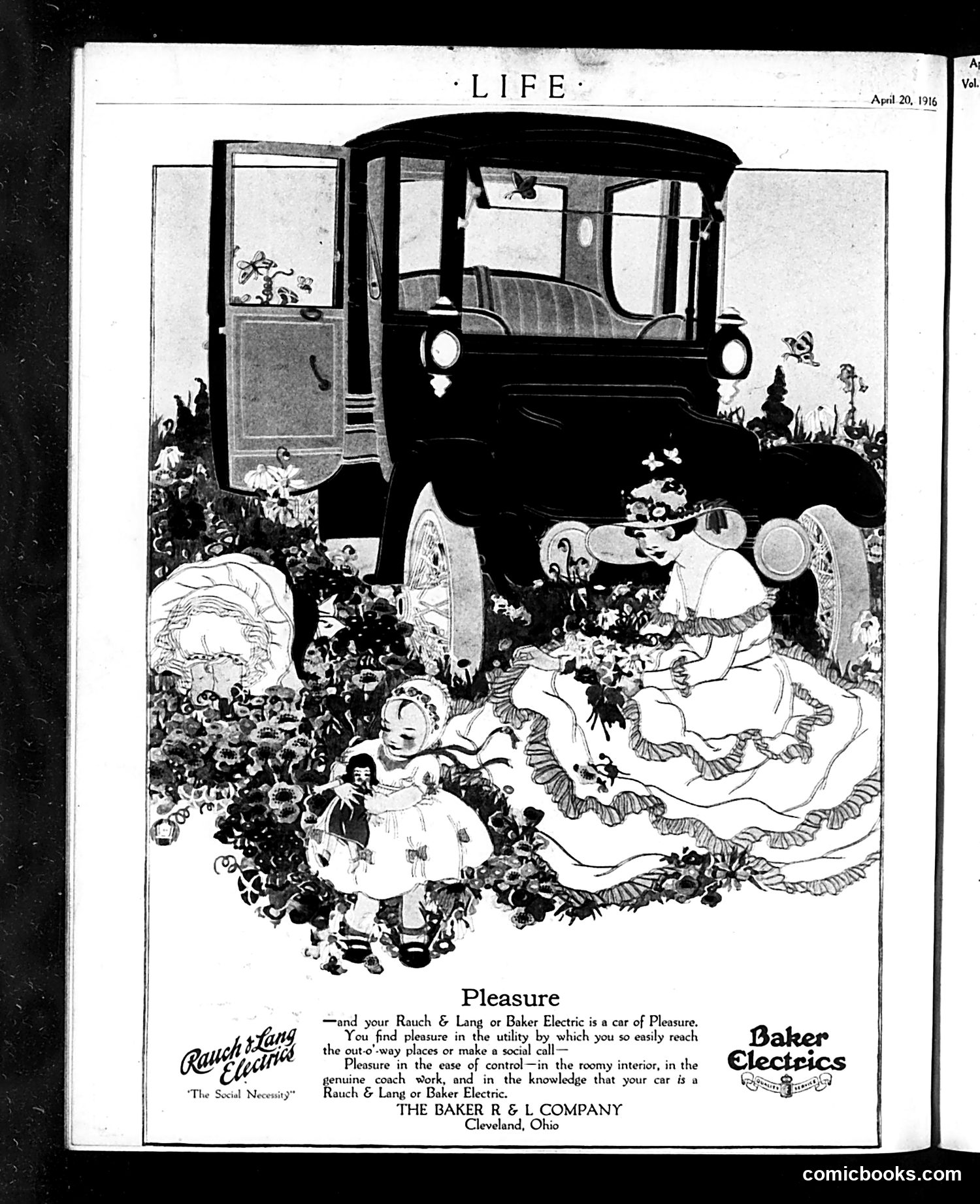
This is primarily a **full-page advertisement** for Baker Electric automobiles, not political satire. The image depicts an early automobile surrounded by a pastoral, idealized scene with women and children enjoying leisure activities—picnicking, relaxing in comfortable dress. The ad's message targets **affluent consumers**, particularly women (who were increasingly marketed to as car purchasers in the 1910s). It emphasizes the electric car's appeal through pleasure and social utility rather than speed or power: ease of control, roomy interiors, and access to "out-o'-way places" for social calls. The whimsical, decorative illustration style—with flowering vines and cherubic figures—suggests luxury and refined domesticity, positioning the Rauch & Lang or Baker Electric as a status symbol for genteel leisure rather than practical transportation. This reflects early automotive marketing that emphasized comfort and society over mechanical capability.