
Life, 1916-04-20 · page 22 of 52
Life — April 20, 1916 — page 22: what you’re looking at
What you’re looking at
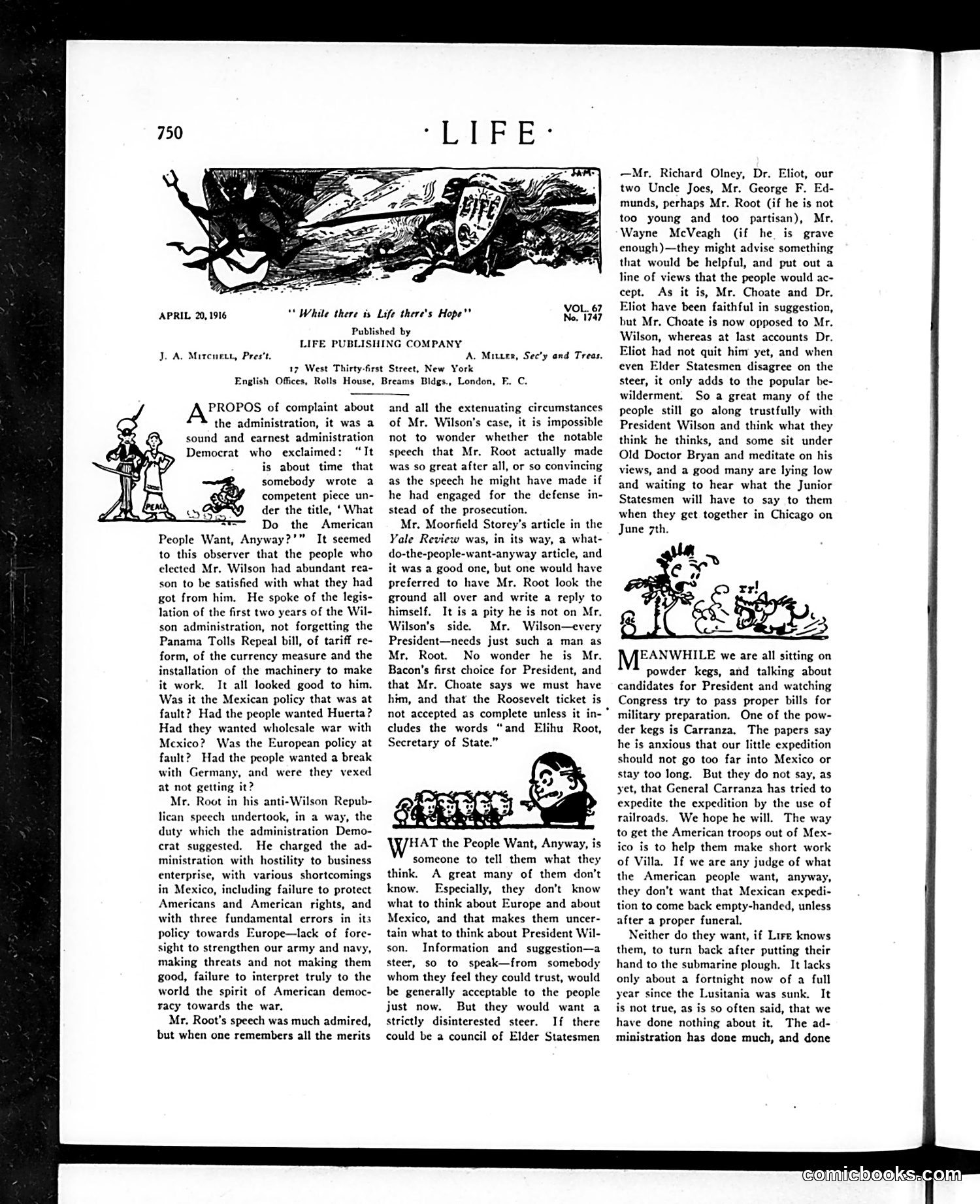
This editorial discusses criticisms of President Woodrow Wilson's administration and suggests the public needs trusted guidance on complex issues. **Key Figures Referenced:** - **President Wilson**: whose policies on Mexico and Europe are debated - **Elihu Root**: prominent Republican offering sharp criticism of Wilson's administration, particularly regarding military preparedness, business hostility, and European policy - **Moorfield Storey**: wrote a critical article in Yale Review **The Point:** The author argues Root's speech, while admired, is one-sided prosecution rather than balanced analysis. The piece suggests the American people need disinterested advice from respected "Elder Statesmen" (like Root, Charles Eliot, and others named) on foreign policy and Mexico—issues creating uncertainty about Wilson's leadership. **The Satire:** The irony is that Root—precisely the capable advisor Wilson needs—opposes him politically, making his criticism partisan rather than objective guidance for the confused public.
📄 Transcribed text from this page (OCR, searchable)
Machine-transcribed from the original scan — historical spelling and the odd misread are preserved.
APRIL 20, 1916 ‘* While there is Life there's Hope" Published by LIFE PUBLISHING COMPANY J. A. Mitenete, Pres’t, A. Mutter, Sec’y and Treas. 17 West Thirty-first Street, New York English Offices, Rolls House, Breams Bldgs. London, F. C. PROPOS of complaint about the administration, it was a sound and earnest administration Democrat who exclaimed: “It is about time that somebody wrote a competent piece un- der the title, ‘ What Do the American People Want, Anyway?’” It seemed to this observer that the people who elected Mr. Wilson had abundant rea- son to be satisfied with what they had got from him. He spoke of the legi: lation of the first two years of the Wil- son administration, not forgetting the Panama Tolls Repeal bill, of tariff re- form, of the currency measure and the installation of the machinery to make it work, It all looked good to him. Was it the Mexican policy that was at fault? Had the people wanted Huerta? Had they wanted wholesale war with Mexico? Was the European policy at fault? Had the people wanted a break with Germany, and were they vexed at not getting it? Mr. Root in his anti-Wilson Repub- lican speech undertook, in a way, the duty which the administration Demo- crat suggested. He charged the ad- ministration with hostility to business enterprise, with various shortcomings in Mexico, including failure to protect Americans and American rights, and with three fundamental errors in its policy towards Europe—lack of fore- sight to strengthen our army and navy, making threats and not making them good, failure to interpret truly to the world the spirit of American democ- racy towards the war. Mr. Root’s speech was much admired, but when one remembers all the merits and all the extenuating circumstances of Mr. Wilson's case, it is impossible not to wonder whether the notable speech that Mr. Root actually made was so great after all, or so convincing as the speech he might have made if he had engaged for the defense in- stead of the prosecution. Mr. Moorfield Storey’s article in the Yale Review was, in its way, a what- do-the-people-want-anyway article, and it was a good one, but one would have preferred to have Mr. Root look the ground all over and write a reply to himself. It is a pity he is not on Mr. Wilson's side. Mr. Wilson—every President—needs just such a man as Mr, Root. No wonder he is Mr. Bacon's first choice for President, and that Mr. Choate says we must have him, and that the Roosevelt ticket is not accepted as complete unless it in-° cludes the words “and Elihu Root, Secretary of State.” HAT the People Want, Anyway, is someone to tell them what they think. A great many of them don’t know. Especially, they don’t know what to think about Europe and about Mexico, and that makes them uncer- tain what to think about President Wi son. Information and suggestion—a steer, so to speak—from somebody whom they feel they could trust, would be generally acceptable to the people just now. But they would want a strictly disinterested steer. If there could be a council of Elder Statesmen —Mr. Richard Olney, Dr. Eliot, our two Uncle Joes, Mr. George F. Ed- munds, perhaps Mr. Root (if he is not too young and too partisan), Mr. Wayne McVeagh (if he is grave enough)—they might advise something that would be helpful, and put out a line of views that the people would ac- cept. As it is, Mr. Choate and Dr. Eliot have been faithful in suggestion, but Mr. Choate is now opposed to Mr. Wilson, whereas at last accounts Dr. Eliot had not quit him yet, and when even Elder Statesmen disagree on the steer, it only adds to the popular be- wilderment. So a great many of the people still go along trustfully with President Wilson and think what they think he thinks, and some sit under Old Doctor Bryan and meditate on his views, and a good many are lying low and waiting to hear what the Junior Statesmen will have to say to them when they get together in Chicago on June 7th. EANWHILE we are all sitting on powder kegs, and talking about candidates for President and watching Congress try to pass proper bills for military preparation. One of the pow- der kegs is Carranza, The papers say he is anxious that our little expedition should not go too far into Mexico or stay too long. But they do not say, as yet, that General Carranza has tried to expedite the expedition by the use of railroads. We hope he will. The way to get the American troops out of Mex- ico is to help them make short work of Villa. If we are any judge of what the American people want, anyway, they don’t want that Mexican expedi- tion to come back empty-handed, unless after a proper funeral. er do they want, if Lire knows them, to turn back after putting their hand to the submarine plough. It lacks only about a fortnight now of a full year since the Lusitania was sunk. It is not true, as is so often said, that we have done nothing about it. The ad- ministration has done much, and done