
Life, 1916-04-20 · page 16 of 52
Life — April 20, 1916 — page 16: what you’re looking at
What you’re looking at
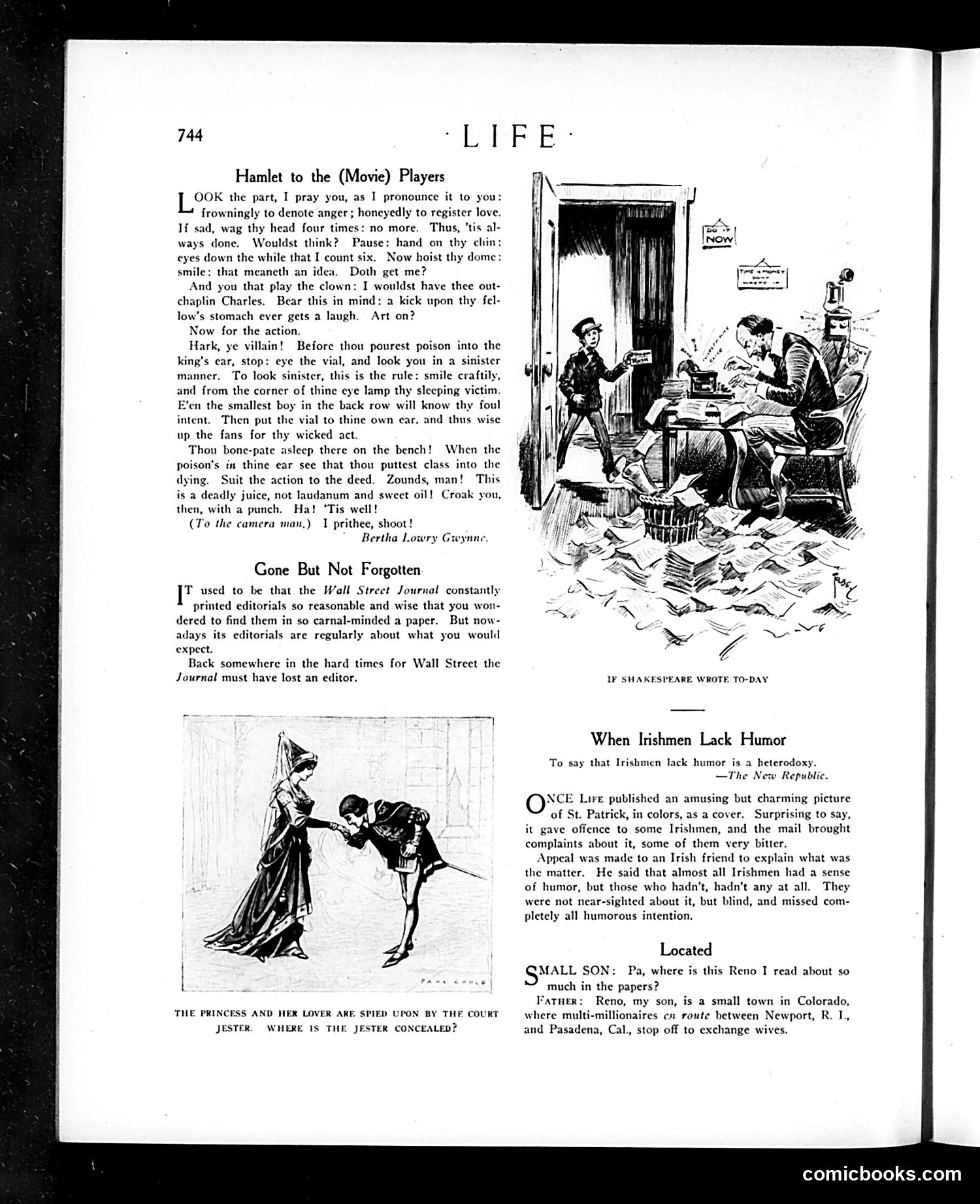
This page contains three satirical pieces: **"Hamlet to the (Movie) Players"** mocks early cinema acting conventions by having Shakespeare's Hamlet instruct actors on exaggerated, mechanical performance—frowning for anger, forced smiles for ideas, crafty grins for villainy. The satire targets silent film's crude emotional vocabulary, where actors overacted to compensate for lack of dialogue. The reference to "out-chaplin Charles" likely alludes to Charlie Chaplin's physical comedy style. **"Gone But Not Forgotten"** satirizes the *Wall Street Journal's* editorial decline, suggesting the publication lost its reasoned voice during financial hardship and now prints predictable content. **"When Irishmen Lack Humor"** notes that *Life* received angry complaints about a St. Patrick cover illustration. An Irish friend explained the complainers simply lacked humor themselves—a gentle irony suggesting humorless people miss jokes entirely. The cartoon below shows a court jester being discovered spying on a princess and her lover, illustrating physical comedy and intrigue themes.
📄 Transcribed text from this page (OCR, searchable)
Machine-transcribed from the original scan — historical spelling and the odd misread are preserved.
744 Hamlet to the (Movie) Players OOK the part, I pray you, as I pronounce it to you: frowningly to denote anger; honeyedly to register love. If sad, wag thy head four times: no more. Thus, ’tis al- ways done. Wouldst think? Pause: hand on thy chin: eyes down the while that I count six. Now hoist thy dome: smile: that meaneth an idea. Doth get me? And you that play the clown: I wouldst have thee out- chaplin Charles. Bear this in mind: a kick upon thy fel- low’s stomach ever gets a laugh. Art on? Now for the action. Hark, ye villain! Before thou pourest poison into the king’s ear, stop: eye the vial, and look you in a sinister manner. To look sinister, this is the rule: smile craftily, and from the corner of thine eye lamp thy sleeping victim. E’en the smallest boy in the back row will know thy foul intent. Then put the vial to thine own ear, and thus wise up the fans for thy wicked act. Thou bone-pate asleep there on the bench! When the poison’s in thine ear see that thou puttest class into the dying. Suit the action to the deed. Zounds, man! This is a deadly juice, not laudanum and sweet oil! Croak you, then, with a punch. Ha! 'Tis well! (To the camera man.) 1 prithee, shoot! Bertha Lowry Gwynne Gone But Not Forgotten T used to be that the Wall Street Journal constantly printed editorials so reasonable and wise that you won- dered to find them in so carnal-minded a paper. But now- adays its editorials are regularly about what you would expect. Back somewhere in the hard times for Wall Street the Journal must have lost an editor. IF SHAKESPEARE WROTE. TO-DAY. When Irishmen Lack Humor To say that Irishmen lack humor is a heterodoxy. —The New Republic. CE Lire published an amusing but charming picture of St. Patrick, in colors, as a cover. Surprising to say, it gave offence to some Irishmen, and the mail brought complaints about it, some of them very bitter. Appeal was made to an Irish friend to explain what was the matter. He said that almost all Irishmen had a sense of humor, but those who hadn't, hadn’t any at all. They were not near-sighted about it, but blind, and missed com- pletely all humorous intention. Located MALL SON: Pa, where is this Reno I read about so much in the papers? Fatuer: Reno, my son, is a small town in Colorado, ‘THE PRINCESS AND HER LOVER ARE SPIED UPON BY THF COURT where multi-millionaires cn route between Newport, R. I, JESTER. WHERE IS THE JESTER CONCEALED? and Pasadena, Cal., stop off to exchange wives. comicbooks.com