
Life, 1916-04-20 · page 28 of 52
Life — April 20, 1916 — page 28: what you’re looking at
What you’re looking at
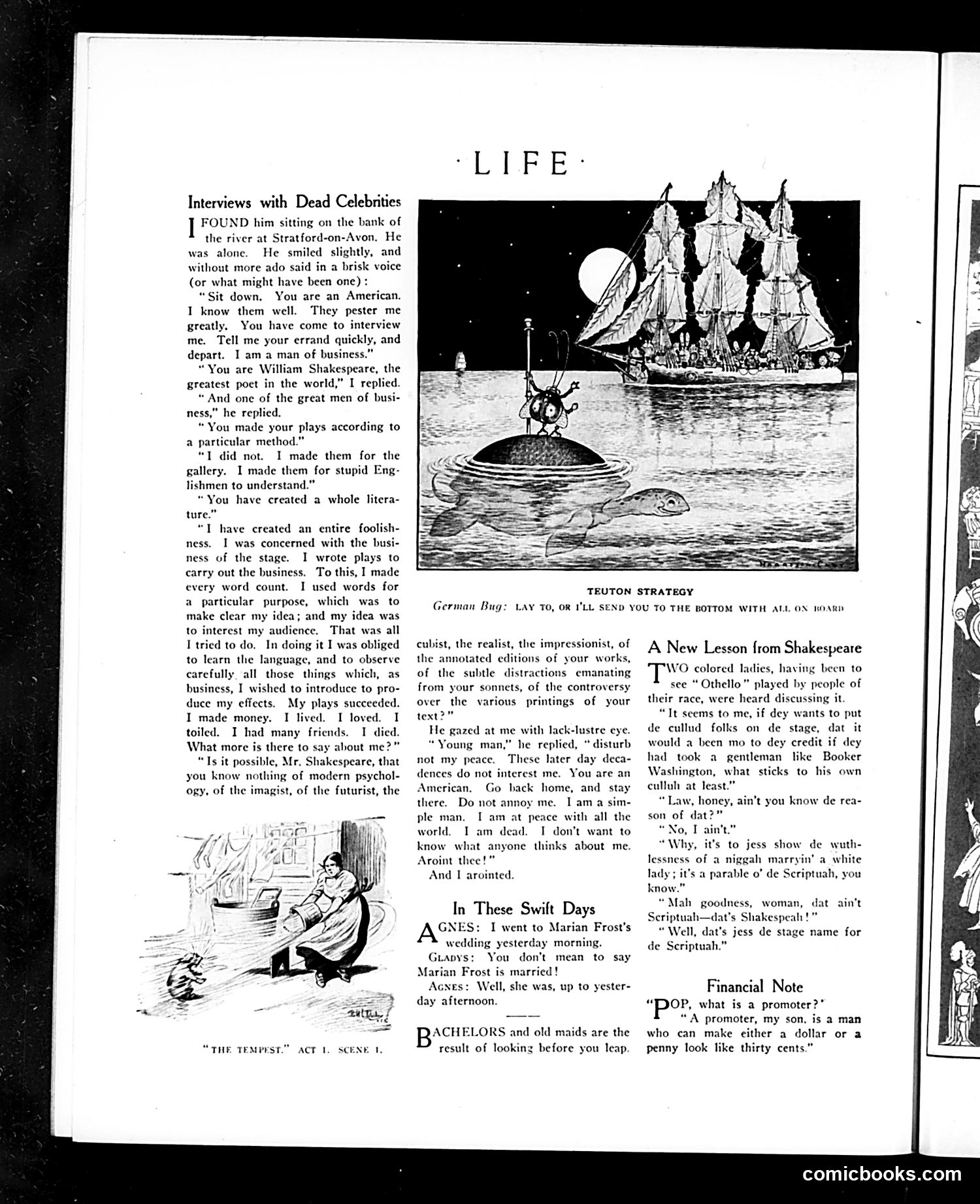
This page contains three satirical pieces from *Life* magazine: **"Interviews with Dead Celebrities"** presents Shakespeare as a no-nonsense businessman dismissing modern literary criticism (imagism, futurism, psychoanalysis). The joke: Shakespeare claims he wrote for "stupid Englishmen" to understand and make money—rejecting the notion that his work carries deep symbolic meaning. This satirizes over-intellectualization of literature. **"In These Swift Days"** is a brief joke about the speed of modern divorce ("up to yesterday afternoon"). **"A New Lesson from Shakespeare"** uses dialect humor (African American vernacular) to mock both the production of *Othello* with Black actors and the audiences' interpretations. One character misidentifies Shakespeare's themes as Biblical parables, confusing literature with scripture. The satire targets both racial stereotyping and audience ignorance. The accompanying illustrations show a ship ("Teuton Strategy") and a scene from *The Tempest*.
📄 Transcribed text from this page (OCR, searchable)
Machine-transcribed from the original scan — historical spelling and the odd misread are preserved.
Interviews with Dead Celebrities FOUND him sitting on the bank of the river at Stratford-on-Avon, He was alone. He smiled slightly, and without more ado said in a brisk voice (or what might have been one) : “Sit down, You are an American. I know them well. They pester me greatly, You have come to interview me. Tell me your errand quickly, and depart. I am a man of business. “You are William Shakespeare, the greatest poet in the worl I replied. “And one of the great men of busi- ness,” he replied. “You made your plays according to a particular method.” “I did not. I made them for the gallery. I made them for stupid Eng- lishmen to understand.” “You have created a whole litera- ture.” “I have created an entire foolish- ness. I was concerned with the busi- ness of the stage. I wrote plays to carry out the business, To this, I made every word count. I used words for a particular purpose, which was to make clear my idea; and my idea was to interest my audience. That was all I tried to do. In doing it I was obliged to learn the language, and to observe carefully all those things which, as business, I wished to introduce to pro- duce my effects. My plays succeeded. I made money. i I loved. 1 toiled. I had many friends. I died. What more is there to say about me?” “Ts it possible, Mr, Shakespeare, that you know nothing of modern psychol- ogy, of the imagist, of the futurist, the “al “THE TEMPEST.” ACT 1. SCENE 1. TEUTON STRATEGY German Bug: cubist, the realist, the impressionist, of the annotated editions of your works, of the subtle distractions emanating from your sonnets, of the controversy over the various printings of your text?” He gazed at me with lack-lustre eye. “Young man,” he replied, “disturb not my peace. These later day deca- dences do not interest me. You are an American. Go back home, and stay there. Do not annoy me. I ama sim- ple man. I am at peace with all the world. I am dead. I don’t want to know what anyone thinks about me. Aroint thee! And I arointed. In These Swift Days GNES: I went to Marian Frost's wedding yesterday morning. Gtapys: You don’t mean to say Marian Frost is married! ‘Es: Well, she was, up to yester- day afternoon. ACHELORS and old maids are the result of looking before you leap. LAY TO, OR I'LL SEND YOU TO THE BOTTOM WITH ALI. ON KOARD A New Lesson from Shakespeare WO colored ladies, having been to see “ Othello” played by people of their race, were heard discussing it “Tt seems to me, if dey wants to put de cullud folks on de stage, dat it would a been mo to dey credit if dey had took a gentleman li Booker Washington, what sticks to his own culluly at I : “Law, honey, ain’t you know de rea- son of dat?” “No, I ain't.” “Why, it's to jess show de wuth- lessness of a niggah marryin’ a white lady; it’s a parable o’ de Scriptuah, you know.” “Mah goodness, woman, dat ain't iptuah—dat's Shakespeah ! Well, dat’s jess de stage name for de Scriptuah.” Financial Note “Por. what is a promoter?’ A promoter, my son, is a man who can make either a dollar or a penny look like thirty cents.” comicbooks.com