
Life, 1916-04-20 · page 18 of 52
Life — April 20, 1916 — page 18: what you’re looking at
What you’re looking at
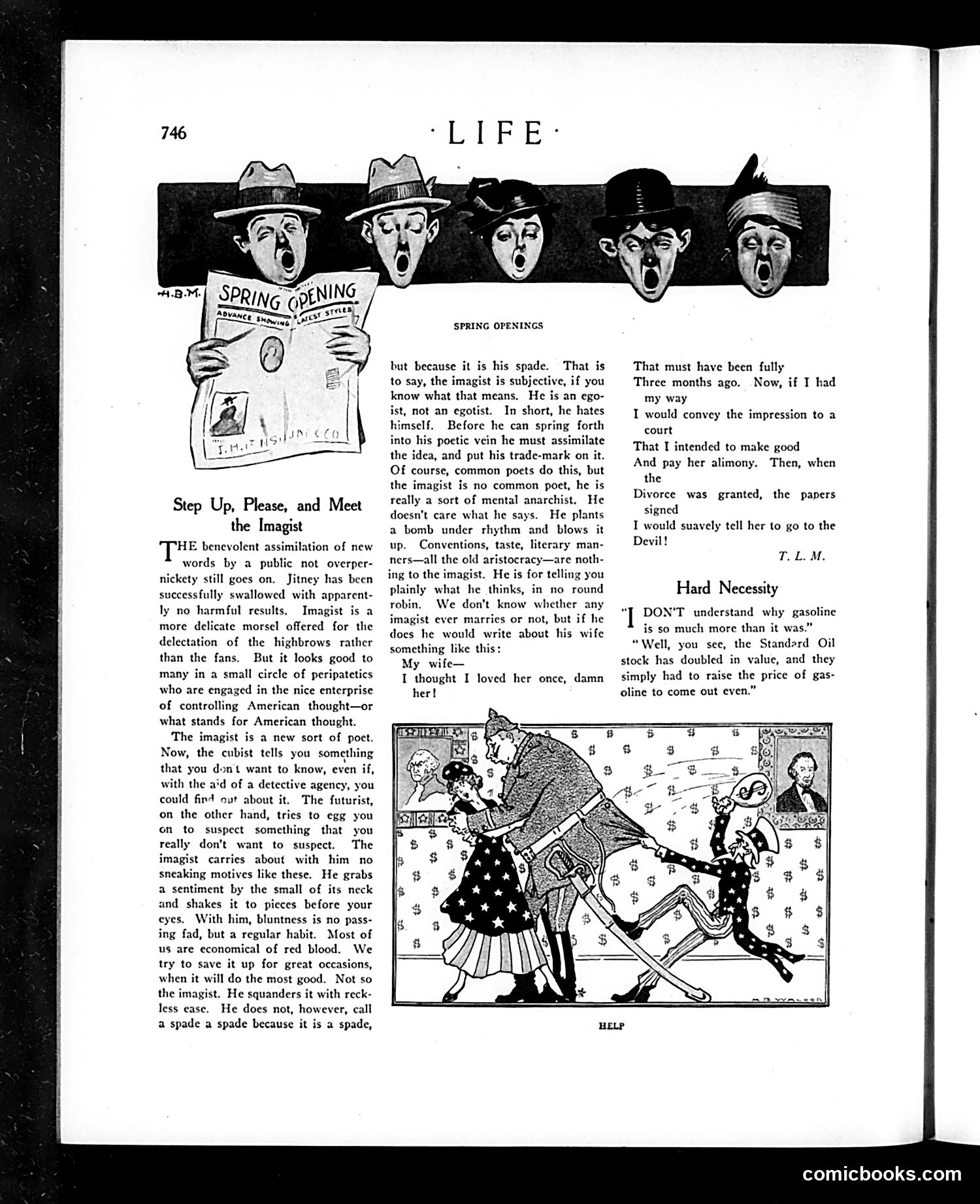
This page satirizes the "Imagist" poetry movement, a early 20th-century literary avant-garde style emphasizing precise imagery and free verse. The article mocks Imagists as pretentious egotists who reject traditional poetic conventions while claiming radical honesty—yet remain fundamentally self-centered and subjective. The five caricatured heads at top represent the movement's exaggerated emotionalism. The sample poem about divorce exemplifies the satire: an Imagist claiming blunt sincerity while actually indulging emotional excess and personal grievance. The cartoon "Help" (bottom) depicts a couple dancing, with dollar signs scattered around—illustrating the accompanying joke about gasoline prices. A Standard Oil shareholder justifies raising prices by claiming the stock's doubled value requires higher costs to "come out even"—obvious corporate doublespeak that Life ridicules as absurd logic masking profit-seeking. Both pieces target early 1900s American pretension: literary avant-gardism and corporate greed dressed in false justification.
📄 Transcribed text from this page (OCR, searchable)
Machine-transcribed from the original scan — historical spelling and the odd misread are preserved.
A.B. SPRING ( oP! ie) | Aova rear set Step Up, Please, and Meet the Imagist 'HE benevolent assimil: words by a public not overper- nickety still goes on. Jitney has been successfully swallowed with apparent- ly no harmful results. Imagist is a more delicate morsel offered for the delectation of the highbrows rather than the fans. But it looks good to many in a small circle of peripatetics who are engaged in the nice enterprise of controlling American thought—or what stands for American thought. The imagist is a new sort of poet. Now, the cubist tells you something that you dont want to know, even if, with the aid of a detective agency, you could find out about it. The futurist, on the other hand, tries to egg you on to suspect something that you really don’t want to suspect. The imagist carries about with him no sneaking motives like these. He grabs a sentiment by the small of its neck and shakes it to pieces before your eyes. With him, bluntness is no pass- ing fad, but a regular habit. Most of us are economical of red blood. We try to save it up for great occasions, when it will do the most good. Not so the imagist. He squanders it with reck- less case. He does not, however, call a spade a spade because it is a spade, ion of new SPRING OPENINGS but because it is his spade. That is to say, the imagist is subjective, if you know what that means. He is an ego- ist, not an egotist. In short, he hates himself. Before he can spring forth into his poetic vein he must assimilate the idea, and put his trade-mark on it. Of course, common poets do this, but the imagist is no common poet, he is really a sort of mental anarchist, He doesn’t care what he says. He plants a bomb under rhythm and blows it up. Conventions, taste, literary man- ners—all the old aristocracy—are noth- ing to the imagist. He is for telling you plainly what he thinks, in no round robin. We don’t know whether any imagist ever marries or not, but if he does he would write about his wife something like this: My wife— I thought I loved her once, damn That must have been fully Three months ago. Now, if I had my way I would convey the impression to a court That I intended to make good And pay her alimony. Then, when the Divorce was granted, the papers signed I would suavely tell her to go to the Devil! T.L.M. Hard Necessity “I DON’T understand why gasoline is so much more than it was.” “Well, you see, the Standard Oil stock has doubled in value, and they simply had to raise the price of gas- oline to come out even.” comicbooks.com