
Life, 1916-04-20 · page 14 of 52
Life — April 20, 1916 — page 14: what you’re looking at
What you’re looking at
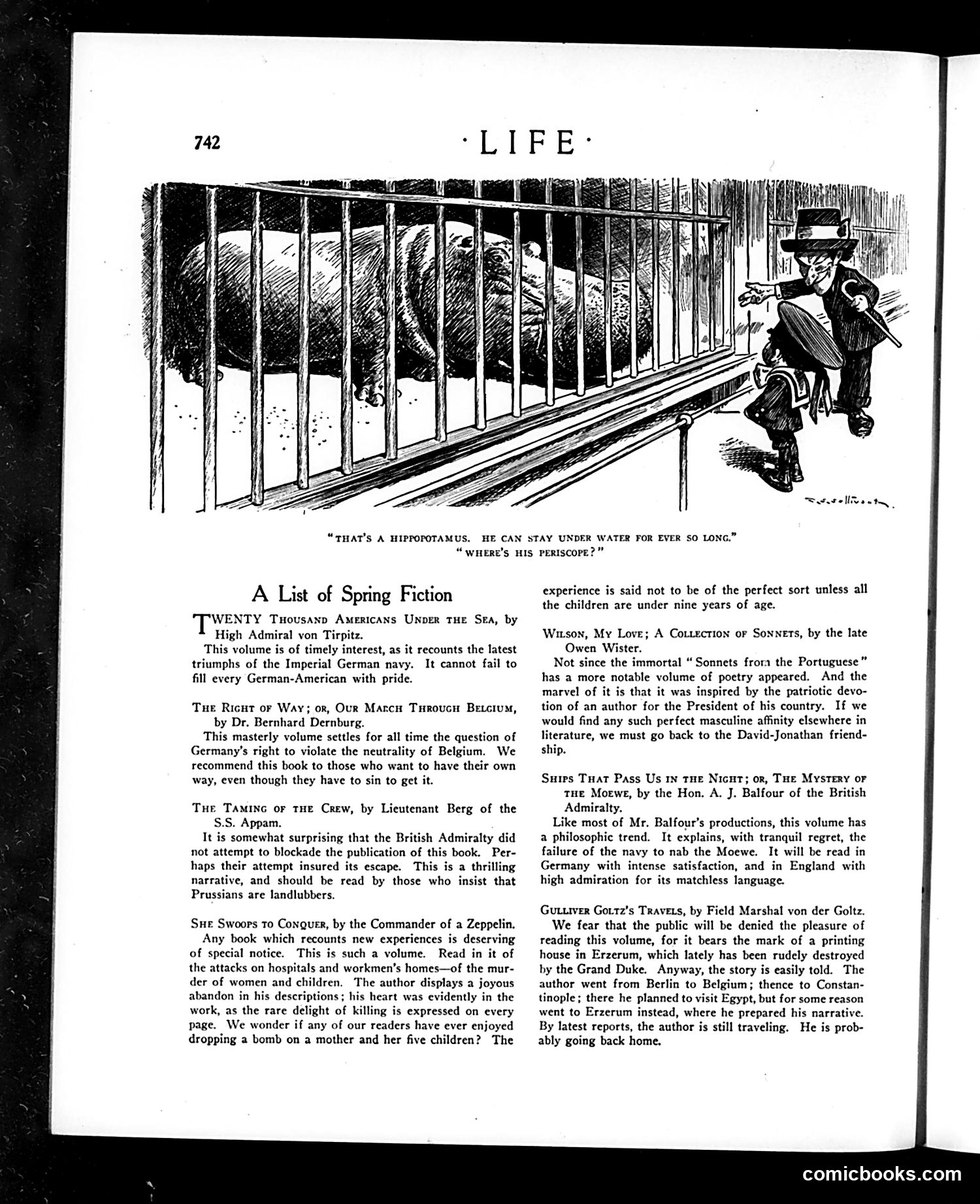
This page contains a cartoon and book reviews rather than political satire. The cartoon depicts a man in a top hat and coat standing outside a hippopotamus enclosure, asking "Where's his periscope?" in response to being told "That's a hippopotamus. He can stay under water for ever so long." The joke is a visual pun: the hippopotamus's ability to remain submerged is being humorously compared to a submarine's use of a periscope. This appears to reference World War I submarine warfare, which was a contemporary concern when this was published. The cartoon plays on the absurdity of mistaking an animal for military technology, or conversely, of expecting an animal to behave like a machine of war. The humor relies on the viewer understanding submarine warfare technology and its role in current events.
📄 Transcribed text from this page (OCR, searchable)
Machine-transcribed from the original scan — historical spelling and the odd misread are preserved.
SSS Ph PENN “THAT'S A HIPPOPOTAMUS. Ses ell ety, HE CAN STAY UNDER WATER FOR EVER SO LONG.” “WHERE'S HIS PERISCOPE?” A List of Spring Fiction 'WENTY Tuousann AMERICANS UNDER THE SeA, by High Admiral von Tirpitz. This volume is of timely interest, as it recounts the latest triumphs of the Imperial German navy. It cannot fail to fill every German-American with pride. Tue Ricut or Way; or, Our Marcu Turoucu Betcium, by Dr. Bernhard Dernburg. This masterly volume settles for all time the question of Germany’s right to violate the neutrality of Belgium. We recommend this book to those who want to have their own way, even though they have to sin to get it. Tue TAMING oF THE Crew, by Lieutenant Berg of the S.S. Appam. It is somewhat surprising that the British Admiralty did not attempt to blockade the publication of this book. Per- haps their attempt insured its escape. This is a thrilling narrative, and should be read by those who insist that Prussians are landlubbers. Sue Swoors to Conquer, by the Commander of a Zeppelin. Any book which recounts new experiences is deserving of special notice. This is such a volume. Read in it of the attacks on hospitals and workmen’s homes—of the mur- der of women and children. The author displays a joyous abandon in his descriptions; his heart was evidently in the work, as the rare delight of killing is expressed on every page. We wonder if any of our readers have ever enjoyed dropping a bomb on a mother and her five children? The experience is said not to be of the perfect sort unless all the children are under nine years of age. Wrrson, My Love; A Cotrection or Sonnets, by the late Owen Wister. Not since the immortal “ Sonnets from the Portuguese” has a more notable volume of poetry appeared. And the marvel of it is that it was inspired by the patriotic devo- tion of an author for the President of his country. If we would find any such perfect masculine affinity elsewhere in literature, we must go back to the David-Jonathan friend- ship. Sups Tuat Pass Us 1n tHE NIGHT; or, THE Mystery oF tHe Moewe, by the Hon, A. J. Balfour of the British Admiralty. Like most of Mr. Balfour’s productions, this volume has a philosophic trend. It explains, with tranquil regret, the failure of the navy to nab the Moewe. It will be read in Germany with intense satisfaction, and in England with high admiration for its matchless language. Gutuiver Gottz’s Travets, by Field Marshal von der Goltz. We fear that the public will be denied the pleasure of reading this volume, for it bears the mark of a printing house in Erzerum, which lately has been rudely destroyed by the Grand Duke. Anyway, the story is easily told. The author went from Berlin to Belgium; thence to Constan- tinople; there he planned to visit Egypt, but for some reason went to Erzerum instead, where he prepared his narrative. By latest reports, the author is still traveling. He is prob- ably going back home, comicbooks.com