
Life, 1916-04-20 · page 38 of 52
Life — April 20, 1916 — page 38: what you’re looking at
What you’re looking at
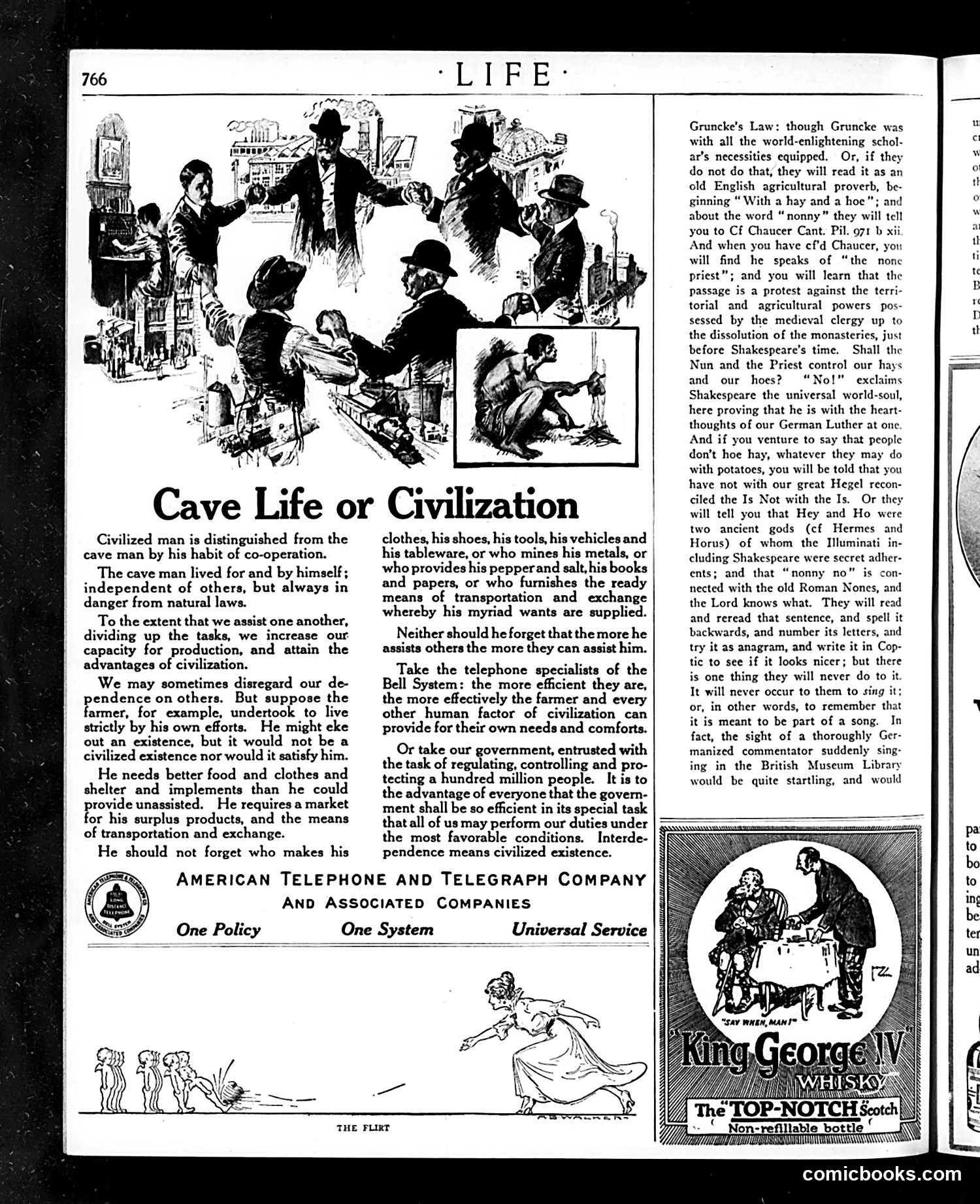
This is primarily an **advertisement for AT&T**, disguised as editorial content about civilization and interdependence. The cartoon illustrates the contrast between primitive "cave man" self-sufficiency and modern civilized cooperation. The accompanying text argues that civilization depends on specialization and mutual reliance—farmers need tools, transportation, communication systems, and government services. The advertisement's explicit purpose is to justify AT&T's monopoly by claiming telephone specialists' efficiency benefits everyone, including farmers. By framing the Bell System as essential infrastructure alongside government, it presents the company as performing a public service rather than pursuing profit. The ad reflects early 20th-century corporate messaging defending big business consolidation as beneficial to society. The "one system, one policy, universal service" slogan promoted AT&T's controlled network model as superior to competition. The King George IV whisky ad below is unrelated advertising filler.
📄 Transcribed text from this page (OCR, searchable)
Machine-transcribed from the original scan — historical spelling and the odd misread are preserved.
Cave Life or Civilization Civilized man is distinguished from the cave man by his habit of co-operation. The cave man lived for and by himself; independent of others, but always in danger from natural laws. To the extent thst ‘we assist one another, dividing up the 8, we increase our capacity for Sdasitn. and attain the advantages of civilization. We may sometimes disregard our de- endence on others. But suppose the farmer, for example, undertook to live strictly by his own efforts. He might eke out an existence, but it would not be a civilized existence nor would it satisfy him. He needs better food and clothes and shelter and implements than he could provide unassisted. He requires a market ‘or his surplus products, and the means of transportation and exchange. He should not forget who makes his clothes, his shoes, his tools, his vehicles and his tableware, or who mines his metals, or | who provides his pepperand salt, his books and papers, or who furnishes the ready means of transportation and exchange whereby his myriad wants are supplied. Neither should he forget that the more he assists others the more they can assist him. Take the telephone specialists of the Bell System: the more efficient they are, the more effectively the farmer and every other human factor of civilization can provide for their own needs and comforts. Or take our government, entrusted with the task of regulating, controlling and pro- tecting a hundred million people. It is to the advantage of everyone that the govern- ment shall be so efficient in its special task that all of us may perform our duties under the most favorable conditions. Interde- pendence means civilized existence. AMERICAN TELEPHONE AND TELEGRAPH COMPANY AND ASSOCIATED COMPANIES One System Universal Service One Policy Gruncke’s Law: though Gruncke was with all the world-enlightening schol- ar’s necessities equipped. Or, if they do not do that, they will read it as an old English agricultural proverb, be- ginning “ With a hay and a hoe”; and about the word “nonny” they will tell you to Cf Chaucer Cant. Pil. 971 b xii And when you have cfd Chaucer, you will find he speaks of “the none priest”; and you will learn that the passage is a protest against the terri- torial and agricultural powers pos- sessed by the medieval clergy up to the dissolution of the monasteries, just before Shakespeare’s time. Shall the Nun and the Priest control our hays and our hoes? “No!” exclaims Shakespeare the universal world-soul, here proving that he is with the heart- thoughts of our German Luther at one. And if you venture to say that people don’t hoe hay, whatever they may do with potatoes, you will be told that you have not with our great Hegel recon- ciled the Is Not with the Is. Or they will tell you that Hey and Ho were two ancient gods (cf Hermes and Horus) of whom the Illuminati in- cluding Shakespeare were secret adher- ents; and that “nonny no” is con- nected with the old Roman Nones, and the Lord knows what. They will read and reread that sentence, and spell it backwards, and number its letters, and try it as anagram, and write it in Cop- tic to see if it looks nicer; but there is one thing they will never do to it. It will never occur to them to sing it; or, in other words, to remember that it is meant to be part of a song. In fact, the sight of a thoroughly Ger- manized commentator suddenly sing- ing in the British Museum Library would be quite startling, and would comicbooks.com