
Life, 1916-04-20 · page 12 of 52
Life — April 20, 1916 — page 12: what you’re looking at
What you’re looking at
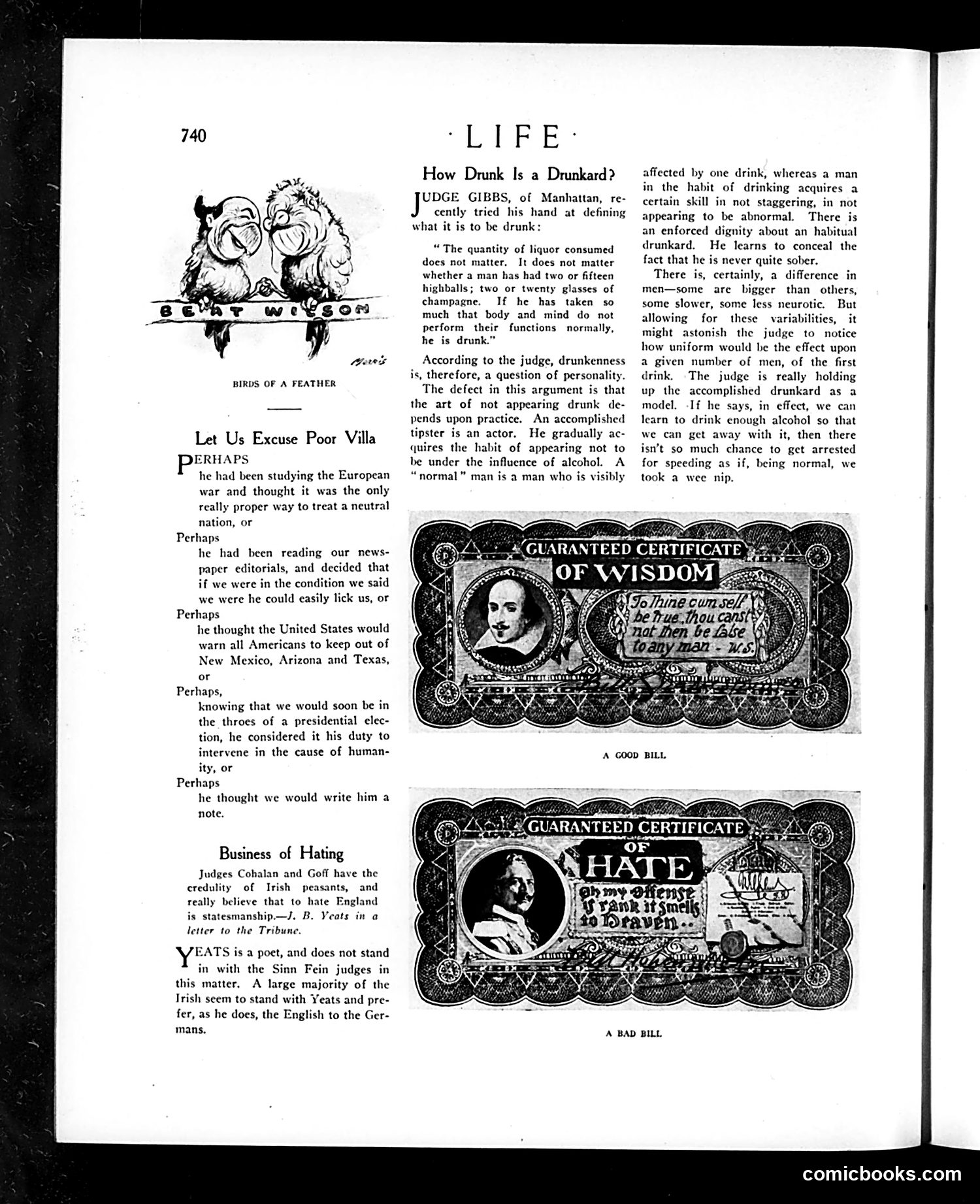
This page contains three satirical pieces. The opening article, "How Drunk Is a Drunkard?" features Judge Gibbs of Manhattan defining drunkenness by quantity consumed rather than visible impairment—a critique of subjective legal standards regarding intoxication. "Let Us Excuse Poor Villa" discusses European neutrality, apparently referencing Pancho Villa (Mexican Revolutionary figure), suggesting American debate over intervention in foreign conflicts. "Business of Hating" comments on Irish-English tensions, noting Irish preference for Yeats over English poets—a cultural/political jab at Anglo-Irish relations. The two "Guaranteed Certificates" are mock documents offering "Wisdom" and "Hate," appearing to satirize both self-improvement culture and nationalist sentiment. The overall page reflects early 20th-century American satirical commentary on politics, social behavior, and international relations.
📄 Transcribed text from this page (OCR, searchable)
Machine-transcribed from the original scan — historical spelling and the odd misread are preserved.
BIRDS OF A FEATHER Let Us Excuse Poor Villa ERHAPS he had been studying the European war and thought it was the only really proper way to treat a neutral nation, or Perhaps he had been reading our news- paper editorials, and decided that if we were in the condition we said we were he could easily lick us, or Perhaps he thought the United States would warn all Americans to keep out of New Mexico, Arizona and Texas, or Perhaps, knowing that we would soon be in the throes of a presidential elec- tion, he considered it his duty to intervene in the cause of human- ity, or Perhaps he thought we would write him note. Business of Hating Judges Cohalan and Goff have the credulity of Irish peasants, and really believe that to hate England is statesmanship—J. B. Yeats in a letter to the Tribune. EATS is a poet, and does not stand in with the Sinn Fein judges in this matter. A large majority of the Irish seem to stand with Yeats and pre- fer, as he does, the English to the Ger- mans, *LIFE- How Dnunk Is a Drunkard? A haar GIBBS, of Manhattan, re- cently tried his hand at defining what it is to be drunk: “ The quantity of liquor consumed does not matter. It does not matter whether a man has had two or fifteen highballs; two or twenty glasses of champagne, If he has taken so much that body and mind do not perform their functions normally, he is drunk.” According to the judge, drunkenness is, therefore, a question of personality. The defect in this argument is that the art of not appearing drunk de- pends upon practice. An accomplished tipster is an actor. He gradually ac- quires the habit of appearing not to be under the influence of alcohol. A “normal” man is a man who is visibly affected by one drink, whereas a man in the habit of drinking acquires a certain skill in not staggering, in not appearing to be abnormal. There is an enforced dignity about an habitual drunkard. He learns to conceal the fact that he is never quite sober. There is, certainly, a difference in men—some are bigger than others, some slower, some less neurotic. But allowing for these variabilities, it might astonish the judge to notice how uniform would be the effect upon a given number of men, of the first drink, The judge is really holding up the accomplished drunkard as a model. -If he says, in effect, we can learn to drink enough alcohol so that we can get away with it, then there isn’t so much chance to get arrested for speeding as if, being normal, we took a wee nip. A GOOD BILL A BAD BILL comicbooks.com