
Life, 1916-04-20 · page 23 of 52
Life — April 20, 1916 — page 23: what you’re looking at
What you’re looking at
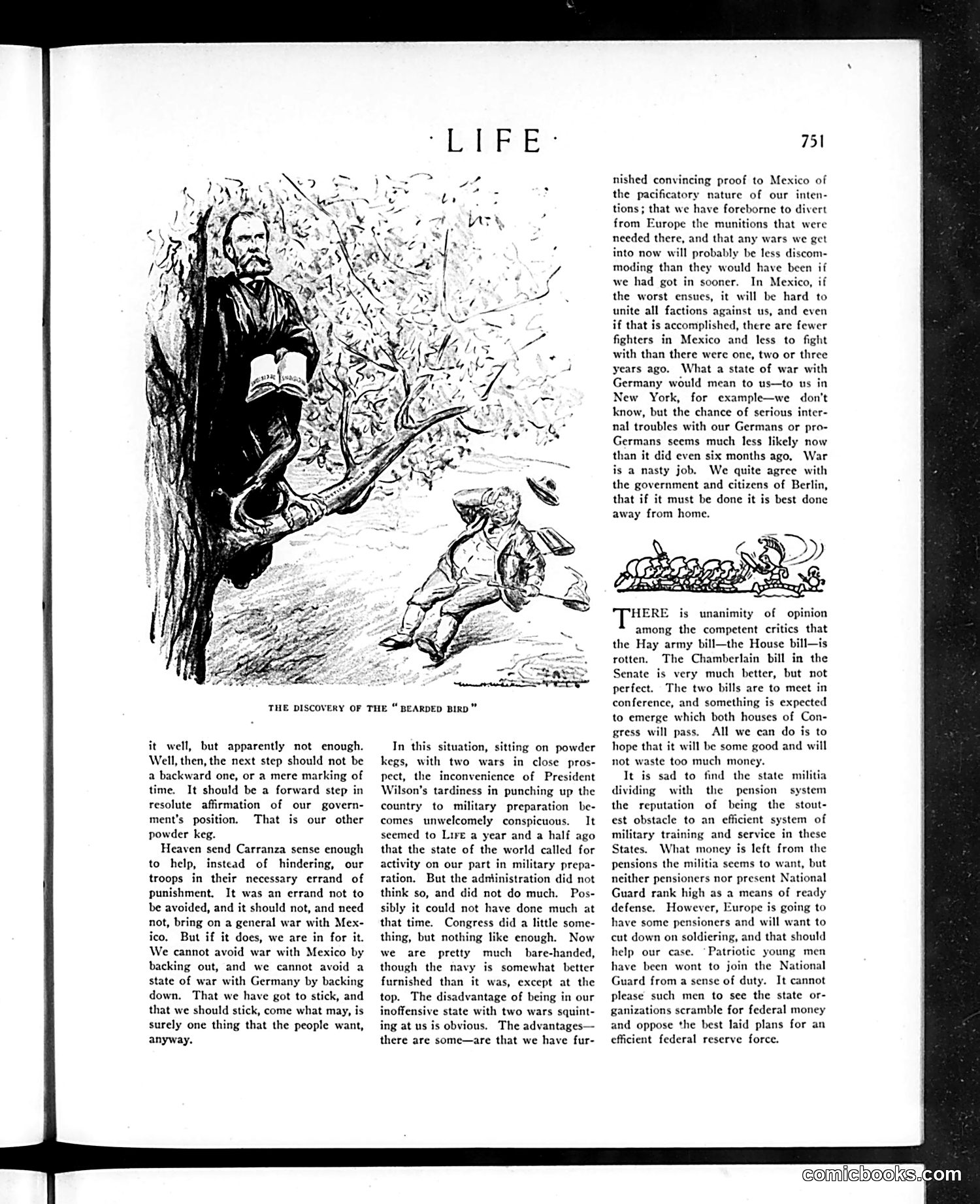
This cartoon satirizes American military unpreparedness amid potential conflicts with Mexico and Germany (circa 1916). The bearded figure in the tree appears to represent an unprepared American soldier or the U.S. military itself—caught off-guard, literally up a tree, as a child (possibly representing Germany or Mexico) approaches with what looks like a stick or weapon. The accompanying text criticizes President Wilson's delayed military preparations. The author argues that while avoiding earlier military buildup had some advantages—proving peaceful intent to Mexico and preserving munitions for Europe—America now faces "two wars in close prospect" while dangerously under-armed. The piece also condemns the "rotten" House military appropriations bill and criticizes state militia as obstacles to efficient defense. The cartoon's title suggests discovering something absurd or ridiculous in one's own position—America, unprepared, facing imminent threats.
📄 Transcribed text from this page (OCR, searchable)
Machine-transcribed from the original scan — historical spelling and the odd misread are preserved.
THE DISCOVERY OF THE “ BEARDED BIRD” it well, but apparently not enough. Well, then, the next step should not be a backward one, or a mere marking of time. It should be a forward step in resolute affirmation of our govern- ment’s position. That is our other powder keg. Heaven send Carranza sense enough to help, instead of hindering, our troops in their necessary errand of punishment. It was an errand not to be avoided, and it should not, and need not, bring on a general war with Mex- ico. But if it does, we are in for it. We cannot avoid war with Mexico by backing out, and we cannot avoid a state of war with Germany by backing down. That we have got to stick, and that we should stick, come what may, is surely one thing that the people want, anyway. In this situation, sitting on powder kegs, with two wars in close pros- pect, the inconvenience of President Wilson's tardiness in punching up the country to military preparation be- comes unwelcomely conspicuous. It seemed to Lire a year and a half ago that the state of the world called for activity on our part in military prepa- ration. But the adniinistration did not think so, and did not do much. Pos- sibly it could not have done much at that time. Congress did a little some- thing, but nothing like enough. Now we are pretty much bare-handed, though the navy is somewhat better furnished than it was, except at the top. The disadvantage of being in our inoffensive state with two wars squint- ing at us is obvious. The advantages— there are some—are that we have fur- 751 nished convincing proof to Mexico of the pacificatory nature of our inten- tions; that we have foreborne to divert from Europe the munitions that were needed there, and that any wars we get into now will probably be less discom- moding than they would have been if we had got in sooner. In Mexico, if the worst ensues, it will be hard to unite all factions against us, and even if that is accomplished, there are fewer fighters in Mexico and less to fight with than there were one, two or three years ago. What a state of war with Germany would mean to us—to us in New York, for example—we don't know, but the chance of serious inter- nal troubles with our Germans or pro- Germans seems much less likely now than it did even six months ago, War is a nasty job. We quite agree with the government and citizens of Berlin, that if it must be done it is best done away from home. is unanimity of opinion among the competent critics that Ti the Hay army bill—the House bill—is rotten. The Chamberlain bill in the Senate is very much better, but not perfect. The two bills are to meet in conference, and something is expected to emerge which both houses of Con- gress will pass. All we can do is to hope that it will be some good and will not waste too much money. It is sad to find the state militia dividing with the pension system the reputation of being the stout- est obstacle to an efficient system of military training and service in these States. What money is left from the pensions the militia seems to want, but neither pensioners nor present National Guard rank high as a means of ready defense. However, Europe is going to have some pensioners and will want to cut down on soldiering, and that should help our case. ‘Patriotic young men have been wont to join the National Guard from a sense of duty. It cannot please such men to see the state or- ganizations scramble for federal money and oppose the best laid plans for an efficient federal reserve force. comichooks.qeln)