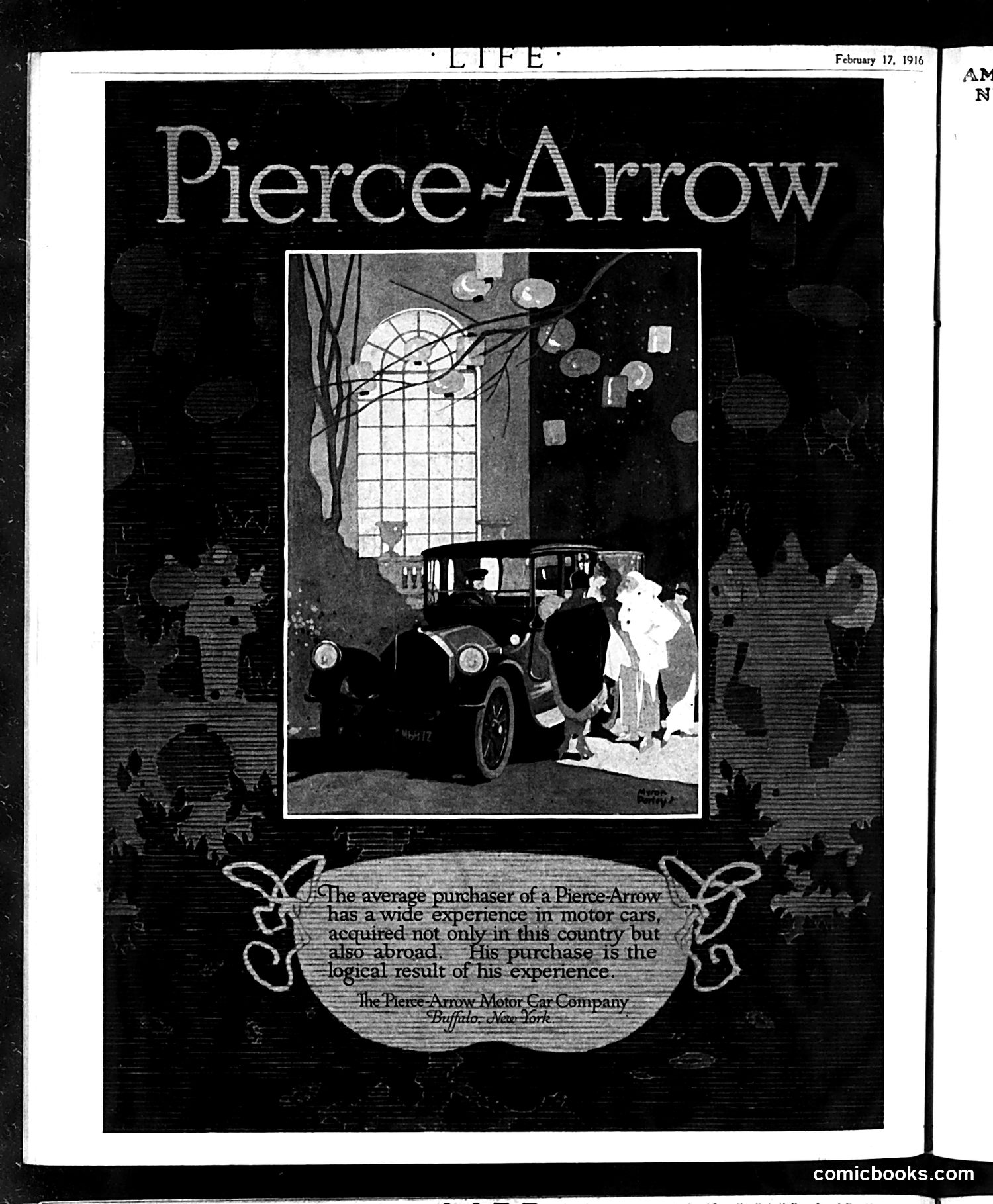
A complete issue · 52 pages · 1916
Life — February 17, 1916
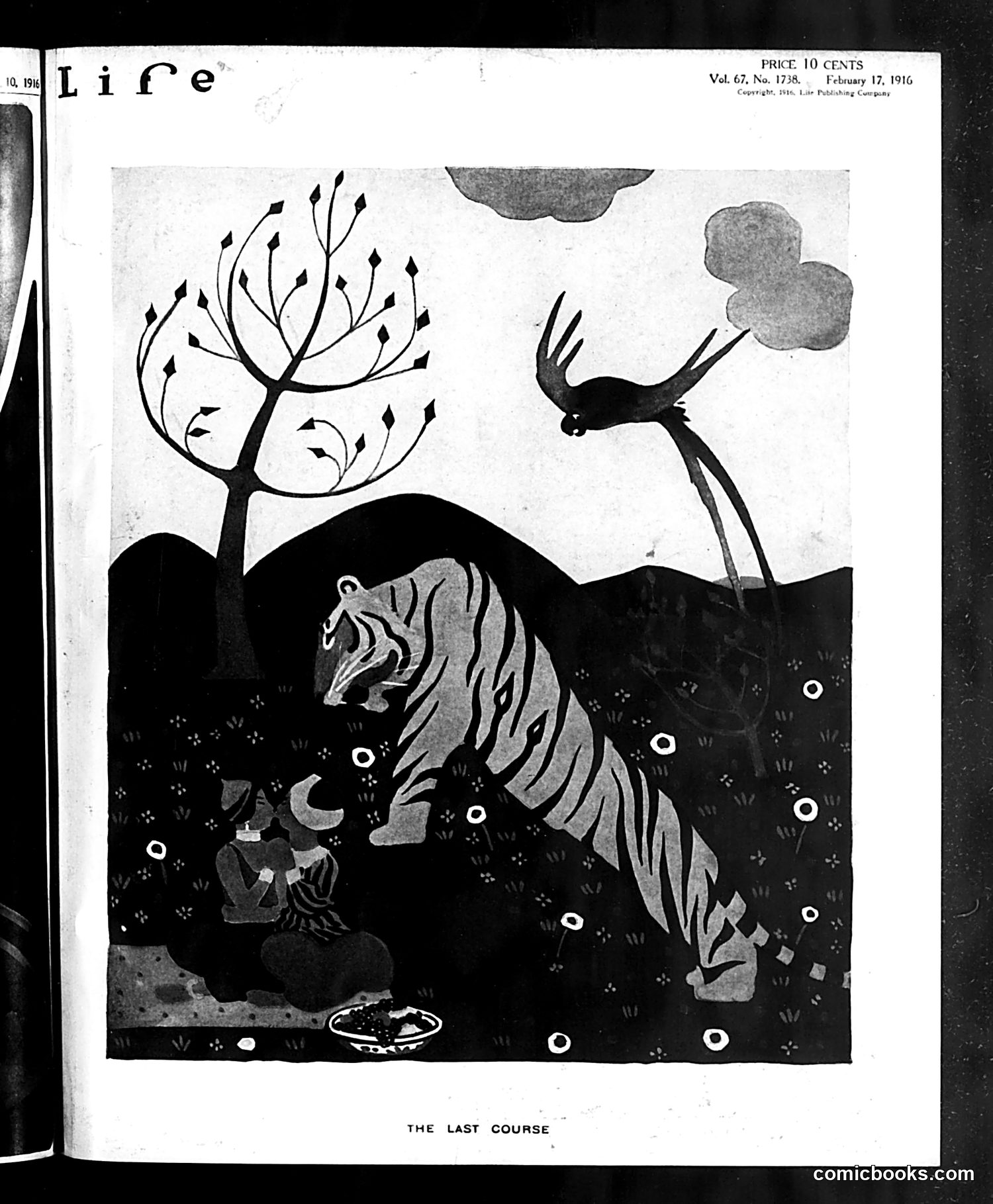
This 1916 *Life* magazine cartoon depicts a surreal, nightmarish scene titled "The Last Course." A skeletal tiger with striped markings dominates the composition, towering over a small seated figure. The figure appears to be dining or in a vulnerable position, suggesting they are about to be consumed—hence "the last course" (final meal, with dark double meaning). The tiger likely represents a predatory force, possibly referencing World War I conflicts or imperial aggression contemporaneous with 1916. The ethereal landscape with a bare tree, flying creature, and moon creates an ominous mood. Without additional context identifying the seated figure, the cartoon's specific political target remains unclear, though it appears to satirize vulnerability to overwhelming destructive power.
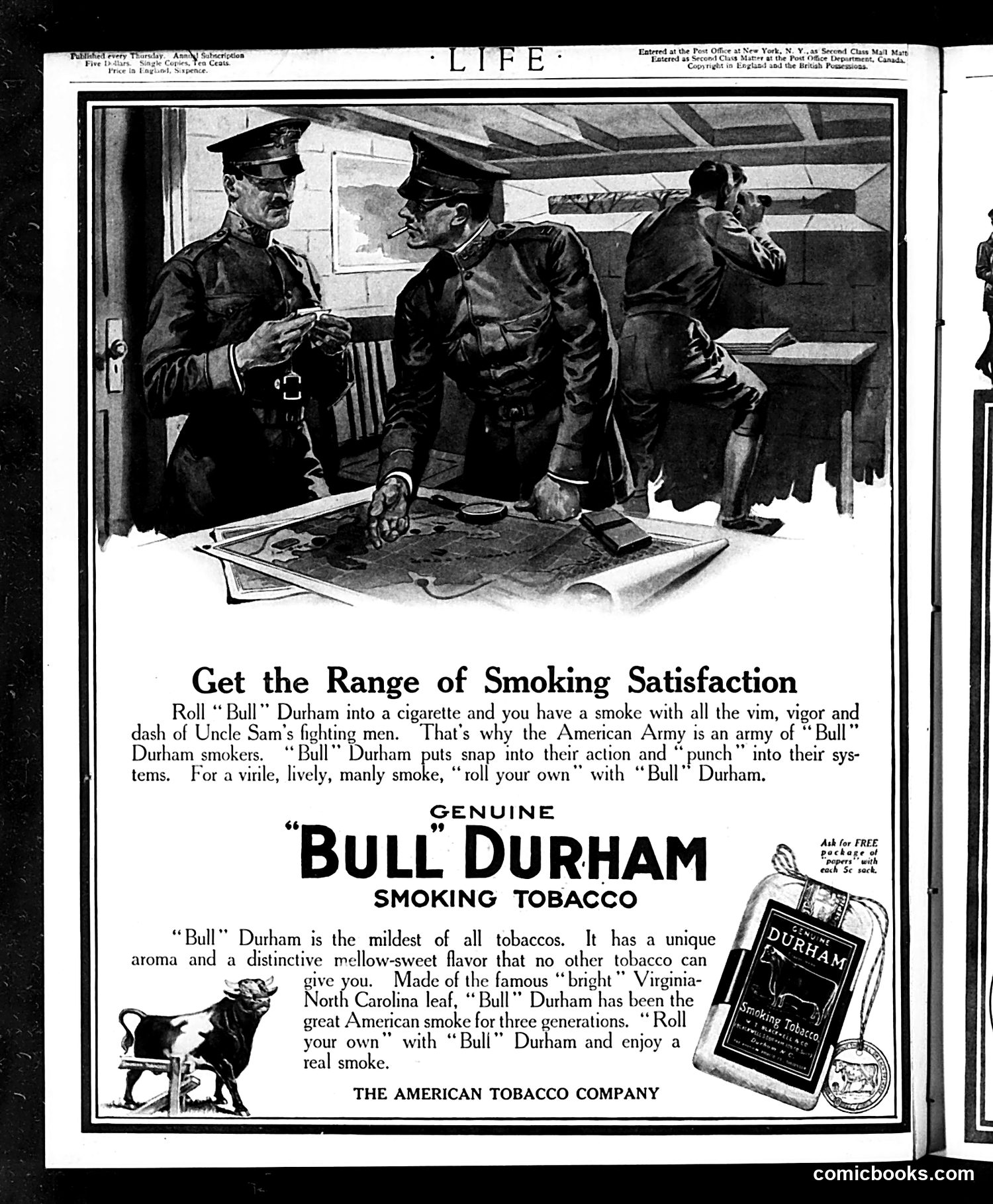
This page is primarily a **tobacco advertisement**, not satire or political commentary. It advertises "Bull Durham" smoking tobacco to American soldiers, likely from World War I era based on the military uniforms and style. The image shows military officers examining what appears to be a map or document—a scene suggesting military planning and authority. The advertisement leverages this patriotic military imagery to market tobacco, claiming Bull Durham is "an army of smokers" and associating the product with "Uncle Sam's fighting men." The pitch emphasizes the tobacco's mild Virginia blend and appeals to masculine ideals of "vim, vigor and dash." This represents early 20th-century marketing that directly associated smoking with military strength and American patriotism—messaging that would be considered highly inappropriate and false by modern standards.
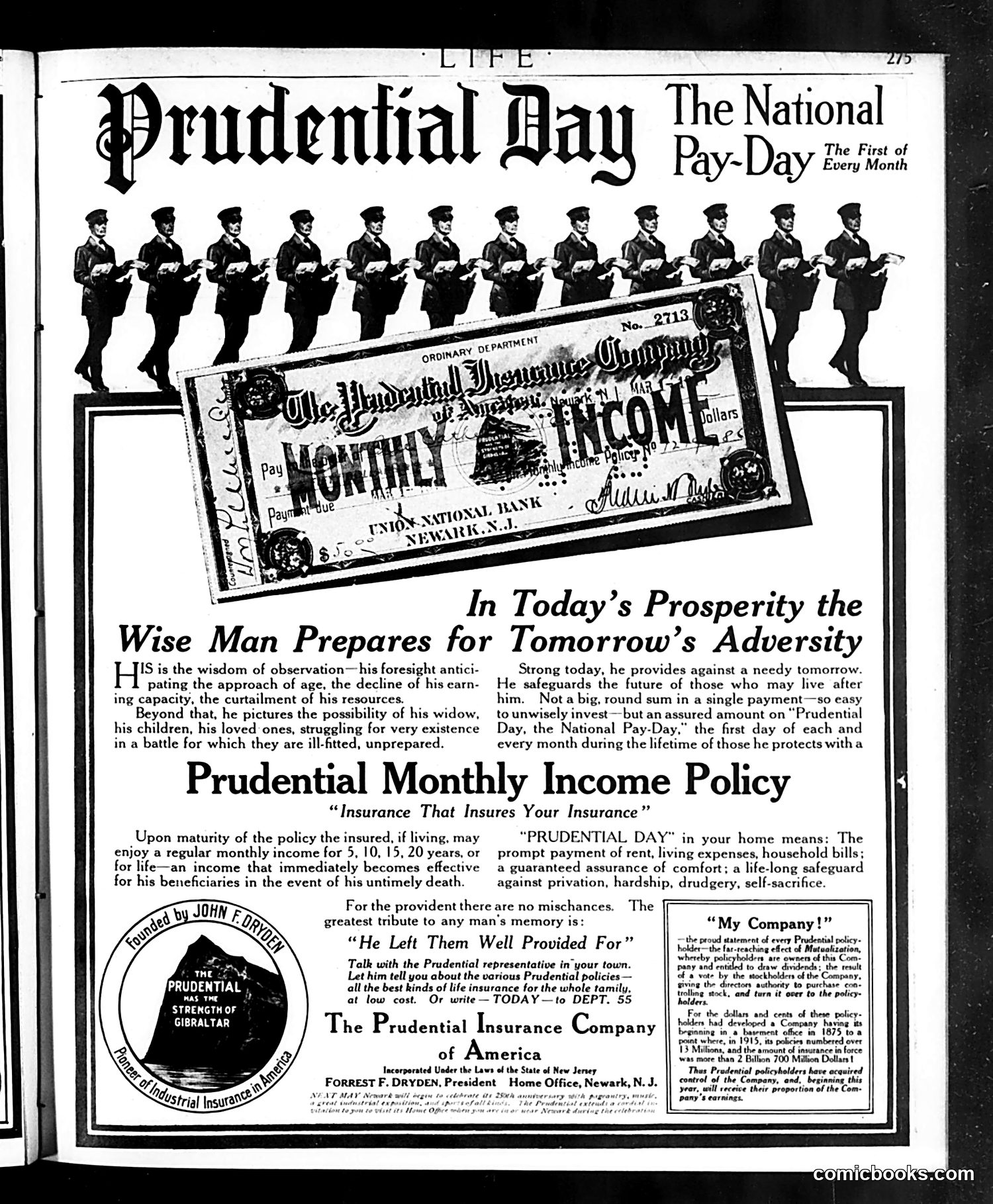
This page is primarily a **full-page advertisement** for the Prudential Insurance Company of America, not political satire. The ad promotes their "Prudential Monthly Income Policy" — an insurance product offering regular monthly payments to policyholders or their beneficiaries. The visual metaphor shows a line of men in business attire marching above a large ceremonial check labeled "MONTHLY INCOME," illustrating the concept of steady, reliable payments. The headline "Prudential Day — The National Pay-Day" presents the first of each month as a secure financial milestone. The accompanying text emphasizes prudent financial planning: "the Wise Man Prepares for Tomorrow's Adversity." This reflects early-20th-century anxieties about economic security and the appeal of insurance as protection against future hardship.
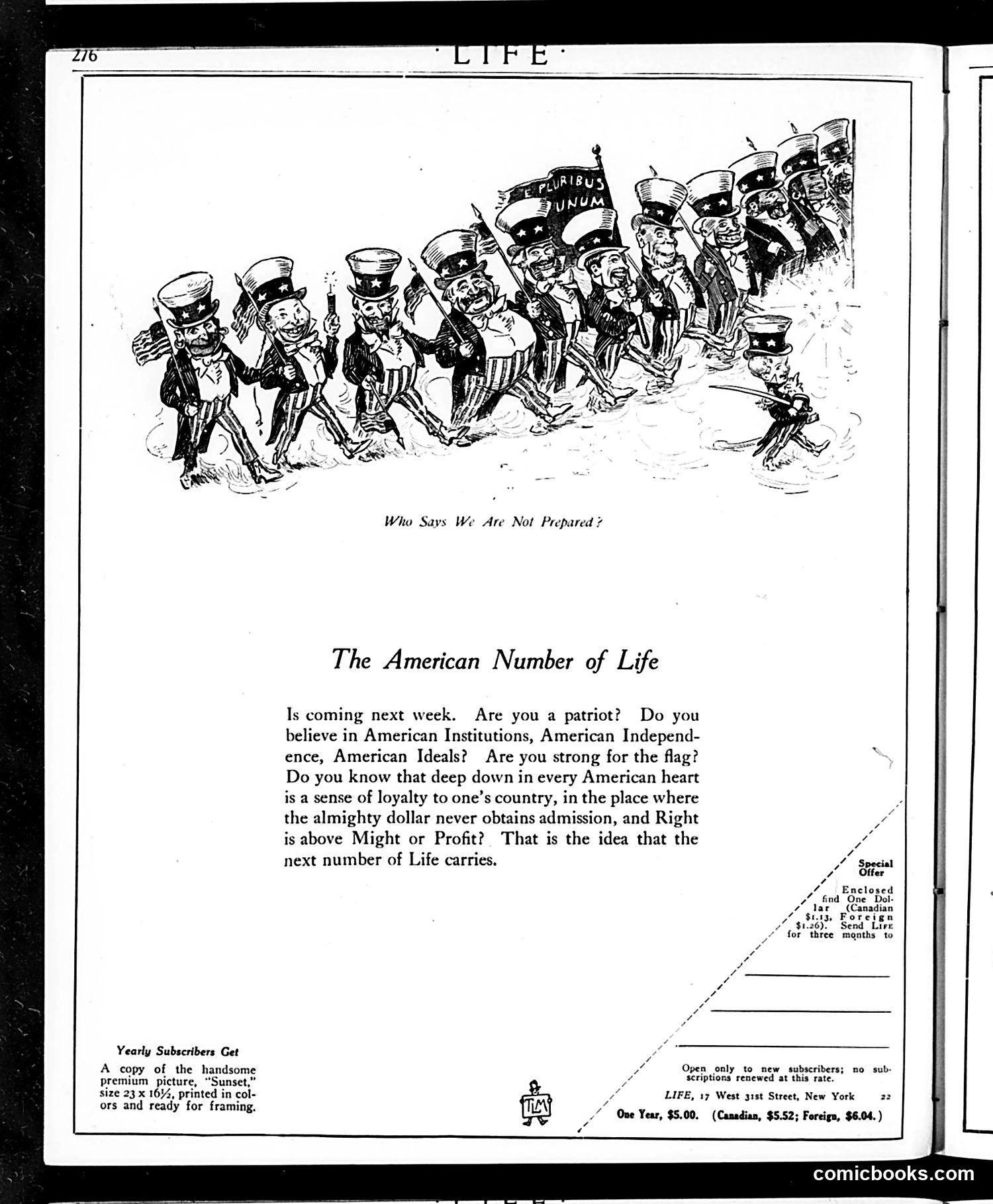
This political cartoon depicts a line of caricatured figures wearing Uncle Sam hats, labeled "E PLURIBUS UNUM" (the national motto). They appear to represent American military or political leadership, drawn in an exaggerated, somewhat grotesque style typical of early 20th-century satirical cartooning. The caption "Who Says We Are Not Prepared?" is ironic—the cartoon likely critiques American military readiness or political leadership, suggesting these figures are *not* adequately prepared despite claims otherwise. The following text promotes "The American Number of Life," appealing to patriotic sentiment about loyalty and American ideals. This appears to be pre-war (likely WWI era) propaganda or commentary on American preparedness debates of that period, though specific historical context requires more dating information.
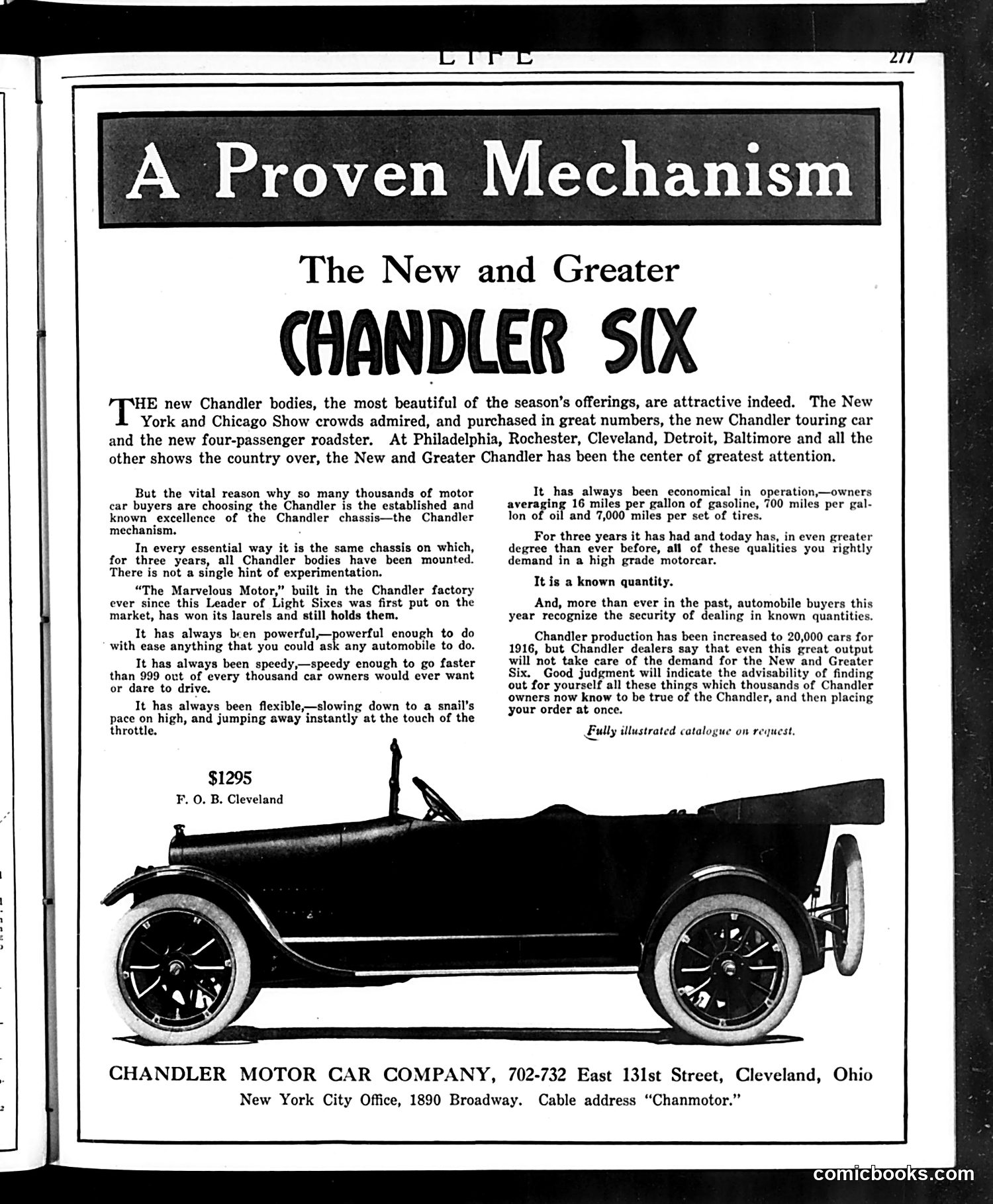
This page is **primarily an advertisement**, not satirical content. It promotes the Chandler Six automobile, manufactured by the Chandler Motor Car Company in Cleveland, Ohio. The ad emphasizes the car's "proven mechanism"—highlighting its chassis design, which had remained consistent for three years. Key selling points include: - Reliability and flexibility ("slowing down to a snail's pace" or "jumping away instantly") - Fuel efficiency (16 miles per gallon) - Known quantity/established reputation - Production capacity (9,000 cars annually) The illustration shows a side-profile silhouette of an open-air touring car typical of 1910s-era automobiles. The $1,295 price (F.O.B. Cleveland) and contact information appear below. This is straightforward commercial advertising with no discernible political or satirical content.
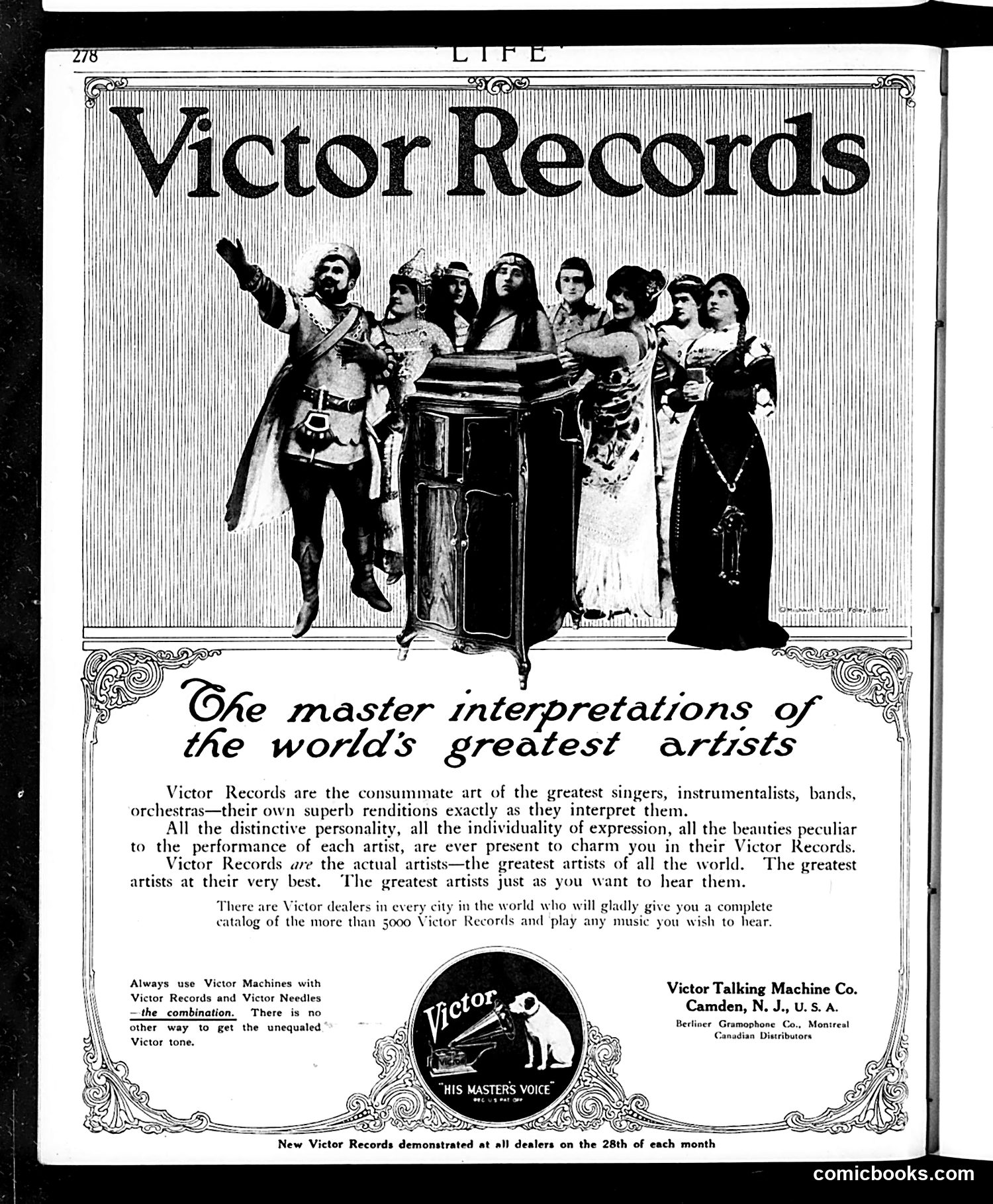
This is a **Victor Records advertisement**, not a political cartoon. It promotes phonograph records and the "His Master's Voice" gramophone player. The image depicts operatic or theatrical figures in period costumes gathered around a phonograph, symbolizing that Victor Records capture "the master interpretations of the world's greatest artists." The text emphasizes that Victor Records preserve famous singers, instrumentalists, and orchestras "exactly as they interpret them." The advertisement targets affluent consumers interested in classical music and opera, claiming Victor offers over 5,000 recordings. It's a straightforward commercial pitch emphasizing the technology's ability to reproduce live performances, not satirical commentary. The page represents early 20th-century marketing in *Life* magazine.
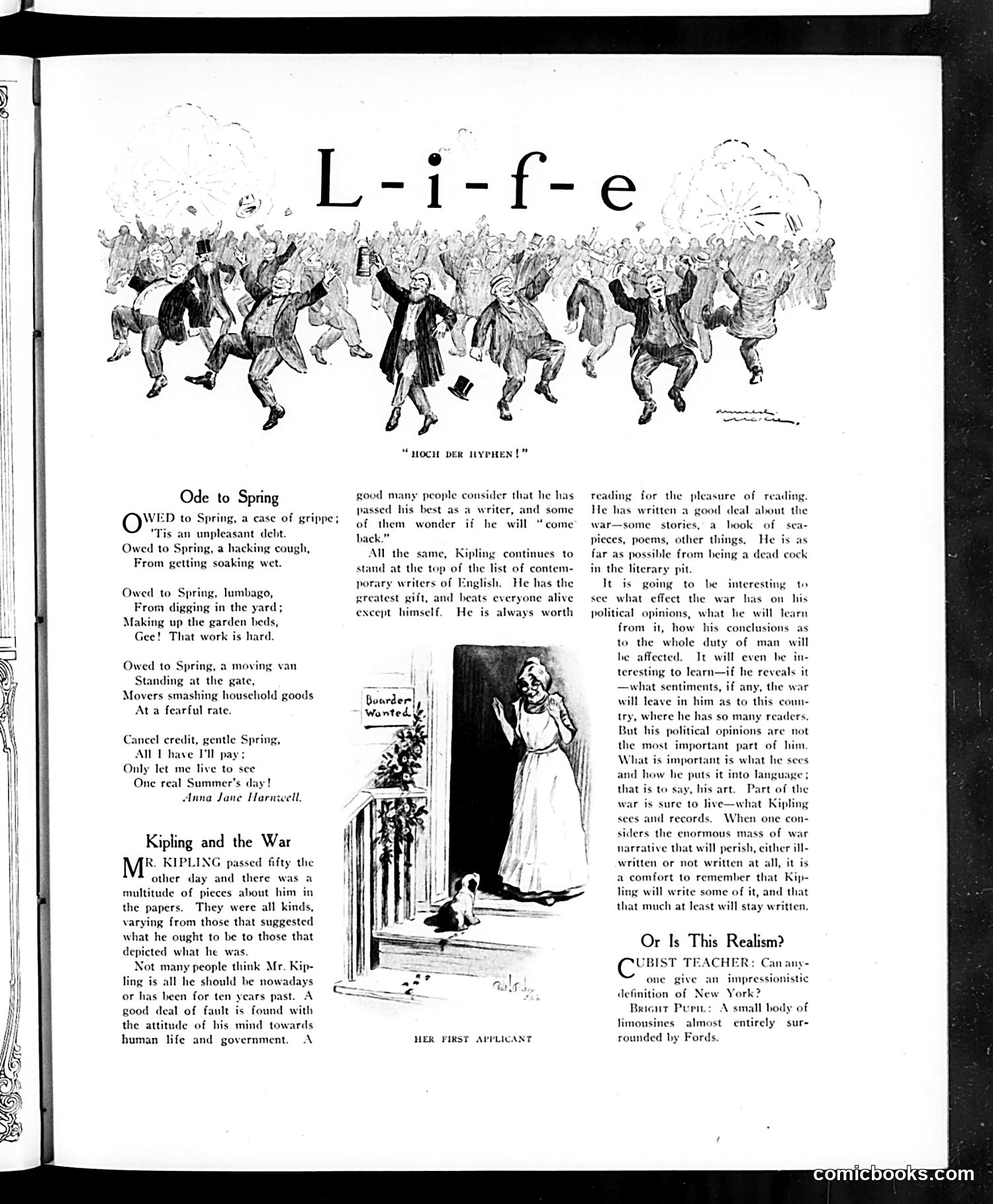
This page from *Life* magazine features commentary on writer Rudyard Kipling's response to World War I. The article "Kipling and the War" discusses how Kipling's wartime writings—varying from realistic depictions to propagandistic pieces—have divided critical opinion. Some readers consider him past his prime as a writer, while others acknowledge his continued literary importance. The "Ode to Spring" by Anna Jane Harnwell is a humorous poem listing debts owed to spring (unpaid bills, garden work, household goods). The cartoon showing a woman labeled "HER FIRST APPLICANT" with a "Boarder Wanted" sign appears to satirize housing shortages or economic difficulties, likely wartime-related. The bottom section "Or Is This Realism?" presents a brief cubist/impressionist teaching joke about New York definitions.
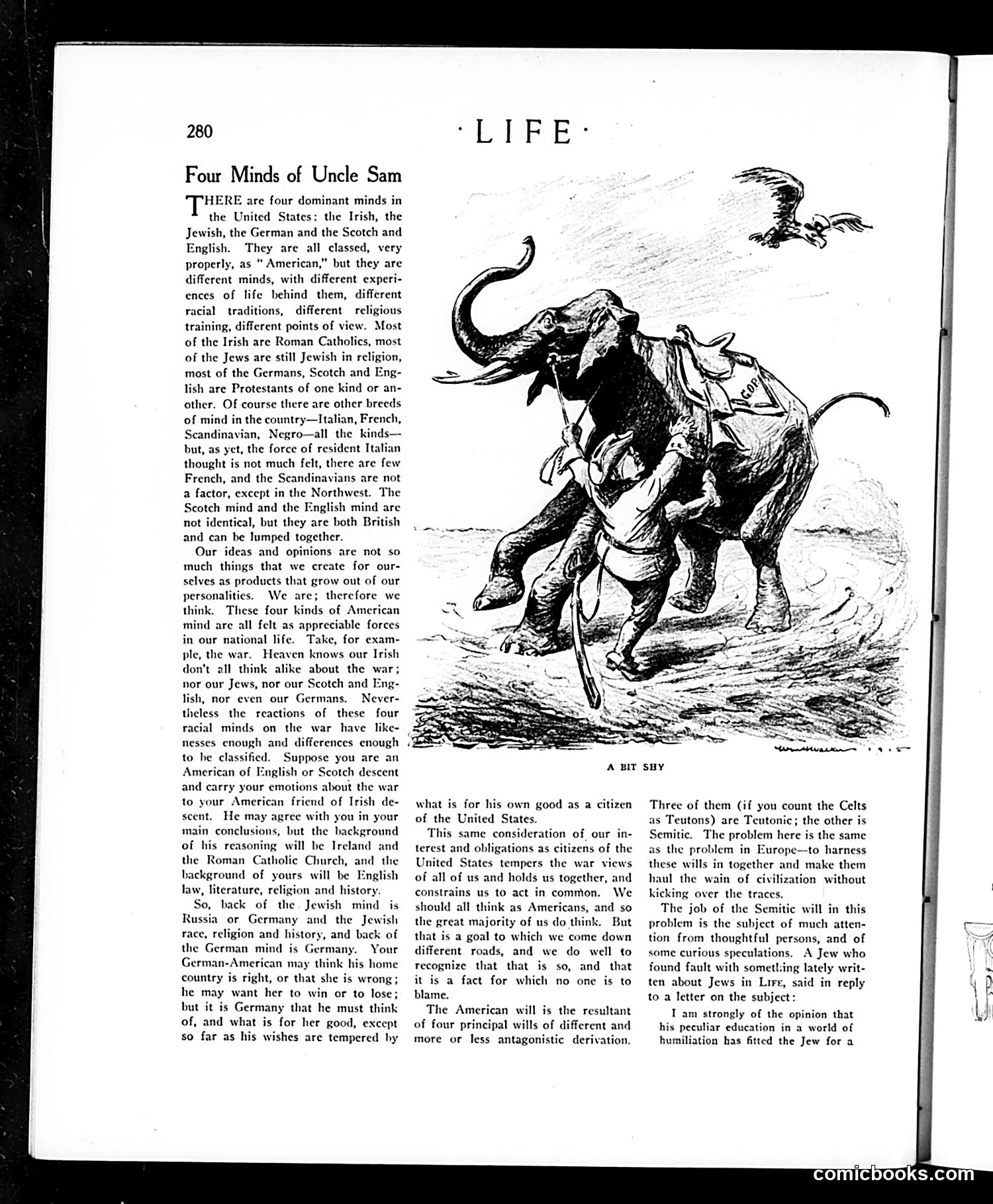
The illustration depicts an **elephant appearing hesitant or withdrawn**, labeled "A BIT SHY." The elephant likely represents the **Republican Party** (a standard political symbol of the era), shown reluctant or nervous about something. The accompanying text discusses **four dominant American "minds"**: Irish, Jewish, German, and Scotch-English populations, examining their different wartime perspectives during what appears to be **World War I**. The author argues these groups had divergent views on the conflict but should unite as Americans. The cartoon's point appears to be that **one political faction was being coy or evasive about committing to a unified American position** regarding the war—hence "a bit shy"—when national consensus was needed.
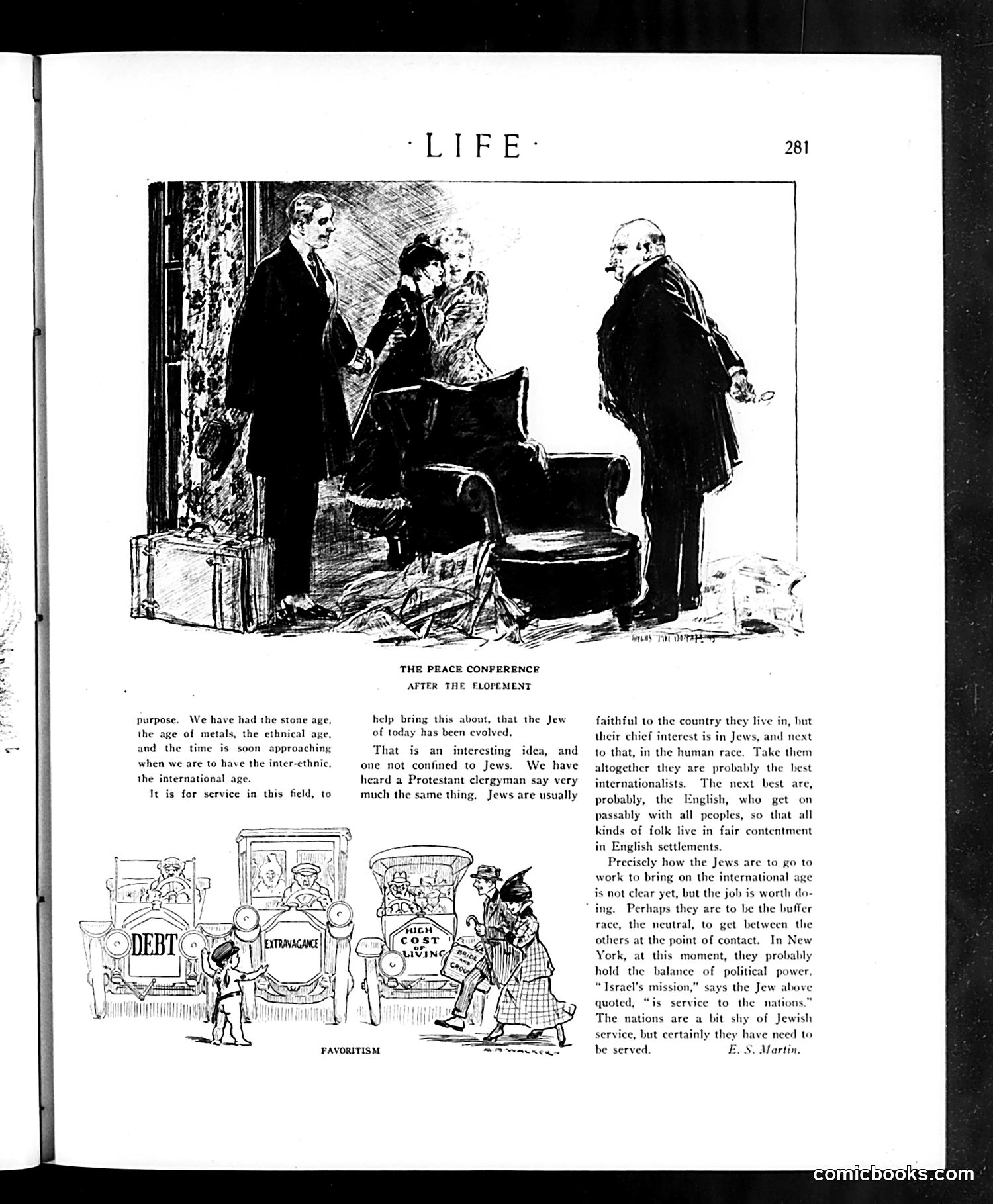
**"The Peace Conference After the Elopement"** (top cartoon): Shows what appears to be a domestic dispute in formal setting—a couple seems to have run away together, disrupting negotiations between two suited gentlemen. The satire likely comments on how personal scandal disrupts serious diplomatic efforts, suggesting peace conferences can be derailed by human drama. **"Favoritism"** (bottom cartoon): Depicts three large figures labeled "DEBT," "EXTRAVAGANCE," and "HIGH COST OF LIVING," each pulling a small child in different directions. This criticizes government favoritism toward certain economic problems while neglecting others, or how competing financial burdens pull citizens apart. The accompanying text discusses Jewish internationalism and service to nations, appearing unrelated to the cartoons.
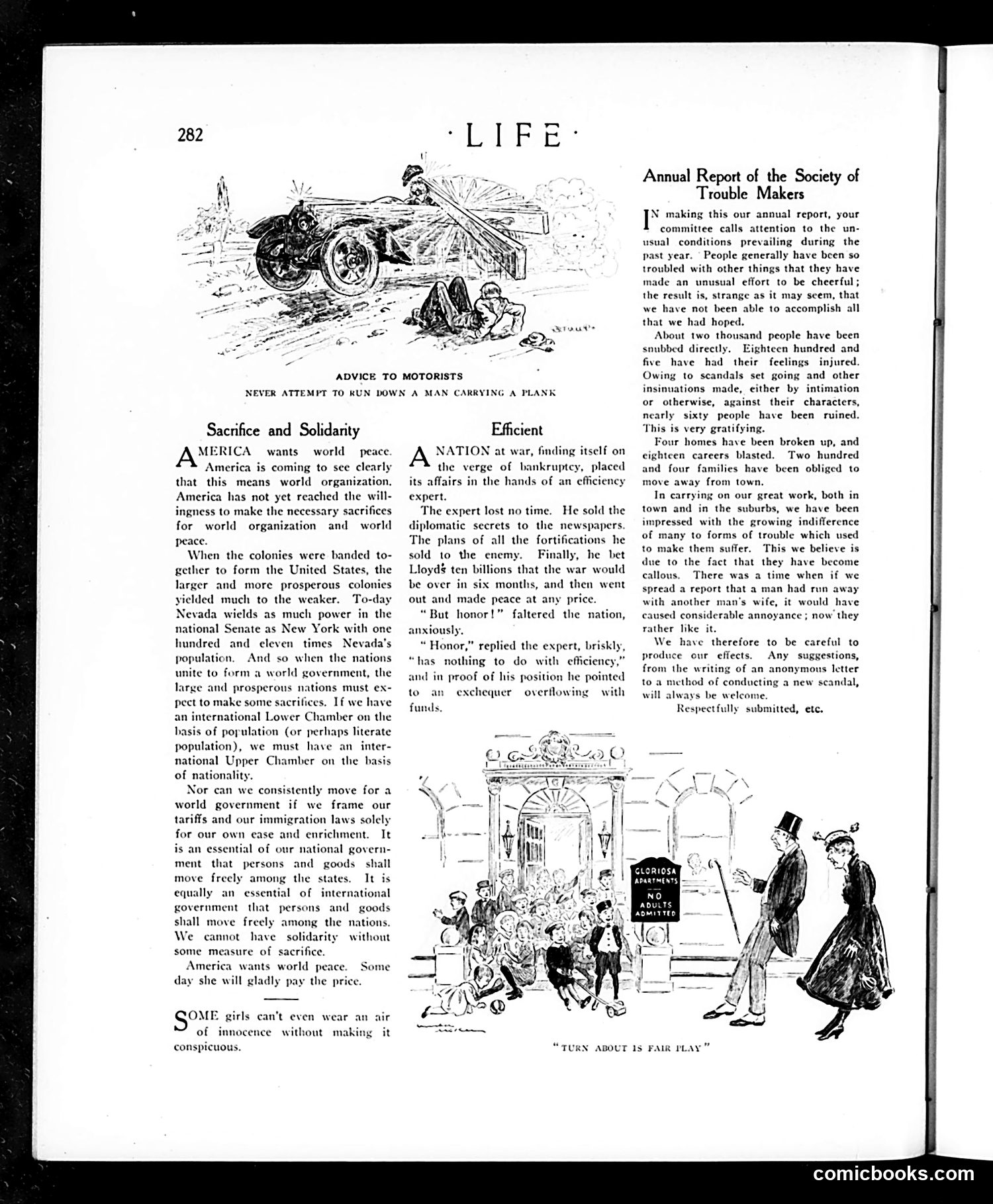
**Top cartoon**: "Advice to Motorists—Never Attempt to Run Down a Man Carrying a Plank" shows a car that has collided with a pedestrian carrying lumber, with the car destroyed and occupants sprawled on the ground. The joke satirizes the unexpected consequences of hitting someone with a large object—the plank proves more dangerous than the automobile. **Main articles**: Two opinion pieces titled "Sacrifice and Solidarity" and "Efficient" discuss American involvement in world peace and international governance. The right column presents an "Annual Report of the Society of Trouble Makers," detailing social disruptions and scandals affecting families and careers. **Bottom cartoon**: "Turn About Is Fair Play" depicts well-dressed figures at what appears to be a public building entrance, likely satirizing social hypocrisy or class disparities.
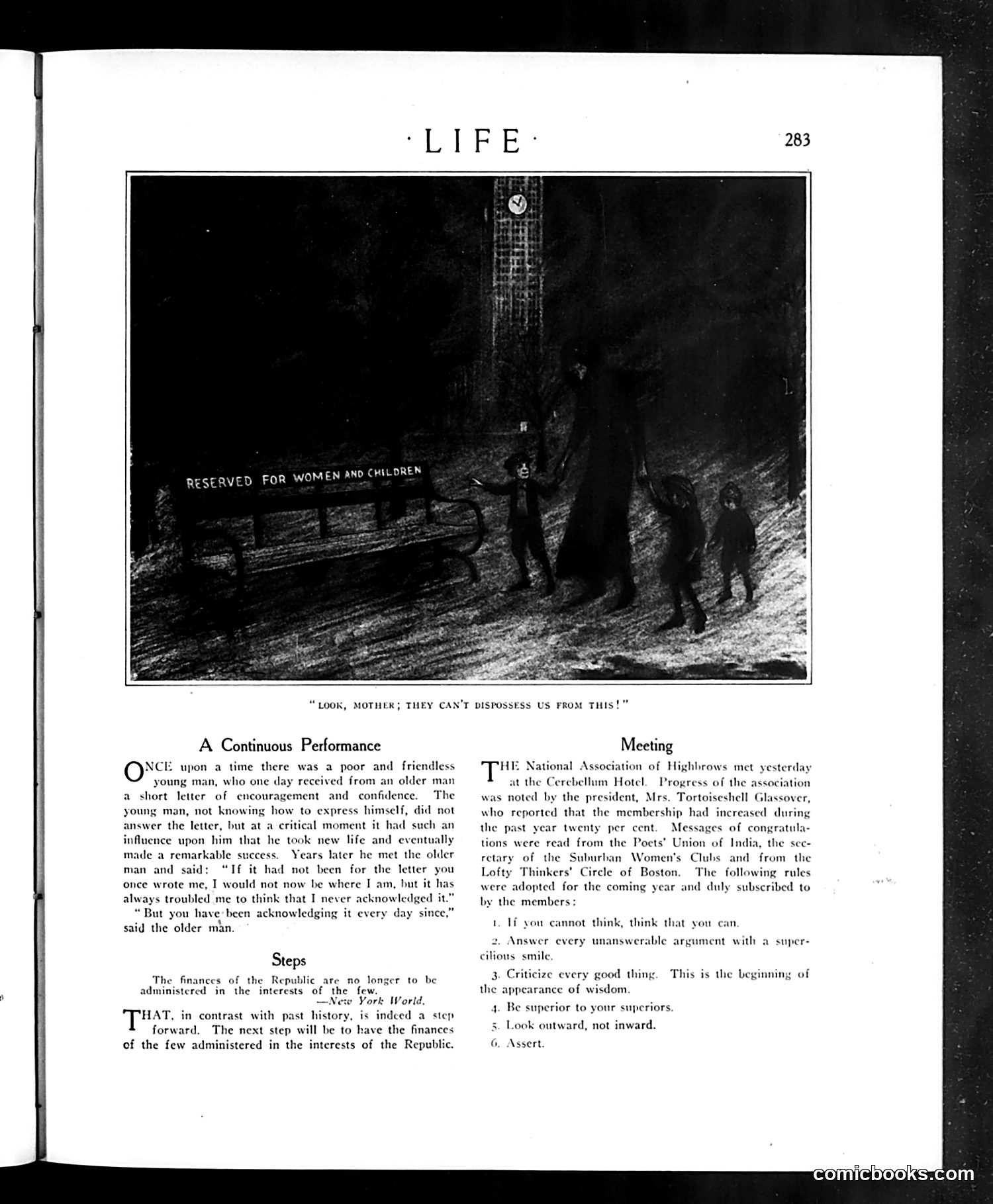
This page from *Life* magazine contains three separate pieces: 1. **The photograph and caption** shows a bench marked "RESERVED FOR WOMEN AND CHILDREN" with men standing nearby. The caption "'LOOK, MOTHER; THEY CAN'T DISPOSSESS US FROM THIS!'" is satirizing gender-segregated public spaces—suggesting men are joking about one remaining place where they retain authority or privilege, even as women's rights and social positions were advancing. 2. **"A Continuous Performance"** is a short moral tale about a poor young man who receives encouragement from an older man, later achieving success and crediting that letter. 3. **"Steps"** discusses republican financial administration, arguing for better management of public funds. 4. **"Meeting"** reports on the National Association of Highways' conference, listing organizational rules adopted by members. The page mixes light satire with earnest civic commentary typical of early 20th-century *Life* magazine.
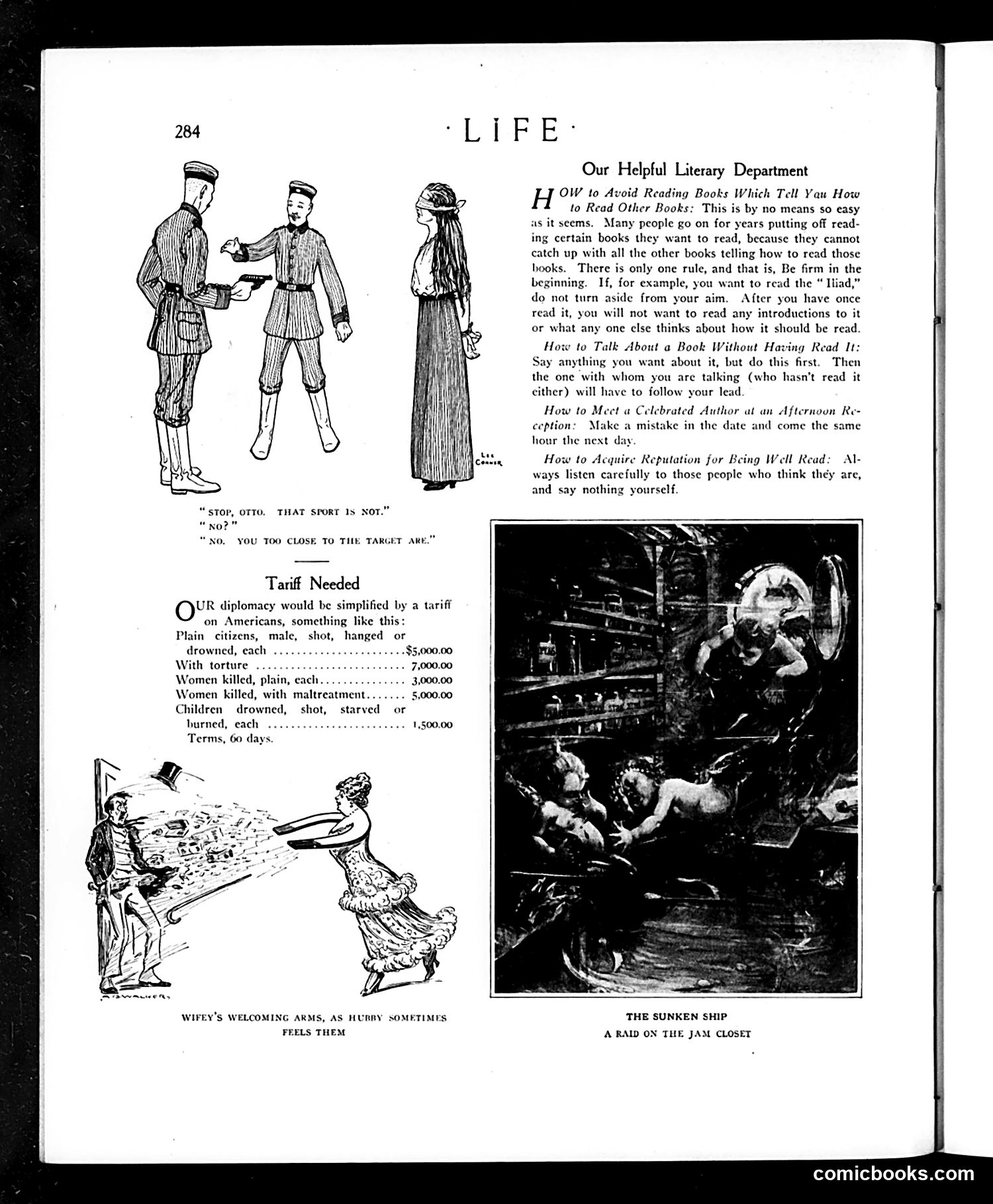
This page contains satirical content about early 20th-century diplomatic and social issues. **"Tariff Needed" section:** Uses dark humor to propose a "tariff on Americans"—listing financial penalties for killing civilians (plain citizens, women, children). This appears to satirize U.S. military intervention or warfare, suggesting the government should charge fees for American-caused deaths as it does for imported goods. The sarcasm critiques military policy. **Top cartoon:** Shows two uniformed figures discussing aim with a woman, captioned about being "too close to the target"—likely mocking military incompetence or friendly-fire incidents. **Bottom cartoon & photo:** "The Sunken Ship—A Raid on the Jam Closet" shows domestic chaos, captioned about a husband's homecoming. This satirizes marital discord and domestic life disruption. The overall tone is cynical wartime satire.
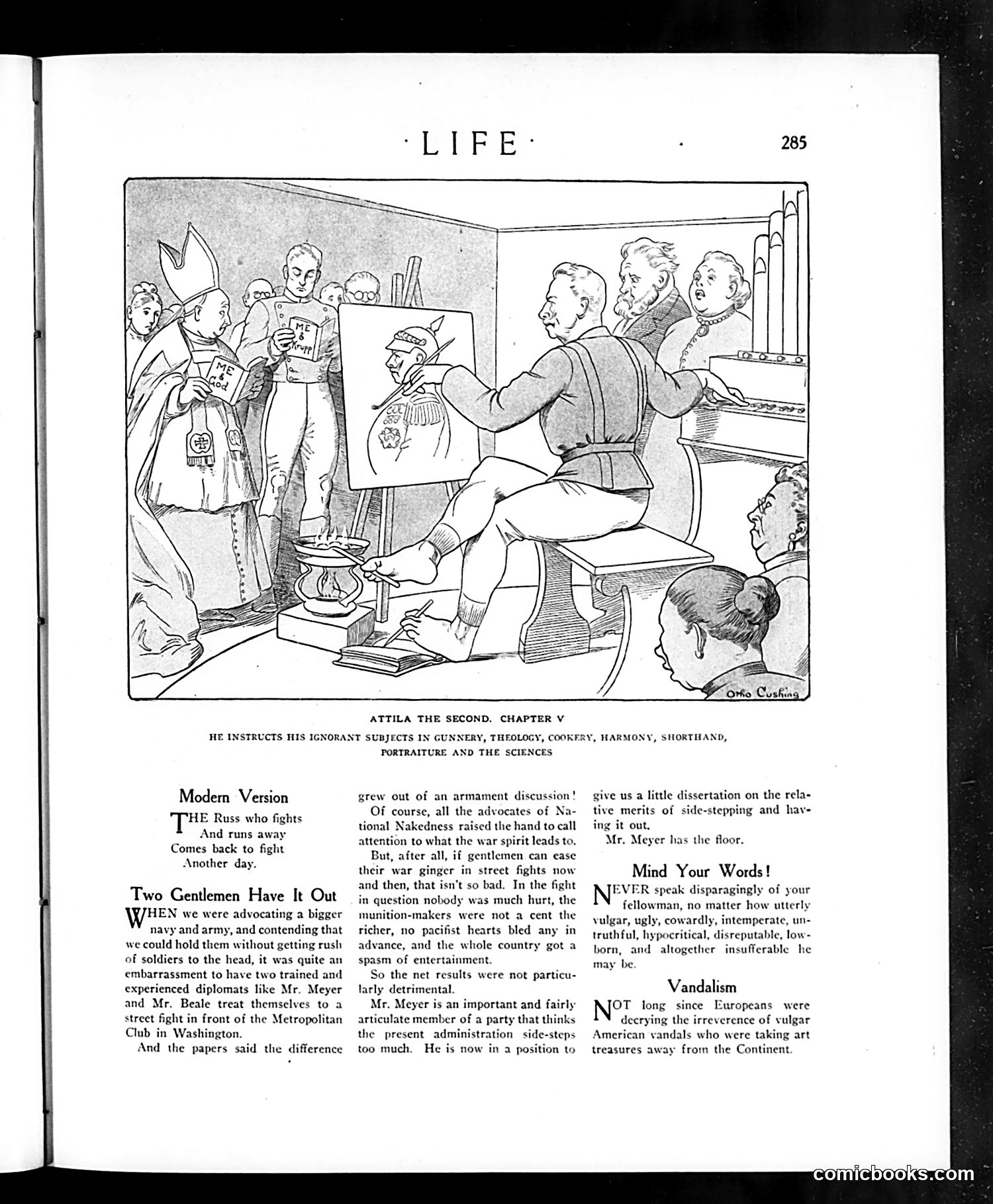
This Life magazine page satirizes early 20th-century military education. The main cartoon depicts **Attila the Second, Chapter V**, showing a military instructor teaching "ignorant subjects in gunnery, theology, cookery, harmony, shorthand, portraiture and the sciences." The joke invokes Attila the Hun—history's archetypal brutal conqueror—to mock an overly ambitious educational curriculum. By naming the instructor "Attila the Second," the cartoonist suggests that such comprehensive, scattered teaching represents intellectual barbarism rather than genuine learning. The accompanying text discusses diplomats Meyer and Beale's street fight near the Metropolitan Club in Washington, implying that even "trained and experienced diplomats" resort to crude violence—supporting the cartoon's theme that civilization merely masks brutish behavior.
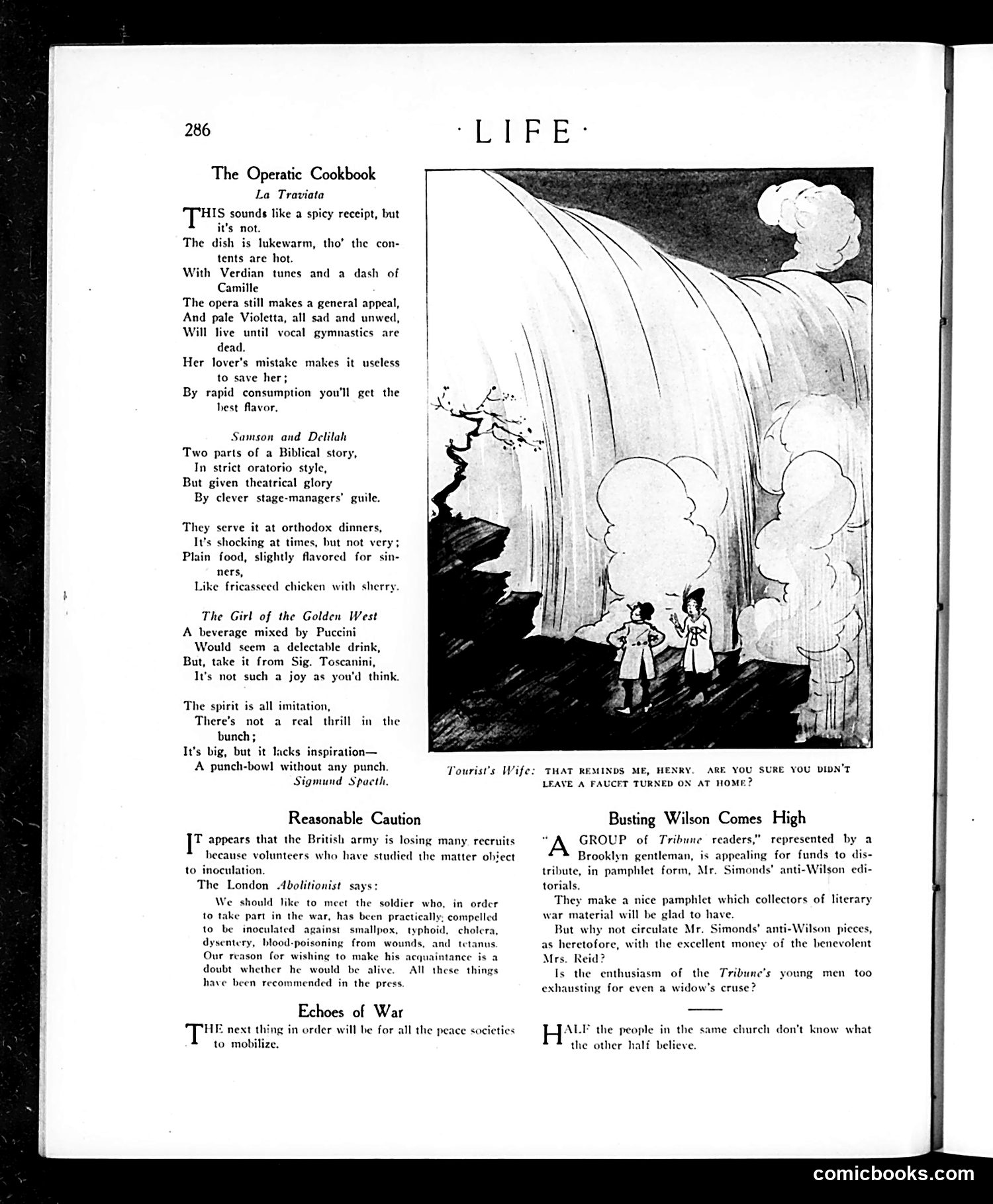
The page contains humorous commentary on opera and social issues rather than political cartoons. "The Operatic Cookbook" section mocks operas like *La Traviata* and *Samson and Delilah*, treating their plots as recipes—a form of literary satire common to Life magazine. The illustration shows a woman and children looking up at curtains, captioned "Tourist's Wife: That reminds me, Henry. Are you sure you didn't leave a faucet turned on at home?"—a domestic humor piece playing on the distraction of theater-going. The remaining text sections ("Reasonable Caution," "Busting Wilson Comes High," "Echoes of War") appear to be editorial commentary on WWI-era topics, including military recruitment concerns and church divisions over the war effort.
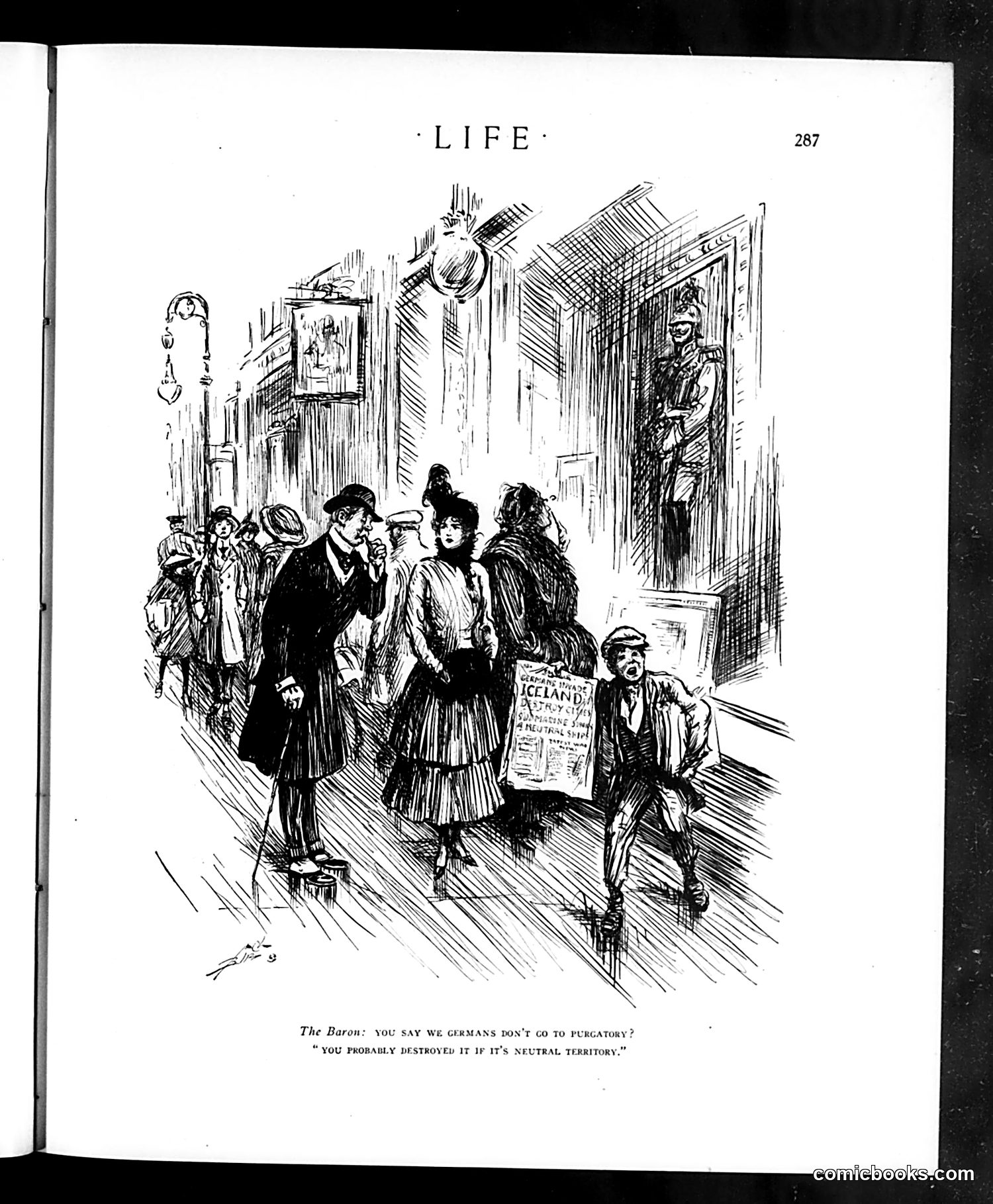
This cartoon appears to reference World War I-era diplomacy regarding purgatory or neutral territory. A Baron (likely a German diplomatic figure) is being confronted on a street by what appears to be a newspaper vendor and other civilians. The caption reads: "YOU SAY WE GERMANS DON'T GO TO PURGATORY? 'YOU PROBABLY DESTROYED IT IF IT'S NEUTRAL TERRITORY.'" The satire mocks German military conduct during WWI, specifically accusations that Germany violated Belgian neutrality and destroyed neutral territory. The joke equates Germany's disregard for neutral nations with hypothetical disregard for neutral spiritual realms—suggesting Germans couldn't respect neutral territory even in religious/afterlife contexts. The cartoon criticizes German wartime actions through dark, absurdist humor typical of period American satirical magazines.
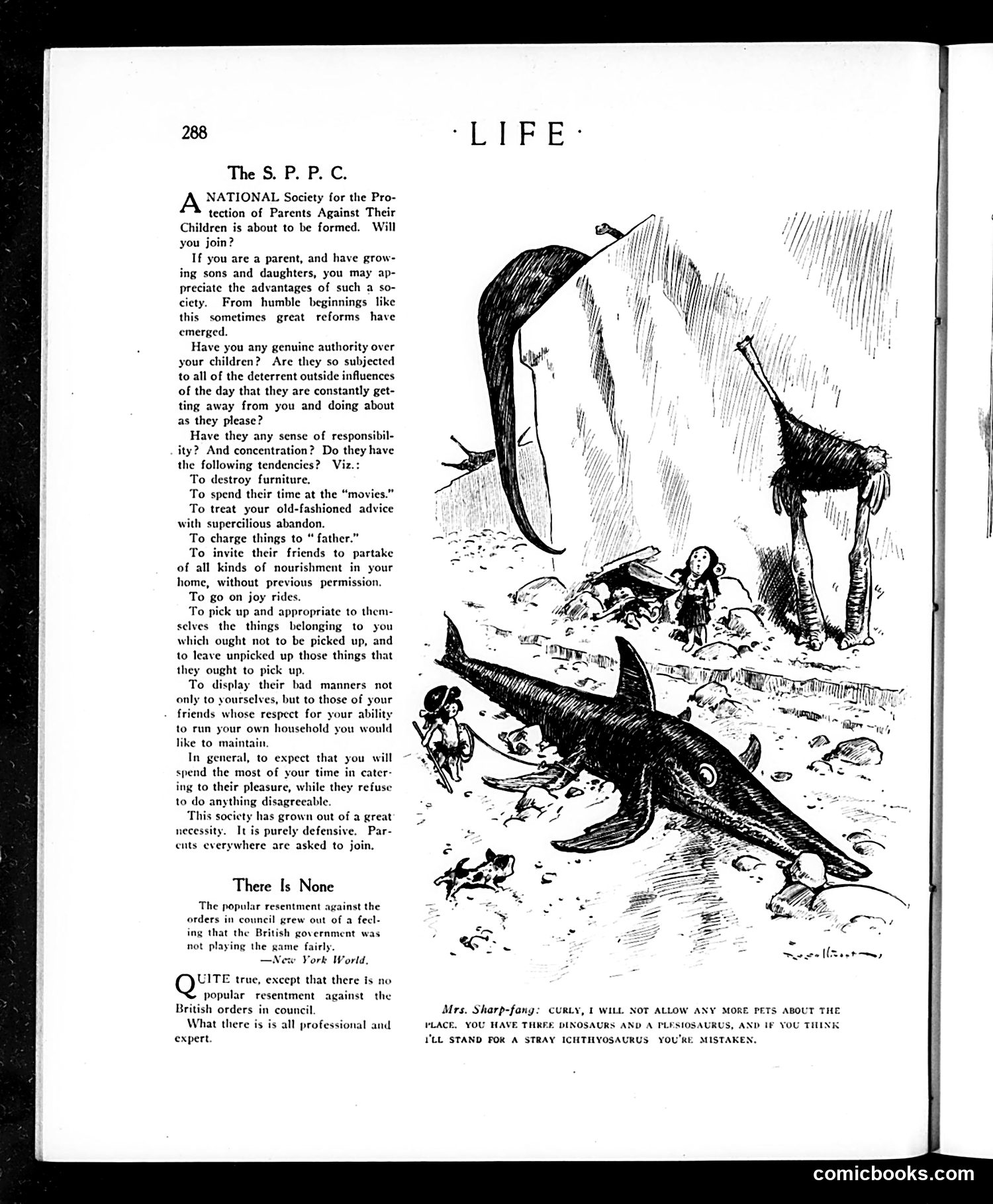
This page contains two satirical pieces about authority and control. **"The S.P.P.C." (Top):** A mock advertisement proposes forming a "National Society for the Protection of Parents Against Their Children." The satire lists common parental frustrations—children destroying furniture, attending movies, ignoring advice, charging purchases to their fathers, taking joy rides, and generally behaving disrespectfully. The humor targets generational conflict and parental loss of authority, suggesting parents need organized defense against modern youth misbehavior. This reflects early-20th-century anxieties about changing family dynamics and young people's independence. **"There Is None" (Bottom):** A brief political commentary on "orders in council" (likely WWI-era British trade restrictions). The text ironically notes there's no *popular* resentment—only professional/expert criticism—suggesting the general public either doesn't understand or doesn't care about the policy, contradicting a claim in the New York World. **The Dinosaur Cartoon:** Mrs. Sharp-fang refuses to tolerate another pet, already having three prehistoric creatures. This appears to be a humorous illustration separate from the main articles, playing on absurdist family management themes.
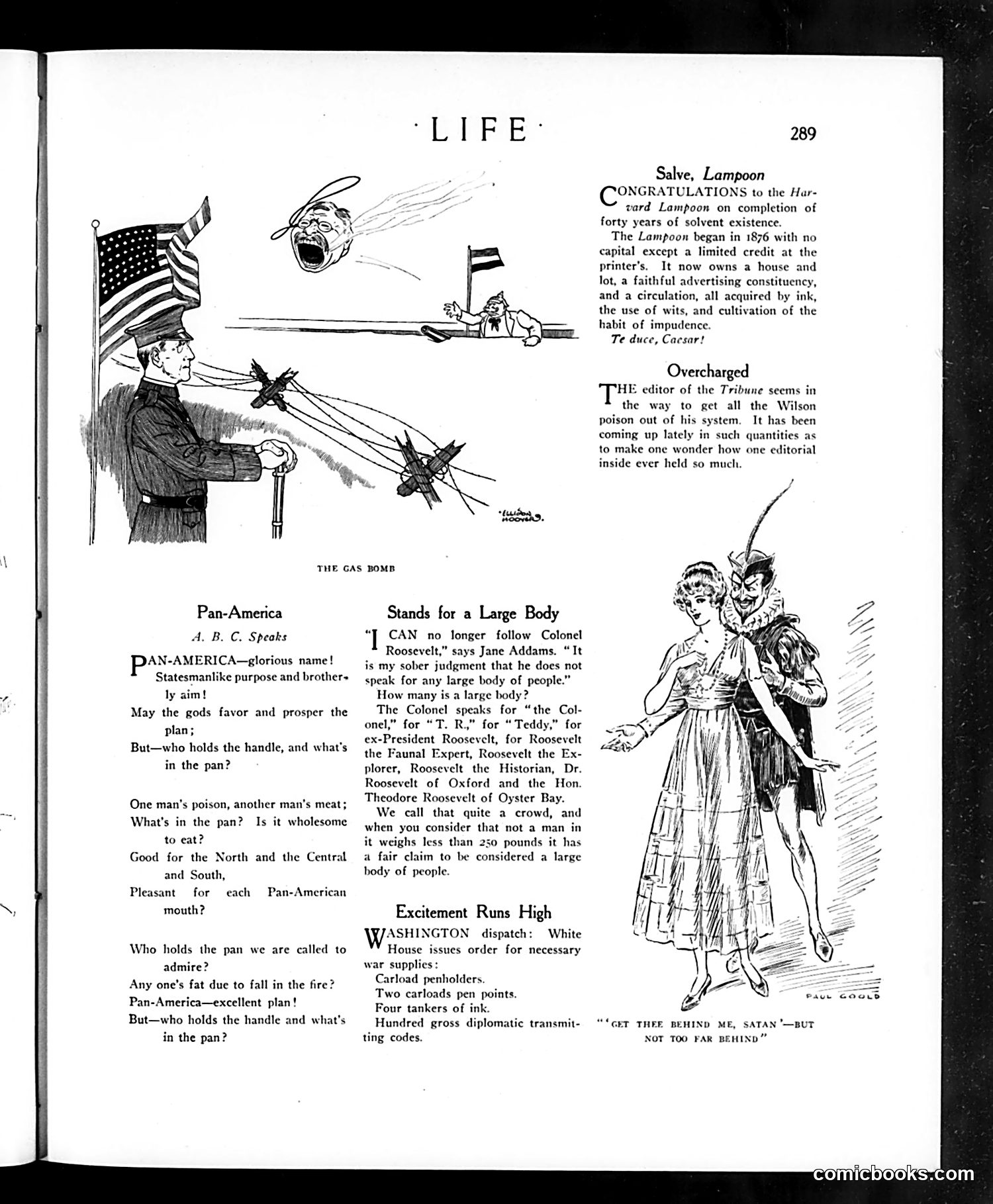
This page contains several satirical pieces mocking American politics circa 1910s-1920s. **"The Gas Bomb"** and **"Pan-America"** critique a Pan-American conference or initiative, questioning who controls the agenda and what benefits it actually delivers ("who holds the handle and what's in the pan?"). **"Stands for a Large Body"** ridicules Theodore Roosevelt's claim to represent "a large body of people." The joke: Roosevelt alone represents numerous versions of himself (explorer, historian, etc.), and since he and his associates all weigh over 250 pounds, they literally constitute "a large body of people"—a pun on his physical bulk. **"Excitement Runs High"** mocks Wilson administration bureaucracy, sarcastically listing absurd "war supplies" (penholders, pen points, ink, codes) needed for diplomatic operations—suggesting excessive paperwork and administrative bloat. **"Salve, Lampoon"** congratulates Harvard's satirical magazine on forty years of success. **"Overcharged"** criticizes the Tribune editor for over-indulging in anti-Wilson rhetoric.
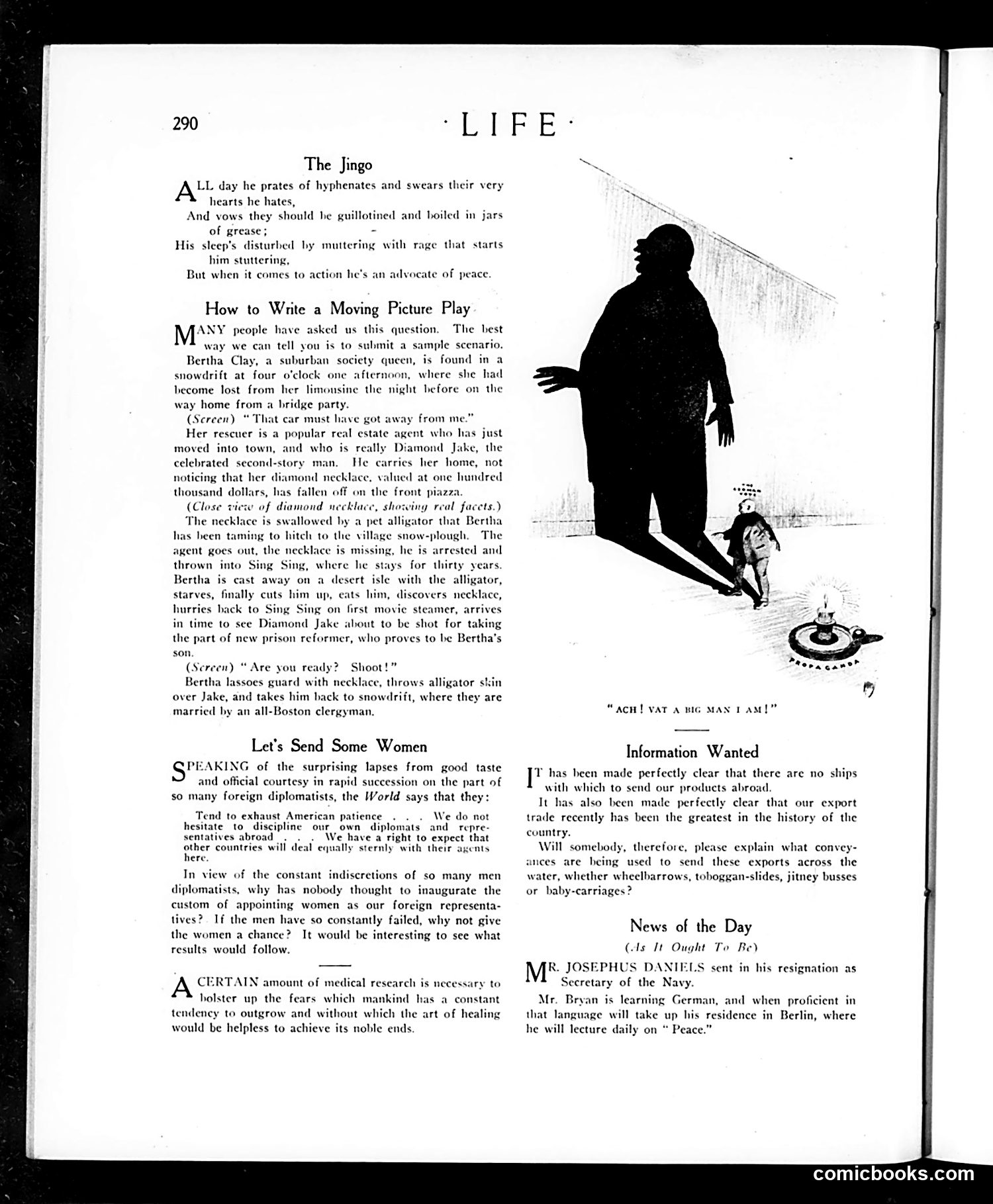
This page contains several satirical pieces typical of Life's editorial commentary: **"The Jingo"** (poem): Mocks a bellicose political figure who daily rants about "hyphenates" (immigrants with divided loyalties) and demands extreme punishments, yet proves cowardly when actual action is required—a common WWI-era critique of warmongers who talk tough but avoid real commitment. **"How to Write a Moving Picture Play"**: Parodies absurdly melodramatic silent film plots by presenting an intentionally ridiculous scenario involving a socialite, a jewel thief, Sing Sing prison, an alligator, and improbable coincidences—mocking the era's overwrought movie storylines. **"Let's Send Some Women"**: Suggests replacing incompetent male diplomats with female representatives, sarcastically implying women couldn't perform worse given recent diplomatic failures. **The cartoon** (bottom right) depicts a large man towering over a small figure, with the caption "Ach! Vat a big man I am!"—likely stereotyping German/Eastern European immigrants with exaggerated self-importance. The page reflects Progressive-era American anxieties about immigration, diplomatic conduct, and entertainment culture.
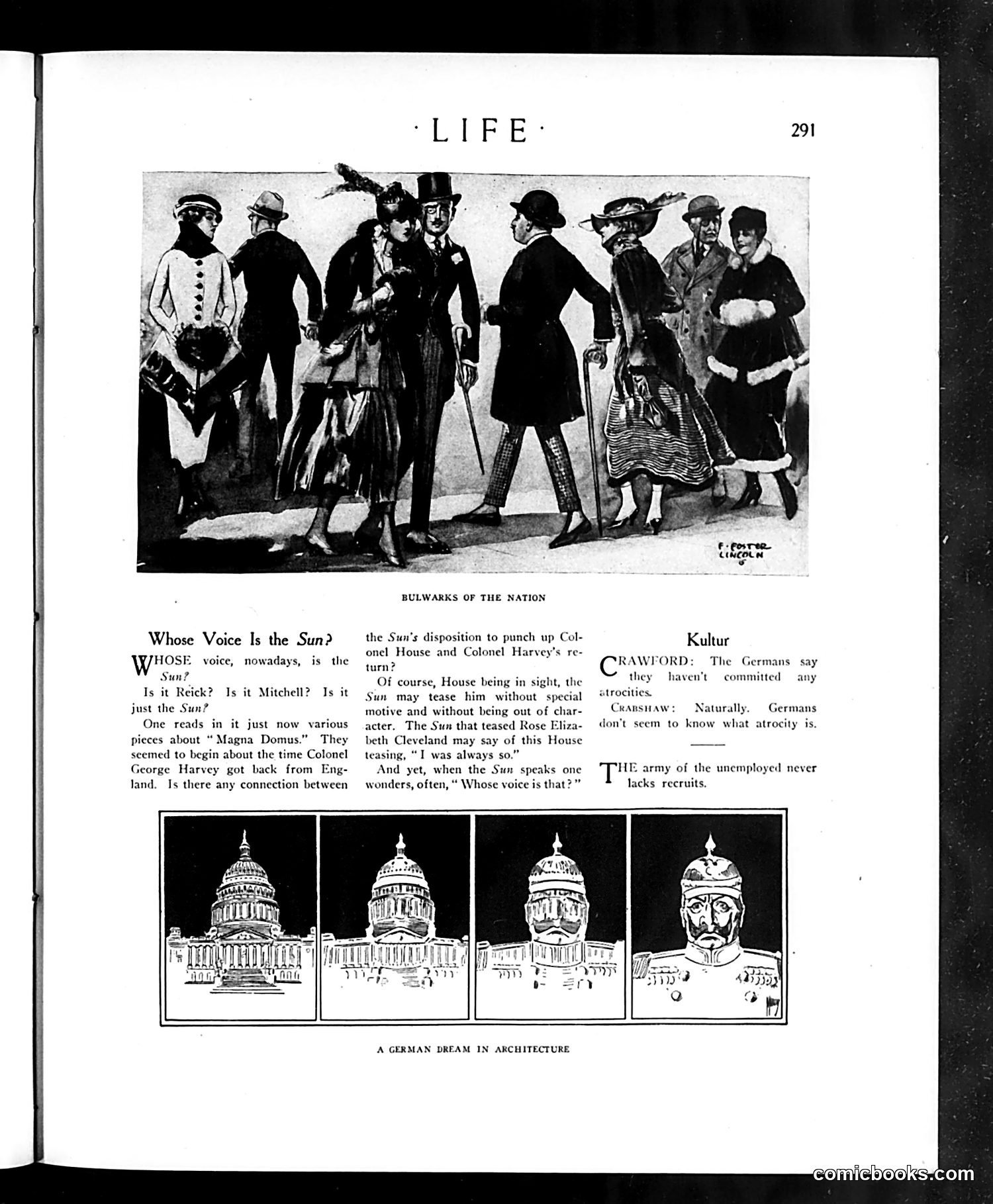
This page satirizes American political influence and German militarism circa World War I era. **"Whose Voice Is the Sun?"** questions whether the newspaper *The Sun* speaks independently or echoes powerful figures like Colonel George Harvey and Colonel House (Woodrow Wilson's advisor). The cartoon suggests the press may be a puppet of political elites rather than an independent voice. **"A German Dream in Architecture"** (bottom) depicts the U.S. Capitol progressively transforming into a German military helmet—a visual warning about German imperial ambitions. Combined with the dialogue mocking German claims of no war atrocities, this warns Americans that German militarism threatens American democracy itself. The top illustration labeled "Bulwarks of the Nation" shows well-dressed social elites, suggesting the irony that these figures claim to defend the nation while potentially corrupting its institutions through hidden influence. The satire warns: beware both foreign militarism *and* domestic corruption of the press by political insiders.
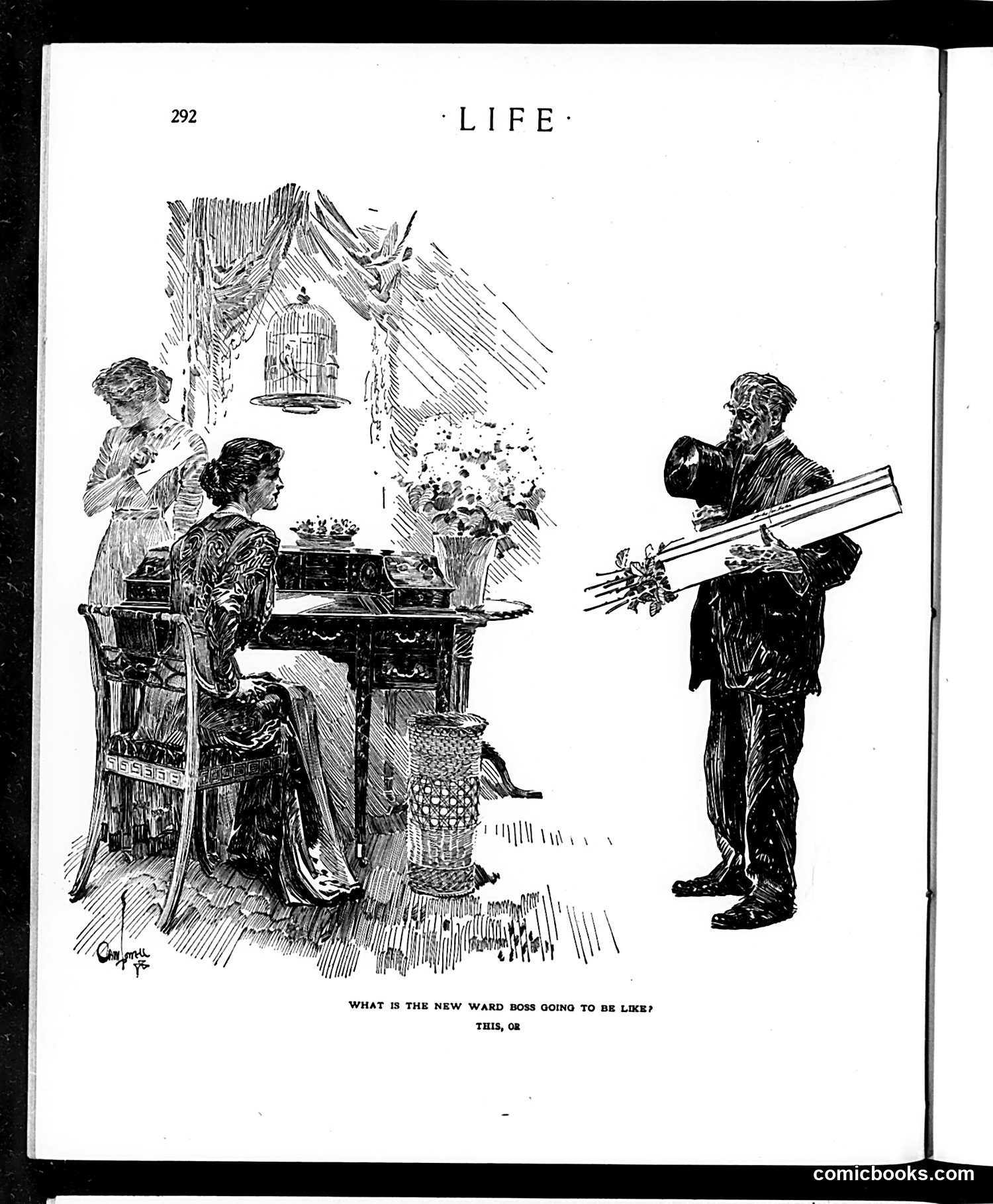
This satirical cartoon poses a question about what a new political "ward boss" will be like, presenting two contrasting scenarios: **Left side:** Shows a traditional corrupt political boss at a desk, surrounded by attendants and symbols of venal power—suggesting the old model of machine politics with bribery and patronage. **Right side:** Depicts a man with a telescope or surveying instrument, appearing to represent a more "modern" or reformed approach to political leadership. The joke likely critiques anxieties about political reform in early 20th-century America. "Ward bosses" controlled urban political machines through patronage and corruption. The cartoon asks whether the new generation will break from this corrupt tradition or merely represent a different style of the same system. The title suggests readers choose which future they expect.
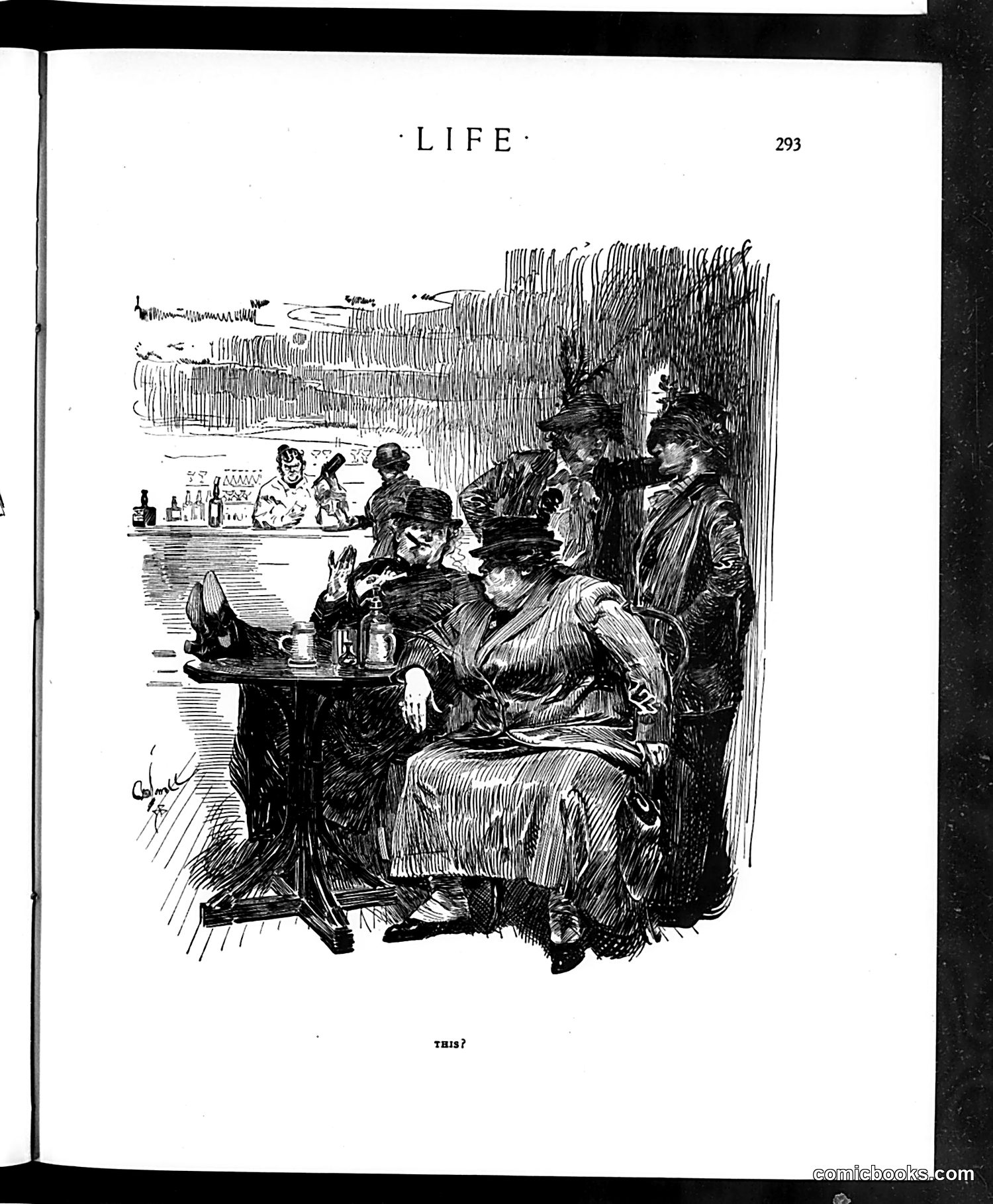
This page from Life magazine (page 293) contains a single sketch titled "THIS?" The ink drawing depicts a social scene in what appears to be a bar or establishment. A well-dressed woman sits at a small table with drinks and bottles, while several men in coats and hats stand nearby, observing her. The woman's prominent position and the men's focused attention suggest she may be a performer or person of interest. Without additional context or captions visible on this page, the specific satire remains unclear. The title "THIS?" appears interrogative, possibly questioning the woman's identity or role. The sketch's style and setting suggest social commentary typical of early 20th-century Life magazine, likely addressing gender dynamics, entertainment venues, or contemporary social customs, but the exact subject cannot be definitively determined from the image alone.
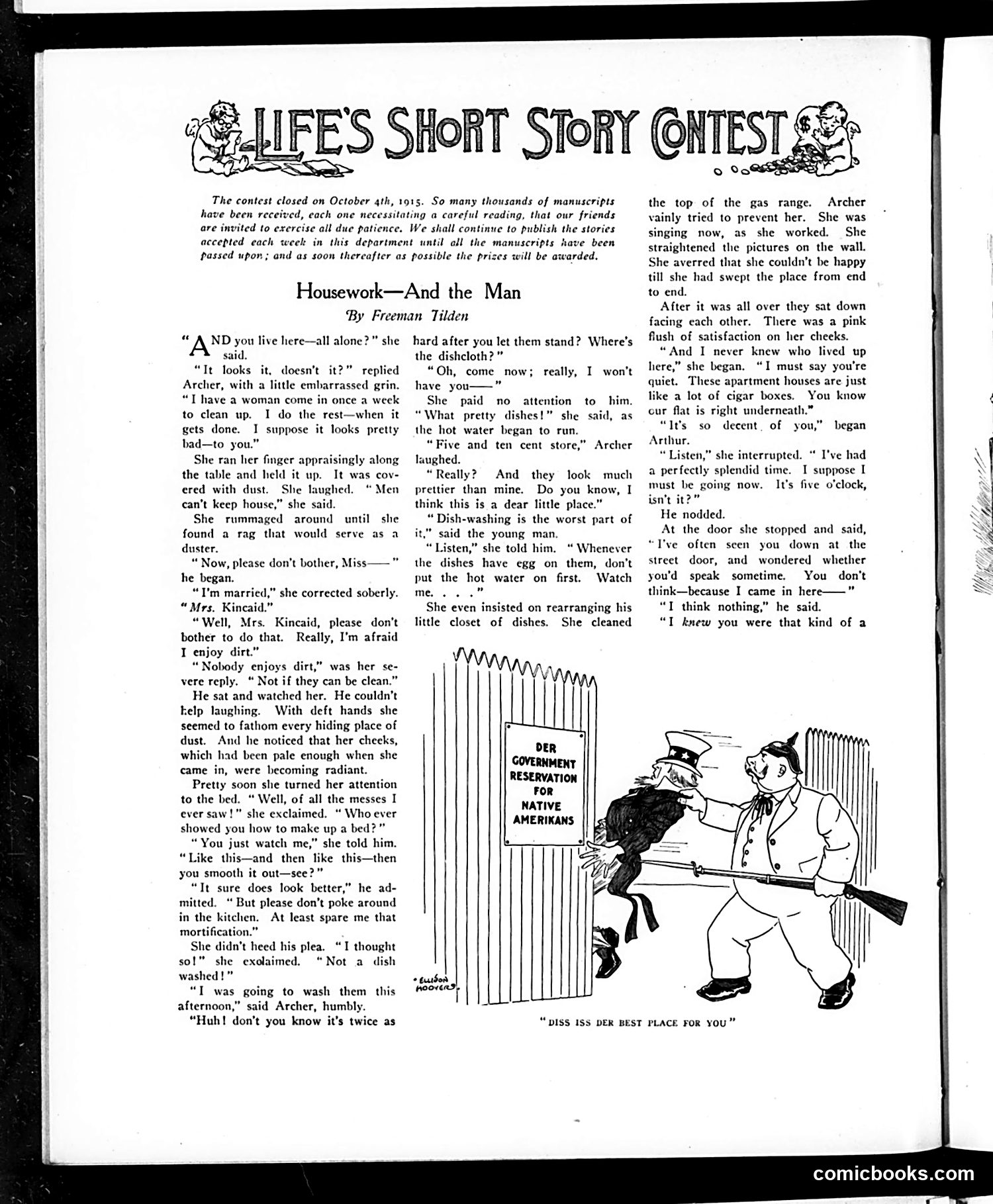
This page contains a romantic short story titled "Housework—And the Man" by Freeman Tilden, published in *Life* magazine's short-story contest (closed October 4, 1915). **The Story's Plot:** A lonely bachelor named Archer lives in a messy apartment. Mrs. Kincaid, a married neighbor from the flat below, visits and becomes energized cleaning his space—washing dishes, making his bed, organizing his closet. As she works, she transforms from pale to radiant. By evening's end, they've developed a connection; she confesses she noticed him and wondered if he'd speak to her. **The Cartoon:** The small illustration depicts a Native American being turned away from "Der Government Reservation for Native Amerikans" by an official with a gun—a commentary on U.S. government treatment of Indigenous peoples and broken reservation policies. **Historical Context:** The 1915 date places this during early Progressive Era America, when such domestic stories about unmarried proximity were mildly risqué. The cartoon's German-language pun reflects anti-German sentiment during WWI's early years.
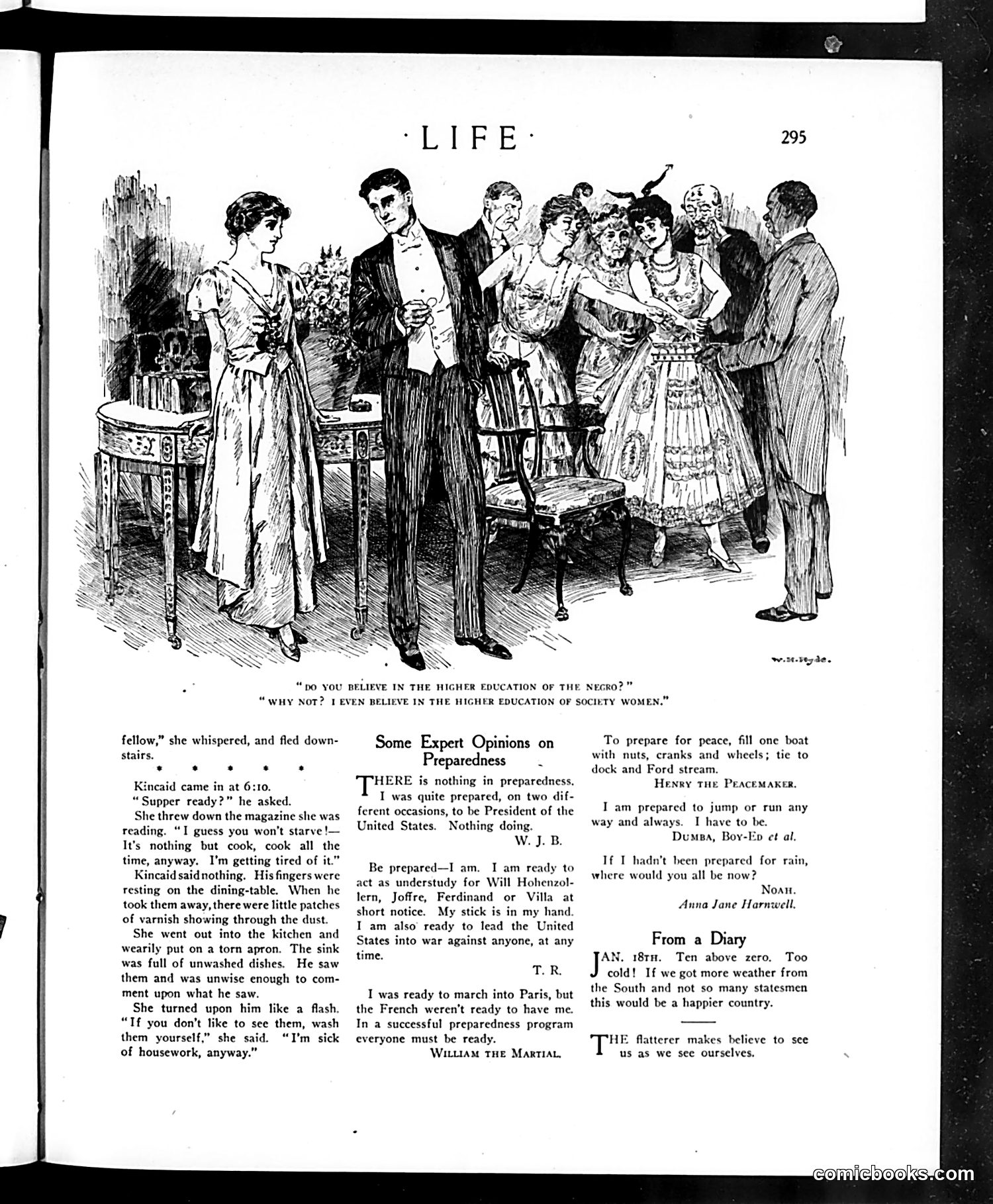
This page contains two satirical pieces from the early 20th century. **The Main Cartoon** depicts a social gathering where a man is asked about educating Black Americans. His response—that he believes in "higher education of society women"—is a dismissive joke equating women's intellectual capacity with that of Black people, mocking both groups simultaneously. The cartoon satirizes the prejudices of educated society. **"Some Expert Opinions on Preparedness"** parodies prominent political figures (identifiable by initials: W.J.B. likely William Jennings Bryan, T.R. likely Theodore Roosevelt) offering absurd commentary on military preparedness. Their responses mix boastful political ambition with military readiness, satirizing politicians' posturing around national defense—a relevant issue during the pre-WWI era. **"From a Diary"** offers brief sardonic observations about weather and politics, typical of Life's humorous filler content. The page's humor relies on readers recognizing contemporary political figures and understanding debates about race, gender, and military policy circa 1910-1915.
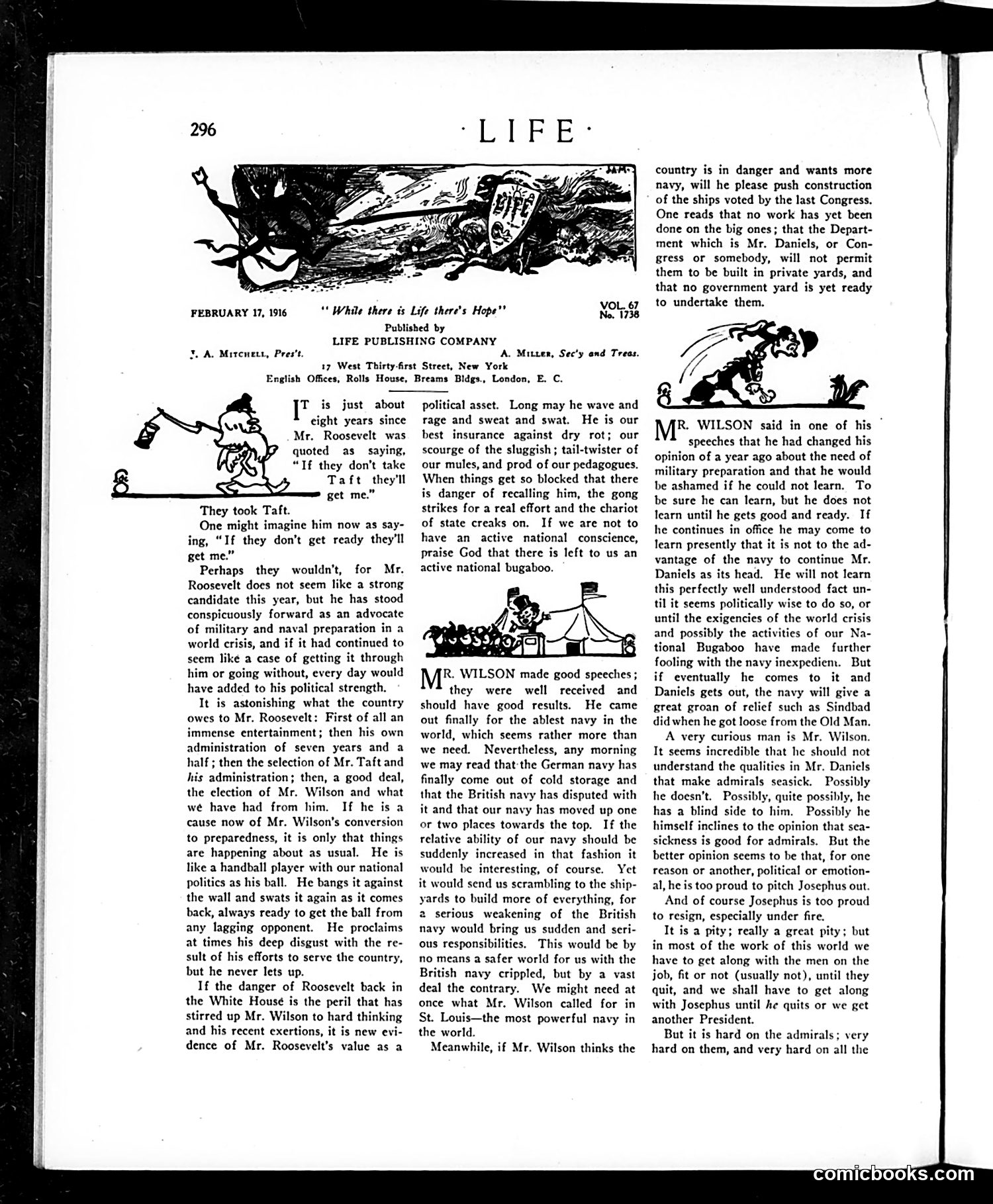
This Life magazine page satirizes former President Theodore Roosevelt's influence on current President Woodrow Wilson's military policy. The article argues that Roosevelt—despite losing the 1912 election to Wilson—has paradoxically strengthened Wilson's administration by serving as a constant "prod" toward preparedness. The cartoons (small illustrations with captions) depict Roosevelt as a forceful figure who keeps the nation's politics in motion, "banging" ideas around like a handball player. The text suggests Roosevelt's aggressive advocacy for naval expansion has inadvertently pushed the hesitant Wilson toward endorsing military buildup. The satirical point: Roosevelt remains a powerful political force even in opposition, effectively driving policy through contrarian pressure. The author also critiques Wilson's Secretary of the Navy, Josephus Daniels, for failing to actually *build* the ships Congress authorized—suggesting talk of preparedness without action.
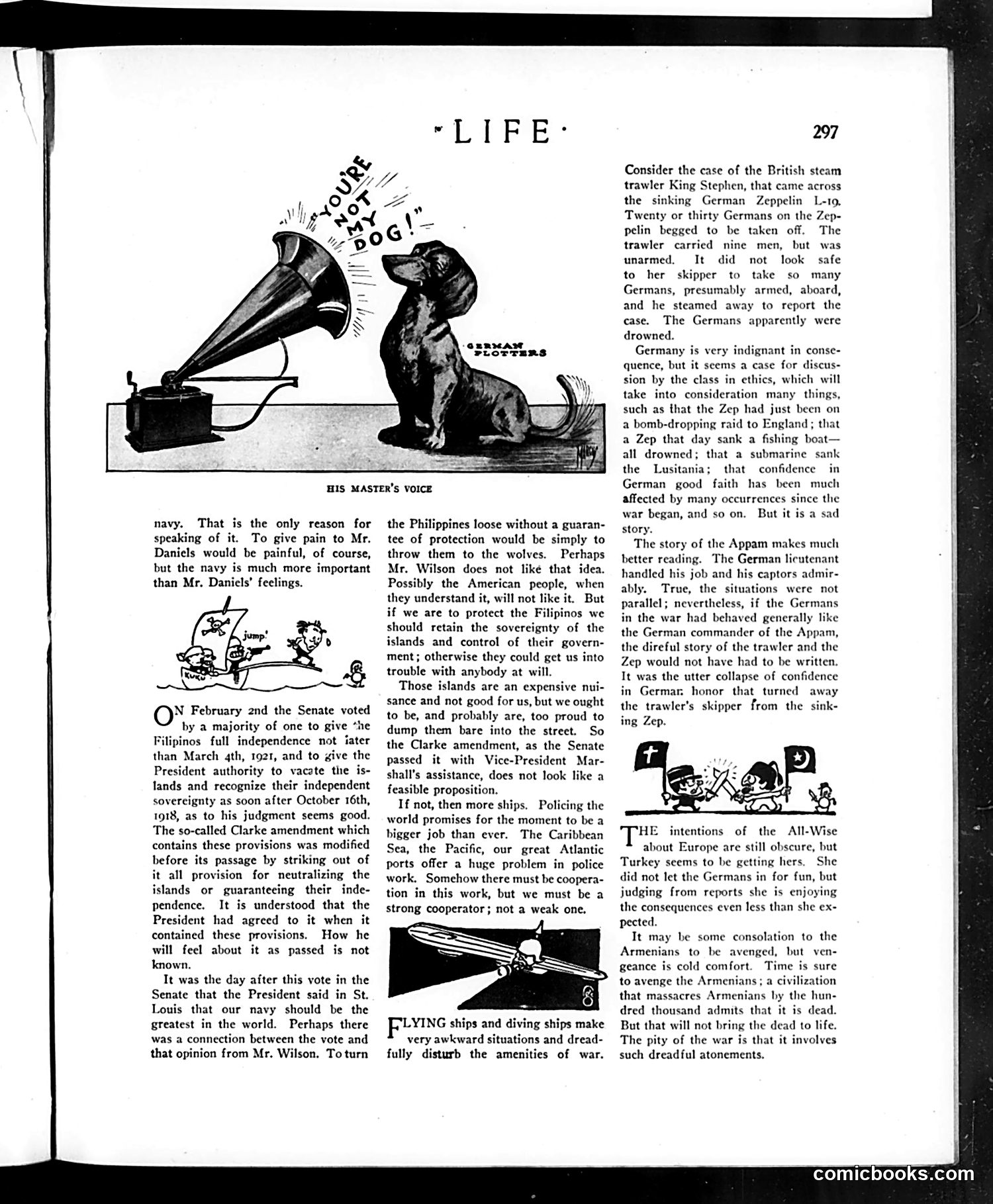
The cartoon depicts a German dog listening to a gramophone labeled "IS YOUR DOG LOYAL?" The satire mocks German obedience to authority, playing on the famous "His Master's Voice" trademark while suggesting Germans blindly follow commands. The accompanying article discusses the Senate's February 2nd vote granting Philippine independence by March 4, 1921—a decision the author criticizes as potentially dangerous. The piece argues that abandoning the Philippines without military protection would be irresponsible, and advocates instead for maintaining American naval supremacy to "police the world." The article also recounts two wartime incidents: the British trawler *King Stephen*'s refusal to rescue Germans from the sinking Zeppelin L-19 (Germans drowned), and the more honorable conduct of the German commander of the *Appam*. The author uses these examples to discuss German honor's "collapse" during the war, contrasting lost confidence in German good faith with occasional moments of civility.
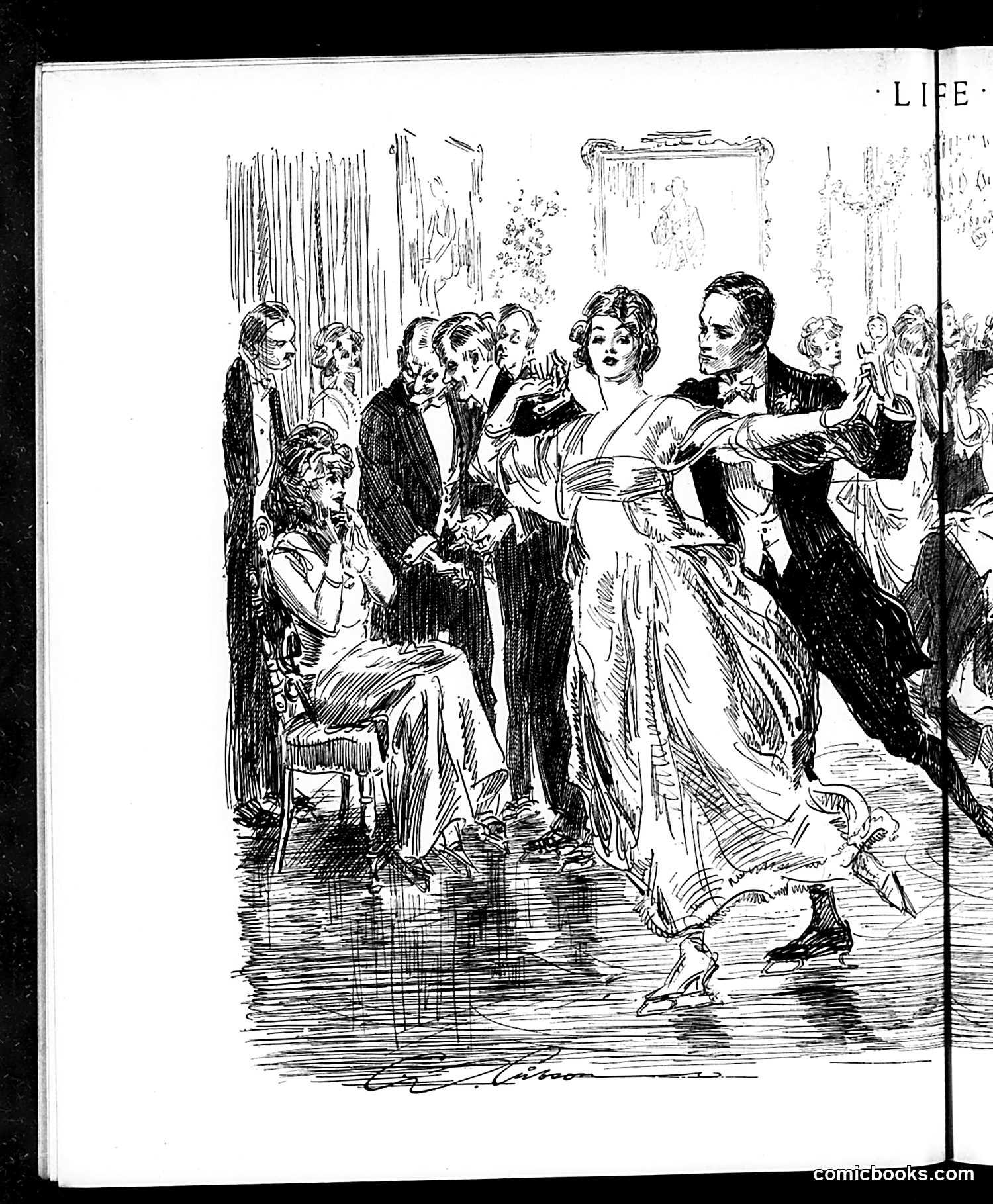
This is a pen-and-ink illustration signed by what appears to be "Cesare" (the signature is visible at bottom). It depicts a formal social gathering—likely a ball or drawing room event—showing elegantly dressed men in formal wear and women in elaborate gowns. The scene appears to satirize high society social dynamics, possibly mocking the artificiality or pretension of upper-class gatherings. A seated woman on the left appears to be observing or reacting to the scene, while a woman in the center commands attention in an elaborate white gown. Without additional OCR text or caption visible on this page, the specific satirical point remains unclear—whether this targets social climbing, fashion excess, courtship customs, or another aspect of Victorian/Edwardian society. The "Life" magazine masthead confirms this is from that American humor publication.
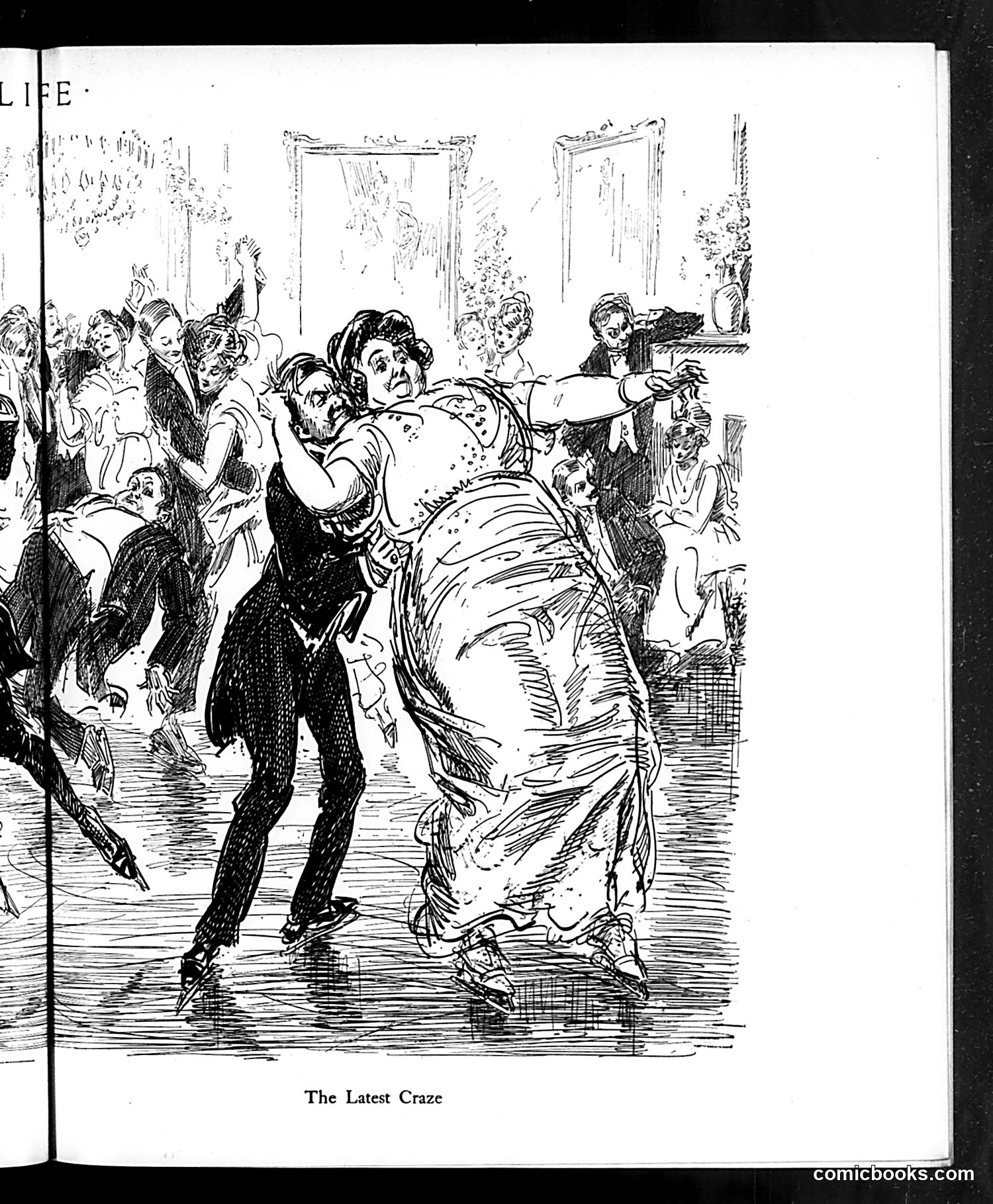
This satirical illustration depicts what appears to be a fashionable social gathering where elegantly dressed Victorian-era attendees observe a woman and man engaged in an unusual dance or physical activity. The title "The Latest Craze" suggests the image mocks a contemporary fad or trend. The exaggerated postures and expressions of the central figures—particularly the woman's dramatic lean-back position—indicate the artist is ridiculing whatever dance or fashion trend was popular when this *Life* magazine issue was published. The crowd's animated reactions suggest both fascination and mockery of the spectacle. Without the publication date visible, the specific craze referenced remains unclear, though the style suggests late 19th or early 20th century. The satire targets how quickly society adopts and celebrates fashionable absurdities.
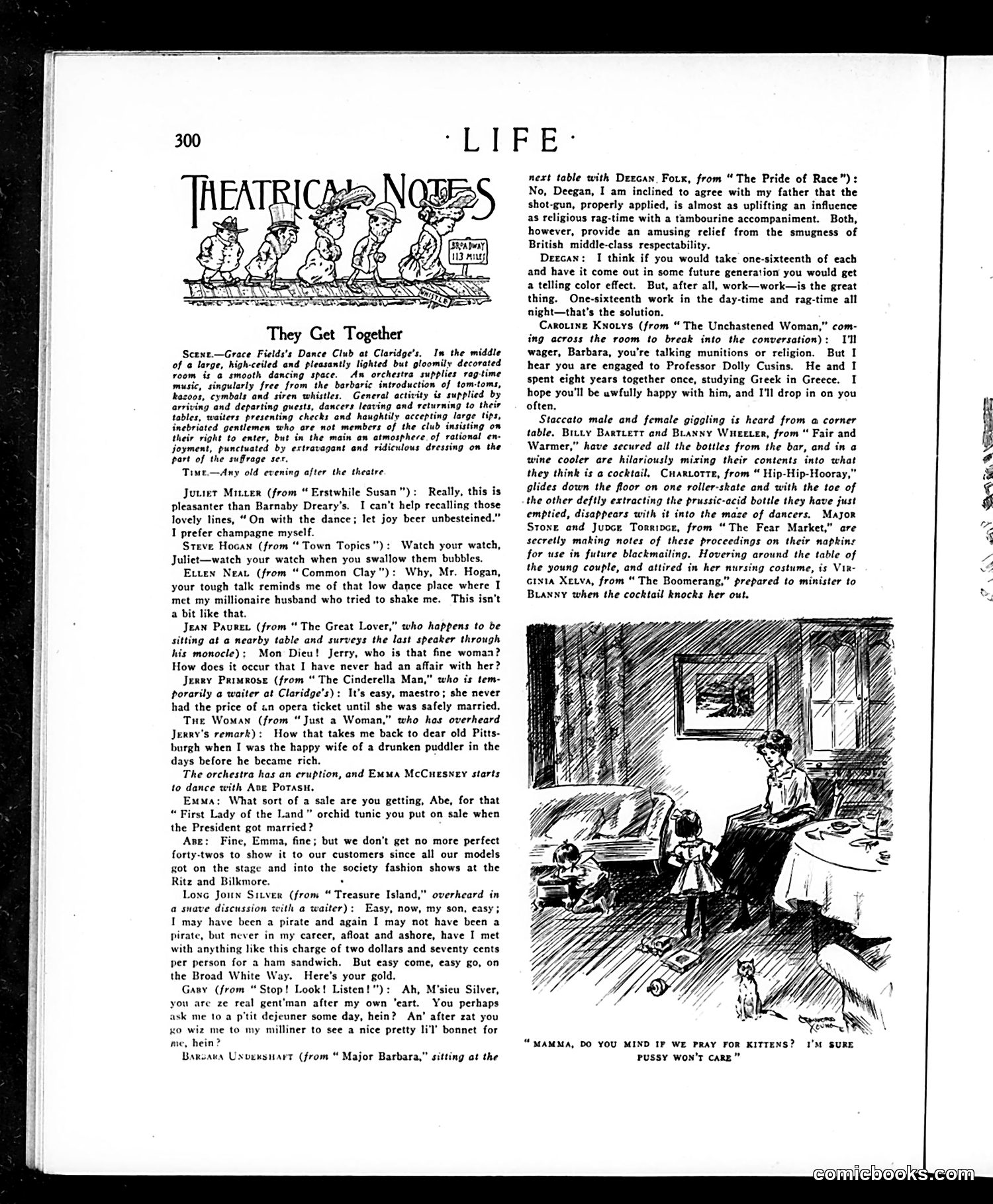
This page satirizes high-society theater-goers at an exclusive London nightclub (Grace Fields's Dance Club at Claridge's). The piece presents snippets of overheard conversation among patrons identified by the theatrical characters they play—actors and actresses from contemporary stage productions. The humor derives from **incongruity**: characters known for dramatic roles (a pirate, a waiter, etc.) are caught making mundane or contradictory remarks in this refined setting. For instance, "Long John Silver" complains about sandwich prices despite his swashbuckling reputation, while a character from "The Cinderella Man" reveals cynical insights about women and wealth. The satire mocks **theater-world pretension**—the assumption that stage personas reflect real character—while also poking fun at upper-class affectation and the artificial mixing of bohemian theater culture with respectable society. The illustration shows patrons in elaborate dress engaged in idle conversation, reinforcing the critique of superficiality and performance masquerading as genuine social interaction.
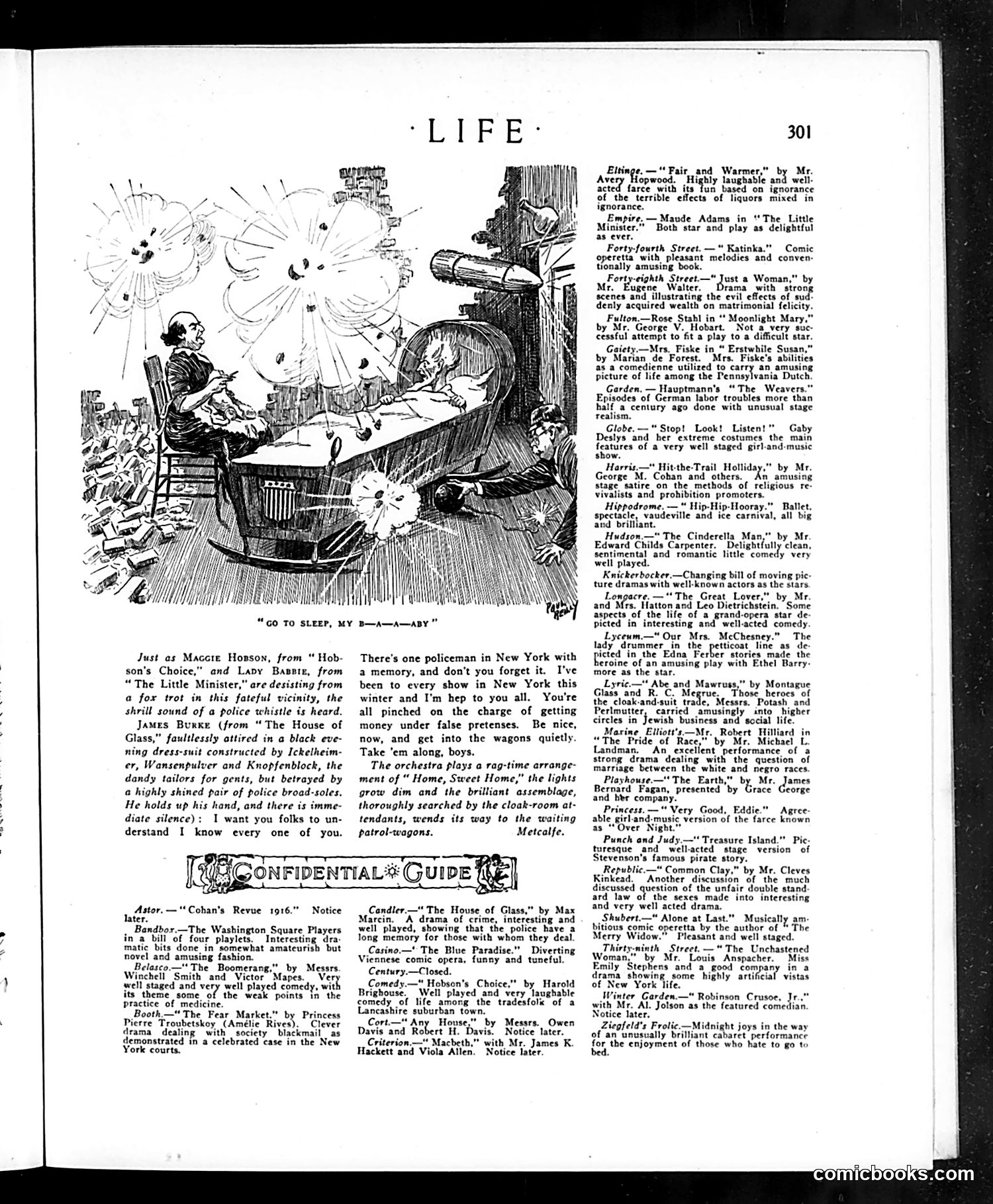
This cartoon satirizes New York police corruption and arbitrary enforcement. A policeman in formal evening dress (incongruously wearing police shoes, betraying his true identity) interrupts theatergoers during a fox trot. He announces he's "pinched" all of them on fabricated charges of "getting money under false pretenses"—despite their obvious innocence—simply because he's attended shows all winter and recognizes them. The satire targets the arbitrary power of police who exploit their positions: this cop uses his "memory" of seeing people at theaters as justification for mass arrests. The orchestra plays "Home, Sweet Home" as patrons are loaded into patrol wagons, creating dark irony. The accompanying theater reviews suggest this reflects actual contemporary concerns about police misconduct and New York's criminal justice system in 1916.
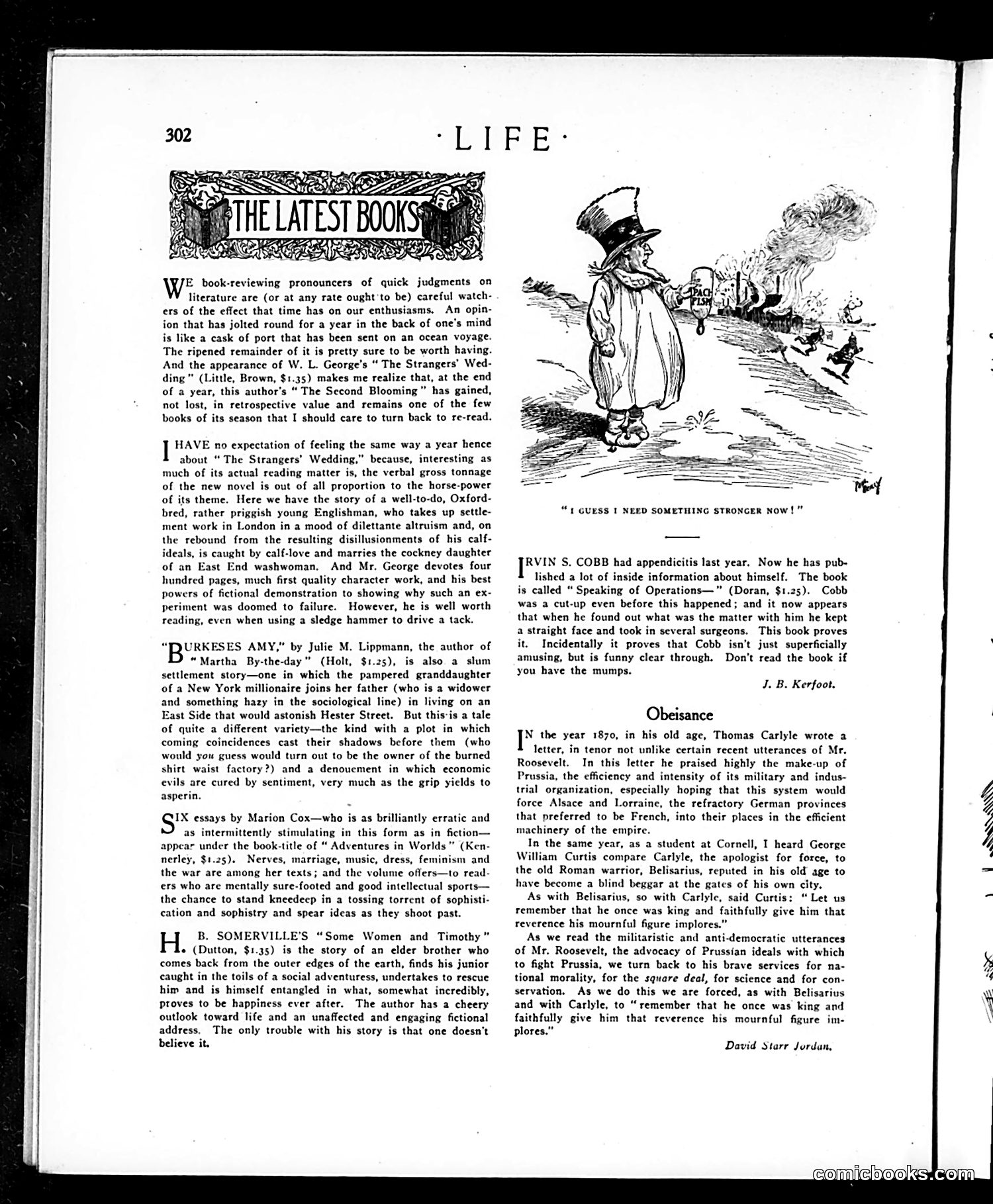
The cartoon depicts a disheveled man in a top hat, apparently intoxicated or exhausted, being chased by what appears to be a temperance advocate or reformer (likely a woman with stern demeanor). The caption suggests the man is fleeing from pressure to abstain from alcohol. This satirizes the temperance movement, which was gaining momentum in early 20th-century America, culminating in Prohibition (1920-1933). The joke mocks the conflict between those promoting sobriety and those resisting such moral crusades. The man's plight—needing "something stronger"—humorously captures the frustration of those opposing temperance reform. The cartoon appears amid book reviews in *Life* magazine, a publication known for satirizing American social movements and cultural debates of the era.
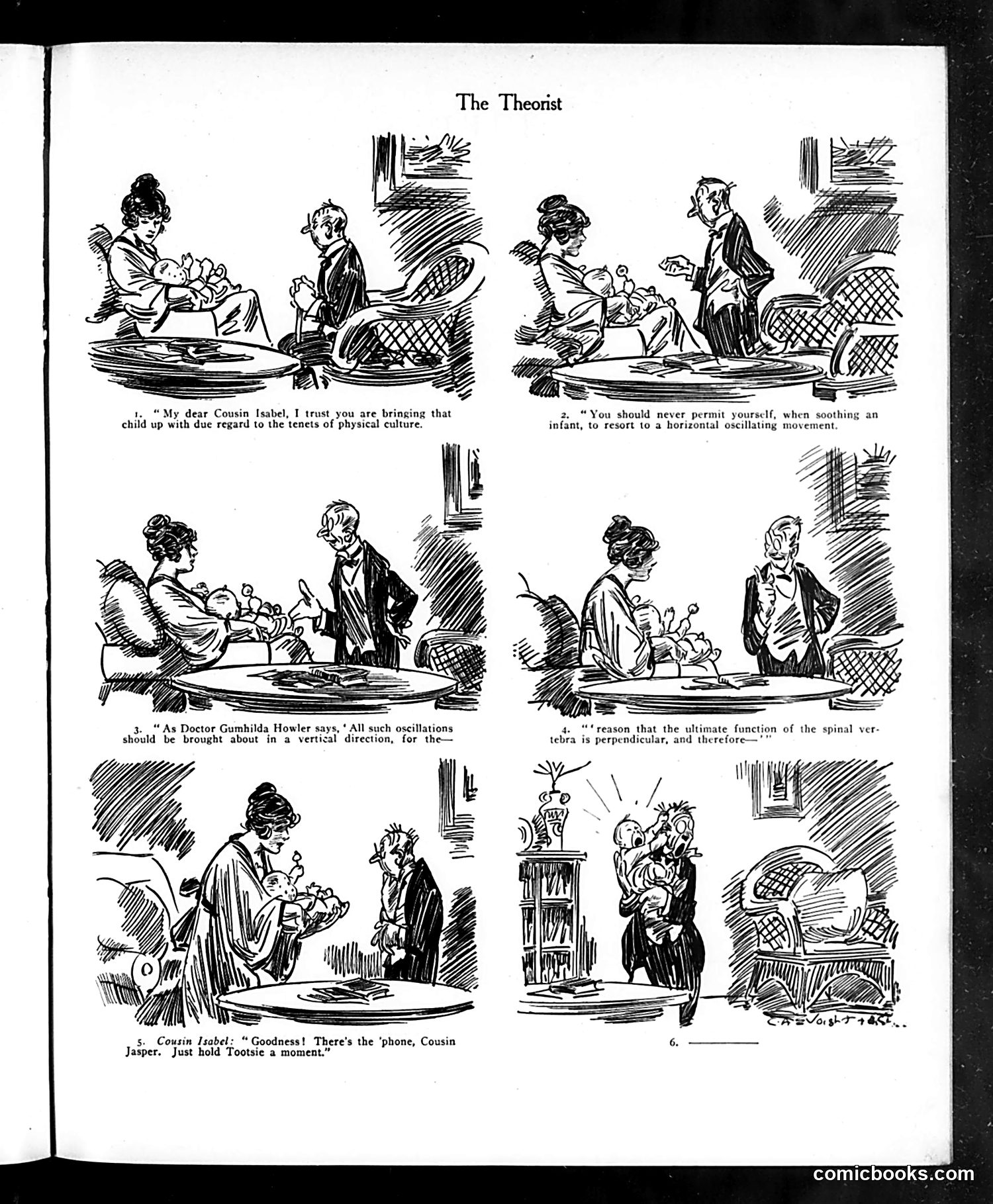
This six-panel satirical comic mocks the era's obsession with pseudoscientific parenting advice. A pedantic male "theorist" (likely representing an overzealous self-proclaimed expert) lectures his cousin Isabel on "physical culture" and proper child-rearing techniques, citing authority figures like "Doctor Gumhilda Howler." His advice against "horizontal oscillating movement" (rocking a baby) in favor of "vertical" motion reflects the era's obsession with applying pseudoscientific theories to everyday child care. The humor culminates when Isabel receives a phone call and leaves the baby with Jasper—forcing the theorist to actually *hold* the infant while maintaining his pompous lecturing stance. The satire targets both pretentious expert culture and the gap between theoretical advice and practical reality. The comic suggests such rigid, jargon-laden parenting theories are absurd and impractical when confronted with actual childcare.
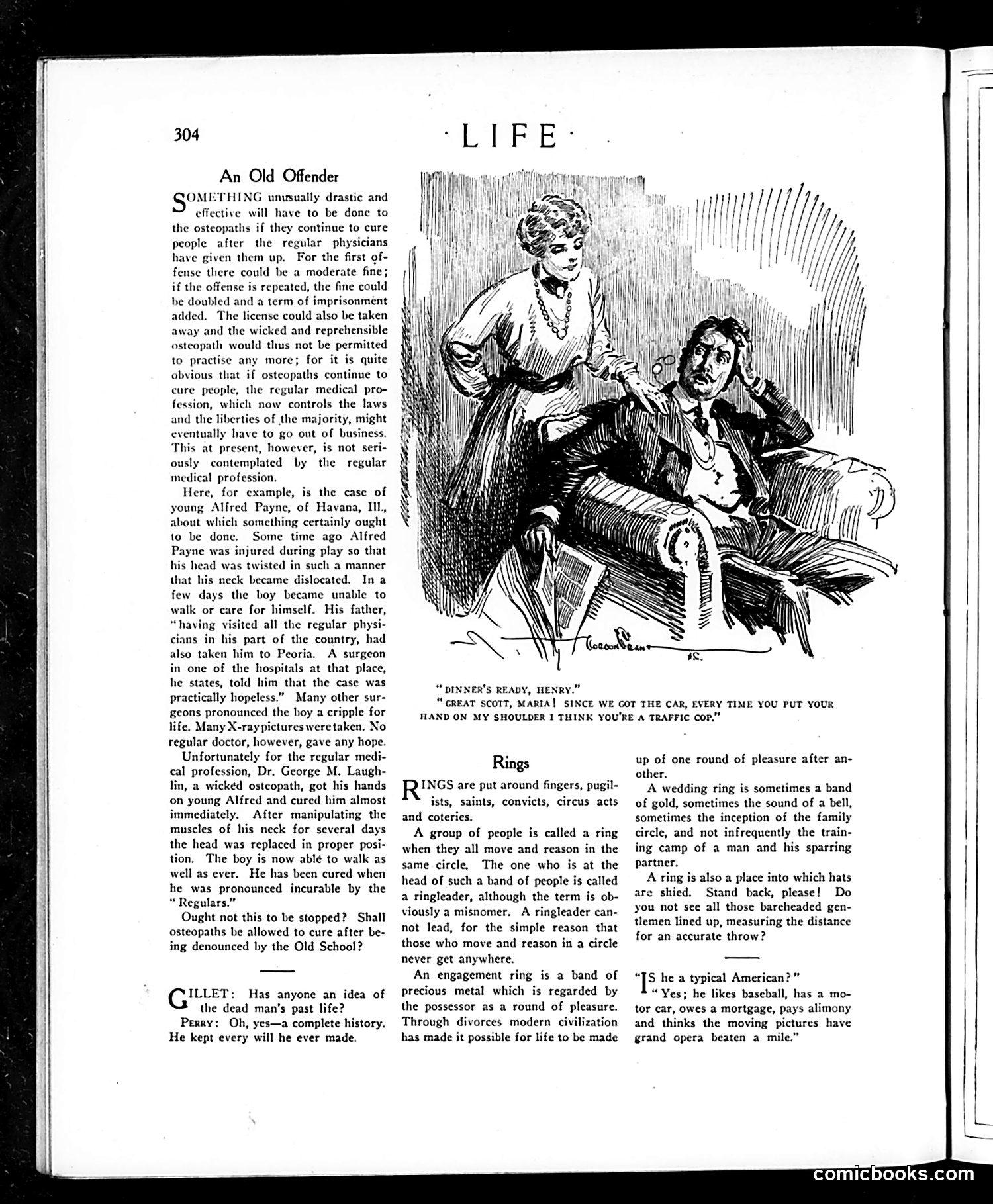
This piece satirizes the medical profession's hostility toward osteopaths, who were gaining credibility by successfully treating patients that regular doctors had declared hopeless. The article presents a real case: young Alfred Payne of Havana, Illinois, suffered a dislocated neck that multiple regular physicians and surgeons pronounced incurable. An osteopath, Dr. George M. Laughlin, cured him through manipulation. Life's satire is biting: it mocks the "regular" (conventional) medical establishment's self-protective monopoly, suggesting they'd actually prefer legislation *against* osteopaths simply because osteopathic success threatens their professional dominance and income. The accompanying illustration shows a woman tending an injured man, visually reinforcing the practical healing the article champions. The satire exposes professional protectionism masquerading as medical standards—attacking the medical profession's control of "laws and liberties" to suppress legitimate competition.
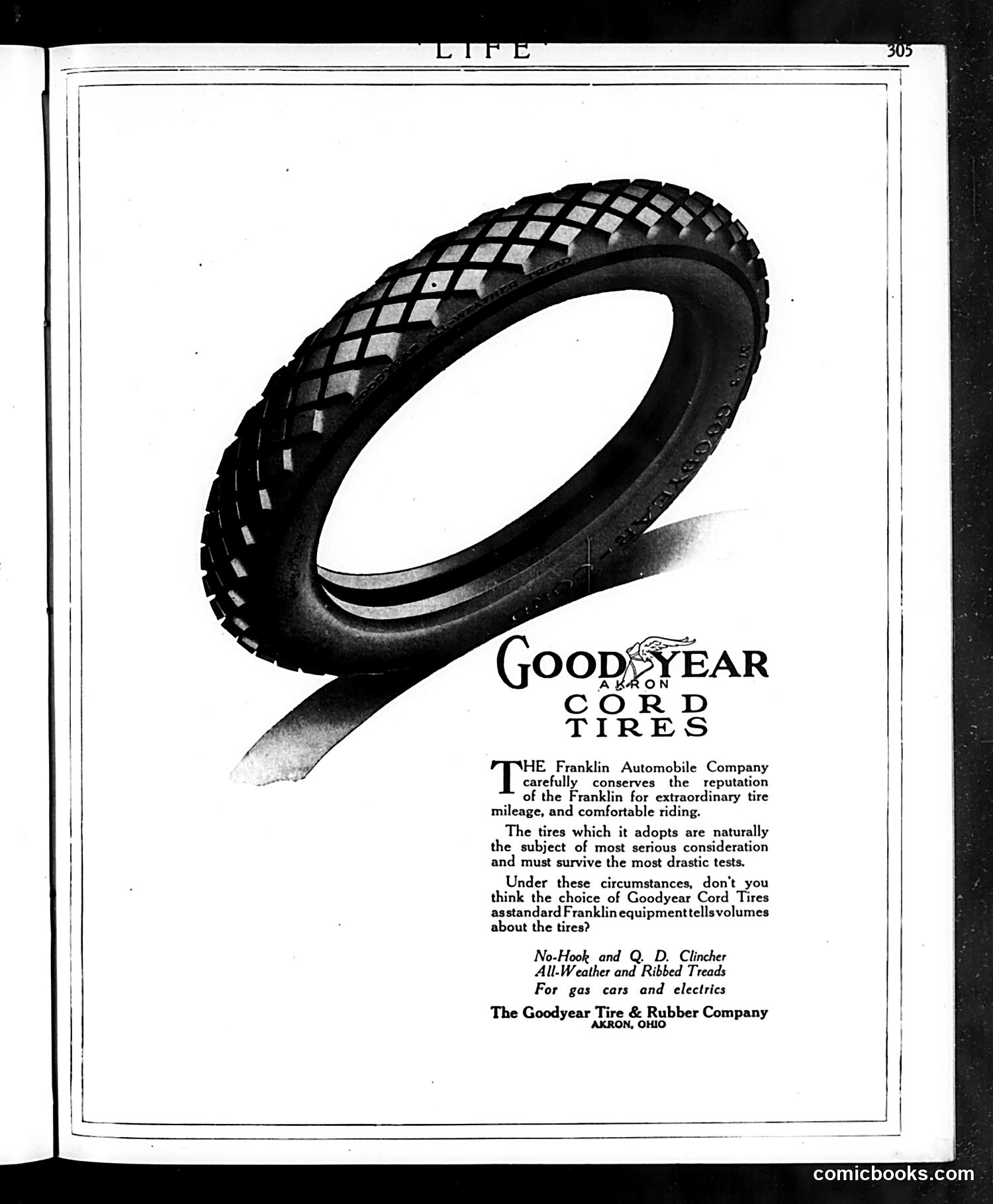
This is a **Goodyear Cord Tires advertisement**, not a political cartoon. The page features a product photograph of a tire rendered in dramatic black-and-white with dimensional shading. The ad's persuasive strategy appeals to consumer logic: the Franklin Automobile Company, known for quality and durability, carefully selects Goodyear tires as standard equipment. The copy argues this choice implicitly endorses Goodyear's superiority—if a reputable car manufacturer trusts these tires with their reputation, consumers should too. The ad mentions "gas cars and electrics," reflecting an era when electric vehicles competed with gasoline automobiles (early-to-mid 20th century). Products listed include "No-Hook" and "Q.D. Clincher" tire variants with "All-Weather and Ribbed Treads." This is straightforward commercial advertising with no satirical content.
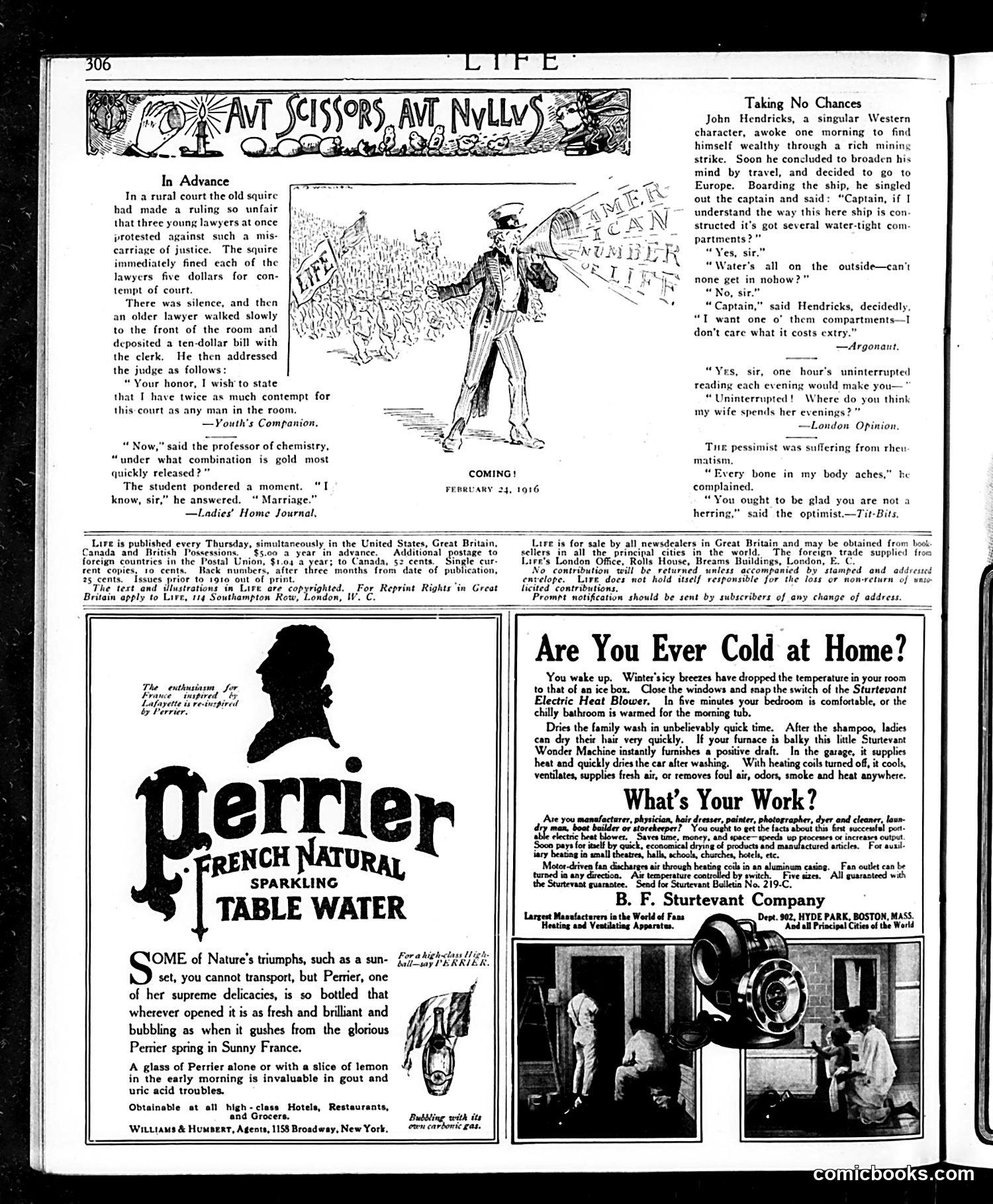
This page contains four brief humorous anecdotes typical of Life's satirical format: 1. **"In Advance"**: A rural judge imposes contempt-of-court fines on protesting lawyers; an older lawyer then deposits $10, stating he has "twice as much contempt," thereby exposing the judge's arbitrary abuse of power through witty defiance. 2. **"Taking No Chances"**: A newly wealthy Western miner, boarding a ship to Europe, asks about watertight compartments, then demands one for his cabin—satirizing nouveau riche anxiety and absurd overcaution. 3. **Marriage/Chemistry joke**: A professor asks when gold is "most quickly released"; a student answers "Marriage"—mocking the expense of matrimony. 4. **Pessimism/herring joke**: A pessimist complains all his bones ache; an optimist replies he should be glad he's not a herring—typical period wordplay humor. The page also contains advertisements for Perrier water and Sturtevant heating equipment. The humor reflects early 20th-century American class attitudes and gender dynamics.
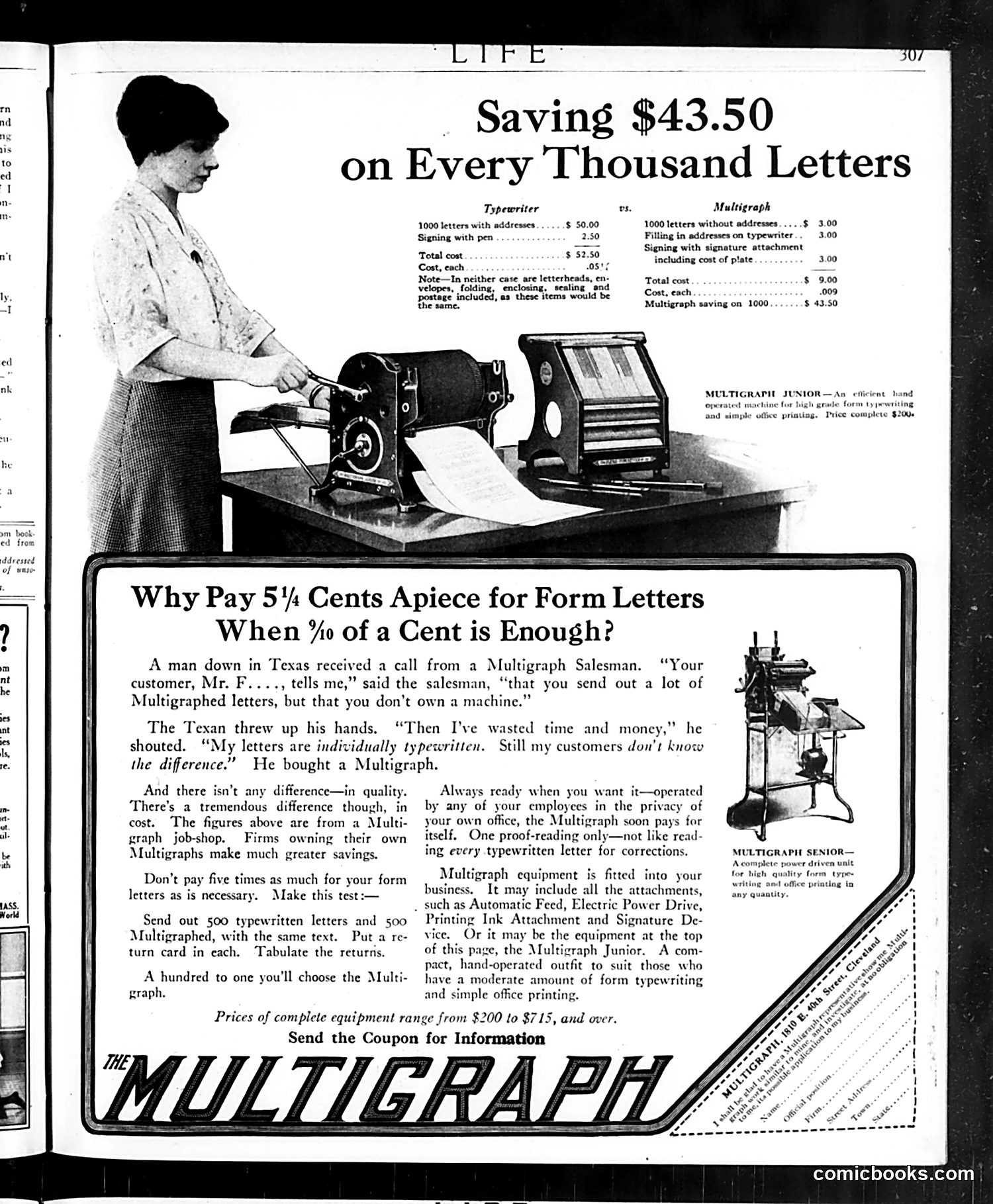
This is primarily a **product advertisement**, not satire or political commentary. It promotes the Multigraph—an early duplicating/printing machine—by comparing its cost-efficiency to typewritten form letters. **The Setup:** A Texas businessman learns he's been wasting money sending individually typewritten form letters when customers can't tell the difference anyway. The implicit joke: his efforts to appear personal are pointless. **The Sales Pitch:** The ad includes cost comparisons showing typewritten letters cost 5.75 cents each versus 0.90 cents via Multigraph—a $43.50 savings per thousand letters. **The Social Context:** This reflects early-20th-century business efficiency culture, where automation and standardization were marketed as progressive solutions. The woman operator in the image was typical advertising imagery for office machinery of this era. **No satire is present**—this is straightforward commercial persuasion using humor (the Texan's reaction) to make a business case for purchasing equipment.
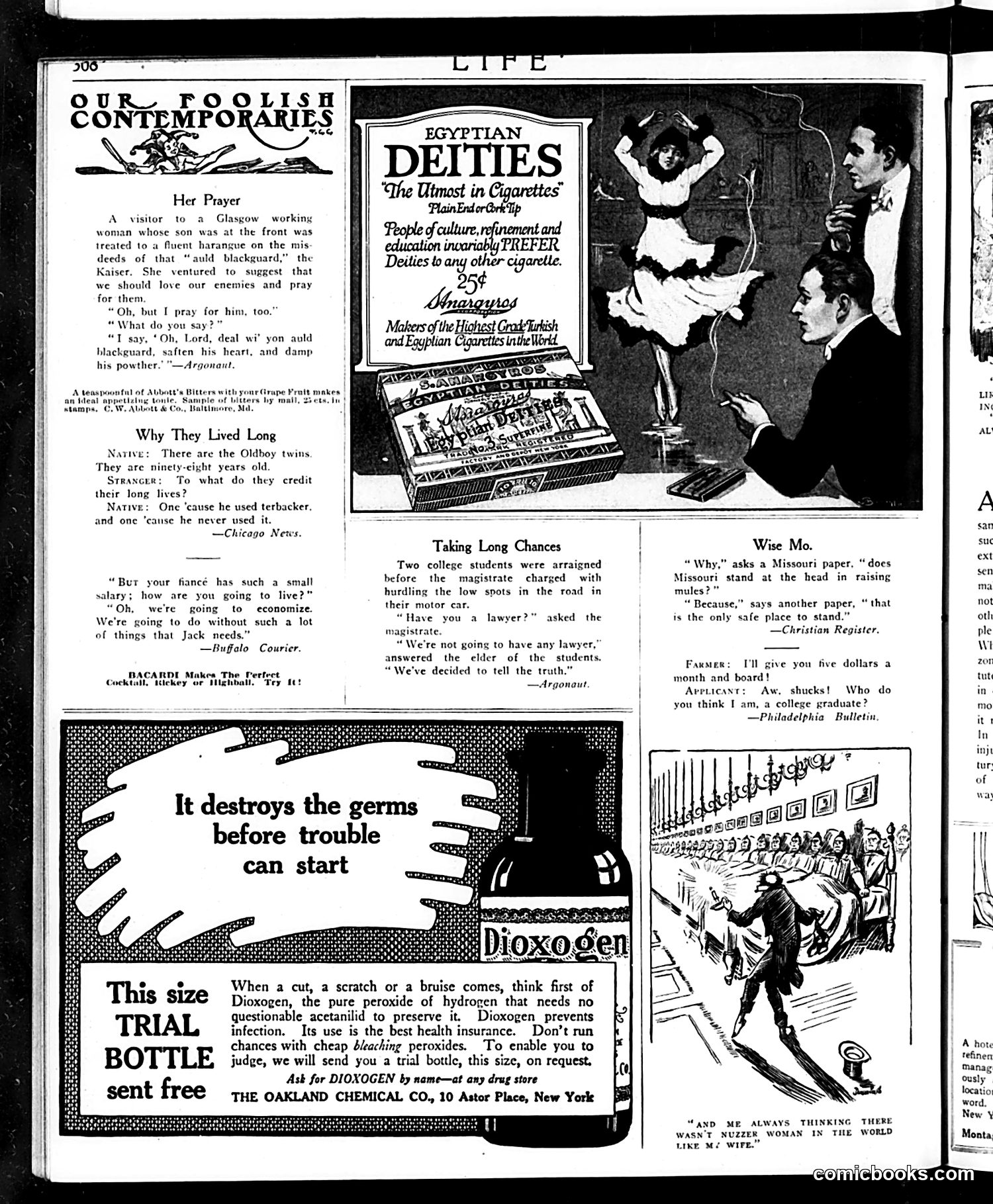
This page contains several brief humorous anecdotes typical of early 20th-century satirical magazines: **"Her Prayer"** mocks Scottish dialect while satirizing wartime attitudes—a Glasgow woman claims to pray for the Kaiser (German emperor during WWI) but only to ask God to "soften his heart and dampen his powder" (destroy his ammunition). The joke targets both the woman's contradiction and anti-German sentiment. **"Why They Lived Long"** is a simple joke: twin brothers attributed their longevity to opposite habits (one used tobacco, one didn't), suggesting both explanations are equally valid nonsense. **"Taking Long Chances"** jokes about college students' arrogance—arrested for reckless driving, they refuse a lawyer, planning to "tell the truth" instead. The page also contains period advertisements, including Egyptian Deities cigarettes and Dioxogen disinfectant, typical of the era's commercial culture. The humor relies on dialect humor, class commentary, and anti-establishment attitudes common to 1920s satirical journalism.
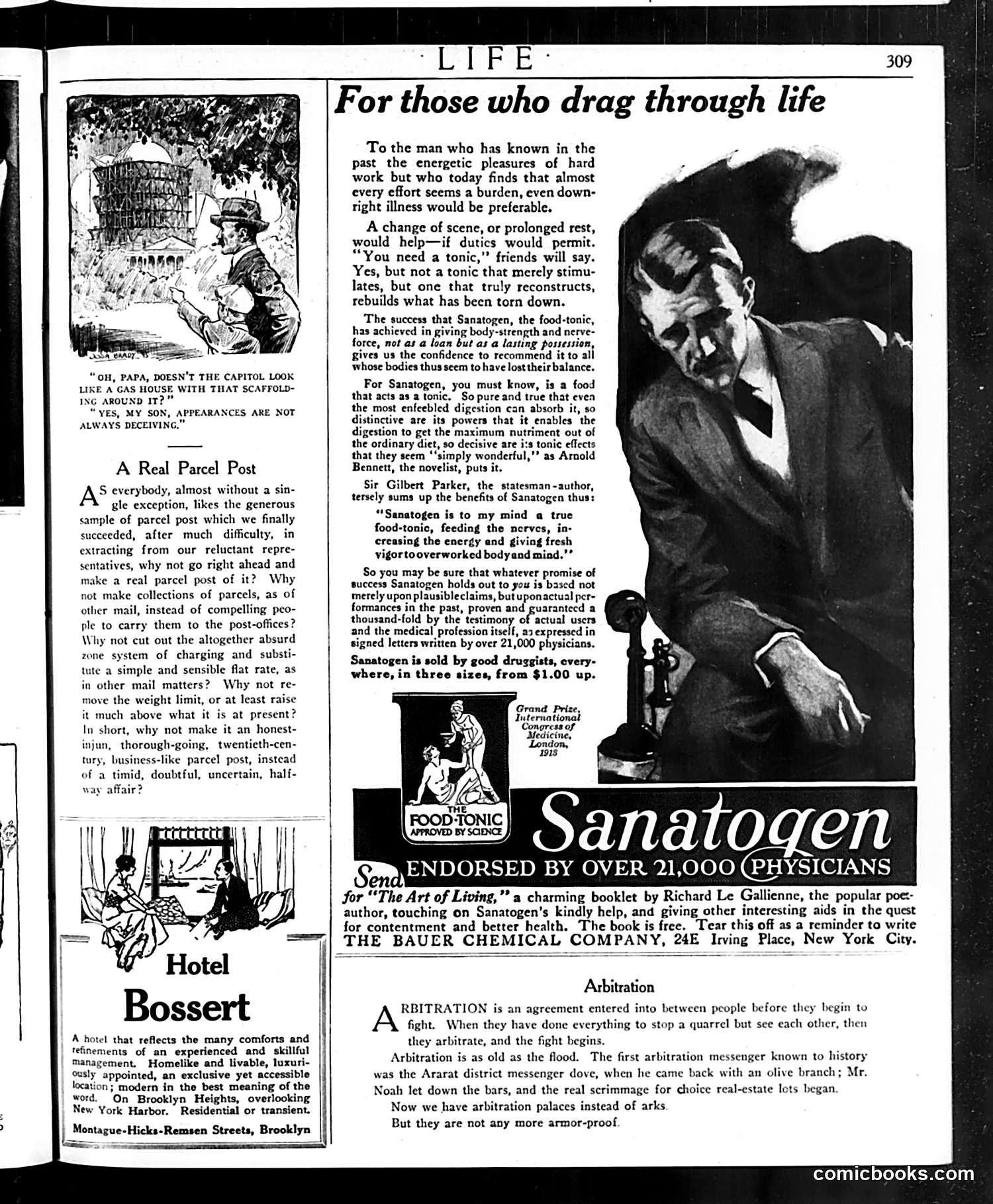
**The Cartoons:** The top cartoon shows a child and parent viewing the Capitol building under construction scaffolding. The joke is political satire: the child innocently compares the scaffolding to a "gas house" (industrial structure), and the father cryptically replies "appearances are not always deceiving"—suggesting the Capitol itself resembles an industrial gas house, mocking Congress as an unglamorous, functional (or corrupt) institution rather than a dignified democratic temple. **"A Real Parcel Post"** is a policy opinion piece arguing the newly-established parcel post system (early 1900s mail delivery) should be expanded with flat rates and higher weight limits instead of the current zone-based, restrictive system. **The rest of the page** is commercial advertising for Sanatogen, a patent "food-tonic" endorsed by celebrities and claiming endorsement from 21,000 physicians—typical early-20th-century health product marketing mixing vague wellness claims with celebrity testimonials. The page primarily advertises rather than satirizes.
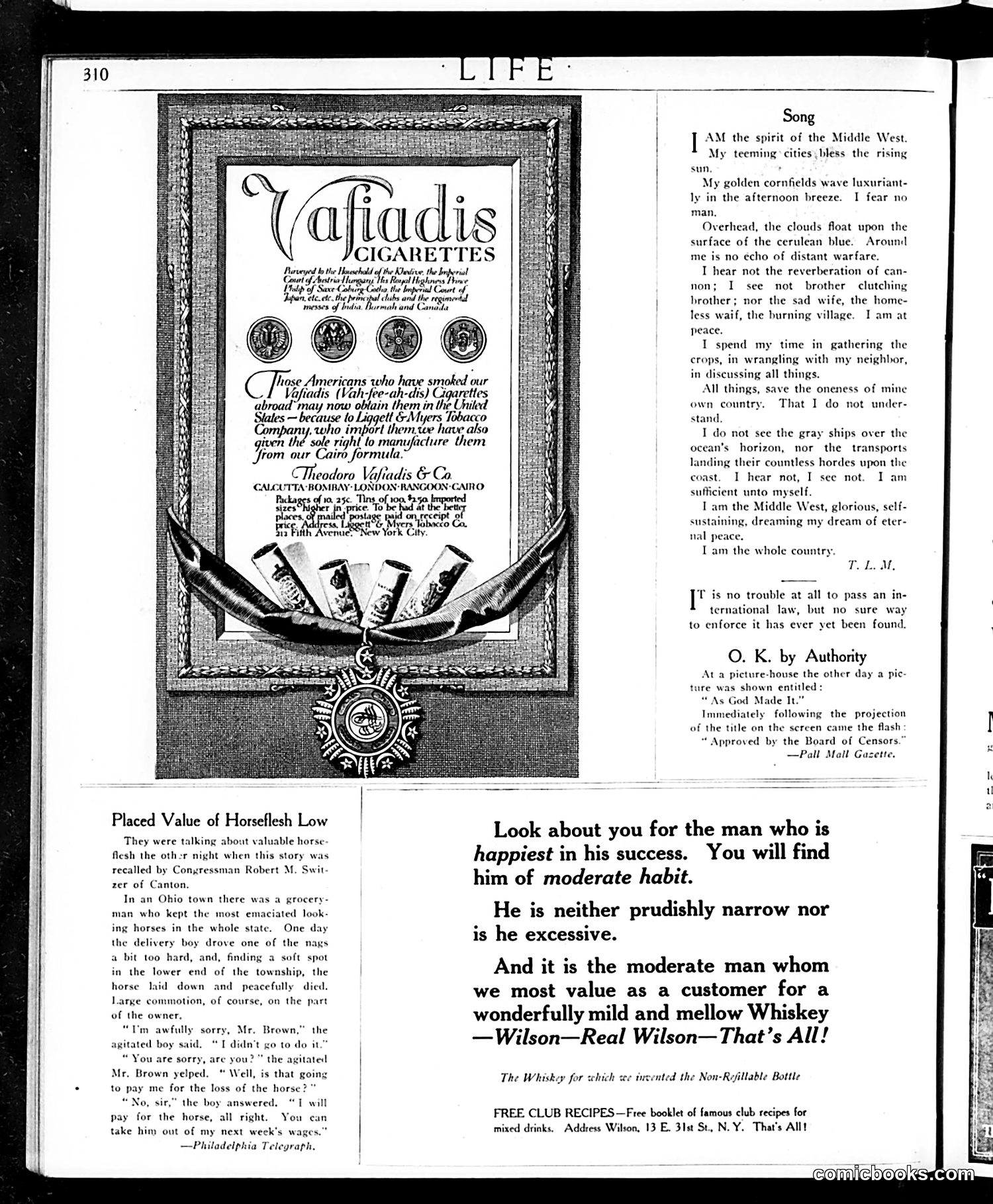
This page mixes advertisements with satirical content typical of early 20th-century *Life* magazine. **The Main Advertisement** is for Vanadis Cigarettes, imported Egyptian cigarettes now manufactured in the U.S. by Liggett & Myers. The ornate layout emphasizes their exotic prestige and royal endorsements. **The Satirical Content** includes: 1. **"Song"** (attributed T.L.M.)—A poem mocking American isolationism, portraying the Midwest as self-satisfied and detached from global conflict (likely referencing World War I tensions). The speaker boasts of peace while remaining willfully ignorant of warfare elsewhere. 2. **"O.K. by Authority"**—A joke about film censorship. A movie titled "As God Made It" is immediately followed by a "Board of Censors" approval notice, satirizing the absurdity of censoring nature itself. 3. **"Placed Value of Horseflesh Low"**—A humorous anecdote about a grocer whose starving horse dies; the boy offers to pay from future wages, showing naive practicality. The Wilson Whiskey advertisement promotes "moderate habit" as a virtue—ironic given Prohibition-era tensions.
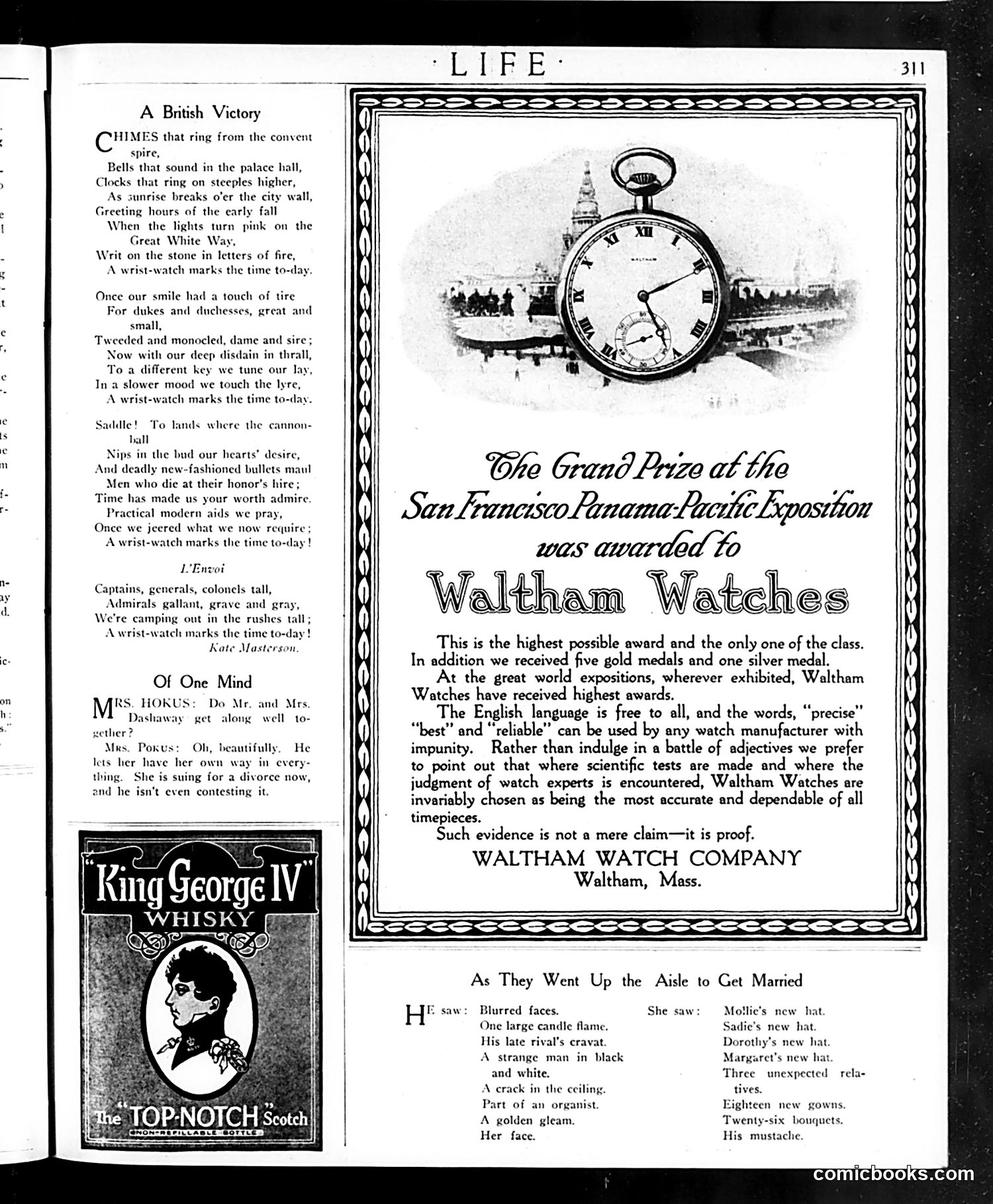
This page from *Life* magazine contains three distinct pieces: **"A British Victory"** (poem): A satirical verse celebrating the adoption of wristwatches by British military officers during what appears to be World War I. The joke is that the British once disdained practical modern items as beneath their aristocratic dignity ("tweeded and monocled"), but warfare has forced them to embrace useful technology. The wristwatch—previously seen as an undignified accessory—now marks military time precisely. This mocks British snobbery while acknowledging that necessity overrides class pretension. **"Of One Mind"** (short humor): A domestic joke where a husband's acceptance of his wife's divorce suit without contest is characterized as marital harmony. The irony is obvious to modern readers. **Waltham Watches Advertisement**: A full-page ad promoting Waltham's Grand Prize win at the San Francisco Panama-Pacific Exposition. Rather than make claims, the company emphasizes that awards and expert judgment prove superiority—a credibility-based sales pitch.
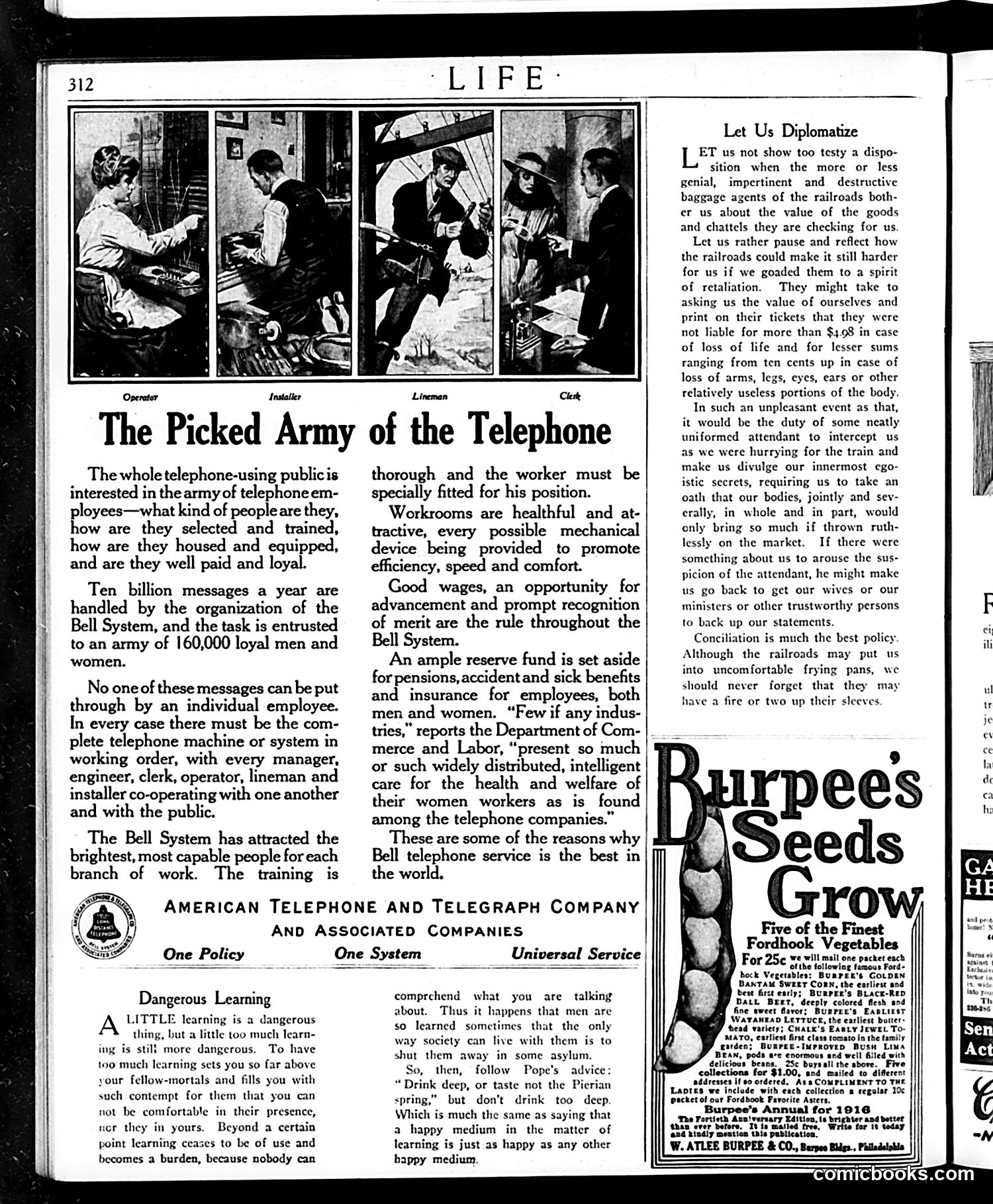
This page combines corporate advocacy with satirical commentary typical of Life magazine's format. **"The Picked Army of the Telephone"** is a promotional article for AT&T/Bell System, illustrated with four photographs labeled Operator, Installer, Lineman, and Clark. The text celebrates telephone workers as loyal, well-trained, and well-compensated employees—a straightforward advertisement emphasizing the company's progressive labor practices, pension funds, and worker welfare during an era when such corporate benevolence was noteworthy (and newsworthy propaganda). **"Let Us Diplomatize"** satirizes railroad baggage agents' procedures for assessing passenger luggage value. The satire warns against angering railroad employees, humorously imagining retaliatory absurdities: if passengers annoy them, railroads might demand passengers assess *their own* bodies' monetary value for liability purposes, with comically low payouts for lost limbs. **"Dangerous Learning"** is a brief philosophical essay advocating moderation in education, warning that excessive learning creates social isolation. The page reflects early 20th-century concerns: corporate labor relations, railroad travel frustrations, and intellectual pretension—all delivered through Life's characteristic mix of earnest advocacy and gentle ridicule.
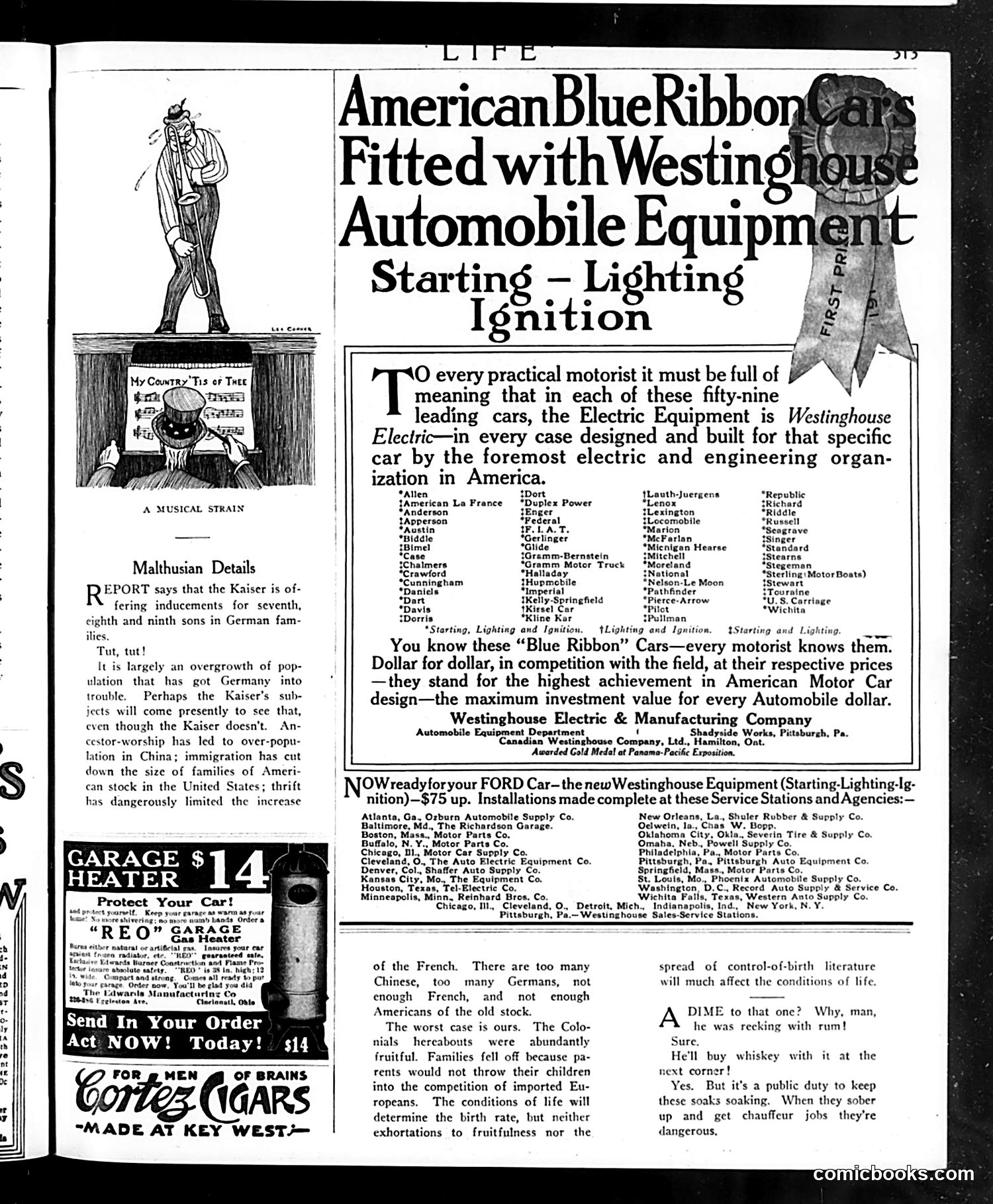
The left cartoon, titled "A Musical Strain," satirizes German Kaiser Wilhelm II's reported offer of inducements for large families (seventh, eighth, ninth sons). The figure stands atop a pedestal labeled "My Country, 'Tis of Thee," playing a violin, suggesting he's orchestrating population growth as patriotic duty. The satire mocks Malthusian concerns—the belief that overpopulation caused Germany's troubles. The Life magazine article argues the Kaiser encourages reproduction despite population already destabilizing the nation. The "musical strain" pun suggests both an orchestrated policy and the strain (burden) of excess population. The cartoon critiques the Kaiser's contradictory logic: Germany suffers from overpopulation, yet he incentivizes more children. This reflects early-20th-century anxieties about population, immigration, and national strength amid rising European tensions.
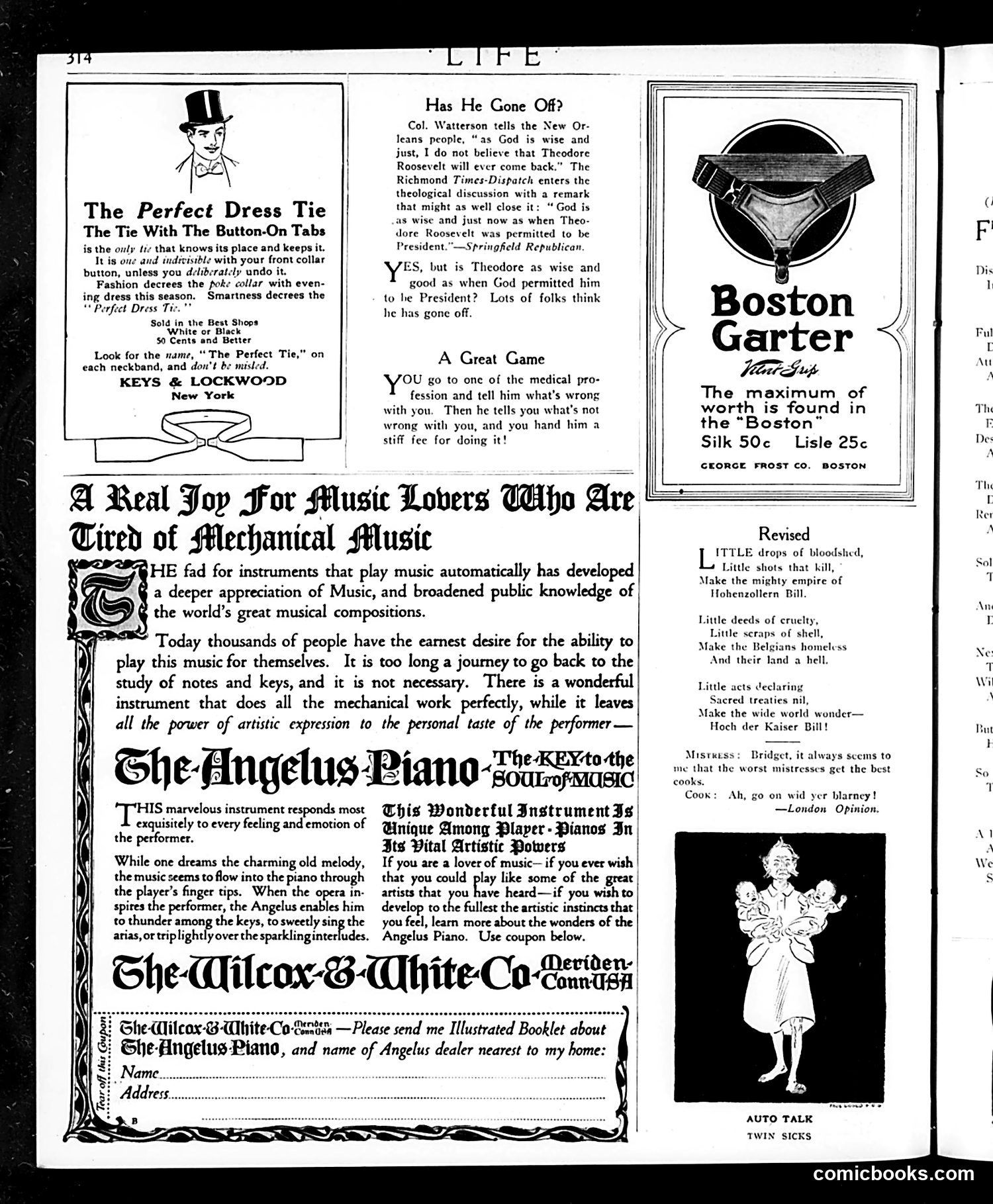
This page contains two distinct satirical pieces amid advertisements: ## "Has He Gone Off?" A brief political commentary on Theodore Roosevelt's absence from public life. The satire plays on religious rhetoric: Colonel Watterson claimed God wouldn't permit Roosevelt's return; the Richmond Times-Dispatch countered that God is "as wise and just now as when Theodore Roosevelt was permitted to be President"—implying Roosevelt himself may have diminished in wisdom and goodness since leaving office. The joke mocks both Roosevelt's possible decline and the absurdity of invoking divine judgment about a political figure. ## "Revised" Poem Anti-German wartime propaganda, likely from WWI. The poem sarcastically credits Kaiser Wilhelm II ("Hohenzollern Bill," "Kaiser Bill") with building his empire through atrocities: bloodshed, violence, destroyed Belgian homes, and violated treaties. It's a bitter condemnation of German militarism and the devastation inflicted on Belgium during the war. Both pieces reflect 1910s-era American political discourse: uncertainty about Roosevelt's legacy and strong anti-German sentiment during or after World War I.
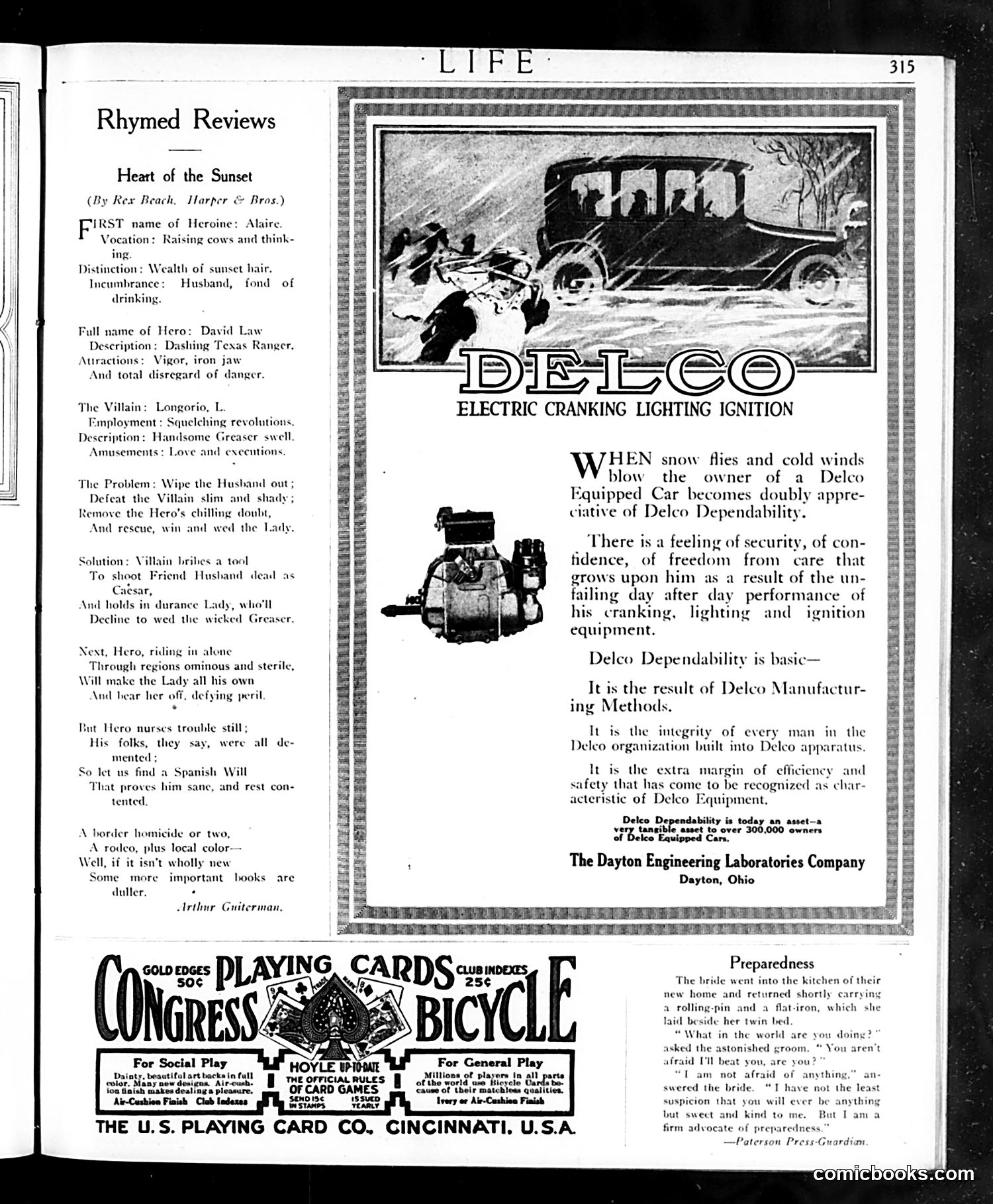
This page contains two distinct elements: **Left side — Book Review:** Arthur Guiterman's satirical verse review of Rex Beach's novel *Heart of the Sunset*. Using a formulaic template, Guiterman mocks the melodramatic plot structure: a virtuous heroine, dashing Texas Ranger hero, villainous "Greaser," contrived violence, and convenient plot devices (a Spanish will proving sanity). The review's tone suggests this is a conventional, somewhat predictable Western romance novel. The term "Greaser" reflects period racial stereotyping against Mexican characters. **Right side — Delco Advertisement:** A full-page advertisement for Delco electric cranking, lighting, and ignition systems. The image shows an early automobile in winter conditions, emphasizing reliability and dependability during harsh weather. **Bottom — Humorous Anecdote:** A brief joke titled "Preparedness" about a bride laying out a rolling pin and flat-iron beside the bed as "defensive weapons," humorously claiming she advocates preparedness (not that she expects to need them). The page is primarily advertising with editorial content framing it.
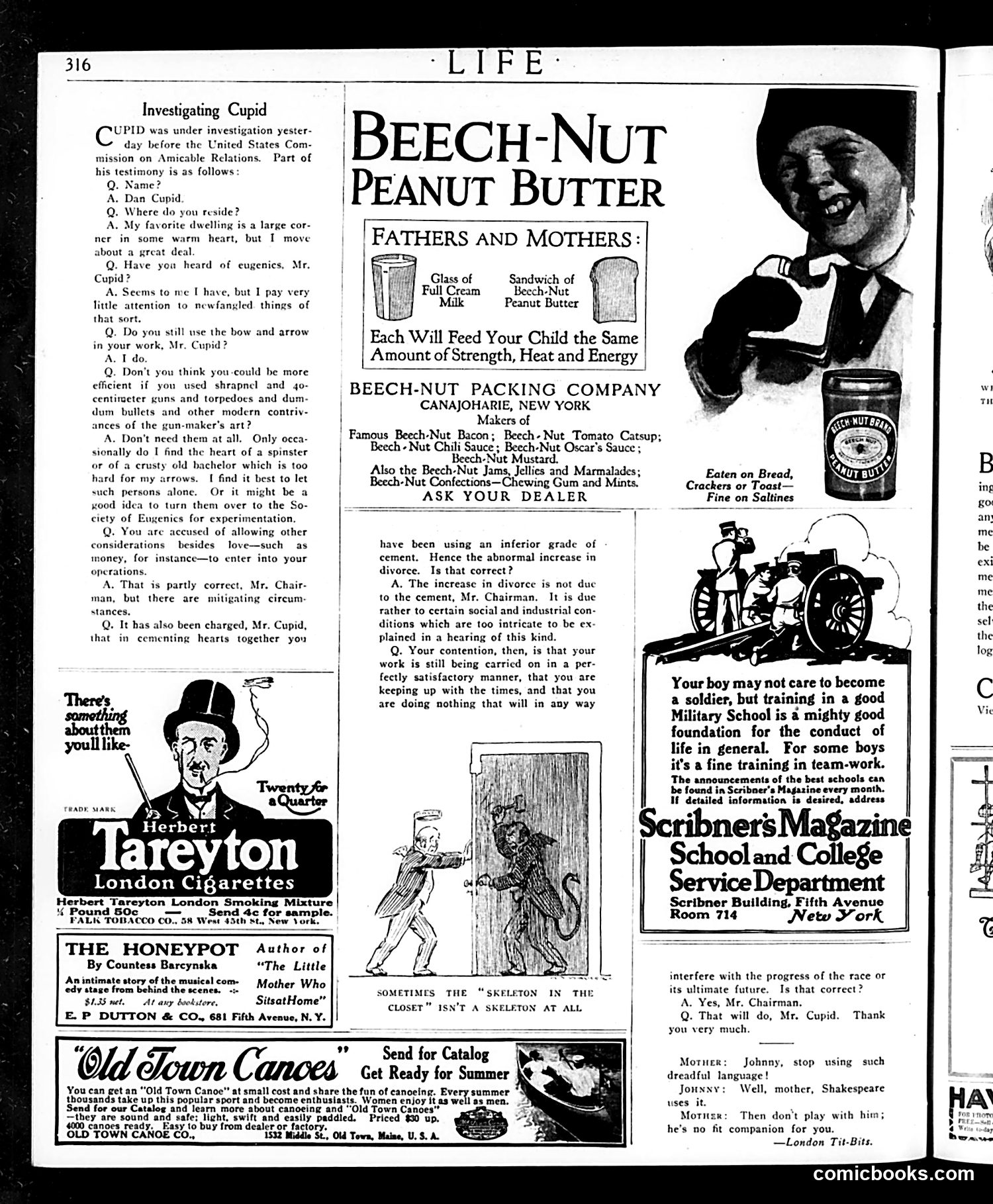
This page's main feature is a humorous mock-trial dialogue where Cupid (personified as "Dan Cupid") is questioned before a U.S. Commission on Amicable Relations about his work facilitating love and marriage. The satire targets early-20th-century concerns about **eugenics** and **modernization**. The interrogator sarcastically suggests Cupid should use modern warfare technology (shrapnel, artillery) instead of traditional arrows—mocking the era's obsession with applying scientific/military "progress" to all aspects of life, including romance and reproduction. Cupid's responses humorously defend tradition and human nature against bureaucratic efficiency. When accused of allowing money to influence matchmaking, he admits to "mitigating circumstances"—a knowing wink at reality. The final exchange suggests that divorce's increase stems from social conditions, not Cupid's methods—a subtle critique of blaming personal relationships for systemic problems. The page is primarily **advertisements** for peanut butter, cigarettes, canoes, and military schools, typical of the era's Life magazine format.
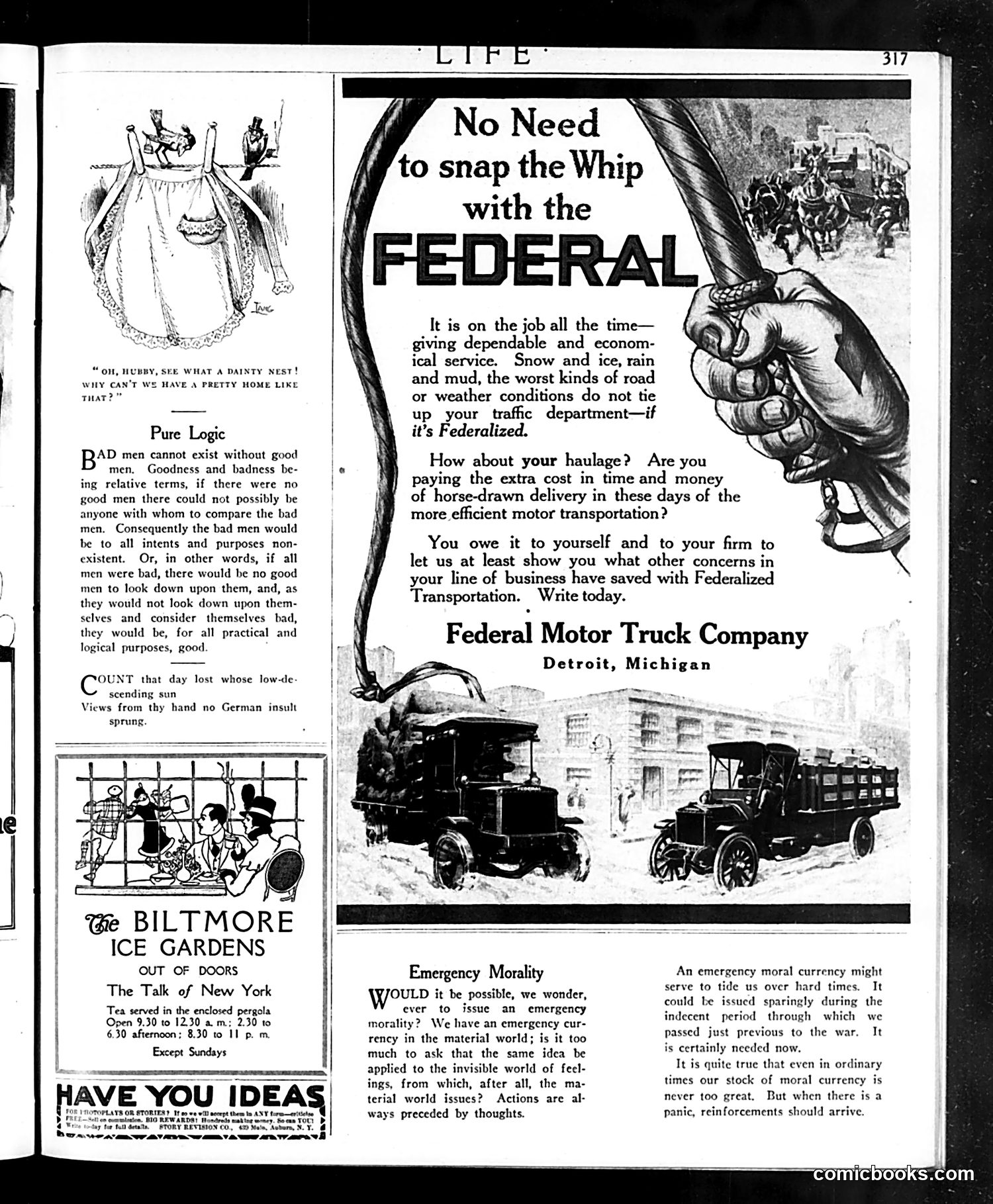
This page mixes editorial cartoons with advertisements and philosophical commentary, typical of Life's satirical format. **The Cartoons:** - Top left ("Oh Hubby, See What a Daisy Nest"): A wife admires a bird's nest, criticizing her own home—simple domestic humor about housekeeping standards. - "Pure Logic" section: A philosophical joke playing on the paradox that "bad men" can't exist without "good men" to compare them to; therefore, if all men were bad, they'd logically be good. **The Advertisement:** The Federal Motor Truck Company ad dominates the right side, using aggressive persuasion ("No Need to snap the Whip"). It argues for motorized trucking over horse-drawn delivery, claiming motor transport provides year-round reliability regardless of weather—appealing to business efficiency and modernity. **Bottom Section:** "Emergency Morality" contemplates whether temporary moral currency (metaphorically, lowered ethical standards) might help society survive post-war hardship, suggesting wartime created moral bankruptcy requiring "reinforcements." The page reflects post-WWI concerns: industrial modernization, business efficiency, and moral reconstruction.
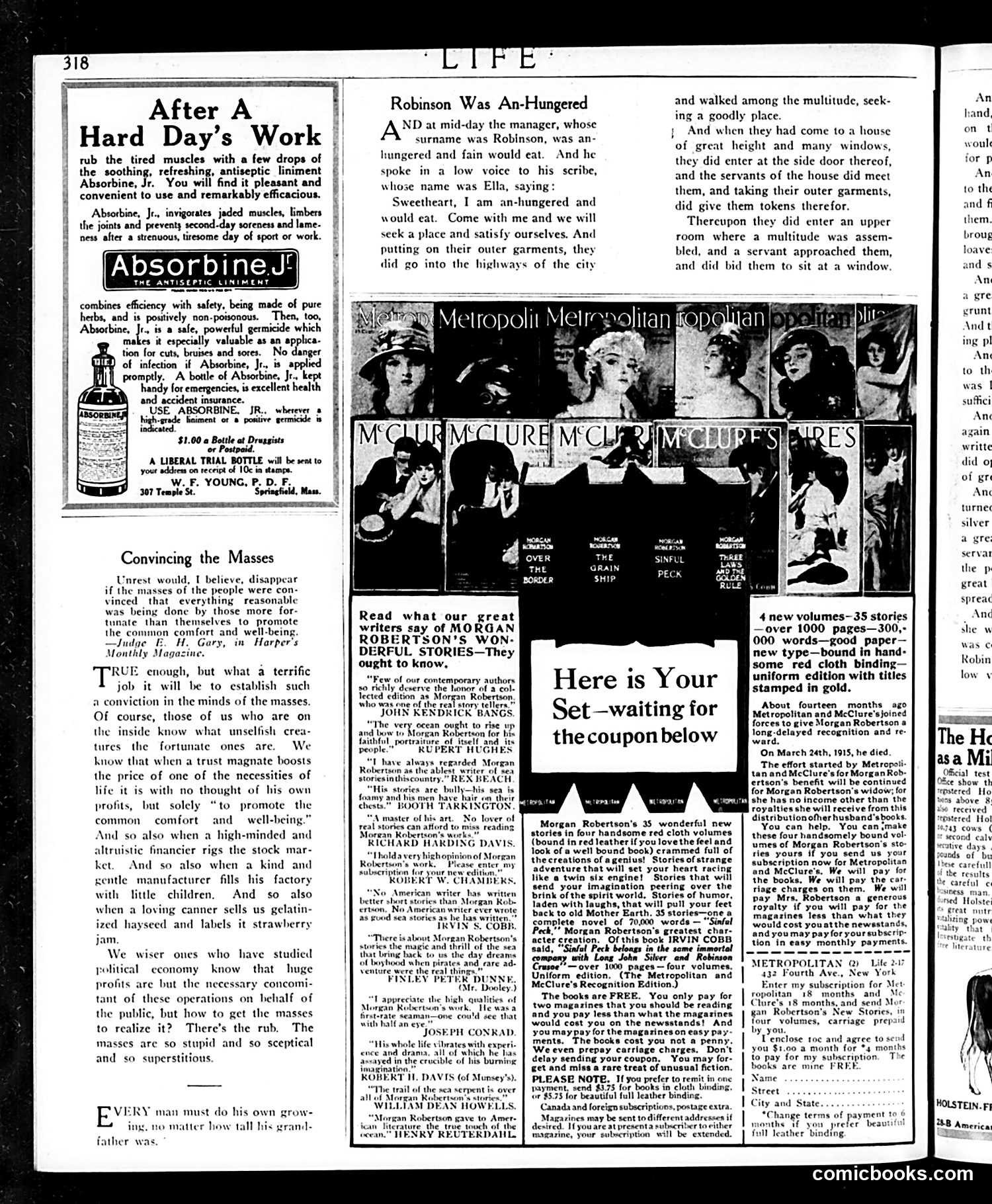
This page mixes **social satire with advertising and literary promotion**, typical of early 20th-century Life magazine. The lead article, "Convincing the Masses," sarcastically mocks wealthy industrialists' claims that their exploitation serves the public good. Judge E.H. Gary's quote—that unrest would disappear if the poor believed the rich acted benevolently—is attacked as naive. The author cuts through this with biting irony: trusts raising prices, financiers rigging markets, factories employing child labor, and canners selling fake strawberry jam all supposedly serve "common comfort and well-being." The satire's point: the masses aren't stupid for doubting these claims—they're right to be skeptical of the wealthy's self-serving justifications. The page also features advertisements for **Absorbine Jr.** liniment and a promotional campaign for **Morgan Robertson's collected stories**, neither of which requires historical context to understand. The biblical pastiche about "Robinson" appears to be humorous filler text mimicking King James language.
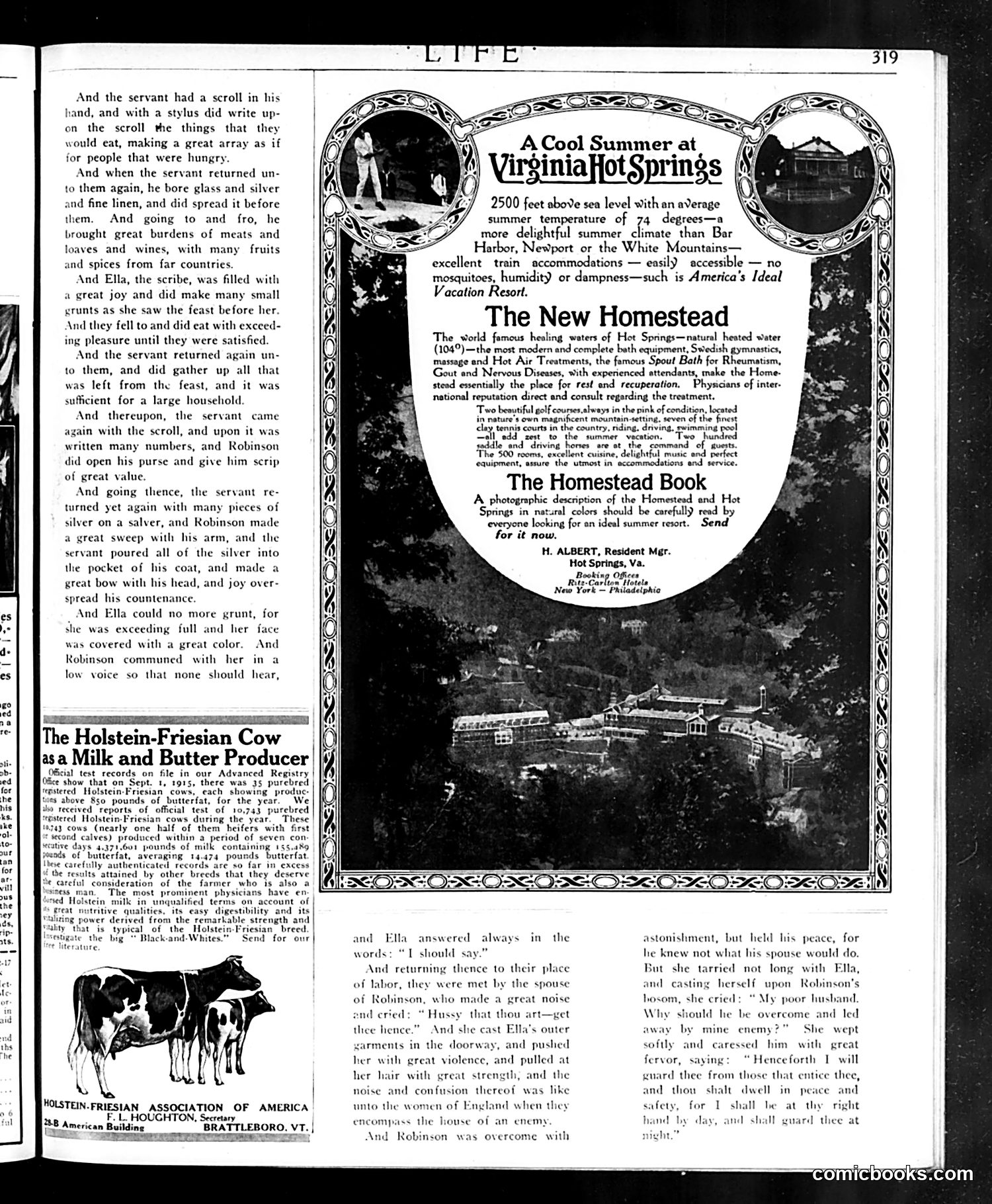
This page mixes narrative fiction with advertisements and lacks a unified political cartoon. The main text is a satirical Biblical parody written in King James style, describing a servant presenting elaborate meals and bills to characters named Robinson and Ella—likely mocking pretentious dining or wasteful spending habits through exaggerated, mock-biblical language. The advertisements occupy most space: Virginia Hot Springs resort promotes mountain vacation amenities, while the Holstein-Friesian Cow association advertises dairy cattle breeding records. These ads are straightforward commercial content, not satire. The page appears to be from Life during the magazine's transition period (likely 1910s-1920s), when it combined literary humor, social commentary, and advertising. The biblical parody may satirize either nouveau riche dining culture or wasteful consumption patterns, but without clearer context about Robinson's identity, the precise social target remains unclear.
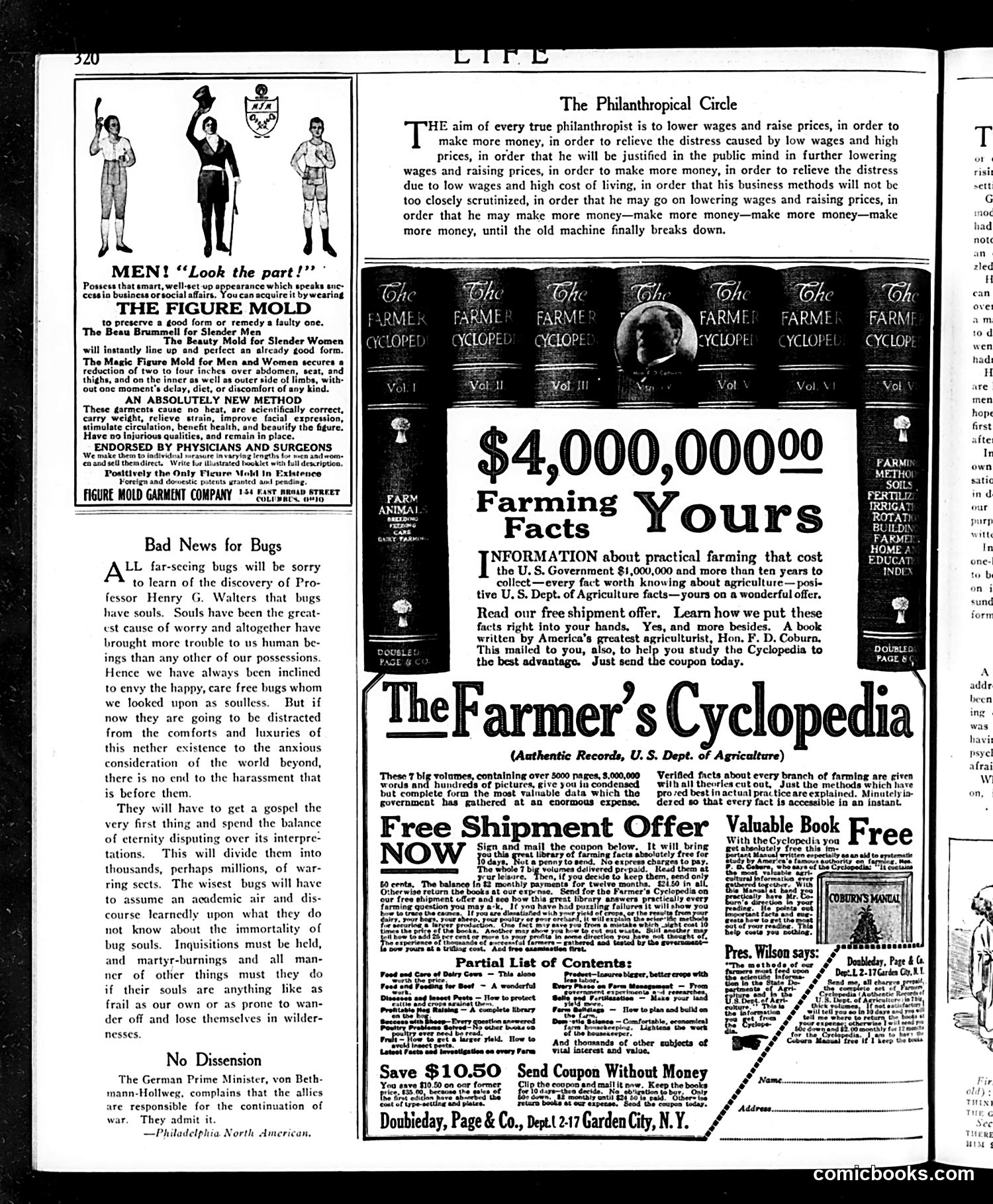
**"The Philanthroprical Circle"** is a savage satire on capitalist hypocrisy. The text presents a circular logic trap: philanthropists claim to lower wages and raise prices to help the poor, but this creates the very poverty they claim to address. They repeat this cycle to justify further exploitation—"make more money, make more money"—until "the old machine finally breaks down." The satire exposes how businessmen use charitable rhetoric to mask self-interested profit-seeking that actually harms workers. **"Bad News for Bugs"** mocks pseudo-scientific claims. It satirizes Professor Henry G. Walters's supposed discovery that bugs have souls. Life argues this is bad news because bugs previously enjoyed carefree comfort as "soulless" creatures; now burdened with souls and moral responsibility, they'll suffer existential anxiety like humans. The joke ridicules both the absurd scientific claim and the human condition itself. The page is primarily **advertising** for Figure Mold garments and The Farmer's Encyclopedia, with these satirical pieces as editorial content.
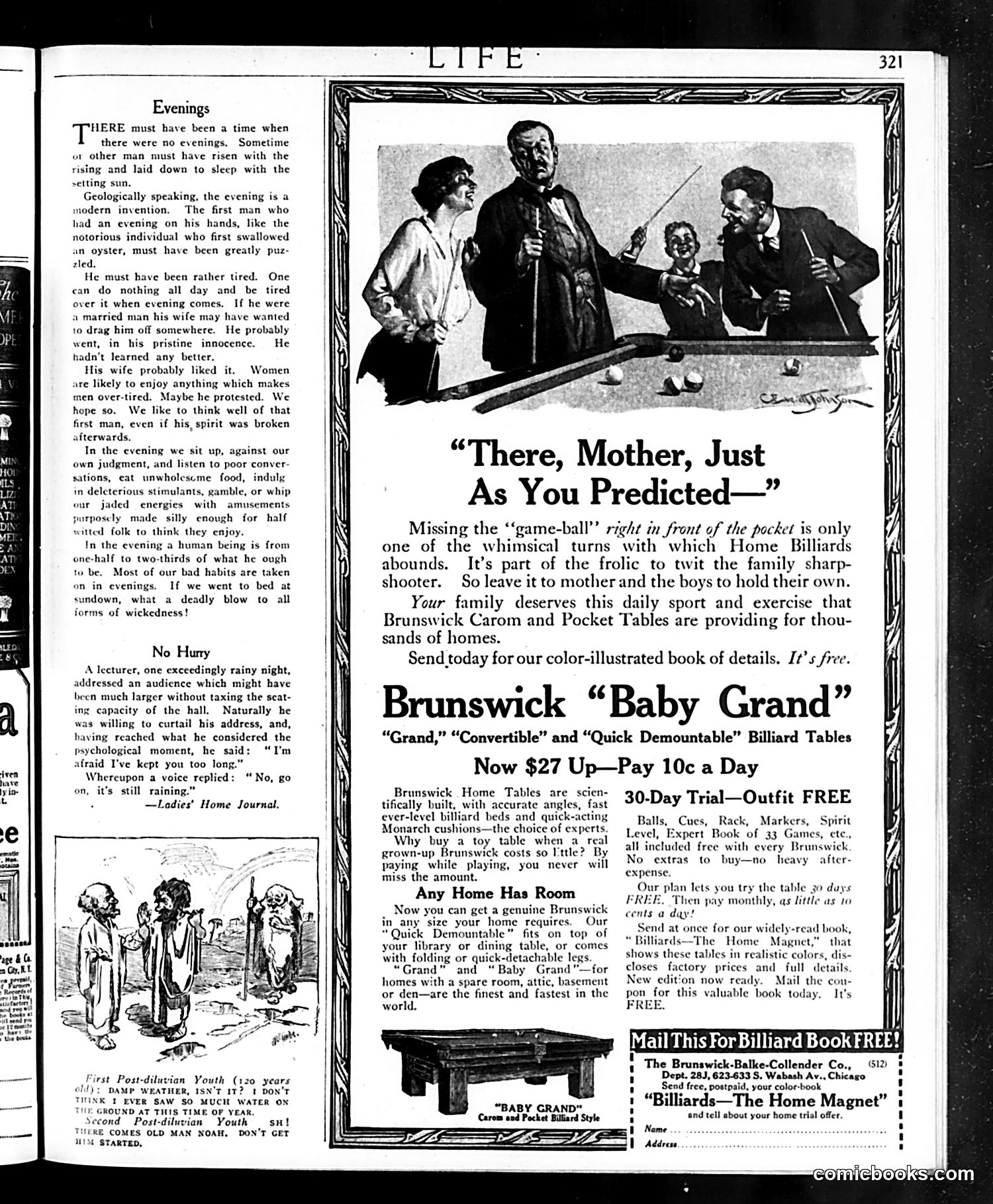
This page combines satirical essays with advertising. **The Essays:** Two humorous pieces mock human behavior. "Evenings" sarcastically traces the "invention" of evening leisure, suggesting humans waste this time on bad habits, mediocre conversation, and foolish amusements. "No Hurry" is a joke about a lecturer addressing a nearly-empty hall during rain; when he offers to cut his talk short, someone replies they're staying anyway because it's still raining outside—implying even his boring speech beats sitting in the rain. **The Advertisement:** The large Brunswick "Baby Grand" billiard table ad features an illustration showing a mother and son at a pool table with the caption "There, Mother, Just As You Predicted—" (suggesting the son missed a shot). The ad frames billiards as wholesome family entertainment, emphasizing affordability ("Pay 10c a day") and promoting it as exercise and bonding. The contrast between the satirical content (mocking wasted evenings) and the ad (selling entertainment for those same evenings) is likely intentional irony.
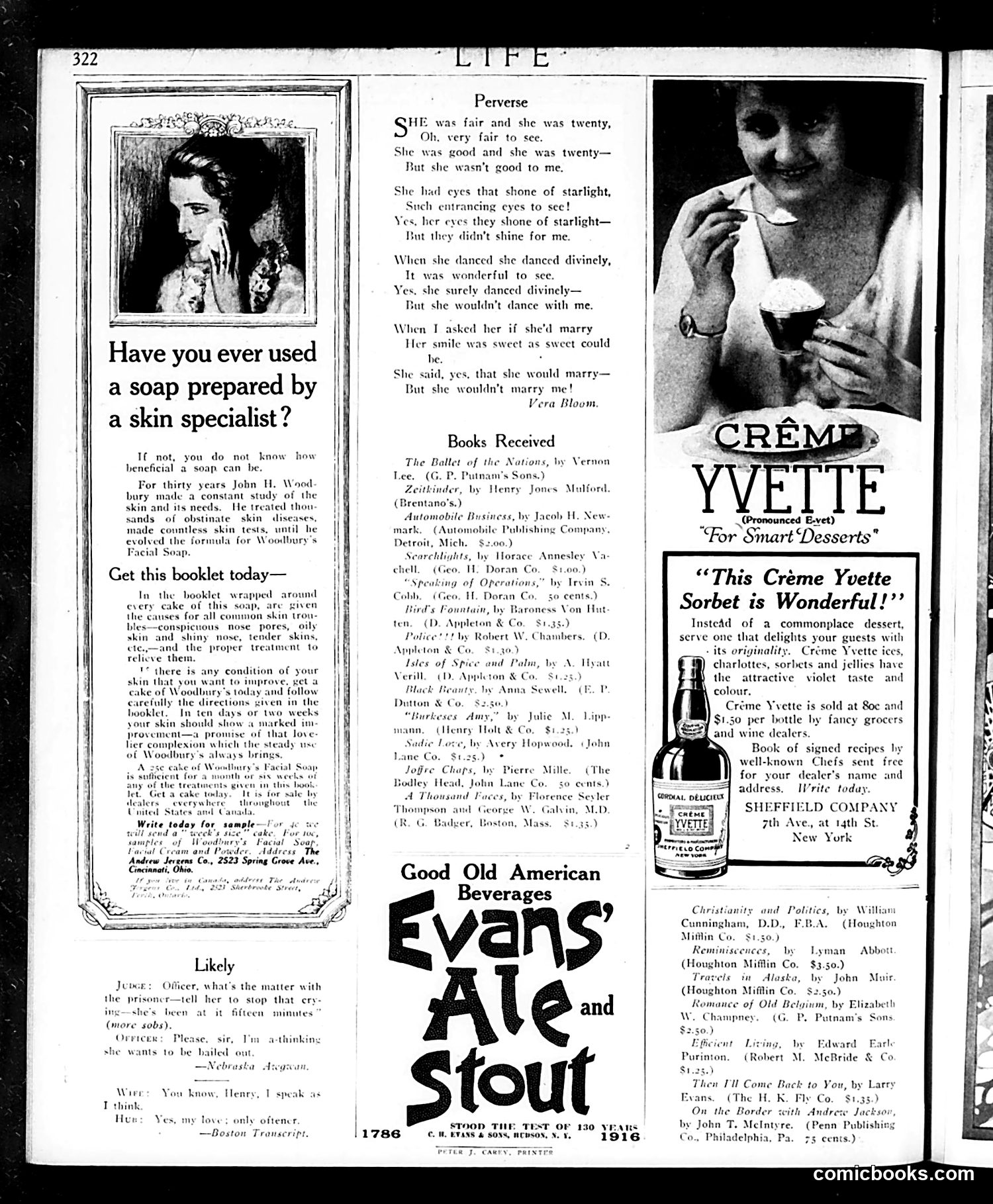
This page from *Life* magazine (dated 1916) is primarily **advertising and book reviews**, not political satire. The content includes: **Advertisements**: Woodbury's soap (emphasizing dermatological benefits), Crème Yvette liqueur, and Evans' Ale and Stout beer. **Two brief jokes** labeled "Likely": - A prisoner crying at the station house, begging to be bailed out - A man lamenting a woman who was beautiful, talented, and agreed to marry him—but wouldn't do any of these things *with him* **Book Reviews**: A lengthy list of newly published works on topics ranging from WWI ("The Ballet of the Nations"), automobiles, and fiction to theology. The humor is domestic and sentimental rather than political. The "Perverse" poem satirizes unrequited love through ironic repetition. There is no identifiable political commentary or caricature on this page.
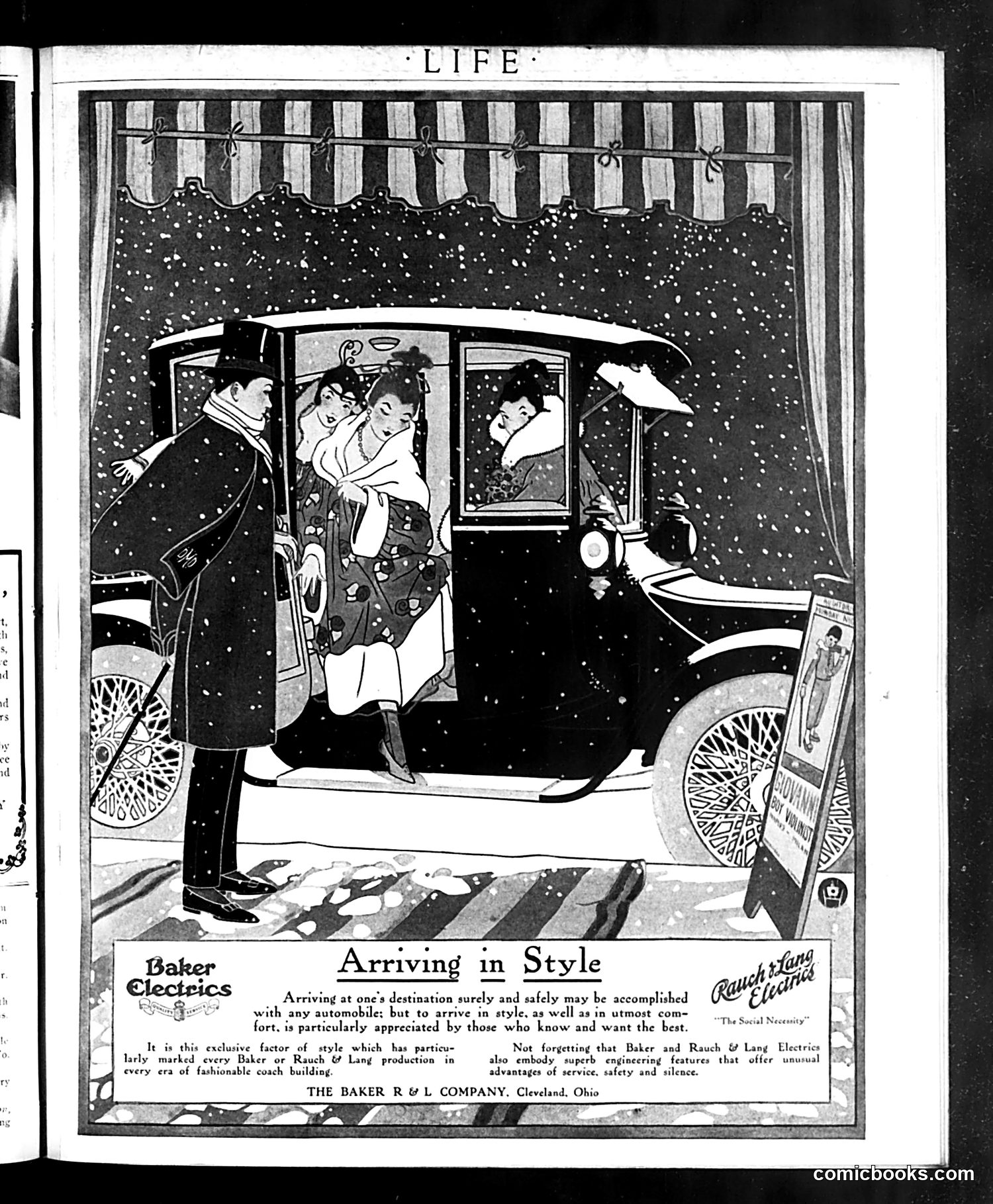
This is a **Baker R&L Company automobile advertisement**, not political satire. It depicts a wealthy couple arriving at an elegant venue in a chauffeur-driven electric car during winter (note the snow). The "joke" or appeal is social rather than satirical: arriving "in style" matters as much as arriving safely. The ad emphasizes that Baker and Rauch & Lang electric vehicles offer not just transportation but **class and sophistication**—important to "those who know and want the best." The advertisement highlights that electric cars were luxury items associated with elegance and comfort. The text stresses engineering quality, safety, and silent operation—features that distinguished premium electrics from noisier gasoline vehicles of the era. This reflects early 1900s automotive culture when cars were status symbols, and electric vehicles (powered by batteries) represented cutting-edge, quieter luxury before gasoline engines became dominant.