
Life, 1916-02-17 · page 32 of 52
Life — February 17, 1916 — page 32: what you’re looking at
What you’re looking at
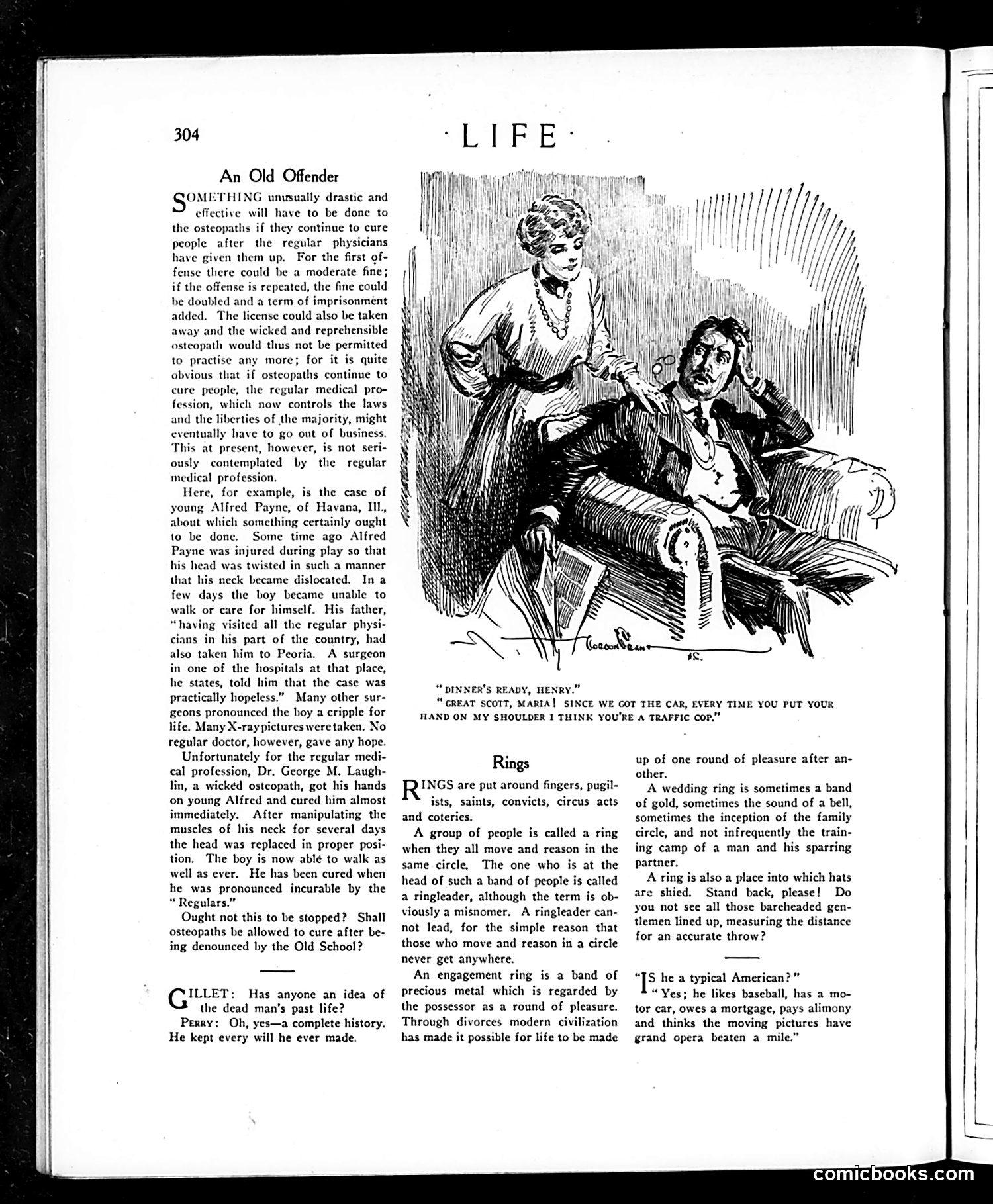
This piece satirizes the medical profession's hostility toward osteopaths, who were gaining credibility by successfully treating patients that regular doctors had declared hopeless. The article presents a real case: young Alfred Payne of Havana, Illinois, suffered a dislocated neck that multiple regular physicians and surgeons pronounced incurable. An osteopath, Dr. George M. Laughlin, cured him through manipulation. Life's satire is biting: it mocks the "regular" (conventional) medical establishment's self-protective monopoly, suggesting they'd actually prefer legislation *against* osteopaths simply because osteopathic success threatens their professional dominance and income. The accompanying illustration shows a woman tending an injured man, visually reinforcing the practical healing the article champions. The satire exposes professional protectionism masquerading as medical standards—attacking the medical profession's control of "laws and liberties" to suppress legitimate competition.
📄 Transcribed text from this page (OCR, searchable)
Machine-transcribed from the original scan — historical spelling and the odd misread are preserved.
304 An Old Offender OMETHING unusually drastic and effective will have to be done to the osteopaths if they continue to cure people after the regular physicians have given them up. For the first of- fense there could be a moderate fine; if the offense is repeated, the fine could be doubled and a term of imprisonment added. The license could also be taken away and the wicked and reprehensible osteopath would thus not be permitted to practise any more; for it is quite obvious that if osteopaths continue to cure people, the regular medical pro- fession, which now controls the laws and the liberties of the majority, might eventually have to go out of business. This at present, however, is not seri- ously contemplated by the regular medical profession. Here, for example, is the case of young Alfred Payne, of Havana, IIL, about which something certainly ought to be done. Some time ago Alfred Payne was injured during play so that his head was twisted in such a manner that his neck became dislocated. In a few days the boy became unable to walk or care for himself. His father, “having visited all the regular physi- cians in his part of the country, had also taken him to Peoria. A surgeon in one of the hospitals at that place, he states, told him that the case was practically hopeless.” Many other sur- geons pronounced the boy a cripple for life, Many X-ray pictures weretaken. No regular doctor, however, gave any hope. Unfortunately for the regular medi- cal profession, Dr, George M. Laugh- lin, a wicked osteopath, got his hands on young Alfred and cured him almost immediately, After manipulating the muscles of his neck for several days the head was replaced in proper posi- tion. The boy is now ablé to walk as well as ever. He has been cured when he was pronounced incurable by the “ Regulars.” Ought not this to be stopped? Shall osteopaths be allowed to cure after be- ing denounced by the Old School? ILLET: Has anyone an idea of the dead man’s past life? Perry: Oh, yes—a complete history. He kept every will he ever made. HAV iI mt HUH at i ERS READY, HENRY.” “GREAT SCOTT, MARIA! SINCE WE GOT THE CAR, EVERY TIME YOU PUT YOUR HAND ON MY SHOULDER I THINK YOU'RE A TRAFFIC COP,” Rings INGS are put around fingers, pugil- ists, saints, convicts, circus acts and coteries. A group of people is called a ring when they all move and reason in the same circle, The one who is at the head of such a band of people is called a ringleader, although the term is ob- viously a misnomer. A ringleader can- not lead, for the simple reason that those who move and reason in a circle never get anywhere. An engagement ring is a band of precious metal which is regarded by the possessor as a round of pleasure. Through divorces modern civilization has made it possible for life to be made up of one round of pleasure after an- other, A wedding ring is sometimes a band of gold, sometimes the sound of a bell, sometimes the inception of the family circle, and not infrequently the train- ing camp of a man and his sparring partner. A ring is also a place into which hats are shied. Stand back, please! Do you not see all those bareheaded gen- tlemen lined up, measuring the distance for an accurate throw? “[S he a typical American?” “Yes; he likes baseball, has a mo- tor car, owes a mortgage, pays alimony and thinks the moving pictures have grand opera beaten a mile.” [ comicbooks.com