
Life, 1916-02-17 · page 29 of 52
Life — February 17, 1916 — page 29: what you’re looking at
What you’re looking at
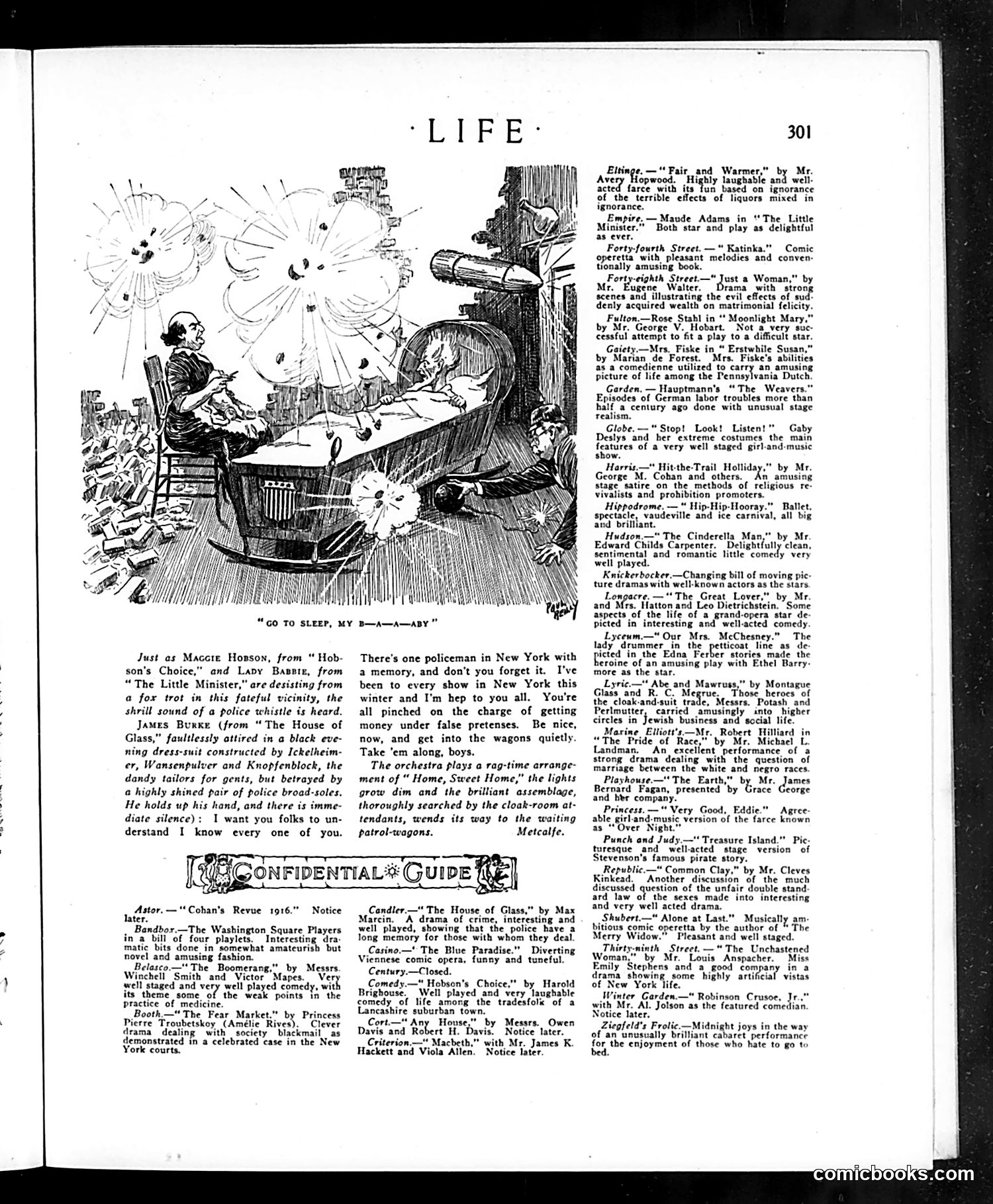
This cartoon satirizes New York police corruption and arbitrary enforcement. A policeman in formal evening dress (incongruously wearing police shoes, betraying his true identity) interrupts theatergoers during a fox trot. He announces he's "pinched" all of them on fabricated charges of "getting money under false pretenses"—despite their obvious innocence—simply because he's attended shows all winter and recognizes them. The satire targets the arbitrary power of police who exploit their positions: this cop uses his "memory" of seeing people at theaters as justification for mass arrests. The orchestra plays "Home, Sweet Home" as patrons are loaded into patrol wagons, creating dark irony. The accompanying theater reviews suggest this reflects actual contemporary concerns about police misconduct and New York's criminal justice system in 1916.
📄 Transcribed text from this page (OCR, searchable)
Machine-transcribed from the original scan — historical spelling and the odd misread are preserved.
ai UN GO TO SLEEP, MY B—A—A—ABY” Just as Maccte Hopson, from “ Hob- son's Choice,” and Lapy Basete, from “The Little Minister,” are desisting from @ fox trot in this fateful vicinity, the shrill sound of a police whistle is heard. James Burke (from “The House of Glass,” faultlessly attired in a black eve- ning dress-suit constructed by Ickelheim- er, Wansenpulver and Knopfenblock, the dandy tailors for gents, but betrayed by a highly shined pair of police broad-soles. He holds up his hand, and there is imme- diate silence): I want you folks to un- derstand I know every one of you. ‘ohan'’s Revue 1916." Notice later. , Bandbor.—The Washington Square Players in a bill of four playlets, Interesting dra: matic bits done in somewhat amateurish but novel and amusing fashion. Belasco.—" The Boomerang,” by Messrs Winchell Smith and Victor Mapes. Ver well staged and very well played comedy, wit its theme some of the weak points in the Practice of medicine. Booth —“ The Fear Market.” by Princess Pierre Troubetskoy (Amélie Rives), Clever drama dealing with society blackmail. as demonstrated in a celebrated case in the New York courts. There's one policeman in New York with a memory, and don’t you forget it. I've been to every show in New York this winter and I'm hep to you all. You're all pinched on the charge of getting money under false pretenses. Be nice, now, and get into the wagons quietly. Take ‘em along, boys. The orchestra plays a rag-time arrange- ment of “ Home, Sweet Home,” the lights grow dim and the brilliant assemblage, thoroughly searched by the cloak-room at- tendants, wends its way to the waiting patrol-wagons. Metcalfe. Candler.—" The House of Glass,” by Max Marcin. A drama of crime, interesting and well played, showing that the police have a long memory for those with whom they deal. Casino.—* The Blue Paradise.” Diverting Viennese comic opera, funny and tuneful. Century.—Closed. Comedy.—" Hobson's Choice,” by Harold Brighouse. Well played and very laughable comedy of life among the tradesfolx of a Lancashire suburban town. Cort.—" Any House,” by Messrs. Owen Davis and Robert H. Davis, Notice later. Criterion.—"' Macbeth,” with Mr. James K. Hackett and Viola Allen. Notice later. Eltinge. —"* Fair and Warmer,” by Mr. Avery Hopwood. Highly laughable and well: acted farce with its {un based on ignorance of the terrible effects of liquors mixed in ignorance. Empi Minister.’ as ever. Forty-fourth Street. —“ Katinka.” operetta with pleasant melodies tionally amusing book. Forty-cighth Street—* J Mr. Eugene Walter rama with strony scenes and illustrating the evil effects of * denly acquired wealth on matrimonial felicit; Fulton.—Rose Stabl in ‘* Moonli, by Mr. George V. Hobart. Not a very suc- cessful attempt to fit a play to a difficult star. Gaiety.—Mrs_ Fiske in “ Erstwhile Susan,” by Marian de Forest. Mrs. Fiske's abilit as a comedienne utilized to carry an amusing picture of life among the Pennsylvania Dutch, Garden. — Hauptmann's “The Weavers.” Episodes of German labor troubles more than half a century ago done with unusual stage realism. Globe. —“ Stop! Look! Listen!" Gaby Deslys and her extreme costumes the main features of a very well staged girl-and-music show. Harris.—" Hit-the-Trail Holliday,” by Mr. George M. Coban and others. An amusing stage satire on the methods of religious re- vivalists and prohibition promoters. Hippodrome. —“ Hip-Hip-Hooray.” Ballet. spectacle, vaudeville and ice carnival, all big and brilliant Hudson.—* The Cinderella Man,” by Mr. Edward Childs Carpenter. Delightfully clean, sentimental and romantic little comedy very well played. Knickerbocker.—Changing bill of moving pic- ture dramas with well-known actors as the stars. Lengact The Great Lover, and Mrs. Hatton and Leo Dietrichstei: aspects of the life of a grand-opera star de- picted interesting and well-acted comedy. Lyceum.—" Our Mrs. McChesney.” The lady drummer _in the petticoat line as de- icted in the Edna Ferber stories made the eroine of an amusing play with Ethel Barry- more as the star. Lyric.—" Abe and Mawruss,” by Montague Glass and R. C. Megrue. Those heroes of the cloak-and-suit trade, Messrs. Potash and Perlmutter, ca: amusingly into higher circles in Jewish business and social life Marine Elliott's—Mr. Robert iard in “The Pride of Race,” by Mr. Michael L. Landman. An. excellent performance of a drama dealing with the question of fe between the white and negro races. ) ‘The Earth,” by Mr. James Bernard Fagan, presented by Grace cOrge and ber company. Princess. —“ Very Good, Eddie.” Agree: able girl-and-music version of the farce known as “Over Nighi Punch and Judy.—"* Treasure Island. turesque and well-acted stage ve! Stevenson's famous pirate story. Republic.—* Common Clay,” by Mr. Cleves kead. Another discussion of the much juestion of the unfair double stand: ard law of the sexes made into interes: and very well acted drama. Shubert.—" Alone at Last.” Musically am- bitious comic operetta by the author of * The Merry Widow.” Pleasant and well staged. Thirty-minth Street. —“ The Unchastened Woma: by Mr. Louis Anspacher. Miss Emily Stephens and a good compan: a drama showing some highly artificial vistas of New York life. Winter Garden.—" Robinson Crusoe, Jr..” with Mr. Al. Jolson as the featured comedian. Notice later. Ziegfeld's Frolic.—Midnight joys in the way ly brilliant cabaret performance 4 the enjoyment of those who hate to go to — Maude Adams in “The Little Both star and play as delightful Comic