
Life, 1916-02-17 · page 8 of 52
Life — February 17, 1916 — page 8: what you’re looking at
What you’re looking at
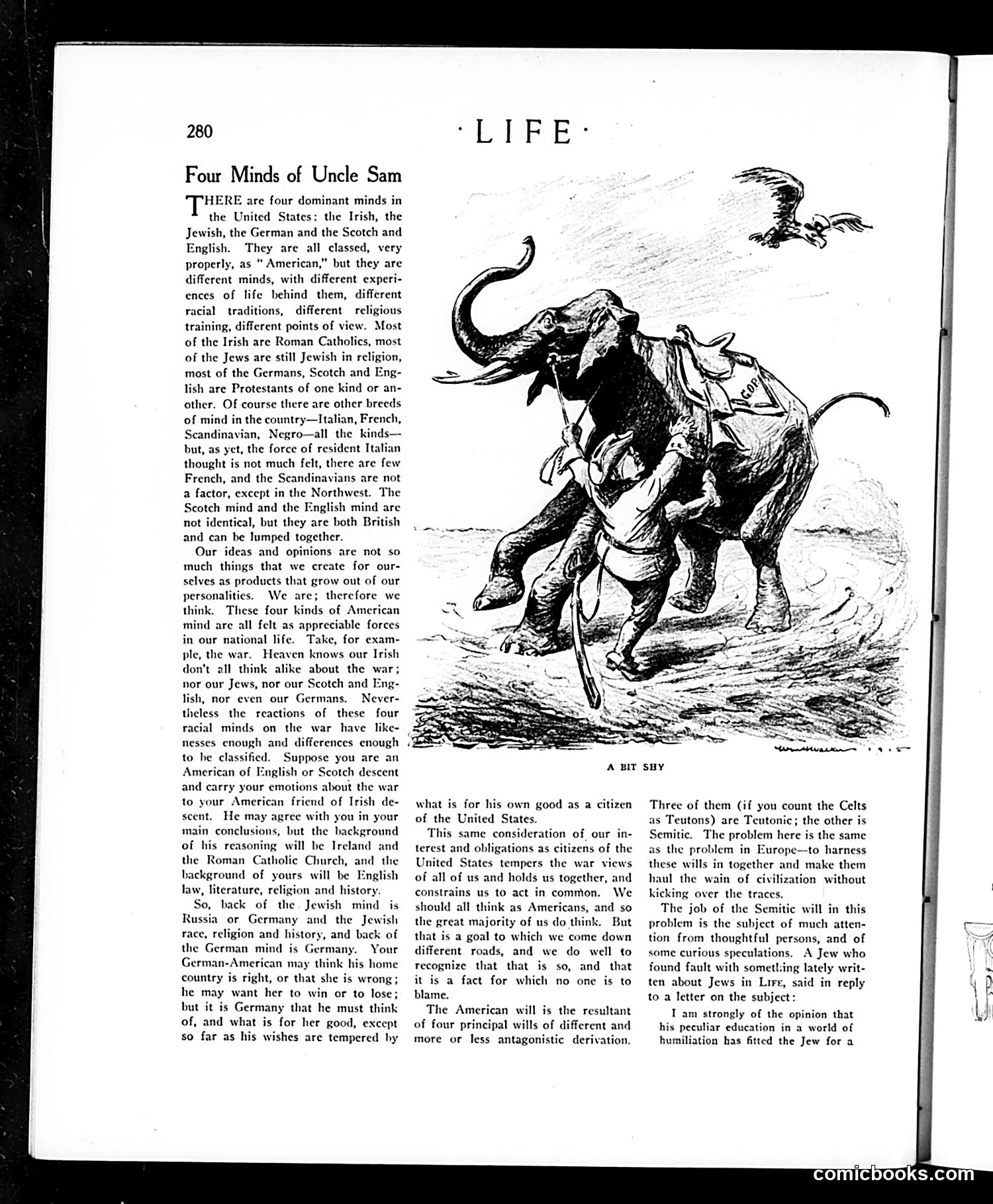
The illustration depicts an **elephant appearing hesitant or withdrawn**, labeled "A BIT SHY." The elephant likely represents the **Republican Party** (a standard political symbol of the era), shown reluctant or nervous about something. The accompanying text discusses **four dominant American "minds"**: Irish, Jewish, German, and Scotch-English populations, examining their different wartime perspectives during what appears to be **World War I**. The author argues these groups had divergent views on the conflict but should unite as Americans. The cartoon's point appears to be that **one political faction was being coy or evasive about committing to a unified American position** regarding the war—hence "a bit shy"—when national consensus was needed.
📄 Transcribed text from this page (OCR, searchable)
Machine-transcribed from the original scan — historical spelling and the odd misread are preserved.
Four Minds of Uncle Sam 'HERE are four dominant minds in the United States: the Irish, the Jewish, the German and the Scotch and English. They are all classed, very properly, as “American,” but they are different minds, with different experi- ences of life behind them, different racial traditions, different rel training, different points of view. Most of the Irish are Roman Catholics, most of the Jews are still Jewish in religion, most of the Germans, Scotch and Eng- lish are Protestants of one kind or an- other. Of course there are other breeds of mind in the country—Italian, French, Scandinavian, Negro—all the kinds— but, as yet, the force of resident Italian thought is not much felt, there are few French, and the Scandinavians are not a factor, except in the Northwest. The Scotch mind and the English mind are not identical, but they are both British and can be lumped together. Our ideas and opinions are not so much things that we create for our- selves as products that grow out of our personalities. We are; therefore we think, These four kinds of American mind are all felt as appreciable forces in our national life. Take, for exam- ple, the war. Heaven knows our Irish don’t all think alike about the wai nor our Jews, nor our Scotch and Eng- lish, nor even our Germans. Never- theless the reactions of these four racial minds on the war have 1 nesses cnough and differences enough to he classified. Suppose you are an American of English or Scotch descent and carry your emotions about the war to your American friend of Irish de- scent. He may agree with you in your main conclusions, but the background of his reasoning will be Ireland and the Roman Catholic Church, and the background of yours will be English law, literature, religion and history. So, back of the. Jewish mind is or Germany and the Jewish race, religion and history, and back of the German mind is Germany. Your German-American may think his home country is right, or that she is wrong; he may want her to win or to lose; but it is Germany that he must think of, and what is for her good, except so far as his wishes are tempered by ious A BIT SHY what is for his own good as a citizen of the United States. This same consideration of, our in- terest and obligations as citizens of the United States tempers the war views of all of us and holds us together, and constrains us to act in comnion. We should all think as Americans, and so the great majority of us do think. But that is a goal to which we come down different roads, and we do well to recognize that that is so, and that it is a fact for which no one is to blame. The American will is the resultant of four principal wills of different and more or less antagonistic derivation. Three of them (if you count the Celts as Teutons) are Teutonic; the other is Semitic. The problem here is the same as the problem in Europe—to harness these wills in together and make them haul the wain of civilization without icking over the traces. The job of the Semitic will in this problem is the subject of much atten- tion from thoughtful persons, and of some curious speculations. A Jew who found fault with sometling lately writ- ten about Jews in Lire, said in reply to a letter on the subject: I am strongly of the opinion that his peculiar education in a world of humiliation has fitted the Jew for a comicbooks.com