
Life, 1916-02-17 · page 25 of 52
Life — February 17, 1916 — page 25: what you’re looking at
What you’re looking at
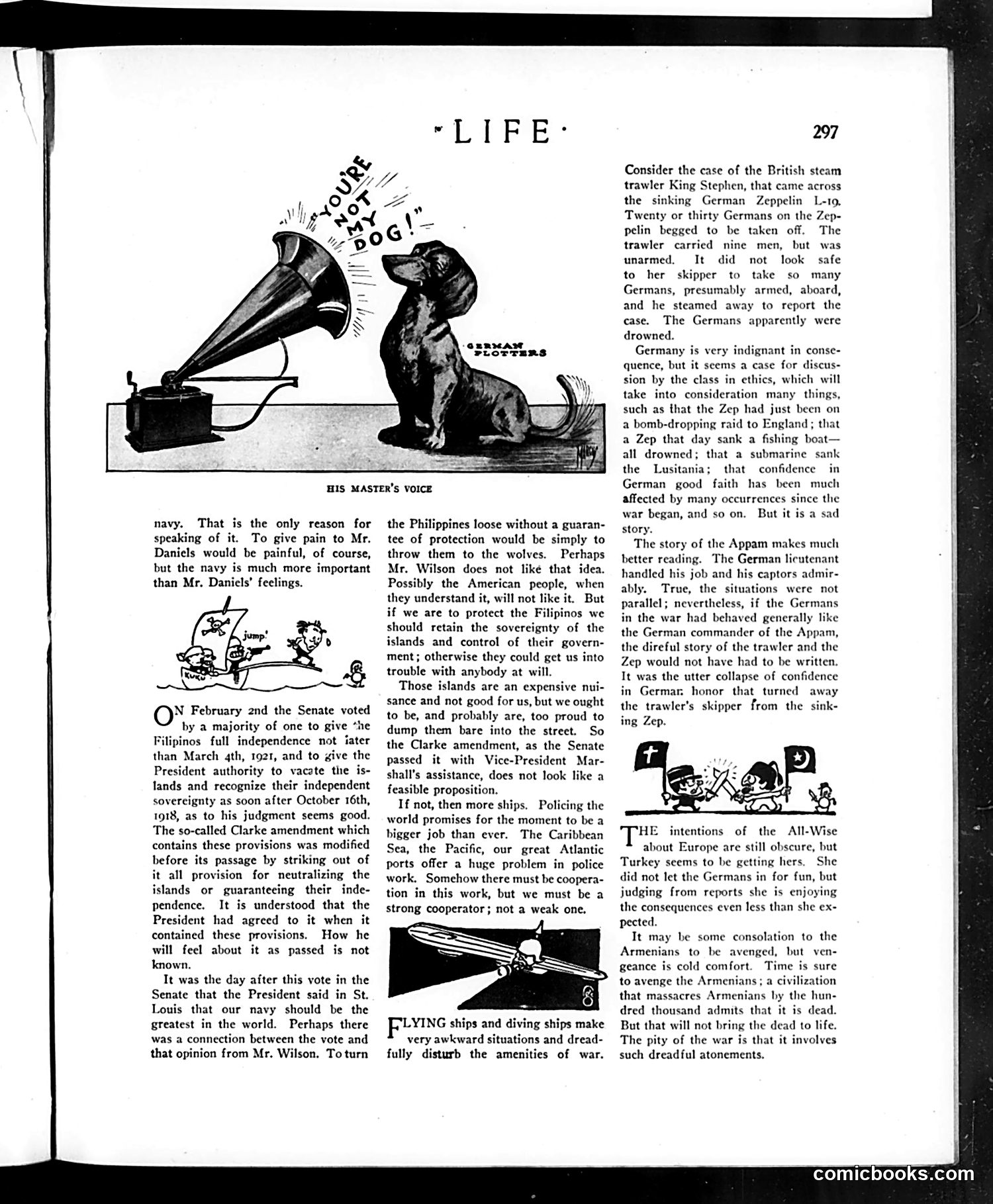
The cartoon depicts a German dog listening to a gramophone labeled "IS YOUR DOG LOYAL?" The satire mocks German obedience to authority, playing on the famous "His Master's Voice" trademark while suggesting Germans blindly follow commands. The accompanying article discusses the Senate's February 2nd vote granting Philippine independence by March 4, 1921—a decision the author criticizes as potentially dangerous. The piece argues that abandoning the Philippines without military protection would be irresponsible, and advocates instead for maintaining American naval supremacy to "police the world." The article also recounts two wartime incidents: the British trawler *King Stephen*'s refusal to rescue Germans from the sinking Zeppelin L-19 (Germans drowned), and the more honorable conduct of the German commander of the *Appam*. The author uses these examples to discuss German honor's "collapse" during the war, contrasting lost confidence in German good faith with occasional moments of civility.
📄 Transcribed text from this page (OCR, searchable)
Machine-transcribed from the original scan — historical spelling and the odd misread are preserved.
HIS MASTER'S VOICE navy. That is the only reason for speaking of it. To give pain to Mr. Daniels would be painful, of course, but the navy is much more important than Mr. Daniels’ feelings. O*’ February 2nd the Senate voted by a majority of one to give “he ipinos full independence not iater than March 4th, ro21, and to give the President authority to vacate the is- lands and recognize their independent sovereignty as soon after October 16th, 1918, as to his judgment seems good. The so-called Clarke amendment which contains these provisions was modified before its passage by striking out of it all provision for neutralizing the islands or guaranteeing their inde- pendence. It is understood that the President had agreed to it when it contained these provisions. How he will feel about it as passed is not known. It was the day after this vote in the Senate that the President said in St. Louis that our navy should be the greatest in the world. Perhaps there was a connection between the vote and that opinion from Mr. Wilson. To turn the Philippines loose without a guaran- tee of protection would be simply to throw them to the wolves. Perhaps Mr. Wilson does not liké that idea. Possibly the American people, when they understand it, will not like it. But if we are to protect the Filipinos we should retain the sovereignty of the islands and control of their govern- ment; otherwise they could get us into trouble with anybody at will. Those islands are an expensive nui- sance and not good for us, but we ought to be, and probably are, too proud to dump them bare into the street. So the Clarke amendment, as the Senate passed it with Vice-President Mar- shall’s assistance, does not look like a feasible proposition. If not, then more ships. Policing the world promises for the moment to be a bigger job than ever. The Caribbean Sea, the Pacific, our great Atlantic ports offer a huge problem in police work. Somehow there must be coopera- tion in this work, but we must be a strong cooperator; not a weak one. FLYING ships and diving ships make very awkward situations and dread- fully disturb the amenities of war. 297 Consider the case of the British steam trawler King Stephen, that came across the sinking German Zeppelin L-19. Twenty or thirty Germans on the Zep- pelin begged to be taken off. The trawler carried nine men, but was unarmed. It did not look safe to her skipper to take so many Germans, presumably armed, aboard, and he steamed away to report the case. The Germans apparently were drowned. Germany is very indignant in conse- quence, but it seems a case for discus- sion by the class in ethics, which will take into consideration many things, such as that the Zep had just been on a bomb-dropping raid to England ; that a Zep that day sank a fishing boat— all drowned; that a submarine sank the Lusitania; that confidence in German good faith has been much affected by many occurrences since the war began, and so on. But it is a sad story. The story of the Appam makes much better reading. The German licutenant handled his job and his captors admir- ably. True, the situations were not parallel; nevertheless, if the Germans in the war had behaved generally like the German commander of the Appam, the direful story of the trawler and the Zep would not have had to be written. It was the utter collapse of confidence in German honor that turned away the trawler's skipper from the sink- ing Zep. HE intentions of the All-Wise about Europe are still obscure, but Turkey seems to be getting hers. She did not let the Germans in for fun, but judging from reports she is enjoying the consequences even less than she ex- pected. It may be some consolation to the Armenians to be avenged, but ven- geance is cold comfort. Time is sure to avenge the Armenians; a ci tion that massacres Armenians by the hun- dred thousand admits that it is dead. But that will not bring the dead to life. The pity of the war is that it involves such dreadful atonements, comicbooks.com