
Life, 1916-02-17 · page 30 of 52
Life — February 17, 1916 — page 30: what you’re looking at
What you’re looking at
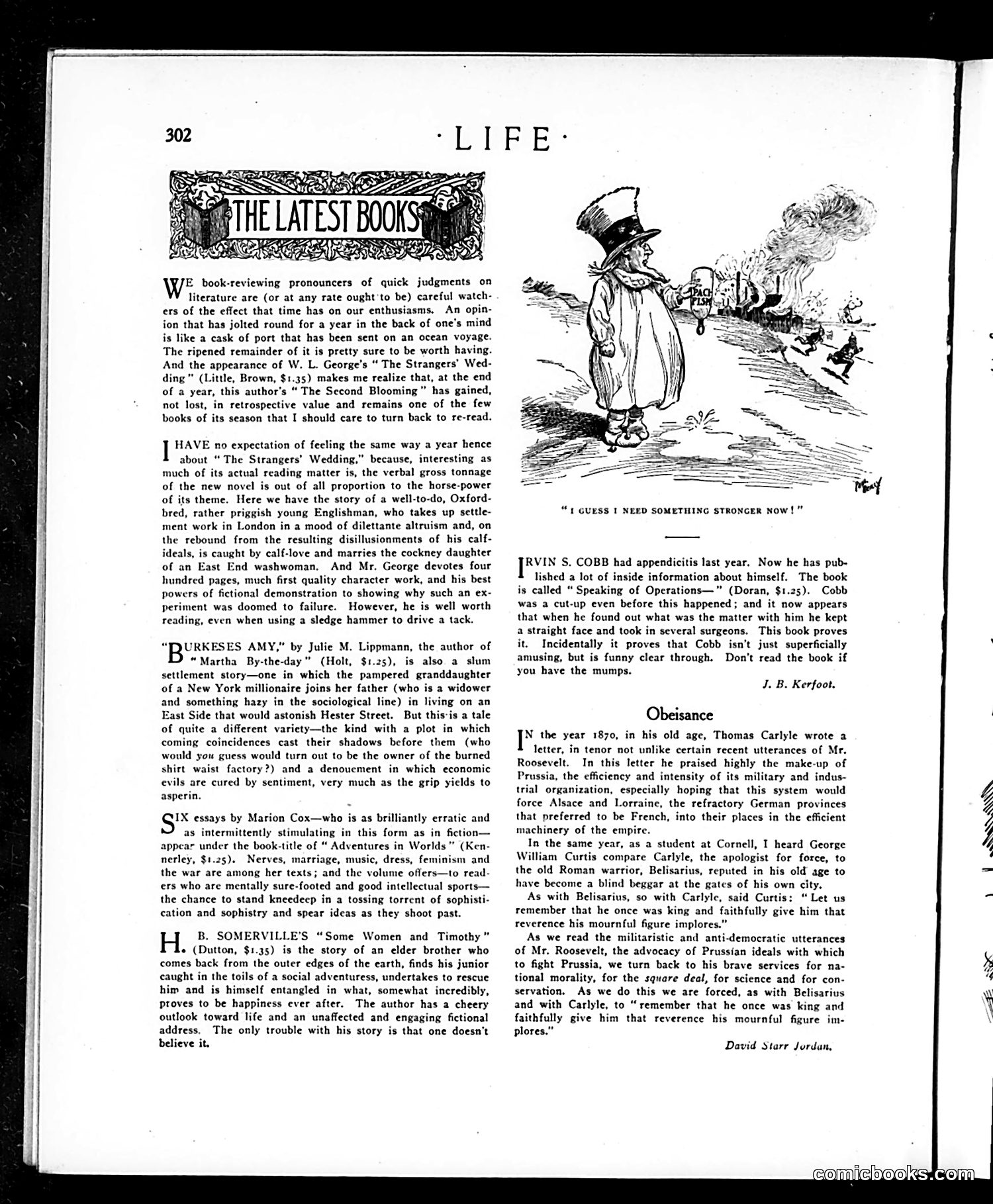
The cartoon depicts a disheveled man in a top hat, apparently intoxicated or exhausted, being chased by what appears to be a temperance advocate or reformer (likely a woman with stern demeanor). The caption suggests the man is fleeing from pressure to abstain from alcohol. This satirizes the temperance movement, which was gaining momentum in early 20th-century America, culminating in Prohibition (1920-1933). The joke mocks the conflict between those promoting sobriety and those resisting such moral crusades. The man's plight—needing "something stronger"—humorously captures the frustration of those opposing temperance reform. The cartoon appears amid book reviews in *Life* magazine, a publication known for satirizing American social movements and cultural debates of the era.
📄 Transcribed text from this page (OCR, searchable)
Machine-transcribed from the original scan — historical spelling and the odd misread are preserved.
E book-reviewing pronouncers of quick judgments on literature are (or at any rate oughtto be) careful watch- ers of the effect that time has on our enthusiasms. An opin- ion that has jolted round for a year in the back of one’s mind is like a cask of port that has been sent on an ocean voyage. The ripened remainder of it is pretty sure to be worth having. And the appearance of W. L. George's “ The Strangers’ Wed- ding" (Little, Brown, $1.35) makes me realize that, at the end of a year, this author's “ The Second Blooming" has gained, not lost, in retrospective value and remains one of the few books of its season that I should care to turn back to re-read. HAVE no expectation of feeling the same way a year hence about “ The Strangers’ Wedding,” because, interesting as much of its actual reading matter is, the verbal gross tonnage of the new novel is out of all proportion to the horse-power of its theme. Here we have the story of a well-to-do, Oxford- bred, rather priggish young Englishman, who takes up settle- ment work in London in a mood of dilettante altruism and, on the rebound from the resulting disillusionments of his calf- ideals, is caught by calf-love and marries the cockney daughter of an East End washwoman. And Mr. George devotes four hundred pages, much first quality character work, and his best powers of fictional demonstration to showing why such an ex- periment was doomed to failure. However, he is well worth reading, even when using a sledge hammer to drive a tack. “PQURKESES AMY,” by Julie M. Lippmann, the author of “Martha By-the-day"” (Holt, $1.25), is also a slum settlement story—one in which the pampered granddaughter of a New York millionaire joins her father (who is a widower and something hazy in the sociological line) in living on an East Side that would astonish Hester Street. But this-is a tale of quite a different variety—the kind with a plot in which coming coincidences cast their shadows before them (who would you guess would turn out to be the owner of the burned shirt waist factory?) and a denouement in which economic evils are cured by sentiment, very much as the grip yields to asperin. IX essays by Marion Cox—who is as brilliantly erratic and as intermittently stimulating in this form as in fiction— appear under the book-title of “ Adventures in Worlds” (Ken- nerley, $1.25). Nerves, marriage, music, dress, feminism and the war are among her texts; and the volume offers—to read- ers who are mentally sure-footed and good intellectual sports— the chance to stand kneedeep in a tossing torrent of sophisti- cation and sophistry and spear ideas as they shoot past. H B. SOMERVILLE’S “Some Women and Timothy” « (Dutton, $1.35) is the story of an elder brother who comes back from the outer edges of the earth, finds his junior caught in the toils of a social adventuress, undertakes to rescue him and is himself entangled in what, somewhat incredibly, Proves to be happiness ever after. The author has a cheery outlook toward life and an unaffected and engaging fictional address, The only trouble with his story is that one doesn't believe it, ESS | NEED SOMETHING STRONGER Now!” RVIN S. COBB had appendicitis last year. Now he has pub- lished a lot of inside information about himself. The book is called “ Speaking of Operations—" (Doran, $1.25). Cobb was a cut-up even before this happened; and it now appears that when he found out what was the matter with him he kept a straight face and took in several surgeons. This book proves it. Incidentally it proves that Cobb isn’t just superficially amusing, but is funny clear through. Don't read the book if you have the mumps. J. B. Kerfoot. Obeisance the year 1870, in his old age, Thomas Carlyle wrote a letter, in tenor not unlike certain recent utterances of Mr. Roosevelt. In this letter he praised highly the make-up of Prussia, the efficiency and intensity of its military and indus- trial organization, especially hoping that this system would force Alsace and Lorraine, the refractory German provinces that preferred to be French, into their places in the efficient machinery of the empire. In the same year, as a student at Cornell, I heard George William Curtis compare Carlyle, the apologist for force, to the old Roman warrior, Belisarius, reputed in his old age to have become a blind beggar at the gates of his own city, As with Belisarius, so with Carlyle, said Curtis: “Let us remember that he once was king and faithfully give him that reverence his mournful figure implores.” As we read the militaristic and anti-democratic utterances of Mr. Roosevelt, the advocacy of Prussian ideals with which to fight Prussia, we turn back to his brave services for na- tional morality, for the square deal, for science and for con- servation, As we do this we are forced, as with Belisarius and with Carlyle, to “remember that he once was king and faithfully give him that reverence his mournful figure im- plores.” David Starr Jordan, T cdyrn as