
Life, 1916-02-17 · page 7 of 52
Life — February 17, 1916 — page 7: what you’re looking at
What you’re looking at
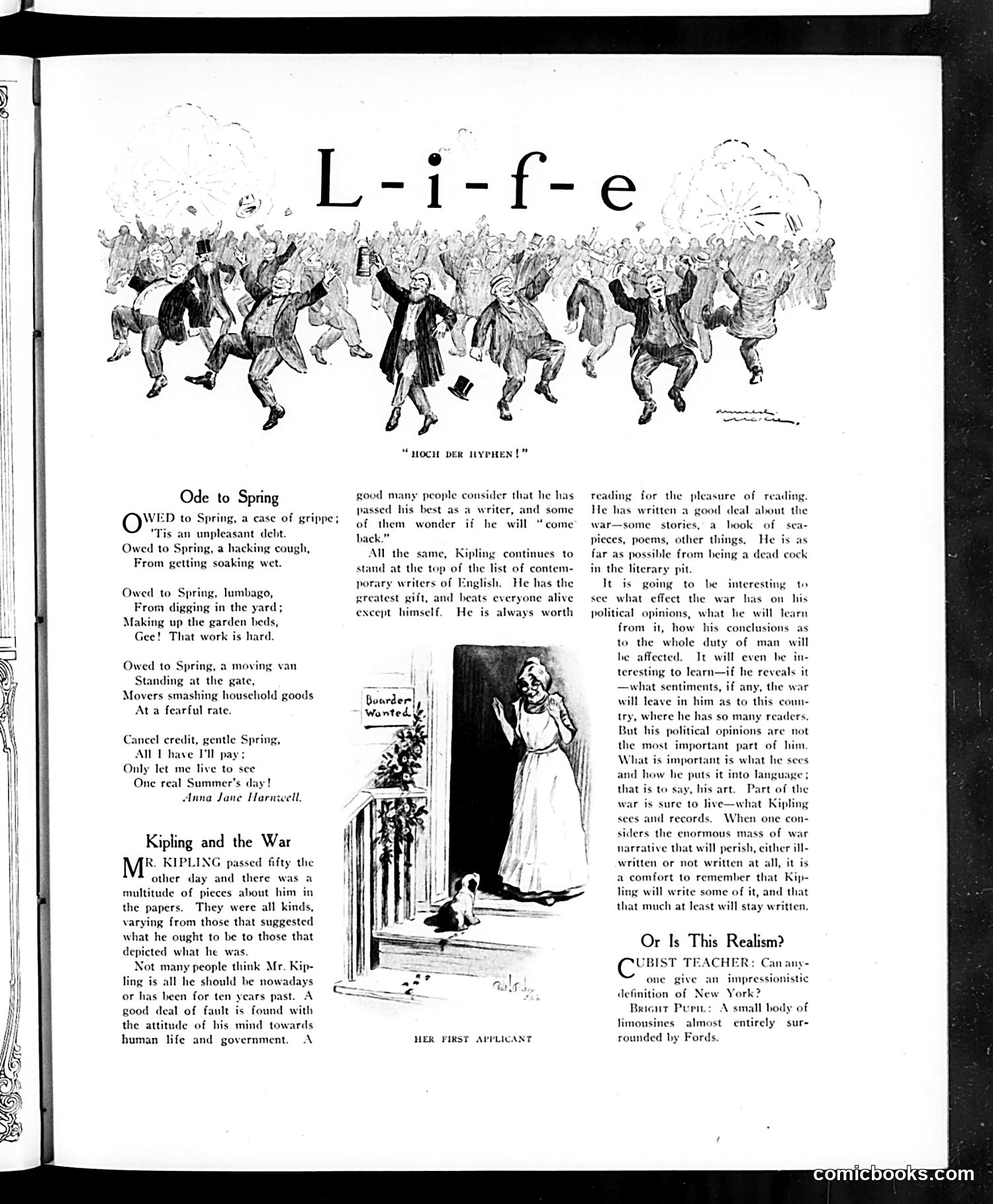
This page from *Life* magazine features commentary on writer Rudyard Kipling's response to World War I. The article "Kipling and the War" discusses how Kipling's wartime writings—varying from realistic depictions to propagandistic pieces—have divided critical opinion. Some readers consider him past his prime as a writer, while others acknowledge his continued literary importance. The "Ode to Spring" by Anna Jane Harnwell is a humorous poem listing debts owed to spring (unpaid bills, garden work, household goods). The cartoon showing a woman labeled "HER FIRST APPLICANT" with a "Boarder Wanted" sign appears to satirize housing shortages or economic difficulties, likely wartime-related. The bottom section "Or Is This Realism?" presents a brief cubist/impressionist teaching joke about New York definitions.
📄 Transcribed text from this page (OCR, searchable)
Machine-transcribed from the original scan — historical spelling and the odd misread are preserved.
Ode to Spring D to Spring, a case of grippe; 1 unpleasant debt. Owed to Spring, a hacking cough, From getting soaking wet. Owed to Spring, lumbago, From digging in the yard; Making up the garden beds, Gee! That work is hard. Owed to Spring, a moving van Standing at the gate, Movers smashing household goods Ata fearful rate. Cancel credit, gentle Spring, ALT have I'll pay Only let me live to see One real Summer's day! Anna Jane Harnwell. Kipling and the War R. KIPLING passed fifty the other day and there was a multitude of pieces about him in the papers. They were all kinds, varying from those that suggested what he ought to be to those that depicted what he was. Not many people think Mr. Kip- ling is all he should be nowada or has been for ten S past. good deal of fault is found w the attitude of his mind towards human life and government. A “MOCH DER 1YPHEN !” nsider that he has writer, and some wonder if he will “come good many people passed his best as a of them back.” All the same, Kipling continues to stand at the top of the list of contem- porary writers of English. He has the greatest gift, and beats everyone alive except himself. He is always worth HER FIRST AVPLICANT reading for the pleasure of reading. He has written a good deal about the stories, a hook of pieces, poems, other things, He is as far as possible from being a dead cock in the literary pit. It is going to be interesting to see what effect the war political opinions, what he will learn from it, how his conclusions as to the whole duty of man_ will he affected. It will even he in- teresting to learn—if he reveals it —what sentiments, if any, the war will leave in him as to this coun- try, where he has so many readers. But his political opinions are not the most important part of him. What is important is what he sees and how he puts it into language ; that is to say, his art. Part of the war is sure to live—what Kipling When one con- siders the enormous mass of war rative that will perish, either ill- written or not written at all, it is a comfort to remember that Kip- ling will write some of it, and that that much at least will stay written. war—some sea- s on his sees and records. Or Is This Realism? UBIST TEACHE one give an impressionistic definition of New York? Bricut Puri: A small body of limousines entirely sur- rounded by Fords. R: Can any- almost