
Life, 1916-02-17 · page 24 of 52
Life — February 17, 1916 — page 24: what you’re looking at
What you’re looking at
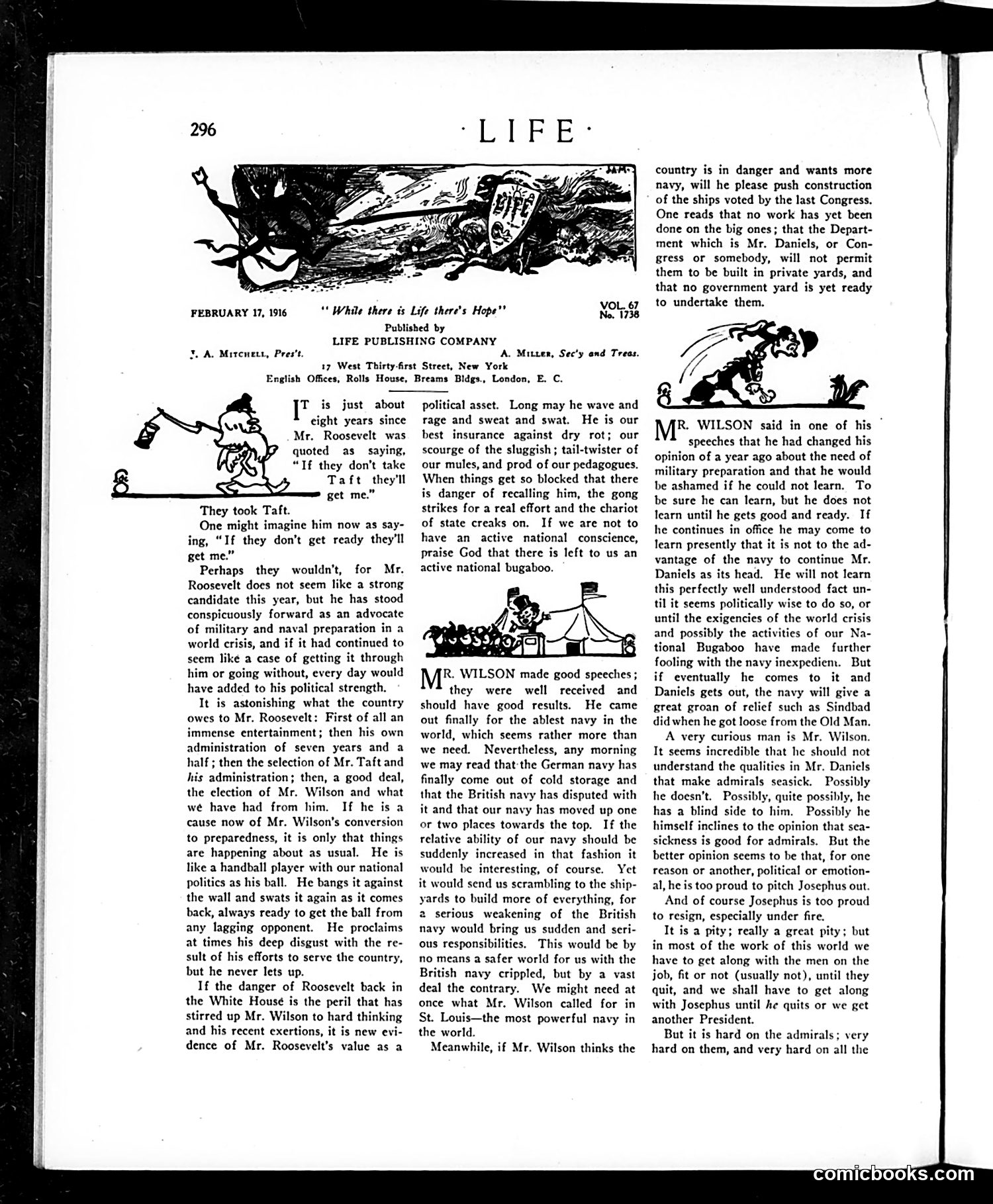
This Life magazine page satirizes former President Theodore Roosevelt's influence on current President Woodrow Wilson's military policy. The article argues that Roosevelt—despite losing the 1912 election to Wilson—has paradoxically strengthened Wilson's administration by serving as a constant "prod" toward preparedness. The cartoons (small illustrations with captions) depict Roosevelt as a forceful figure who keeps the nation's politics in motion, "banging" ideas around like a handball player. The text suggests Roosevelt's aggressive advocacy for naval expansion has inadvertently pushed the hesitant Wilson toward endorsing military buildup. The satirical point: Roosevelt remains a powerful political force even in opposition, effectively driving policy through contrarian pressure. The author also critiques Wilson's Secretary of the Navy, Josephus Daniels, for failing to actually *build* the ships Congress authorized—suggesting talk of preparedness without action.
📄 Transcribed text from this page (OCR, searchable)
Machine-transcribed from the original scan — historical spelling and the odd misread are preserved.
FEBRUARY 17, 1916 “\ While there is Life there's Hope" Published by LIFE PUBLISHING COMPANY 3. A. Mirenett, Pres’t. A. Mitten, Sec'y and Treas. 17 West Thirty-first Street, New York English Offices, Rolls House, Breams Bldgs, London, E. C. ‘i is just about eight years since Mr. Roosevelt was quoted as saying, “If they don’t take Taft they'll get me.” They took Taft. One might imagine him now as say- ing, “If they don’t get ready they'll get me.” Perhaps they wouldn't, for Mr. Roosevelt does not seem like a strong candidate this year, but he has stood conspicuously forward as an advocate of military and naval preparation in a world crisis, and if it had continued to seem like a case of getting it through him or going without, every day would have added to his political strength. It is astonishing what the country owes to Mr. Roosevelt: First of all an immense entertainment; then his own administration of seven years and a half; then the selection of Mr. Taft and his administration; then, a good deal, the election of Mr. Wilson and what wé have had from him. If he is a cause now of Mr. Wilson's conversion to preparedness, it is only that things are happening about as usual. He is like a handball player with our national politics as his ball. He bangs it against the wall and swats it again as it comes back, always ready to get the ball from any lagging opponent. He proclaims at times his deep disgust with the re- sult of his efforts to serve the country, but he never lets up. If the danger of Roosevelt back in the White Hous¢ is the peril that has stirred up Mr. Wilson to hard thinking and his recent exertions, it is new evi- dence of Mr. Roosevelt’s value as a political asset. Long may he wave and rage and sweat and swat. He is our best insurance against dry rot; our scourge of the sluggish; tail-twister of our mules, and prod of our pedagogues. When things get so blocked that there is danger of recalling him, the gong strikes for a real effort and the chariot of state creaks on. If we are not to have an active national conscience, praise God that there is left to us an active national bugaboo. M* WILSON made good speeches ; they were well received and should have good results. He came out finally for the ablest navy in the world, which seems rather more than we need. Nevertheless, any morning we may read thatthe German navy has finally come out of cold storage and that the British navy has disputed with it and that our navy has moved up one or two places towards the top. If the relative ability of our navy should be suddenly increased in that fashion it would be interesting, of course. Yet it would send us scrambling to the ship- yards to build more of everything, for 2 serious weakening of the British navy would bring us sudden and seri- ous responsibilities. This would be by no means a safer world for us with the British navy crippled, but by a vast deal the contrary. We might need at once what Mr. Wilson called for in St. Louis—the most powerful navy in the world. Meanwhile, if Mr. Wilson thinks the country is in danger and wants more navy, will he please push construction of the ships voted by the last Congress. One reads that no work has yet been done on the big ones; that the Depart- ment which is Mr. Daniels, or Con- gress or somebody, will not permit them to be built in private yards, and that no government yard is yet ready to undertake them. R. WILSON said in one of his ° speeches that he had changed his opinion of a year ago about the need of military preparation and that he would be ashamed if he could not learn. To be sure he can learn, but he does not learn until he gets good and ready. If he continues in office he may come to learn presently that it is not to the ad- vantage of the navy to continue Mr. Daniels as its head. He will not learn this perfectly well understood fact un- til it seems politically wise to do so, or until the exigencies of the world crisis and possibly the activities of our Na- tional Bugaboo have made further fooling with the navy inexpediem. But if eventually he comes to it and Daniels gets out, the navy will give a great groan of relief such as Sindbad did when he got loose from the Old Man. A very curious man is Mr. Wilson. It seems incredible that he should not understand the qualities in Mr. Daniels that make admirals seasick. Possibly he doesn’t. Possibly, quite possibly, he has a blind side to him. Possibly he himself inclines to the opinion that sea- sickness is good for admirals. But the better opinion seems to be that, for one reason or another, political or emotion- al, he is too proud to pitch Josephus out. And of course Josephus is too proud to resign, especially under fire. It is a pity; really a great pity; but in most of the work of this world we have to get along with the men on the job, fit or not (usually not), until they quit, and we shall have to get along with Josephus until he quits or we get another President. But it is hard on the admirals; very hard on them, and very hard on all the