
Life, 1916-02-17 · page 35 of 52
Life — February 17, 1916 — page 35: what you’re looking at
What you’re looking at
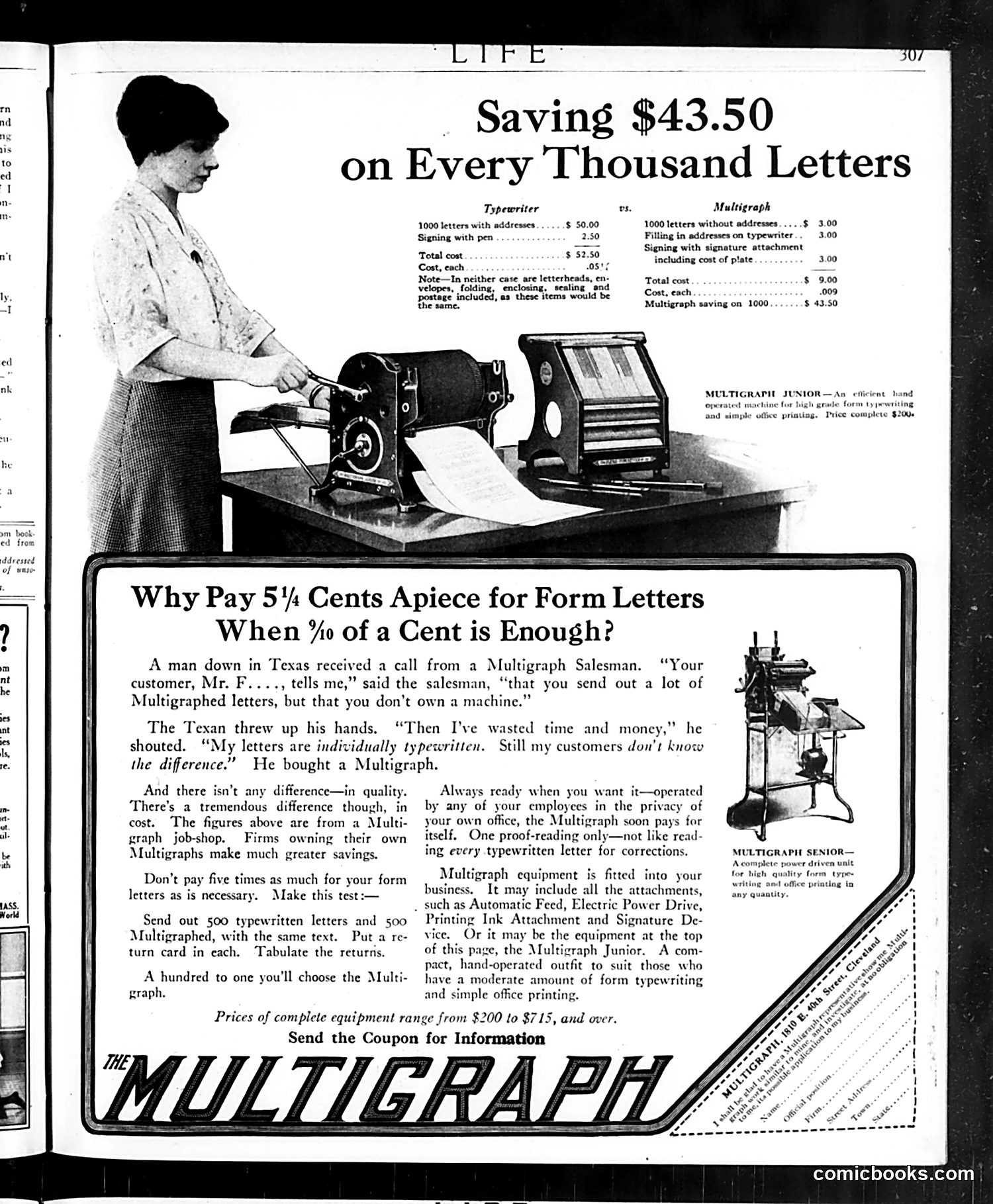
This is primarily a **product advertisement**, not satire or political commentary. It promotes the Multigraph—an early duplicating/printing machine—by comparing its cost-efficiency to typewritten form letters. **The Setup:** A Texas businessman learns he's been wasting money sending individually typewritten form letters when customers can't tell the difference anyway. The implicit joke: his efforts to appear personal are pointless. **The Sales Pitch:** The ad includes cost comparisons showing typewritten letters cost 5.75 cents each versus 0.90 cents via Multigraph—a $43.50 savings per thousand letters. **The Social Context:** This reflects early-20th-century business efficiency culture, where automation and standardization were marketed as progressive solutions. The woman operator in the image was typical advertising imagery for office machinery of this era. **No satire is present**—this is straightforward commercial persuasion using humor (the Texan's reaction) to make a business case for purchasing equipment.
📄 Transcribed text from this page (OCR, searchable)
Machine-transcribed from the original scan — historical spelling and the odd misread are preserved.
rn nd ne is to ed nm nt 1000 letters with addresses, Signing with pen Total cost Cost, each Note—In neither case are letterheads, en- Total cost velopes, folding, enclosing, sealing ‘and postage included, as these items would be the same. _ Saving $43.50 on Every Thousand Letters Typewriter vs. Cost, each m book: ed from dressed of wase Why Pay 5'4 Cents Apiece for Form Letters When %o of a Cent is Enough? A man down in Texas received a call from a Multigraph Salesman. “Your customer, Mr. F...., tells me,” said the salesman, “that you send out a lot of Multigraphed letters, but that you don’t own a machine.” The Texan threw up his hands. “Then I’ve wasted time and money,” he shouted. ‘My letters are individually typewritten. Still my customers don't know the difference.’ He bought a Multigraph. And there isn’t any difference—in quality. There’s a tremendous difference though, in cost. The figures above are from a Multi- graph job-shop. Firms owning their own Multigraphs make much greater savings. Don't pay five times as much for your form letters as is necessary. Make this test :— Send out 500 typewritten letters and 500 Multigraphed, with the same text. Put a re- turn card in each. Tabulate the returns. A hundred to one you'll choose the Multi- graph. . such as Automatic Feed, Electric Power Drive, Always ready when you want it—operated by any of your employees in the privacy of your own office, the Multigraph soon pays for itself. One proof-reading only—not like read- ing every typewritten letter for corrections. Multigraph equipment is fitted into your business. It may include all the attachments Printing Ink Attachment and Signature De- vice. Or it may be the equipment at the top of this page, the Multigraph Junior. A com- pact, hand-operated outfit to suit those who have a moderate amount of form typewriting and simple office printing. Prices of complete equipment range from $200 to $715, and over. Send the Coupon for Information Multigraph 1000 letters without addresses.....$ 3.00 Filling in addresses on typewriter... 3.00 Signing with signati including cost of plate attachment Multigraph saving on 1000 MULTIGRAPH SENIOR— Acomplete power driven unit for high quality form type 1 office printing in any quantity. comicbooks.com