
A complete issue · 52 pages · 1914
Life — June 4, 1914
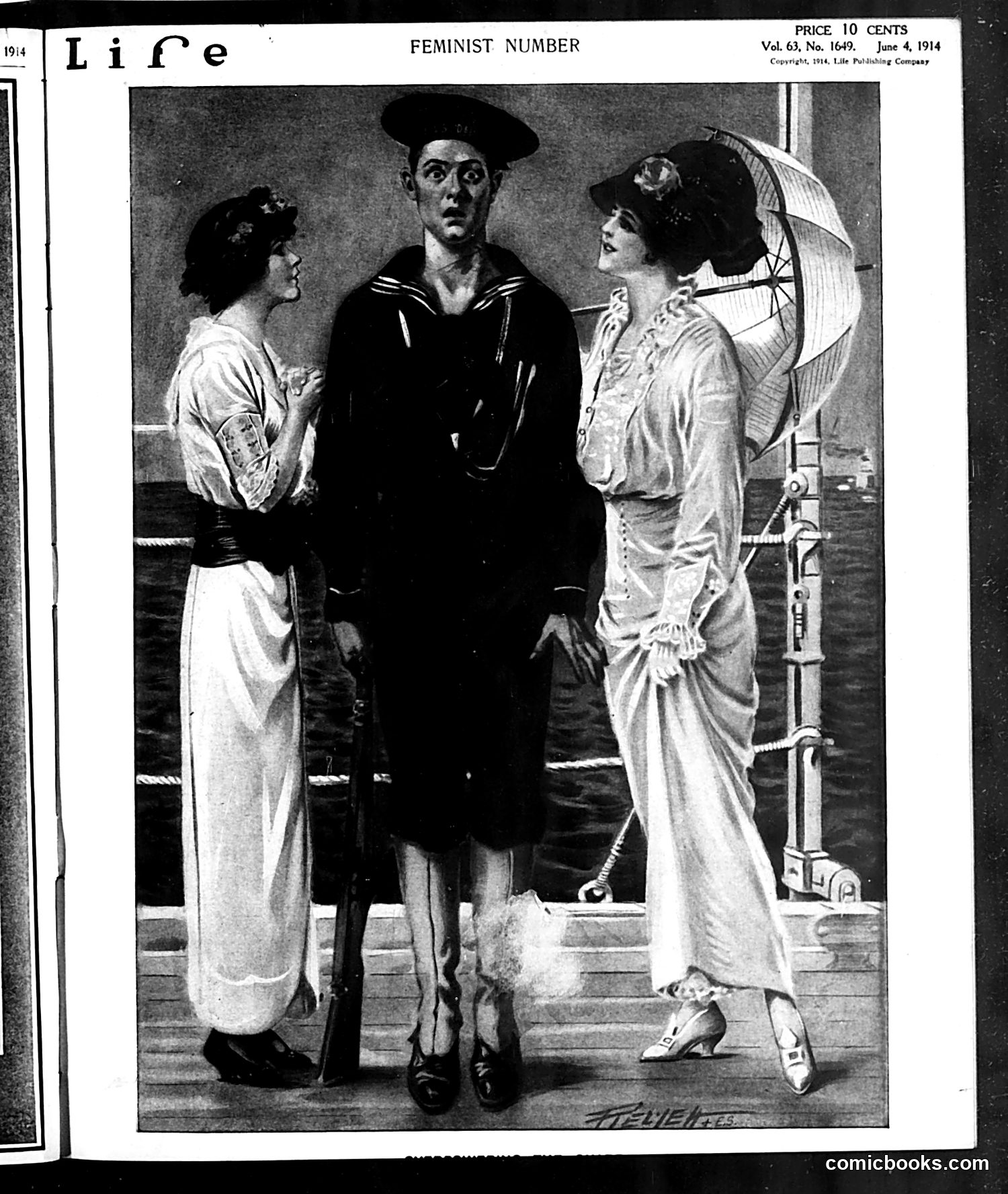
This is the cover of Life magazine's "Feminist Number" from June 4, 1914, priced at 10 cents. The illustration shows a sailor (center) flanked by two women in early-1910s dress. The women appear to be flirting with or vying for his attention—one holds a parasol, suggesting leisure and courtship. The satire likely mocks the feminist movement by depicting women as still primarily focused on attracting men, undermining claims of independence and equality. The "helpless" sailor caught between competing female attention ironizes both feminist aspirations and traditional gender dynamics. This reflects the magazine's skepticism toward women's rights activism during the suffrage era, suggesting feminists were hypocritical or that female liberation was incompatible with conventional femininity and romantic pursuit.
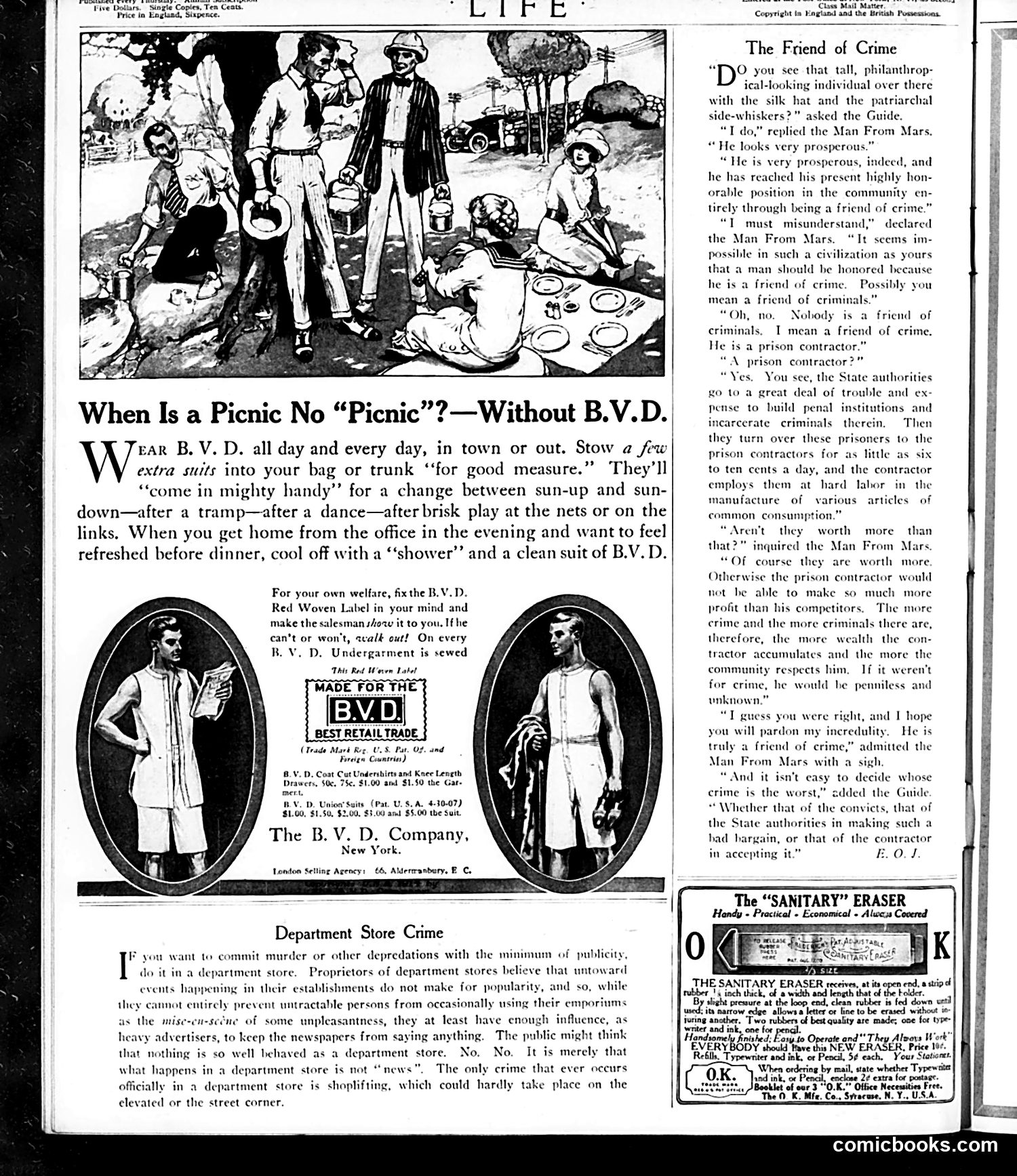
This page contains **two distinct pieces**: **Upper section**: A B.V.D. (men's underwear) advertisement using humor about picnics. The ad jokes that proper undergarments make outdoor activities more comfortable, particularly "after a tramp—after a dance." It's straightforward product marketing disguised as lifestyle advice. **Lower section**: A satirical piece titled "The Friend of Crime" features dialogue between a "Guide" and a "Man From Mars" discussing prison contractors—private companies hired to build and operate penal institutions. The satire critiques how these contractors profit from crime rates: the more criminals imprisoned, the wealthier the contractor becomes. The piece suggests this creates perverse incentives, as the contractor benefits from keeping crime high rather than reducing it. This appears to satirize prison privatization practices and their moral implications.
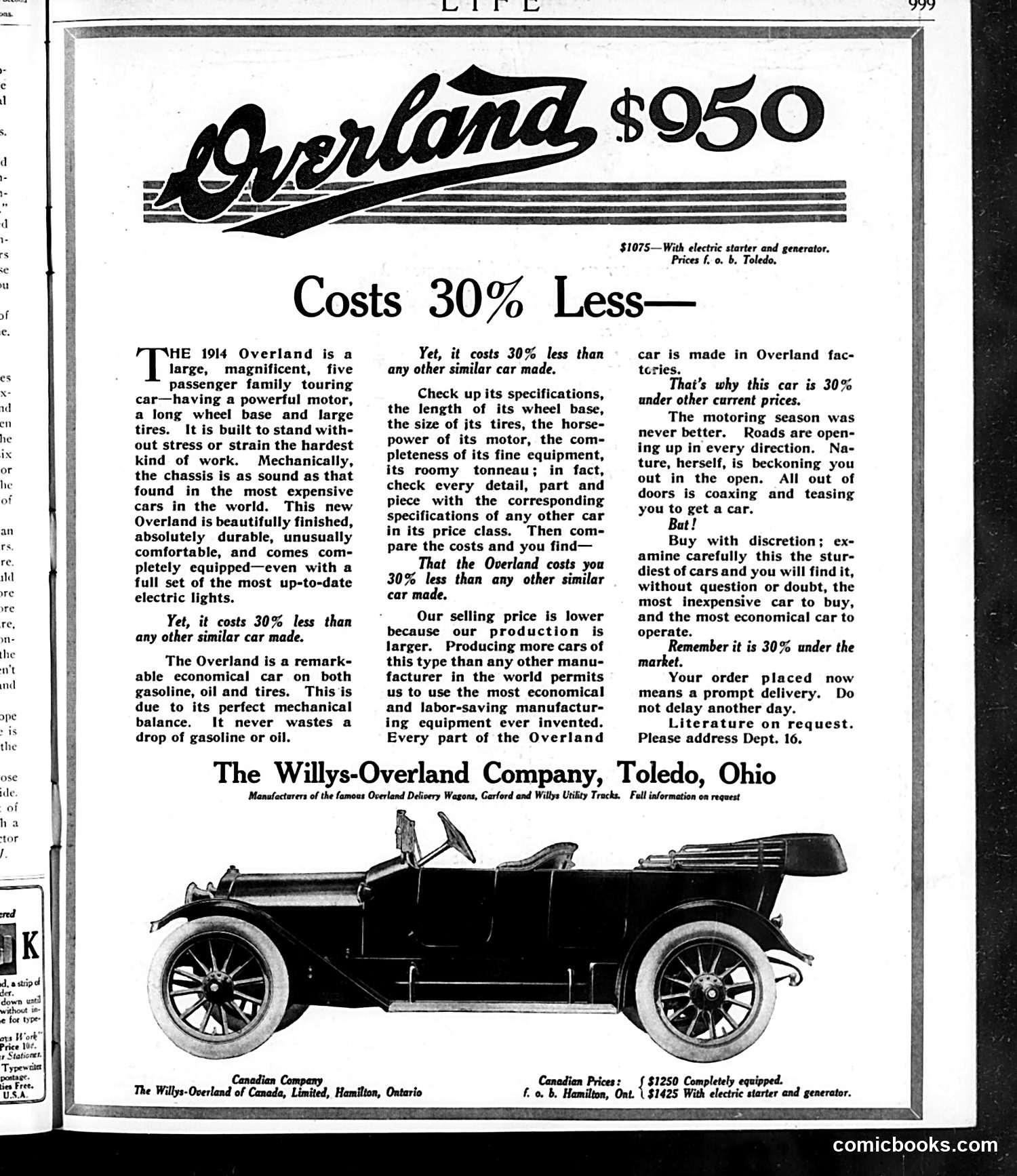
This is **not a cartoon or satire page** — it's a **straightforward automobile advertisement** from Life magazine. The page promotes the 1914 Overland touring car, priced at $950. The ad's central claim is that the Overland "Costs 30% Less" than comparable vehicles while offering equivalent specifications and features. The company emphasizes economical manufacturing through high-volume production, mechanical efficiency, and competitive pricing. The image shows a side-view illustration of the open-air touring car with characteristic early-1900s styling: spoke wheels, minimal enclosed cabin, and prominent headlights. This represents standard early automotive marketing — comparing value and features to justify purchase decisions — rather than political or social satire. Life magazine included such advertisements alongside its editorial content.
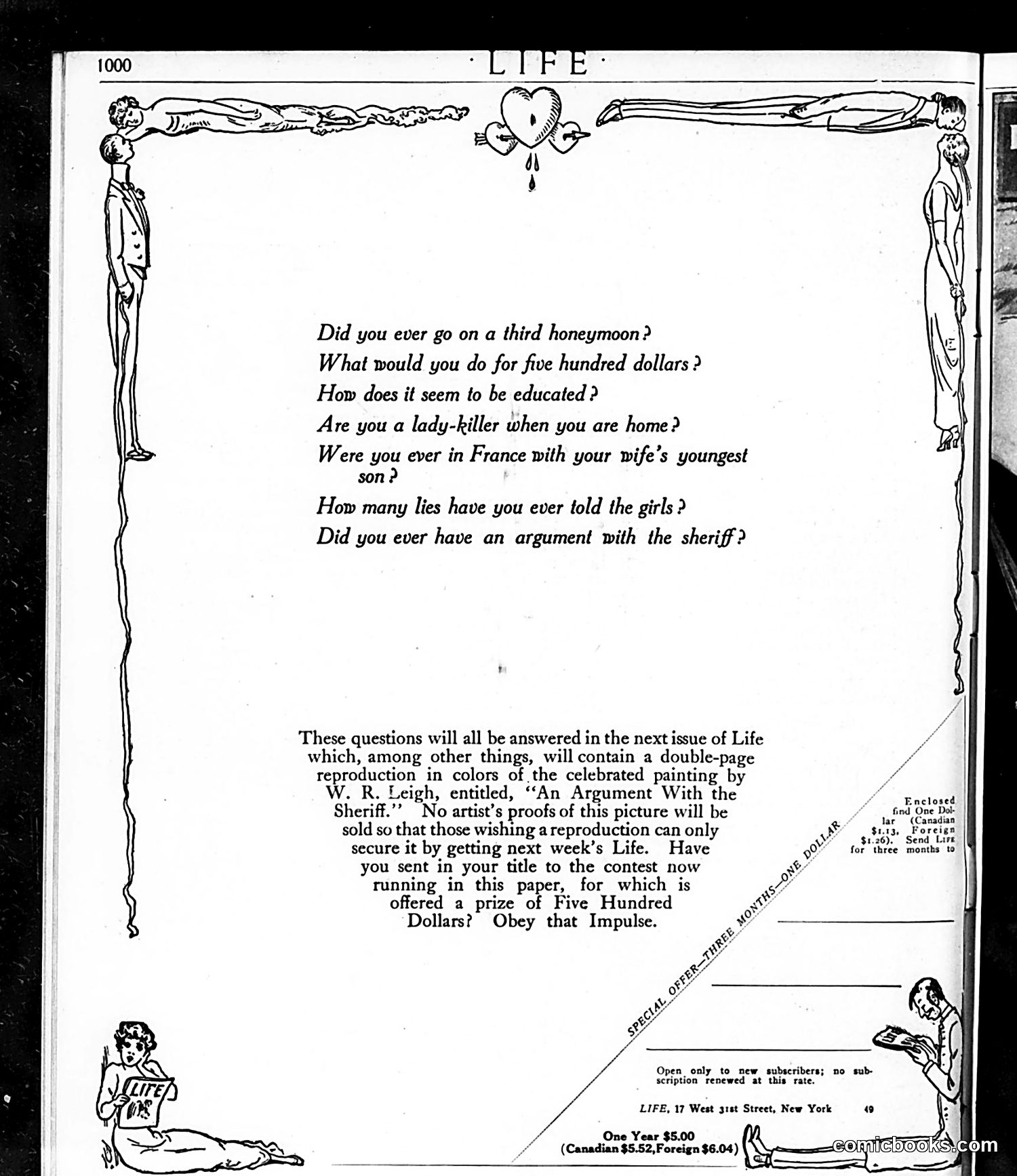
This appears to be a **contest announcement and teaser page** rather than a political cartoon. The central text poses seven provocative questions about an unnamed man's personal life—including infidelity ("lady-killer"), dishonesty, and conflicts with authority ("argument with the sheriff"). The page announces these questions will be answered in the next issue through a **double-page reproduction** of W.R. Leigh's painting titled *"An Argument With the Sheriff."* The format is a **marketing device**: readers must buy next week's issue to see the painting and learn the answers. A $500 prize contest is mentioned for submitting titles. The decorative border features classical nude figures, typical of Life's aesthetic approach. This is essentially **paid advertising disguised as editorial content**, using curiosity and satire to drive circulation.
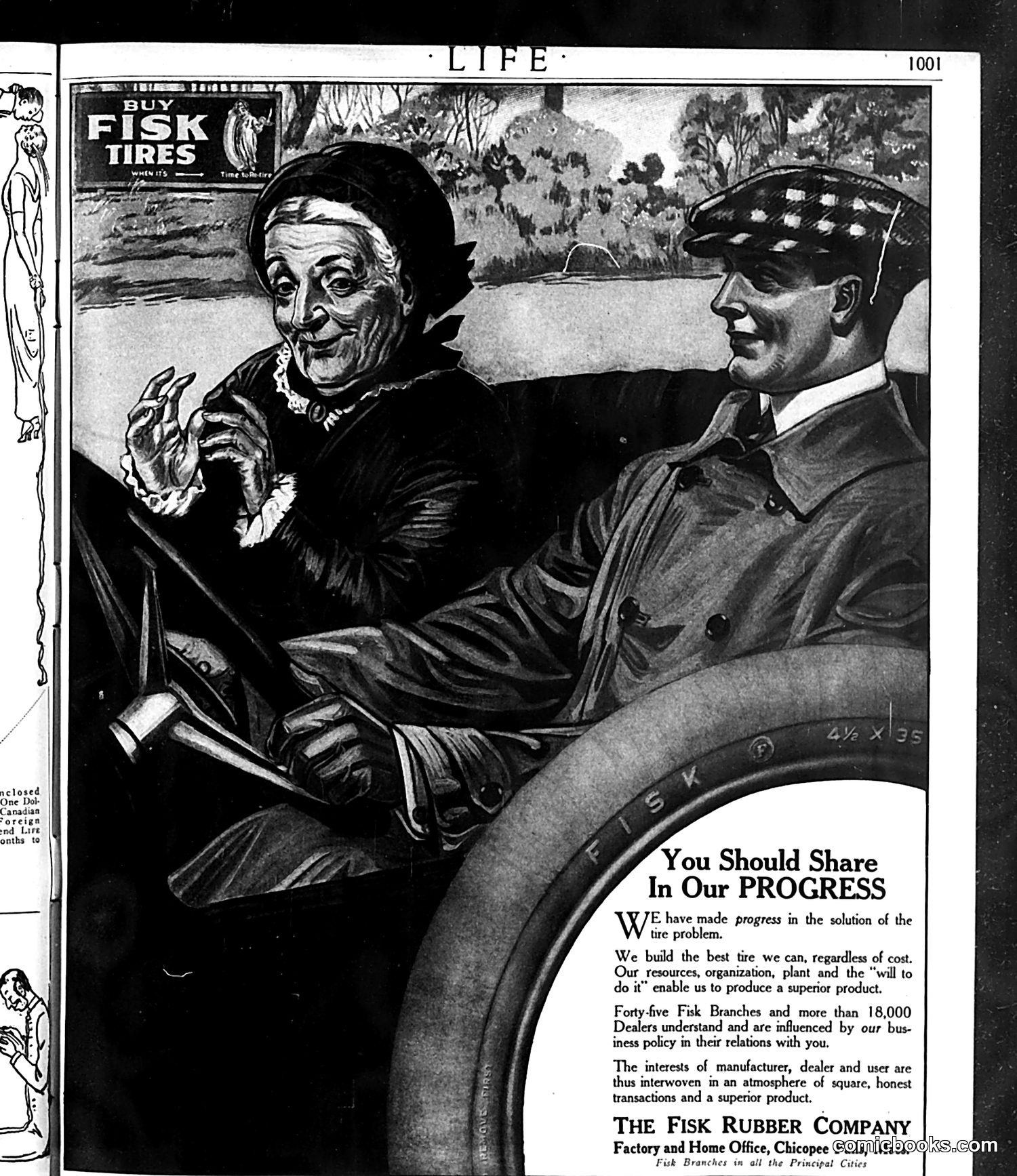
This page is primarily a **Fisk Rubber Company advertisement**, not political satire. The image shows two figures in an automobile: an elderly woman with exaggerated features and a driver. The caricatured woman appears to be a stereotyped "old lady" character—a common advertising trope of the era—rather than a specific political figure. The ad's headline "You Should Share In Our PROGRESS" emphasizes Fisk's manufacturing improvements and distribution network (45 branches, 18,000 dealers). The accompanying text promotes their tire quality and business philosophy. While the caricature style reflects period advertising conventions, this is fundamentally a commercial message rather than political commentary. The humor relies on generic character types rather than targeting identifiable public figures.
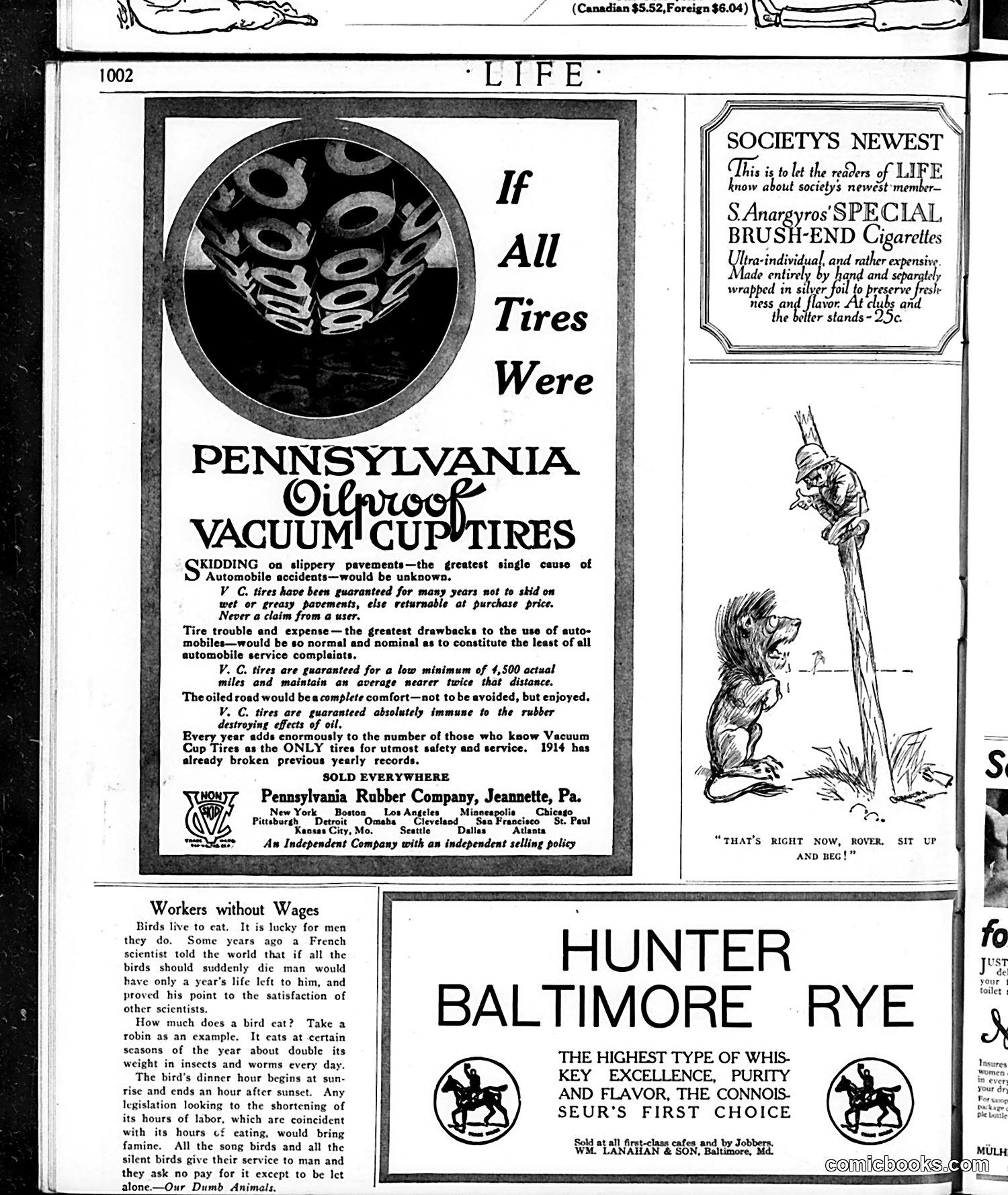
This page is primarily **advertising**, not political satire. The main content includes: 1. **Pennsylvania Vacuum Cup Tires ad** (left): A hypothetical advertisement imagining if all tires were this brand, emphasizing safety on slippery pavements and reduced accidents. 2. **S Anargyros Cigarettes ad** (top right): Promoting hand-rolled, individually-wrapped luxury cigarettes at 25 cents. 3. **Cartoon** (center right): A humorous drawing captioned "That's right, now, rover. Sit up and beg!" shows a dog begging. This appears to be unrelated social humor rather than political commentary. 4. **Hunter Baltimore Rye ad** (bottom): Whiskey advertisement emphasizing quality. 5. **"Workers without Wages"** (lower left): A brief satirical piece about birds as "workers" unpaid except for survival—light social commentary on labor rather than political critique.
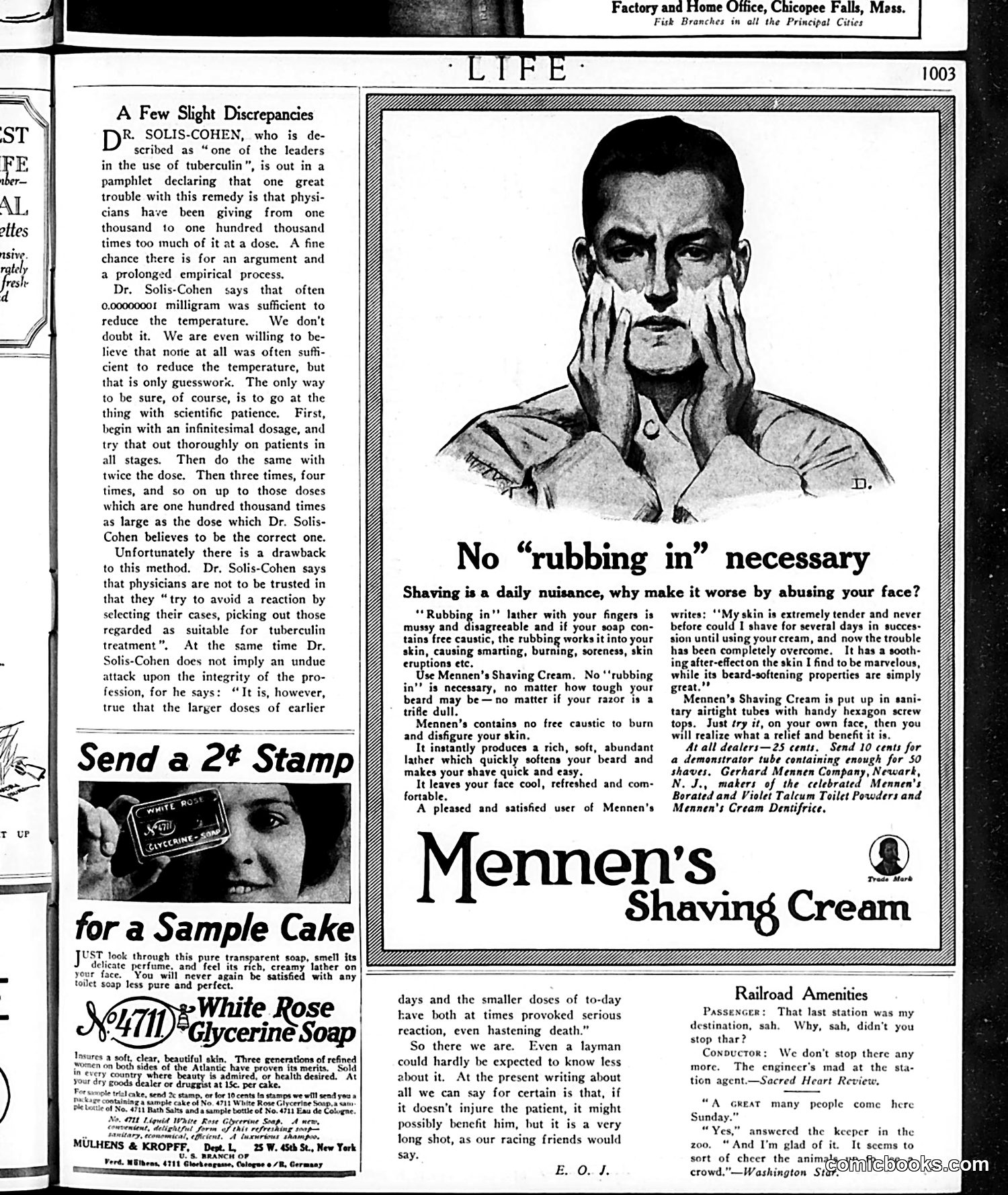
This page is primarily **advertising and medical commentary**, not political satire. The main content includes: 1. **"A Few Slight Discrepancies"** — An article critiquing Dr. Solis-Cohen's tuberculosis treatment using tuberculin, questioning whether physicians are administering unsafe dosages. This reflects early-1900s medical debate about dosing protocols. 2. **Mennen's Shaving Cream advertisement** — Features a portrait of a man with prominent facial hair, promoting shaving cream as eliminating the need for "rubbing in." This addresses a common consumer complaint about shaving products of that era. 3. **White Rose Glycerine Soap advertisement** — Standard period product promotion. 4. **"Railroad Amenities"** — A brief humorous dialogue about station amenities. The page reflects **turn-of-the-century concerns about medical safety and consumer product effectiveness**, with no significant political commentary visible.
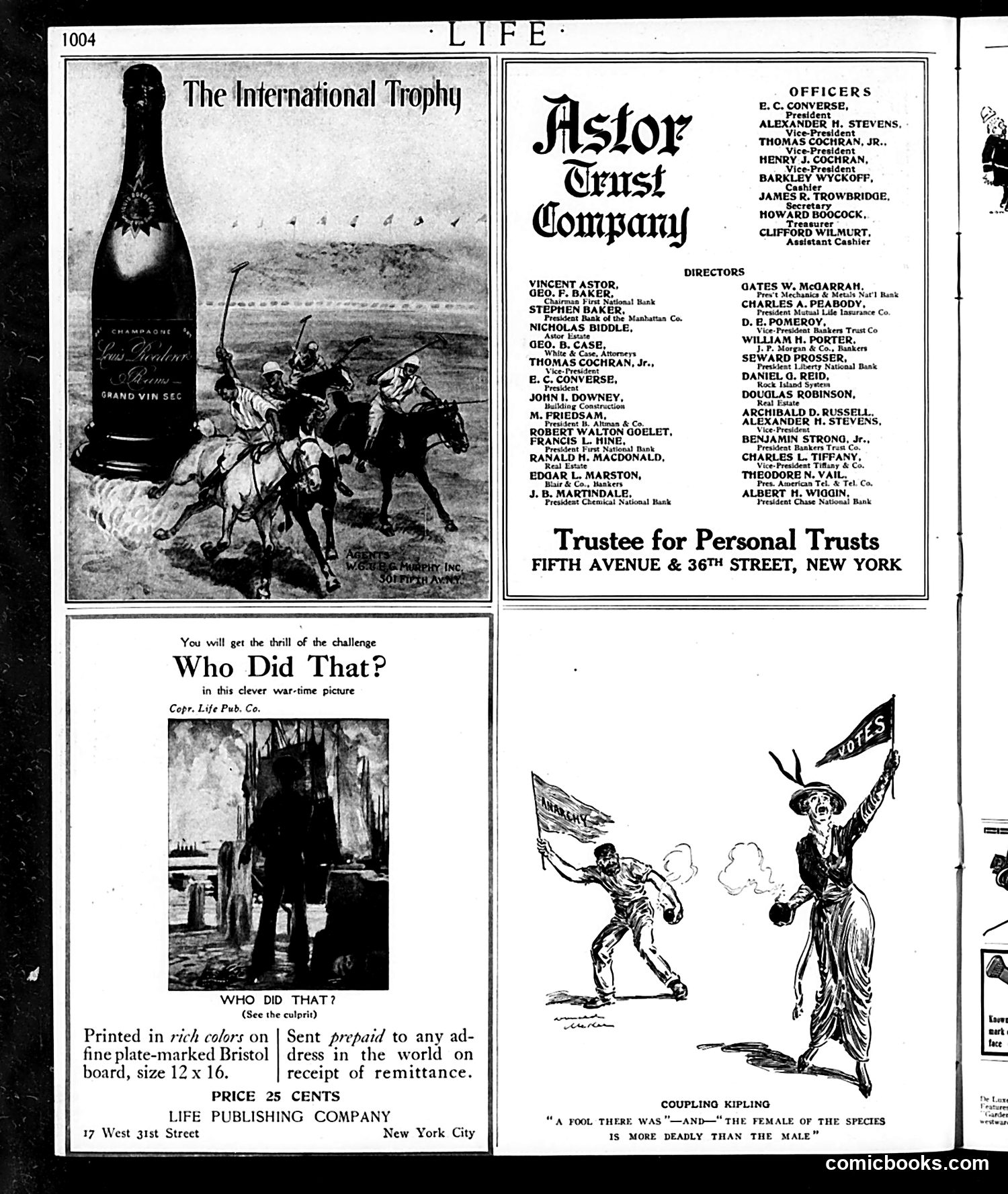
This page contains mostly **advertisements and corporate listings** rather than political cartoons. The top features a **Champagne ad** for "Pol Roger" featuring horses and riders in a landscape. The **Astor Trust Company** occupies significant space, listing officers and directors—a straightforward corporate advertisement. The only cartoon content is at bottom right, credited to **Rudyard Kipling**, showing a woman holding "Votes" flags while a man gestures below. The caption reads: "A FOOL THERE WAS"—AND—"THE FEMALE OF THE SPECIES IS MORE DEADLY THAN THE MALE." This appears to be **anti-suffrage satire**, mocking women's voting rights by invoking Kipling's famous misogynistic phrase. The "Who Did That?" section is an interactive puzzle game, not political commentary.
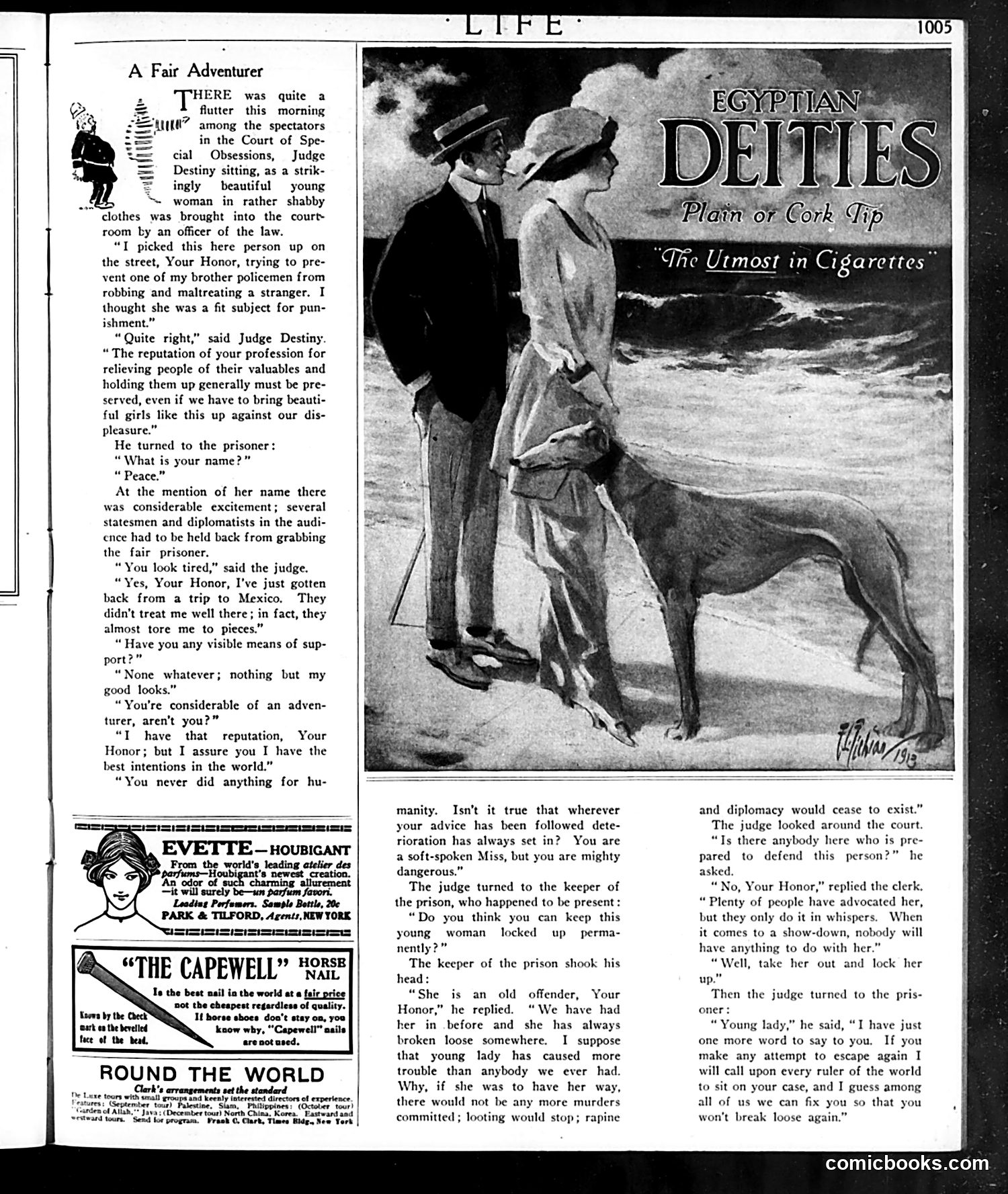
This page contains a short story titled "A Fair Adventurer" about a woman brought before Judge Destiny for alleged theft. The narrative satirizes both the justice system and the woman's defense—she claims to be a professional thief with good intentions, stealing from the wealthy to help the poor. The judge and court officials find her charming rather than criminal. The advertisements below include promotions for cigarettes ("Egyptian Deities"), a horse nail product, and theatrical performances. The satire appears to mock both the romanticization of crime and the inconsistent application of justice, where an attractive female defendant receives leniency that others wouldn't. It's social commentary on class, gender, and judicial bias in early 20th-century America.
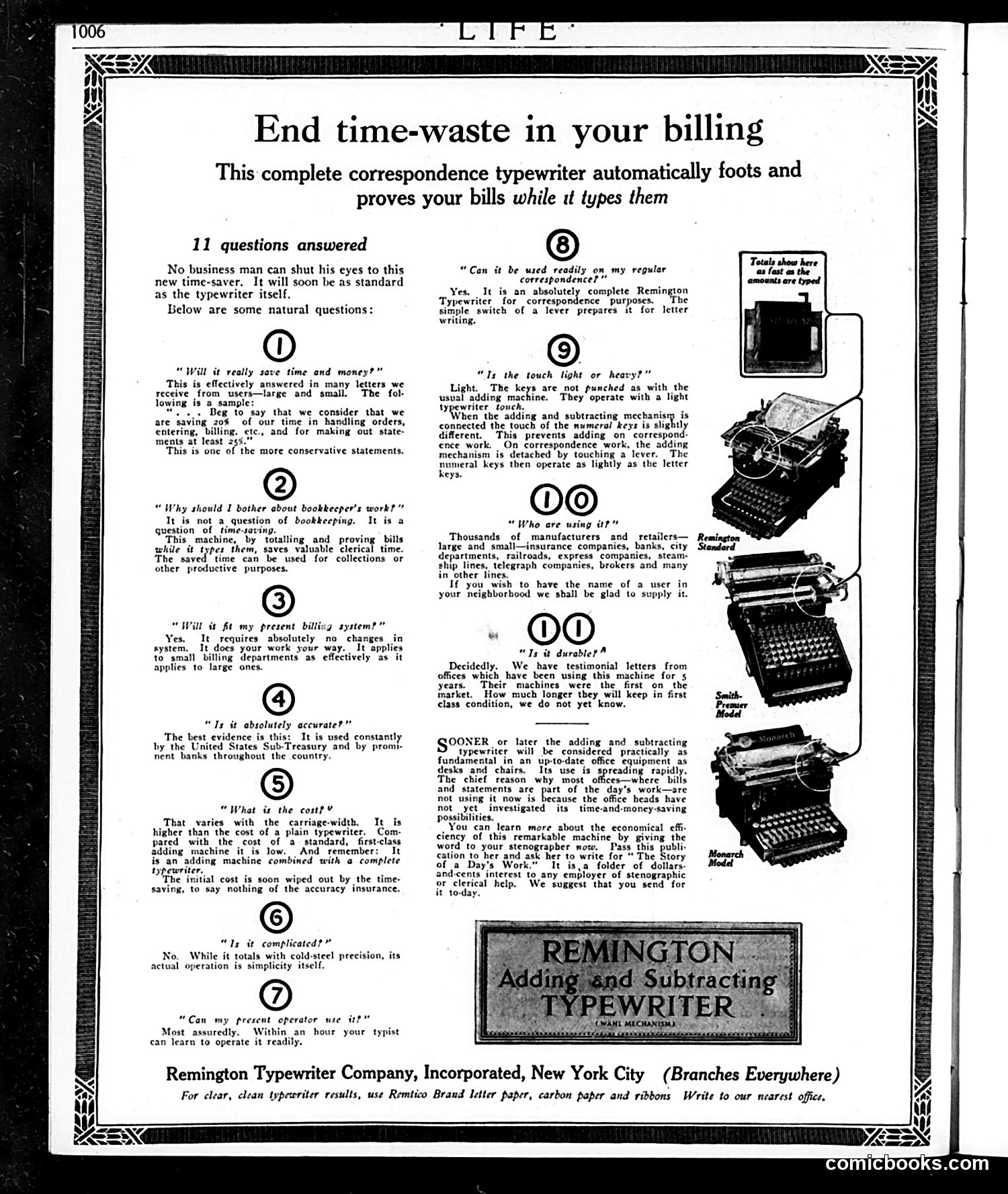
This is a **full-page advertisement** for the Remington Adding and Subtracting Typewriter, not a cartoon or satirical content. The ad uses a Q&A format addressing 11 business objections about the machine. Key selling points emphasized: - Saves time and money in billing/bookkeeping - Works with existing accounting systems - Operates with light touch (like regular typewriters) - Durable and reliable (testimonials mentioned) - Affordable and becoming standard office equipment The right side shows product photographs of different typewriter models. The ad frames this device as essential modern office technology—positioning it as inevitable ("SOONER or later the adding and subtracting typewriter will be considered practically fundamental"). For modern readers: this represents early 20th-century business automation marketing, emphasizing efficiency gains to justify equipment costs.
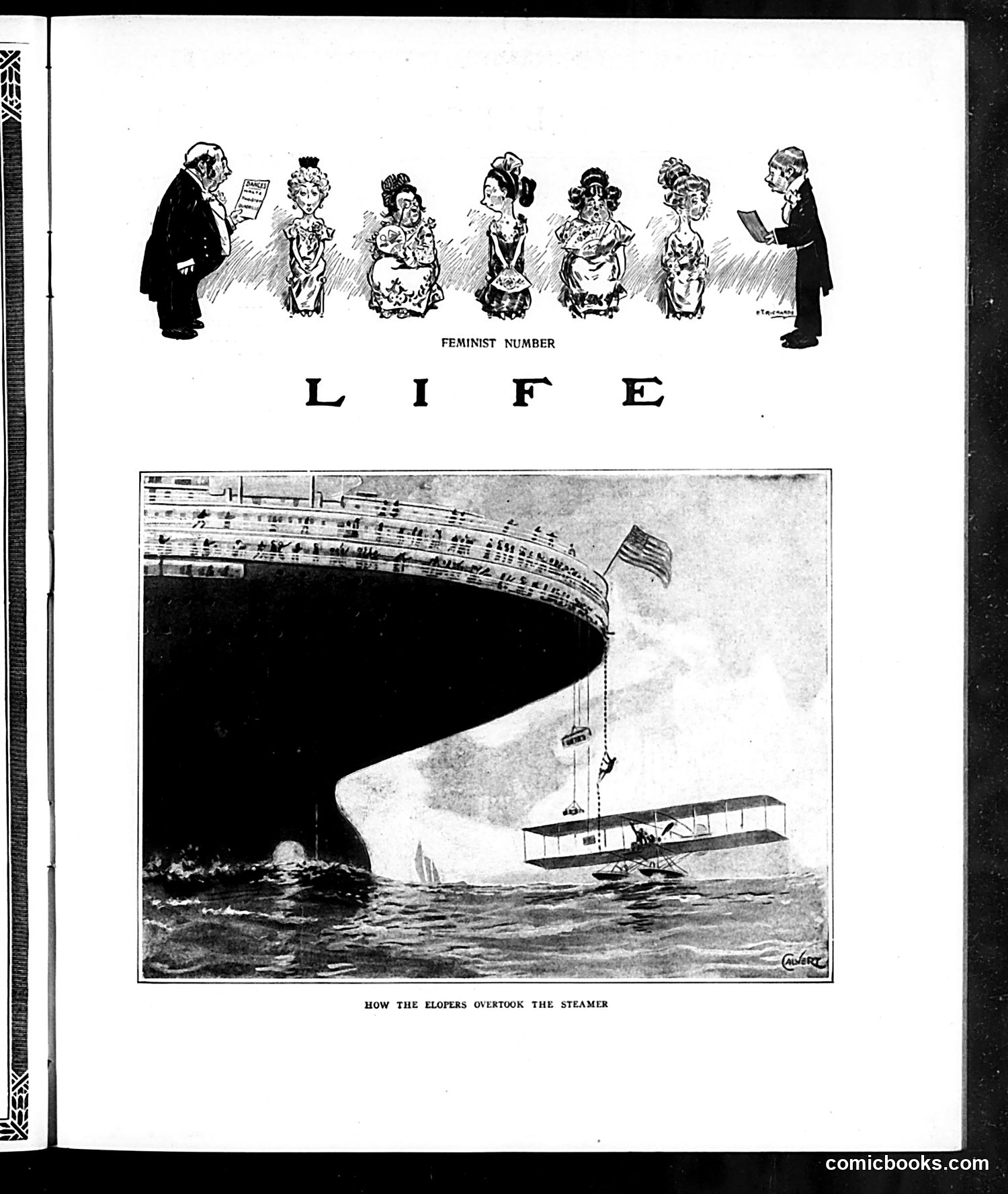
This is a satirical "Feminist Number" page from Life magazine featuring two cartoons about women's activism and elopement. **Top illustration:** Six women in elaborate dress are flanked by two men examining documents. This appears to mock feminist movements of the early 20th century, caricaturing women activists through exaggerated clothing and styling. **Bottom cartoon ("How the Elopers Overtook the Steamer"):** An early airplane carrying eloping couples flies past a large ocean steamer. This satirizes the dramatic speed of new aviation technology compared to traditional ship travel, likely referencing contemporary elopement scandals or the intersection of modern technology with romantic escapades—a popular satirical theme of the era. The page's overall tone mocks both feminist movements and the chaos created by modern innovation.
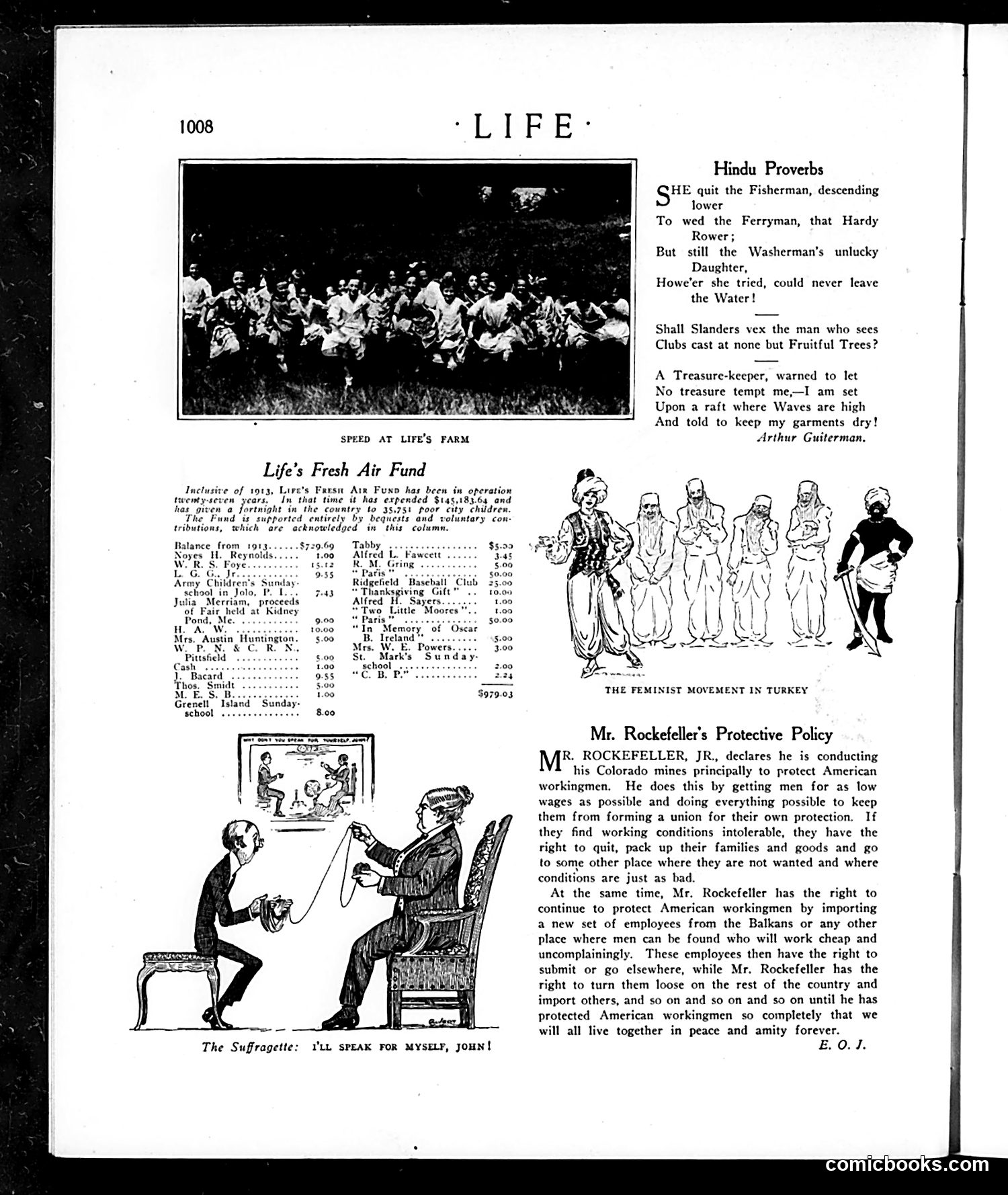
The cartoon titled "The Suffragette: I'LL SPEAK FOR MYSELF, JOHN!" depicts a woman confronting a man, satirizing the women's suffrage movement. The woman appears to be asserting her right to political voice independent of male representation—a direct jab at anti-suffrage arguments that women didn't need voting rights because men represented their interests. The accompanying article "Mr. Rockefeller's Protective Policy" critiques John D. Rockefeller Jr.'s labor practices in Colorado mines. The satire suggests his "protective" measures—keeping wages low and discouraging unionization—actually exploit workers while claiming to prevent unrest. The ironic tone highlights the contradiction between paternalistic corporate rhetoric and exploitative reality. Both pieces represent early 20th-century Progressive Era concerns: women's political equality and workers' rights.
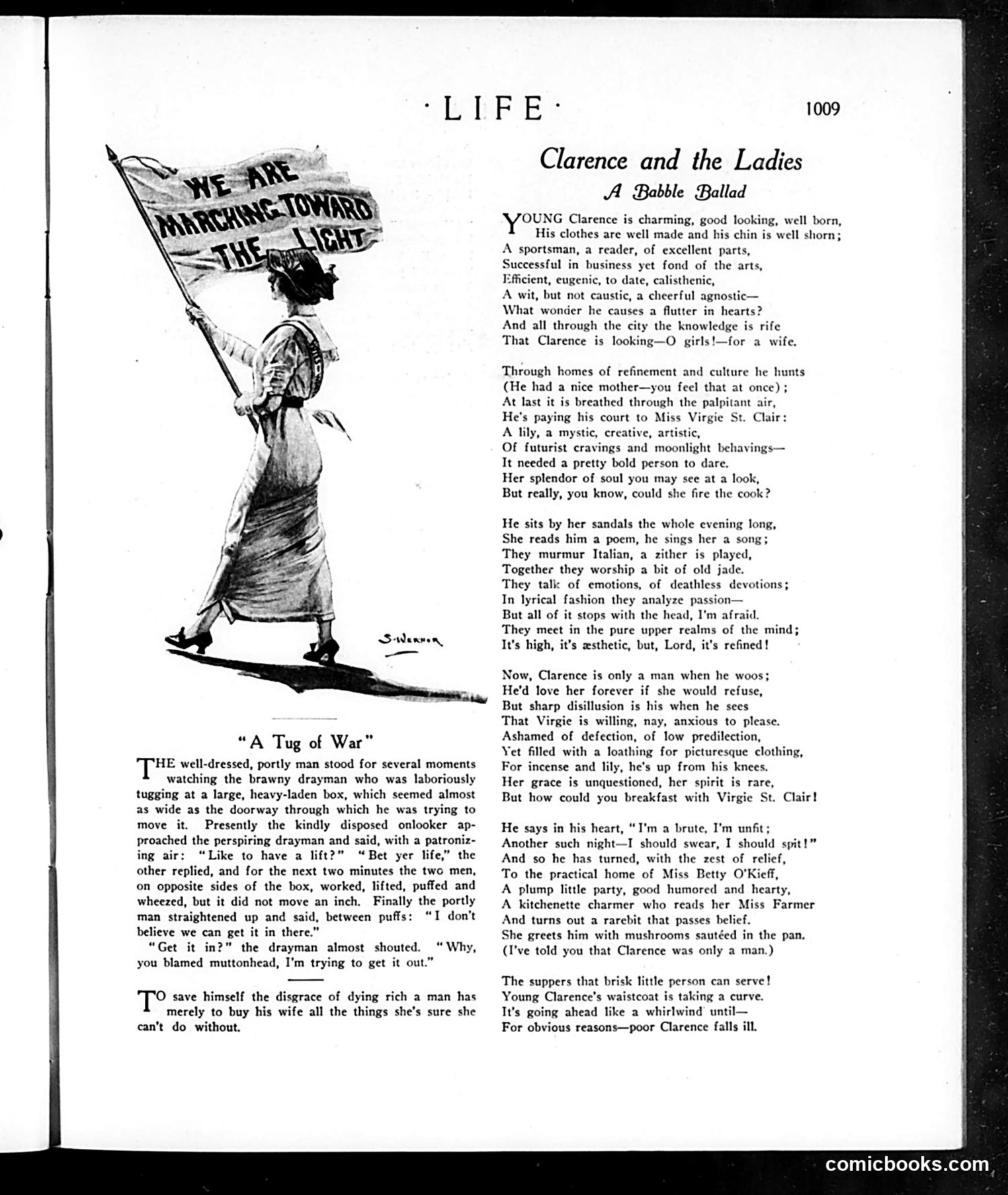
This cartoon satirizes the suffrage movement through a "tug of war" between a well-dressed man and a woman holding a banner reading "WE ARE BRINGING TOWARD THE LIGHT." The woman appears to be winning, pulling the reluctant man forward. The accompanying story "Clarence and the Ladies: A Babble Ballad" mocks a young man named Clarence who is pursued by women, particularly Miss Virgie St. Clair. The narrative suggests that women's assertiveness—whether through suffrage activism or romantic pursuit—is pulling men unwillingly along. The satire criticizes both the suffrage movement and women's increasing social agency as forceful and emasculating, positioning men as reluctant victims being dragged toward change against their will.
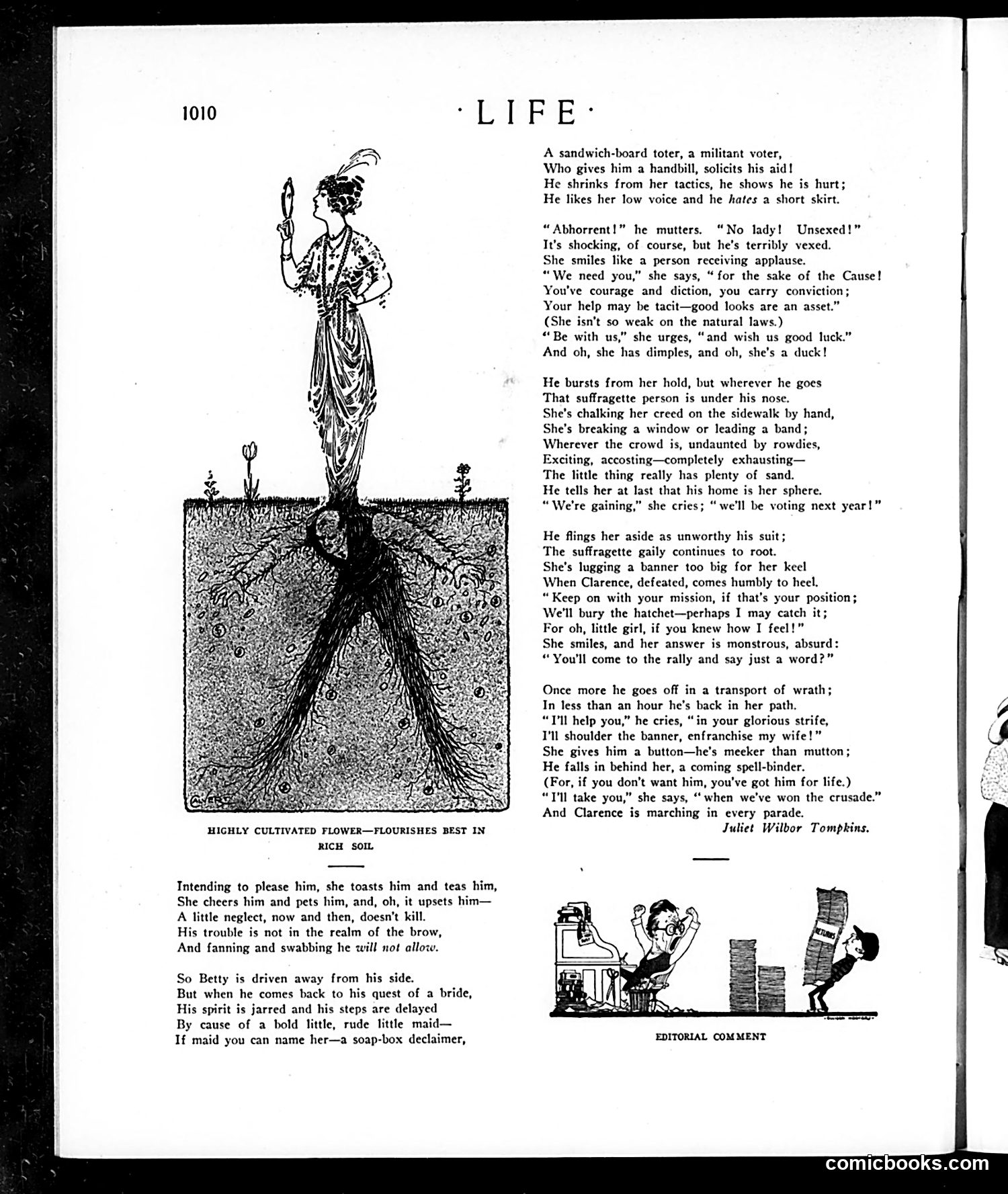
This is a satirical poem by Juliet Wilbor Tompkins about the friction between a male political activist and his suffragette wife. The central illustration—a cultivated flower with deep roots—symbolizes how "highly cultivated" women (like suffragettes) are grounded in conviction. The poem mocks their domestic conflict: he's a "militant voter" focused on politics; she's a suffragette obsessed with women's voting rights. He finds her activism embarrassing and overbearing ("sandwich-board toter"), but she's relentless, chalking her creed on sidewalks and carrying oversized banners. He eventually capitulates, agreeing to support her cause to restore peace. The satire cuts both ways—critiquing both his dismissive attitude toward women's suffrage and her single-minded, somewhat exhausting commitment. The couple represents the broader social debate over women's voting rights during the suffrage movement era.
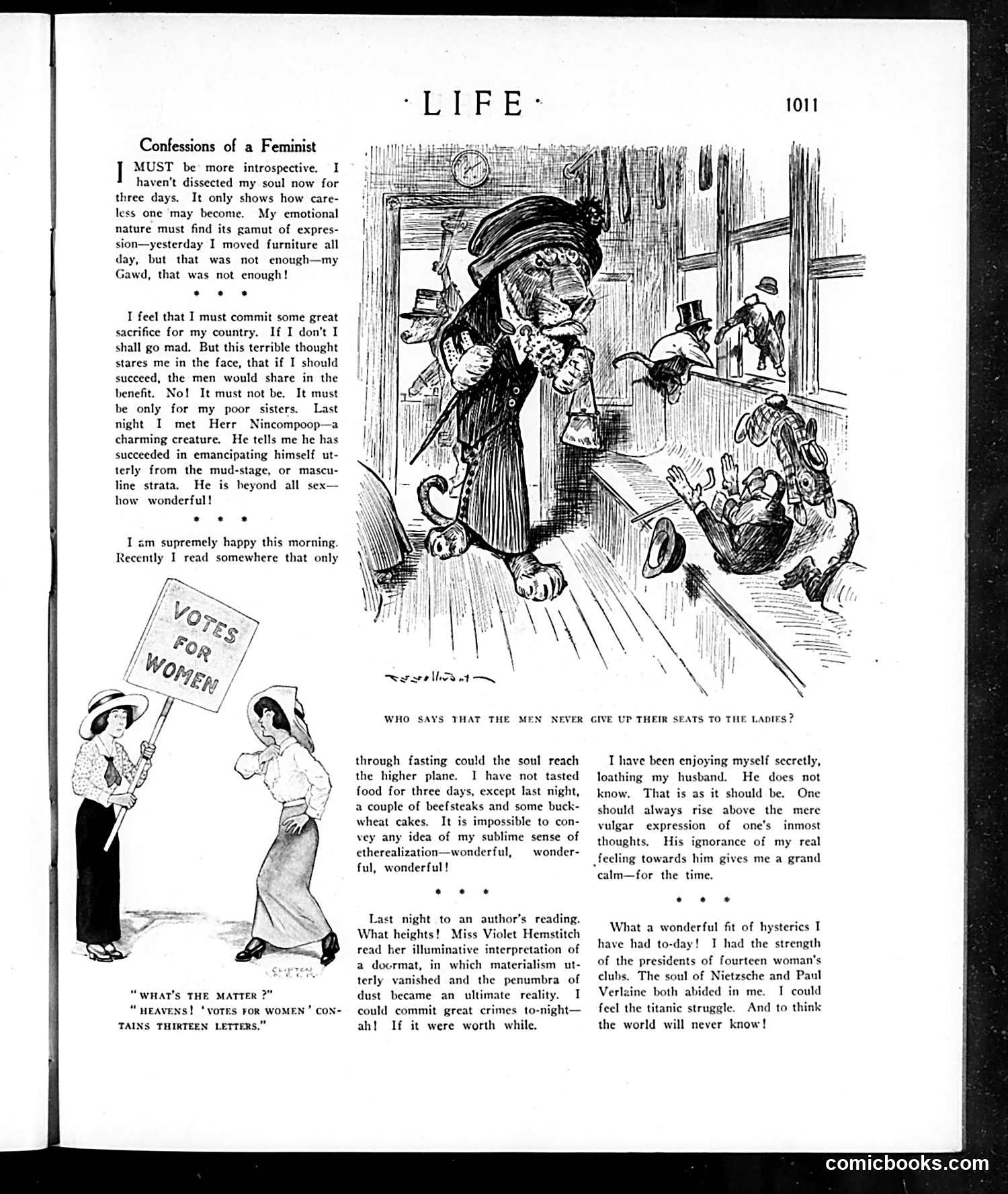
This page mocks the early women's suffrage movement through a deliberately exaggerated first-person account of a self-absorbed feminist activist. The satire portrays her as: - **Emotionally unstable and performative**: engaging in dramatic fasting, manufactured hysteria, and constant introspection rather than substantive activism - **Self-contradictory**: claiming to sacrifice for her sisters while excluding men from benefits; fasting while eating beefsteaks - **Pretentious**: adopting pseudo-intellectual philosophy and obscure literary references to justify her behavior - **Hypocritical**: secretly despising her husband while maintaining false composure The accompanying cartoon and small comic about "votes for women" containing thirteen letters reinforce the joke: the suffragist movement is presented as trivial word-play and performative nonsense rather than serious political reform. The overall message is dismissive—the piece suggests female activists are emotionally unstable dilettantes rather than serious political agents. This reflects common anti-suffrage propaganda of the era.
This page announces the winner of Life magazine's 1912 contest on feminism—a $300 prize won by W.R. Hotchkin's essay arguing **against** the feminist movement. ## The Anti-Feminist Argument Hotchkin's winning essay presents a conservative position opposing feminism: women are "naturally" suited to home and motherhood, while men are designed for labor. He argues feminism wrongly pushes women into commercial work, competing with men and abandoning their "crowning glory." ## The Satire's Target Life magazine—historically a satirical publication—appears to be satirizing this anti-feminist argument by publishing it as the "winner." By presenting this deeply traditional viewpoint as the prize-winning wisdom, the magazine likely mocked both the essay's sentimentality and the conservative resistance to women's expanding roles during the Progressive Era. ## Historical Context This reflects early 1910s debates over women's suffrage and labor rights. The winning essay's emphatic capitalization of "LOVE," "HAPPINESS," and "HOME" underscores the era's idealization of domesticity—precisely what feminists were challenging.
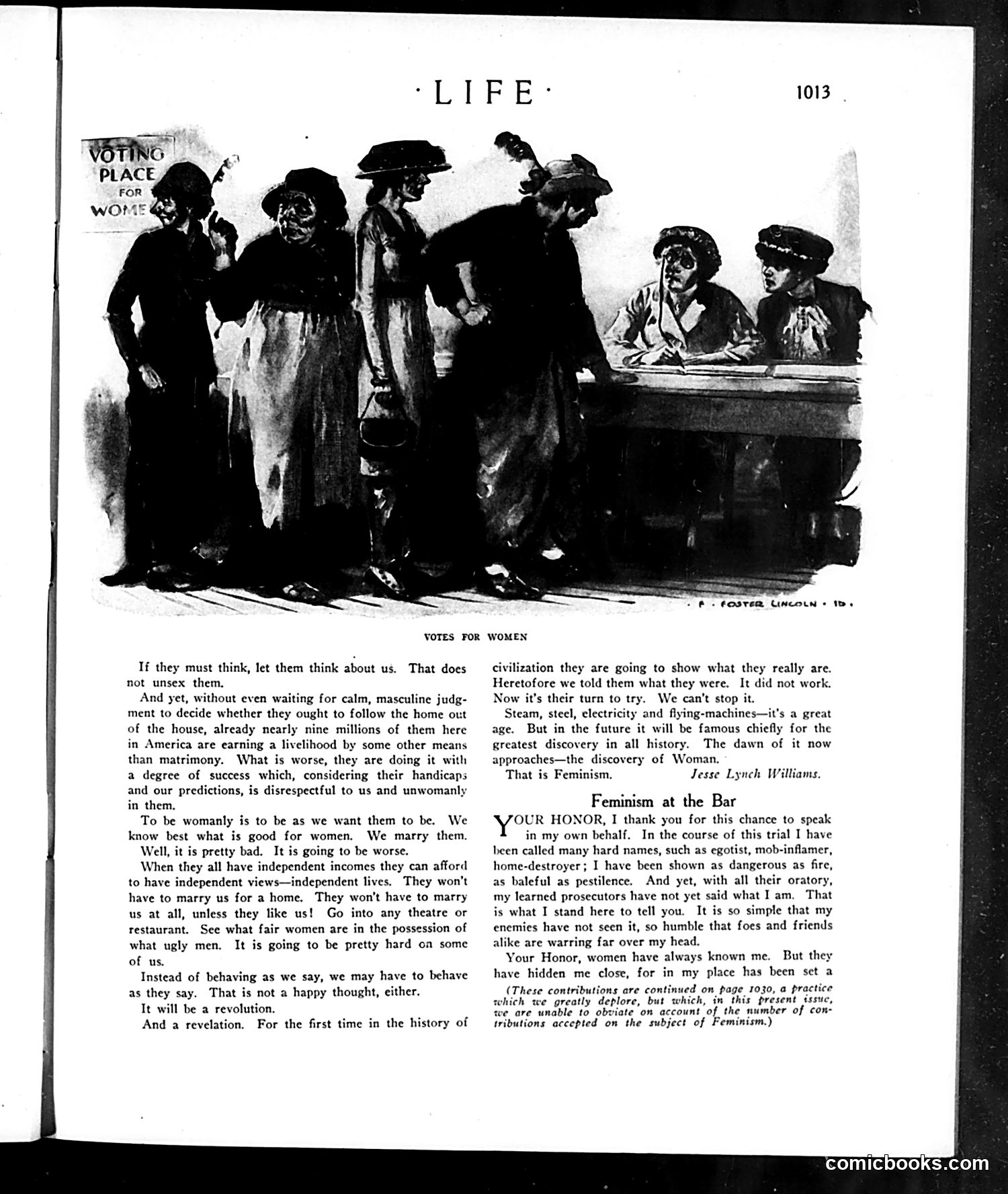
This page contains two satirical pieces about early 1900s feminism and women's suffrage. The cartoon depicts women at a voting place, illustrating the emerging political reality of female voters. The first article, attributed to Jesse Lynch Williams, presents a sardonic male perspective on women's independence. It mocks men's anxiety about women earning their own money and gaining economic autonomy—noting that nine million American women already work outside the home. The satire highlights male fears that financial independence will let women refuse marriage and demand equality ("behaving as they say" instead of obeying). Williams frames this women's liberation as inevitable ("a revolution") while sarcastically calling it "feminism." The second piece, "Feminism at the Bar," features a woman defendant speaking in court about her identity, suggesting she's been mischaracterized by prosecutors as dangerous. The magazine indicates this addresses ongoing debate about feminism's social impact. Together, these pieces reflect contemporary anxieties about changing gender roles and women's increasing public presence and agency.
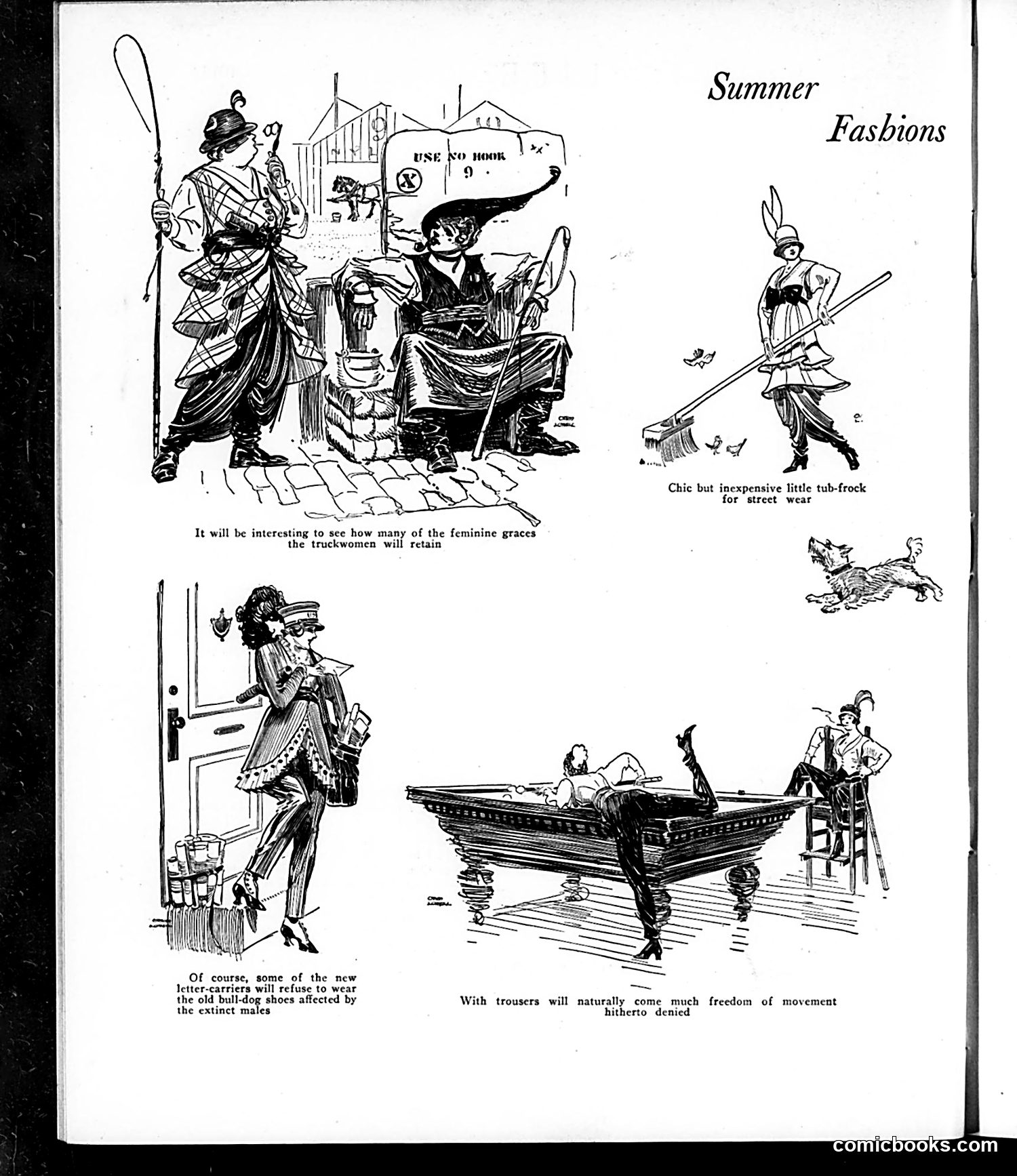
This page satirizes women entering traditionally male occupations during what appears to be WWI era (when men were away fighting). The cartoons mock how women adopting jobs like trash collection, mail delivery, and other labor would need to wear practical clothing—trousers and work gear instead of feminine dresses. The humor targets two audiences: it jokes that women will lose "feminine graces" doing manual labor, while simultaneously mocking the absurdity of expecting them to maintain elegance while hauling garbage or delivering mail. The caption about letter-carriers refusing "bull-dog shoes" and trousers granting "freedom of movement hitherto denied" suggests ironic commentary on both women's practical needs and societal expectations about femininity and propriety.
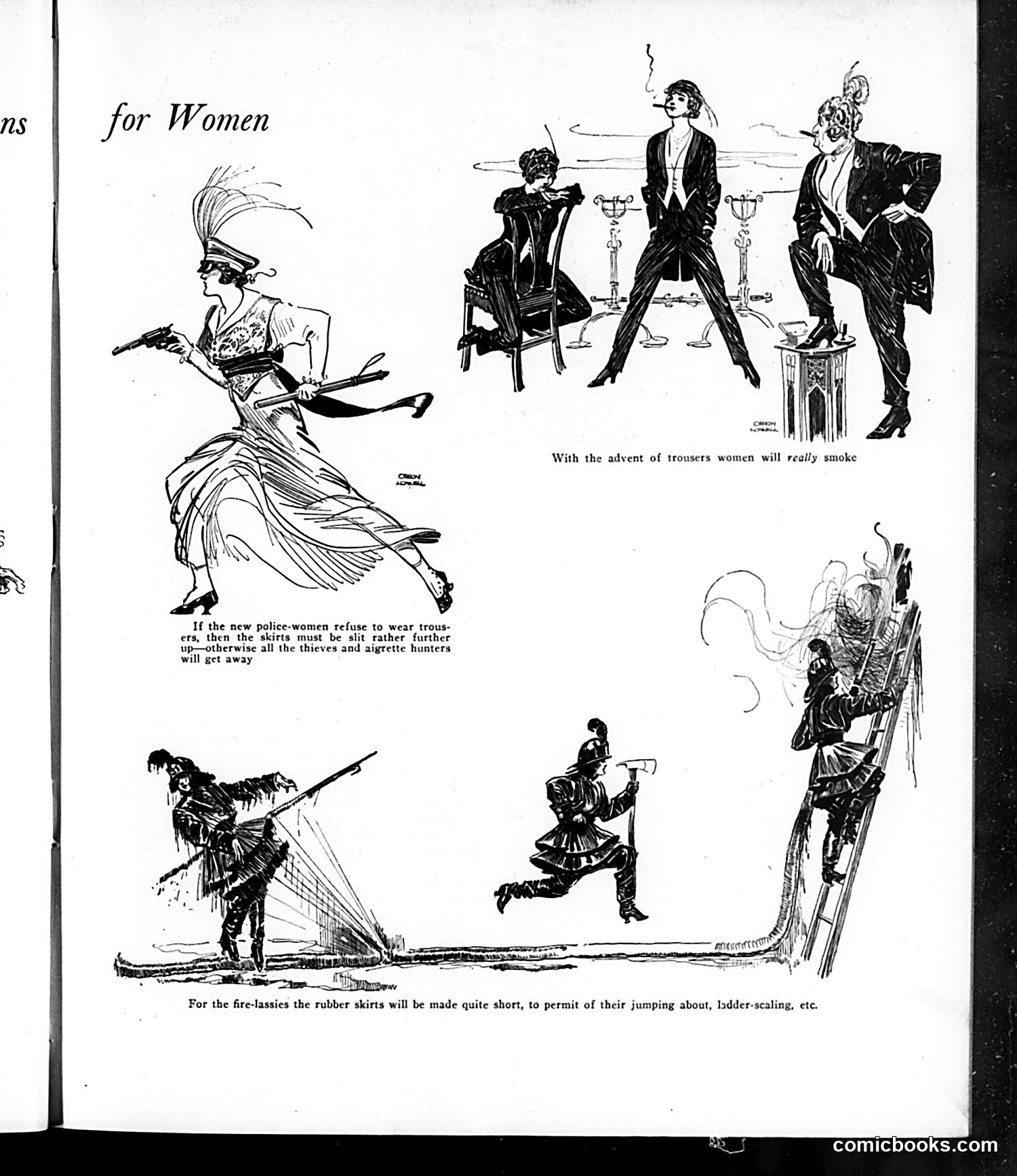
This page satirizes the emerging trend of women wearing **trousers** in early 20th-century society. The cartoons mock anxieties about female dress reform through exaggeration: 1. **Top right**: Women in business attire smoking cigarettes—suggesting trousers lead to "masculine" vices 2. **Top left**: A woman in a skirt wielding weapons, captioned that police-women refusing trousers must wear *shorter* skirts to chase criminals 3. **Bottom**: Fire-fighting women in abbreviated rubber skirts, supposedly for ladder-climbing The satire targets **multiple concerns simultaneously**: - Social hysteria over women abandoning traditional feminine dress - Questions about how women could function in new professional roles (police, firefighting) - The absurdity of compromising either modesty or practicality The joke is that reformers face impossible choices—wear trousers (scandalous) or wear impractically short skirts (also scandalous). The cartoons mock both the conservative resistance to change and the practical difficulties of integrating women into male-dominated professions.
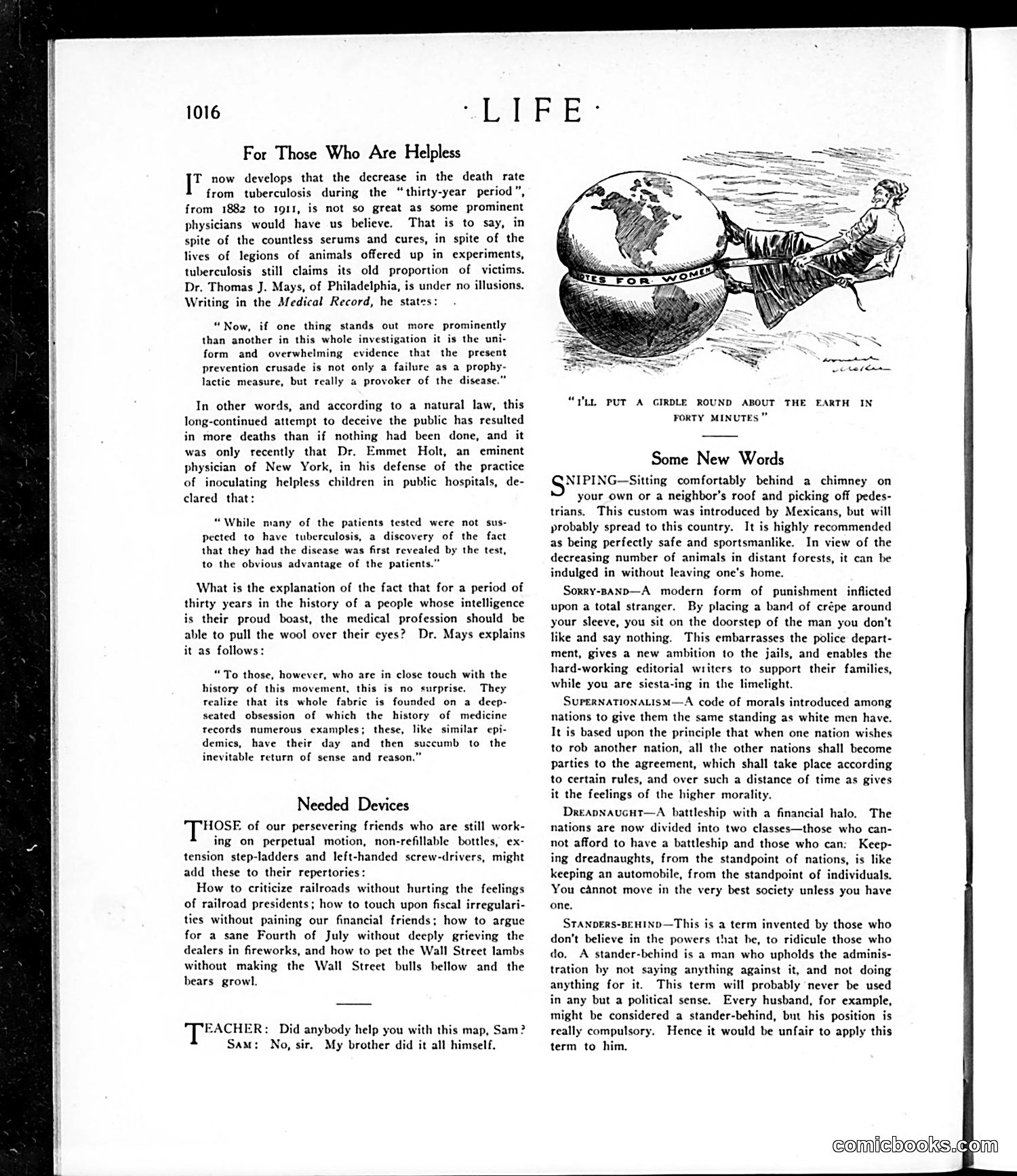
**Main Article - "For Those Who Are Helpless":** This critiques the medical establishment's tuberculosis prevention campaign (1882-1911). The article argues that despite animal experimentation and countless treatments, TB death rates haven't significantly declined. Dr. Thomas J. Mays contends the prevention crusade has actually *increased* deaths by deceiving the public. The piece questions why the medical profession could "pull the wool over" the public's eyes for thirty years—suggesting organized deception rather than genuine medical progress. **Cartoon:** The illustration shows a figure attempting to encircle Earth with a girdle, captioned "I'll put a girdle round about the earth in forty minutes." This appears to mock grandiose promises—likely referencing inflated medical claims about curing disease. **"Some New Words" Section:** Satirical new vocabulary mocking social absurdities: "sniping" (shooting pedestrians from roofs), "sorry-band" (public shaming of disliked neighbors), and "supernationalism" (false morality between nations). These mock both violence and hypocrisy in contemporary society. **Overall:** Life magazine attacks medical hubris, false prevention campaigns, and broader social dishonesty.
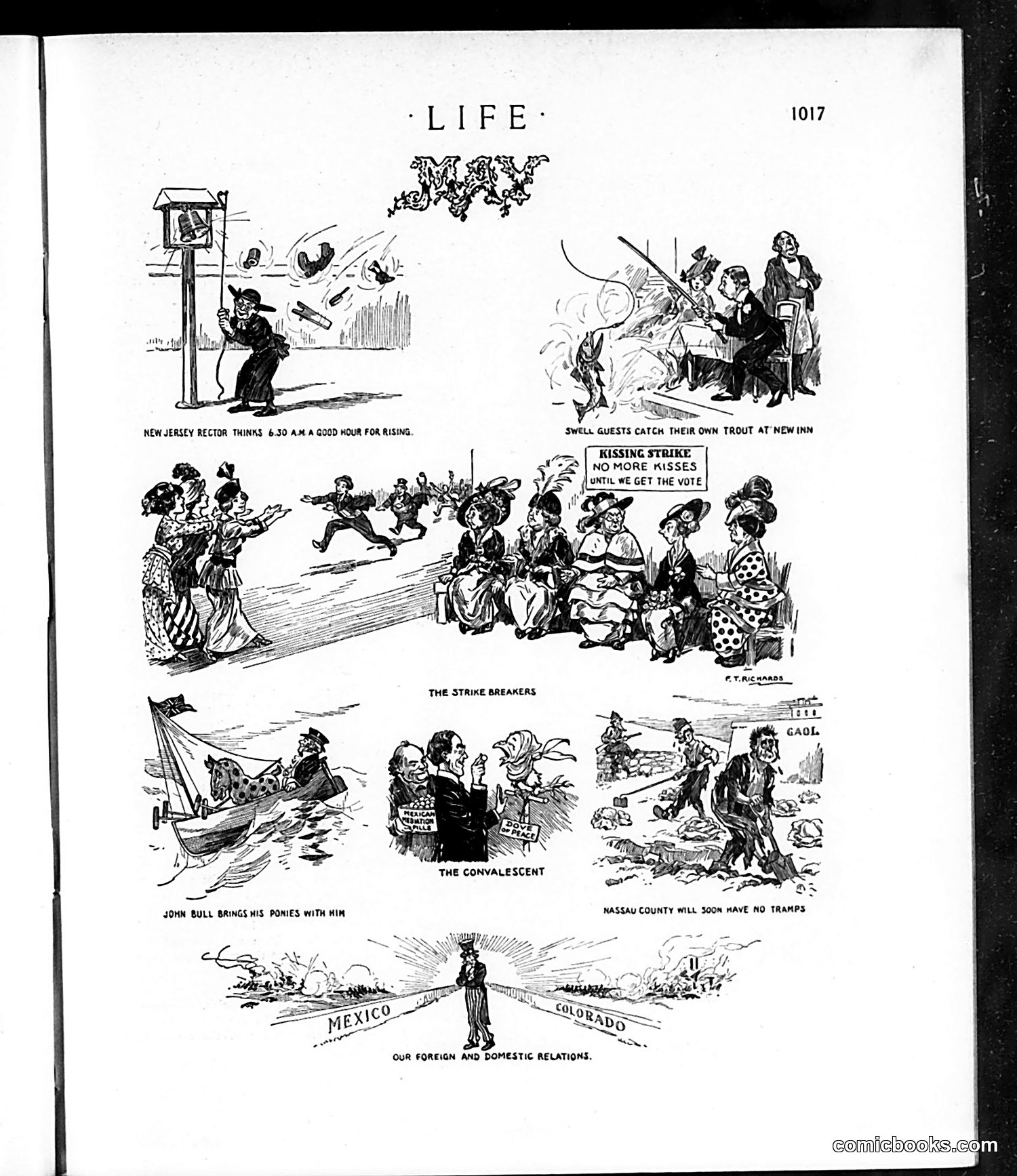
This page collects multiple satirical cartoons addressing early 20th-century American issues: **Top panels** mock a New Jersey rector's early rising and fishing guests catching their own trout—light social humor. **"The Strike Breakers"** depicts women holding a "kissing strike" banner, refusing kisses until gaining voting rights—referencing the women's suffrage movement. **"The Convalescent"** and "Nassau County Tramps"** appear to address social welfare or vagrancy issues. **"John Bull Brings His Ponies"** likely references British imperial affairs. **"Our Foreign and Domestic Relations"** (bottom) shows Lady Liberty balancing Mexico and Colorado, likely commenting on American border tensions or resource conflicts during this period. The cartoons use exaggeration and visual metaphor to critique politics, social movements, and government policy.
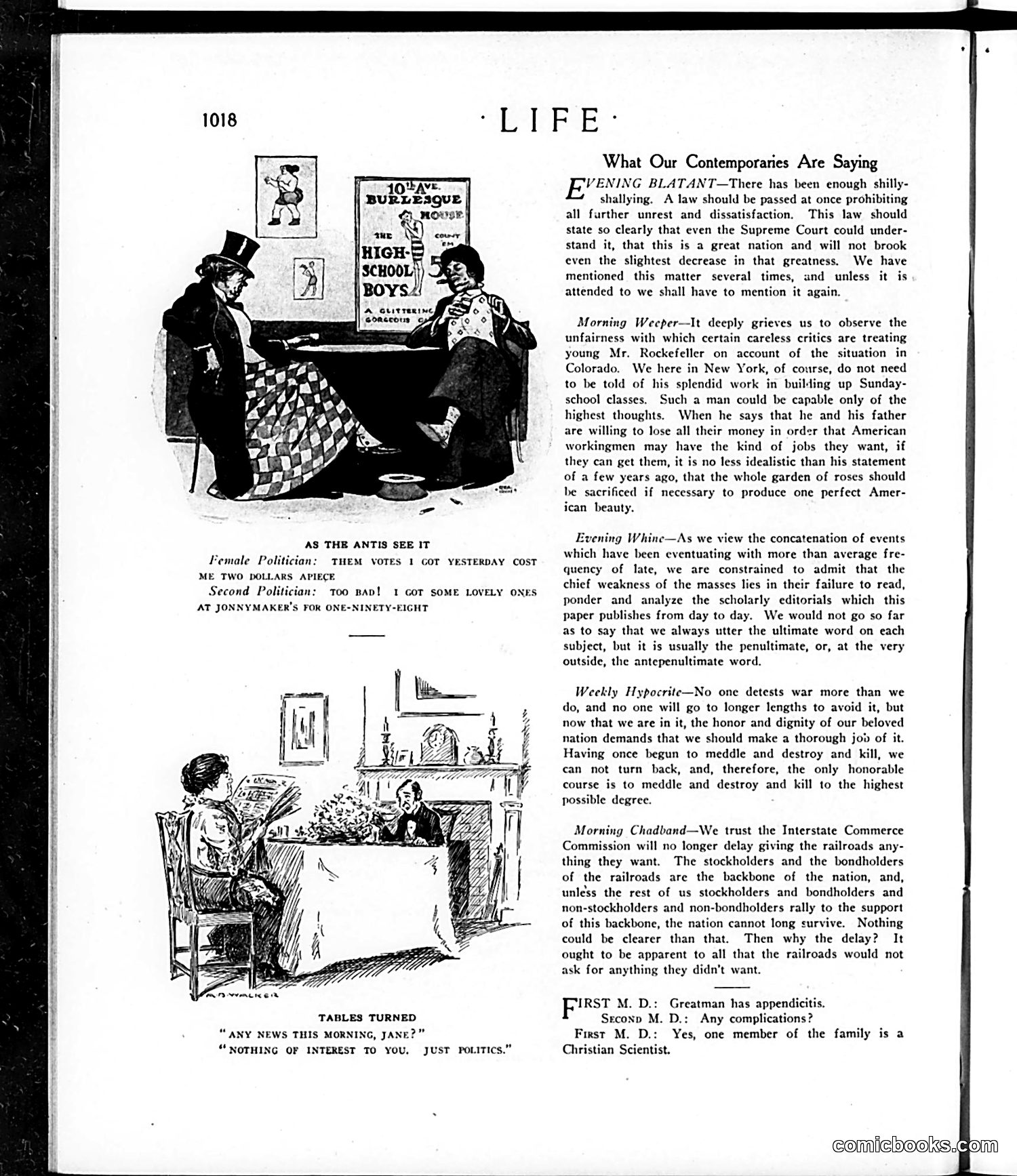
**Top Cartoon ("As the Antis See It"):** Two politicians discuss vote-buying costs, with one boasting about cheaper votes at "Jonnymaker's." This mocks anti-suffrage arguments by depicting male politicians as already corrupt vote-purchasers—suggesting women voters couldn't be worse. The "Antis" are opponents of women's suffrage. **Bottom Cartoon ("Tables Turned"):** A woman reads a newspaper while dismissing her husband's request for news as "just politics"—previously women's typical role. Now she's the one uninterested in politics, reversing traditional gender dynamics. **Editorial Parodies:** The "What Our Contemporaries Are Saying" section satirizes hypocritical newspaper editorials through fake newspaper personas: praising Rockefeller despite labor unrest (Colorado), claiming intellectual superiority, advocating maximum war effort while claiming to oppose war, and favoring railroad interests over public welfare. **Context:** Published during WWI and the suffrage debate, Life ridicules both political corruption and editorial double-speak.
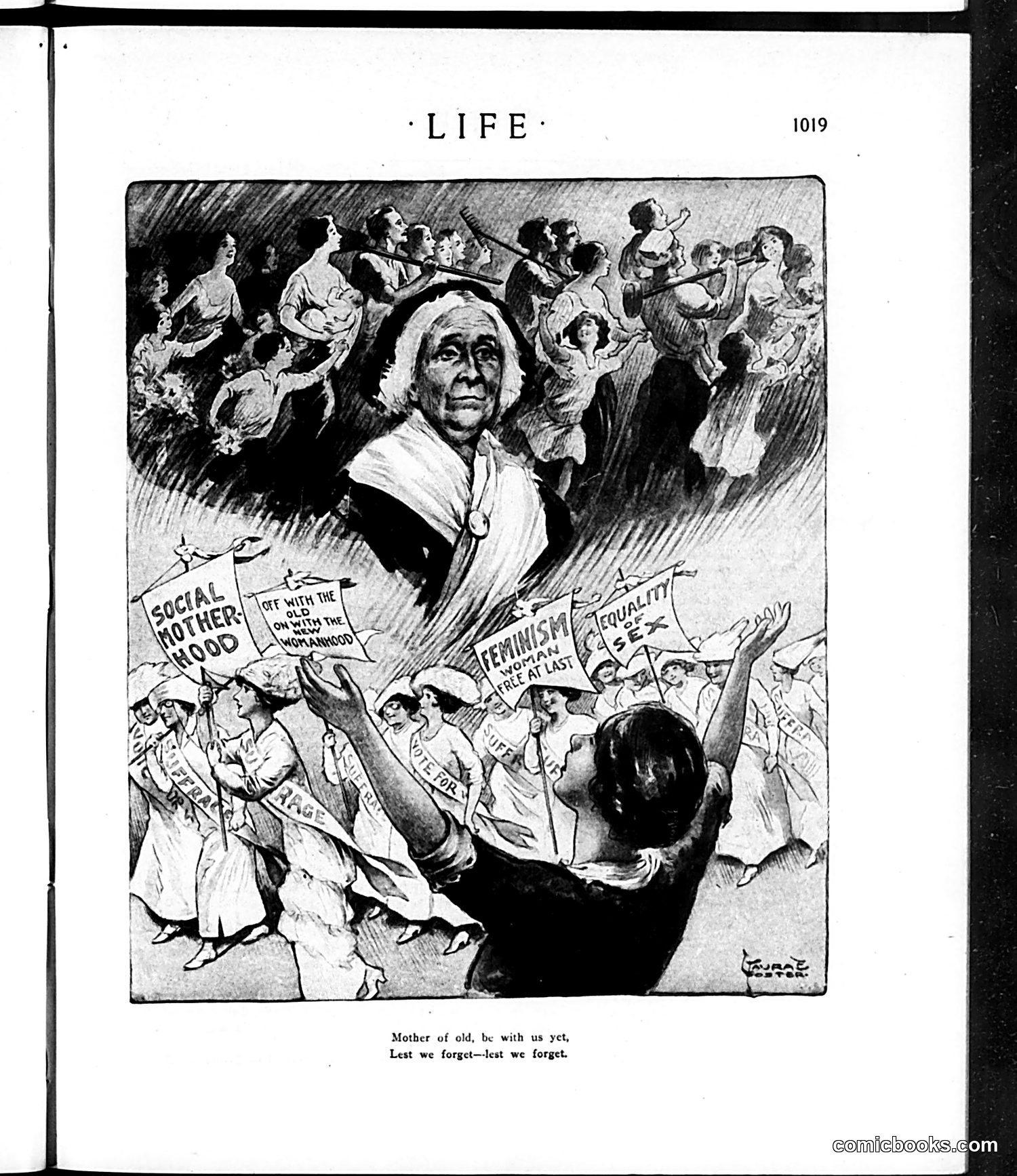
This Life magazine cartoon depicts a ghostly elderly woman (labeled "Mother of old") presiding over a women's suffrage movement. The marching women below carry banners reading "Social Motherhood," "Feminism," "Equality," and other progressive causes, while the spectral figure watches from above. The satire appears to invoke historical "motherhood" as a spiritual guide for modern feminism and women's rights activism. The repeated phrase "lest we forget" suggests the artist is reminding viewers of traditional maternal values while women pursue political equality and expanded social roles. The cartoon likely critiques or comments on tensions between traditional femininity and feminist activism—whether modern women's movements honor or reject classical ideals of motherhood and domesticity.
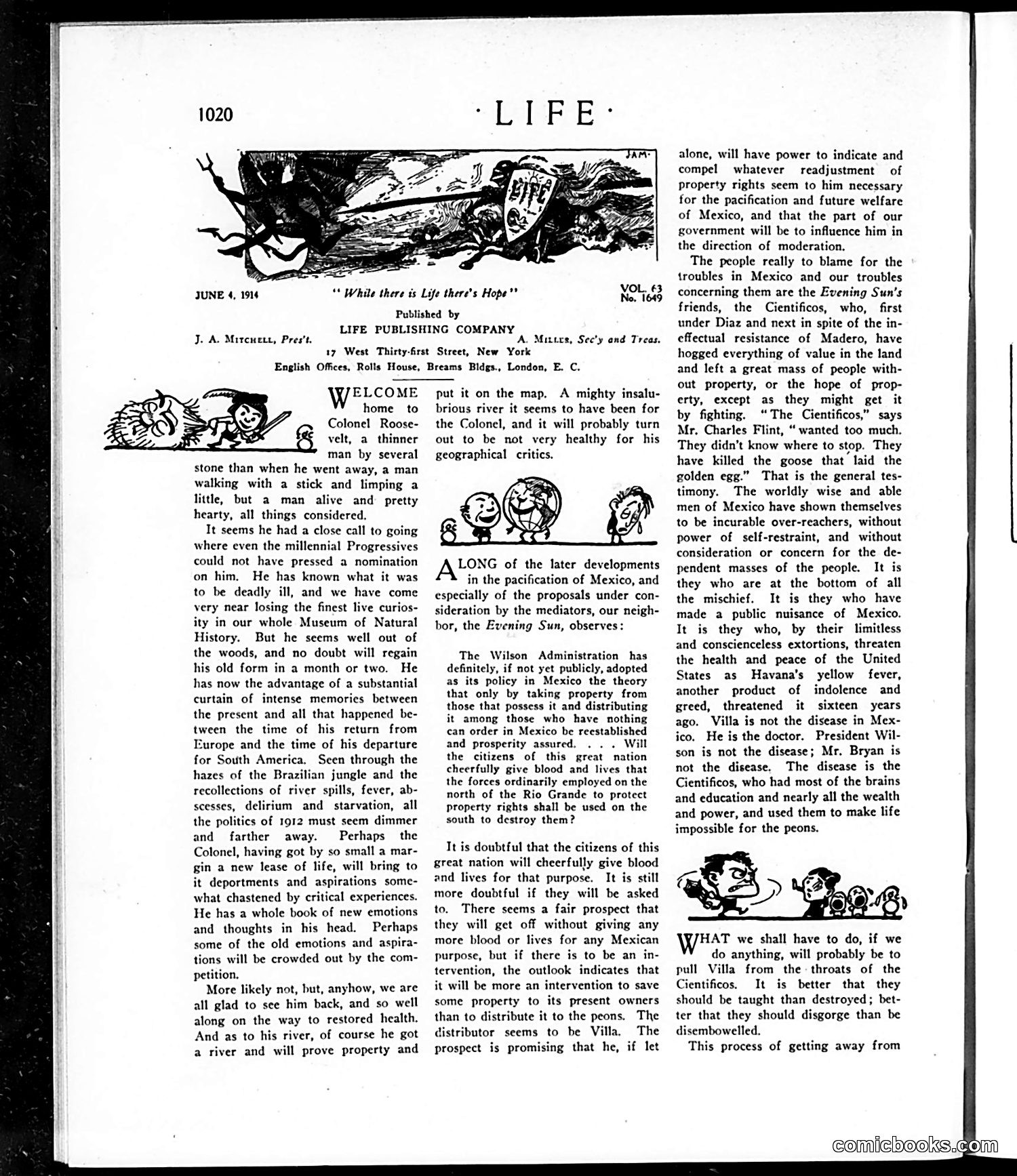
This page welcomes Theodore Roosevelt home from his dangerous 1913-1914 South American expedition, where he nearly died of illness traveling the Brazilian "River of Doubt." The editorial celebrates his survival with gentle humor about his weakened state, suggesting the ordeal may have sobered his political temperament after the contentious 1912 split election. The main article critiques Wilson Administration policy toward Mexico's ongoing civil unrest. It sarcastically questions whether Americans will sacrifice blood and lives to *redistribute* Mexican property to peasants (supporting revolutionary forces) rather than protect existing property rights. The piece blames Mexico's troubles on the **Científicos**—the educated elite who served the Díaz dictatorship—and suggests Villa (the revolutionary general) will ultimately determine Mexico's future regardless of U.S. involvement. The satire targets American interventionist impulses while expressing skepticism about supporting land redistribution.
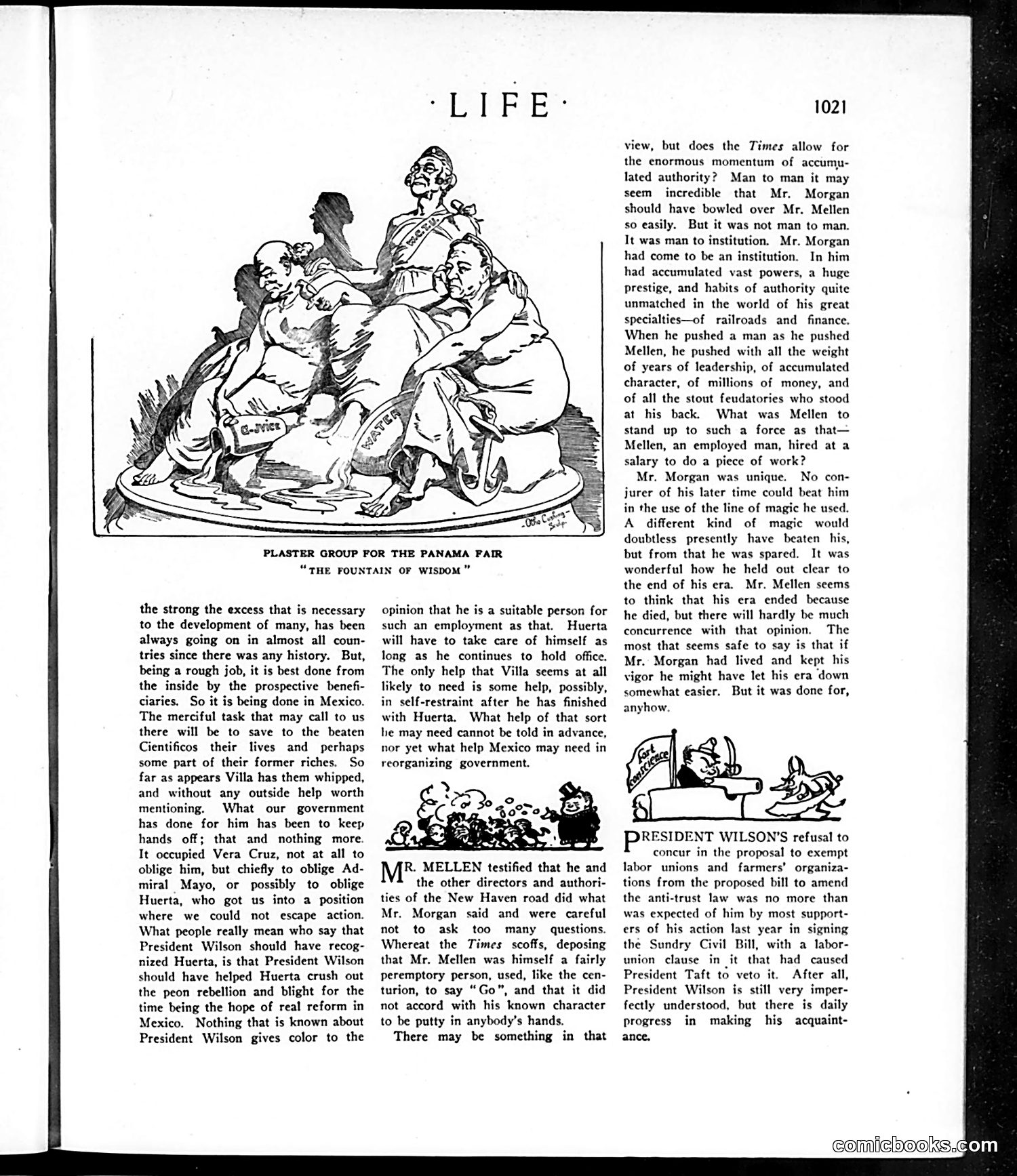
This satirical plaster sculpture group ridicules Mexican political leadership during the Mexican Revolution era (circa 1913-1914). The caricatured figures appear to represent Mexican political and military authorities—likely including President Huerta and associated corrupt officials ("Cientificos")—depicted as bloated, foolish, and lacking wisdom despite their power and pretensions. The accompanying text discusses U.S. intervention in Mexico, President Wilson's foreign policy stance, and the internal Mexican conflicts between reform movements (Villa) and the established regime (Huerta). The cartoon's title sardonically suggests these leaders represent the opposite of wisdom, mocking their incompetence and moral bankruptcy as Mexico undergoes revolutionary upheaval. The "fountain" ironically suggests they're a source of guidance when actually embodying corruption and folly.
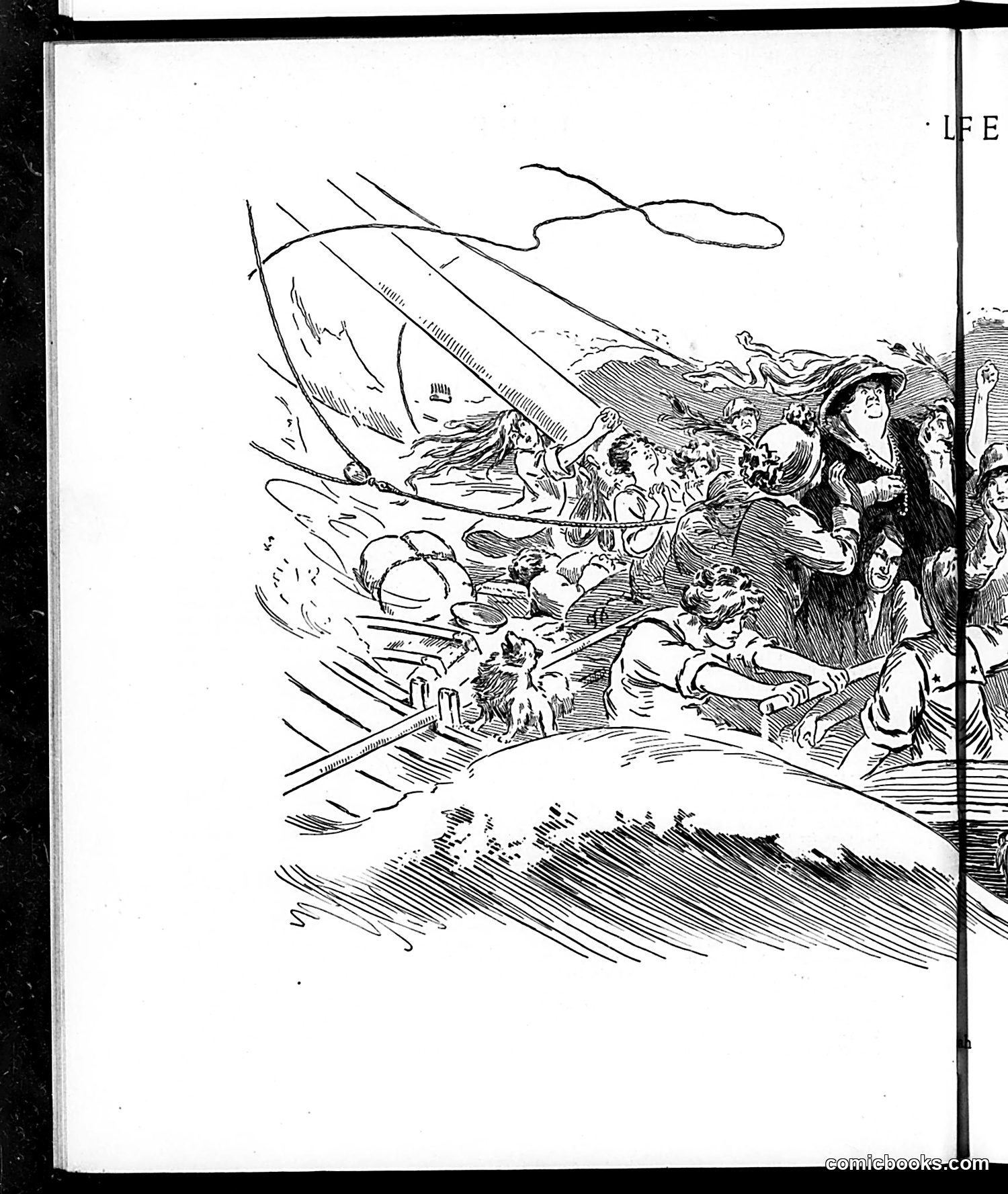
The OCR text appears corrupted and provides no legible content. Based solely on the image: this is a satirical engraving showing a dramatic maritime scene with a large sailing vessel in distress or sinking on the left, while a crowd of figures on the right—including women, children, and men in period dress—gesture frantically toward it. The style suggests 19th-century social or political commentary, likely depicting a shipwreck disaster. Without legible text identifying the specific vessel, figures, or event referenced, I cannot determine the particular political satire or social commentary intended. The scene appears designed to critique public reaction to a real maritime tragedy, but the specific target remains unclear.
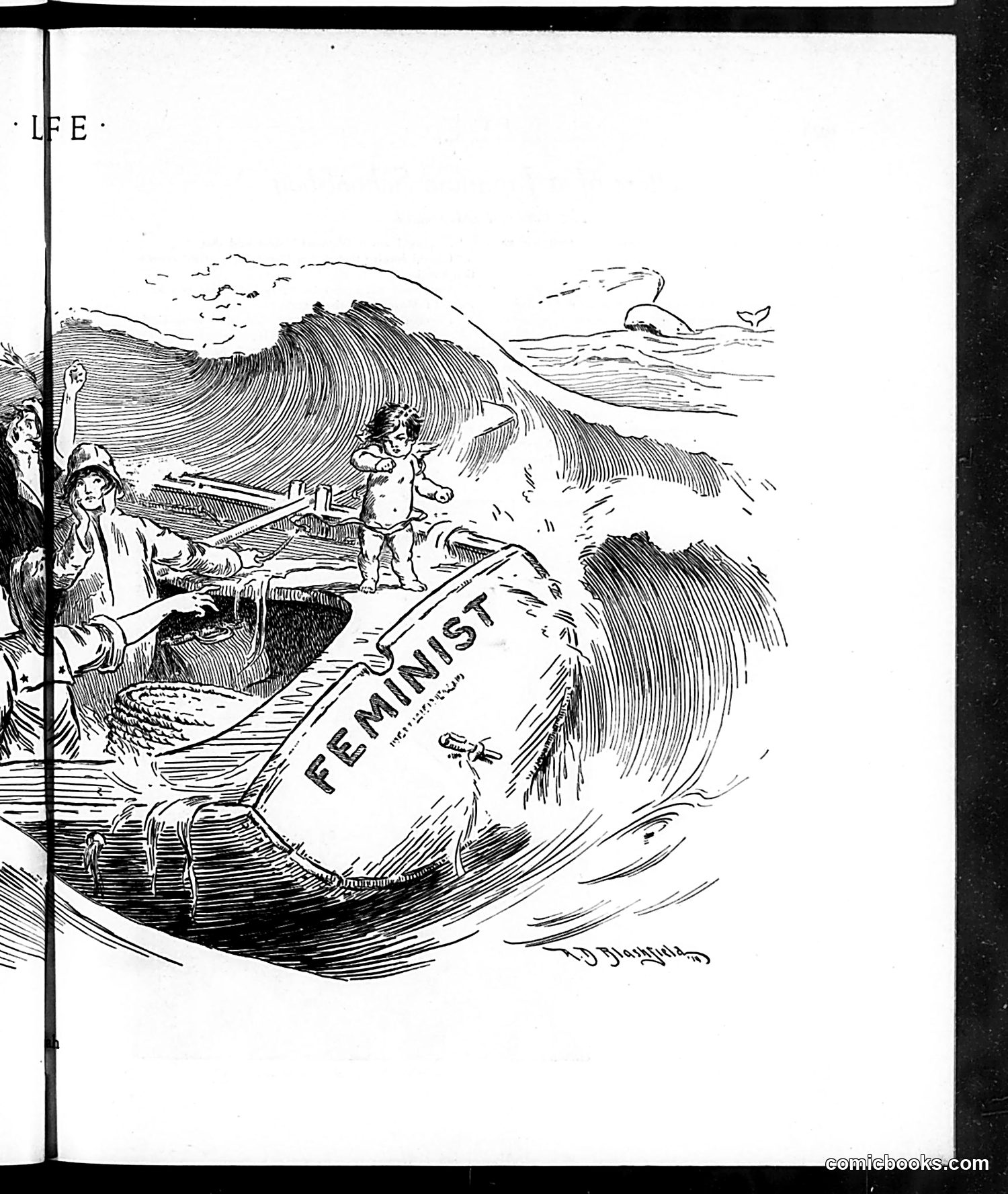
This appears to be an early 20th-century satirical cartoon from *Life* magazine depicting feminism as a large wave or tide threatening to engulf traditional society. The label "FEMINISM" is written on the wave itself. On the left, figures appear to be resisting or observing this surge, while on the right, additional figures are shown in the water. A small child stands on the beach, seemingly oblivious or unprotected. The cartoon employs the common satirical device of depicting the women's suffrage and feminist movement as an overwhelming, destructive force—a "wave" of change threatening to submerge conventional social order. This reflects opposition to women's rights activism prevalent in that era.
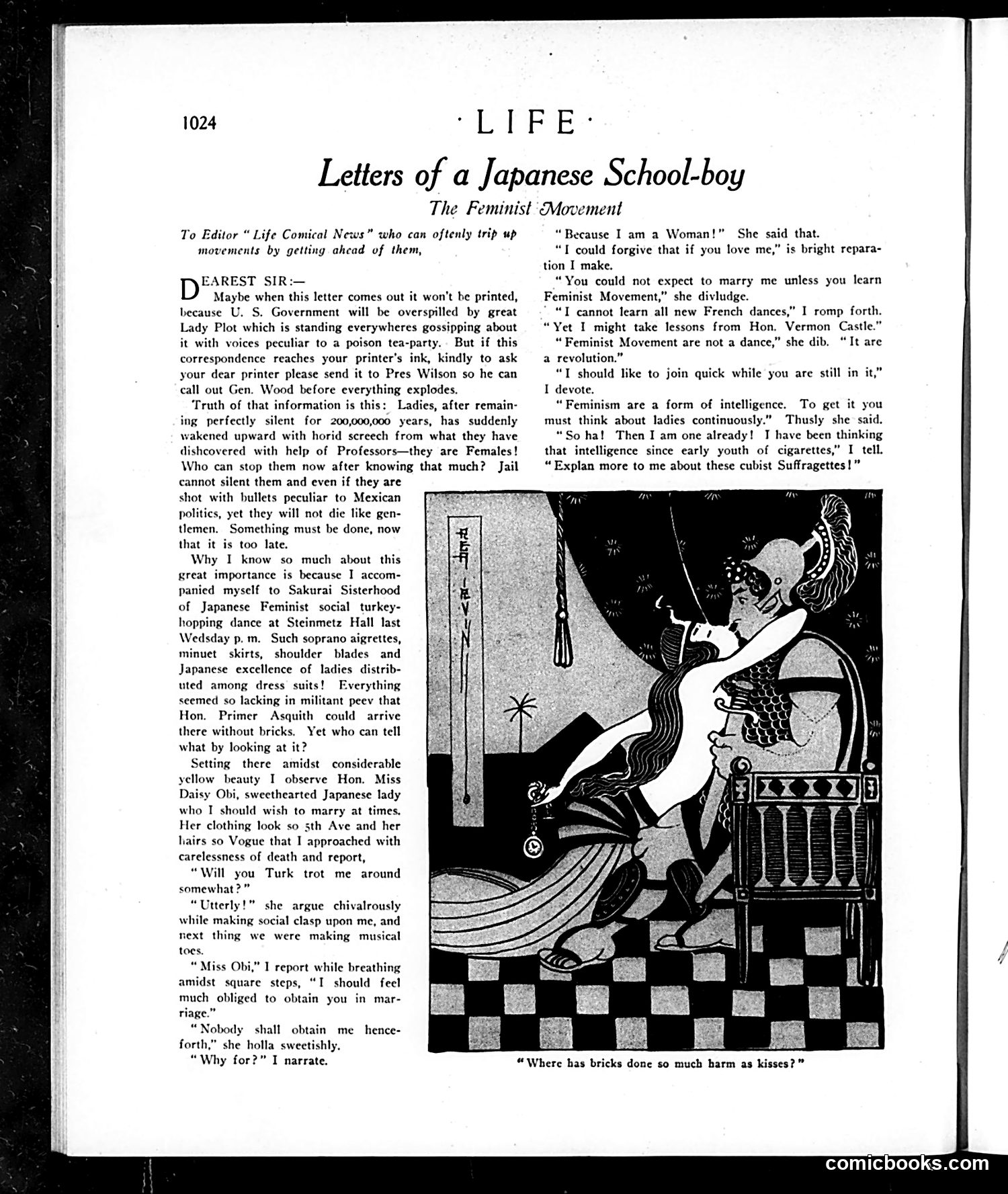
This satirical piece mocks the early 20th-century feminist/suffrage movement through the voice of a deliberately obtuse Japanese observer—a common comic device of the era to create cultural distance and exaggerate absurdity. **The Satire:** The "school-boy" writer expresses alarm that women have "discovered" they are female and now demand political recognition, presenting feminism as dangerous hysteria requiring government intervention ("call out Gen. Wood"). He treats women's suffrage as threatening social chaos comparable to Mexican political violence. **The Romance Subplot:** His attempted courtship with "Miss Daisy Obi" (a stereotyped Japanese name) illustrates his confusion: he mistakes feminist consciousness for a dance craze, conflates French dances with revolutionary thought, and reduces women's intelligence demands to romantic flattery. **The Cartoon Caption:** "Where has bricks done so much harm as kisses?" references suffragettes' actual property destruction while suggesting women's true power lies in seduction—a typical anti-feminist jab dismissing political activism as emotional rather than rational. The piece ridicules both suffragists and male resistance to women's equality.
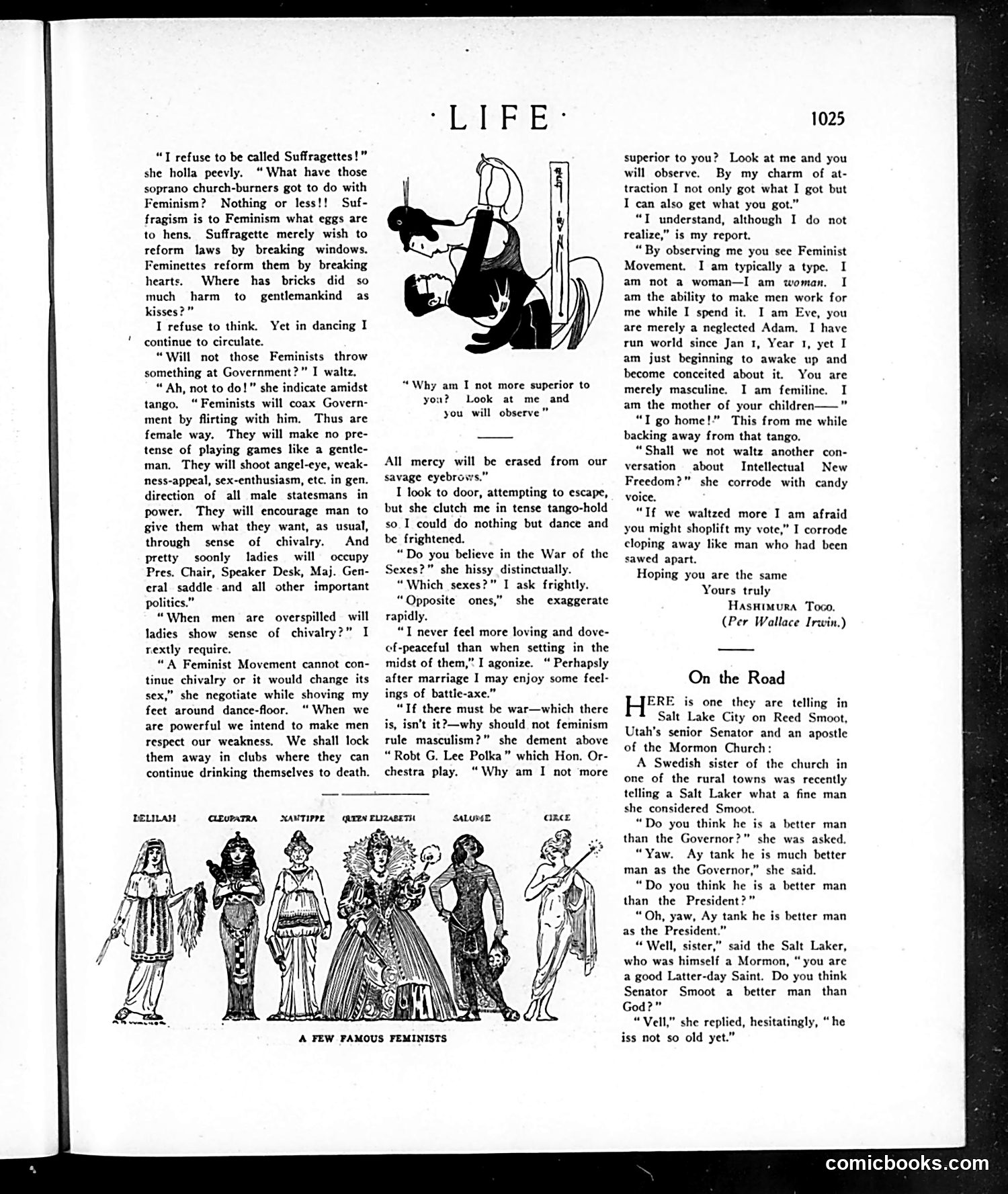
This Life magazine page satirizes competing feminist movements of the era. The main cartoon depicts a dancing couple debating feminism versus suffragism. The female character argues that "feminettes" (her term) reform society through charm and manipulation of men—flirting with politicians, using "sex-enthusiasm"—rather than the crude tactics of suffragettes who break windows. The satire mocks both movements: suffragettes for property destruction, and the "new feminists" for claiming superiority while admitting their power derives solely from male chivalry. The female character's contradictions are intentional comedy—she boasts of ruling the world since creation while simultaneously claiming men still control things. The bottom illustration shows "famous feminists" (historical figures like Cleopatra, Queen Elizabeth), contrasting past female power with present debates about women's rights and roles. The "On the Road" anecdote provides lighter relief, offering no political content—merely a joke about a Swedish immigrant's assessment of a Mormon politician.
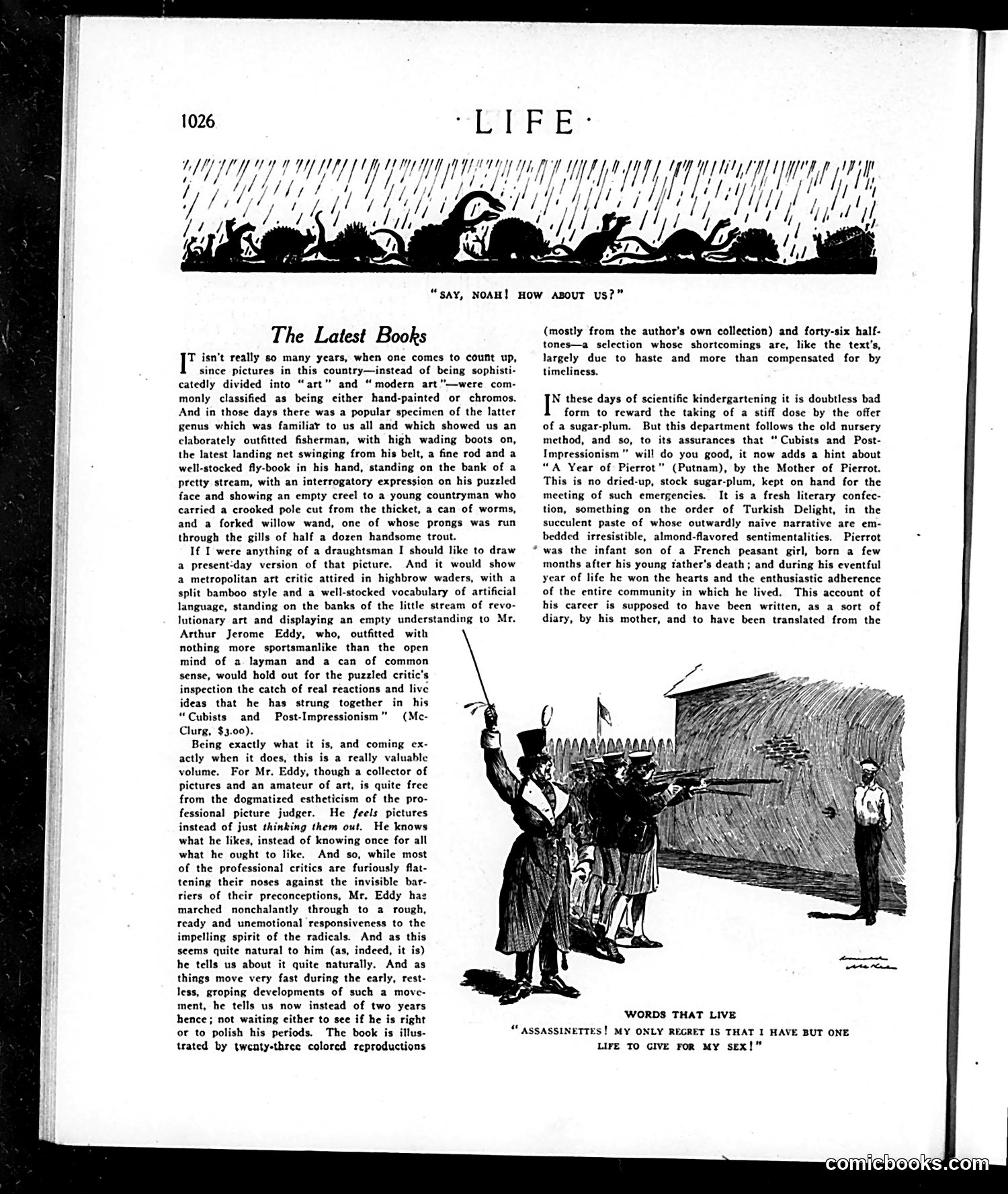
The top cartoon depicts Noah's Ark with animals asking Noah "How about us?"—a joke about being left out or overlooked. It introduces a book review section. The main content reviews Arthur Jerome Eddy's *Cubists and Post-Impressionism*, comparing modern art criticism to a fishing parable. The satire contrasts a pretentious art critic wearing "highbrow waders" and spouting "artificial language" about revolutionary art—yet understanding nothing—with Eddy, an amateur layman with "common sense" who actually appreciates modern art genuinely. The cartoon below shows a figure confronting what appears to be a woman, captioned with a quote about assassinettes regretting having only one life to give for their sex—likely referencing women's suffrage activism or feminism of the era. The reviews promote books on avant-garde art and a sentimental novel called *A Year of Pierrot*.
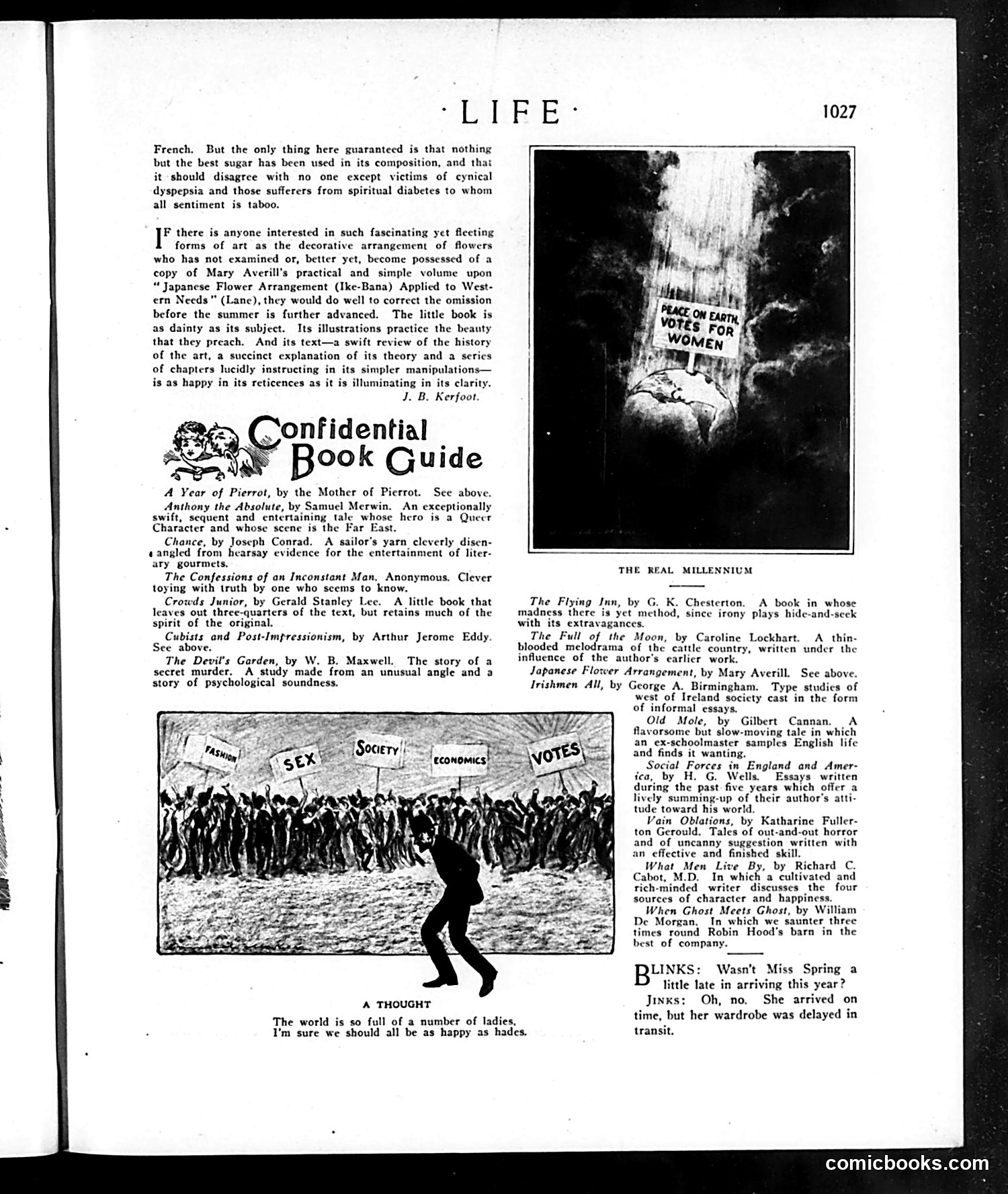
The main cartoon depicts a silhouetted figure being pulled or drawn toward a large crowd of people holding signs reading "SEX," "SOCIETY," "ECONOMICS," and "VOTES." The caption reads: "The world is so full of a number of ladies, I'm sure we should all be as happy as hades." **The Satire:** This is commentary on early 20th-century women's activism and the expanding scope of women's concerns beyond the domestic sphere. The cartoon mocks the era's anxieties about women's increasing involvement in public issues—sexuality, social reform, economics, and voting rights (likely referencing suffrage movements). The figure appears overwhelmed or reluctant, suggesting satirical skepticism toward these social changes. The phrase "happy as hades" adds sardonic tone, implying that women's public activism was viewed by some as disruptive rather than progressive. This reflects common anti-feminist sentiment of the period, presented here as lighthearted magazine satire.
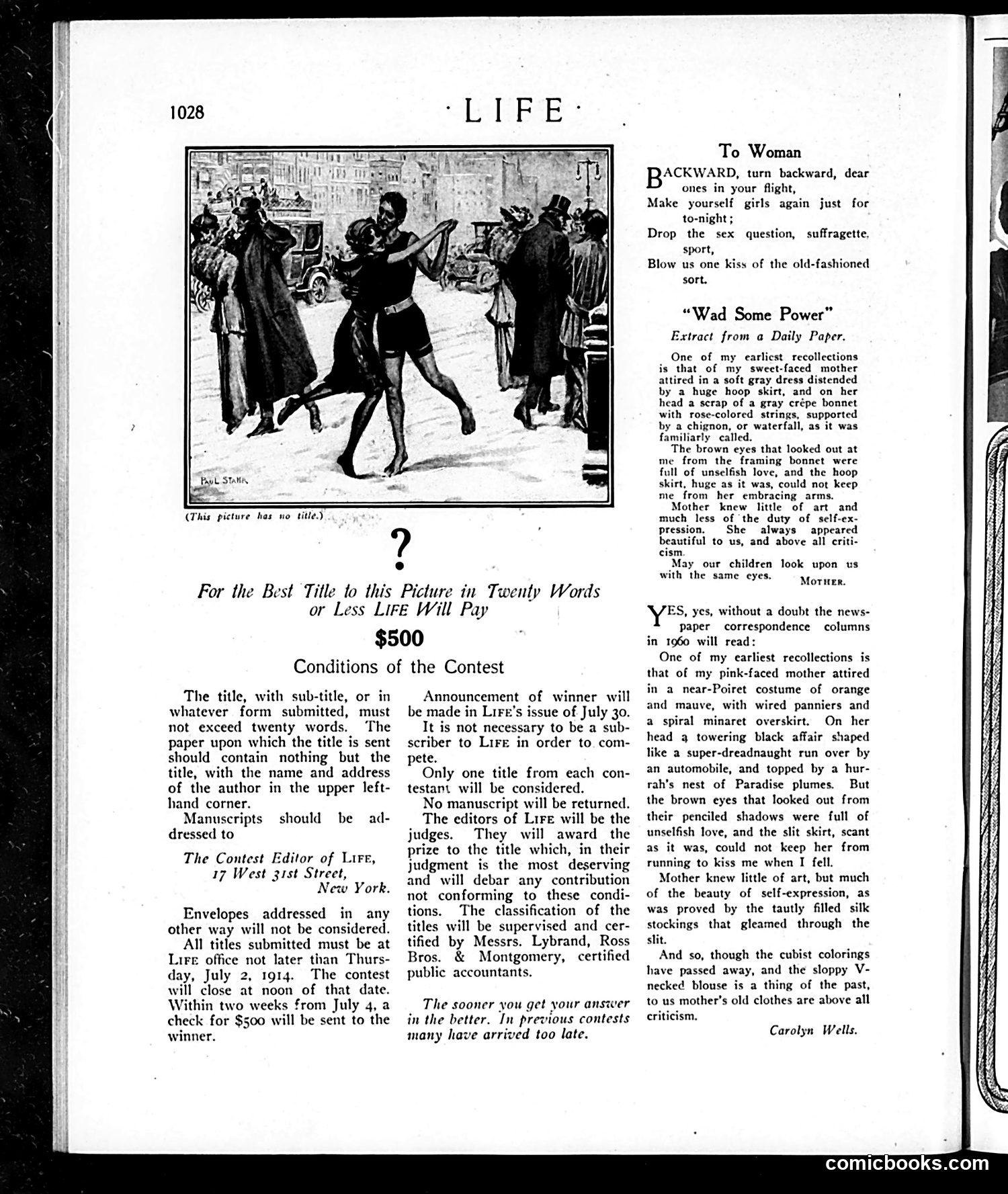
This page combines a **title-contest for an untitled cartoon** with editorial commentary on women's fashion and feminism. The cartoon depicts a street scene where a woman in modern dress appears to be dancing or moving freely among formally dressed onlookers—likely satirizing the "new woman" and suffragette movement of the 1910s. The accompanying text attacks this modernity. The poem "To Woman" nostalgically urges women to abandon the "sex question" (feminism/suffrage) and return to traditional femininity. The essay parodies this backward-looking sentiment by contrasting two eras: an idealized past where mothers wore restrictive hoop skirts yet appeared selfless, versus a predicted 1960 future where mothers wearing modern, revealing fashions would be equally devoted—suggesting that fashion changes cannot erase maternal love, thus subtly undermining the anti-feminist message. **The satire's target**: Life attacks progressive women's liberation while the embedded essay ironically undercuts that very criticism, implying progress is inevitable and natural.
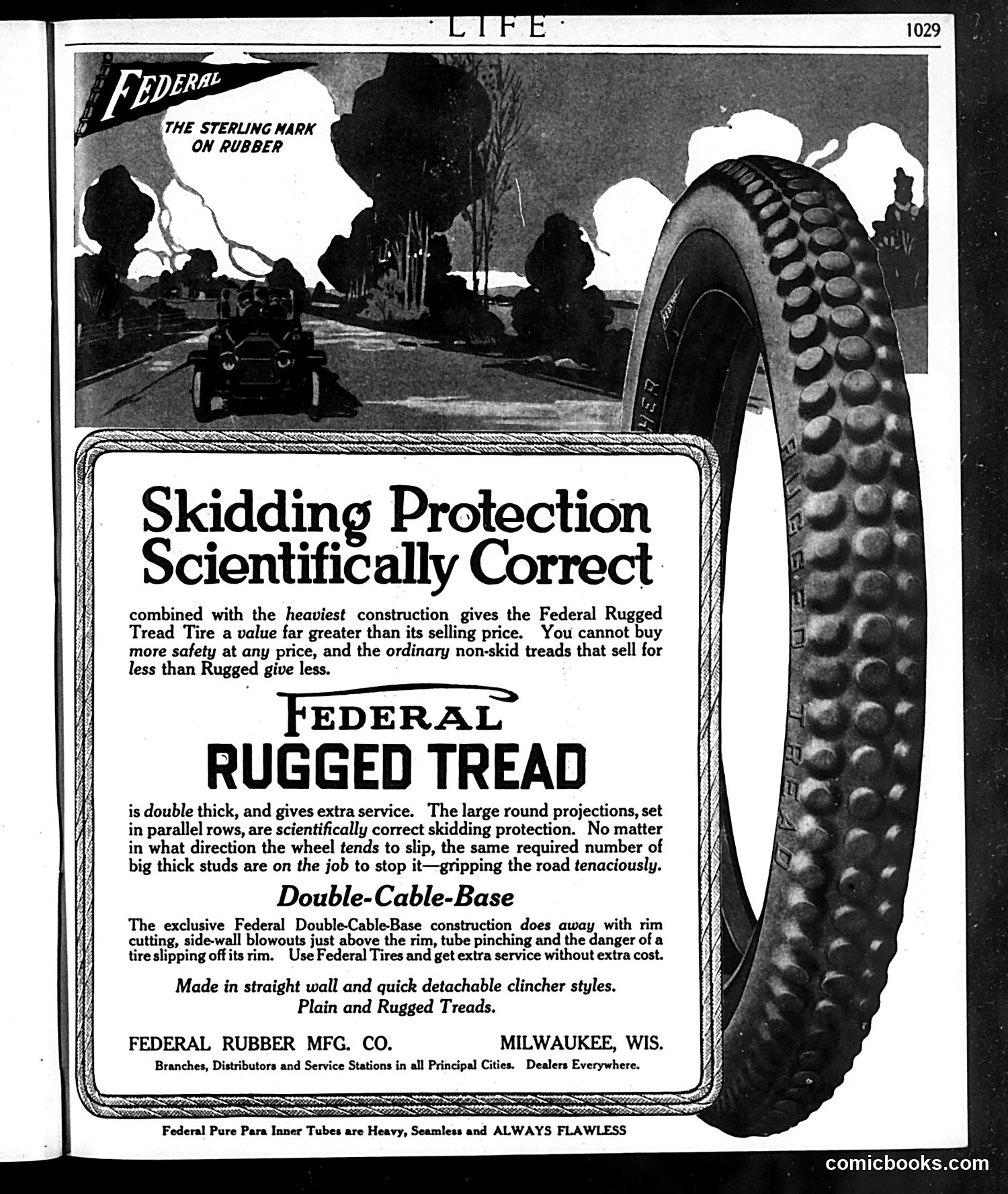
This is a straightforward **automobile tire advertisement**, not political satire. It appears in *Life* magazine (page 1029) and promotes Federal Rubber Manufacturing Company's "Rugged Tread" tire. The ad emphasizes safety features: the large round studs provide "skidding protection" in all directions, and the "Double-Cable-Base" construction prevents rim damage and blowouts. The dramatic image shows an early automobile on a tree-lined road with an enlarged tire profile displaying the distinctive stud pattern. The key sales pitch: Federal's superior construction justifies its price—you cannot buy more safety elsewhere, and cheaper non-skid tires provide less protection. The company was based in Milwaukee, Wisconsin and operated branches nationally. There is no political message or satire present—this is simply period automotive advertising emphasizing engineering reliability.
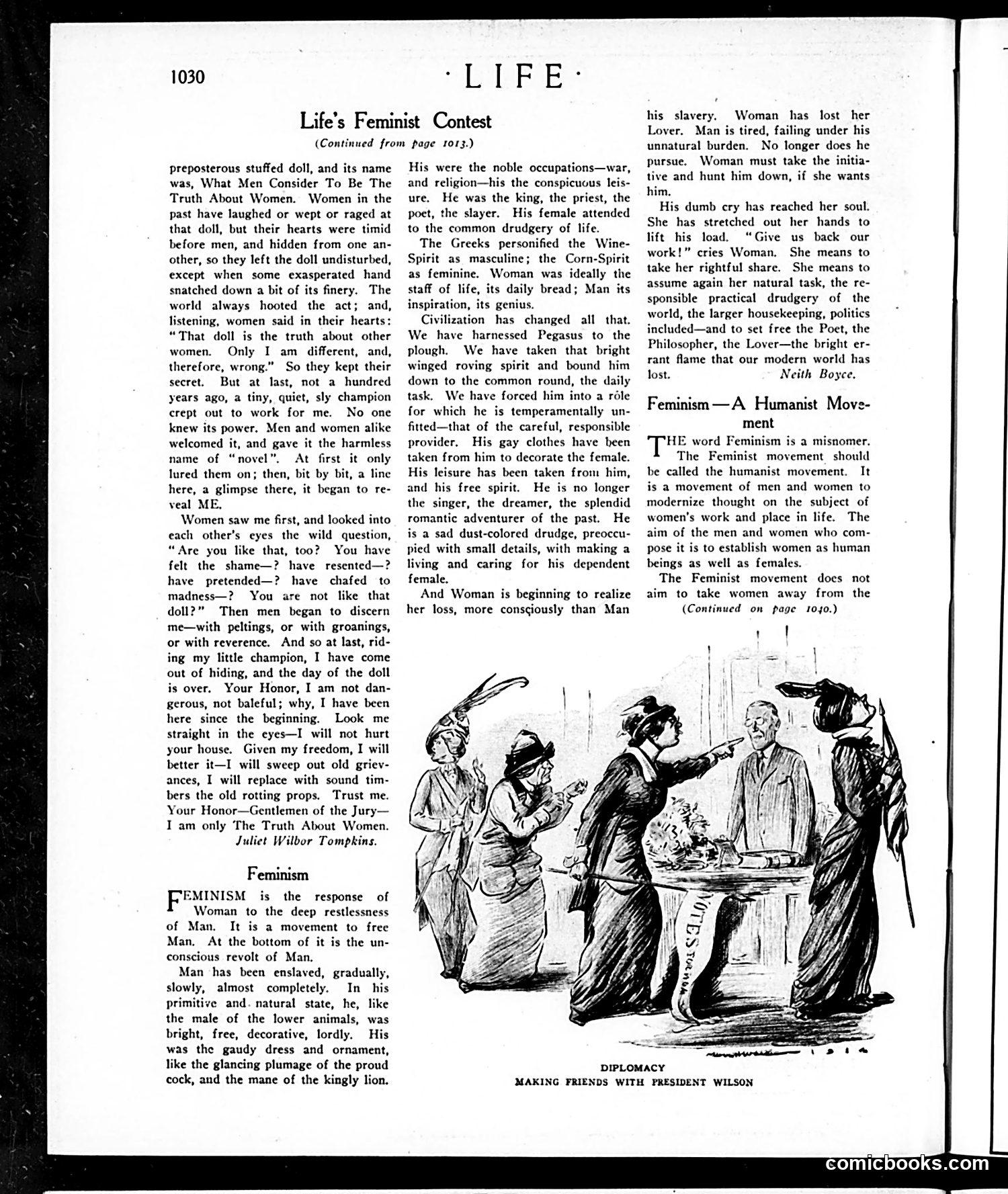
This page presents competing feminist arguments through literary excerpts and satire. The main text—attributed to Juliet Wilbor Tompkins—uses the metaphor of a "stuffed doll" representing false stereotypes about women. Tompkins argues that the novel as a literary form has gradually revealed women's authentic inner lives, dispelling myths and allowing women to recognize their shared experiences of shame and resentment. The lower essay reframes feminism paradoxically: it argues feminism actually *frees men* from civilization's constraints. The author claims modern man has become an oppressed "drudge," stripped of his natural decorative leisure and adventurous spirit, forced into domestic provider roles. Woman, realizing man's exhaustion, now must "hunt him down" and reclaim work to restore his dignity. The cartoon "Making Friends with President Wilson" (bottom) likely satirizes diplomatic efforts, though specific context is unclear. The page presents feminism as complex—simultaneously about women's liberation AND male restoration.
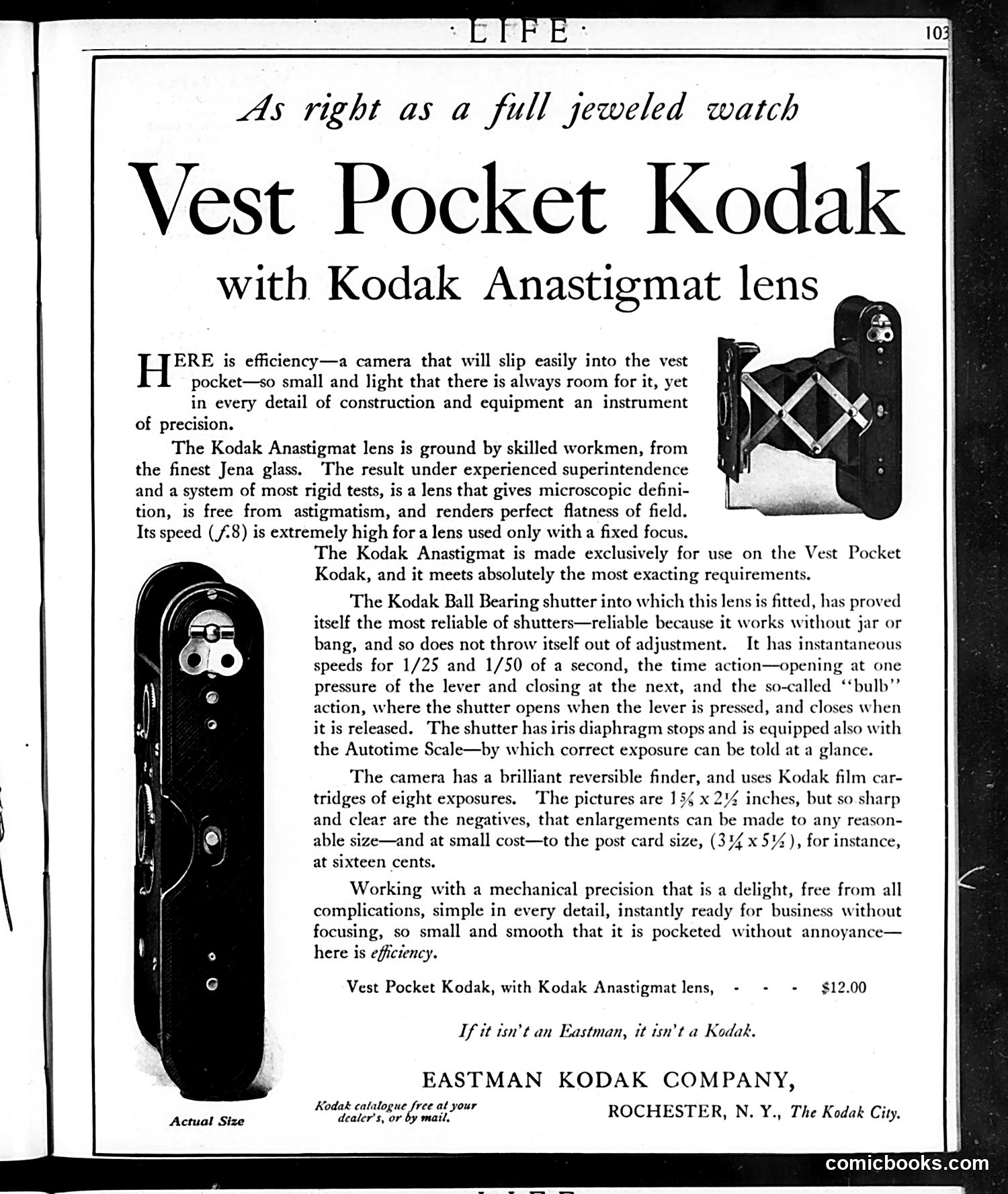
This page is a straightforward advertisement for the Vest Pocket Kodak camera, not political satire or humor. It appears in *Life* magazine (page 103), which during this era mixed editorial content with advertising. The ad emphasizes the camera's compact design ("slip easily into the vest pocket") combined with precision engineering—comparing it to "a full jeweled watch." Technical features like the Kodak Anastigmat lens, Ball Bearing shutter, and Autotime Scale are highlighted to position this as a professional-quality instrument despite its small size. The phrase "If it isn't an Eastman, it isn't a Kodak" is simply a brand slogan asserting market dominance. The price ($12.00) and two product photographs demonstrate the actual camera's modest dimensions. This is period advertising targeting early-20th-century professionals and enthusiasts who wanted portable but reliable photography equipment—with no satirical commentary intended.
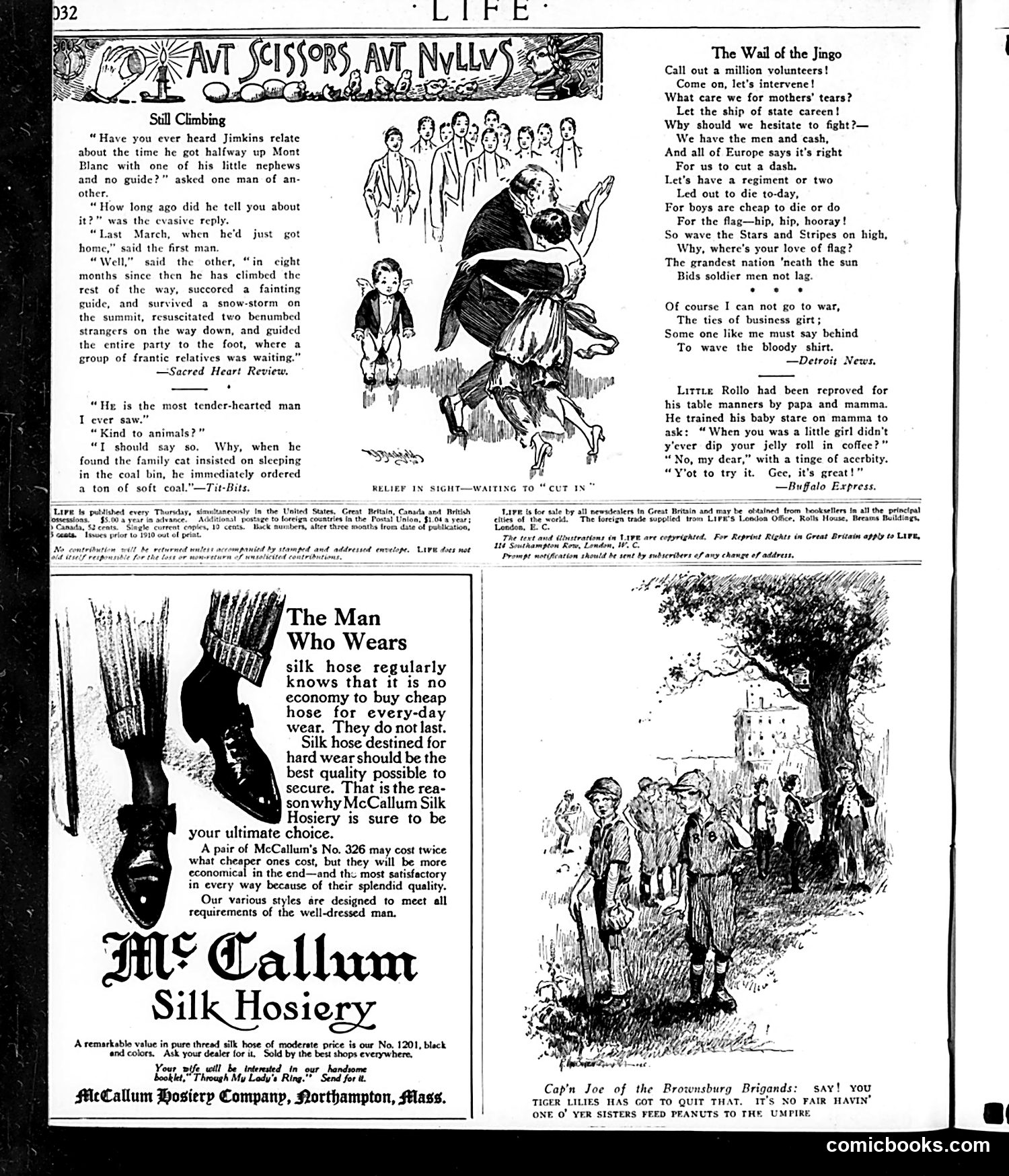
This page from *Life* magazine contains several distinct satirical pieces: **"The Wail of the Jingo"** is the primary political cartoon, mocking American interventionists who eagerly call for war while exempting themselves. The poem criticizes wealthy businessmen who patriotically wave flags and demand young soldiers fight ("boys are cheap to die"), yet claim business obligations prevent their own service—they stay home "to wave the bloody shirt" (profit from patriotic fervor). This satirizes WWI-era jingoism and class hypocrisy. **"Still Climbing"** and other brief comic anecdotes mock social pretension and exaggeration—people who endlessly retell inflated versions of mundane events. **"Little Rollo"** humorously depicts childhood innocence questioning adult behavior. The page also features a **McCallum Silk Hosiery advertisement** and a baseball joke about bribing an umpire with peanuts. The dominant message targets wealthy elites promoting military intervention while avoiding personal sacrifice.
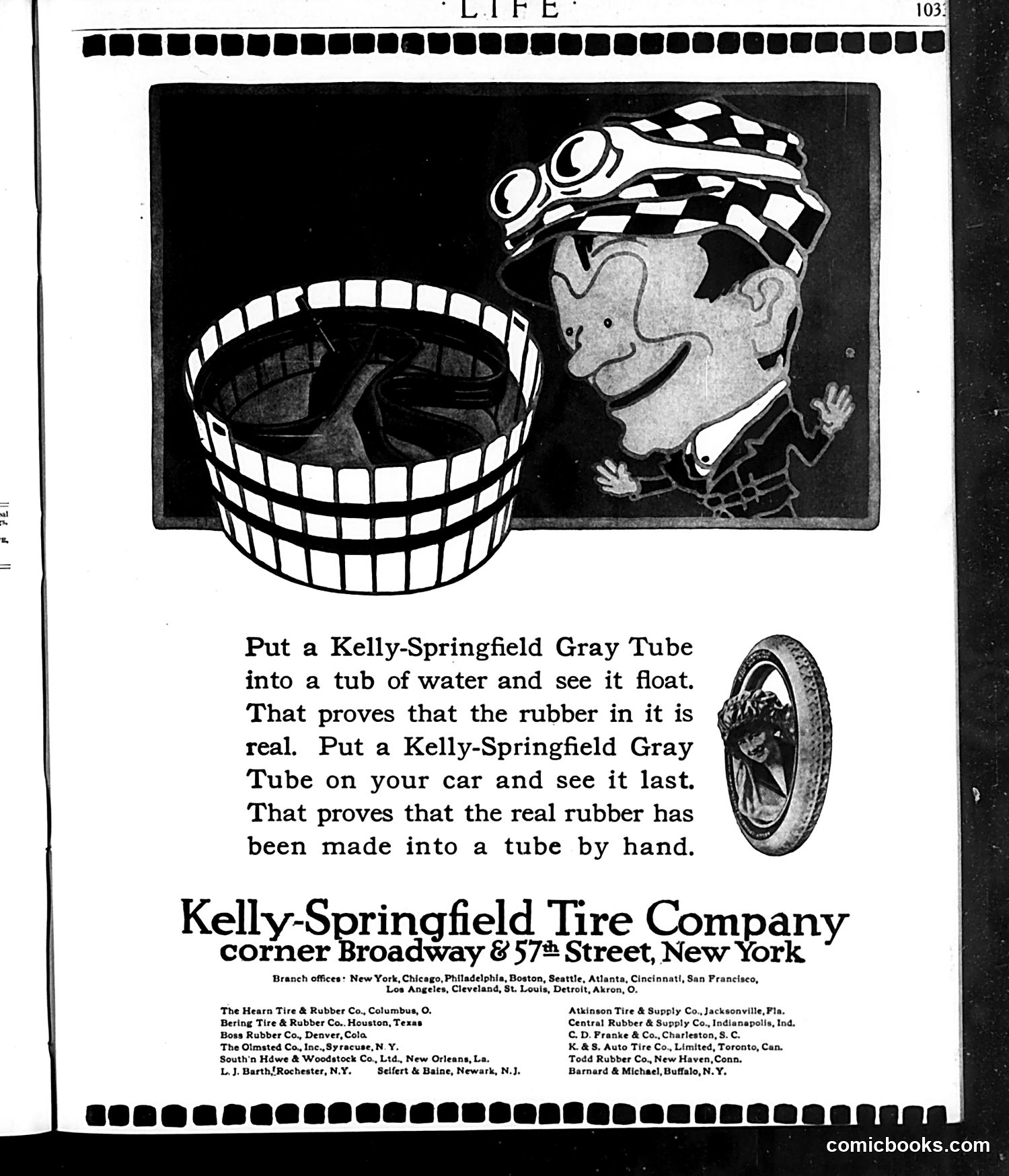
This is a **tire company advertisement**, not political satire. The page promotes Kelly-Springfield tires through a humorous demonstration concept. The cartoon shows a character (appears to be a caricatured driver or mechanic) wearing a checkered cap next to a wire basket/container and a tire. The ad's logic is comedic: floating a rubber tube in water "proves" the rubber is real; placing that same tube on a car and watching it last "proves" the rubber was hand-crafted into a quality product. The satire is gentle and self-aware—the company is essentially poking fun at advertising claims by offering absurdist "proof" of quality. This reflects early 20th-century advertising's mix of actual product demonstration and playful humor to sell tires to automobile owners. The branch office listings indicate this was a significant national tire manufacturer of the era.
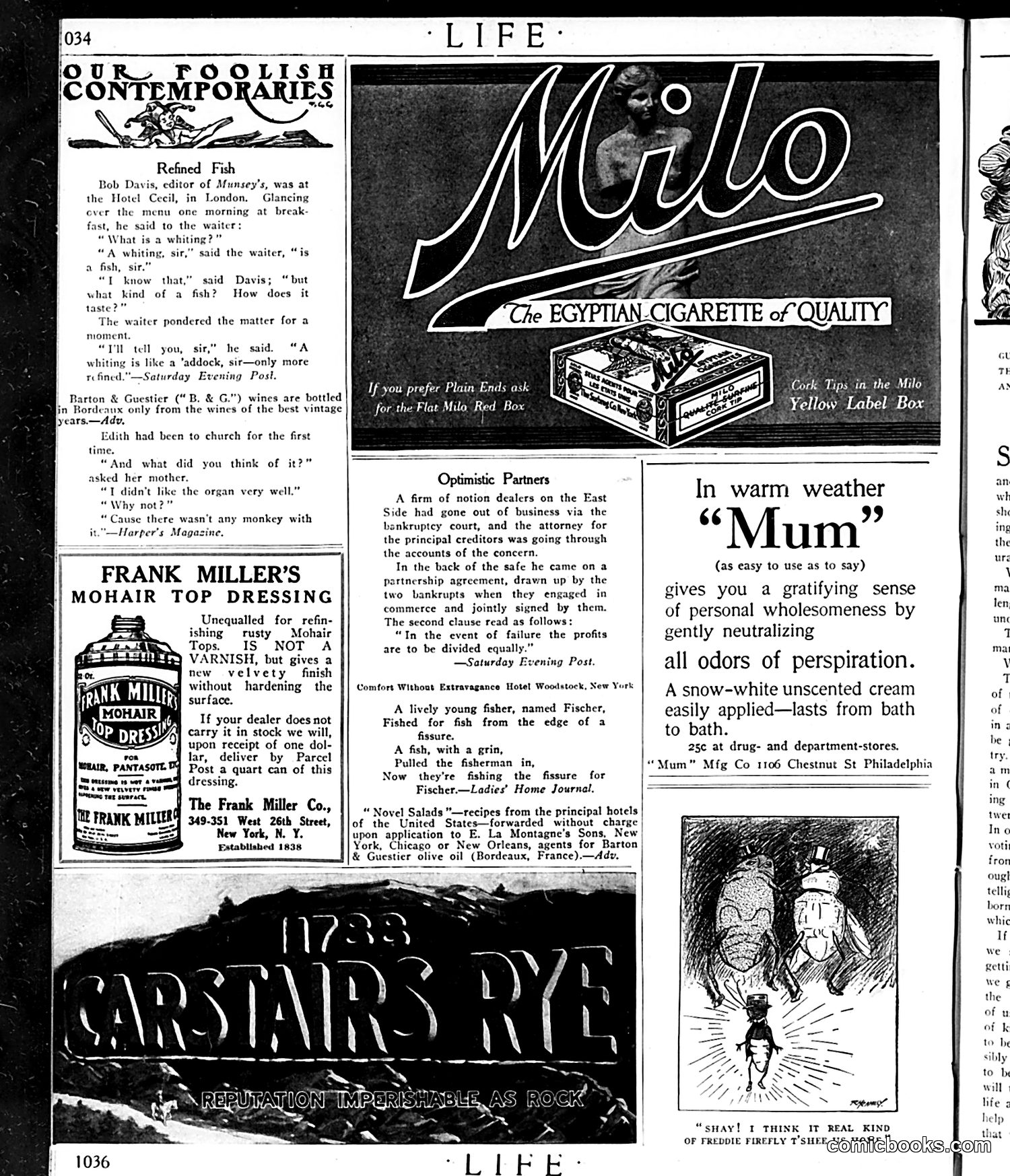
This page is primarily **advertising and humorous anecdotes** rather than political satire. The content includes: **"Our Foolish Contemporaries"** column: Three brief jokes mocking social awkwardness—a waiter's circular definition of fish, a child's confusion about church organs lacking "monkeys" (organ grinders), and a paradoxical partnership agreement dividing bankruptcy profits equally. **Advertisements** dominate: Milo cigarettes, Frank Miller's Mohair Top Dressing, and "Mum" deodorant (a snow-white cream neutralizing perspiration odors). **A humorous poem** about a fisherman named Fischer pulled into a fissure by a grinning fish—wordplay humor typical of the era. The cartoons appear to be visual gags rather than political commentary. This reflects *Life* magazine's shift toward lighter satirical humor and commercial advertising by this period, rather than hard-hitting political critique. The page exemplifies early 20th-century American magazine humor: genteel, pun-based, and commercially integrated.
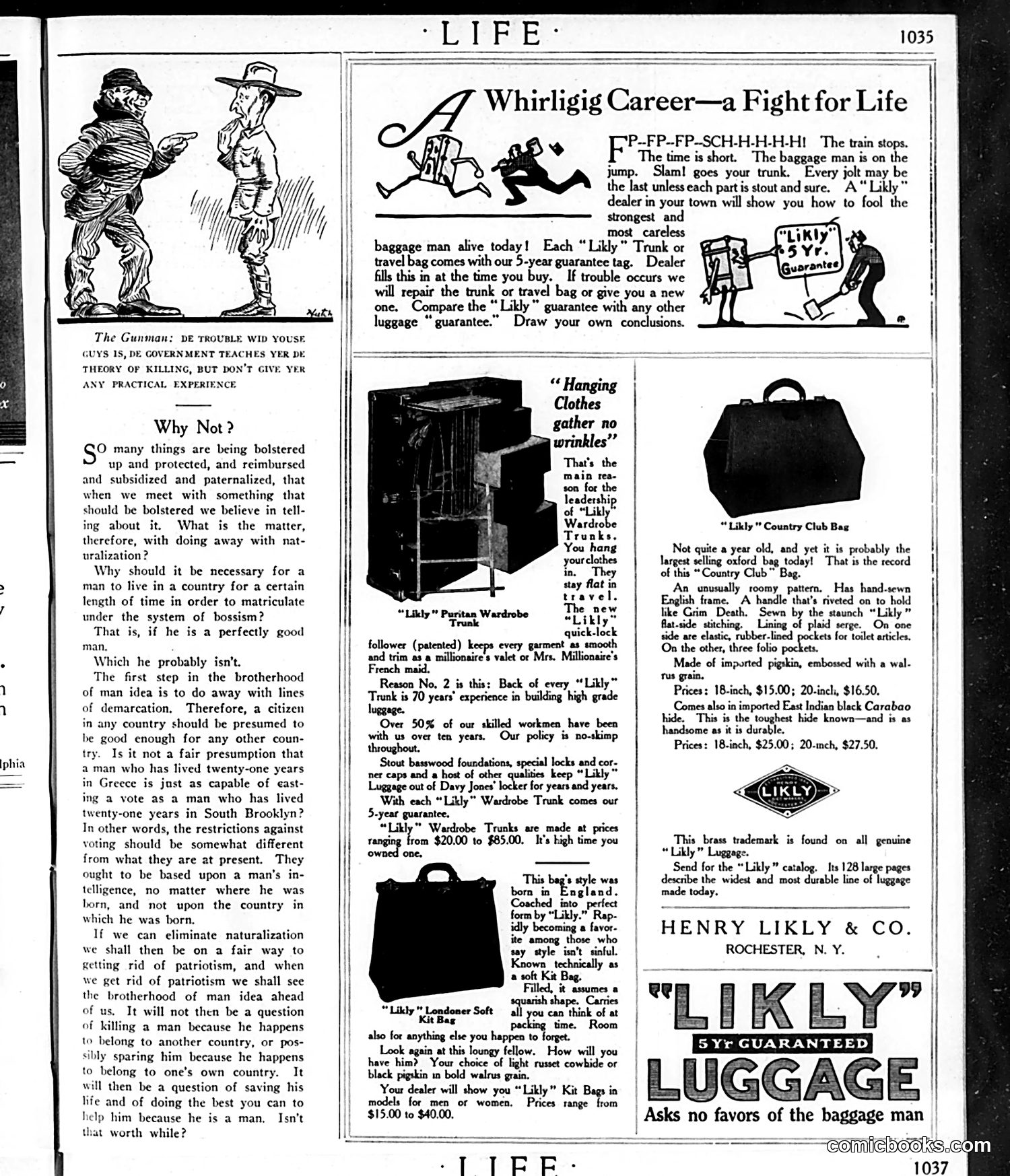
This page combines a political cartoon with luggage advertising. **The Cartoon ("The Gunman"):** A crude sketch depicts a gunman (drawn in exaggerated, stereotypical immigrant dialect) complaining that government teaches killing theory but provides no "practical experience." The satire targets early 20th-century anxieties about immigrant criminality and anarchist violence—playing on nativist fears that foreign-born residents posed dangers to American society. **The Editorial ("Why Not?"):** The accompanying text sarcastically argues for eliminating naturalization requirements, proposing that citizenship should depend on intelligence rather than national origin. The ironic point: if we truly believe in universal human brotherhood, we should stop privileging birthplace—but the author doubts this will happen because patriotism and national loyalty remain powerful. **The Ads:** The rest of the page advertises "Likly" luggage and wardrobe trunks, emphasizing durability and quality craftsmanship. The cartoon's crude dialect humor reflects period prejudices; modern readers should recognize this reflects historical xenophobia rather than endorsing it.
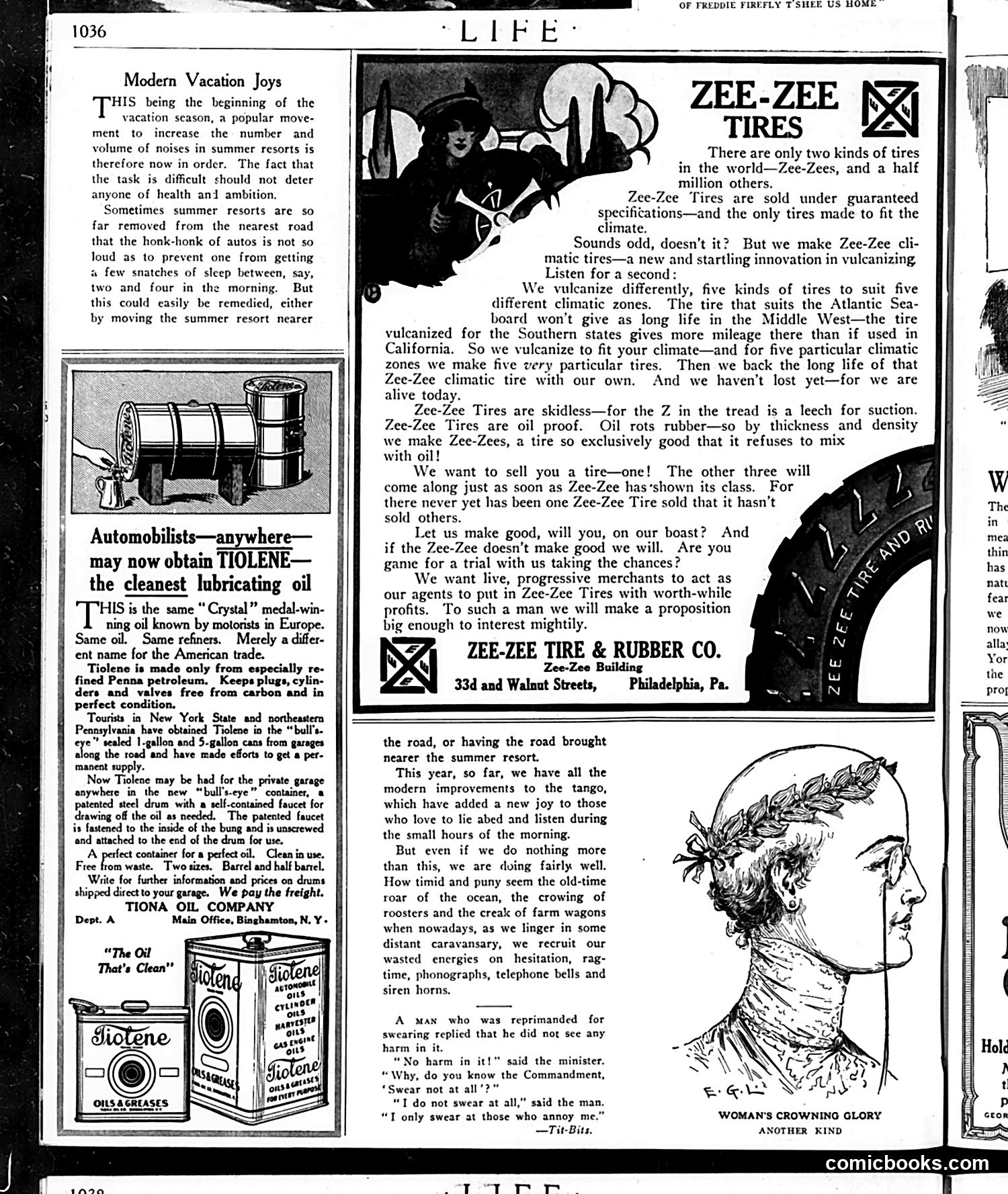
This page contains satirical editorial content alongside period advertisements, typical of Life magazine's format. **"Modern Vacation Joys"** is a tongue-in-cheek essay lamenting the noise pollution at summer resorts. It sardonically suggests that peaceful vacations are being destroyed by automobile horns and farm sounds (roosters, ocean waves, wagon creaks). The humor lies in the exaggerated complaint that resorts are *too quiet* and need more noise—a reversal of expected vacation desires. This reflects early-20th-century anxieties about automobiles transforming American leisure and countryside life. **The advertisements** for Tiolene oil and Zee-Zee tires represent typical automotive marketing of the era, emphasizing durability and regional product customization (Zee-Zee's "climatic tires" for different U.S. zones). **The sketch "Woman's Crowning Glory"** (bottom right) appears unrelated to the page's main content—likely a standard feature or filler illustration. The satire targets both the automobile industry's rapid expansion and Americans' conflicted feelings about modernization disrupting traditional vacation experiences.
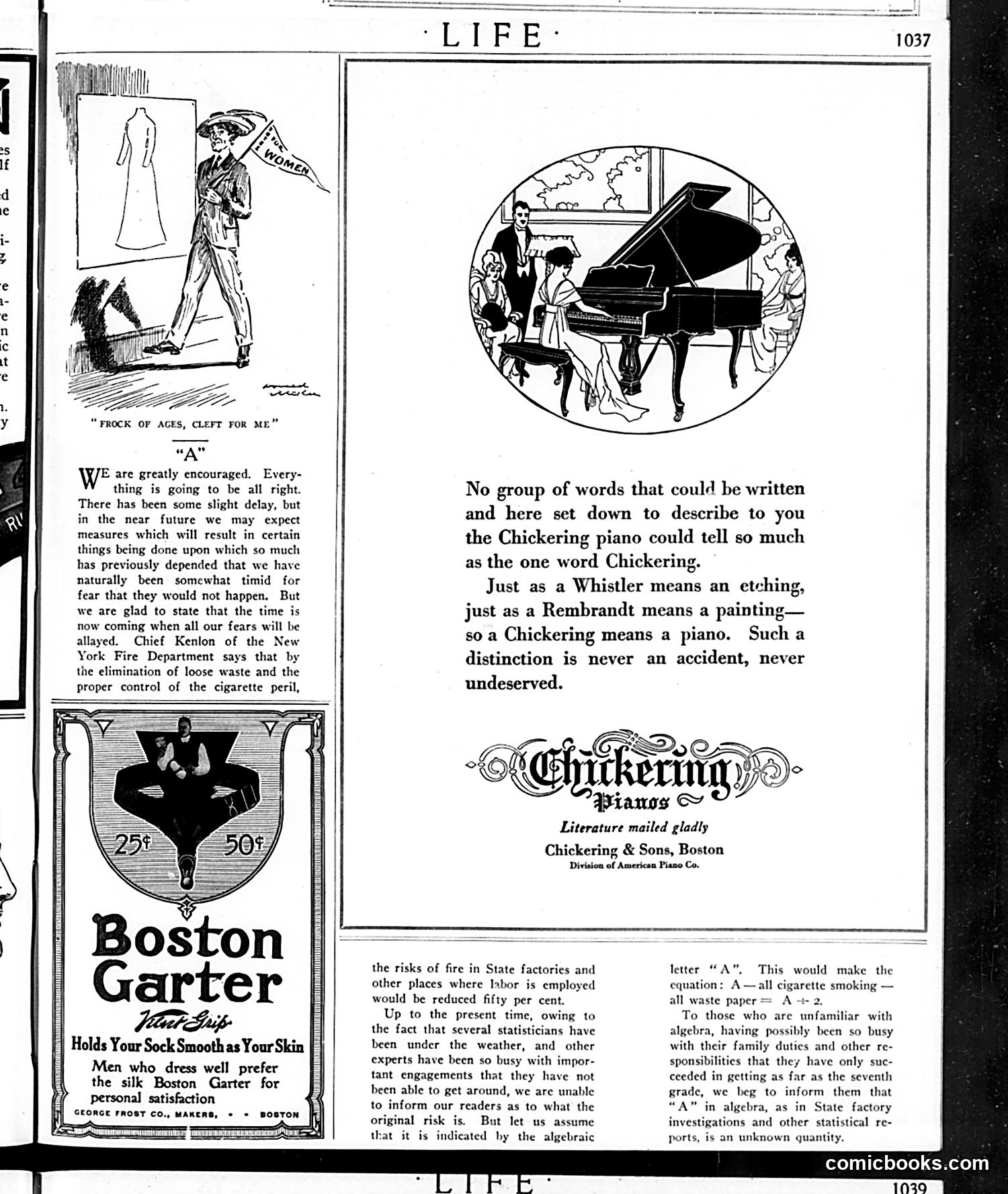
This page contains two satirical pieces mocking bureaucratic incompetence and vague promises. **Top cartoon**: "Frock of Ages, Cleft for Me" shows a fashioner presenting a dress design while a squirrel observes—likely satirizing absurd or impractical fashion claims. **Main text (marked "A")**: Life ridicules New York Fire Chief Kenlon's vague assurances about factory fire safety. The joke: the Chief promises that eliminating cigarette waste will reduce fire risk "fifty per cent," but Life sarcastically notes that statisticians haven't even determined what the original risk *is*. Using mock mathematical language, they expose the absurdity—Fire Chief Kenlon is making confident proclamations based on unknown data ("A" = an unknown quantity). This mocks how government officials make dramatic safety claims without actual evidence or clear baselines. The page also contains period **advertisements** (Boston Garter socks, Chickering pianos) typical of Life's commercial content.
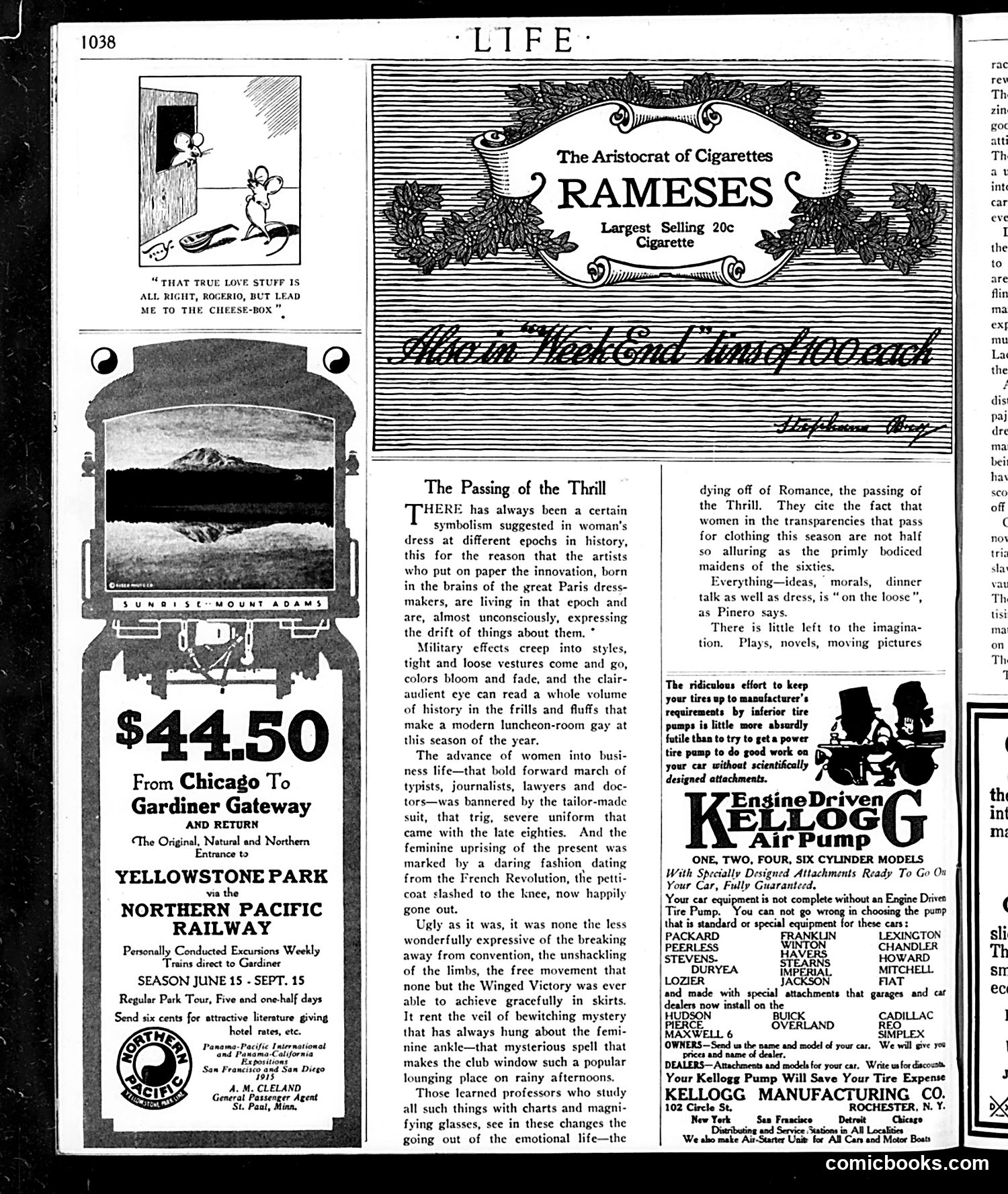
This page features a satirical article lamenting changes in women's fashion and behavior circa 1920s. The text argues that modern women's liberated dress—shorter skirts, looser clothing—represents the "passing of Romance" and "the Thrill." The author contends that as women entered business (typists, lawyers, journalists), they abandoned corseted formality for practical tailored suits. The article frames this as cultural decay: transparent, revealing modern fashions lack the "mystery" and allure of Victorian-era modest dress. The piece cynically suggests contemporary life—plays, novels, moving pictures—offers "little left to the imagination." This reflects period anxieties about women's liberation and changing gender norms. The satire cuts both ways: while Life mocks conservative nostalgia for restrictive Victorian fashion, it also critiques modern society's perceived loss of decorum and romance. The article exemplifies early 20th-century hand-wringing over rapid social change and women's independence.
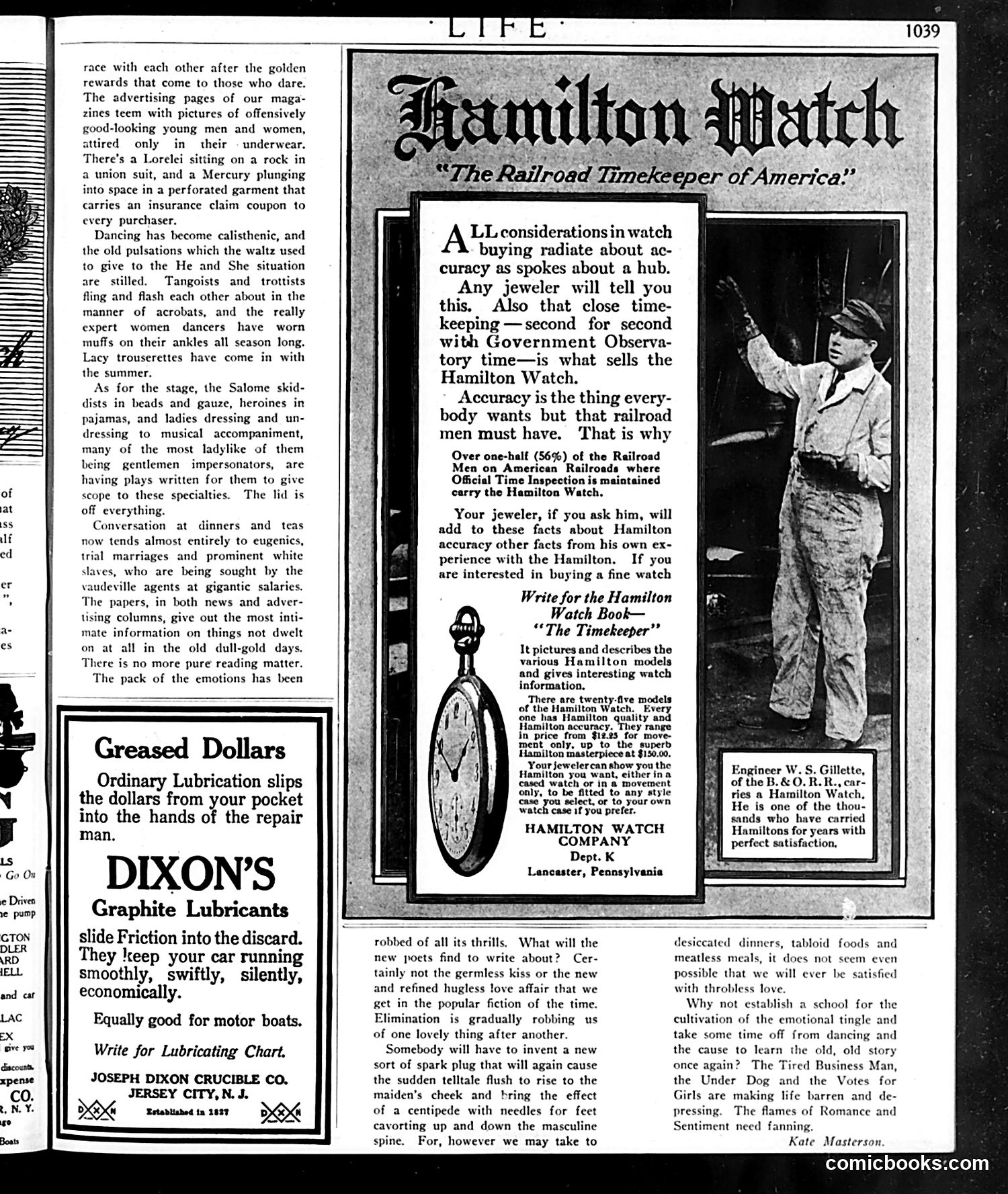
This page contains a satirical essay lamenting modern social changes, paired with period advertisements. The main text criticizes early 20th-century trends: revealing fashion in advertising, "calisthenic" dancing replacing sensual waltzing, provocative stage performances, and frank public discussion of previously taboo topics (eugenics, unmarried relationships, sexuality). The author mourns lost "thrills" and emotional restraint, arguing society has stripped away mystery and propriety. The satire targets contemporary anxieties about rapid moral loosening—what conservatives viewed as dangerous modernism. The vivid complaints about women in underwear ads, stage undressing, and casual conversation about sex reveal period prudishness. The page is largely advertisements (Dixon's lubricants, Hamilton watches), typical of Life magazine's revenue model. The Hamilton Watch ad emphasizes railroad precision—a practical counterpoint to the moral chaos described above.
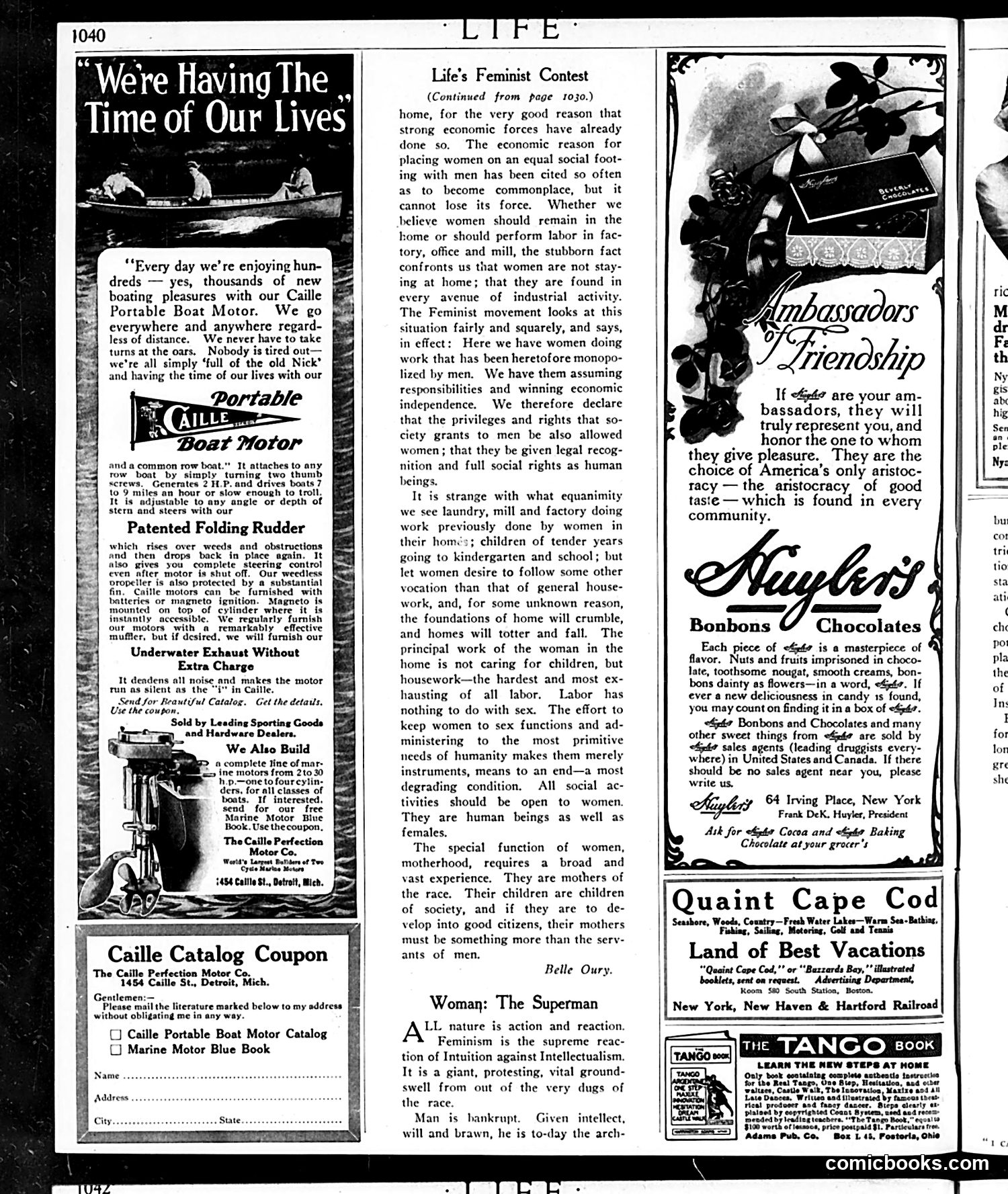
This page is primarily **advertising** interspersed with editorial content on feminism. The dominant visuals are **product advertisements**: a Caille Portable Boat Motor (top left, showing leisure boating), Nuyler's Chocolates (top right), and other consumer goods. The substantive text is **"Life's Feminist Contest"** (continued from page 1030), which argues for women's **economic and social equality**. The article observes that women already work in factories, mills, and offices—performing labor previously monopolized by men—yet society resists granting them full legal rights and social recognition. The author (likely Belle Onry, bylined at bottom) critiques the contradictory logic that allows women's industrial labor while denying them equality, and attacks the notion that women pursuing vocations beyond housework threatens the home. The piece treats feminism as a practical response to existing economic conditions rather than abstract ideology. This reflects the **1910s-1920s American feminist debate** during women's suffrage activism, focusing on labor equality and legal recognition rather than purely domestic concerns.
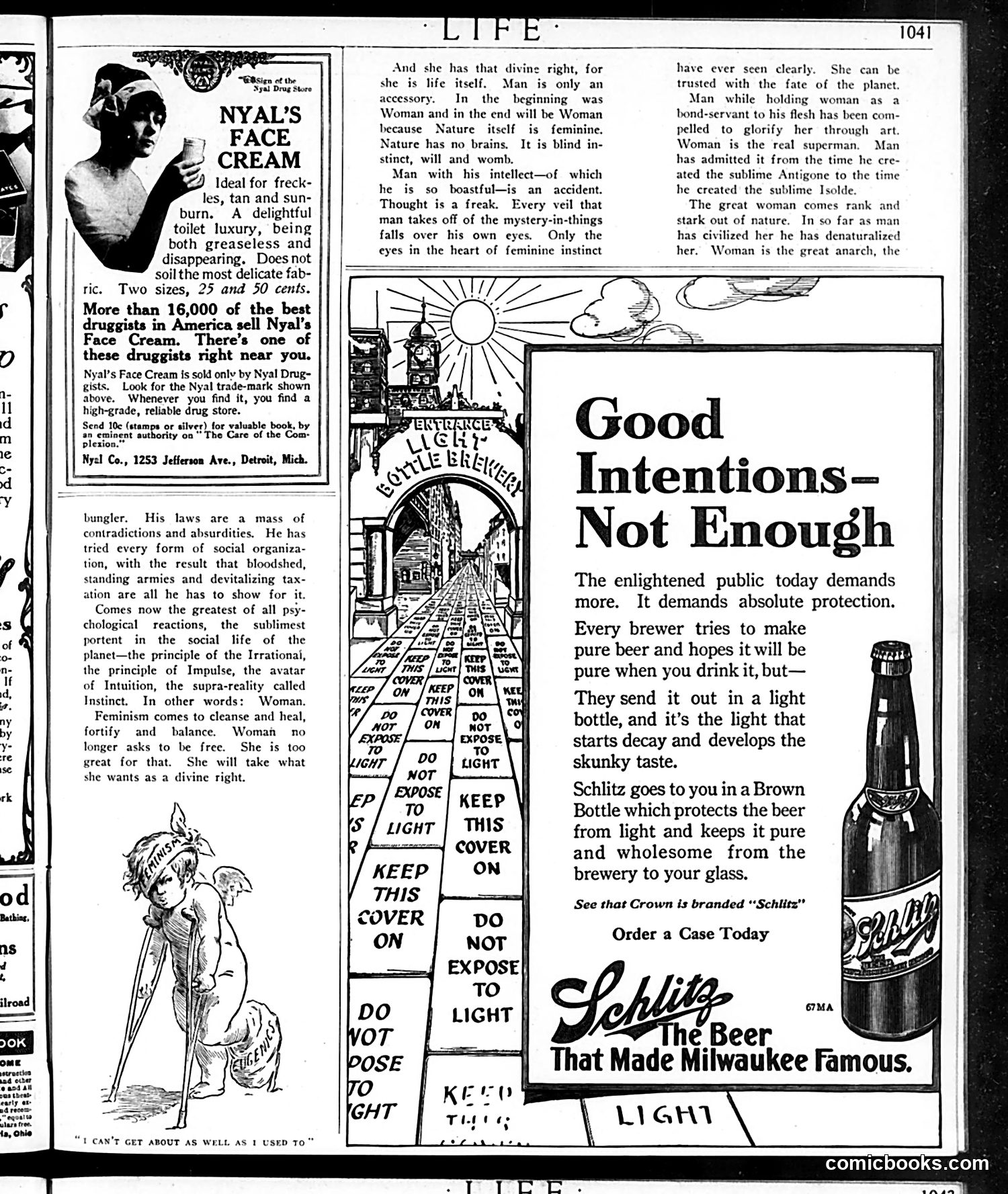
This page combines a philosophical essay on feminism with period advertising. ## The Editorial Content The left-center text is a pro-feminist manifesto (author unclear from image) arguing that Woman represents "Instinct" and intuitive wisdom superior to Man's flawed intellect and reason. It characterizes women as "the real superman" and society's redemptive force. The rhetoric—"Woman is the great anarch"—reflects early-20th-century feminist and suffragette discourse, though the patronizing tone ("she is too great") reveals the piece's likely satirical intent. Life magazine often mocked pretentious intellectual trends. ## The Advertising Two ads appear: **Nyal's Face Cream** (upper left) and a dominant **Schlitz Beer advertisement** (center-right). The beer ad emphasizes brown bottles protecting beer from light-induced deterioration—a practical sales pitch. The juxtaposition with the feminist essay is likely coincidental rather than satirical. The cartoon illustration in the lower left remains unclear without caption visibility.
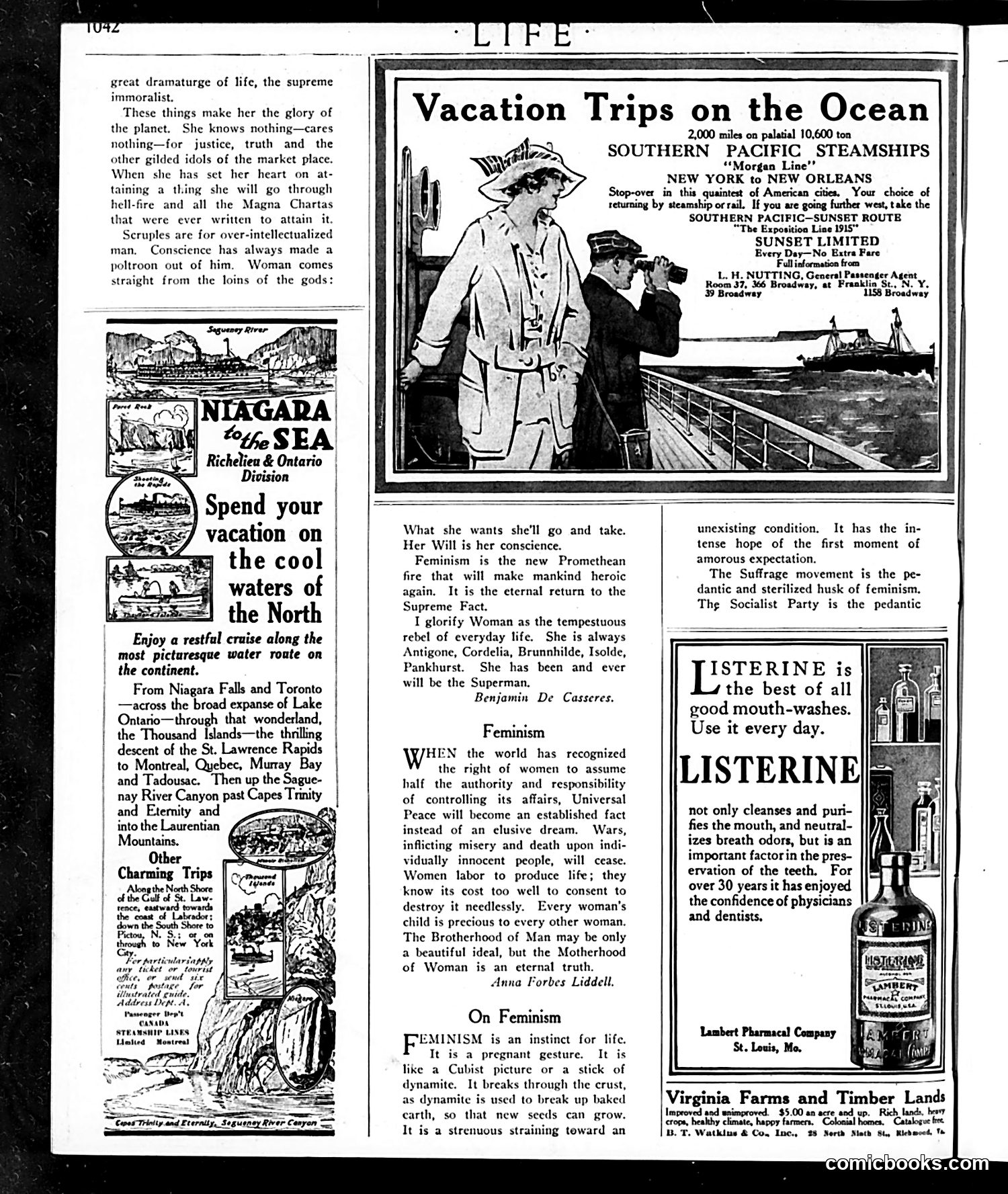
This page presents competing visions of feminism circa 1915. The main text consists of three philosophical essays debating women's liberation: **Benjamin De Casseres** celebrates Woman as an amoral "Superman" figure—passionate, willful, unconstrained by conscience or convention. He invokes tragic heroines (Antigone, Cordelia) and the suffragist Pankhurst as examples. **Anna Forbes Liddell** argues feminism will bring universal peace, since women—producers of life—won't consent to war's destruction. She distinguishes the "Motherhood of Woman" as eternal truth from mere male ideals. **The final essay** treats feminism as vital instinct and "dynamite" breaking through social crust, dismissing the suffrage movement as merely "pedantic" activism while praising socialism as more radical. The page juxtaposes these abstract debates with mundane **advertisements** (steamship vacations, Listerine mouthwash, farmland), creating ironic contrast between lofty feminist philosophy and commercial consumer culture. The satire likely mocks both feminism's grandiose rhetoric and its trivialization by advertising.
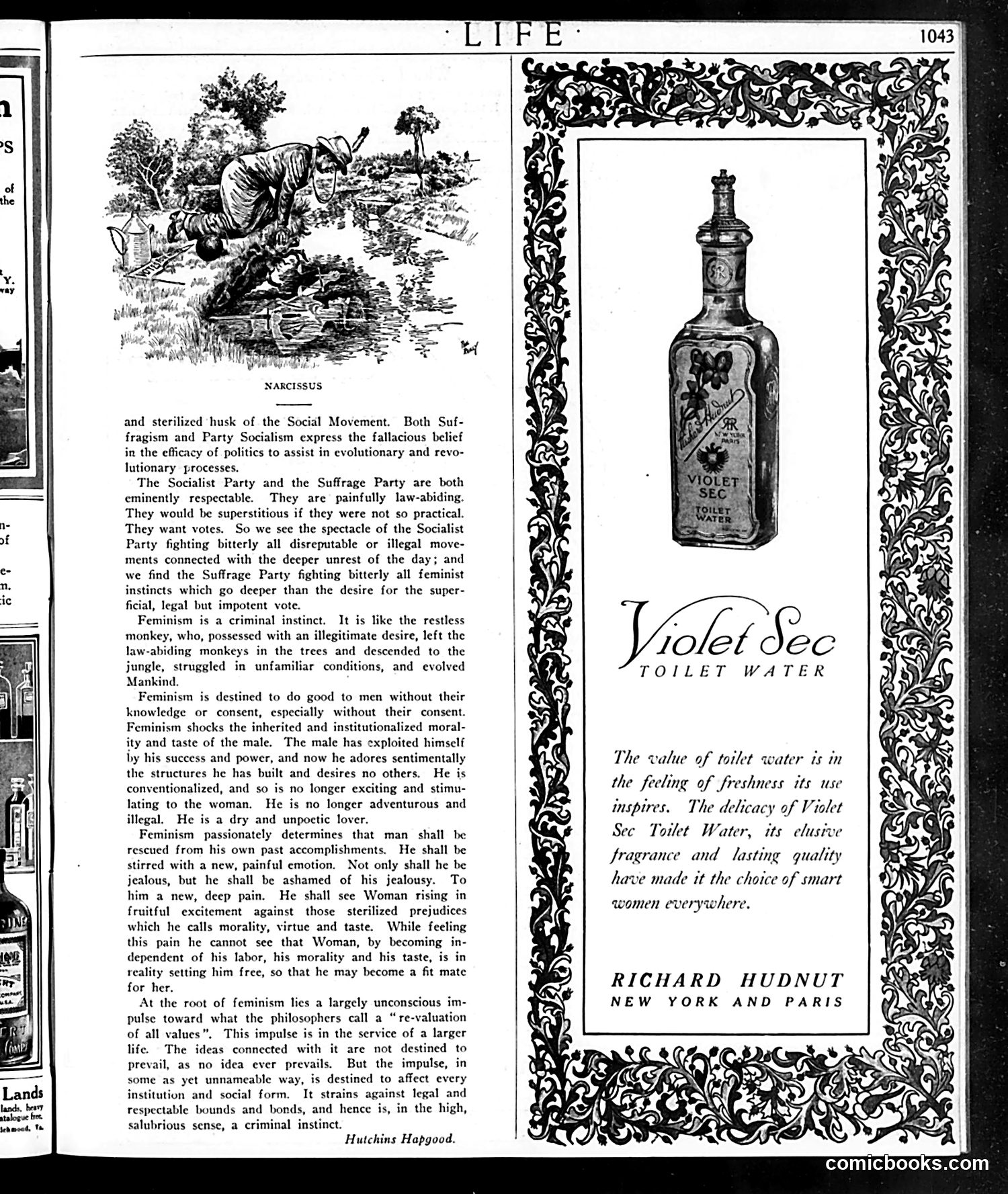
**Left Column - Editorial Content:** This is Hutchins Hapgood's essay attacking feminism as a "criminal instinct." The piece sarcastically praises feminism while condemning it, arguing that the organized Suffrage Party and Socialist Party are ineffectual because they're too respectable and law-abiding. Hapgood's central claim: true feminism is radical and lawless, destined to disrupt male-dominated institutions regardless of political legality. The "Narcissus" illustration (top left) likely depicts self-absorption—possibly critiquing either male vanity or the movement's focus. **Right Column - Advertisement:** A Richard Hudnut toilet water ad featuring an ornate decorative border. This placement is notable: the magazine juxtaposes Hapgood's lengthy polemic against women's liberation with a luxury beauty product advertisement targeting women, creating ironic contrast between the editorial's radical rhetoric and the magazine's commercial appeal to female consumers. **Context:** This reflects early 20th-century Life magazine's satirical, often contradictory stance on women's rights—simultaneously mocking suffragists while profiting from women's consumer culture.
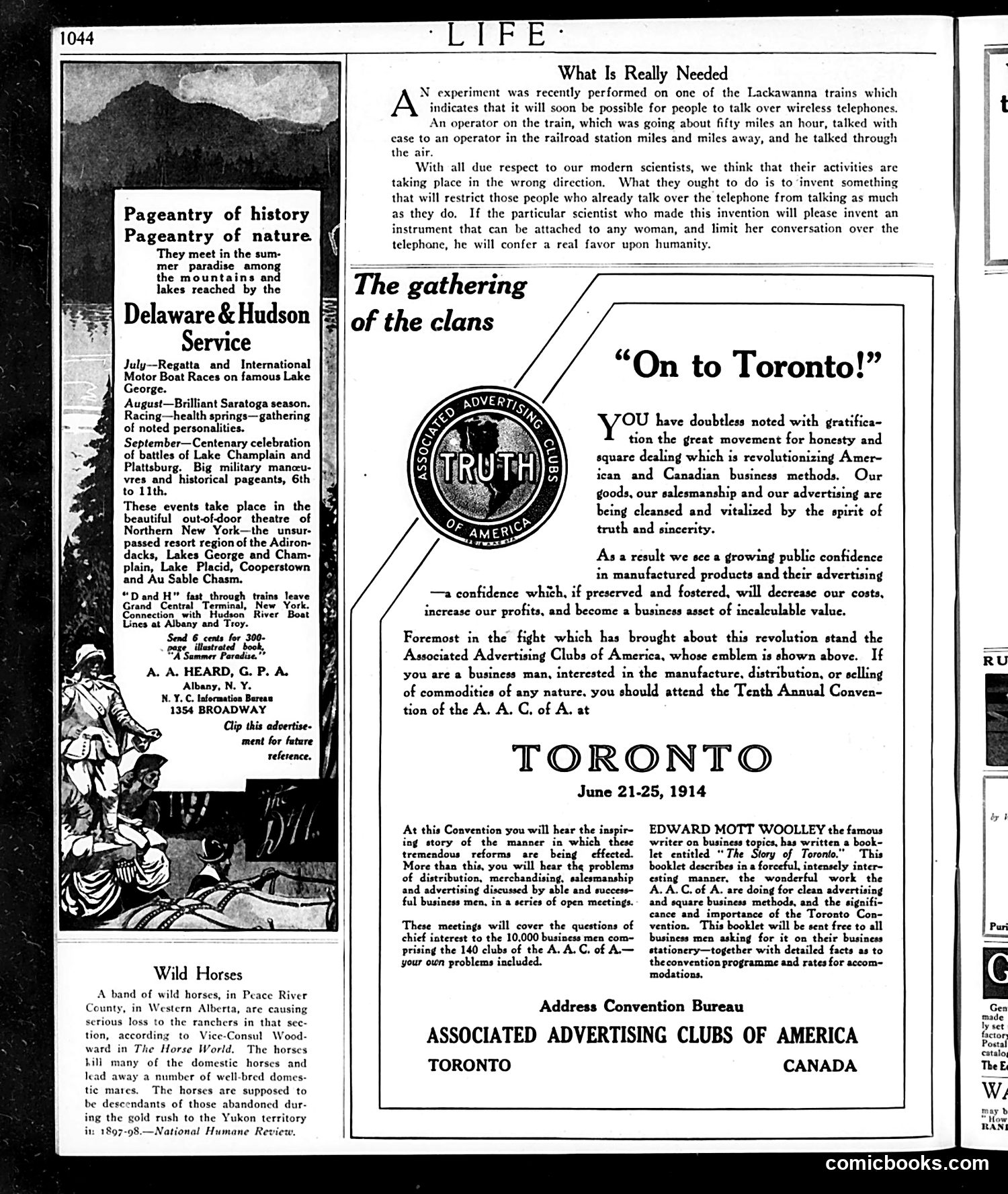
This page primarily contains advertising and convention promotion rather than political cartoons. The main satirical content appears in the opening section "What Is Really Needed," which mocks recent wireless telephone technology demonstrated on Lackawanna trains. The author jokes that scientists should instead invent a device to *restrict* women's telephone conversations rather than enable wireless communication. This reflects period attitudes about women as excessive talkers—a sexist stereotype common to early 20th-century humor that modern readers would recognize as dated and offensive. The rest of the page promotes the 1914 Toronto convention of the Associated Advertising Clubs of America, emphasizing their mission promoting "truth and sincerity" in advertising and business ethics. The left sidebar advertises Delaware & Hudson Service travel opportunities through New York's scenic regions. No clearly identifiable political figures or caricatures appear on this page.
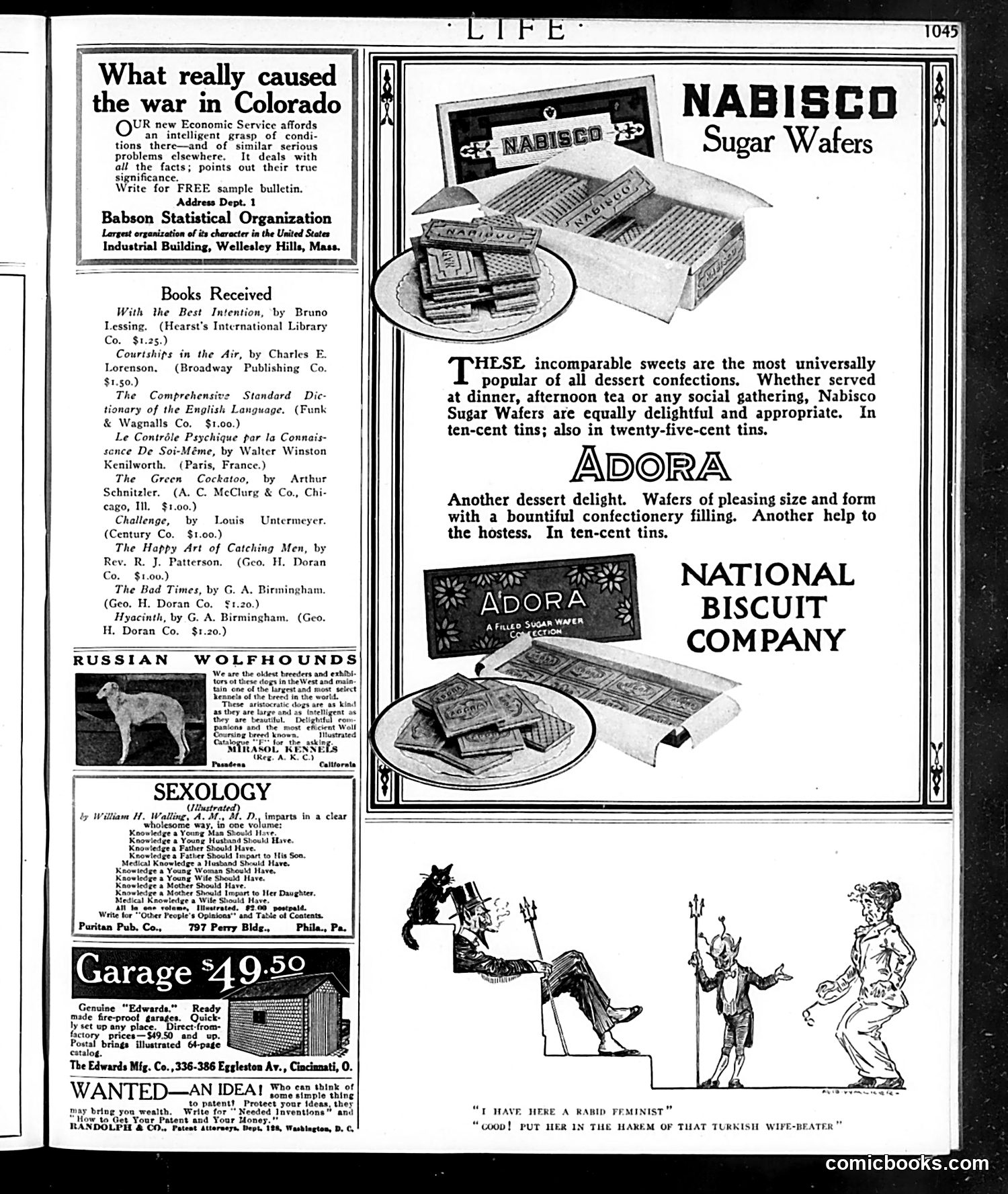
This page is primarily **advertising** for consumer products (Nabisco wafers, Adora biscuits), interspersed with book listings and other commercial notices. The only cartoon appears at the bottom: a satirical drawing mocking feminism. It shows a man presenting a woman to another man as "a rabid feminist," with the response suggesting she be put "in the harem of that Turkish wife-beater"—implying her feminist views would be "corrected" through subjugation in a Turkish household. **The satire's point:** This reflects early 20th-century anti-feminist mockery, ridiculing women's rights advocates by suggesting they deserve harsh treatment or domination. The "Turkish wife-beater" reference plays on Western stereotypes of Ottoman/Turkish men as brutal oppressors of women—darkly joking that such oppression would silence feminists. For modern readers, this illustrates how mainstream American magazines published contemptuous humor targeting the emerging women's suffrage and rights movement of that era.
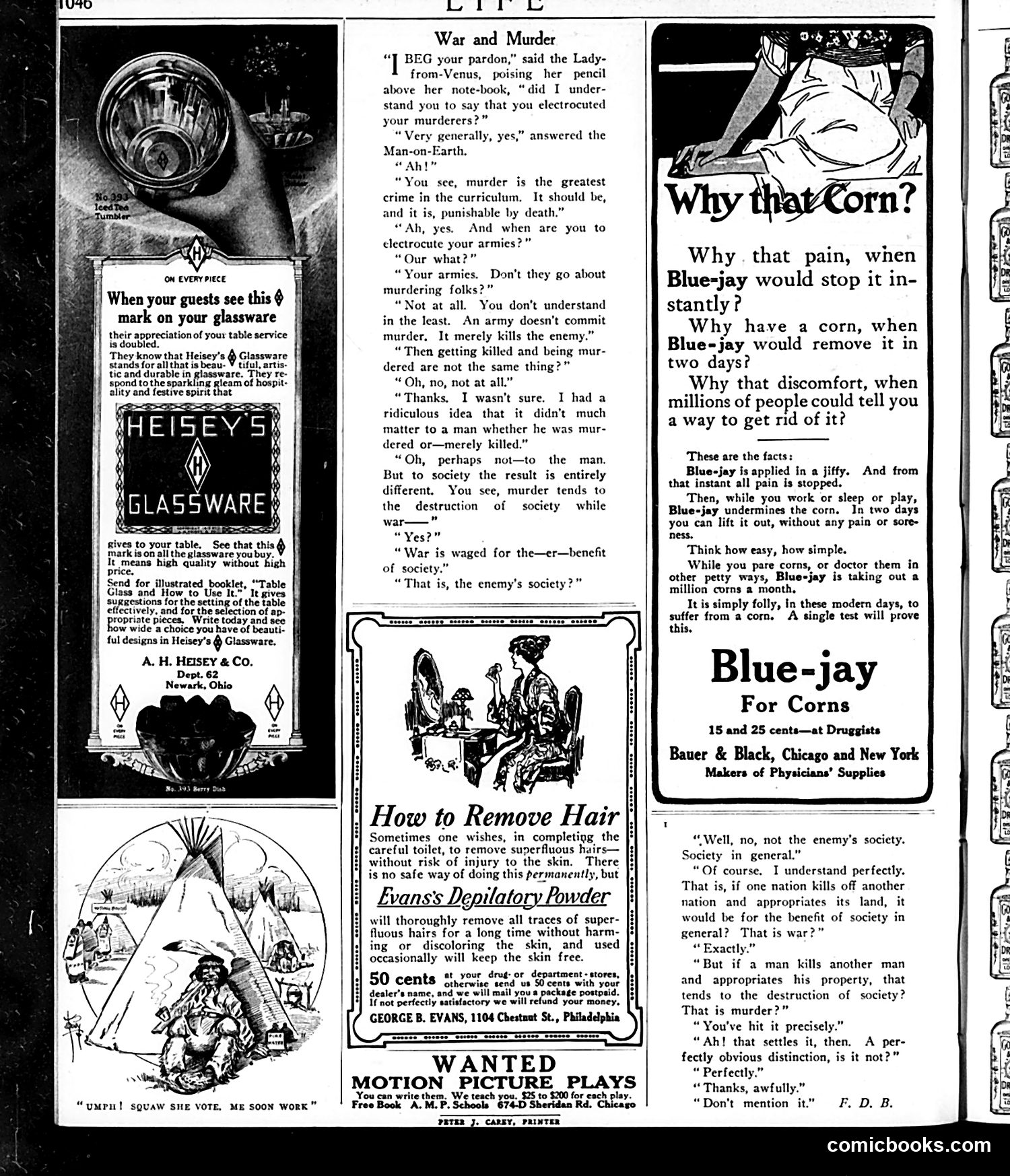
This page contains a satirical dialogue titled "War and Murder" between a Lady-from-Venus and a Man-on-Earth. The cartoon's central point is a **critique of war's hypocrisy**: Earth society executes individuals for murder as the gravest crime, yet wages war—where soldiers kill enemy populations—and considers this justified, even noble. The dialogue exposes the logical contradiction: when the Lady asks why armies aren't electrocuted for "murdering folks," the Man distinguishes between "murder" (criminal, individual killing) and "killing the enemy" (war, state-sanctioned killing). The satire lies in showing this distinction as absurd—both result in death, yet society morally condemns one while glorifying the other. By using an outsider observer (the Lady-from-Venus), the cartoonist makes familiar assumptions seem strange and illogical, a common satirical technique. The page's other advertisements (for glassware, corn remover, hair removal) are incidental to this antiwar message.
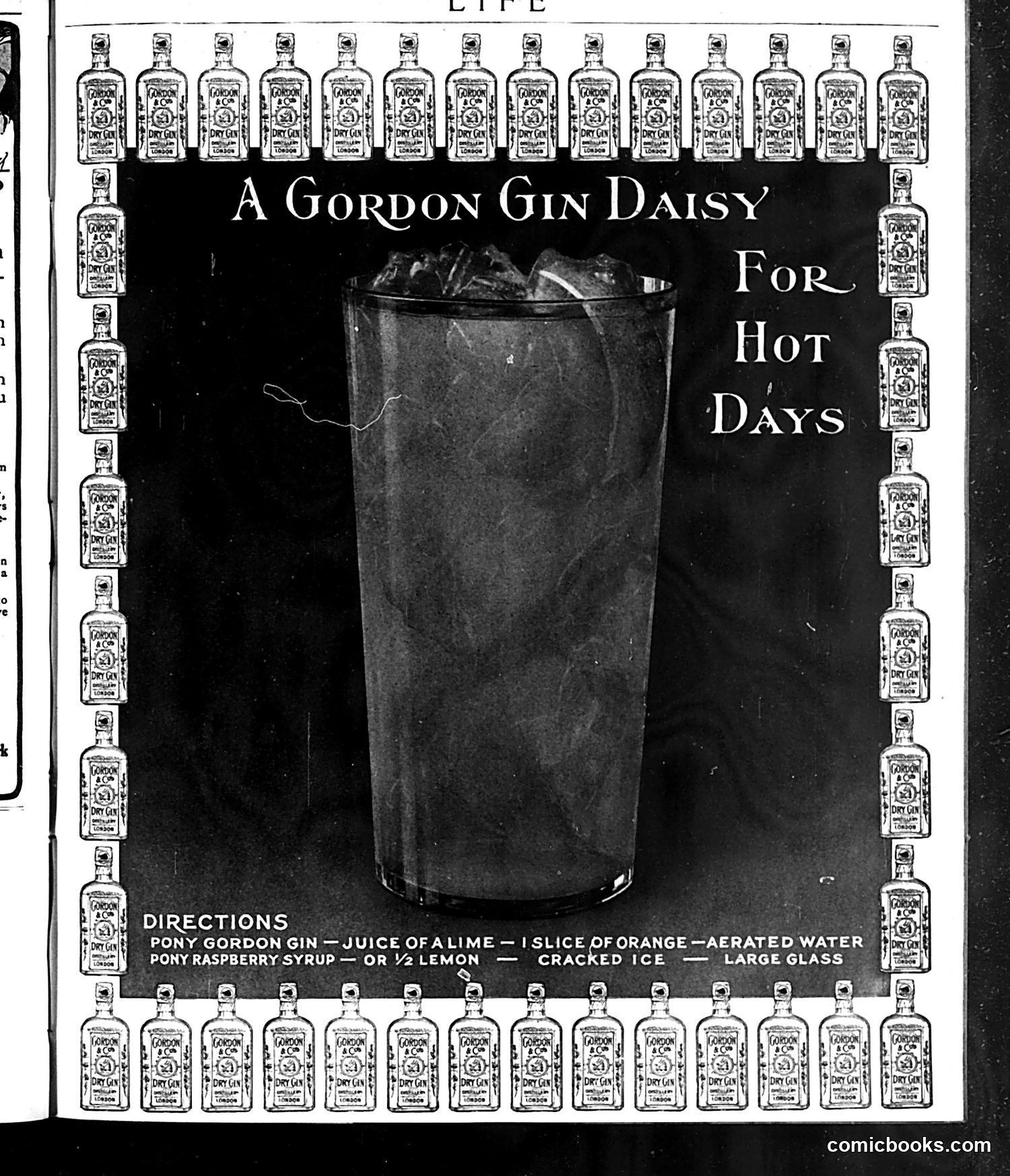
This is primarily a **Gordon's Gin advertisement**, not political satire. The page features a recipe/advertisement for a cocktail called "A Gordon Gin Daisy" presented as an ideal refreshment for hot weather. The directions list ingredients: pony (small measure) of Gordon Gin, juice of a lime, one slice of orange, aerated water, pony raspberry syrup or half lemon, cracked ice, and a large glass. The advertisement uses decorative borders of Gordon's Gin bottles framing a large photograph of the finished cocktail—a tall glass filled with ice and the mixed drink. This appears to be from the Prohibition era's end or shortly after, when alcohol advertising had resumed in American publications. The "daisy" was a standard cocktail category of the period.
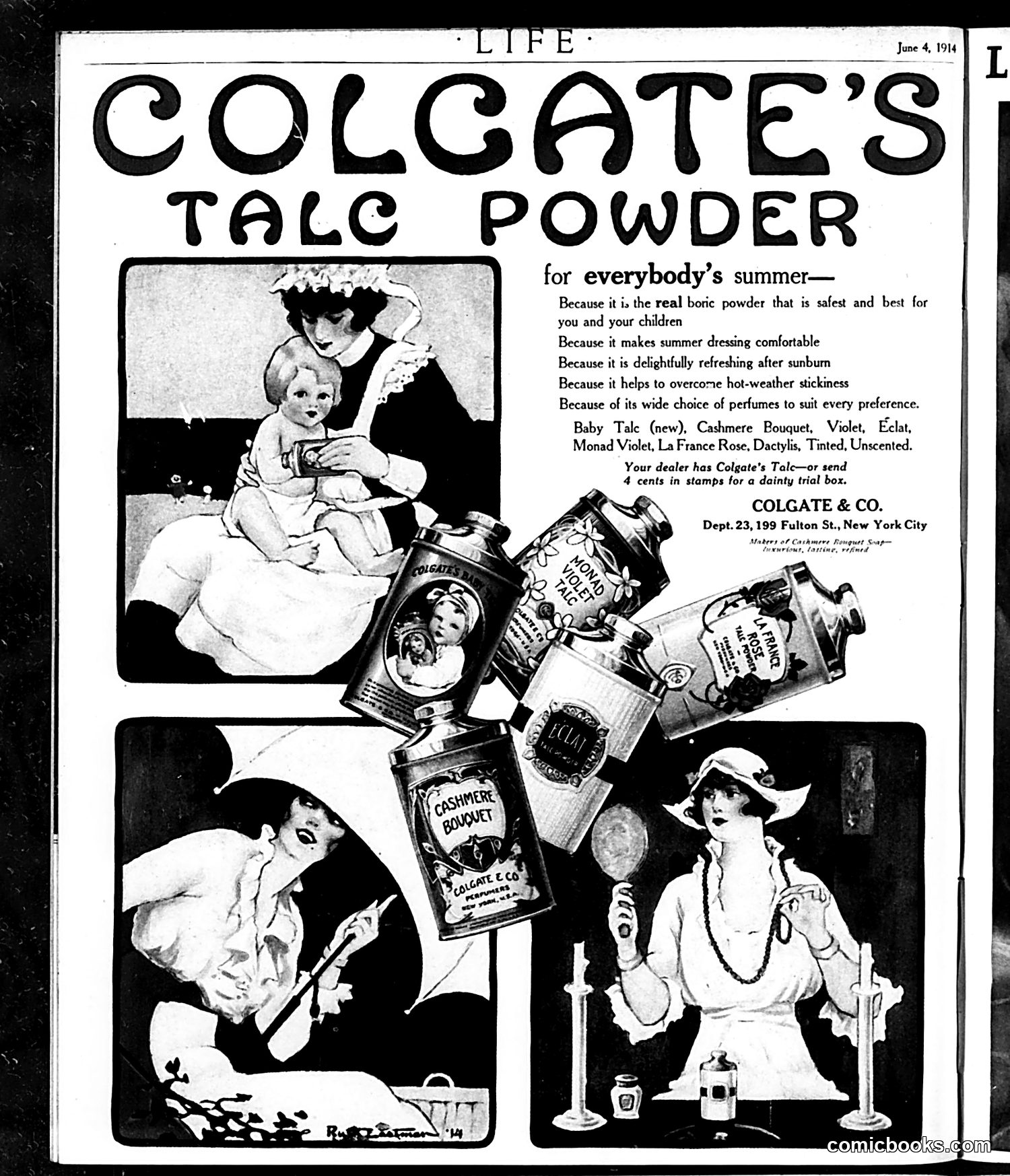
This is a straightforward **product advertisement**, not satire. It promotes Colgate & Co.'s talc powder for summer use, marketed primarily to women and mothers. The imagery shows three scenes: a mother with a baby, and two women using the powder for summer comfort. The central display showcases multiple scent varieties (Cashmere Bouquet, Violet, etc.), emphasizing choice. The marketing pitch emphasizes practical summer benefits—cooling, comfort, reducing perspiration and "hot-weather stickiness"—while also claiming the boric acid formula is "safest and best for you and your children." This reflects early 20th-century attitudes toward talc and boric acid as beneficial personal hygiene products. The ad offers a trial box for four cents in stamps, a common direct-mail marketing tactic of the era. This represents standard commercial advertising of its period, before modern concerns about talc safety emerged.