
Life, 1914-06-04 · page 25 of 52
Life — June 4, 1914 — page 25: what you’re looking at
What you’re looking at
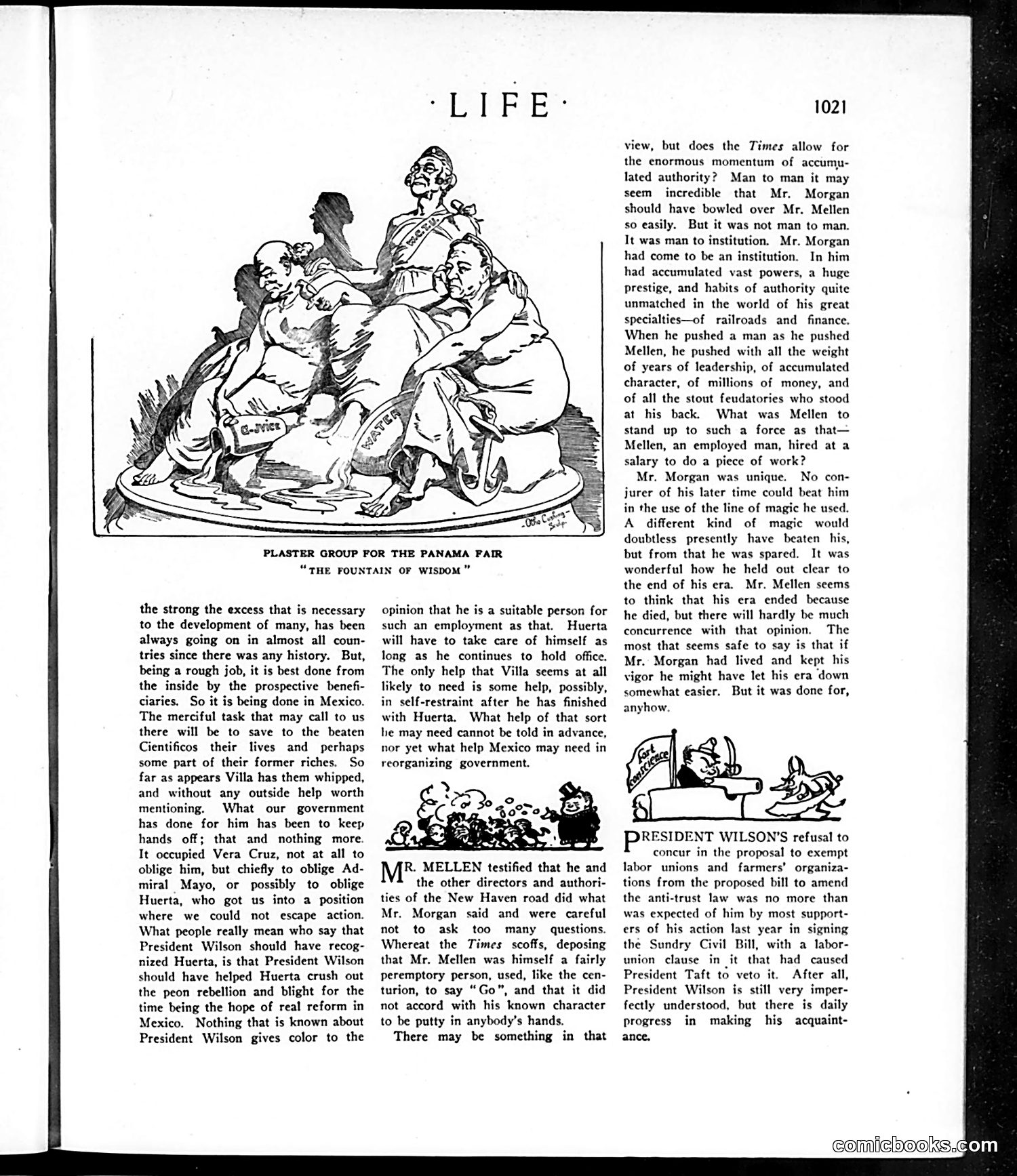
This satirical plaster sculpture group ridicules Mexican political leadership during the Mexican Revolution era (circa 1913-1914). The caricatured figures appear to represent Mexican political and military authorities—likely including President Huerta and associated corrupt officials ("Cientificos")—depicted as bloated, foolish, and lacking wisdom despite their power and pretensions. The accompanying text discusses U.S. intervention in Mexico, President Wilson's foreign policy stance, and the internal Mexican conflicts between reform movements (Villa) and the established regime (Huerta). The cartoon's title sardonically suggests these leaders represent the opposite of wisdom, mocking their incompetence and moral bankruptcy as Mexico undergoes revolutionary upheaval. The "fountain" ironically suggests they're a source of guidance when actually embodying corruption and folly.
📄 Transcribed text from this page (OCR, searchable)
Machine-transcribed from the original scan — historical spelling and the odd misread are preserved.
PLASTER GROUP FOR THE PANAMA FAIR “THE FOUNTAIN OF WISDOM” the strong the excess that is necessary to the development of many, has been always going on in almost all coun- tries since there was any history. But, being a rough job, it is best done from the inside by the prospective benefi- ciaries, So it is being done in Mexico. The merciful task that may call to us there will be to save to the beaten Cientificos their lives and perhaps some part of their former riches. So far as appears Villa has them whipped, and without any outside help worth mentioning. What our government has done for him has been to keep hands off; that and nothing more. It occupied Vera Cruz, not at all to oblige him, but chiefly to oblige Ad- miral Mayo, or possibly to oblige Huerta, who got us into a position where we could not escape action. What people really mean who say that President Wilson should have recog- nized Huerta, is that President Wilson should have helped Huerta crush out the peon rebellion and blight for the time being the hope of real reform in Mexico. Nothing that is known about President Wilson gives color to the opinion that he is a suitable person for such an employment as that. Huerta will have to take care of himself as long as he continues to hold office. The only help that Villa seems at all likely to need is some help, possibly, in self-restraint after he has finished with Huerta. What help of that sort he may need cannot be told in advance, nor yet what help Mexico may need in reorganizing government. R. MELLEN testified that he and the other directors and authori- ties of the New Haven road did what Mr. Morgan said and were careful not to ask too many questions. Whereat the Times scoffs, deposing that Mr. Mellen was himself a fairly peremptory person, used, like the cen- turion, to say “Go”, and that it did not accord with his known character to be putty in anybody’s hands. There may be something in that 1021 view, but does the Times allow for the enormous momentum of accumu- lated authority? Man to man it may seem incredible that Mr. Morgan should have bowled over Mr. Mellen so easily. But it was not man to man. It was man to institution. Mr. Morgan had come to be an institution. In him had accumulated vast powers, a huge prestige, and habits of authority quite unmatched in the world of his great specialties—of railroads and finance. When he pushed a man as he pushed Mellen, he pushed with all the weight of years of leadership, of accumulated character, of millions of money, and of all the stout feudatories who stood at his back. What was Mellen to stand up to such a force as that— Mellen, an employed man, hired at a salary to do a piece of work? Mr. Morgan was unique. No con- jurer of his later time could beat him in the use of the line of magic he used. A different kind of magic would doubtless presently have beaten his, but from that he was spared. It was wonderful how he held out clear to the end of his era. Mr. Mellen seems to think that his era ended because he died, but there will hardly be much concurrence with that opinion. The most that seems safe to say is that if Mr. Morgan had lived and kept his vigor he might have let his era down somewhat easier. But it was done for, RESIDENT WILSON’S refusal to concur in the proposal to exempt labor unions and farmers’ organiza- tions from the proposed bill to amend the anti-trust law was no more than was expected of him by most support- ers of his action last year in signing the Sundry Civil Bill, with a labor- union clause in it that had caused President Taft to veto it. After all, President Wilson is still very imper- fectly understood, but there is daily progress in making his acquaint- ance, comichooks.qelu)