
Life, 1914-06-04 · page 17 of 52
Life — June 4, 1914 — page 17: what you’re looking at
What you’re looking at
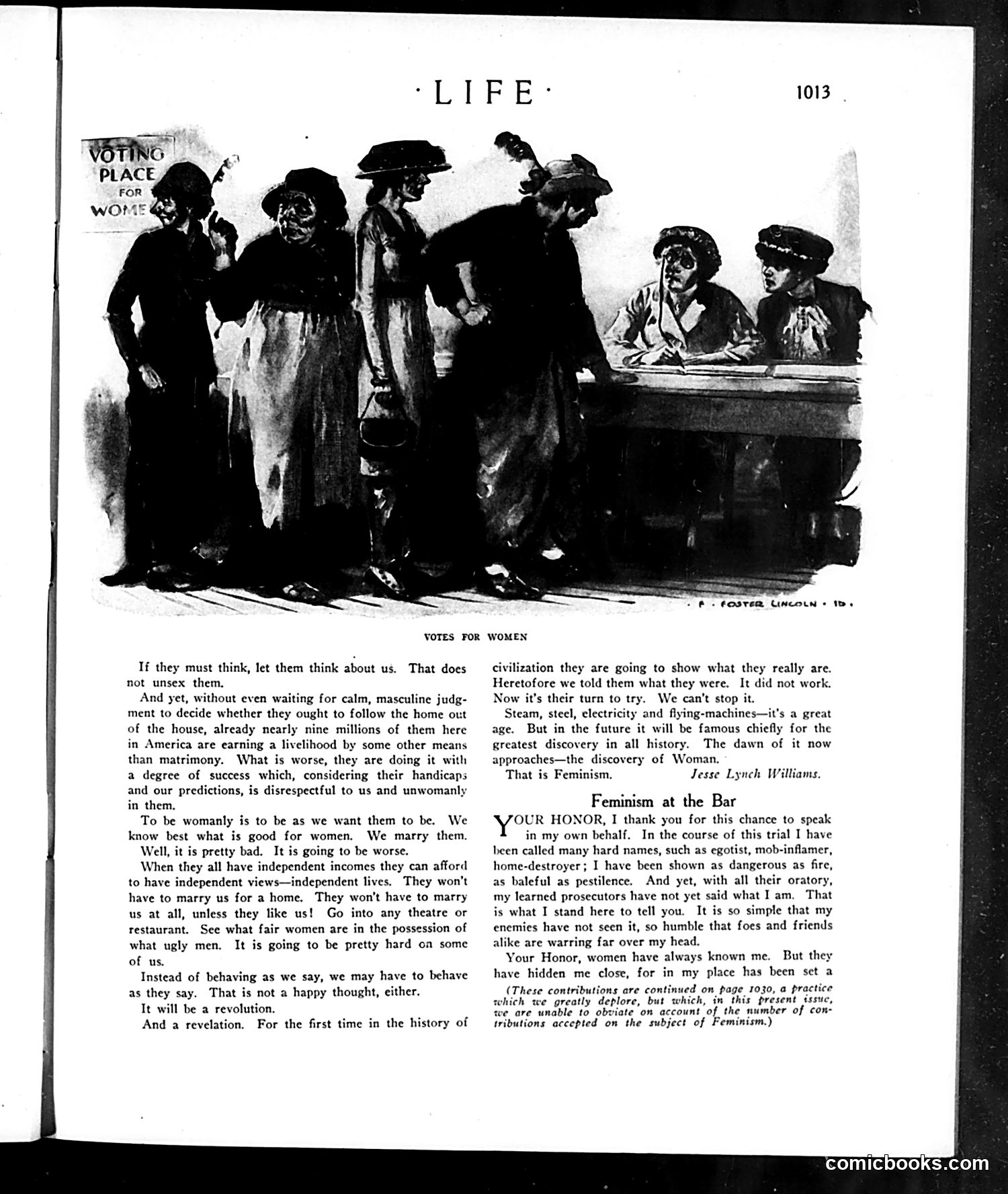
This page contains two satirical pieces about early 1900s feminism and women's suffrage. The cartoon depicts women at a voting place, illustrating the emerging political reality of female voters. The first article, attributed to Jesse Lynch Williams, presents a sardonic male perspective on women's independence. It mocks men's anxiety about women earning their own money and gaining economic autonomy—noting that nine million American women already work outside the home. The satire highlights male fears that financial independence will let women refuse marriage and demand equality ("behaving as they say" instead of obeying). Williams frames this women's liberation as inevitable ("a revolution") while sarcastically calling it "feminism." The second piece, "Feminism at the Bar," features a woman defendant speaking in court about her identity, suggesting she's been mischaracterized by prosecutors as dangerous. The magazine indicates this addresses ongoing debate about feminism's social impact. Together, these pieces reflect contemporary anxieties about changing gender roles and women's increasing public presence and agency.
📄 Transcribed text from this page (OCR, searchable)
Machine-transcribed from the original scan — historical spelling and the odd misread are preserved.
+ B+ FOSTER LINCOLN © Ie VOTES FOR WOMEN If they must think, let them think about us. That does not unsex them, And yet, without even waiting for calm, masculine judg- ment to decide whether they ought to follow the home out of the house, already nearly nine millions of them here in America are earning a livelihood by some other means than matrimony. What is worse, they are doing it with a degree of success which, considering their handicaps and our predictions, is disrespectful to us and unwomanly in them, To be womanly is to be as we want them to be. We know best what is good for women. We marry them. Well, it is pretty bad. It is going to be worse. When they all have independent incomes they can afford to have independent views—independent lives. They won't have to marry us for a home. They won't have to marry us at all, unless they like us! Go into any theatre or restaurant. See what fair women are in the possession of what ugly men, It is going to be pretty hard on some of us. Instead of behaving as we say, we may have to behave as they say. That is not a happy thought, either. It will be a revolution. And a revelation. For the first time in the history of civilization they are going to show what they really are. Heretofore we told them what they were. It did not work. Now it’s their turn to try. We can’t stop Steam, steel, electricity and flying-machines—it’s a great age. But in the future it will be famous chiefly for the greatest discovery in all history. The dawn of it now approaches—the discovery of Woman. That is Feminism. Jesse Lynch Williams. Feminism at the Bar OUR HONOR, I thank you for this chance to speak in my own behalf. In the course of this trial I have been called many hard names, such as egotist, mob-inflamer, home-destroyer; I have been shown as dangerous as fire, as baleful as pestilence. And yet, with all their oratory, my learned prosecutors have not yet said what I am, That is what I stand here to tell you. It is so simple that my enemies have not seen it, so humble that foes and friends alike are warring far over my head. Your Honor, women have always known me. But they have hidden me close, for in my place has been set a (These contributions are continued on page 1030, @ practice which we greatly deplore, but which, in this present issuc, we are unable to obviate ‘on account of the number of con- tributions accepted on the subject of Feminism.) comicbooks.com