
Life, 1914-06-04 · page 31 of 52
Life — June 4, 1914 — page 31: what you’re looking at
What you’re looking at
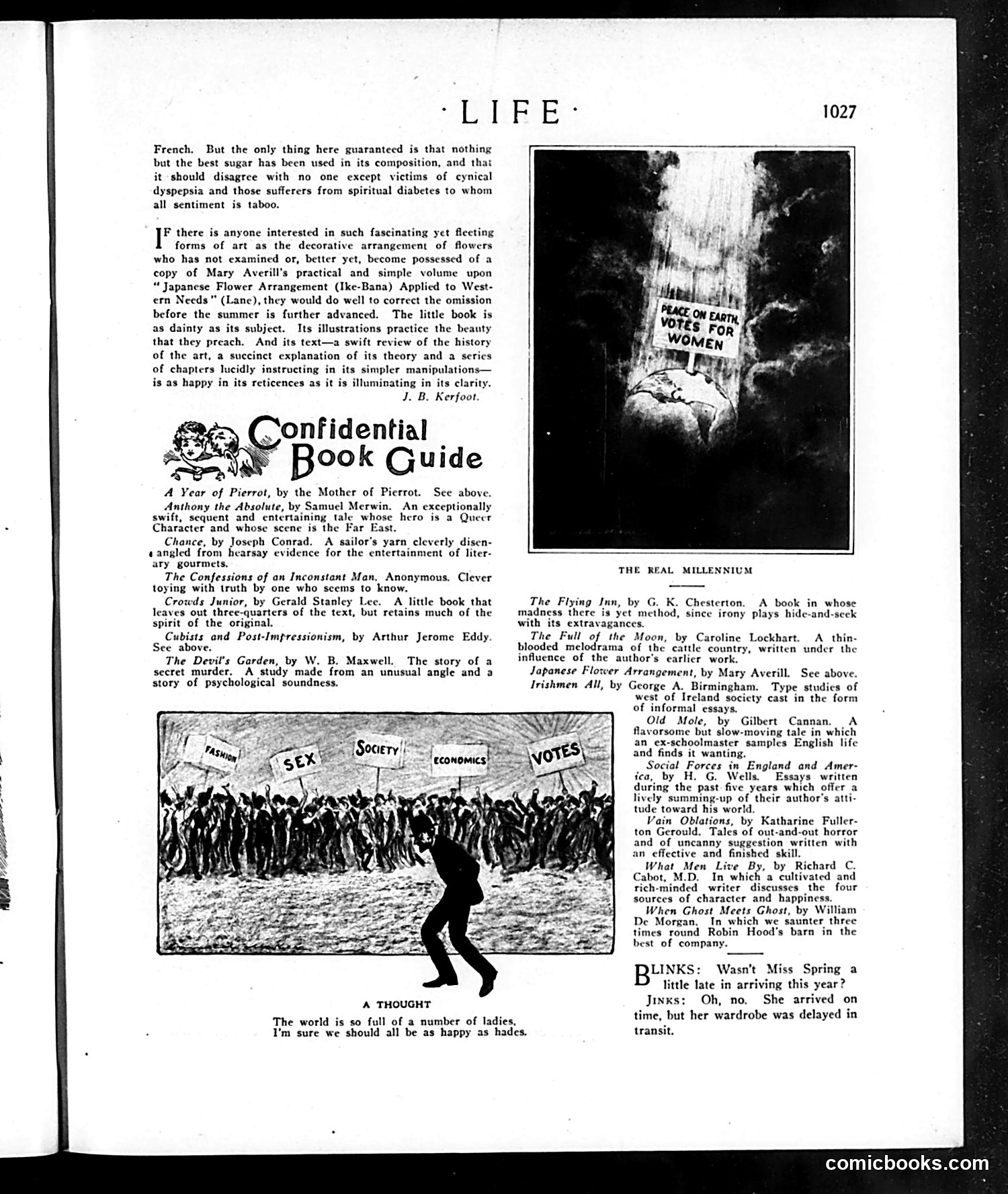
The main cartoon depicts a silhouetted figure being pulled or drawn toward a large crowd of people holding signs reading "SEX," "SOCIETY," "ECONOMICS," and "VOTES." The caption reads: "The world is so full of a number of ladies, I'm sure we should all be as happy as hades." **The Satire:** This is commentary on early 20th-century women's activism and the expanding scope of women's concerns beyond the domestic sphere. The cartoon mocks the era's anxieties about women's increasing involvement in public issues—sexuality, social reform, economics, and voting rights (likely referencing suffrage movements). The figure appears overwhelmed or reluctant, suggesting satirical skepticism toward these social changes. The phrase "happy as hades" adds sardonic tone, implying that women's public activism was viewed by some as disruptive rather than progressive. This reflects common anti-feminist sentiment of the period, presented here as lighthearted magazine satire.
📄 Transcribed text from this page (OCR, searchable)
Machine-transcribed from the original scan — historical spelling and the odd misread are preserved.
Se se Se aa DTeRSE® French. But the only thing here guaranteed is that nothing but the best sugar has been used in its composition, and that it should disagree with no one except victims of cynical dyspepsia and those sufferers from spiritual diabetes to whom all sentiment is taboo. F there is anyone interested in such fascinating yet fiecting forms of art as the decorative arrangement of flowers who has not examined or, better yet, become possessed of a copy of Mary Averill’s practical and simple volume upon “Japanese Flower Arrangement (Ike-Bana) Applied to West- ern Needs” (Lane), they would do well to correct the omission before the summer is further advanced. The little book is as dainty as its subject. Its illustrations practice the beauty that they preach. And its text—a swift review of the history of the art, a succinct explanation of its theory and a serics of chapters lucidly instructing in its simpler manipulations— is as happy in its reticences as it is illuminating in its clarity. J. B. Kerfoot. onfidential Book Guide A Year of Pierrot, by the Mother of Pierrot. See above. Anthony the Absolute, by Samuel Merwin, An exceptionally swift, sequent and entertaining tale whose hero is a Queer Character and whose scene is the Far East. Chance, by Joseph Conrad. A sailor's yarn cleverly disen- angled from hearsay evidence for the entertainment of liter- ary gourmets, The Confessions of an Inconstant Man, Anonymous. Clever toying with truth by one who scems to know. Crowds Junior, by Gerald Stanley Lee. A little book that leaves out three-quarters of the text, but retains much of the spirit of the original. Cubists and Post-Impressionism, by Arthur Jerome Eddy. See above. The Devil's Garden, by W. B. Maxwell. The story of a secret murder. A study made from an unusual angle and a story of psychological soundness. A THOUGHT The world is so full of a number of ladies, THE REAL MILLENNIUM The Flying Inn, by G. K. Chesterton. A book in whose madness there is yet method, since irony plays hide-and-seek with its extravagances. The Full of the Moon, by Caroline Lockhart. A thin- blooded melodrama of the cattle country, written under the influence of the author's earlier work. Japanese Flower Arrangement, by Mary Averill. See above. Irishmen All, by George A. Birmingham. Type studies of west of Ireland society cast in the form of informal essays. Old Mole, by Gilbert Cannan. A flavorsome but slow-moving tale in which an ex-schoolmaster samples English life and finds it wanting. Social Forces in England and Amer- ica, by H. G. Wells. Essays written during the past five years which offer a lively ‘summing-up of their author's atti- tude toward his world. Vain Oblations, by Katharine Fuller- ton Gerould, Tales of out-and-out horror d of uncanny suggestion written with effective and finished skill. What Men Live By, by Richard C. Cabot, M.D. In which a cultivated and rich-minded writer discusses the four sources of character and happiness. When Ghost Meets Ghost, by William De Morgan, In which we saunter three times round Robin Hood's barn in the best of company. LINKS: Wasn't Miss Spring a little late in arriving this year? Jinks Oh, no. She arrived on time, but her wardrobe was delayed in I'm sure we should all be as happy as hades. transit. comicbooks.com