
Life, 1914-06-04 · page 34 of 52
Life — June 4, 1914 — page 34: what you’re looking at
What you’re looking at
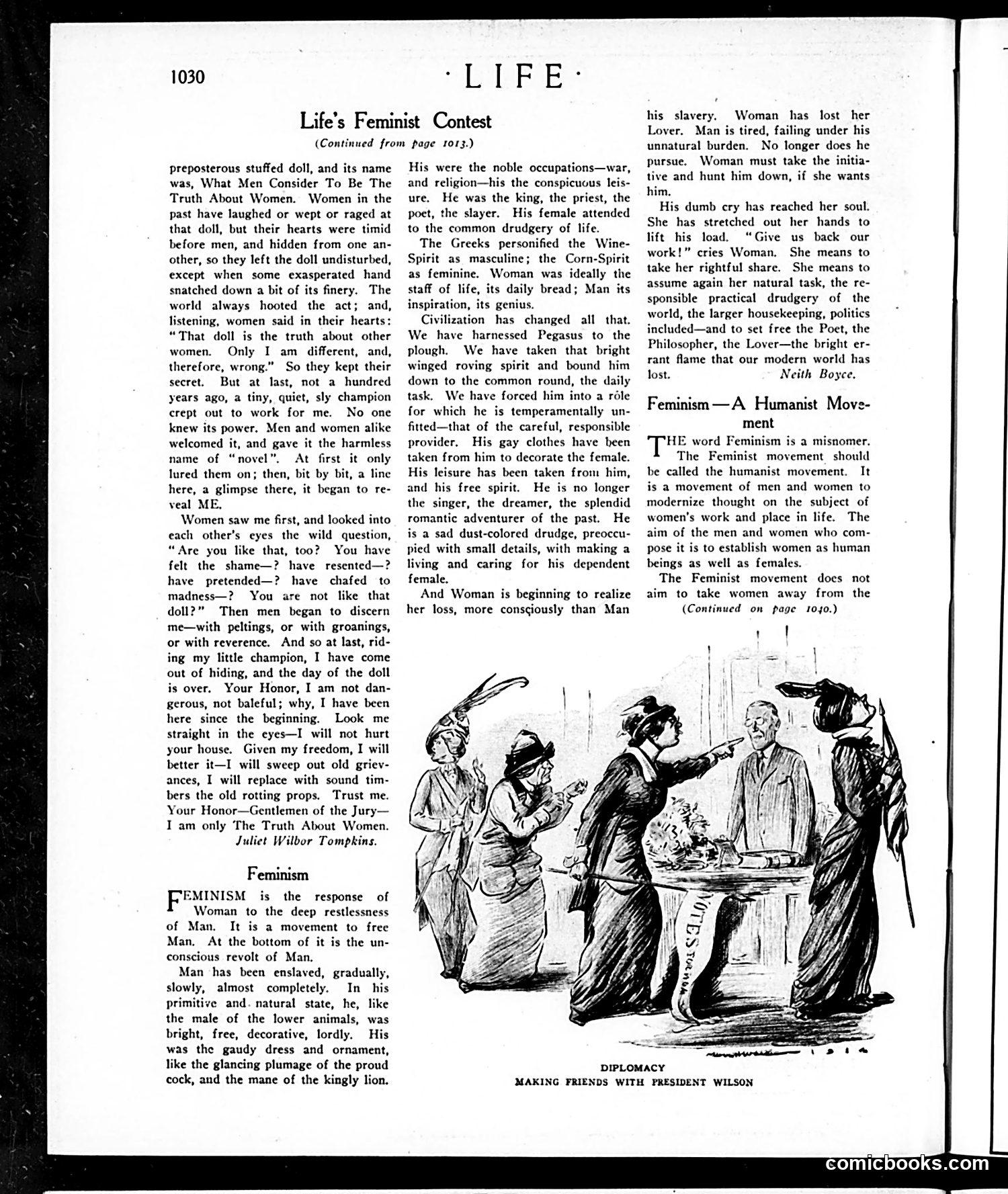
This page presents competing feminist arguments through literary excerpts and satire. The main text—attributed to Juliet Wilbor Tompkins—uses the metaphor of a "stuffed doll" representing false stereotypes about women. Tompkins argues that the novel as a literary form has gradually revealed women's authentic inner lives, dispelling myths and allowing women to recognize their shared experiences of shame and resentment. The lower essay reframes feminism paradoxically: it argues feminism actually *frees men* from civilization's constraints. The author claims modern man has become an oppressed "drudge," stripped of his natural decorative leisure and adventurous spirit, forced into domestic provider roles. Woman, realizing man's exhaustion, now must "hunt him down" and reclaim work to restore his dignity. The cartoon "Making Friends with President Wilson" (bottom) likely satirizes diplomatic efforts, though specific context is unclear. The page presents feminism as complex—simultaneously about women's liberation AND male restoration.
📄 Transcribed text from this page (OCR, searchable)
Machine-transcribed from the original scan — historical spelling and the odd misread are preserved.
ESS Life’s Feminist Contest (Continued from page 1013.) preposterous stuffed doll, and its name was, What Men Consider To Be The Truth About Women. Women in the past have laughed or wept or raged at that doll, but their hearts were timid before men, and hidden from one an- other, so they left the doll undisturbed, except when some exasperated hand snatched down a bit of its finery. The world always hooted the act; and, listening, women said in their hearts: “That doll is the truth about other women. Only I am different, and, therefore, wrong.” So they kept their secret. But at last, not a hundred years ago, a tiny, quiet, sly champion crept out to work for me. No one knew its power. Men and women alike welcomed it, and gave it the harmless name of “novel”. At first it only lured them on; then, bit by bit, a line here, a glimpse there, it began to re- veal ME, Women saw me first, and looked into each other's eyes the wild question, “Are you like that, too? You have felt the shame—? have resented—? have pretended—? have chafed to madness—? You are not like that doll?” Then men began to discern me—with peltings, or with groanings, or with reverence. And so at last, rid- ing my little champion, I have come out of hiding, and the day of the doll is over. Your Honor, I am not dan- gerous, not baleful; why, I have been here since the beginning. Look me straight in the eyes—I will not hurt your house. Given my freedom, I will better it—I will sweep out old griev- ances, I will replace with sound tim- bers the old rotting props. Trust me. Your Honor—Gentlemen of the Jury— Tam only The Truth About Women. Juliet Wilbor Tompkins. Feminism FEMINISM is the response of Woman to the deep restlessness of Man. It is a movement to free Man. At the bottom of it is the un- conscious revolt of Man. Man has been enslaved, gradually, slowly, almost completely. In his primitive and. natural state, he, like the male of the lower animals, was bright, free, decorative, lordly. His was the gaudy dress and ornament, like the glancing plumage of the proud cock, and the mane of the kingly lion. His were the noble occupations—war, and religion—his the conspicuous leis- ure. He was the king, the priest, the poet, the slayer. His female attended to the common drudgery of life. The Greeks personified the Wine- Spirit as masculine; the Corn-Spirit as feminine. Woman was ideally the staff of life, its daily bread; Man its inspiration, its genius. Civilization has changed all that. We have harnessed Pegasus to the plough. We have taken that bright winged roving spirit and bound him down to the common round, the daily task. We have forced him into a réle for which he is temperamentally un- fitted—that of the careful, responsible provider, His gay clothes have been taken from him to decorate the female. His leisure has been taken from him, and his free spirit. He is no longer the singer, the dreamer, the splendid romantic adventurer of the past. He is a sad dust-colored drudge, preoccu- pied with small details, with making a living and caring for his dependent female. And Woman is beginning to realize her loss, more consciously than Man his slavery. Woman has lost her Lover. Man is tired, failing under his unnatural burden. No longer does he pursue. Woman must take the initia- tive and hunt him down, if she wants him, His dumb cry has reached her soul. She has stretched out her hands to lift his load. “Give us back our work!” cries Woman. She means to take her rightful share. She means to assume again her natural task, the re- sponsible practical drudgery of the world, the larger housekeeping, politics included—and to set free the Poet, the Philosopher, the Lover—the bright er- rant flame that our modern world has lost. Neith Boyce. Feminism —A Humanist Move- ment HE word Feminism is a misnomer. The Feminist movement. should be called the humanist movement. It is a movement of men and women to modernize thought on the subject of women’s work and place in life. The aim of the men and women who com- pose it is to establish women as human beings as well as females. The Feminist movement docs not aim to take women away from the (Continued on page 1040.) DIPLOMACY MAKING FRIENDS WITH PRESIDENT WILSON eomicbooks.com