
Life, 1914-06-04 · page 14 of 52
Life — June 4, 1914 — page 14: what you’re looking at
What you’re looking at
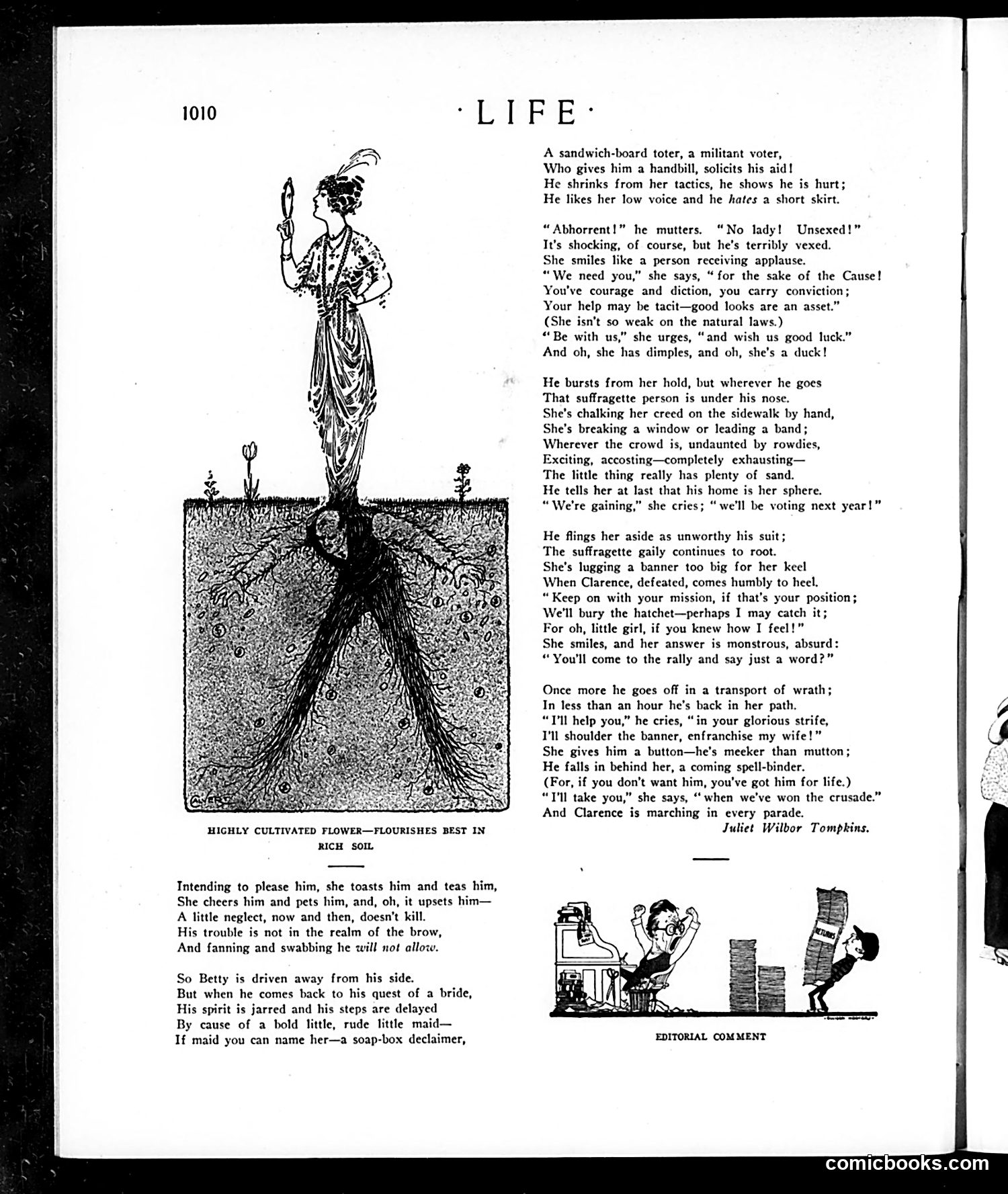
This is a satirical poem by Juliet Wilbor Tompkins about the friction between a male political activist and his suffragette wife. The central illustration—a cultivated flower with deep roots—symbolizes how "highly cultivated" women (like suffragettes) are grounded in conviction. The poem mocks their domestic conflict: he's a "militant voter" focused on politics; she's a suffragette obsessed with women's voting rights. He finds her activism embarrassing and overbearing ("sandwich-board toter"), but she's relentless, chalking her creed on sidewalks and carrying oversized banners. He eventually capitulates, agreeing to support her cause to restore peace. The satire cuts both ways—critiquing both his dismissive attitude toward women's suffrage and her single-minded, somewhat exhausting commitment. The couple represents the broader social debate over women's voting rights during the suffrage movement era.
📄 Transcribed text from this page (OCR, searchable)
Machine-transcribed from the original scan — historical spelling and the odd misread are preserved.
“ETRE HIGHLY CULTIVATED FLOWER—FLOURISHES BEST IN RICH SOIL Intending to please him, she toasts him and teas him, She cheers him and pets him, and, oh, it upsets him— A little neglect, now and then, doesn’t kill. His trouble is not in the realm of the brow, And fanning and swabbing he will not allow. So Betty is driven away from his side. But when he comes back to his quest of a bride, His spirit is jarred and his steps are delayed By cause of a bold little, rude little maid— If maid you can name her—a soap-box declaimer, A sandwich-board toter, a militant voter, Who gives him a handbill, solicits his aid! He shrinks from her tactics, he shows he is hurt; He likes her low voice and he hates a short skirt. “Abhorrent!” he mutters. “No lady! Unsexed!” It’s shocking, of course, but he’s terribly vexed. She smiles like a person receiving applause. “We need you,” she says, “for the sake of the Cause! You've courage and diction, you carry conviction; Your help may be tacit—good looks are an asset.” (She isn’t so weak on the natural laws.) “Be with us,” she urges, “and wish us good luck.” And oh, she has dimples, and oh, she’s a duck! He bursts from her hold, but wherever he goes That suffragette person is under his nose. She's chalking her creed on the sidewalk by hand, She's breaking a window or leading a band; Wherever the crowd is, undaunted by rowdies, Exciting, accosting—completely exhausting— The little thing really has plenty of sand. He tells her at last that his home is her sphere. “We're gaining,” she cries; “we'll be voting next year!” He flings her aside as unworthy his suit; The suffragette gaily continues to root. She's lugging a banner too big for her keel When Clarence, defeated, comes humbly to heel. “Keep on with your mission, if that’s your position; We'll bury the hatchet—perhaps I may catch it; For oh, little girl, if you knew how I feel!” She smiles, and her answer is monstrous, absurd: “You'll come to the rally and say just a word?” Once more he goes off in a transport of wrath; In less than an hour he’s back in her path, “T'll help you,” he cries, “in your glorious strife, I'll shoulder the banner, enfranchise my wife!” She gives him a button—he'’s meeker than mutton; He falls in behind her, a coming spell-binder. (For, if you don’t want him, you've got him for life.) “Till take you,” she says, “when we've won the crusade.” XS And Clarence is marching in every parade. Juliet Wilbor Tompkins. EDITORIAL COMMENT comicbooks.com