
Life, 1914-06-04 · page 16 of 52
Life — June 4, 1914 — page 16: what you’re looking at
What you’re looking at
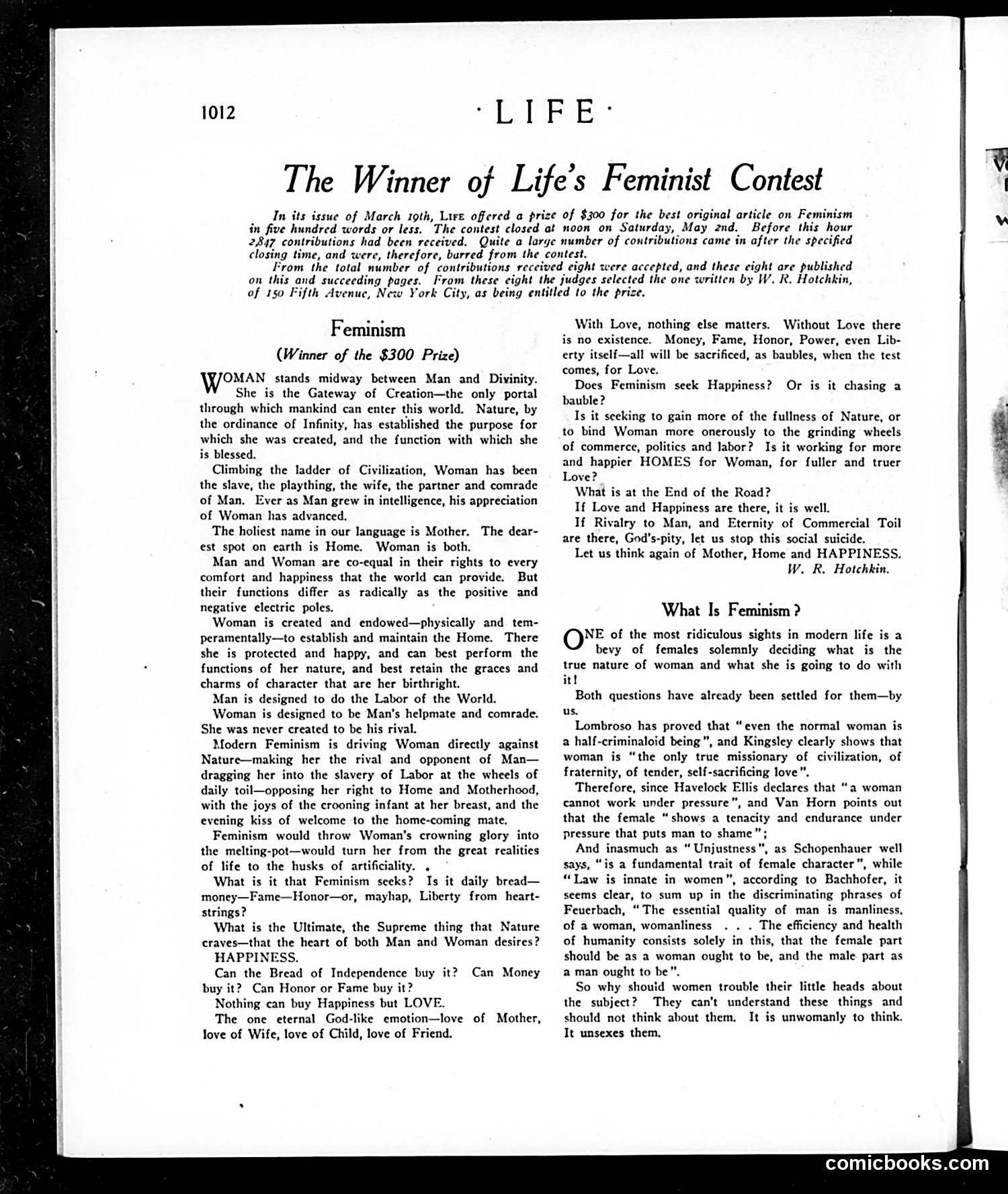
This page announces the winner of Life magazine's 1912 contest on feminism—a $300 prize won by W.R. Hotchkin's essay arguing **against** the feminist movement. ## The Anti-Feminist Argument Hotchkin's winning essay presents a conservative position opposing feminism: women are "naturally" suited to home and motherhood, while men are designed for labor. He argues feminism wrongly pushes women into commercial work, competing with men and abandoning their "crowning glory." ## The Satire's Target Life magazine—historically a satirical publication—appears to be satirizing this anti-feminist argument by publishing it as the "winner." By presenting this deeply traditional viewpoint as the prize-winning wisdom, the magazine likely mocked both the essay's sentimentality and the conservative resistance to women's expanding roles during the Progressive Era. ## Historical Context This reflects early 1910s debates over women's suffrage and labor rights. The winning essay's emphatic capitalization of "LOVE," "HAPPINESS," and "HOME" underscores the era's idealization of domesticity—precisely what feminists were challenging.
📄 Transcribed text from this page (OCR, searchable)
Machine-transcribed from the original scan — historical spelling and the odd misread are preserved.
ge) ba) El loam The Winner of Life’s Feminist Contest In its issue of March 19th, Lire offered a prize of $300 for the best original article on Feminism in five hundred words or less. The contest closed at noon on Saturday, May 2nd. Before this hour 2847 contributions had been received. Quite a large number of contributions came in after the specified closing time, and were, therefore, barred from the contest. From the total number of contributions received eight were accepted, and these eight are published on this and succeeding pages. From these cight the judges selected the one written by W. R. Hotchkin, of 150 Fifth Avenue, New York City, as being entitled to the prize. Feminism (Winner of the $300 Prize) WOMAN stands midway between Man and Divinity. She is the Gateway of Creation—the only portal through which mankind can enter this world. Nature, by the ordinance of Infinity, has established the purpose for which she was created, and the function with which she is blessed. Climbing the ladder of Civilization, Woman has been the slave, the plaything, the wife, the partner and comrade of Man. Ever as Man grew in intelligence, his appreciation of Woman has advanced, The holiest name in our language is Mother. The dear- est spot on earth is Home. Woman is both. Man and Woman are co-equal in their rights to every comfort and happiness that the world can provide. But their functions differ as radically as the positive and negative electric poles. Woman is created and endowed—physically and tem- peramentally—to establish and maintain the Home. There she is protected and happy, and can best perform the functions of her nature, and best retain the graces and charms of character that are her birthright. Man is designed to do the Labor of the World. Woman is designed to be Man's helpmate and comrade. She was never created to be his rival. Modern Feminism is driving Woman directly against Nature—making her the rival and opponent of Man— dragging her into the slavery of Labor at the wheels of daily toil—opposing her right to Home and Motherhood, with the joys of the crooning infant at her breast, and the evening kiss of welcome to the home-coming mate. Feminism would throw Woman's crowning glory into the melting-pot—would turn her from the great realities of life to the husks of artificiality. . What is it that Feminism seeks? Is it daily bread— money—Fame—Honor—or, mayhap, Liberty from heart- strings? What is the Ultimate, the Supreme thing that Nature craves—that the heart of both Man and Woman desires? HAPPINESS. Can the Bread of Independence buy it? buy it? Can Honor or Fame buy it? Nothing can buy Happiness but LOVE. The one eternal God-like emotion—love of Mother, love of Wife, love of Child, love of Friend. Can Money With Love, nothing else matters. Without Love there is no existence. Money, Fame, Honor, Power, even Lib- erty itself—all will be sacrificed, as baubles, when the test comes, for Love. Does Feminism seek Happiness? bauble? Is it seeking to gain more of the fullness of Nature, or to bind Woman more onerously to the grinding wheels of commerce, politics and labor? Is it working for more and happier HOMES for Woman, for fuller and truer Love? What is at the End of the Road? If Love and Happiness are there, it is well. If Rivalry to Man, and Eternity of Commercial Toil are there, God’s-pity, let us stop this social suicide. Let us think again of Mother, Home and HAPPINESS. W. R. Hotchkin. Or is it chasing a What Is Feminism > ONE of the most ridiculous sights in modern life is a bevy of females solemnly deciding what is the true nature of woman and what she is going to do with it! Both questions have already been settled for them—by us. Lombroso has proved that “even the normal woman is a half-criminaloid being”, and Kingsley clearly shows that woman is “the only true missionary of civilization, of fraternity, of tender, self-sacrificing love”. Therefore, since Havelock Ellis declares that “a woman cannot work under pressure”, and Van Horn points out that the female “shows a tenacity and endurance under Pressure that puts man to shame”; And inasmuch as “ Unjustness”, as Schopenhauer well says, “is a fundamental trait of female character”, while “Law is innate in women”, according to Bachhofer, it seems clear, to sum up in the discriminating phrases of Feuerbach, “The essential quality of man is manliness, of a woman, womanliness . . . The efficiency and health of humanity consists solely in this, that the female part should be as a woman ought to be, and the male part as a man ought to be”. So why shouid women trouble their little heads about the subject? They can’t understand these things and should not think about them. It is unwomanly to think. It unsexes them, comicbooks.com