
Life, 1914-06-04 · page 30 of 52
Life — June 4, 1914 — page 30: what you’re looking at
What you’re looking at
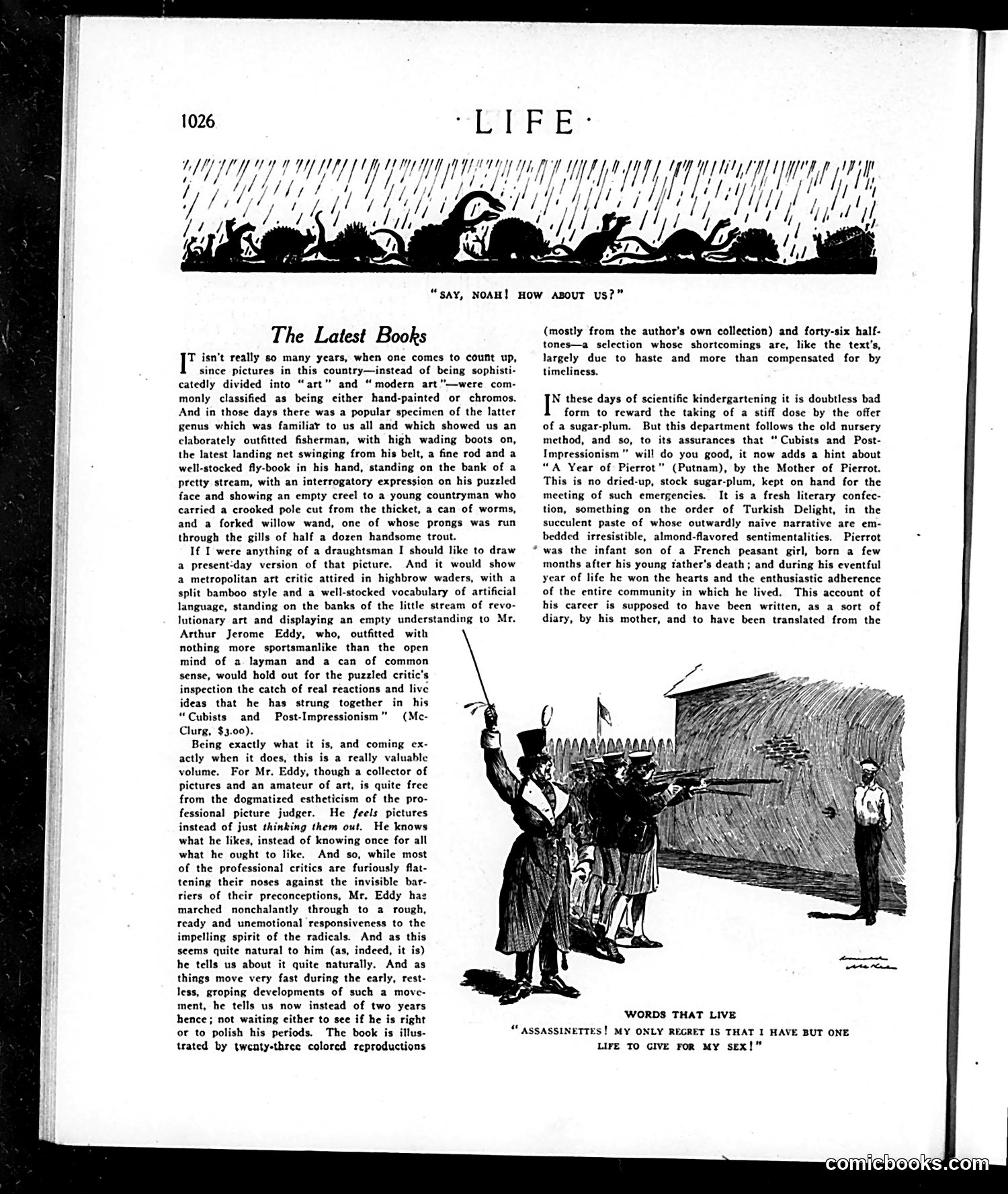
The top cartoon depicts Noah's Ark with animals asking Noah "How about us?"—a joke about being left out or overlooked. It introduces a book review section. The main content reviews Arthur Jerome Eddy's *Cubists and Post-Impressionism*, comparing modern art criticism to a fishing parable. The satire contrasts a pretentious art critic wearing "highbrow waders" and spouting "artificial language" about revolutionary art—yet understanding nothing—with Eddy, an amateur layman with "common sense" who actually appreciates modern art genuinely. The cartoon below shows a figure confronting what appears to be a woman, captioned with a quote about assassinettes regretting having only one life to give for their sex—likely referencing women's suffrage activism or feminism of the era. The reviews promote books on avant-garde art and a sentimental novel called *A Year of Pierrot*.
📄 Transcribed text from this page (OCR, searchable)
Machine-transcribed from the original scan — historical spelling and the odd misread are preserved.
1026 LI h /! /, rd if / WH, yi HL puny NAP Y| ALE nmr mean FE UMS 1 Why iif minnie rH a uf “Say, NOAH! HOW AsOUT US?” The Latest Books 'T isn’t really so many years, when one comes to count up, since pictures in this country—instead of being sophisti- catedly divided into “art” and “modern art"—were com- monly classified as being either hand-painted or chromos. And in those days there was a popular specimen of the latter genus which was familiar to us all and which showed us an claborately outfitted fisherman, with high wading boots on, the latest landing net swinging from his belt, a fine rod and a well-stocked fly-book in his hand, standing on the bank of a pretty stream, with an interrogatory expression on his puzzled face and showing an empty creel to a young countryman who carried a crooked pole cut from the thicket, a can of worms, and a forked willow wand, one of whose prongs was run through the gills of half a dozen handsome trout. If I were anything of a draughtsman I should like to draw a present-day version of that picture, And it would show a metropolitan art critic attired in highbrow waders, with a split bamboo style and a well-stocked vocabulary of artificial language, standing on the banks of the little stream of revo- lutionary art and displaying an empty understanding to Mr. Arthur Jerome Eddy, who, outfitted with nothing more sportsmanlike than the open mind of a layman and a can of common sense, would hold out for the puzzled critic's inspection the catch of real reactions and live ideas that he has strung together in his “Cubists and Post-Impressionism” (Mc- Clurg, $3.00). Being exactly what it is, and coming cx- actly when it does, this is a really valuable volume. For Mr. Eddy, though a collector of pictures and an amateur of art, is quite free from the dogmatized estheticism of the pro- fessional picture judger. He feels pictures instead of just thinking them out. He knows what he likes, instead of knowing once for all what he ought to like. And so, while most of the professional critics are furiously flat- tening their noses against the invisible bar- riers of their preconceptions, Mr. Eddy haz marched nonchalantly through to a rough, ready and unemotional responsiveness to the impelling spirit of the radicals. And as this seems quite natural to him (as, indeed, it is) he tells us about it quite naturally, And as things move very fast during the early, rest- less, groping developments of such a move- ment, he tells us now instead of two years hence; not waiting either to see if he is right or to polish his periods. The book is illus- trated by twenty-three colored reproductions (mostly from the author’s own collection) and forty-six half- tones—a selection whose shortcomings are, like the text's, largely due to haste and more than compensated for by timeliness. IX these days of scientific kindergartening it is doubtless bad form to reward the taking of a stiff dose by the offer of a sugar-plum. But this department follows the old nursery method, and so, to its assurances that “Cubists and Post- Impressionism" will do you good, it now adds a hint about “A Year of Pierrot" (Putnam), by the Mother of Pierrot. This is no dried-up, stock sugar-plum, kept on hand for the meeting of such emergencies. It is a fresh literary confec- tion, something on the order of Turkish Delight, in the succulent paste of whose outwardly naive narrative are em- bedded irresistible, almond-flavored sentimentalities. Pierrot was the infant son of a French peasant girl, born a few months after his young father’s death ; and during his eventful year of life he won the hearts and the enthusiastic adherence of the entire community in which he lived. This account of his career is supposed to have been written, as a sort of diary, by his mother, and to have been translated from the ‘WORDS THAT LIVE “ ASSASSINETTES ! MY ONLY REGRET IS THAT I HAVE BUT ONE LIFE TO GIVE FOR MY SEX!”