
A complete issue · 44 pages · 1914
Life — March 12, 1914
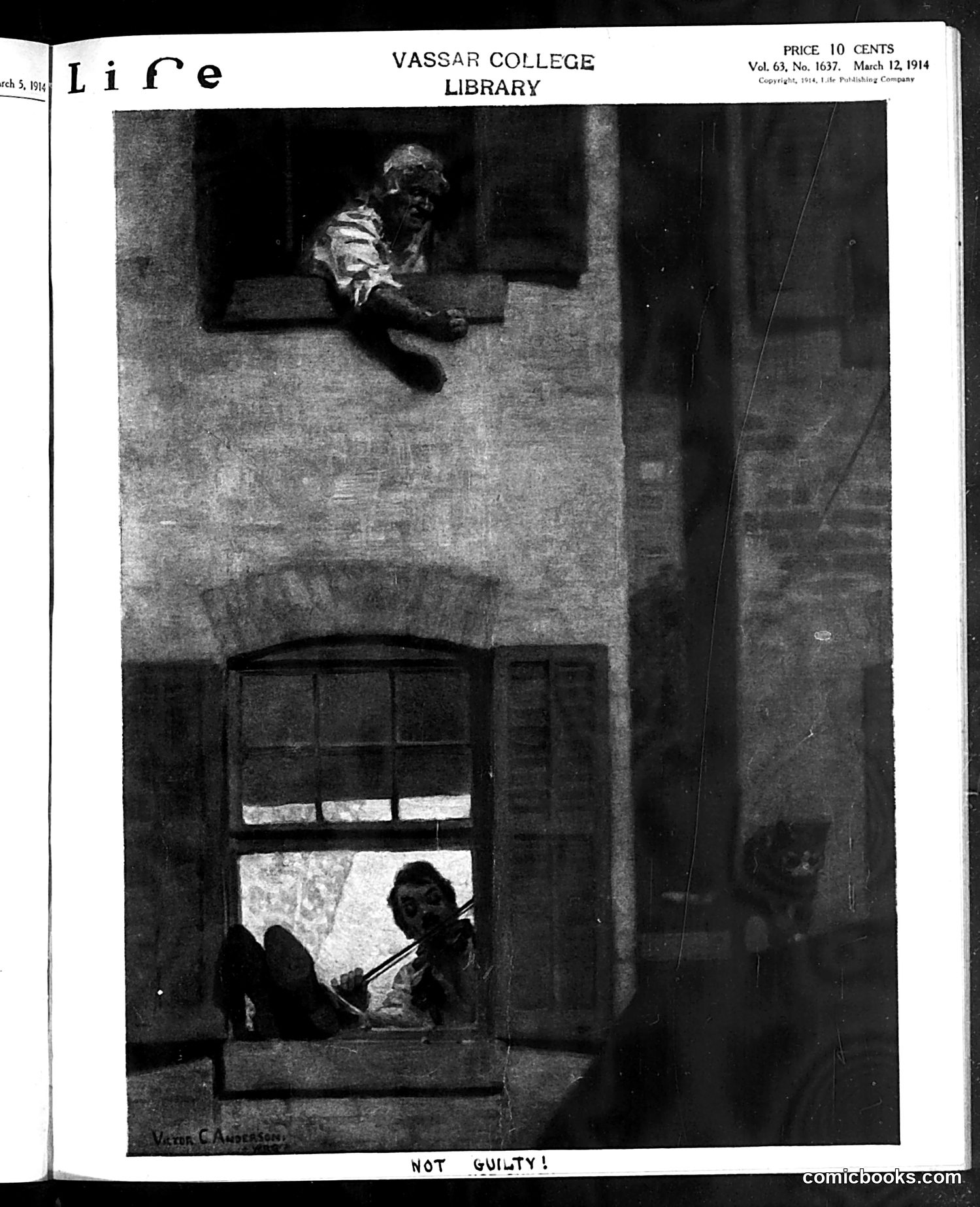
This political cartoon depicts a scene with two figures separated by a window or barrier. The upper figure appears to be a judge or authority figure looking down, while below, a person sits playing what seems to be a musical instrument or pipe. The caption "NOT GUILTY!" suggests ironic commentary on a legal verdict. The composition—with the authority figure above and the accused below—inverts typical courtroom hierarchy, possibly satirizing judicial corruption or bias. Without additional context about March 1914 events, the specific figures and case remain unclear, though the cartoon likely comments on a contemporary trial that aroused public skepticism about the verdict's fairness.
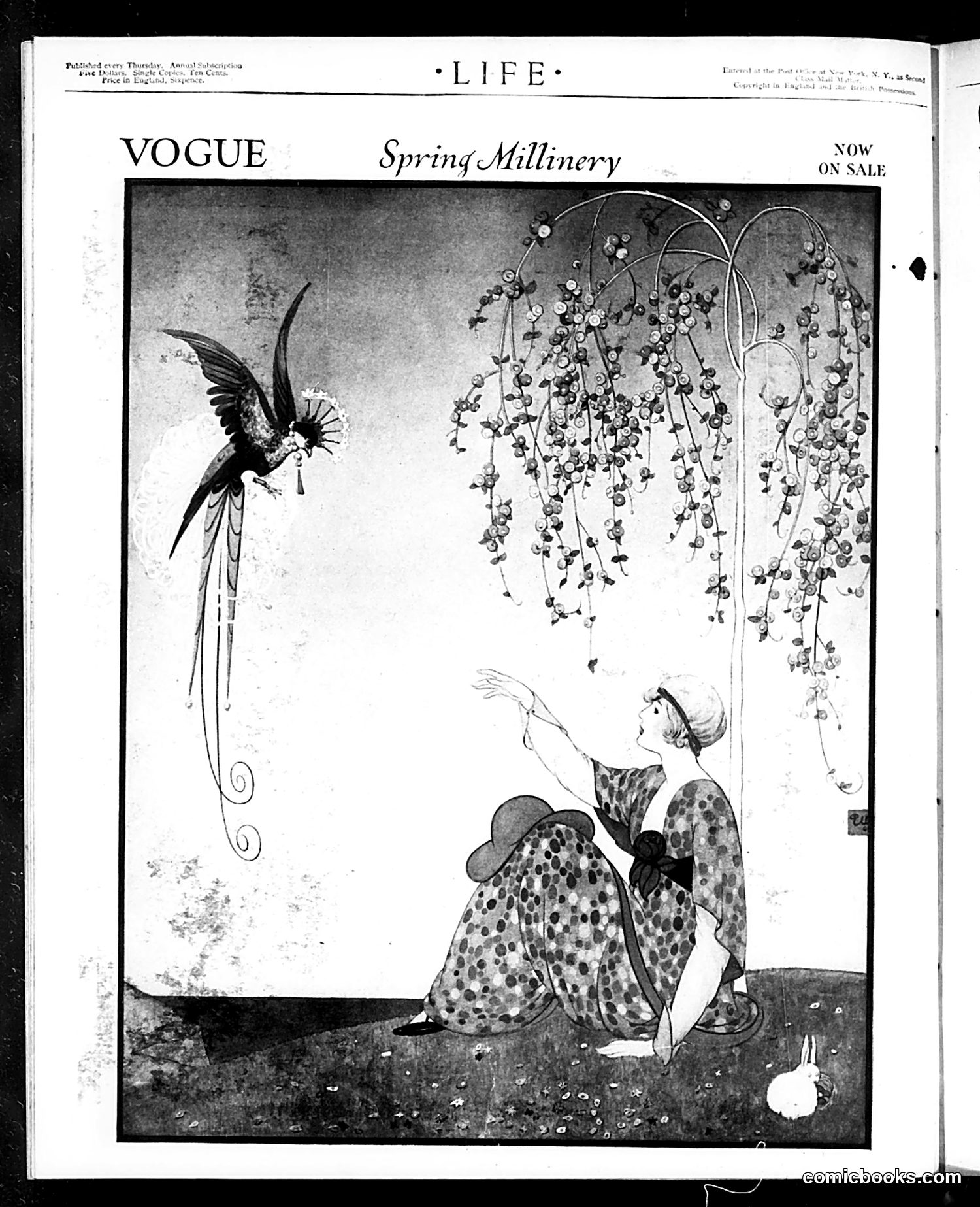
This page is primarily an advertisement for Vogue's spring millinery collection, not political satire. The illustration depicts a fashionable woman in a patterned dress and cloche hat, reaching upward toward hanging floral decorations (appearing to be wisteria or similar cascading flowers). A stylized bird with elaborate tail feathers perches on the left. The image celebrates spring fashion and seasonal renewal rather than conveying political commentary. The woman's pose and the abundant flowering vines suggest themes of springtime elegance and natural beauty—common marketing devices for seasonal fashion. The exotic bird adds decorative sophistication typical of high-fashion magazine aesthetics of the era. This represents commercial advertising content, not editorial satire.
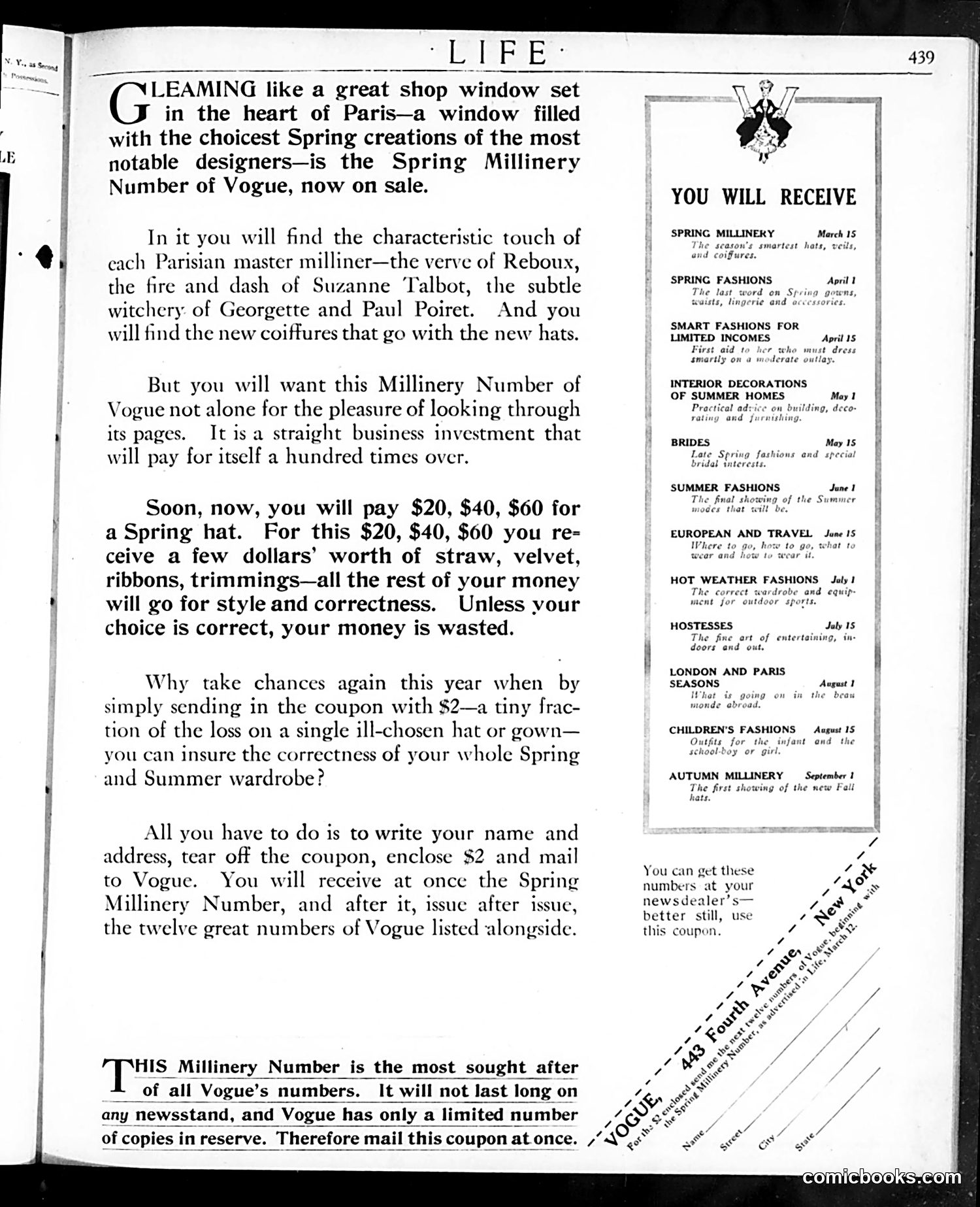
This page is primarily **advertising, not satire or editorial content**. It promotes Vogue magazine's Spring Millinery Number, positioned as a shop window displaying creations from noted Parisian hat designers including Reboux, Suzanne Talbot, Georgette, and Paul Poiret. The pitch is straightforward commercial messaging: for $2 enclosed with a coupon, readers can receive the Millinery Number plus eleven subsequent Vogue issues, ensuring they make correct fashion choices. The advertisement emphasizes that buying the magazine is a "business investment" that pays for itself many times over—a common sales technique of the era. There are no political cartoons, caricatures, or satirical commentary visible. This is pure consumer marketing, typical of Life magazine's advertising content circa the 1920s.
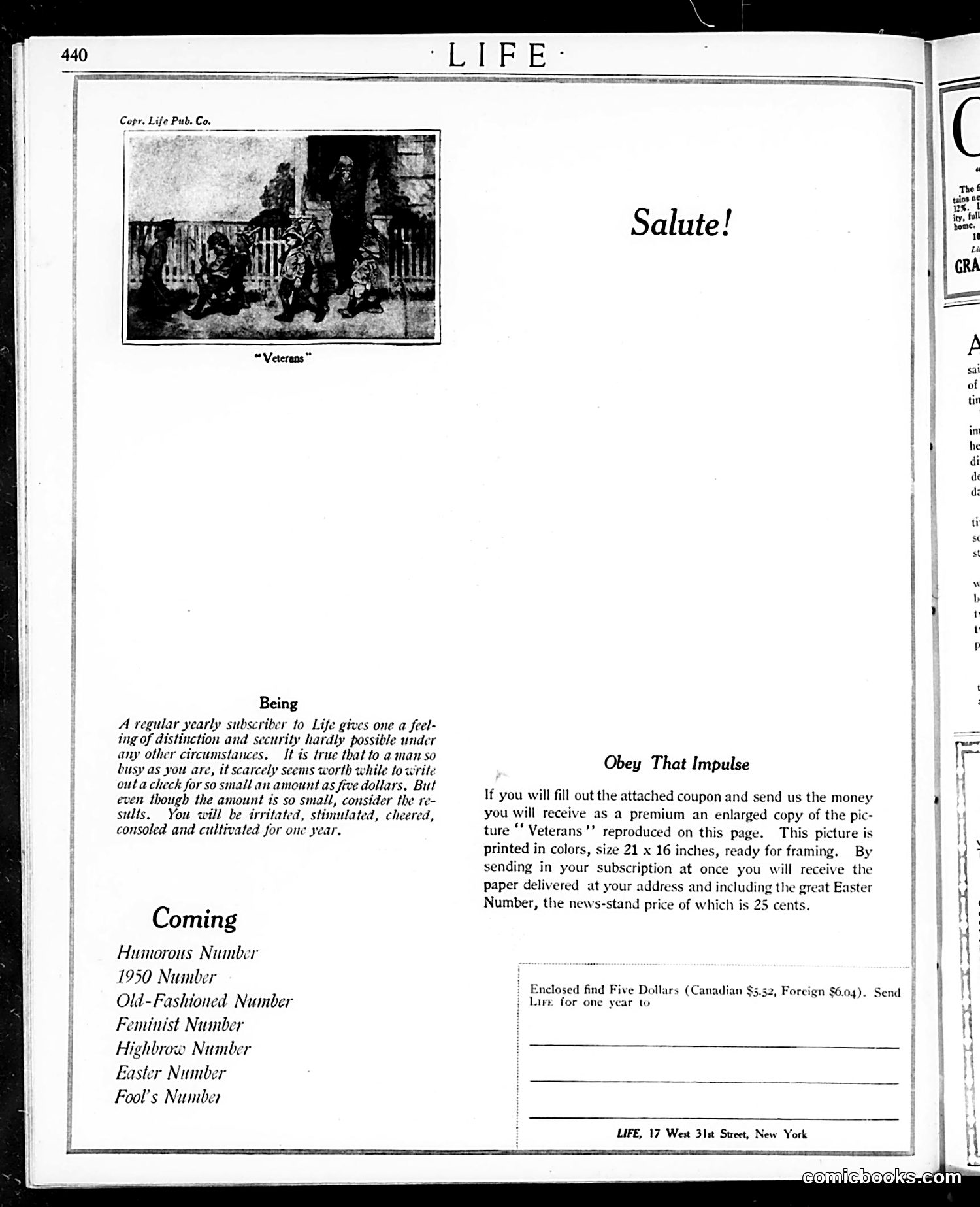
This page is primarily **subscription advertising** for Life magazine, not political satire. The image labeled "Veterans" appears to show a group of military figures in uniform saluting, likely honoring war veterans. The accompanying text uses this image to appeal to readers' patriotic sentiments—suggesting that subscribing to Life provides "distinction and security" and promises readers will feel "irritated, stimulated, cheered, consoled and cultivated." The "Coming" section lists upcoming special issues: Humorous, 1930, Old-Fashioned, Feminist, Highbrow, Easter, and Fool's Number—indicating Life's editorial diversity. The subscription offer requests five dollars (Canadian $5.32, Foreign $6.04) for one year's delivery, with a premium enlarged print of the "Veterans" image.
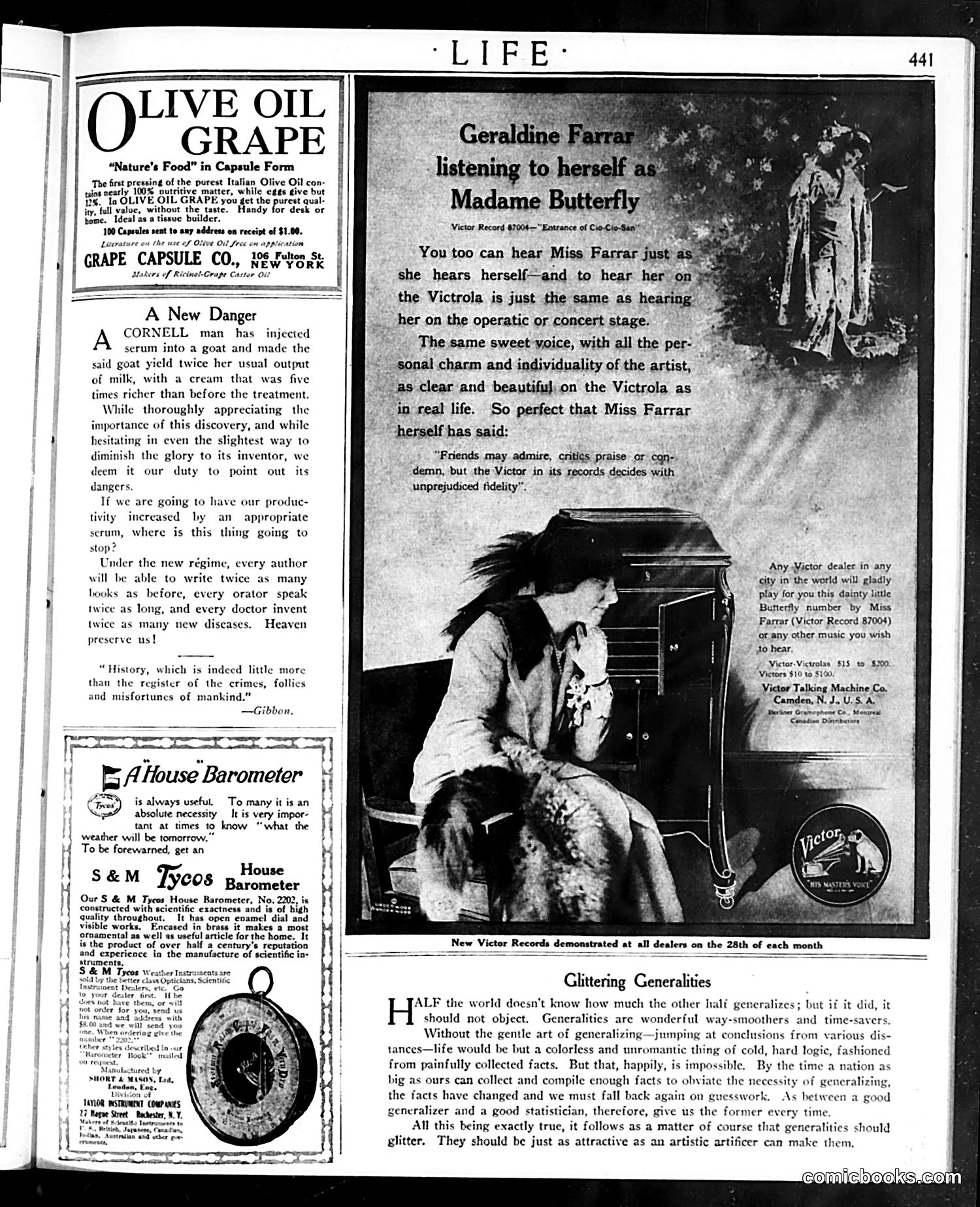
This page is primarily **advertising and product promotion** rather than editorial satire. The left column features ads for Olive Oil Grape capsules, a house barometer, and a cautionary article titled "A New Danger" about serums increasing productivity. The dominant right-side content is a **Victor Records advertisement** featuring opera singer Geraldine Farrar listening to herself perform "Madame Butterfly" on a Victrola phonograph. The copy emphasizes the recording's fidelity—that hearing Farrar on the Victor machine matches hearing her live performance. The bottom article, "Glittering Generalities," appears to be editorial commentary on the value and dangers of broad generalizations in reasoning. This is a commercial-heavy magazine page typical of early 20th-century publication format.
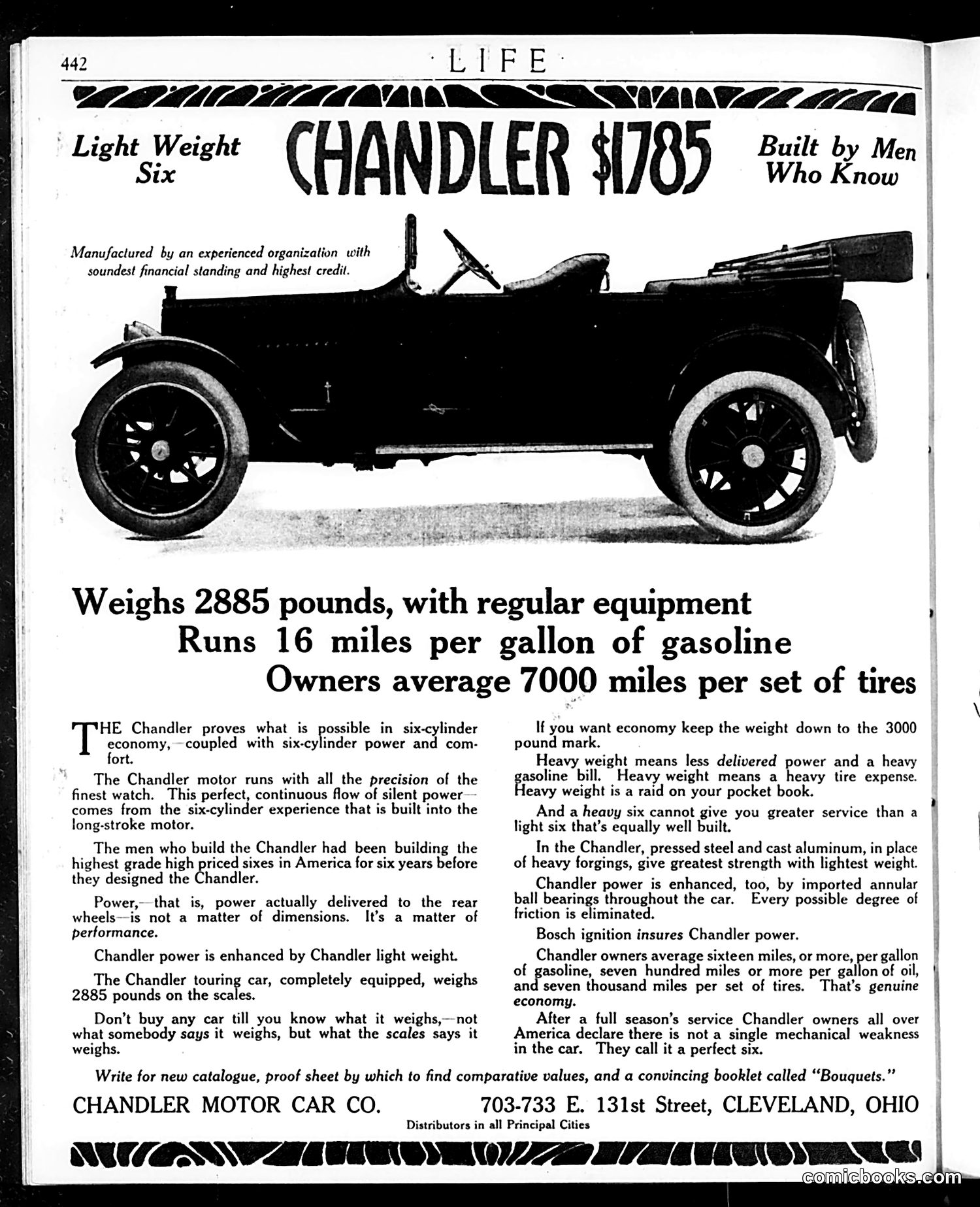
This is **not a cartoon or satirical content** — it's a straightforward automobile advertisement from *Life* magazine's advertising section (page 442). The Chandler Motor Car Company of Cleveland, Ohio is marketing their "Light Weight Six" automobile, priced at $1,785. The ad emphasizes economy through light weight (2,885 pounds), fuel efficiency (16 miles per gallon), and tire durability (7,000 miles per set). The advertisement uses competitive rhetoric typical of early automotive marketing, contrasting the Chandler's advantages against unnamed competitors. It appeals to practical buyers concerned with operational costs — relevant context for the post-WWI era when automobiles were still luxury items for many Americans. The page contains no political satire or social commentary.
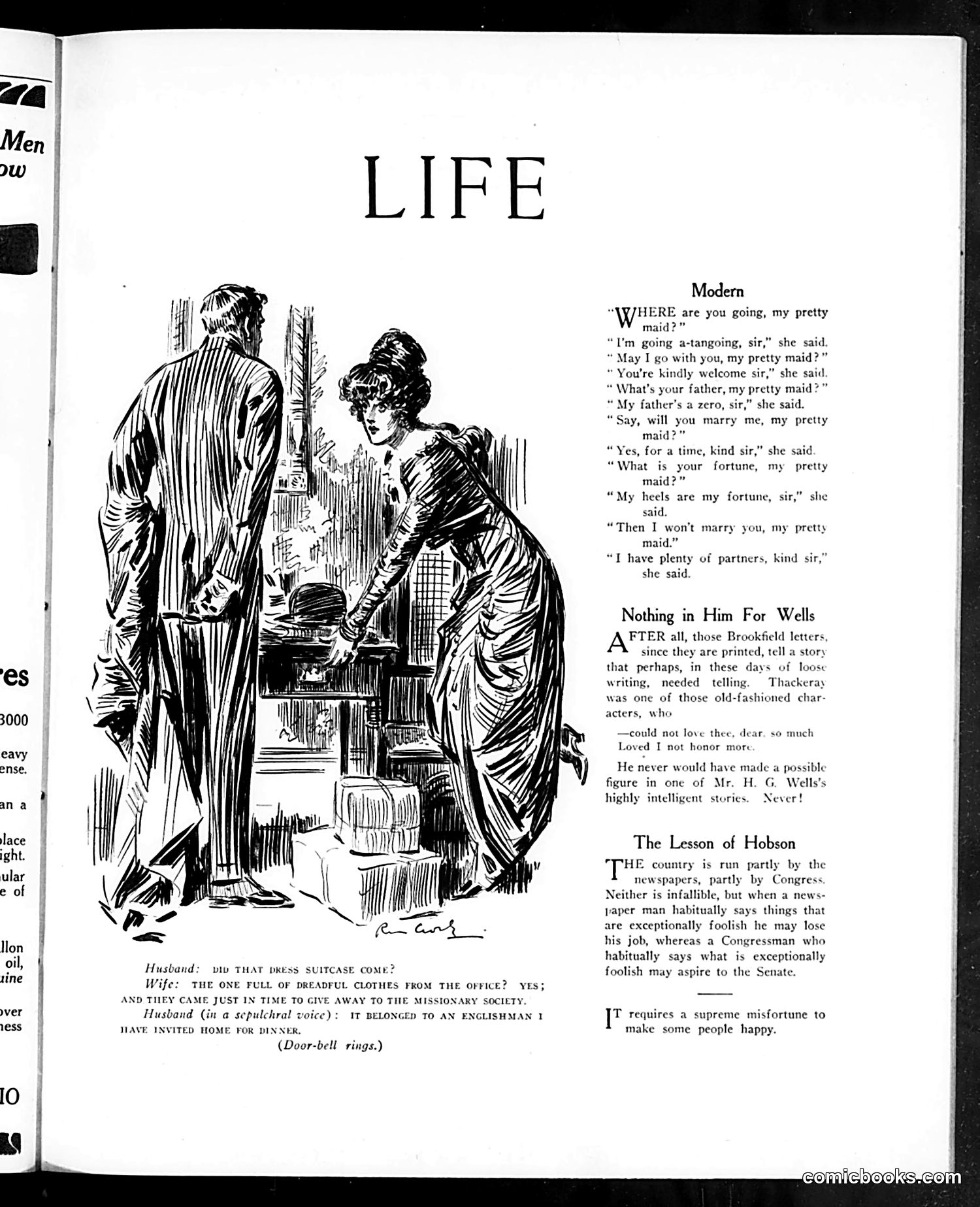
This page contains a satirical cartoon and accompanying short stories. The main illustration depicts a husband and wife with packed suitcases, labeled "Modern." The husband asks about a dress suitcase; the wife explains the clothes are from the office and destined for a missionary society donation, having arrived just in time for a dinner invitation that belonged to an Englishman. The satire targets early 20th-century social hypocrisy: the wife's convenient "donation" is actually repurposing hand-me-downs for personal entertaining. The cartoon mocks both the fashion pretense of the era and the selective charity of the social classes—donating goods for appearance's sake rather than genuine altruism.
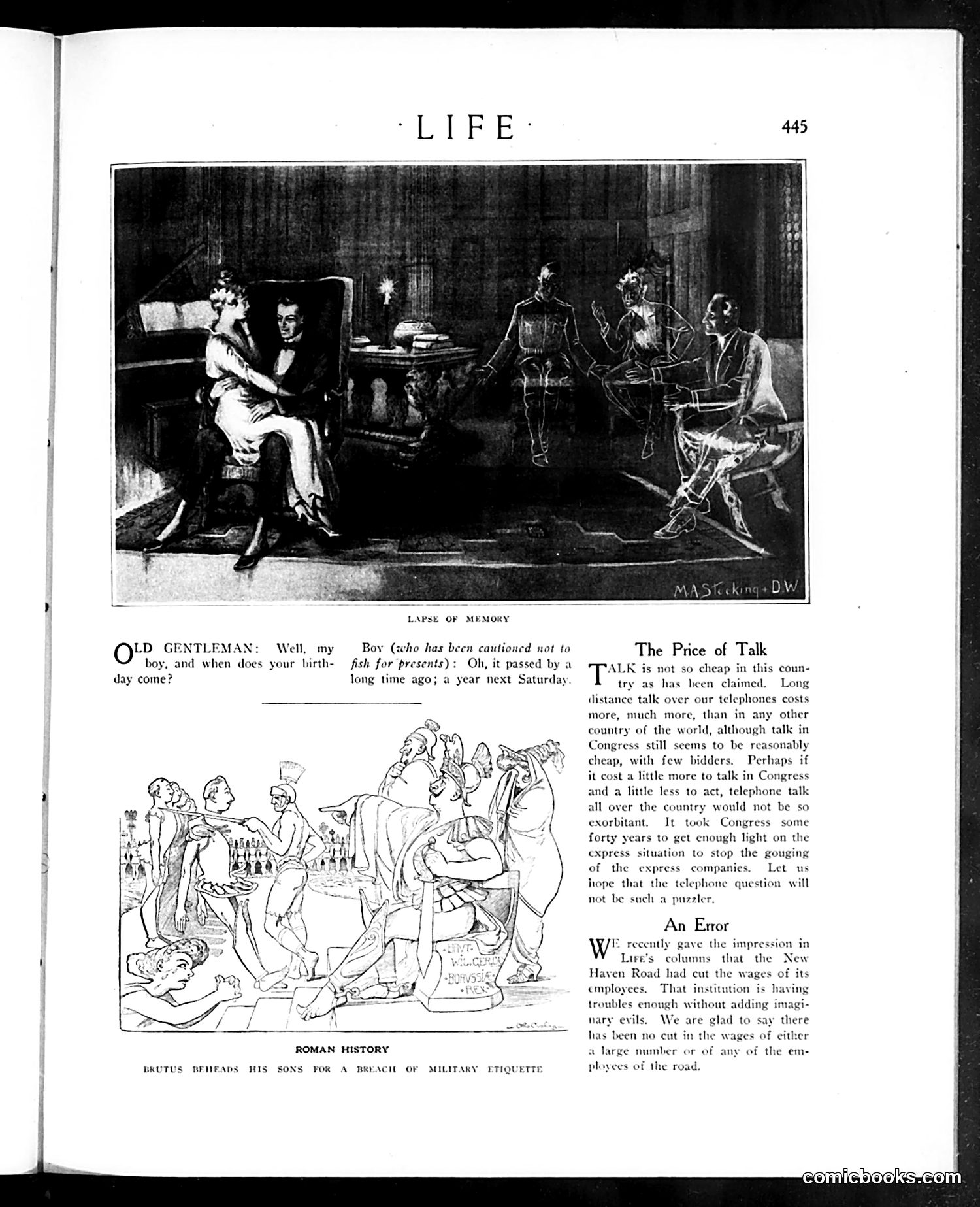
**Top Cartoon ("Lapse of Memory"):** An old gentleman asks a young boy about his birthday, which the boy says was "a year next Saturday"—a nonsensical answer suggesting the child has been coached with a false answer (noted in the caption's parenthetical warning). The joke satirizes either parents' dishonesty with children or children's unreliability. **Bottom Cartoon ("Roman History"):** Depicts a Roman general (Brutus) instructing his sons in military etiquette before battle. The satire likely mocks formal military protocol as overly concerned with manners rather than practical warfare. **Text Sections:** Include commentary on telephone costs and a correction regarding New Haven Road wage cuts, suggesting this issue addresses labor and infrastructure issues contemporary to publication.
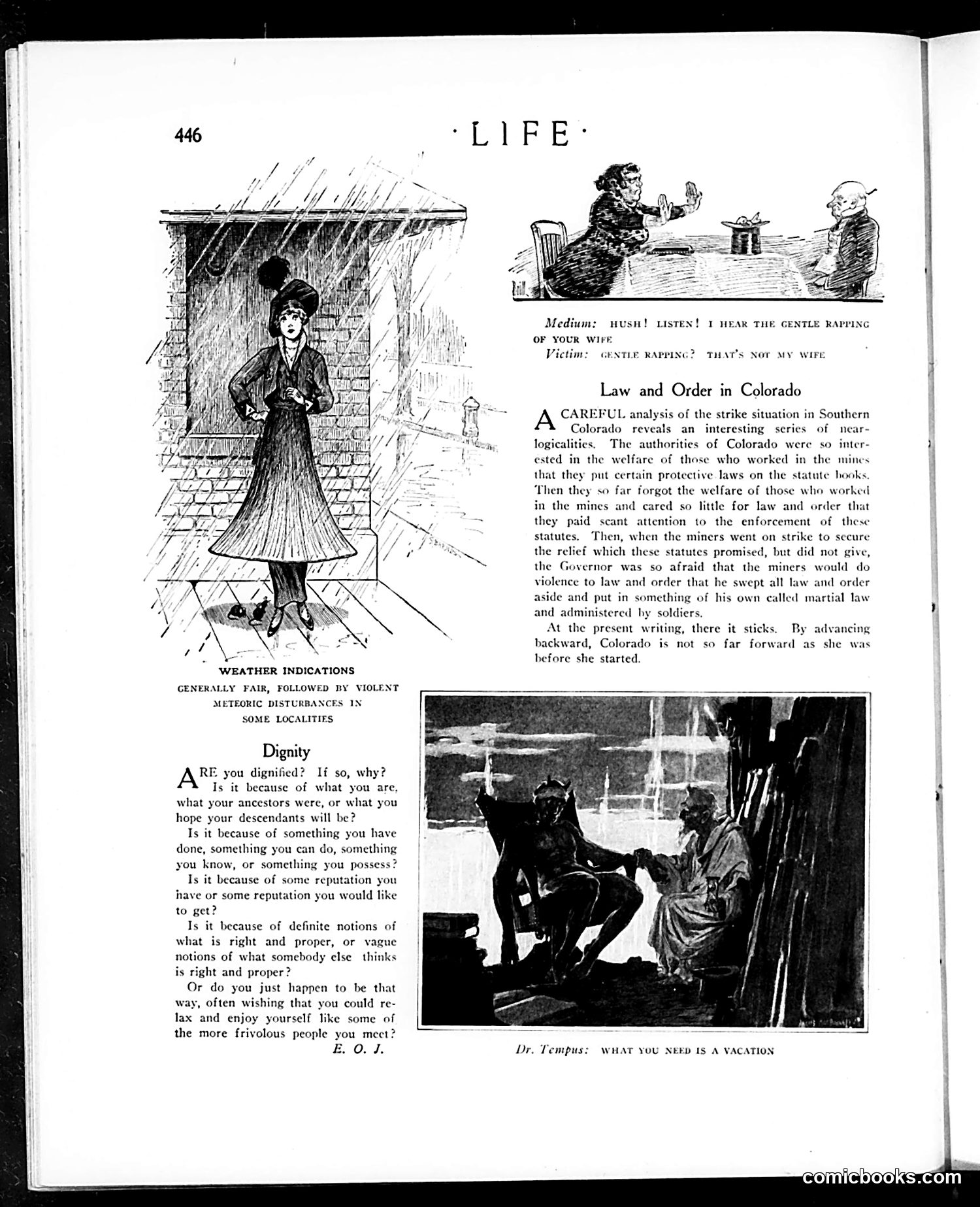
This page contains three distinct pieces: 1. **"Weather Indications"** (left): A sketch of a woman standing in heavy rain, captioned to suggest that fair weather followed by violent meteor disturbances occurs "in some localities"—likely a satirical comment on unpredictable or chaotic conditions. 2. **"Law and Order in Colorado"** (center): An article criticizing Colorado authorities' response to mining strikes. It argues that while officials enacted protective labor laws, they neglected enforcement and ultimately imposed martial law when miners struck—abandoning statutory protections for military control. 3. **"Dignity"** (bottom left): A philosophical essay questioning what dignity means—whether derived from ancestry, accomplishments, reputation, or simply personality. 4. **"Dr. Tempus"** (right): A photograph captioned "What you need is a vacation," showing what appears to be a medical consultation.
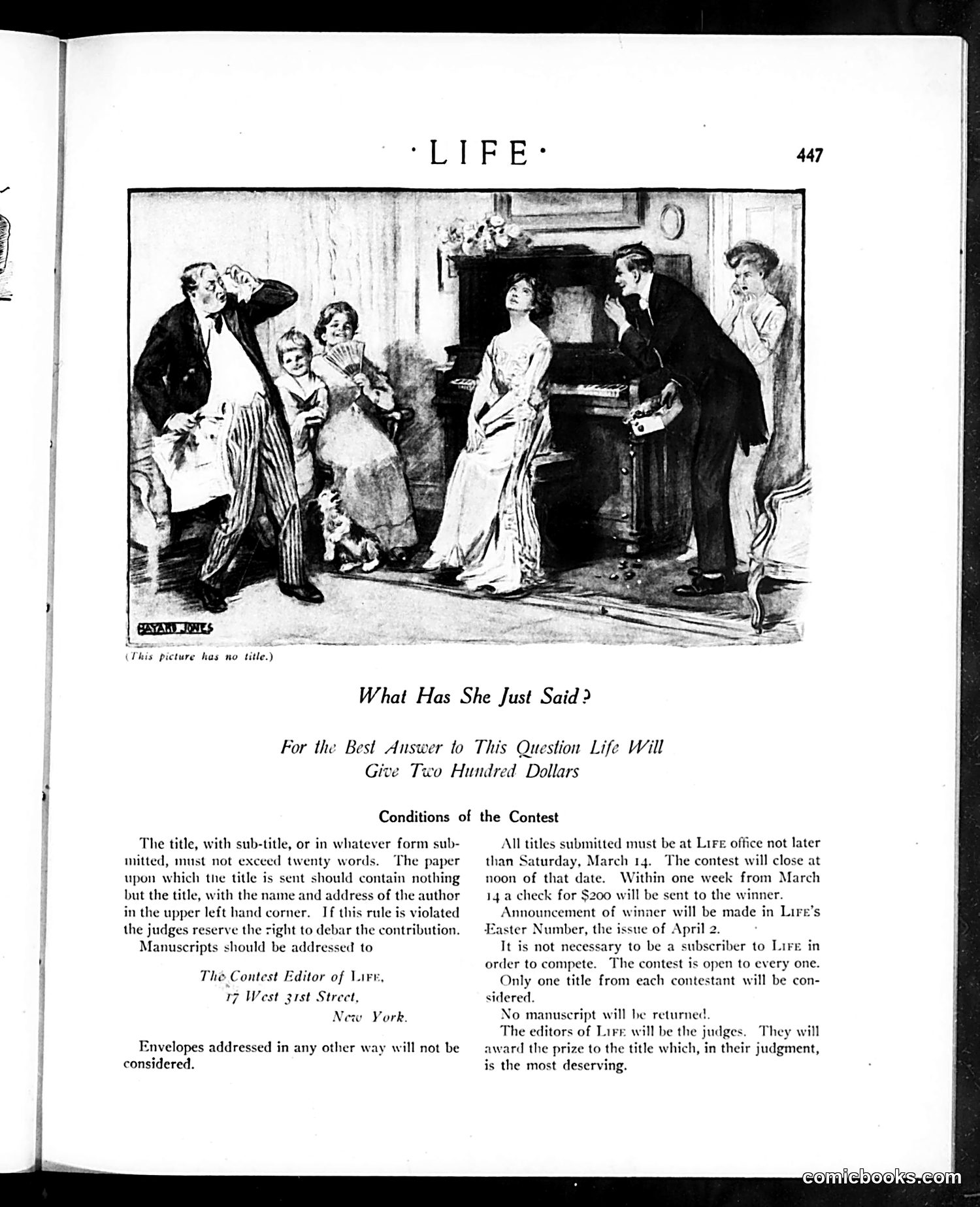
This page features a drawing captioned "What Has She Just Said?" and announces a contest offering $200 to readers who submit the best caption for the untitled illustration. The cartoon depicts a social gathering in what appears to be an elegant parlor, with a woman seated at a piano as the focal point. A man on the left appears shocked or surprised, while other well-dressed figures (men and women) react with varying degrees of interest or concern. The woman's statement—now lost to us—apparently provoked this dramatic response. The satire relies on visual humor: readers must invent witty or humorous dialogue explaining her provocative remark. This was a popular interactive format in early 20th-century magazines, engaging readers while generating content. The cartoon's humor depends entirely on the imagined scandal or surprising comment she's made.
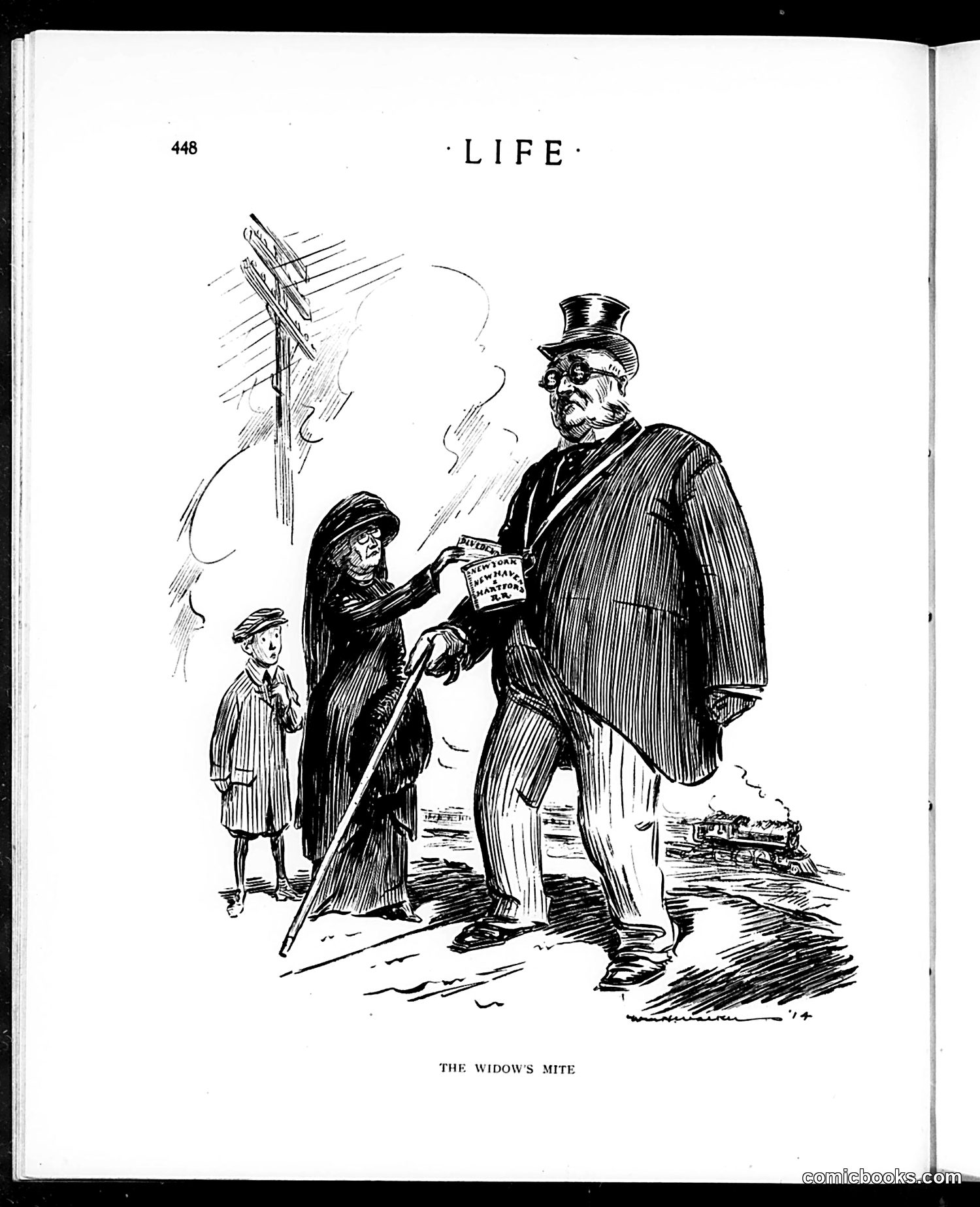
This cartoon illustrates the biblical parable of the widow's mite (Mark 12:41-44), where Jesus praises a poor widow who gives her last coins to the temple, valuing her small sacrifice over wealthy donors' large contributions. The image shows a well-dressed, top-hatted gentleman (likely representing a wealthy industrialist or politician) receiving a contribution from a woman in poor clothing, while a small child stands nearby. A train appears in the background, suggesting railroad or industrial wealth. The satire appears to critique how the wealthy exploit the poor by accepting donations from those who can least afford them, while the title's biblical reference suggests hypocrisy—the gentleman takes the widow's meager offering despite his obvious prosperity. The cartoon comments on class inequality and exploitation in the Gilded Age.
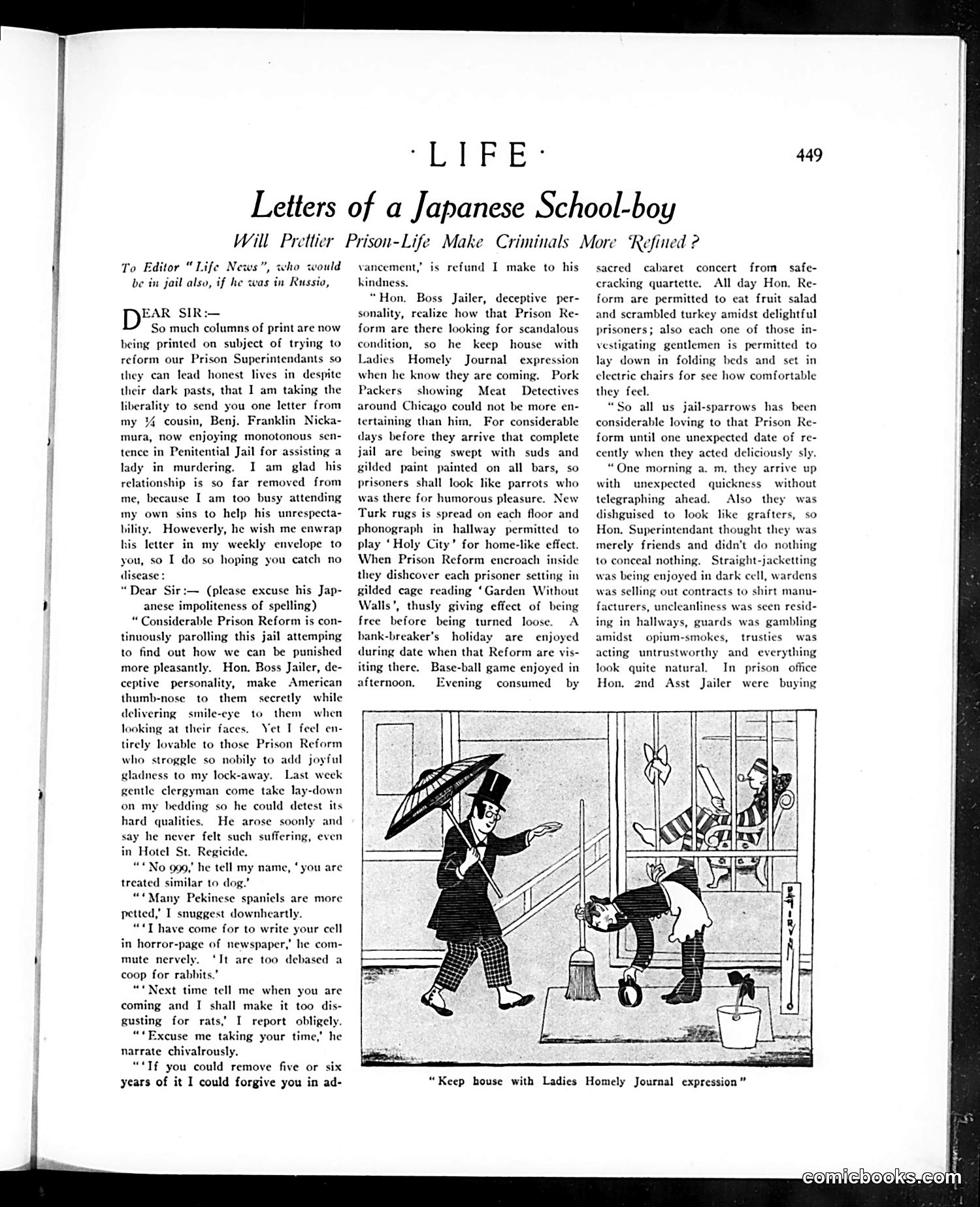
This page presents a letter satirizing American prison reform efforts. A Japanese schoolboy writes to *Life*'s editor, observing that efforts to make prisons more humane—through comfortable furnishings, entertainment, and pleasant conditions—may actually encourage criminal behavior rather than reform it. The accompanying cartoon illustrates the irony: it shows what appears to be a jailer or guard maintaining a prison cell with surprising domesticity, depicted with humorous exaggeration. The caption "Keep house with Ladies Homely Journal expression" suggests the prison is being run like a comfortable home rather than a place of punishment. The satire targets American progressivism of the era—specifically the belief that improved prison conditions would rehabilitate inmates—by having an outsider (the Japanese boy) point out the logical absurdity from a critical distance.
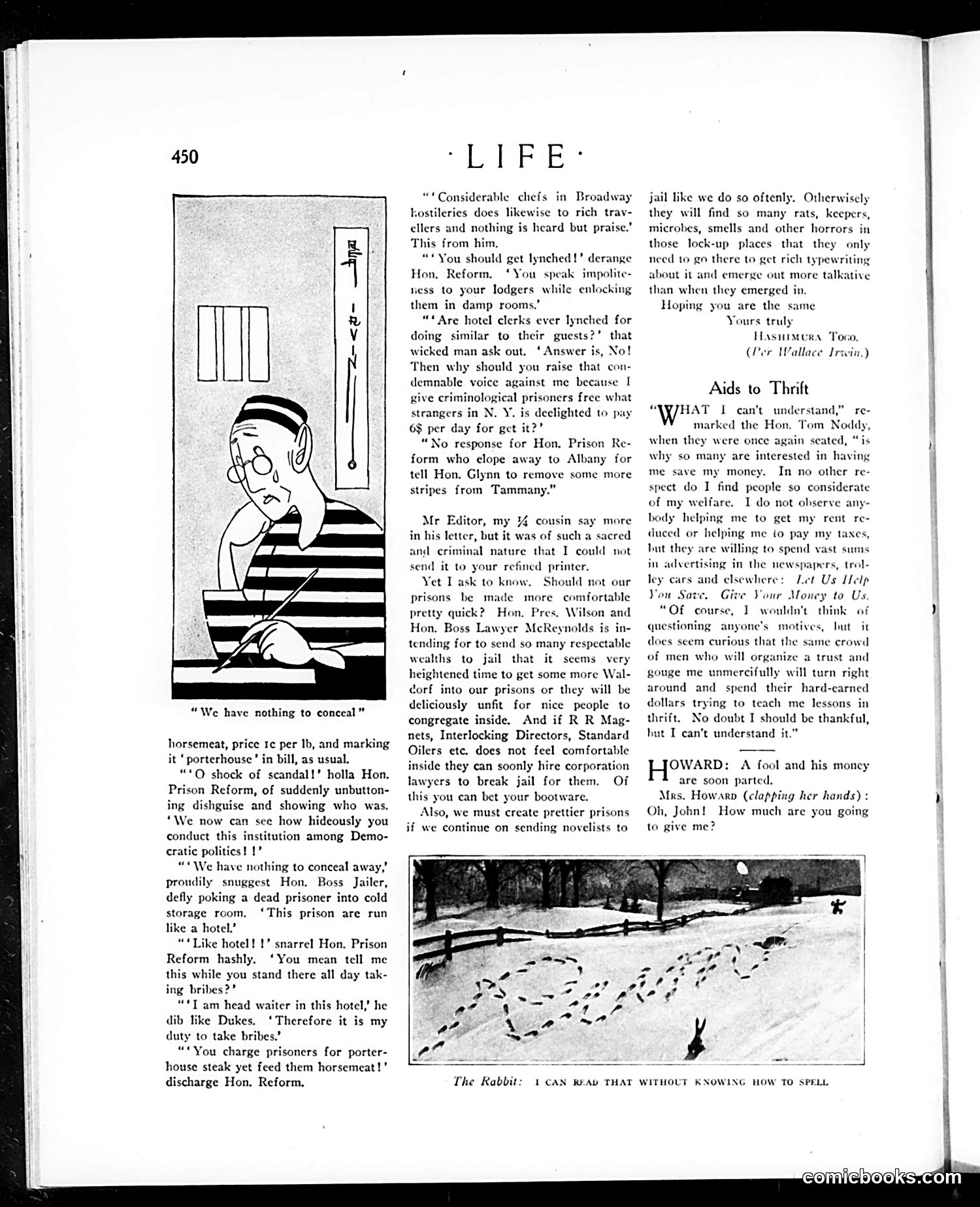
This page satirizes prison reform debates of the early 20th century. The cartoon depicts a prisoner in striped uniform declaring "We have nothing to conceal," a sardonic comment on reformers' arguments for improving jail conditions. The accompanying letters mock advocates calling for more comfortable prisons—better food, hotel-like amenities, and "pretty quick" reforms. Critics argue these proposals are absurd, comparing prisoner care to hospitality. One letter sarcastically suggests charging prisoners "porterhouse steak" fees. The satire targets the tension between humanitarian prison reform and public skepticism about coddling criminals. The prisoner's statement ironically suggests prisoners have nothing to hide from scrutiny, while simultaneously mocking reformers' idealism about institutional improvement. The rabbit photograph's caption appears unrelated to the prison debate.
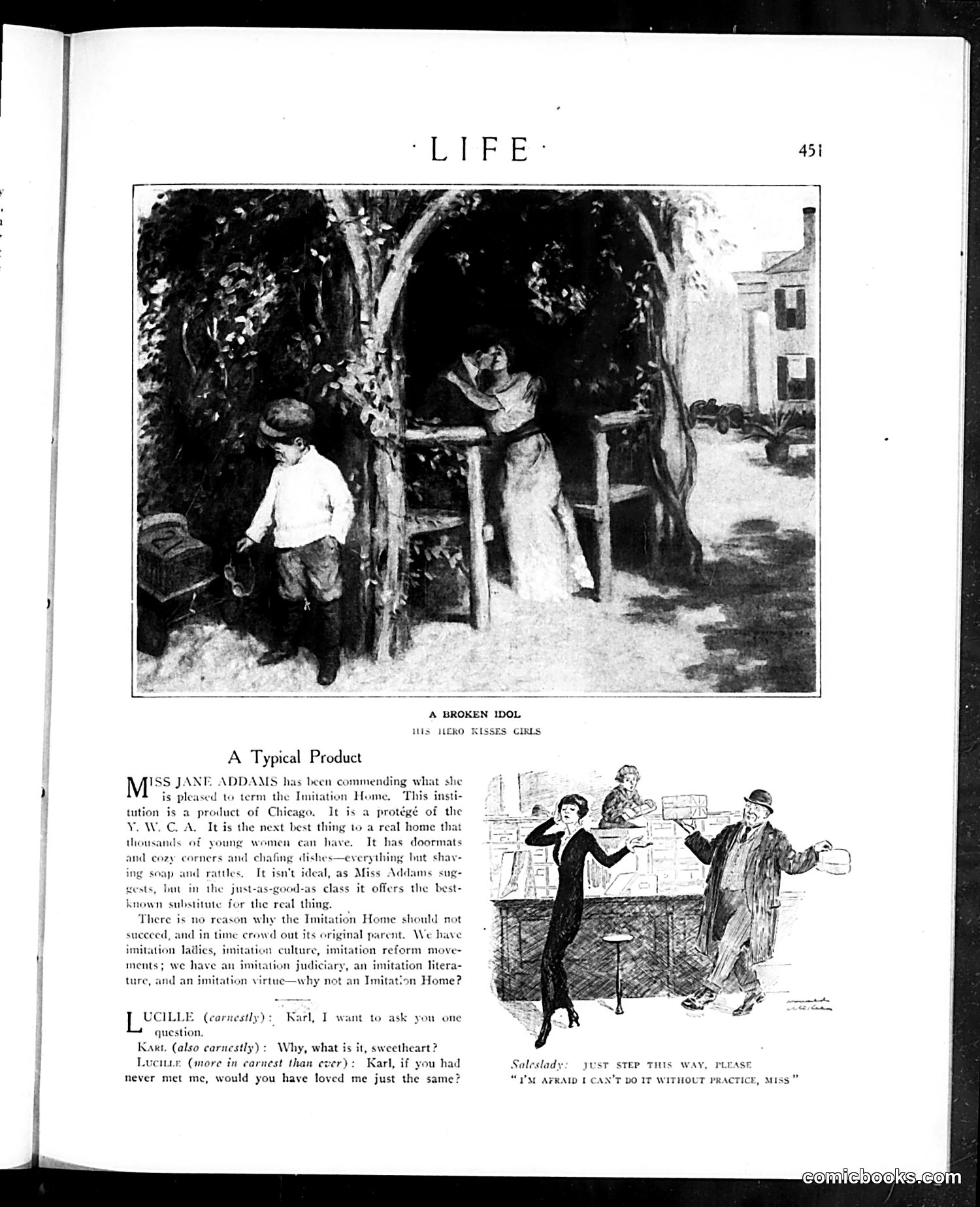
This page satirizes Jane Addams's "Imitation Home," a Chicago YMCA initiative providing affordable housing for young working women. The article argues the institution, while well-intentioned, offers only a "just-as-good-as" substitute for genuine domesticity—complete with "doormats and cozy corners" but lacking authenticity. The cartoon below mocks the absurdity of "imitation" solutions by depicting a skating instructor telling a woman he cannot teach her "without practice"—a nonsensical excuse that mirrors the article's point: you cannot authentically replicate life experience through institutions alone. The photograph at top ("A Broken Idol") shows what appears to be children in a shelter setting, illustrating the real conditions these facilities served. The cartoon's dialogue between Karl and Lucille, meanwhile, presents romantic sentimentality—a contrast highlighting how artificial environments cannot replicate genuine human connection.
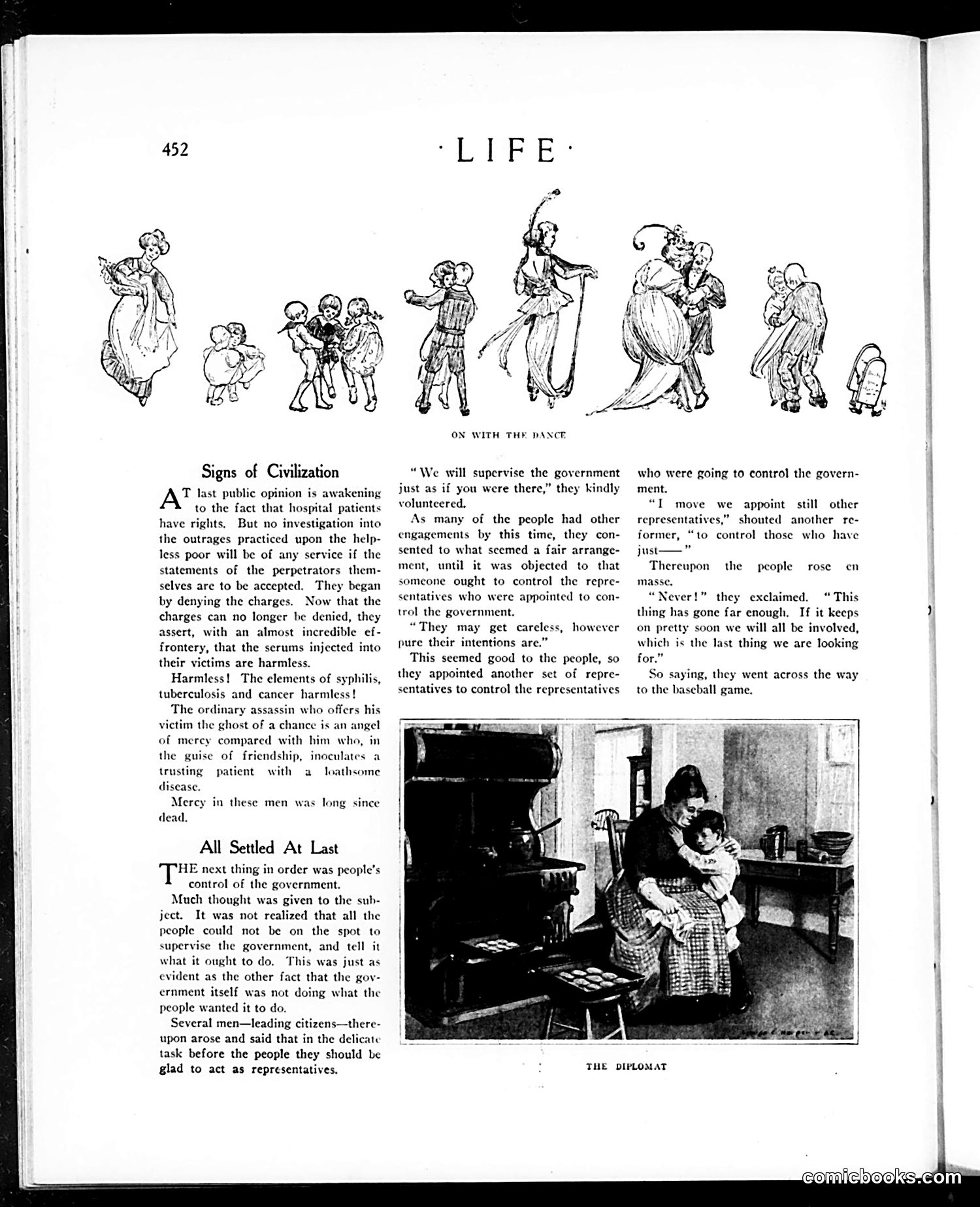
This satirical piece mocks the proliferation of bureaucratic oversight in democratic governance. The text describes citizens appointing representatives to supervise the government, who then appoint *other* representatives to supervise those representatives—creating an absurd infinite regress of oversight layers. The satire's point: citizens eventually realize this system has become so convoluted that "we will all be involved," defeating the original purpose of delegation. Rather than fix the problem, they abandon civic engagement entirely, going to a baseball game instead. The accompanying illustrations show "On With the Dance"—figures in various poses suggesting frivolous activity and distraction. The page also includes a separate section, "Signs of Civilization," condemning hospital abuses and medical malpractice where patients were allegedly harmed by dangerous injections, presented as a darker commentary on institutional corruption masquerading as benevolence. Together, these pieces critique both government dysfunction and public apathy.
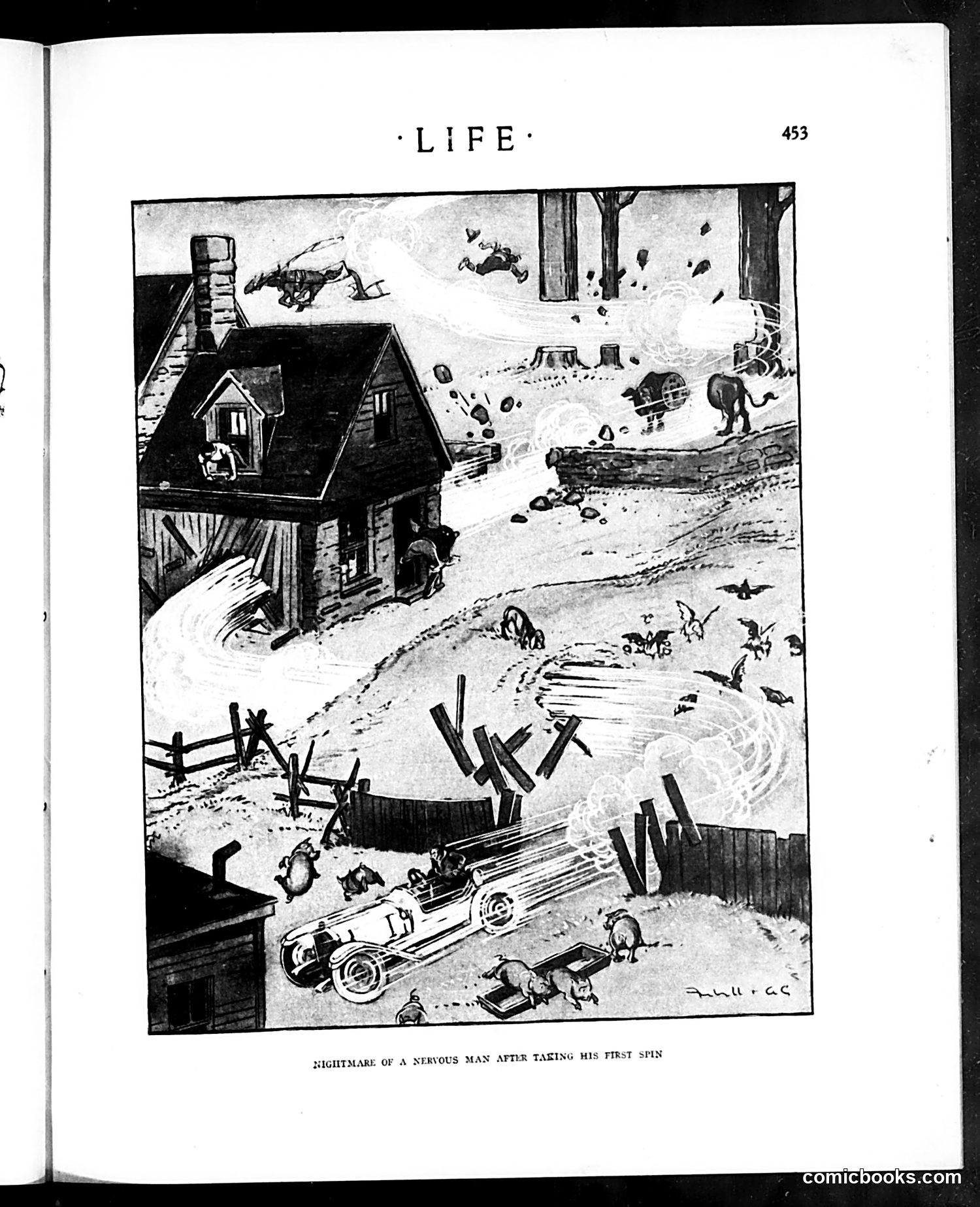
This is a humorous cartoon depicting the anxious fantasies of someone experiencing their first automobile ride. The caption reads "Nightmare of a Nervous Man After Taking His First Spin." The illustration shows an exaggerated disaster scenario: a car spinning wildly out of control in a rural/farm setting, causing chaos—flying debris, frightened animals, damaged fences, a collapsing house, and people scattering in panic. The joke satirizes early-20th-century anxieties about automobiles as dangerous, unpredictable machines. For a nervous passenger unaccustomed to motor vehicles, the experience apparently felt so chaotic and terrifying that their imagination conjured this catastrophic fantasy. It's social satire mocking both the anxiety of "modern" people fearful of new technology and the actual hazards of early, barely-controlled automobiles.
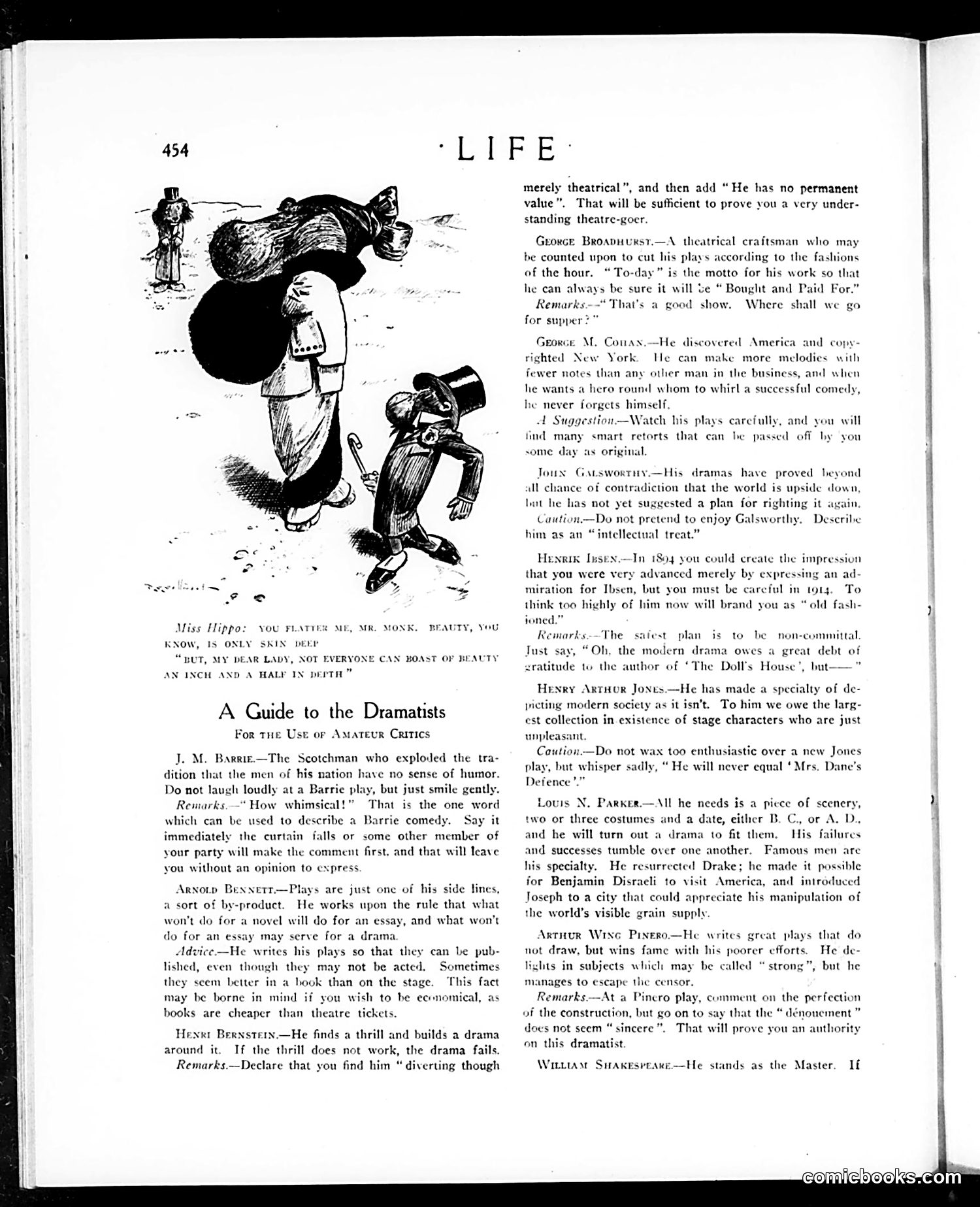
This page from *Life* magazine presents "A Guide to the Dramatists," a satirical guide mocking theater critics and playwrights' reputations circa the early 1900s. The cartoon shows a hippopotamus (Miss Hippo) conversing with a small man (Mr. Monk), making a joke about beauty being "only skin deep"—but sarcastically noting that even one-and-a-half inches of skin is more than some possess. The text that follows satirizes famous playwrights by offering cynical advice to amateur critics on how to discuss their work without genuine understanding. For example: praise Barrie as "whimsical," dismiss Bernstein as "theatrical" yet lacking "permanent value," and treat Ibsen cautiously since enthusiasm for him now marks one as "old fashioned." The satire targets both pretentious critics who repeat clichés and the playwrights themselves—suggesting their work is fashionable, formulaic, or overrated. It's essentially mocking the theater world's snobbery and the gap between critical praise and actual merit.
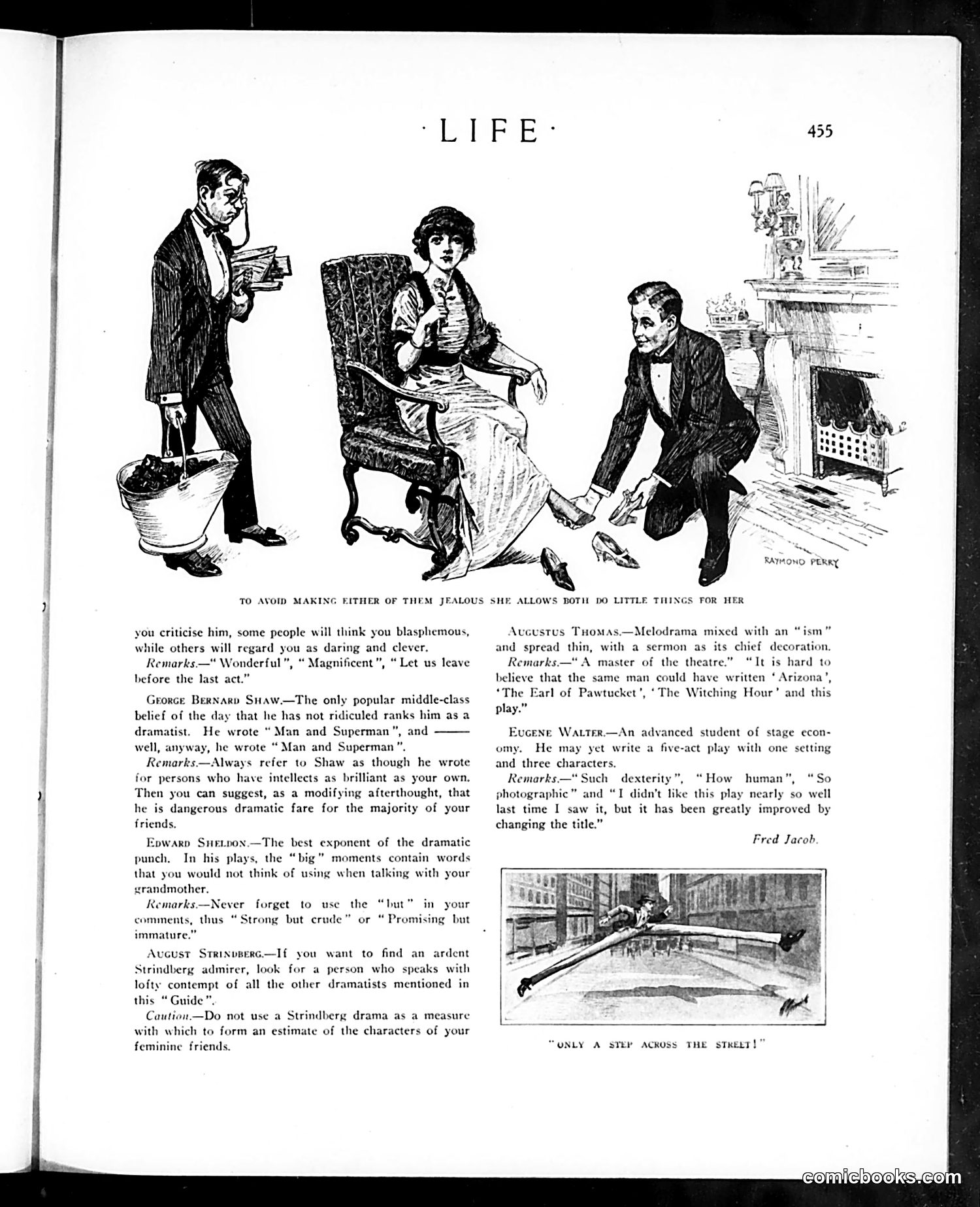
This page satirizes how to discuss contemporary playwrights while appearing sophisticated. The cartoon (by Raymond Perry) depicts a woman accepting small favors from two men simultaneously—the visual metaphor for the page's theme: how to flatter both rivals without appearing to favor either. The text mocks theatrical pretension by offering "guides" to praising famous dramatists (Shaw, Sheldon, Strindberg, Thomas, Walter) while revealing nothing genuine about them. Readers are advised to use vague praise ("Wonderful," "Magnificent"), affect intellectual superiority, and selectively quote obscure references. The humor targets Edwardian-era theater culture: the snobbery surrounding serious drama, the pressure to appear cultured by praising playwrights one may not understand, and the hypocrisy of public opinion. The second illustration shows someone crossing a street—likely illustrating a dramatic moment from one of the works discussed. This reflects early 1900s concerns about middlebrow cultural posturing and the gap between authentic appreciation and performative sophistication.
This page addresses two contemporary issues: **The Benton Affair**: The text discusses the death of a British subject (Benton) in Mexico during the Mexican Revolution. General Villa's forces are suspected, but an investigation commission has postponed viewing the exhumed body due to objections from General Carranza. The satirist wryly notes the investigation will likely report vague "complications" (mocking how deaths are euphemistically reported), and questions whether blame-shifting between Mexican leaders helps anyone—particularly Britain, which prefers the U.S. mediate. **Corporate Philosophy Shift**: The essay celebrates that American attitudes toward corporations have fundamentally changed since 1912. Previously, companies served shareholders with minimal obligations to the public; now there's recognition that corporations have broader social responsibilities. This reflects Progressive Era reforms following the life-insurance industry scandals investigated by James Alexander and James Hyde. The cartoons (though unclear in detail) appear to support these themes of social transformation and patience during turbulent times.
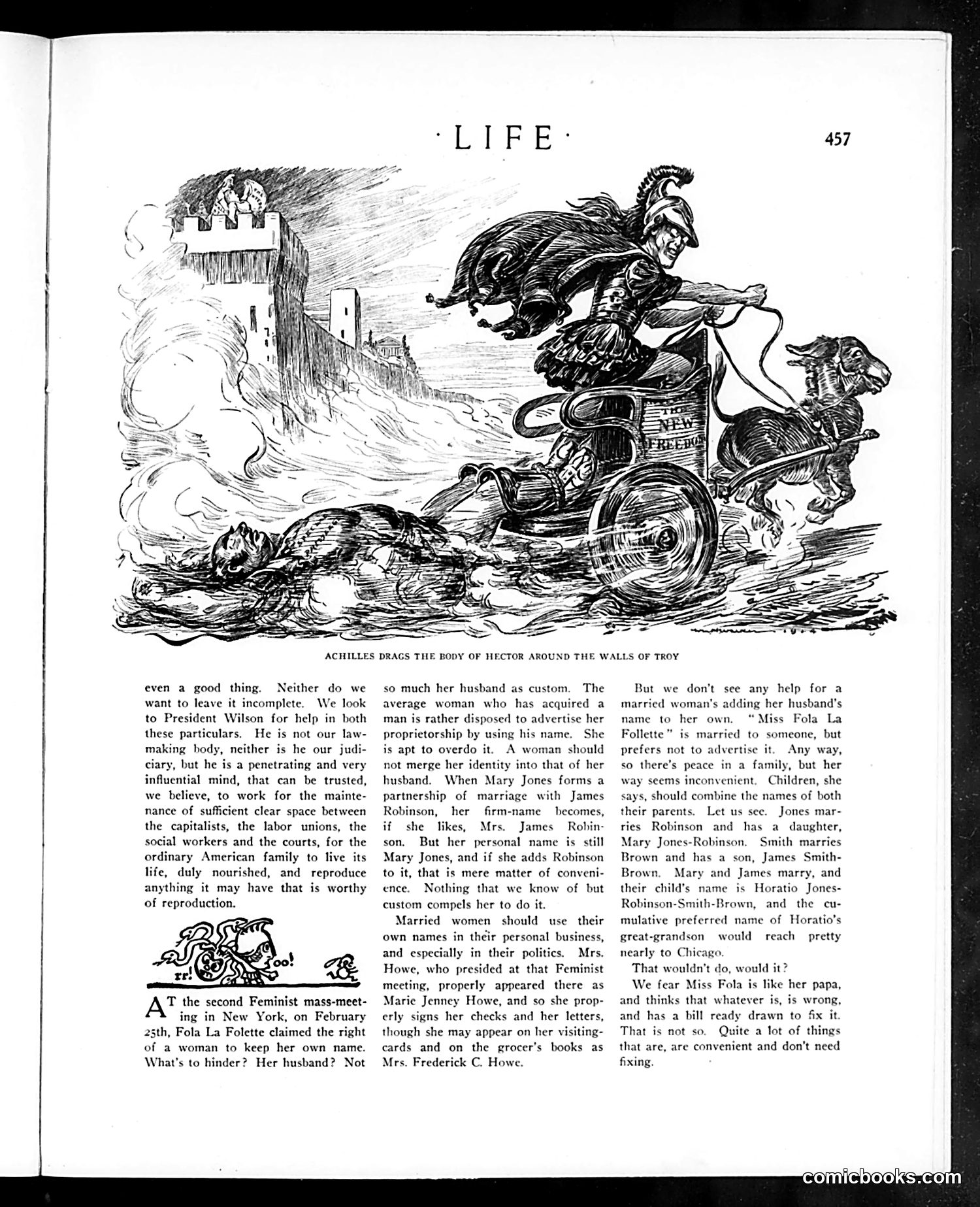
The page contains two distinct pieces: **The Illustration** depicts the famous classical scene of Achilles dragging Hector's body around Troy's walls—a reference to Homer's *Iliad*. The caption suggests this is satirical commentary, likely about violent or excessive responses to conflict, though the specific contemporary reference is unclear without additional context. **The Text** discusses women's naming rights after marriage, prompted by feminist activist Fola La Follette's February 1912 speech advocating women keep their own names professionally. The author (writing to President Wilson) supports women using maiden names in business and politics, but argues against La Follette's suggestion that children combine both parents' surnames—showing how impractical naming would become across generations. The piece reflects early 20th-century feminist debates about women's identity and property rights in marriage, while the author takes a moderate, pragmatic position skeptical of radical reform.
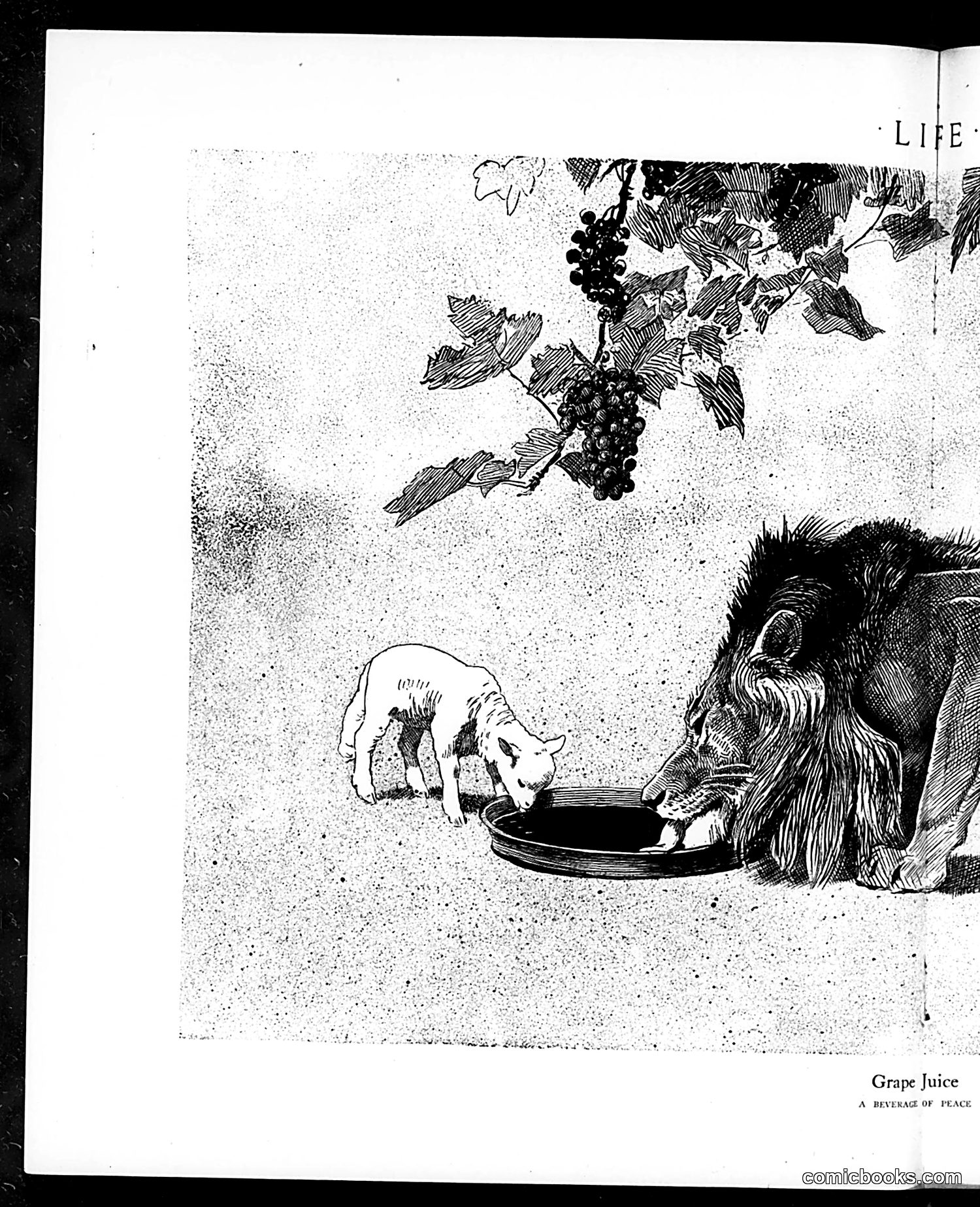
This illustration depicts two animals sharing from a bowl labeled "Grape Juice." On the right is a large, fierce-looking lion or similar predator; on the left is a small, mild-looking goat or sheep. Above them hangs a grapevine with heavy fruit. The caption "A Beverage of Peace" suggests satirical commentary on conflict resolution. The stark contrast between the powerful predator and vulnerable prey animal sharing peacefully appears to mock the notion that a simple beverage—or by extension, any consumer product or diplomatic gesture—could resolve fundamental power imbalances or natural antagonisms between opposing forces. This likely reflects early 20th-century skepticism about whether commercial products or pacifist solutions could genuinely prevent conflict between stronger and weaker nations or groups.
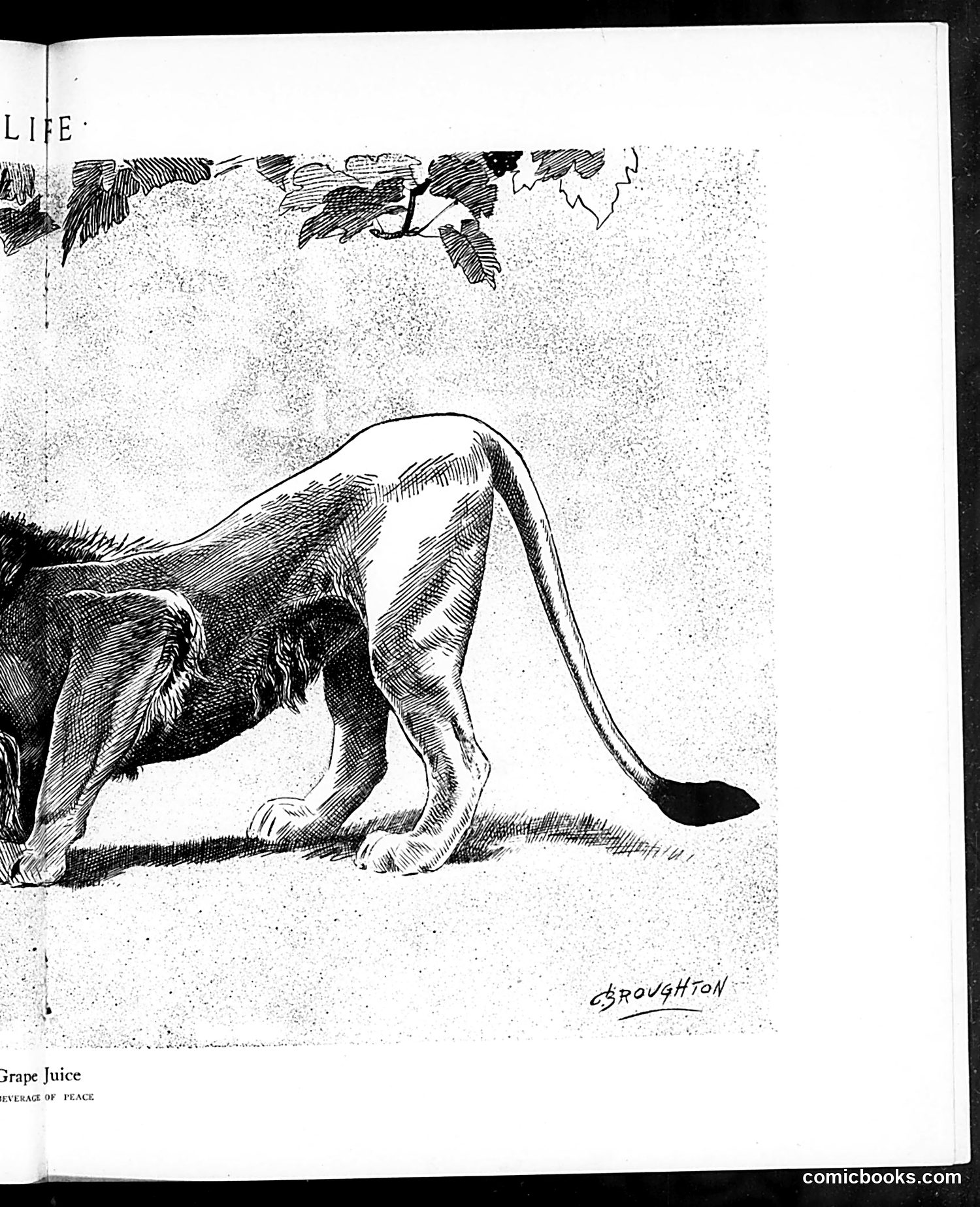
This page features a cartoon by Croughton showing a dog in a submissive, dejected posture looking down at its own shadow. The heading "Grape Juice" with the subtitle "Beverage of Peace" appears to be satirical. This likely references Woodrow Wilson's famous promotion of grape juice as a temperance alternative to alcohol—Wilson was a vocal prohibition advocate. The cartoon's dejected dog may satirize the ineffectiveness or unpopularity of such prohibition efforts, or mock the idealistic "peace" messaging attached to what many saw as an unpopular policy. The image suggests the cartoonist is mocking either Wilson's temperance stance or the broader prohibition movement's failure to achieve its stated goals, using the downcast dog as a symbol of disappointment or defeat.
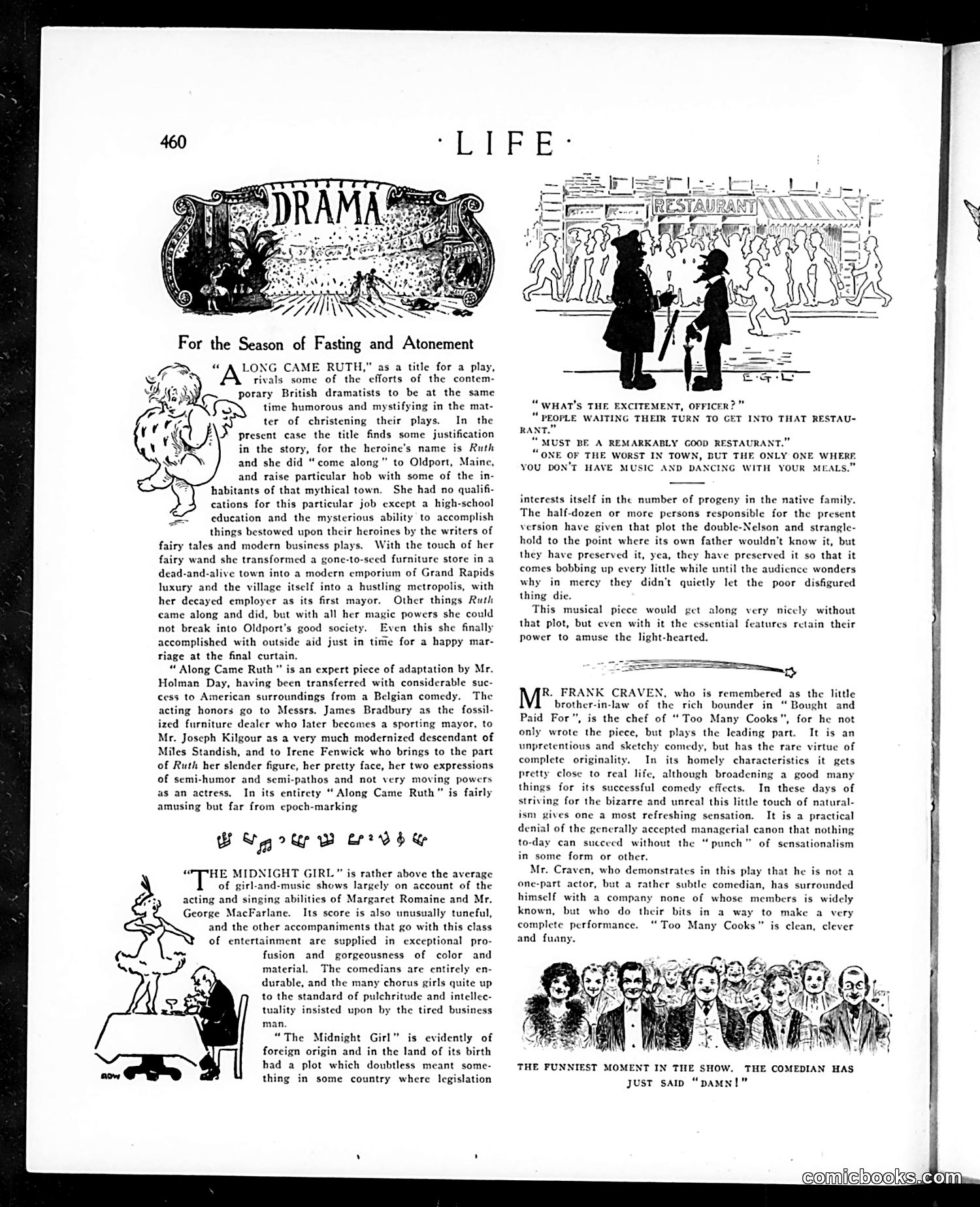
This page reviews three contemporary theatrical productions. The main content consists of theater criticism rather than political satire. **"Along Came Ruth"** is reviewed as a competent but unremarkable adaptation of a Belgian comedy, featuring actress Irene Fenwick as a small-town woman who transforms a declining Maine community. **"The Midnight Girl"** is praised above-average for its performers Margaret Romaine and George MacFarlane, though criticized for an overly convoluted plot that undermines the musical entertainment. **The cartoon** at top-right satirizes restaurant culture: an officer explains crowds waiting outside a terrible restaurant—"the only one where you don't have music and dancing with your meals." This mocks the era's trend of adding entertainment to dining establishments, suggesting some patrons actually prefer a simpler dining experience without mandatory musical accompaniment. The final review discusses **"Too Many Cooks,"** written by and starring Frank Craven, praised for originality and homely realism despite being sketchy in construction.
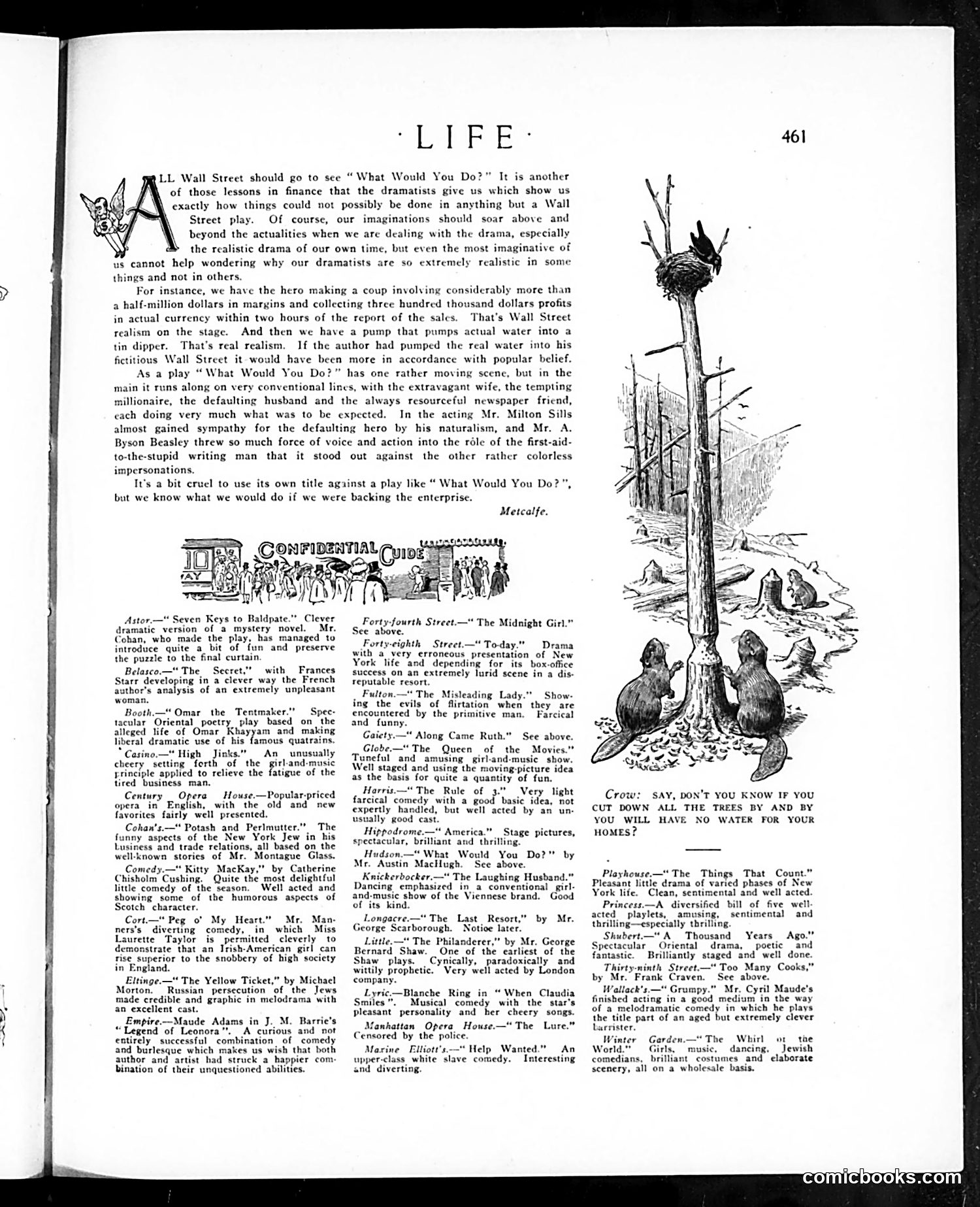
This page critiques the play "What Would You Do?" — a Wall Street drama. The magazine's theater reviewer (bylined "Metcalfe") satirizes the play's contradictory realism: it depicts a financial coup involving half-million-dollar margins and three-hundred-thousand-dollar profits with meticulous accuracy, yet uses a *real pump* to spray actual water into a tin dipper as stage effect. The satire's point: dramatists obsess over financial detail to seem authentic but ignore practical realism. The reviewer notes the irony that if the author had pumped *real* water into his fictional Wall Street scenario, it would be "more in accordance with popular belief"—suggesting audiences find high finance incomprehensible compared to literal stage mechanics. The cartoon image (right) appears unrelated editorial art. The page concludes with brief reviews of other theatrical productions, listing various Broadway venues and plays.
This is primarily a **book review section** titled "Confidential Book Guide," not a political cartoon page. The only illustration is a generic decorative header showing figures among books—not a satirical cartoon. The content reviews recent publications, comparing two authors: **James Stephens** (Dublin) and **Harris Merton Lyon** (St. Louis). The reviewer notes their striking similarities—both young writers with artistic vision producing collections of short stories—yet emphasizes their fundamental differences in temperament and approach to their craft. The tone is literary criticism rather than satire. References like "Crock of Gold" and "The Threepenny-Piece" reflect Stephens' actual works. The humor is gentle and observational, not politically pointed. This represents Life magazine's broader cultural coverage beyond political satire—focusing on contemporary literature for educated readers interested in reviewing new books of merit.
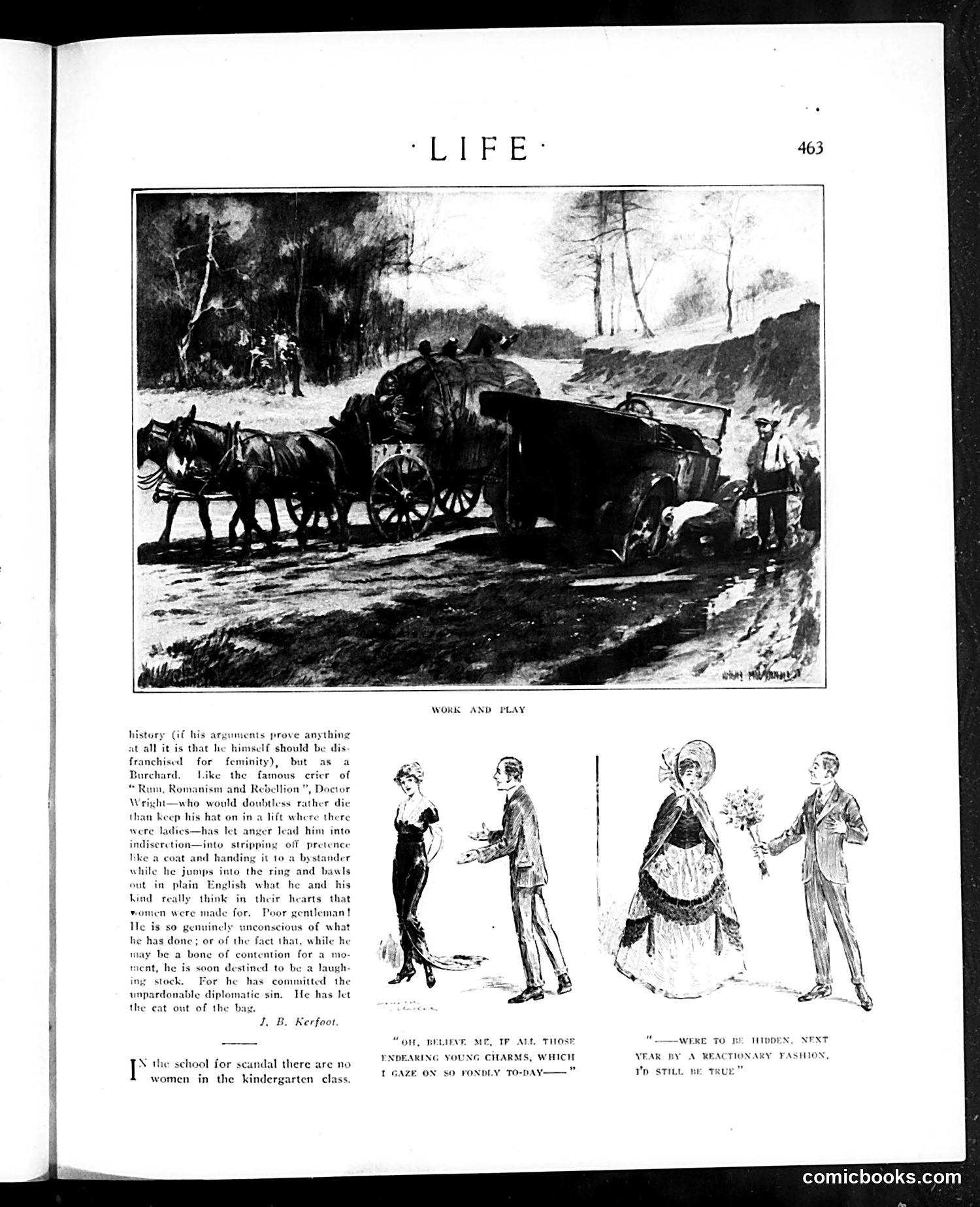
This page satirizes gender politics and social hypocrisy in early 20th-century America. The top photograph shows laborers and horses—"work"—contrasting with the illustrated vignettes below showing romantic courtship—"play." The text criticizes a figure named "Doctor Wright" (likely a real public figure) who carelessly revealed his true opinions about women's roles, committing a "diplomatic sin" by speaking plainly rather than maintaining polite pretense. The article mocks him for being "genuinely unconscious" of his gaffe and destined to become "a laughing stock." The cartoon captions underscore the satire: a man begs a woman to hide her "reactionary fashions" and "endearing young charms" next year—implying women were expected to perform femininity and attractiveness while men publicly denied that women deserved equality or franchise (voting rights). The joke targets the contradiction between what men *say* about women's roles and what they actually *believe*.
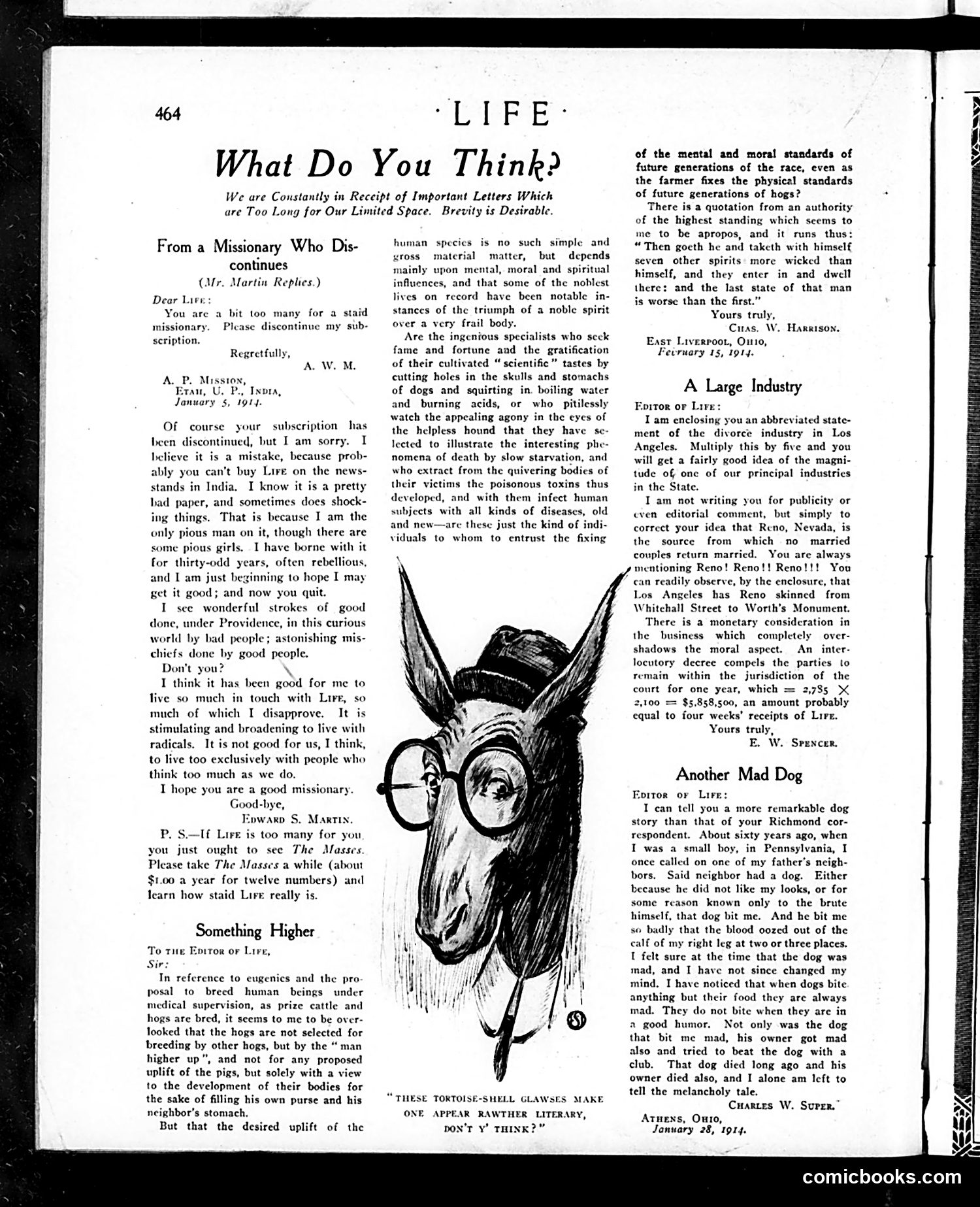
This page features the magazine's letters section with reader responses to Life's editorial positions. The main cartoon depicts a goat wearing tortoise-shell glasses, captioned "These tortoise-shell glawses make one appear rawther literary, don't y' think?" — a visual joke mocking intellectual pretension and affectation. The letters address serious topics: one missionary complains Life is too radical (editor Martin defends the magazine's value precisely *because* it challenges readers); another attacks eugenics advocates, arguing they're morally unfit to direct human breeding—their cruel animal experiments demonstrate spiritual corruption. The writer quotes scripture to suggest evil amplifies itself. A third letter begins discussing divorce industry in Los Angeles, mentioning "Reno" (Nevada's divorce haven), suggesting concerns about rising marriage dissolution. The satire targets progressive-era debates: eugenics' scientific claims, religious versus secular authority, and social upheaval.
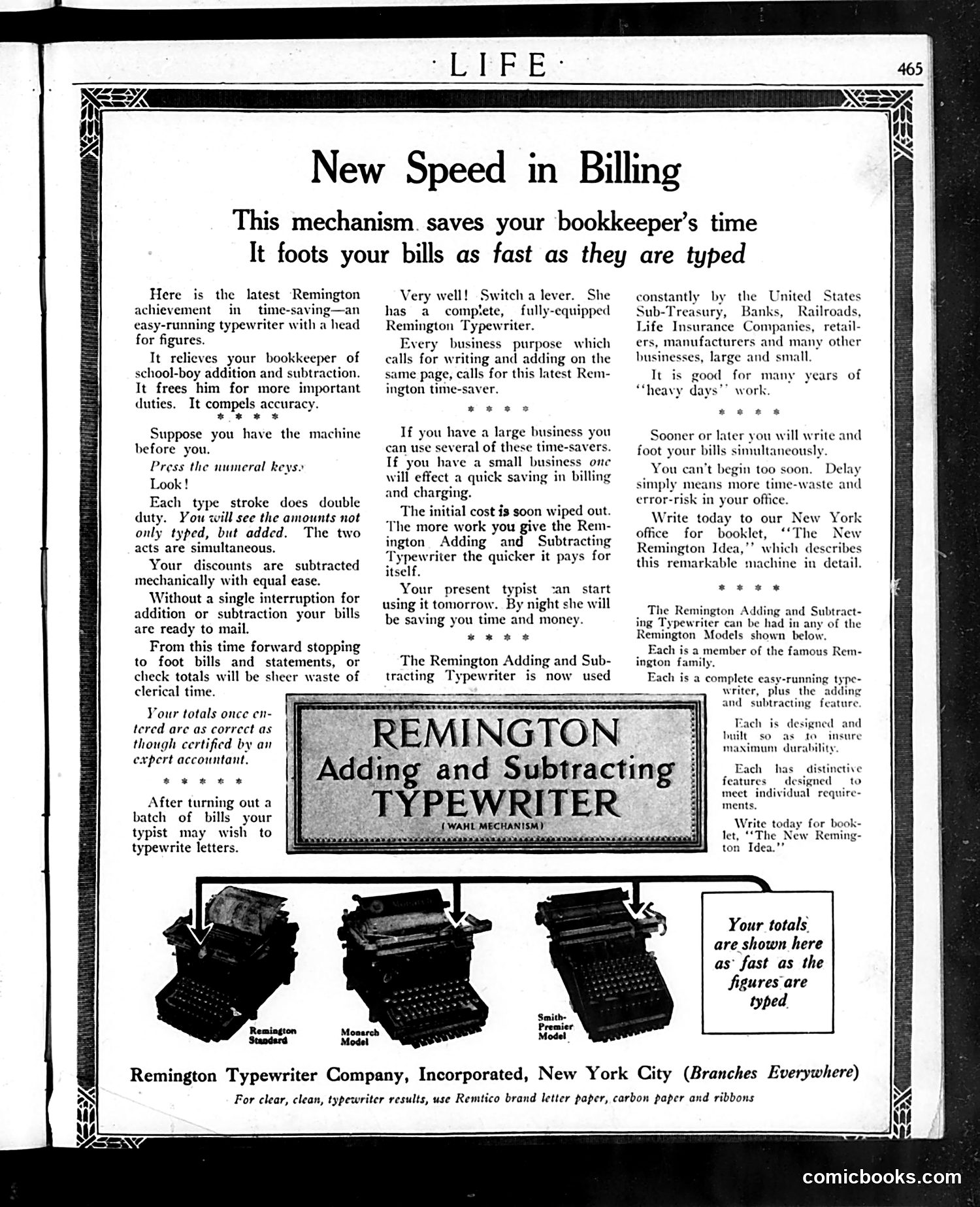
This is a **straightforward advertisement**, not satire or political commentary. It promotes Remington's new Adding and Subtracting Typewriter—a mechanical innovation that performs arithmetic automatically while typing. **The "Point":** This machine saves clerical labor by eliminating manual addition/subtraction when preparing bills. Each keystroke both types numbers AND calculates totals simultaneously. The ad emphasizes efficiency gains: freeing bookkeepers from tedious arithmetic, reducing errors, and paying for itself quickly through time savings. **Context for modern readers:** This represents early office automation (appears to be 1920s-1930s era based on style). The typewriter with built-in calculating function was genuinely innovative technology—what we'd now recognize as a precursor to electric calculators and computer spreadsheets. The ad's appeal to businesses large and small, and its mention of government/corporate adoption (Sub-Treasury, railroads, insurance companies), reflects how transformative such labor-saving devices were in that era. There is no cartoon or satire present—this is simply period business advertising.
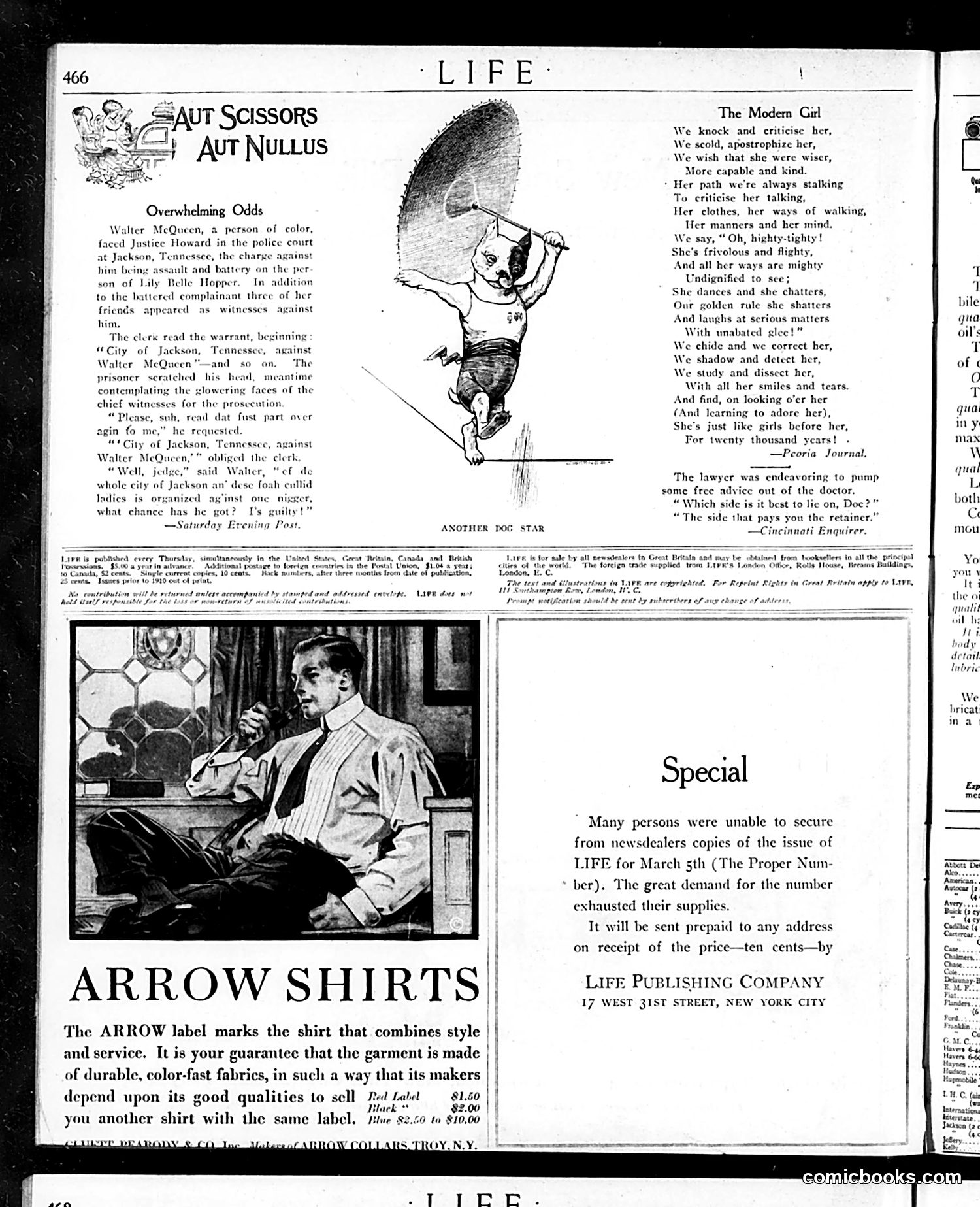
This page contains three distinct pieces of humor: **"Aut Scissors Aut Nullus" (top left):** A satirical legal anecdote mocking racial attitudes and courtroom injustice. Walter McQueen, described as "a person of color," faces assault charges in Jackson, Tennessee with multiple witnesses against him. The joke's cruelty lies in McQueen's despair—seeing the organized opposition against him, he asks what chance he has, suggesting the deck is stacked based on race. **"The Modern Girl" (top right):** A poem critiquing society's hypocrisy toward young women. Adults constantly criticize modern girls' fashion, behavior, and morality as frivolous and undignified, yet the poem's punchline reveals this is timeless—"just like girls before her, / For twenty thousand years!" It satirizes generational hand-wringing about youth. **"Another Dog Star" (center):** A brief joke about a lawyer's mercenary advice to a doctor—lie on whichever side "pays you the retainer." The page also advertises Arrow Shirts and announces a sold-out Life magazine issue from March 5th.
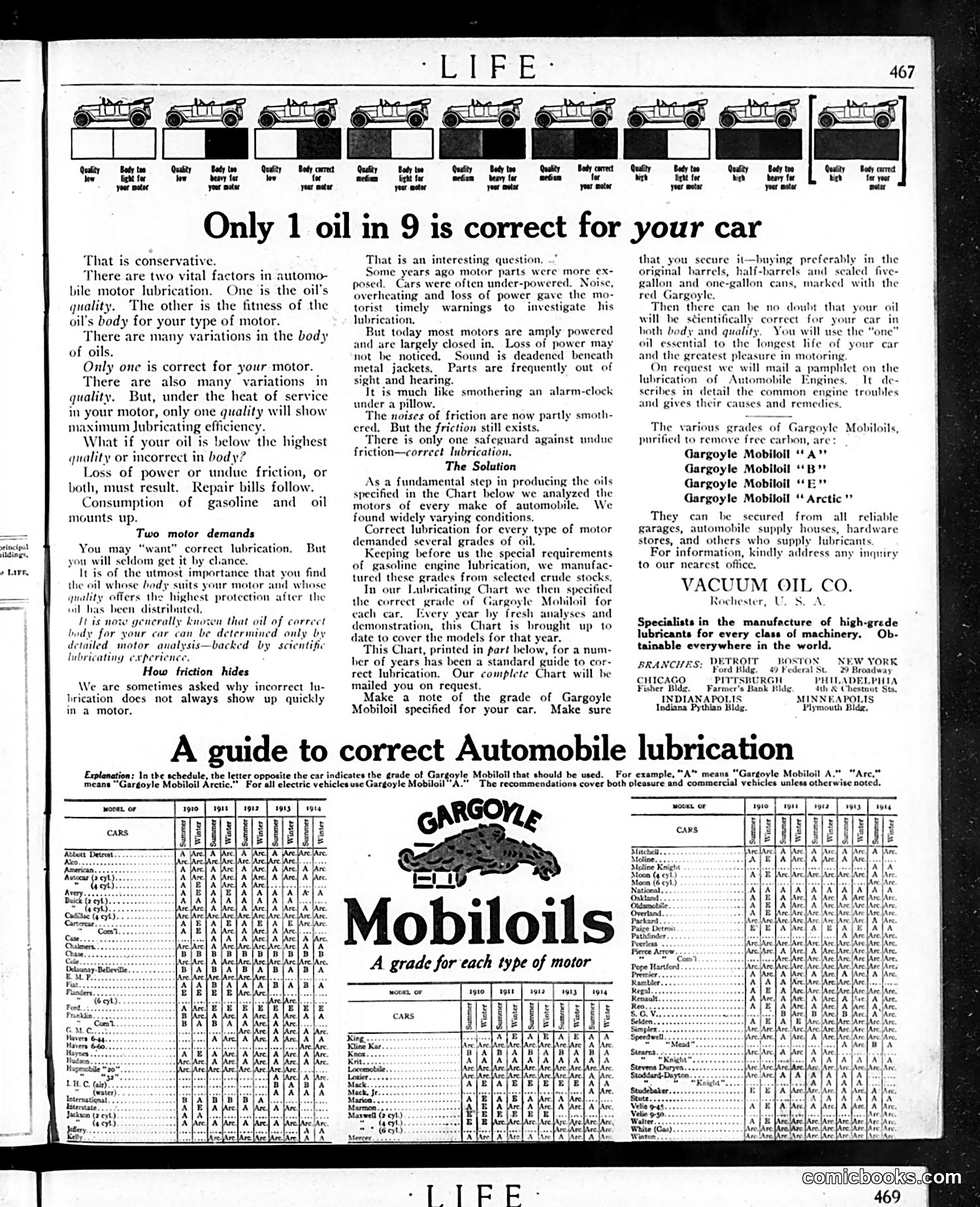
This is primarily **advertising, not satire or political content**. The page promotes Gargoyle Mobiloil motor oil through what appears to be an educational guide. The opening cartoon strip at top shows nine identical cars with varying fill patterns under their bodies—a visual metaphor illustrating the text's central claim: only one oil grade is correct for each specific car model. The repetition emphasizes the specificity and importance of matching oil type to vehicle. The accompanying guide charts list automobile makes (Alden, Apperson, Auburn, etc.) cross-referenced with recommended Gargoyle Mobiloil grades by year. This represents early automotive consumer education—the market for automobiles was still relatively new, and proper maintenance wasn't yet standardized knowledge. The message is essentially: "Don't guess at oil choice; use our scientific analysis to find your car's correct grade." It's consumer-directed marketing framed as technical expertise, typical of 1910s-1920s advertising that positioned corporate products as solutions to modern mechanical complexity.
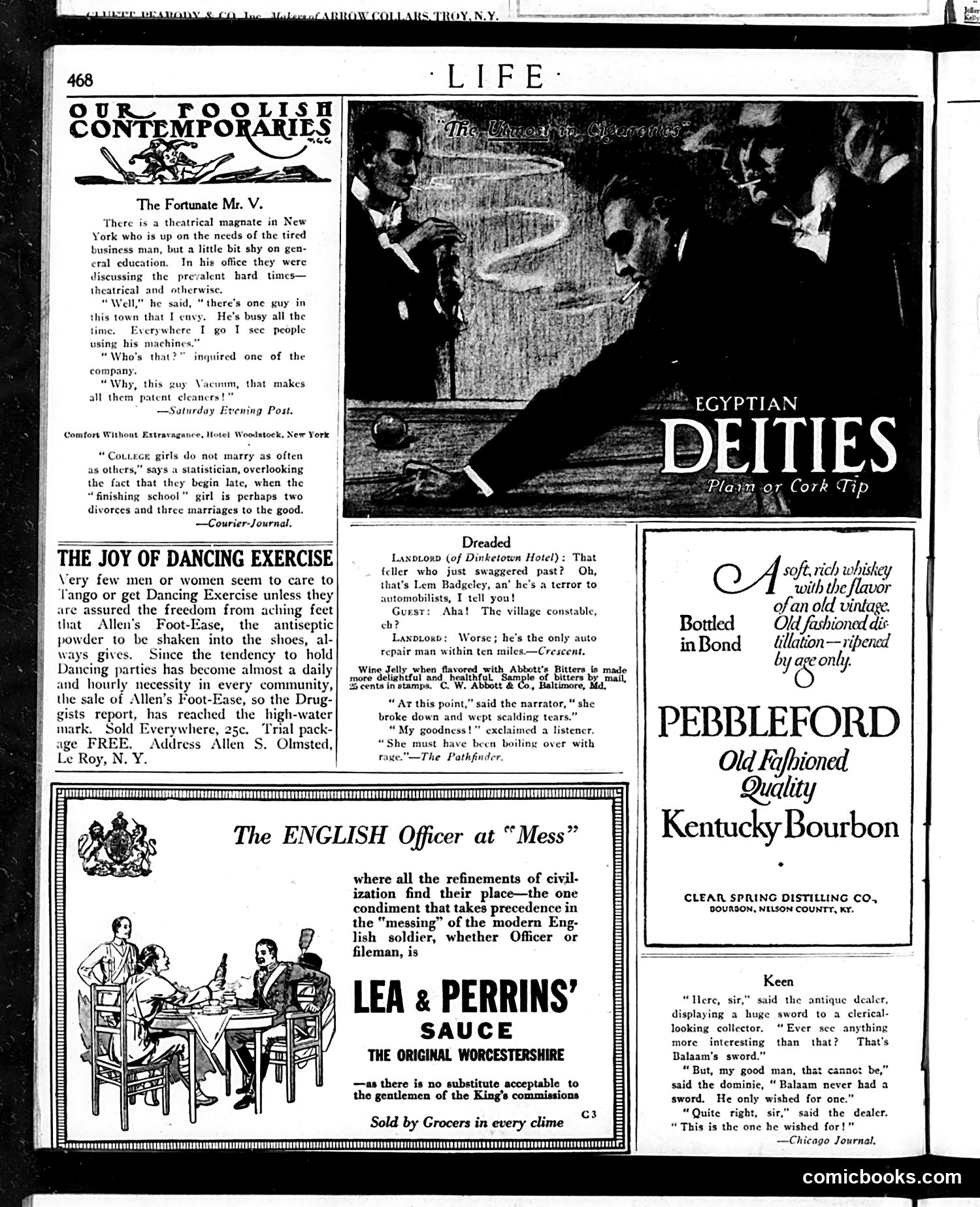
This page contains several satirical pieces typical of Life's humor: **"The Fortunate Mr. V."** jokes about a theater magnate's ignorance—he envies "Vacium," thinking it's a person's name, when discussing a vacuum cleaner company. The satire mocks the businessman's lack of education despite his success. **"The Joy of Dancing Exercise"** is an advertisement disguised as editorial content, promoting Allen's Foot-Ease powder by claiming dancing has become a social necessity, thus driving shoe-powder sales. **Other comedic pieces** include jokes about college girls divorcing frequently, a rural constable who's actually an auto repairman, and a cleric correcting someone's biblical knowledge about Balaam's sword. The page is primarily **advertising**: Lea & Perrins sauce, Pebbleford bourbon, and other products are interspersed with humor. The "Egyptian Deities" image appears to be a film or theatrical advertisement rather than satire. Overall, the page reflects early 20th-century concerns about business, education, and modern social customs.

This is a **full-page advertisement**, not a cartoon or satire. It promotes Detroit Steel Products Co.'s automobile springs. The ad addresses a practical concern for early 20th-century car owners: springs were critical components that absorbed road vibrations and stress. The headline "Save Your Car From Road Rack" appeals to durability-conscious buyers. The advertisement emphasizes Detroit Springs' superiority through claims of specialized engineering, rigorous testing, and a two-year guarantee. It notes the product is used by major American manufacturers (an "Honor Roll" endorsement). A notable feature is the **self-lubricating cups** on spring leaves—presented as exclusive technology that prevents squeaking, distinguishing this product from competitors. The page includes technical details about heat-treatment and testing procedures, plus a photograph showing expert workers hand-"fitting" leaves with precision tools, emphasizing craftsmanship and quality control. This reflects the era's emphasis on mechanical reliability and the marketing of industrial-grade automobile components to consumers concerned about vehicle longevity.
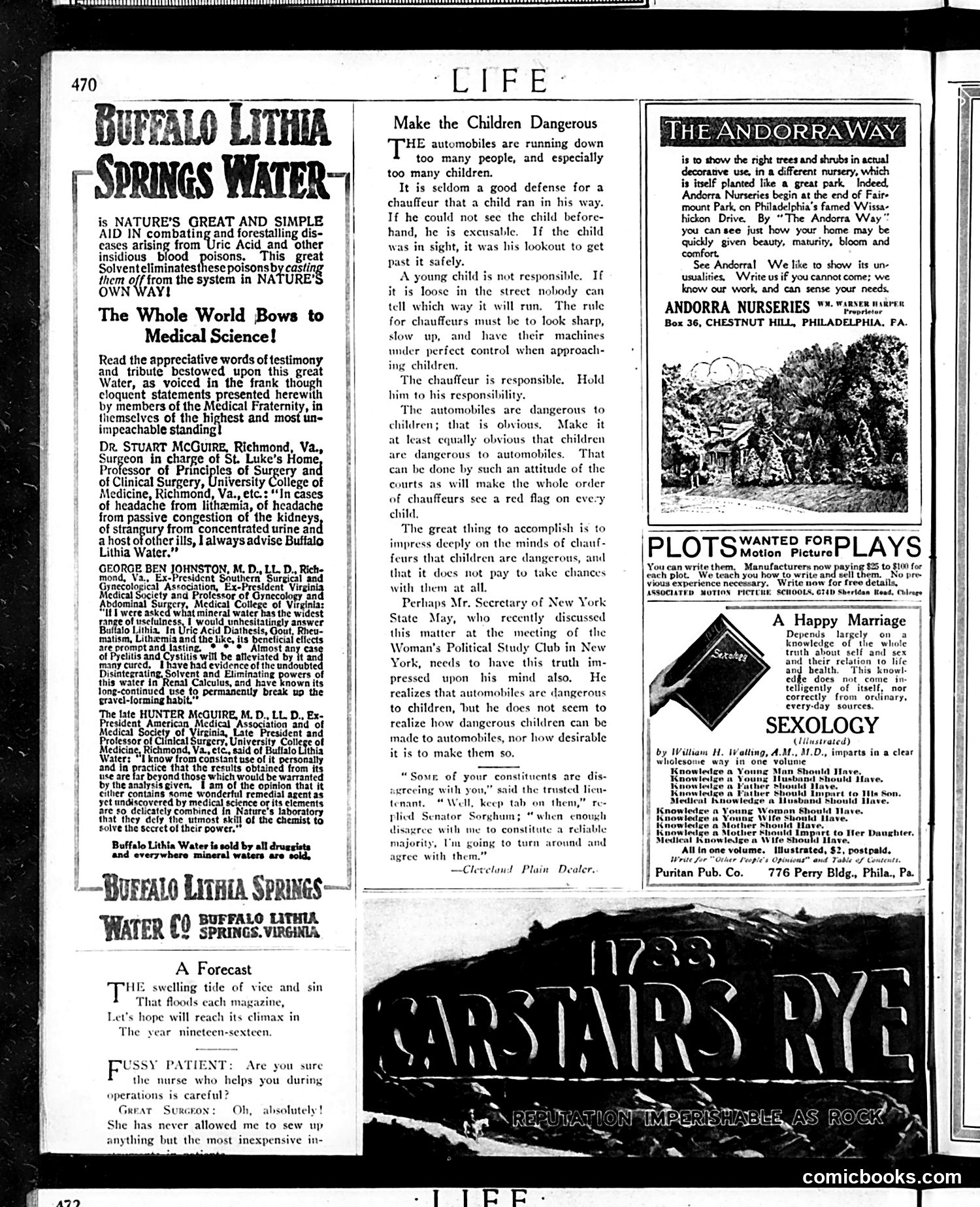
This page contains **advertisements and editorial commentary** rather than political cartoons. The **Buffalo Lithia Springs Water ads** dominate the left side, featuring testimonials from prominent Richmond, Virginia physicians claiming the mineral water cures ailments like gout, kidney problems, and "uric acid" conditions—typical turn-of-century medical marketing with dubious health claims. The **center editorial, "Make the Children Dangerous,"** argues that automobile drivers should be held legally responsible for child pedestrian deaths, not the other way around. The author advocates making children appear as dangerous obstacles to motorists through court precedent, forcing drivers to treat every child as a serious traffic hazard requiring caution. This reflects early 20th-century anxiety about automobiles as new urban dangers to vulnerable populations. The right side contains typical period advertisements for nurseries, motion picture plays, and marriage/sexuality guides—common Life magazine content.
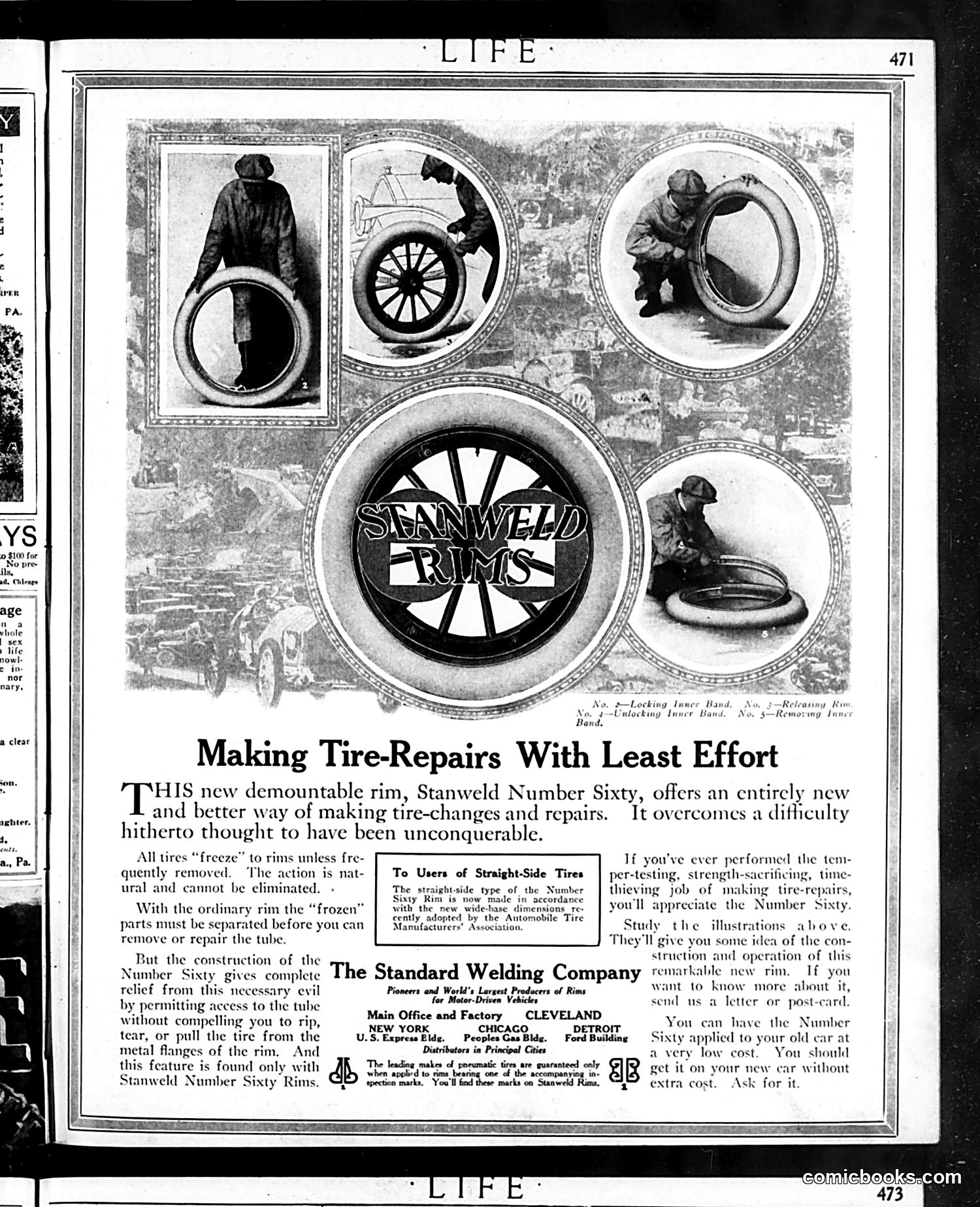
This page is primarily **advertising**, not political satire. It promotes the Stanweld Number Sixty demountable automobile rim, manufactured by the Standard Welding Company (Cleveland, Chicago, Detroit, New York). The five circular vignettes show workers demonstrating tire-repair procedures—locking, unlocking, and removing the inner band—illustrating the rim's key innovation: it allows tire access without removing the wheel from the car. The advertisement addresses a genuine automotive problem of the era: tires would "freeze" to rims during storage, making repairs difficult. The Number Sixty's design allegedly solved this by providing direct access to the tube. The text emphasizes convenience and cost-effectiveness, suggesting readers equip both old and new vehicles with this rim. This reflects early-1900s automobile technology when tire maintenance was frequent and labor-intensive.
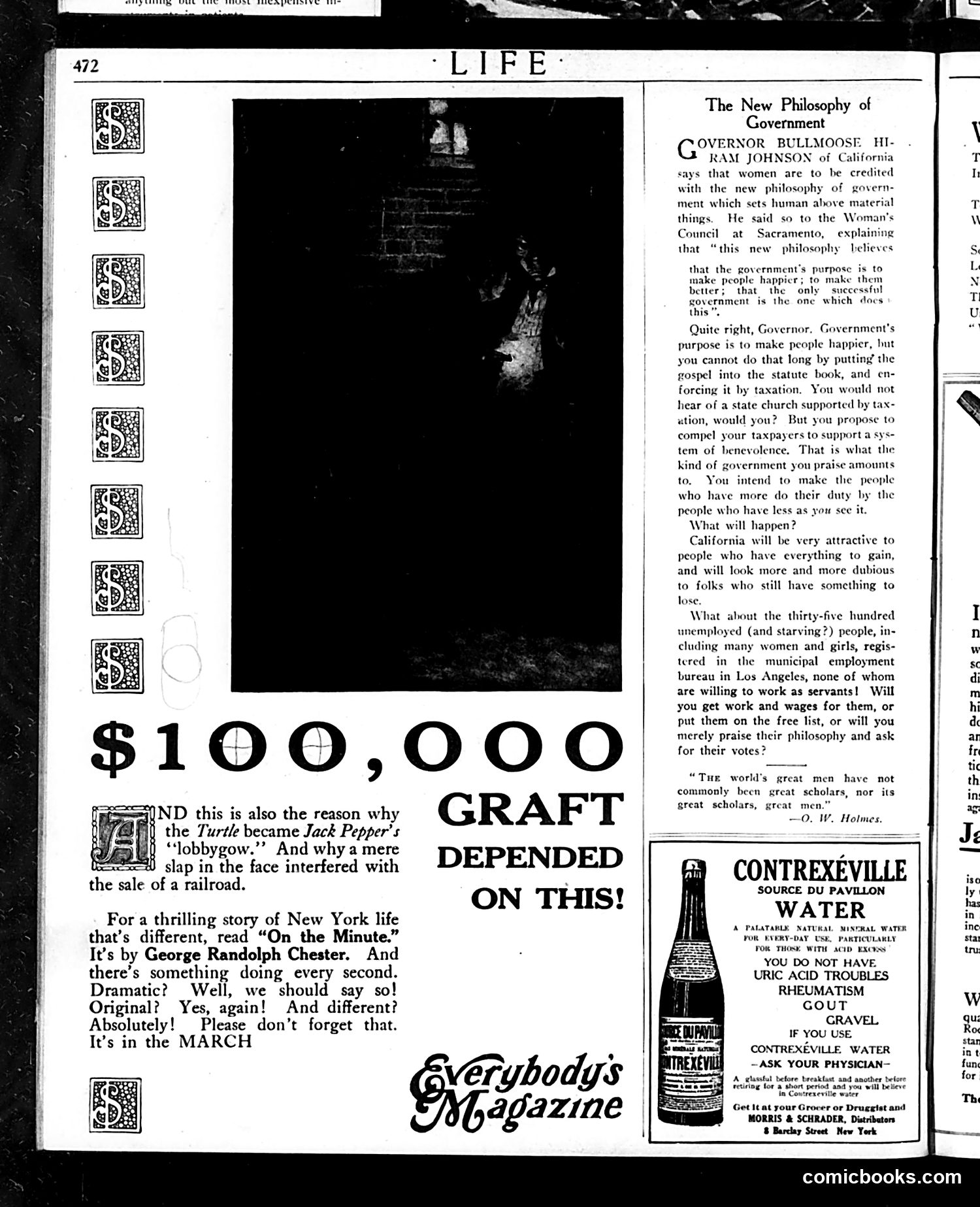
This page contains satirical commentary on California Governor Hiram Johnson's progressive philosophy of government. Johnson (associated with the "Bull Moose" Progressive Party) advocated using government to make people "happier" and prioritize human welfare over material concerns. The unnamed satirist mocks this idealism, arguing that government cannot legislate happiness or morality through taxation without becoming tyrannical—comparing it to an unwanted state church. The critique focuses on practical contradictions: Johnson's philosophy will attract those seeking benefits while repelling those with existing resources. The satire particularly targets the gap between rhetoric and reality: Johnson praises the philosophy of 3,500 unemployed women in Los Angeles, yet offers no concrete solution for their employment or survival. The satirist suggests the governor merely wants their votes while offering only praise. The cartoon attacks Progressive-era paternalism as benevolent coercion dressed in idealistic language.
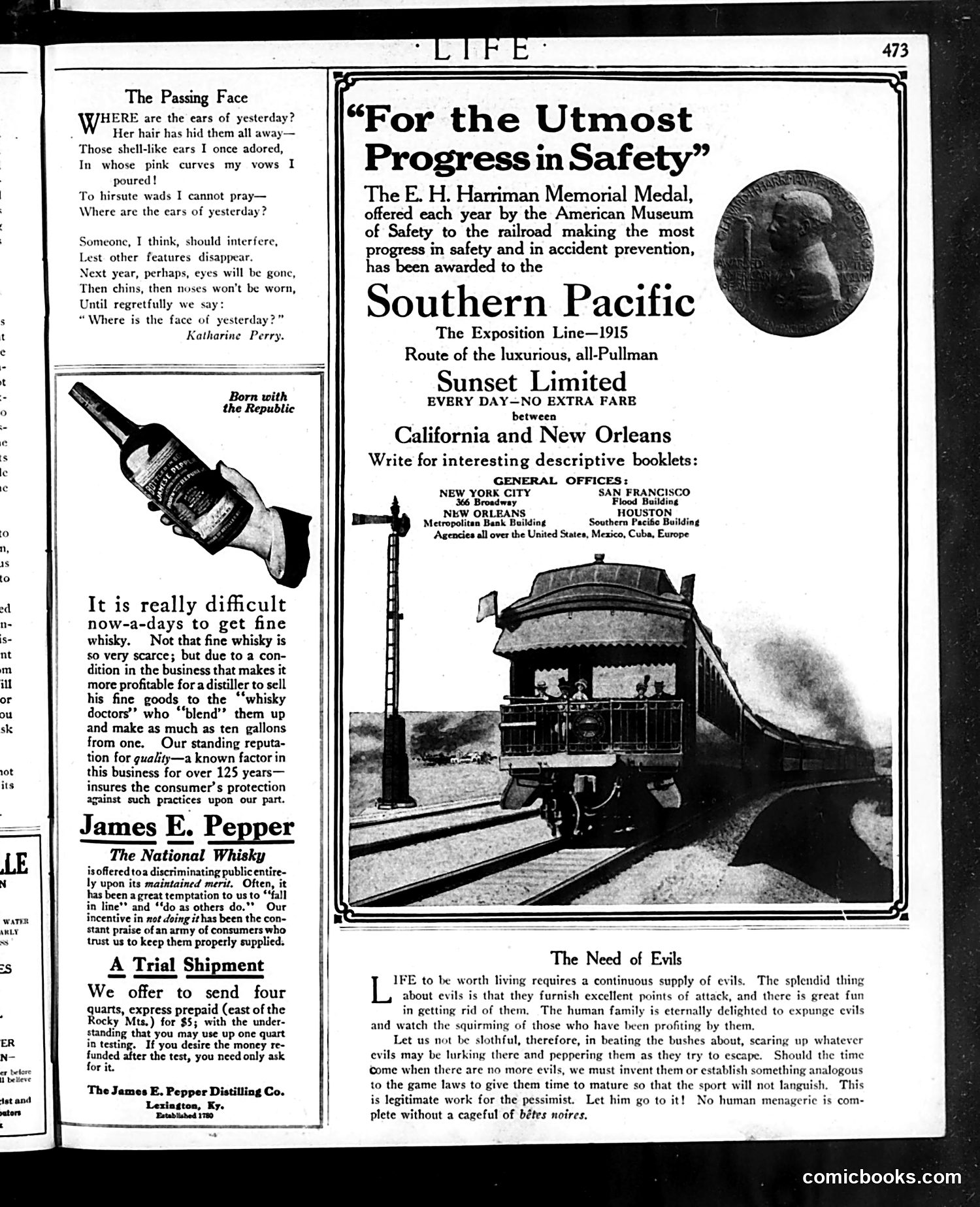
This page blends satirical poetry, advertisements, and editorial commentary typical of early 1900s Life magazine. **"The Passing Face"** (left): A poem by Katharine Perry lamenting modern fashion trends, specifically women's hairstyles that hide their ears and facial features. It's social satire about how changing beauty standards make women unrecognizable—each year something else disappears under fashionable hair. **Advertisements**: James E. Pepper whisky (claiming quality integrity despite Prohibition-era pressure to dilute spirits with "blending"), and Southern Pacific Railroad advertising their "Sunset Limited" train while claiming an E.H. Harriman safety medal. **"The Need of Evils"** (right): Editorial commentary arguing that society needs problems to solve—without evils to fight, life becomes boring. It's philosophical satire suggesting pessimists serve a useful social function by identifying and attacking societal problems, keeping civilization engaged and purposeful. The page represents Life's characteristic mix of light social observation and deeper cultural commentary on modernity, commerce, and human nature.
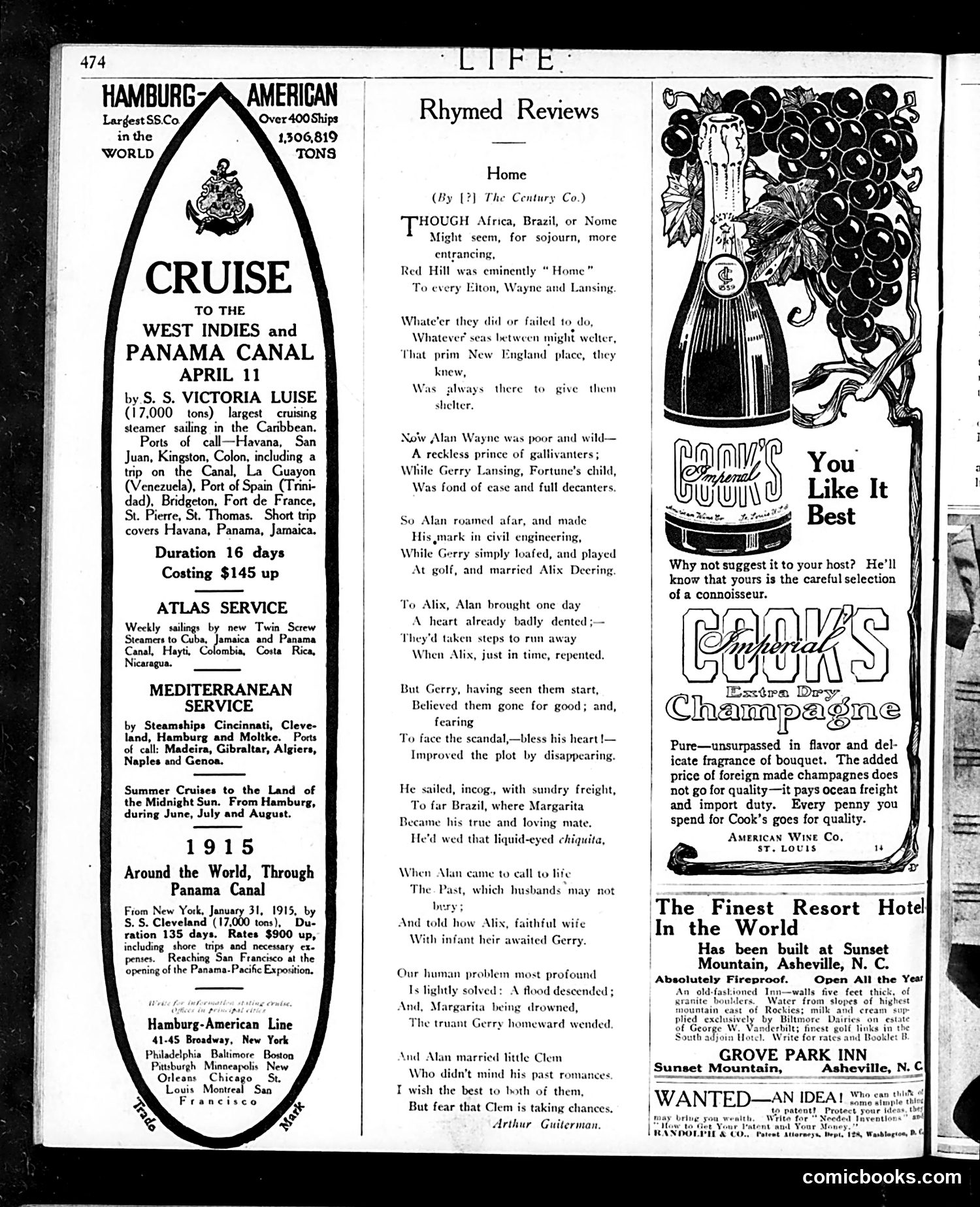
This page is primarily **advertisements and a poem**, not political satire. The left side advertises **Hamburg-American cruise lines** offering trips to the West Indies and Panama Canal (11 days, $145), Mediterranean service, and a 1915 world cruise starting from New York. The center contains a **rhymed poem titled "Home"** (by The Century Co.) telling a romantic narrative: Alan Wayne, a poor but ambitious civil engineer, wins Alix Deering's heart. However, her friend Gerry thinks they've eloped. Alan sails away on business; Alix faithfully waits. They reunite and marry, with Margareta (Alix's friend who had drowned) conveniently resurrecting to marry Clem. It's sentimental Victorian verse about love and faithfulness—typical period magazine content. The right side shows **product advertisements** for Cook's champagne and Grove Park Inn resort in Asheville, North Carolina.
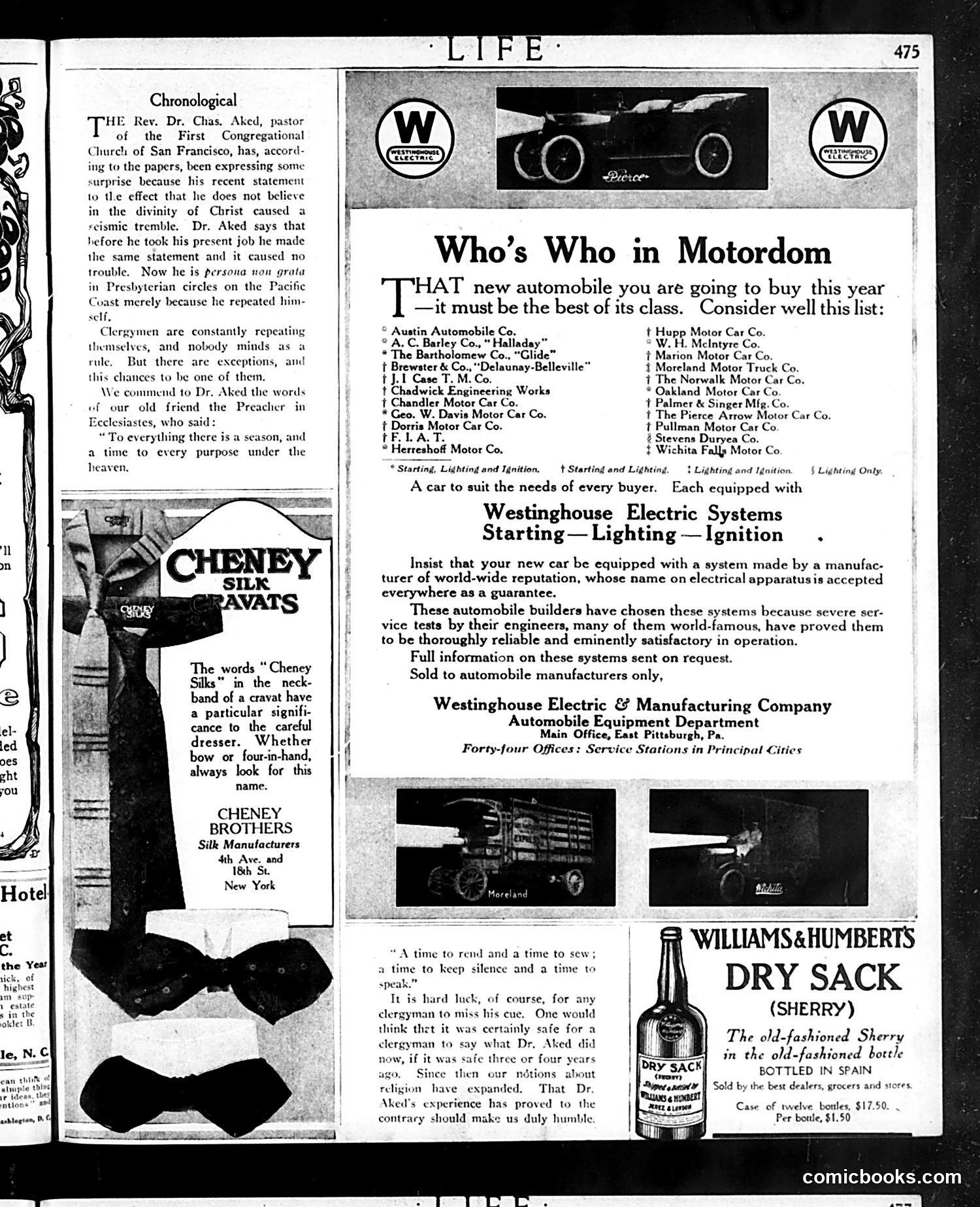
This page mixes editorial commentary with advertisements—primarily a Westinghouse Electric ad for automobile systems and product placements for Cheney silk neckwear and Williams & Humberts sherry. The main editorial piece discusses **Rev. Dr. Chas. Aked**, pastor of San Francisco's First Congregational Church, who caused controversy by stating he doesn't believe in Christ's divinity. The satire is gentle: Aked claims this statement caused no trouble when he made it before taking his current position, yet now it makes him "persona non grata" in Presbyterian circles. The piece humorously notes that clergy constantly repeat themselves without consequence—*except* when timing matters. The biblical quote about "a time to speak and a time to keep silence" underscores the joke: Aked picked the wrong moment to repeat himself publicly. This reflects early 1900s religious debates over modernism versus traditional theology within Protestant denominations.
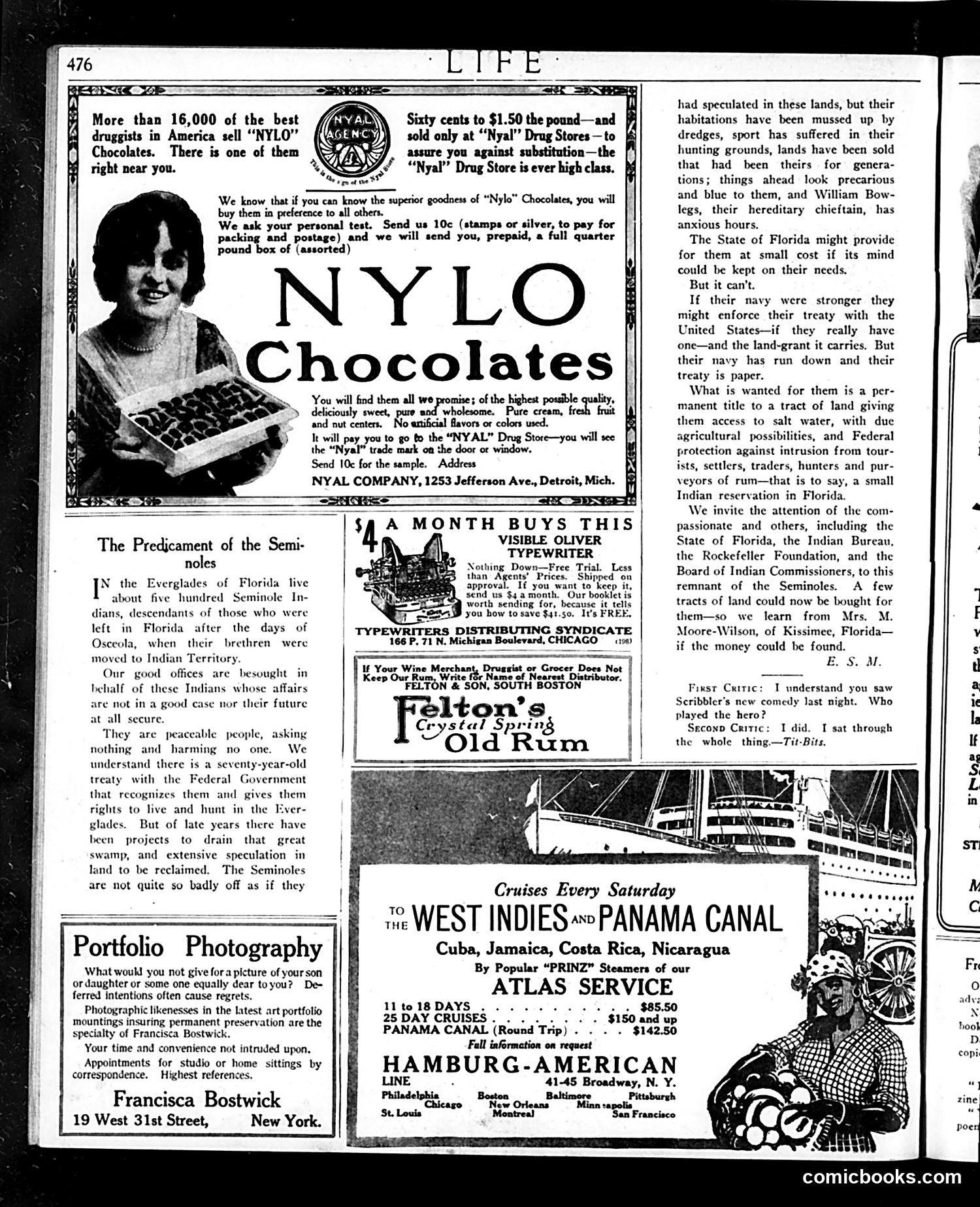
This page is primarily **advertisements** interspersed with one substantive editorial piece. The main non-advertising content is "The Predicament of the Seminoles," which advocates for the approximately 500 remaining Seminole Indians in Florida's Everglades—descendants of those who escaped removal during the Indian Wars of the 1830s-40s. The piece criticizes development projects (drainage schemes, land speculation) that are destroying their hunting grounds and threatens their tenuous legal status. It notes their treaty rights are merely "paper" and argues the state should establish a formal reservation with protected land access, agricultural resources, and federal protection against encroachment by tourists, settlers, and traders. The satire is gentle: Life is shaming Florida's indifference to its indigenous population while colonial development proceeds unchecked. The piece appeals to readers' sense of justice regarding a marginalized group facing displacement. The page's advertisements include Nylo Chocolates, photography services, typewriters, and cruise lines—typical early-20th-century commerce.
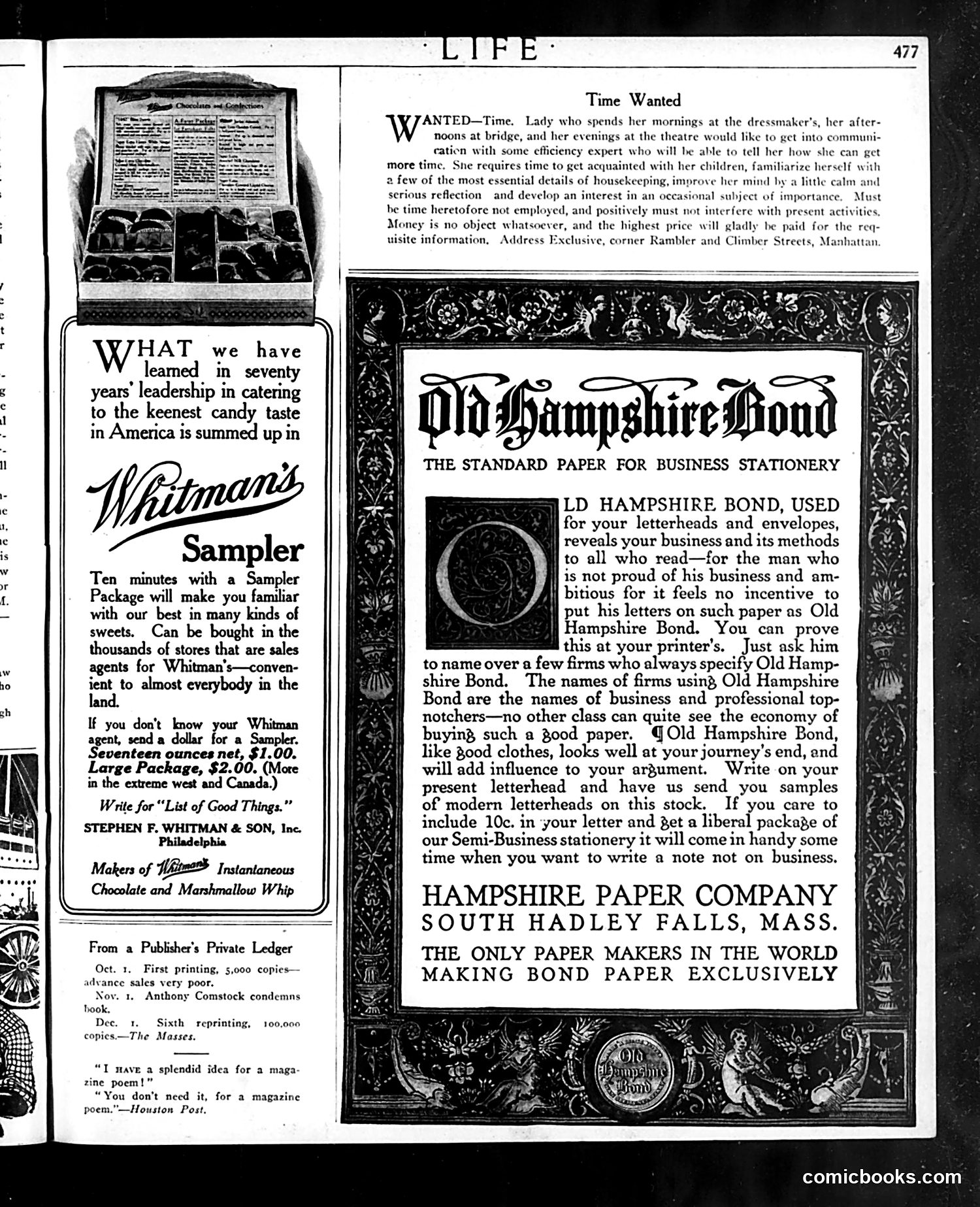
This page is primarily **advertising** rather than satirical content. It contains three distinct ads: 1. **Whitman's Sampler** (candy) - Standard product advertisement emphasizing 70 years of candy-making expertise. 2. **"Time Wanted"** - A humorous classified ad (not satire, but social commentary) seeking someone to find "lost time" for a wealthy woman juggling dressmaker appointments, theater evenings, and domestic duties. The joke critiques upper-class women's overscheduled lives and their disconnect from family/household responsibilities—she wants to know her children and manage her home but has no time. 3. **Hampshire Bond Paper** - Business stationery advertisement claiming the paper reflects a businessman's character and professionalism. The page also includes a brief publisher's ledger anecdote about a book condemned by Anthony Comstock (a famous censor) that subsequently sold 100,000 copies—illustrating how censorship paradoxically boosted sales. This is primarily a **commercial publication**, not a political cartoon or satirical commentary page.
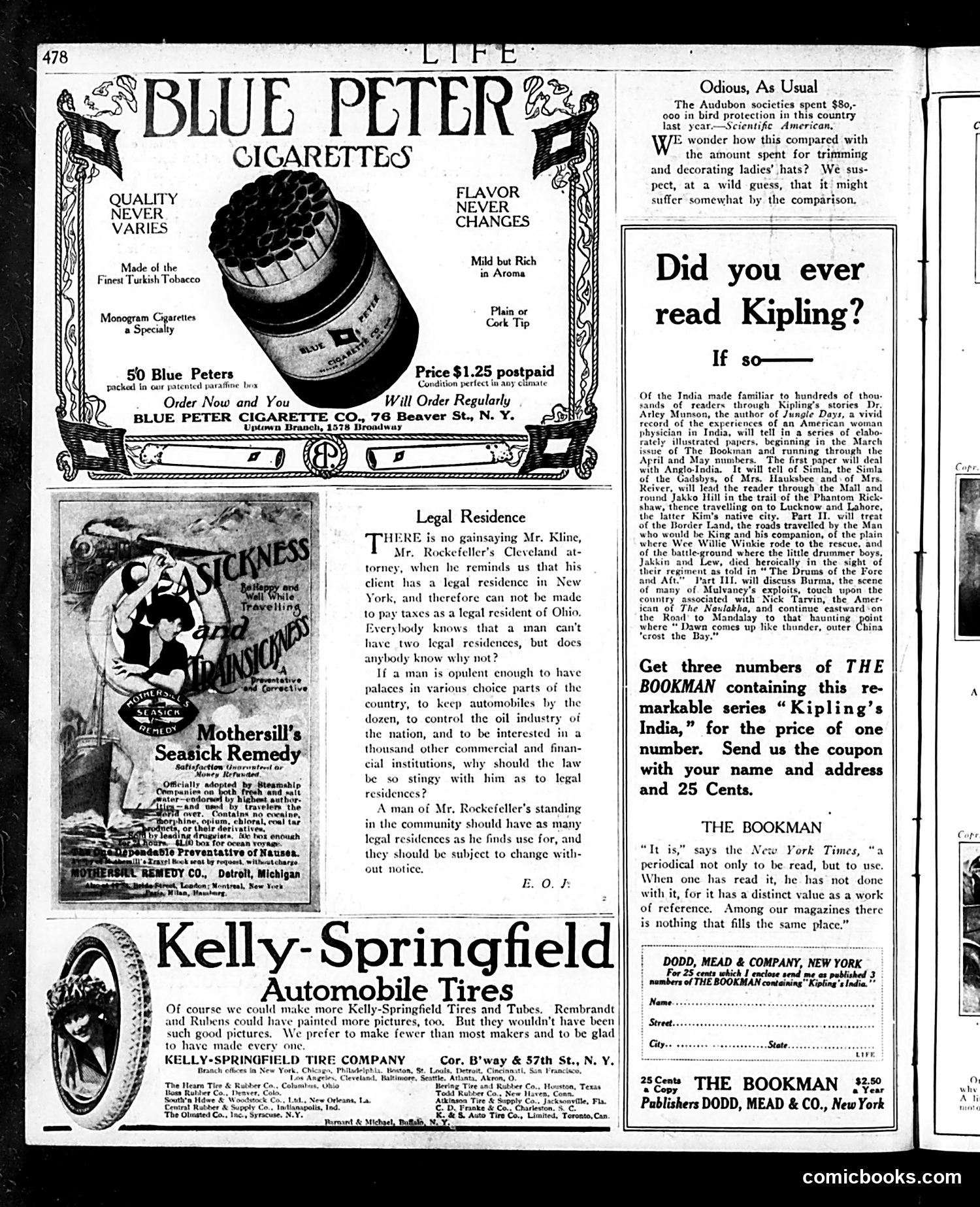
This page is primarily **advertisements and editorial content** rather than political cartoons. The main satirical piece is titled "Legal Residence," attacking the tax strategies of wealthy industrialists like **John D. Rockefeller**. The editorial mocks Rockefeller's Cleveland attorney's argument that Rockefeller cannot be taxed in Ohio because his legal residence is New York—despite owning multiple palatial homes nationwide. The satire argues sarcastically that a man wealthy enough to own numerous properties and control entire industries should logically be permitted multiple legal residences subject to change without notice. This reflects **Gilded Age tax-avoidance practices** by the ultra-wealthy, whom Life magazine frequently criticized for exploiting legal loopholes to avoid taxes while ordinary citizens could not. The page also includes a brief social satire noting that the Audubon Society spent $80,000 annually protecting birds, while more money was spent decorating ladies' hats with bird feathers—highlighting the contradiction between conservation efforts and contemporary fashion practices. The remaining content consists of period product advertisements for cigarettes, automobile tires, and patent medicines.
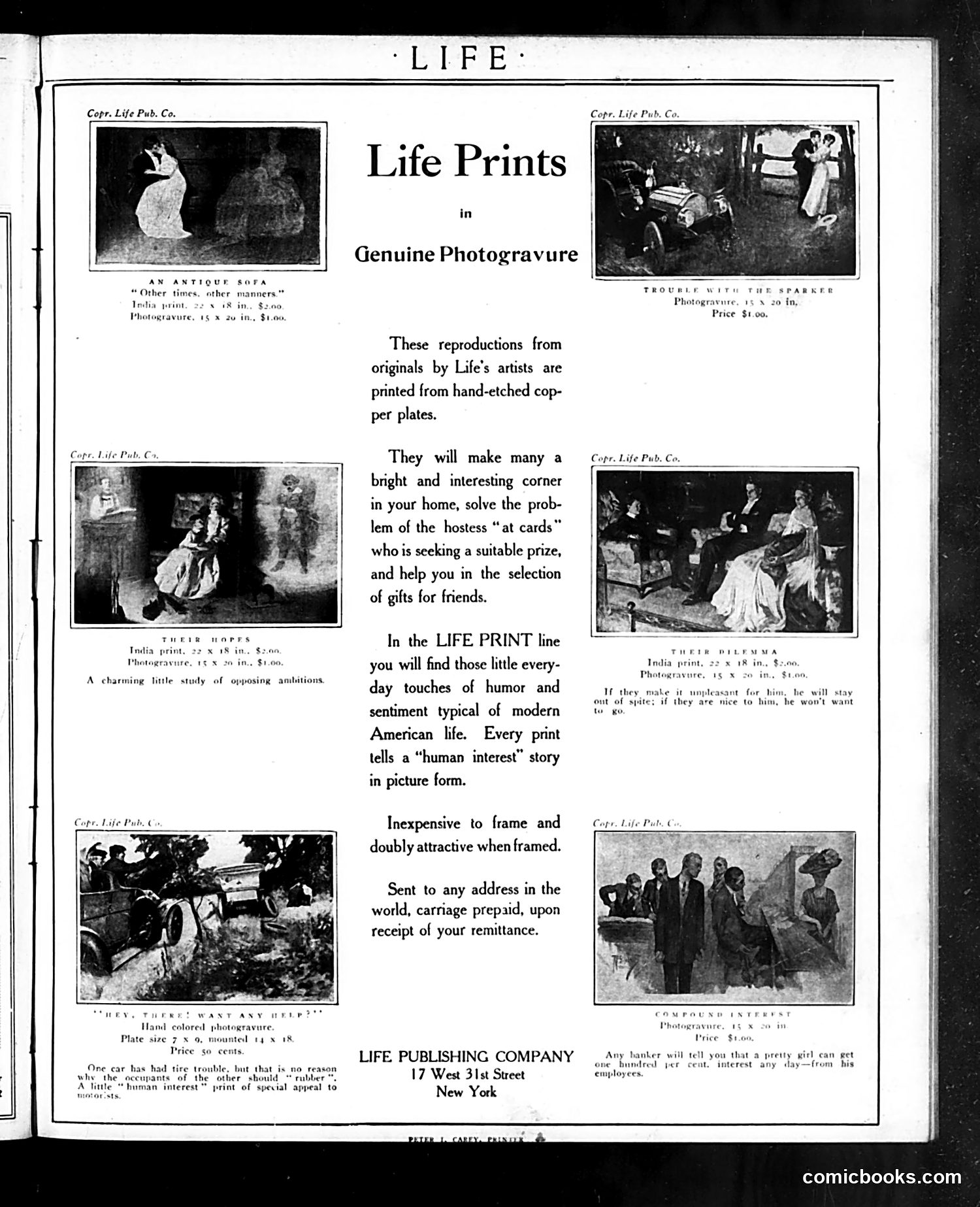
This is primarily a **product advertisement** for Life Publishing Company's photogravure prints, not satirical content. The page showcases six prints available for purchase, each depicting scenes of "modern American life" with humorous or sentimental themes. The prints shown include domestic scenes like "An Antique Sofa" (contrasting old and new manners), "Their Hopes" (depicting opposing ambitions), and "Trouble with the Sparkler" (a romantic or social mishap). Titles like "Compounded Interest" and "Types Dilemma" suggest everyday relationship humor. The advertisement emphasizes these hand-etched copper plate reproductions as affordable, frameable home décor suitable as hostess gifts. Prices range from $1.00-$5.00. The marketing pitch targets middle-class readers seeking inexpensive art reflecting relatable American domestic life—a typical consumer product pitch of the era, not satire.
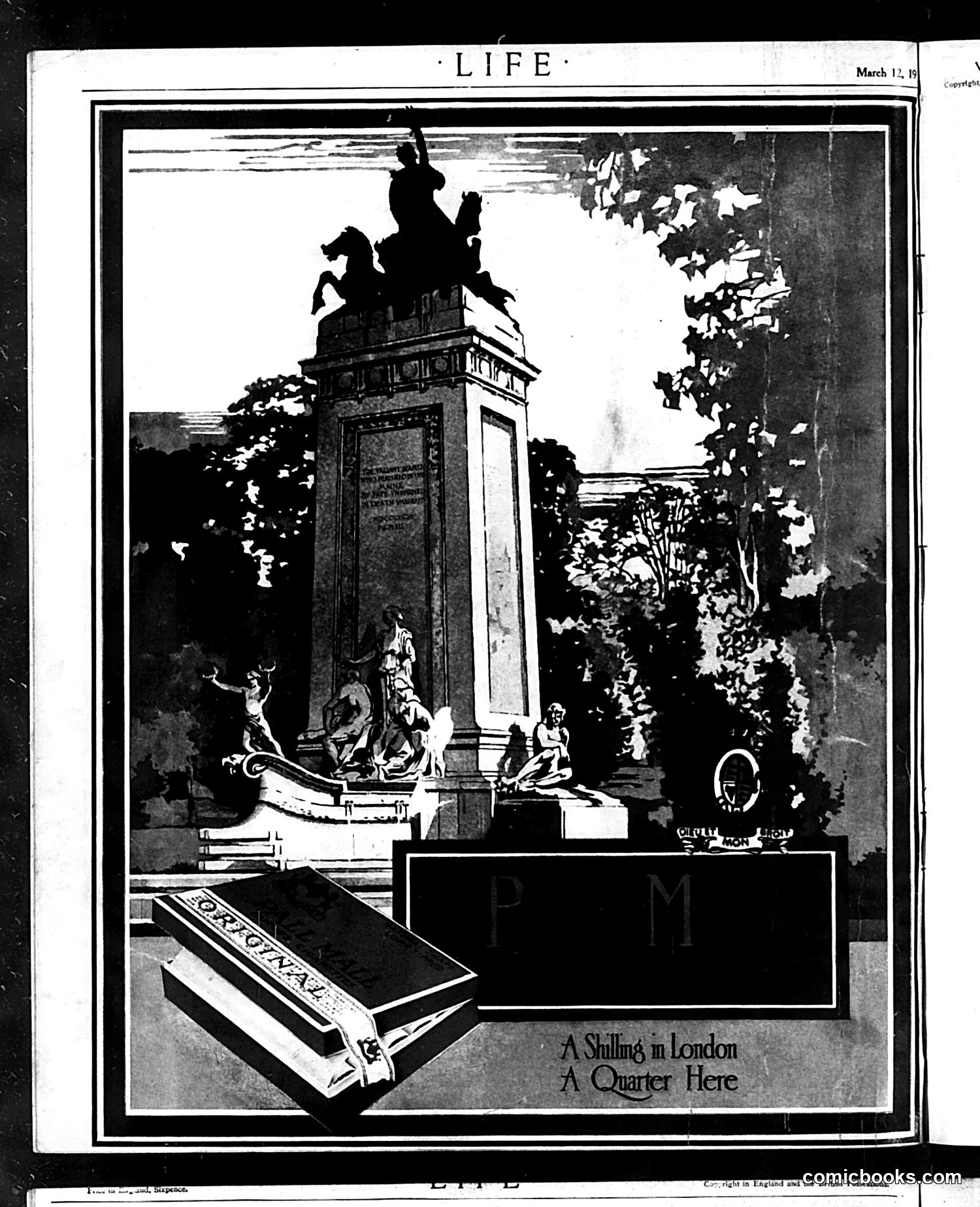
This is a LIFE magazine cover from March 12 (year unclear from image). The illustration depicts an equestrian statue in a London park or memorial setting, with a coffin in the foreground and ivy-covered surroundings. The caption reads: "A Shilling in London / A Quarter Here" This appears to be satirizing **currency exchange rates** between British and American money during an unspecified period (likely WWI or interwar era, given the publication style). The joke likely compares the relative purchasing power or value disparity between a British shilling and an American quarter—suggesting one is worth considerably more than the other, or that exchange rates heavily favor one nation over the other. The memorial statue setting may ironically frame this economic commentary as a "monument" to financial disparity between the two nations.