
Life, 1914-03-12 · page 25 of 44
Life — March 12, 1914 — page 25: what you’re looking at
What you’re looking at
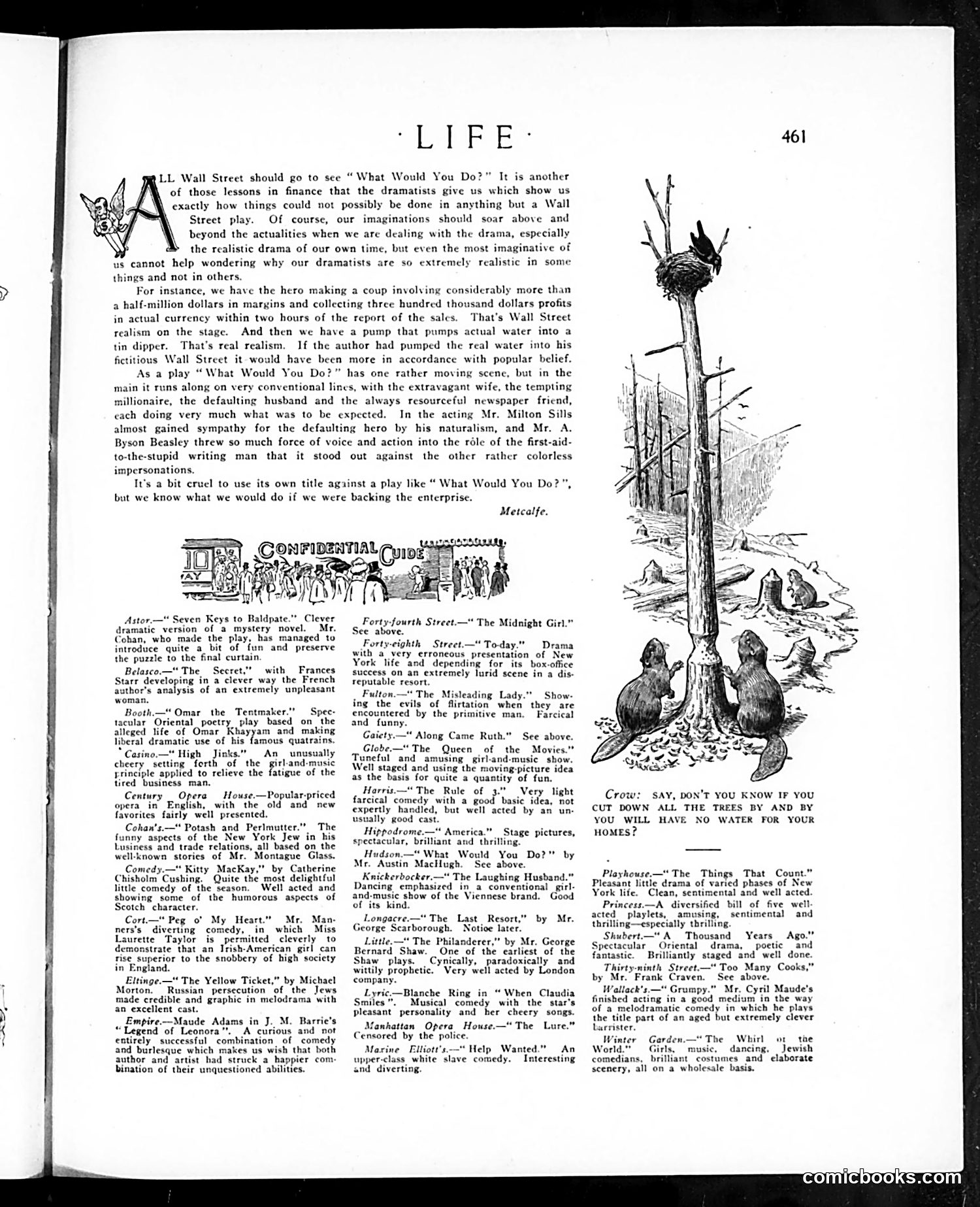
This page critiques the play "What Would You Do?" — a Wall Street drama. The magazine's theater reviewer (bylined "Metcalfe") satirizes the play's contradictory realism: it depicts a financial coup involving half-million-dollar margins and three-hundred-thousand-dollar profits with meticulous accuracy, yet uses a *real pump* to spray actual water into a tin dipper as stage effect. The satire's point: dramatists obsess over financial detail to seem authentic but ignore practical realism. The reviewer notes the irony that if the author had pumped *real* water into his fictional Wall Street scenario, it would be "more in accordance with popular belief"—suggesting audiences find high finance incomprehensible compared to literal stage mechanics. The cartoon image (right) appears unrelated editorial art. The page concludes with brief reviews of other theatrical productions, listing various Broadway venues and plays.
📄 Transcribed text from this page (OCR, searchable)
Machine-transcribed from the original scan — historical spelling and the odd misread are preserved.
exactly how things could not possibly be done in anything but a Wall Street play. Of course, our imaginations should soar above and us cannot help wondering why our dramatists are so extremely realistic in some things and not in others. in actual currency within two hours of the report of the sales. That's Wall Street realism on the stage. And then we have a pump that pumps actual water into a As a play “What Would You Do?” has one rather moving scene, but in the main it runs along on very conventional lines, with the extravagant wife, the tempting almost gained sympathy for the defaulting hero by his naturalism, and Mr. A. Byson Beasley threw so much force of voice and action into the réle of the first-aid- mg LL Wall Street should go to sce “What Would You Do?” It is another i" of those lessons in finance that the dramatists give us which show us beyond the actualities when we are dealing with the drama, especially the realistic drama of our own time, but even the most imaginative of For instance, we have the hero making a coup involving considerably more than a half-million dollars in margins and collecting three hundred thousand dollars profits tin dipper. That's real realism. If the author had pumped the real water into his fictitious Wall Street it would have been more in accordance with popular belief. millionaire, the defaulting husband and the always resourceful newspaper friend, each doing very much what was to be expected. In the acting Mr. Milton Sills to-the-stupid writing man that it impersonations. stood out against the other rather colorless It's a bit cruel to use its own title against a play like “ What Would You Do?”, but we know what we would do if we were backing the enterprise. Astor.—" Seven Keys to Baldpate.” Clever dramatic version of a mystery novel. Mr. Cohan, who made the play, has managed to introduce quite a bit of fun and preserve the puzzle to the final curtain. Belasco.— The Secret," with Frances Starr developing in a clever way the French author's analysis of an extremely unpleasant woman. Booth.—* Omar the Tentmaker."" — Spec- tacular Oriental poetry play based on the alleged life of Omar Khayyam and making liberal dramatic use of his famous quatrains. *Casino.—" High Jinks.” An unusually cheery setting forth of the girl-and-music Frinciple applied to relieve the fatigue of the tired business man, Century Opera House.—Popular-priced opera in English, with the old and new favorites fairly well presented. Cohan's.—* Potash and Perlmutter. The funny aspects of the New York Jew in his Lusiness and trade relations, all based on the well-known stories of Mr. Montague Glass. Comedy.—" Kitty MacKay,” by Catherine Chisholm Cushing. Quite the most delightful little comedy of the season. Well acted and showing some of the humorous aspects of Scotch character. Cort.—" Peg of My Heart.” Mr. Man- ners’s diverting comedy, in which Miss Laurette Taylor is permitted cleverly to demonstrate that an Irish-American gitl can rise superior to the snobbery of high society in England. Eltinge.—" The Yellow Ticket,” by Michael Morton. Russian persecution ‘of the Jews made credible and graphic in melodrama with an excellent cast. Empire—Maude Adams in J. M. Barrie's “Legend of Leonora”. A curious and not entirely successful combination of comedy and burlesque which makes us wish that both author and artist had struck a happier com- bination of their unquestioned abilities. Metcalfe. Forty-fourth Street.—" The Midnight Gi See above. ae Forty-cighth —Street—" To-day." with a very erroneous presentation of New York life and depending for its box-office success on an extremely lurid scene in a dis- reputable resort. Drama _ Fulton.—" The Misleading Lady." Show: ing the evils of flirtation when they are encountered by the primitive man. Farcical and funny. Gaiety.—" Along Came Ruth." See above. Globe.—" The Queen of the Movie Tuneful and amusing girl-and-musie show. Well staged and using the moving-picture idea as the basis for quite a quantity of fun, Horris.—“ The Rule of 3." Very light farcical comedy with a good basic idea, not expertly handled, but well acted by an un- usually good cast. Hippodrome.—" America.” Stage pictures, spectacular, brilliant and thrilling. Hudson.—* What Would You Do?" by Mr. Austin MacHlugh. See above. Knickerbocker.—" The Laughing Husband.” Dancing emphasized in a conventional girl- and-music show of the Viennese brand. Good of its kind. _ Longacre.—* The Last Resort,” by George Scarborough. Notive later. Little." The Philanderer,” by Mr. George Bernard Shaw. One of the earliest of the Shaw plays. Cynically, paradoxically and wittily prophetic. Very well acted by London company Lyric.—Blanche Ring in “ When Claudia Smiles”. Musical comedy with the star's pleasant personality and her cheery songs. Manhattan Opera House.—“ The Lure.” Censored by the police Maxine Elliott's. —" Help Wanted.” An upper-class white slave comedy. Interesting and diverting. Mr. Crow: SAY, DON'T YOU KNOW IF You CUT DOWN ALL THE TREES BY AND BY YOU WILL HAVE NO WATER FOR YOUR HOMES? Playhouse.—" The Things That Count.” Pleasant little drama of varied phases of New York life. Clean, sentimental and well acted. Princess.—A diversified bill of five well acted playlets, amusing, sentimental and thrilling—especially thrilling. Shubert.—" A Thousand Years Ago.” Spectacular. Oriental drama, poetic and fantastic. Brilliantly staged and well done. Thirty-ninth Street—" Too Many Cooks,” by Mr. Frank Craven. See above. Wallack’s.—" Grumpy.” Mr. Cyril Maude’s finished acting in a good medium in the way of a melodramatic comedy in which he plays the title part of an aged but extremely clever Larrister. Winter —“The Whirl or tae World.” Girls, music, dancing, Jewish comedians, brilliant. costumes and elaborate scenery, ail on a wholesale basis. Garden