
Life, 1914-03-12 · page 37 of 44
Life — March 12, 1914 — page 37: what you’re looking at
What you’re looking at
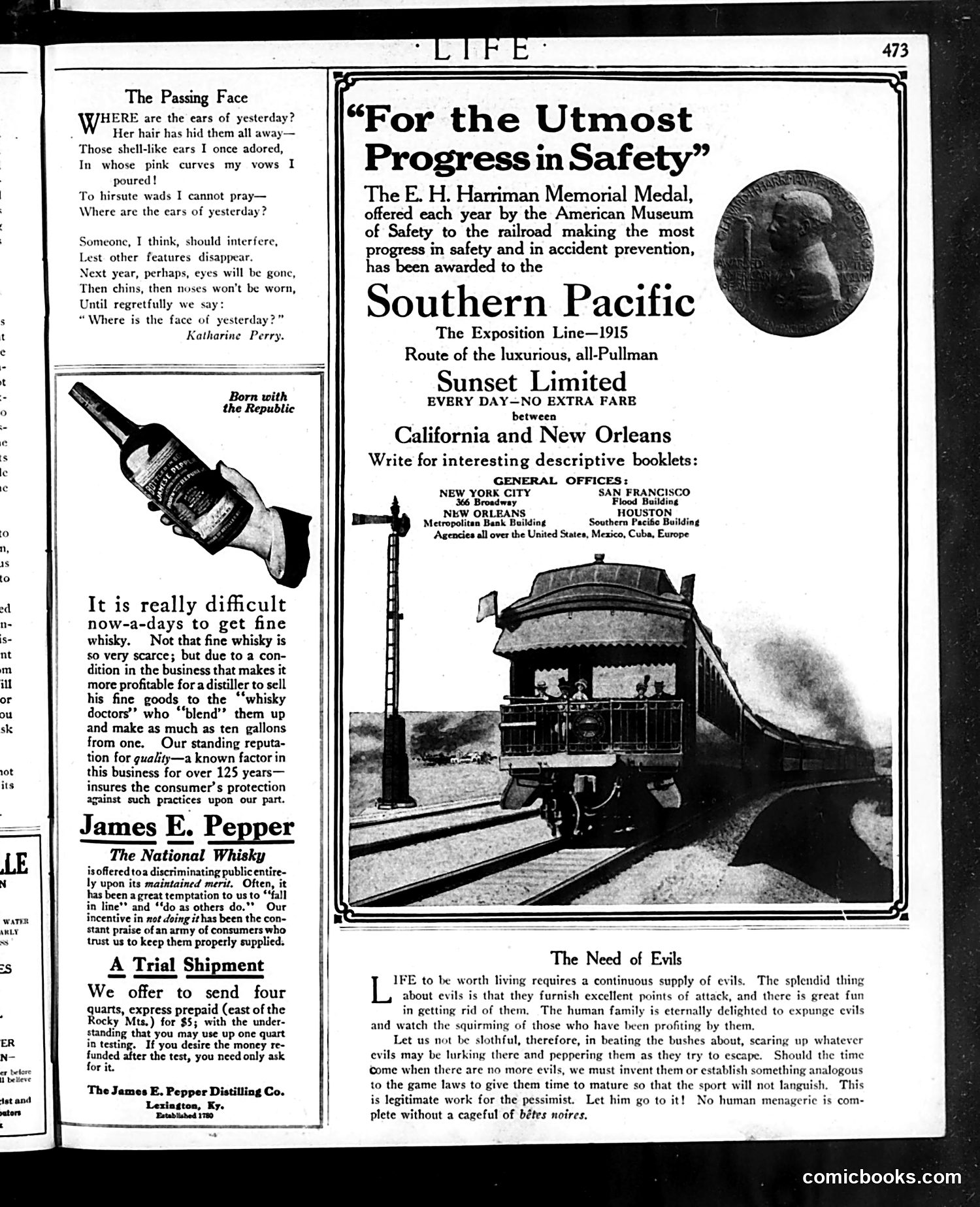
This page blends satirical poetry, advertisements, and editorial commentary typical of early 1900s Life magazine. **"The Passing Face"** (left): A poem by Katharine Perry lamenting modern fashion trends, specifically women's hairstyles that hide their ears and facial features. It's social satire about how changing beauty standards make women unrecognizable—each year something else disappears under fashionable hair. **Advertisements**: James E. Pepper whisky (claiming quality integrity despite Prohibition-era pressure to dilute spirits with "blending"), and Southern Pacific Railroad advertising their "Sunset Limited" train while claiming an E.H. Harriman safety medal. **"The Need of Evils"** (right): Editorial commentary arguing that society needs problems to solve—without evils to fight, life becomes boring. It's philosophical satire suggesting pessimists serve a useful social function by identifying and attacking societal problems, keeping civilization engaged and purposeful. The page represents Life's characteristic mix of light social observation and deeper cultural commentary on modernity, commerce, and human nature.
📄 Transcribed text from this page (OCR, searchable)
Machine-transcribed from the original scan — historical spelling and the odd misread are preserved.
er belere I beteve tet and ators 7 The Passing Face THERE are the ears of yesterday? Her hair has hid them all away— Those shell-like ears I once adored, In whose pink curves my vows I poured! To hirsute wads I cannot pray- Where are the ears of yesterday? Someone, I think, should interfere, Lest other features disappear. Next year, perhaps, eyes will be gone, Then chins, then noses won't be worn, Until regretfully we sa: “Where is the face of yesterday?” Katharine Perry. Born with the Republic It is really dificult now-a-days to get fine whisky. Not that fine whisky is so very scarce; but due to a con- dition in the business that makes it more profitable for a distiller to sell his fine goods to the “‘whisky doctors’’ who “‘blend’? them up and make as much as ten gallons from one. Our standing reputa- tion for guality—a known factor in this business for over 125 years— insures the consumer’ s protection against such practices upon our part. James E. Pepper The National Whisky is offered toa discriminating publicentire- ly upon its maintained merit. Often, it been a great temptation to us to “fall in line** and ‘do as others do.** Our incentive in not doing ithas been the con- stant praise of an army of consumers who trust us to keep them properly supplied. A Trial Shipment -—-— We offer to send four quarts, express prepaid (east of the Rocky Mts.) for $5; with the under- standing that you may use up one quart in testing. If you desire the money re- funded after the test, you need only ask for it. The James E. Pepper Distilling Co. Lexington, Ky. Batablished 1780 “For the Utmost Progress in Safety” The E. H. Harriman Memorial Medal, offered each year by the American Museum of Safety to the railroad making the most progress in safety and in accident prevention, has been awarded to the Southern Pacific The Exposition Line—1915 Route of the luxurious, all-Pullman Sunset Limited EVERY DAY—NO EXTRA FARE between California and New Orleans Write for interesting descriptive booklets: GENERAL OFFICES: NEW YORK CITY SAN FRANCISCO ‘36 Brosdway Flood Bi NEW ORLEANS HOUSTON Metropolitan Bank Building Southern Pacific Buil Agencies all over the United States, Mexico, Cuba, Europe The Need of Evils IFE to be worth living requires a continuous supply of evils. The splendid thing L about evils is that they furnish excellent points of attack, and there is great fun in getting rid of them. The human family is eternally delighted to expunge evils and watch the squirming of those who have been profiting by them, Let us not be slothful, therefore, in beating the bushes about, scaring up whatever evils may be lurking there and peppering them as they try to escape. Should the time come when there are no more evils, we must invent them or establish something analogous to the game laws to give them time to mature so that the sport will not languish. This is legitimate work for the pessimist. Let him go to it! No human menagerie is com- plete without a cageful of bétes noires, comicbooks.com