
Life, 1914-03-12 · page 24 of 44
Life — March 12, 1914 — page 24: what you’re looking at
What you’re looking at
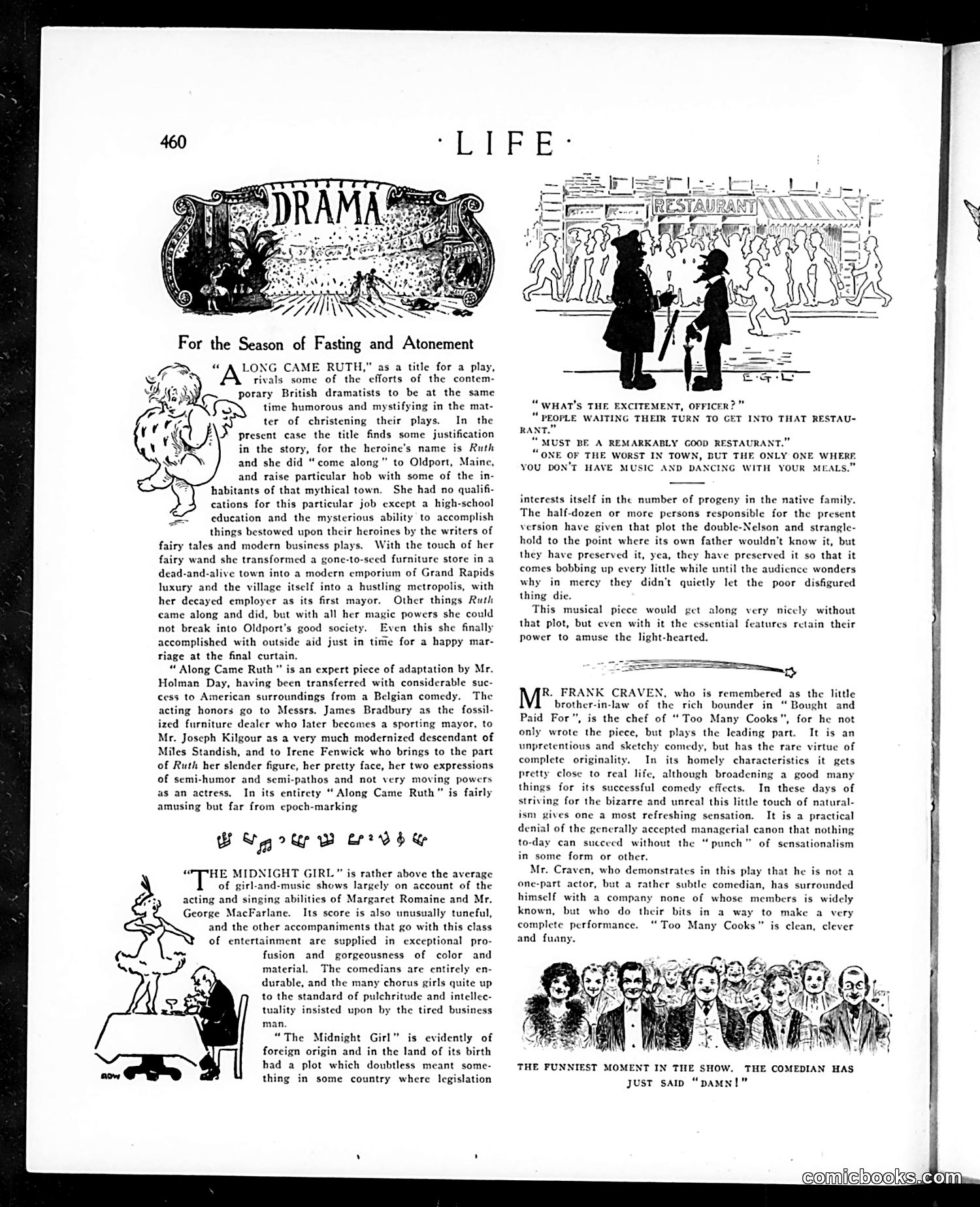
This page reviews three contemporary theatrical productions. The main content consists of theater criticism rather than political satire. **"Along Came Ruth"** is reviewed as a competent but unremarkable adaptation of a Belgian comedy, featuring actress Irene Fenwick as a small-town woman who transforms a declining Maine community. **"The Midnight Girl"** is praised above-average for its performers Margaret Romaine and George MacFarlane, though criticized for an overly convoluted plot that undermines the musical entertainment. **The cartoon** at top-right satirizes restaurant culture: an officer explains crowds waiting outside a terrible restaurant—"the only one where you don't have music and dancing with your meals." This mocks the era's trend of adding entertainment to dining establishments, suggesting some patrons actually prefer a simpler dining experience without mandatory musical accompaniment. The final review discusses **"Too Many Cooks,"** written by and starring Frank Craven, praised for originality and homely realism despite being sketchy in construction.
📄 Transcribed text from this page (OCR, searchable)
Machine-transcribed from the original scan — historical spelling and the odd misread are preserved.
For the Season of Fasting and Atonement ae LONG CAME RUTH,” as a title for a play, rivals some of the efforts of the contem- porary British dramatists to be at the same time humorous and mystifying in the mat- ter of christening their plays. In the Present case the title finds some justification in the story, for the heroine's name is Ruth and she did “come along” to Oldport, Maine, and raise particular hob with some of the in- habitants of that mythical town. She had no qualifi- cations for this particular job except a high-school education and the mysterious ability to accomplish things bestowed upon their heroines by the writers of fairy tales and modern business pla With the touch of her fairy wand she transformed a gone-to-sced furniture store in a dead-and-alive town into a modern emporium of Grand Rapids luxury and the village itself into a hustling metropolis, with her decayed employer as its first mayor. Other things Ruth came along and did, but with all her magic powers she could not break into Oldport’s good society. Even this she finally accomplished with outside aid just in time for a happy mar- riage at the final curtain. “ Along Came Ruth” is an expert piece of adaptation by Mr. Holman Day, having been transferred with considerable suc- cess to American surroundings from a Belgian comedy. The acting honors go to Messrs. James Bradbury as the foss ized furniture dealer who later becomes a sporting mayor, to Mr. Joseph Kilgour as a very much modernized descendant of Miles Standish, and to Irene Fenwick who brings to the part of Ruth her slender figure, her pretty face, her two expressions of semi-humor and semi-pathos and not very moving powers as an actress, In its entirety “Along Came Ruth” is fairly amusing but far from epoch-marking BMgre w vee “THE MIDNIGHT GIRL” is rather above the average of girl-and-music shows largely on account of the acting and singing abilities of Margaret Romaine and Mr. George MacFarlane. Its score is also unusually tuneful, and the other accompaniments that go with this class material, The comedians are entirely en- < tuality insisted upon by the tired business foreign origin and in the land of its birth “WHAT'S THE EXCITEMENT, OFFICER?” “PEOPLE WAITING THEIR TURN TO GET INTO THAT RESTAU- RANT. “MUST BE A REMARKABLY GOOD RESTAURA: “ONE OF THE WORST IN TOWN, BUT THE ONLY ONE WHERF. YOU DON'T HAVE MUSIC AND DANCING WITH YOUR MEALS,” interests itself in the number of progeny in the native family. The half-dozen or more persons responsible for the present version have given that plot the double-Nelson and strangle- hold to the point where its own father wouldn't know it, but they have preserved it, yea, they have preserved it so that it comes bobbing up every little while until the audience wonders why in mercy they didn’t quictly let the poor disfigured thing die. This musical piece would get along very nicely without that plot, but even with it the essential features retain their Power to amuse the light-hearted. ==, R. FRANK CRAVEN, who is remembered as the little brother-in-law of the rich bounder in “ Bought and Paid For", is the chef of “Too Many Cooks”, for he not only wrote the piece, but plays the leading part. It is an unpretentious and sketchy comedy, but has the rare virtue of complete originality. In its homely characteristics it gets pretty close to real life, although broadening a good many things for its successful comedy effec! In these days of striving for the bizarre and unreal this little touch of natural- ism gives one a most refreshing sensation. It is a practical denial of the generally accepted manage: canon that nothing to-day can suceced without the “punch” of sensationalism in some form or other. Mr. Craven, who demonstrates in this play that he is not a one-part actor, but a rather subtle comedian, has surrounded himself with a company none of whose members is widely known, but who do their bits in a way to make a very complete performance. ‘Too Many Cooks” is clean, clever and fuany, THE FUNNIEST MOMENT IN THE SHOW, THE COMEDIAN HAS of entertainment are supplied in exceptional pro- LF fusion and gorgeousness of color and ro durable, and the many chorus girls quite up to the standard of pulchritude and intellec- man. “The Midnight Girl” is evidently of ne” _ had a plot which doubtless meant some- thing in some country where legislation just sai “pamn!” comichoo!