
Life, 1914-03-12 · page 26 of 44
Life — March 12, 1914 — page 26: what you’re looking at
What you’re looking at
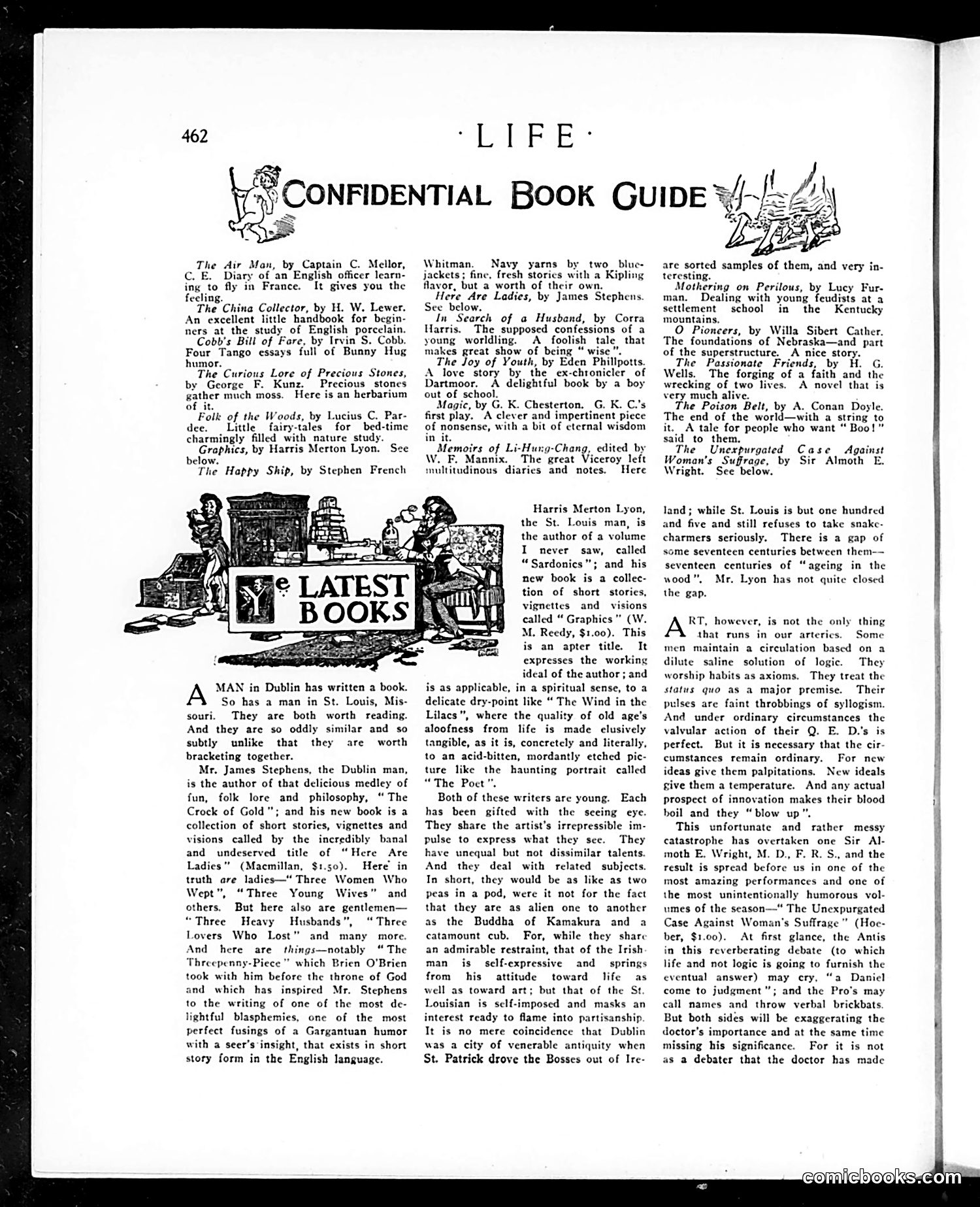
This is primarily a **book review section** titled "Confidential Book Guide," not a political cartoon page. The only illustration is a generic decorative header showing figures among books—not a satirical cartoon. The content reviews recent publications, comparing two authors: **James Stephens** (Dublin) and **Harris Merton Lyon** (St. Louis). The reviewer notes their striking similarities—both young writers with artistic vision producing collections of short stories—yet emphasizes their fundamental differences in temperament and approach to their craft. The tone is literary criticism rather than satire. References like "Crock of Gold" and "The Threepenny-Piece" reflect Stephens' actual works. The humor is gentle and observational, not politically pointed. This represents Life magazine's broader cultural coverage beyond political satire—focusing on contemporary literature for educated readers interested in reviewing new books of merit.
📄 Transcribed text from this page (OCR, searchable)
Machine-transcribed from the original scan — historical spelling and the odd misread are preserved.
The Air Man, by Captain C. Mellor, C.E. Diary of ‘an English officer learn: ing to fly in France. It gives you the feeling. The China Collector, by H. W. Lewer. An excellent little handbook for begin- ners at the study of English porcelain. Cobb's Bill of Fore, by Irvin S. Cobb. Four Tango essays full of Bunny Hug humor. . The Curious Lore of Precious Stones, by George F. Kunz. Precious stones gather much moss. Here is an herbarium of it. Folk of the Woods, by Lucius C. Par- dee. Little fairy-tales for ime charmingly filled with nature study. Graphics, by Harris Merton Lyon. See below. ss The Happy Ship, by Stephen French MAN in Dublin has written a book. So has a man in St. Louis, Mis- They are both worth reading. And they are so oddly similar and so souri. subtly unlike that they are worth bracketing together. Mr. James Stephens, the Dublin man, is the author of that delicious medley of fun, folk lore and philosophy, “ The Crock of Gold"; and his new book is a collection of short stories, vignettes and visions called by the incredibly banal and undeserved title of “Here Are Ladies” (Macmillan, $1.50). Here in truth are ladies—“ Three Women Who Wept”, “Three Young Wives” and others, But here also are gentlemen— “Three Heavy Husbands”, “ Three Lovers Who Lost” and many more. And here are things—notably “ The Threepenny-Piece " which Brien O'Brien took with him before the throne of God and which has inspired Mr. Stephens to the writing of one of the most de- lightful blasphemies, one of the most perfect fusings of a Gargantuan humor with a seer’s ‘insight, that exists in short story form in the English language. “CONFIDENTIAL BOOK GUIDE %4- Whitman. Navy yarns by two_bluc- jackets; fine, fresh storics with a Kipling flavor, but a worth of their own. Here Are Ladies, by James Stephens. See below, In Search of a Husband, by Corra Harris. The supposed confessions of a young worldling. A foolish tale that makes great show of being “ wise”. The Joy of Youth, by Eden Phillpotts. A love story by the ex-chronicler of Dartmoor. A delightful book by a boy out of school. Magic, by G. K. Chesterton. G. K. C.'s first play. A clever and impertinent piece of nonsense, with a bit of eternal wisdom in it. Memoirs of EcHang Chong, edited by W. F. Mannix. The great Viceroy left multitudinous diaries and notes. “Here Harris Merton Lyon, the St. Louis man, is the author of a volume I never saw, called “ Sardonic! and his new book is a collec- tion of short stories, vignettes and visions called “ Graphics" (W. M. Reedy, $1.00). This is an apter title. It expresses the working ideal of the author ; and is as applicable, in a spiritual sense, to a delicate dry-point like “ The Wind in the Lilacs", where the quality of old age’s aloofness from life is made clusively tangible, as it is, concretely and literally, to an acid-bitten, mordantly etched pic- ture like the haunting portrait called “The Poet". Both of these writers are young. Each has been gifted with the seeing eye. They share the artist's irrepressible im- pulse to express what they see. They have unequal but not dissimilar talents. And they deal with related subjects. In short, they would be as like as two peas in a pod, were it not for the fact that they are as alien one to another as the Buddha of Kamakura and a catamount cub. For, while they share an admirable restraint, that of the Irish man is self-expressive and springs from his attitude toward life as well as toward art; but that of the St Louisian is self-imposed and masks an interest ready to flame into partisanship It is no mere coincidence that Dublin was a city of venerable antiquity when St. Patrick drove the Bosses out of Ire- ‘ are sorted samples of them, and very in- teresting. Mothering on Perilous, by Lucy Fur- man. Dealing with young feudists at a settlement school in the Kentucky mountains, O Pioneers, by Willa Sibert Cather. The foundations of Nebraska—and part of the superstructure. A nice story. The Passionate Friends, by H. G. Wells. The forging of a faith and the wrecking of two lives. A novel that is very much alive. The Poison Belt, by A. Conan Doyle. The end of the world—with a string to it. A tale for people who want “ Boo!” said to them, The Unexpurgated Case Against Woman's Suffrage, by Sir Almoth E. Wright. See below. land; while St. Louis is but one hundred and five and still refuses to take snake- charmers seriously. There is a gap of some seventeen centuries between them-— seventeen centuries of “ageing in the wood”, Mr. Lyon has not quite closed the gap. RT, however, is not the only thing that runs in our arterics. men maintain a circulation based on a dilute saline solution of logic. They worship habits as axioms. They treat the Status quo as a major premise. Their pulses are faint throbbings of syllogism. And under ordinary circumstances the valvular action of their Q. E. D.'s perfect. But it is necessary that the cir- cumstances remain ordinary. For new ideas give them palpitations. New ideals give them a temperature. And any actual prospect of innovation makes their blood boil and they “blow up”. This unfortunate and rather messy catastrophe has overtaken one Sir Al- moth E, Wright, M. D., F. R. S., and the result is spread before us in one of the most amazing performances and one of the most unintentionally humorous vol- umes of the season—"“ The Unexpurgated Case Against Woman's Suffrage " (Hoe- ber, $1.00). At first glance, the Antis in this reverberating debate (to which life and not logic is going to furnish the eventual answer) may cry, “a Daniel come to judgment"; and the Pro’s may call names and throw verbal brickbats. But both sides will be exaggerating the doctor's importance and at the same time missing his significance. For it is not as a debater that the doctor has made Some a ET