
Life, 1914-03-12 · page 20 of 44
Life — March 12, 1914 — page 20: what you’re looking at
What you’re looking at
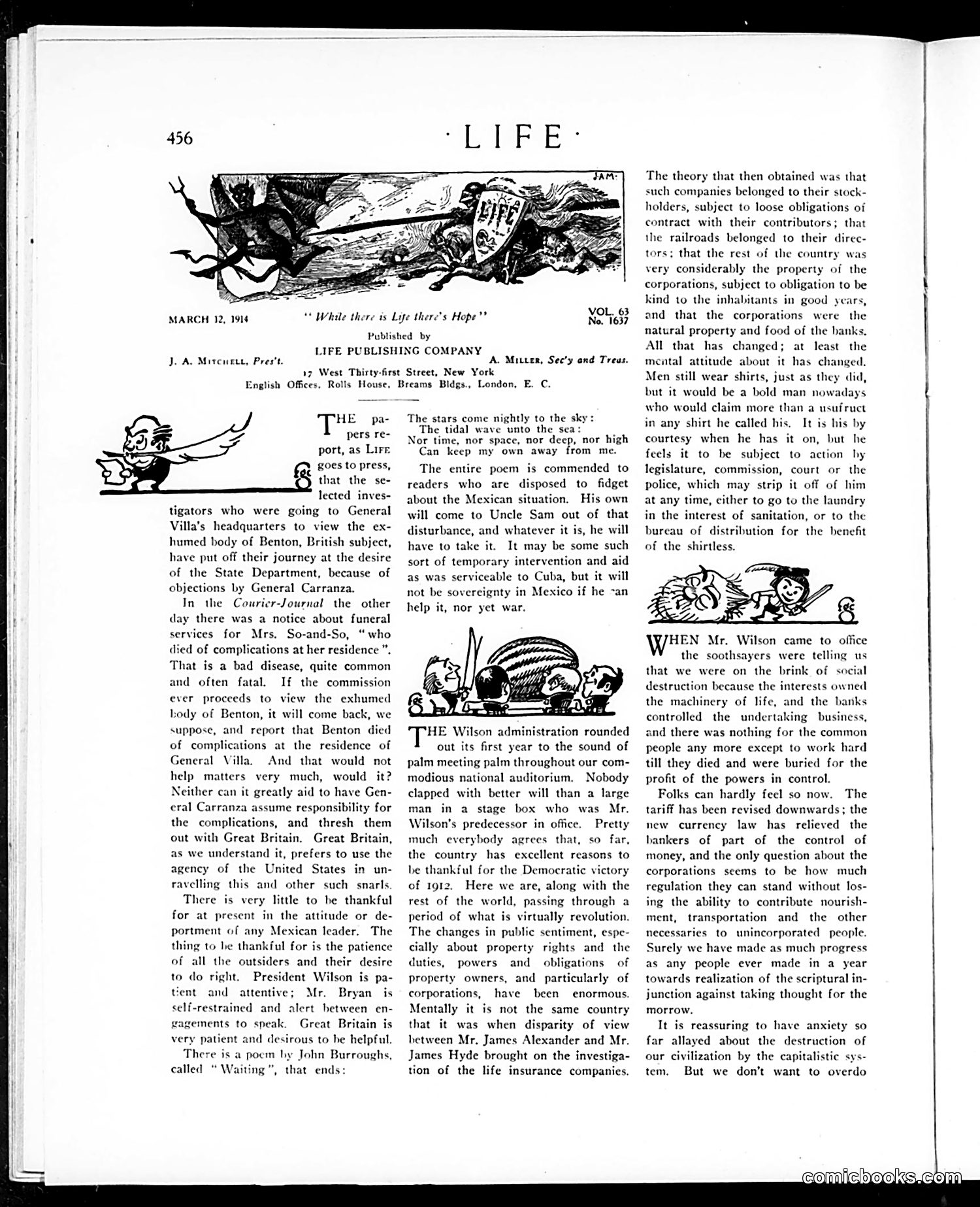
This page addresses two contemporary issues: **The Benton Affair**: The text discusses the death of a British subject (Benton) in Mexico during the Mexican Revolution. General Villa's forces are suspected, but an investigation commission has postponed viewing the exhumed body due to objections from General Carranza. The satirist wryly notes the investigation will likely report vague "complications" (mocking how deaths are euphemistically reported), and questions whether blame-shifting between Mexican leaders helps anyone—particularly Britain, which prefers the U.S. mediate. **Corporate Philosophy Shift**: The essay celebrates that American attitudes toward corporations have fundamentally changed since 1912. Previously, companies served shareholders with minimal obligations to the public; now there's recognition that corporations have broader social responsibilities. This reflects Progressive Era reforms following the life-insurance industry scandals investigated by James Alexander and James Hyde. The cartoons (though unclear in detail) appear to support these themes of social transformation and patience during turbulent times.
📄 Transcribed text from this page (OCR, searchable)
Machine-transcribed from the original scan — historical spelling and the odd misread are preserved.
(<> MARCH 12, 1914 “While there is Life there's Hope** Nee Published by LIFE PUBLISHING COMPANY J. A. Mitcurte, Pres’t. A. Miter, See’y and Treus. 17 West Thirty-first Street, New York English Offices, Rolls House, Breams Bldgs., London, E. C. HE pa- oS pers re- port, as Lirr goes to press, that the lected inves- tigators who were going to General Villa’s headquarters to view the ex- humed body of Benton, British subject, have put off their journey at the desire of the State Department, because of objections by General Carranza. In the Courier-Journal the other day there was a notice about funeral services for Mrs, So-and-So, “who died of complications at her residence ”. That is a bad disease, quite common and often fatal. If the commission ever proceeds to view the exhumed Lody of Benton, it will come back, wi suppose, and report that Benton died of complications at the residence of General Villa. And that would not help matters very much, would it? Neither can it greatly aid to have Gen- eral Carranza assume responsibility for the complications, and thresh them out with Great Britain. Great Britain, as we understand it, prefers to use the agency of the United States in un- ravelling this and other such snarls. There is very little to he thankful for at present in the attitude or de- portment of any Mexican leader. The thing to he thankful for is the patience of all the outsiders and their desire to do right. President Wilson is pa- tent and attentive; Mr. Bryan is self-restrained and alert between en- gagements to speak. Great Britain is very patient and desirous to be helpful. There is a poem by John Burroughs, called “ Waiting”, that ends: The stars come nightly to the sky: The tidal wave unto the sea: Nor time, nor space, nor deep, nor high Can keep my own away from me. The entire poem is commended to readers who are disposed to fidget about the Mexican situation. His own will come to Uncle Sam out of that disturbance, and whatever it is, he will have to take it. It may be some such sort of temporary intervention and aid as was serviceable to Cuba, but it will not be sovereignty in Mexico if he -an help it, nor yet war. HE Wilson administration rounded out its first year to the sound of palm meeting palm throughout our com- modious national auditorium. Nobody clapped with better will than a large man in a stage box who was Mr. Wilson's predecessor in office. Pretty much everybody agrees that, so far, the country has excellent reasons to be thankful for the Democratic victory of 1912. Here we are, along with the rest of the world, passing through a period of what is virtually revolution. The changes in public sentiment, espe- cially about property rights and the duties, powers and obligations of property owners, and particularly of corporations, have been enormous. Mentally it is not the same country that it was when disparity of view hetween Mr. James Alexander and Mr. James Hyde brought on the investiga- tion of the life insurance companies. The theory that then obtained was that such companies belonged to their stock- holders, subject to loose obligations of contract with their contributors; that the railroads belonged to their dir tors; that the rest of the country was very considerably the property the corporations, subject to obligation to be kind to the inhabitants in good years, and that the corporations were the natural property and food of the banks, All that has changed; at least the mental attitude about it has changed. Men still wear shirts, just as they did, but it would be a bold man nowadays who would claim more than a usufruct in any shirt he called his. It is his by courtesy when he has it on, but he feels it to be subject to action hy legislature, commission, court or the police, which may strip it off of him at any time, cither to go to the laundry in the interest of sanitation, or to the bureau of distribution for the benefit of the shirtless. HEN Mr. Wilson came to office the soothsayers were telling us that we were on the brink of social destruction because the interests owned the machinery of life, and the banks controlled the undert and there was nothing for the common people any more except to work hard till they died and were buried for the profit of the powers in control. Folks can hardly feel so now. The tariff has been revised downwards ; the new currency law has relieved the bankers of part of the control of money, and the only question about the corporations seems to be how much regulation they can stand without los- ing the ability to contribute nourish- ment, transportation and the other necessaries to unincorporated people. Surely we have made as much progress as any people ever made in a year towards realization of the scriptural in- junction against taking thought for the morrow. It is reassuring to have anxiety so far allayed about the destruction of our civilization by the capitalistic sys- tem. But we don’t want to overdo king business,