
Life, 1914-03-12 · page 21 of 44
Life — March 12, 1914 — page 21: what you’re looking at
What you’re looking at
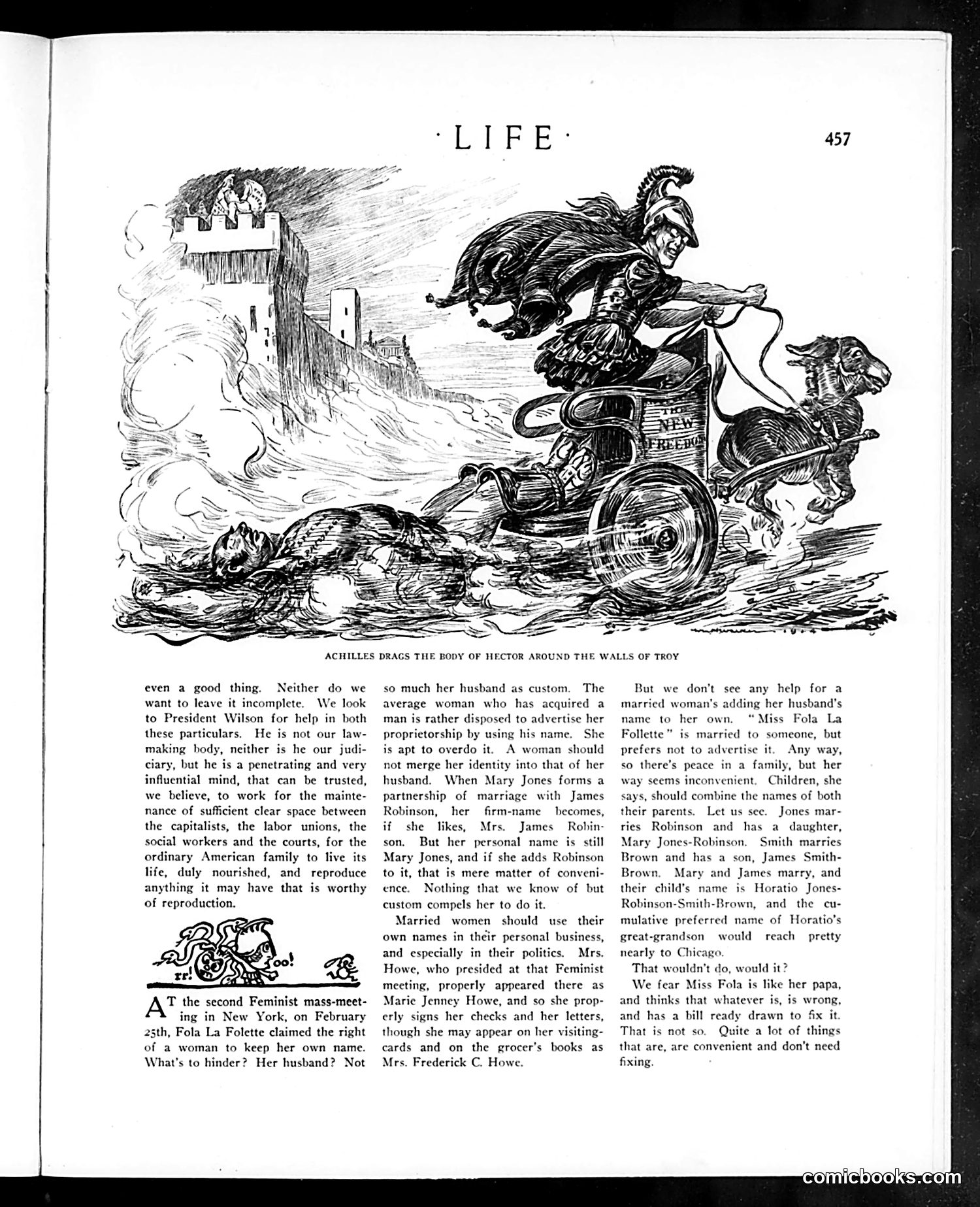
The page contains two distinct pieces: **The Illustration** depicts the famous classical scene of Achilles dragging Hector's body around Troy's walls—a reference to Homer's *Iliad*. The caption suggests this is satirical commentary, likely about violent or excessive responses to conflict, though the specific contemporary reference is unclear without additional context. **The Text** discusses women's naming rights after marriage, prompted by feminist activist Fola La Follette's February 1912 speech advocating women keep their own names professionally. The author (writing to President Wilson) supports women using maiden names in business and politics, but argues against La Follette's suggestion that children combine both parents' surnames—showing how impractical naming would become across generations. The piece reflects early 20th-century feminist debates about women's identity and property rights in marriage, while the author takes a moderate, pragmatic position skeptical of radical reform.
📄 Transcribed text from this page (OCR, searchable)
Machine-transcribed from the original scan — historical spelling and the odd misread are preserved.
ae 457 ACHILLES DRAGS THE BODY OF HECTOR AROUND THE WALLS OF TROY even a good thing. Neither do we want to leave it incomplete. We look to President Wilson for help in both these particulars. He is not our law- making body, neither is he our judi- ciary, but he is a penetrating and very influential mind, that can be trusted, we believe, to work for the mainte- nance of sufficient clear space between the capitalists, the labor unions, the social workers and the courts, for the ordinary American family to live its life, duly nourished, and reproduce anything it may have that is worthy of reproduction. T the second Feminist mass-meet- ing in New York, on February 25th, Fola La Folette claimed the right of a woman to keep her own name. What's to hinder? Her husband? Not so much her husband as custom. The average woman who has acquired a man is rather disposed to advertise her proprietorship by using his name. She is apt to overdo it. A woman should not merge her identity into that of her husband. When Mary Jones forms a partnership of marriage with James Robinson, her firm-name becomes, if she likes, Mrs. James Robin- son, But her personal name is. still Mary Jones, and if she adds Robinson to it, that is mere matter of conveni- ence. Nothing that we know of but custom compels her to do it. Married women should use their own names in their personal business, and especially in their politics. Mrs. Howe, who presided at that Feminist meeting, properly appeared there as Marie Jenney Howe, and so she prop- erly signs her checks and her letters, though she may appear on her visiting- cards and on the grocer’s books as Mrs. Frederick C. Howe. But we don’t see any help for a married woman's adding her husband's name to her own. fiss Fola La Follette” is married to someone, but prefers not to advertise it. Any way, so there’s peace in a family, but her way seems inconvenient, Children, she says, should combine the names of both their parents. Let us see. Jones mar- ries Robinson and has a daughter, Mary Jones-Robinson, Smith marries Brown and has a son, James Smith- Brown. Mary and James marry, and their child’s name is Horatio Jones- Robinson-Smith-Brown, and the cu- mulative preferred name of Horatio’s great-grandson would reach pretty nearly to Chicago. That wouldn't do, would it? We fear Miss Fola is like her papa, and thinks that whatever is, is wrong, and has a bill ready drawn to fix it That is not so. Quite a lot of things that are, are convenient and don't need fixing.