
Life, 1914-03-12 · page 8 of 44
Life — March 12, 1914 — page 8: what you’re looking at
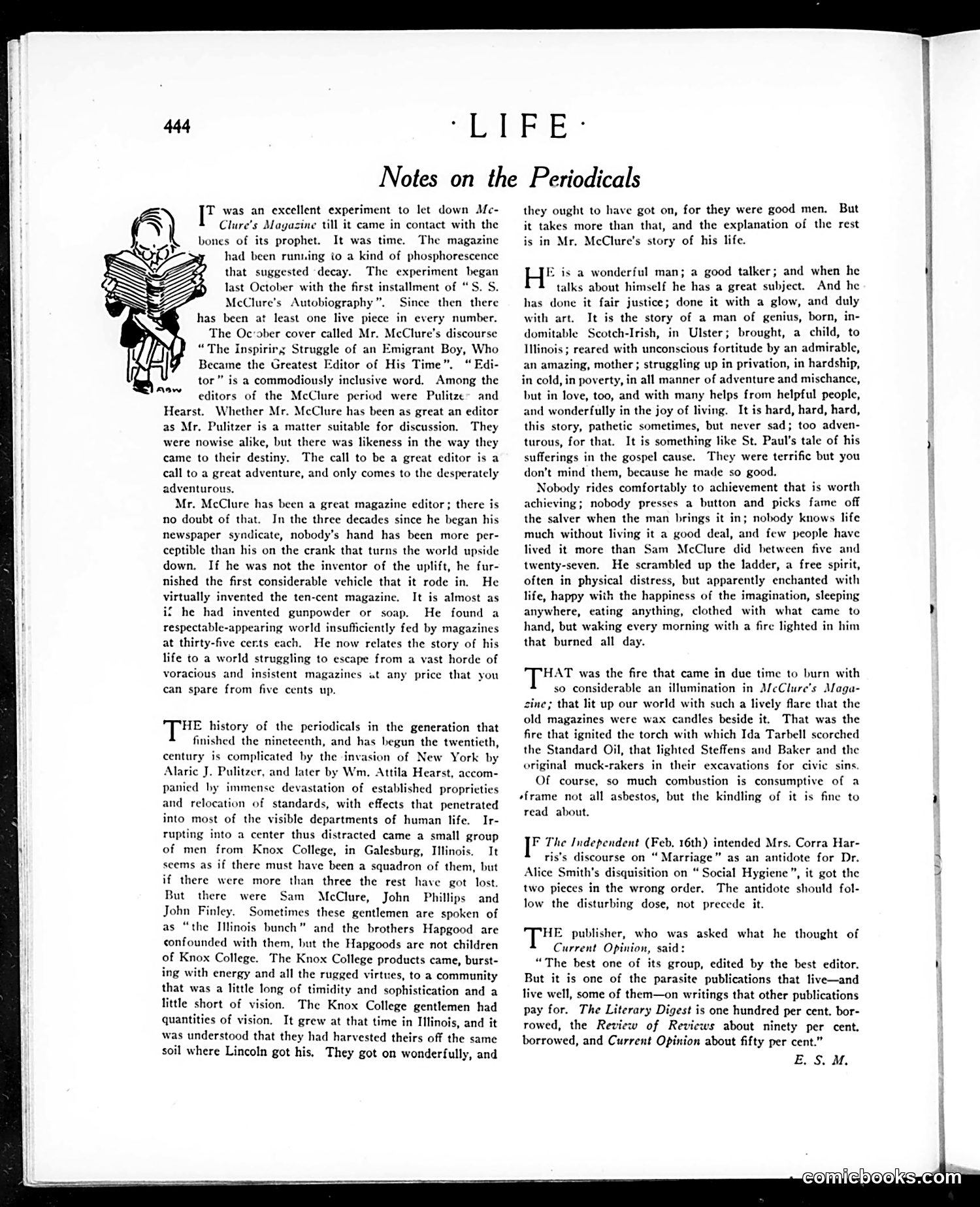
A restored page from Life, 1914-03-12. Page through the whole issue in the reader above.
📄 Transcribed text from this page (OCR, searchable)
Machine-transcribed from the original scan — historical spelling and the odd misread are preserved.
T was an excellent experiment to let down Me- Clure’s Magazine till it came in contact with the bones of its prophet. It was time. The magazine had been runing to a kind of phosphorescence that suggested decay. The experiment began last October with the first installment of “S. S. McClure’s Autobiography”. Since then there has been at least one live piece in every number. The Oc’ober cover called Mr. McClure’s discourse “The Inspirirg Struggle of an Emigrant Boy, Who Became the Greatest Editor of His Time”. “ Edi- tor” is a commodiously inclusive word. Among the editors of the McClure period were Pulitze~ and Hearst. Whether Mr. McClure has been as great an editor as Mr. Pulitzer is a matter suitable for discussion. They were nowise alike, but there was likeness in the way they came to their destiny. The call to be a great editor is a call to a great adventure, and only comes to the desperately adventurous. Mr. McClure has been a great magazine editor; there is no doubt of that. In the three decades since he began his newspaper syndicate, nobody's hand has been more per- ceptible than his on the crank that turns the world upside down. If he was not the inventor of the uplift, he fur- nished the first considerable vehicle that it rode in. He virtually invented the ten-cent magazine. It is almost as if he had invented gunpowder or soap. He found a respectable-appearing world insufficiently fed by magazines at thirty-five certs cach, He now relates the story of his life to a world struggling to escape from a vast horde of voracious and insistent magazines at any price that you can spare from five cents up. PRE history of the periodicals in the generation that finished the nineteenth, and has begun the twentieth, century is complicated by the invasion of New York by Alaric J. Pulitzer, and later by Wm, Attila Hearst, accom- panied hy immense devastation of established proprieties and relocation of standards, with effects that penetrated into most of the visible departments of human life. Ir- rupting into a center thus distracted came a small group of men from Knox College, in Galesburg, Illinois. It seems as if there must have been a squadron of them, but if there were more than three the rest have got lost. But there were Sam McClure, John Phillips and John Finley. Sometimes these gentlemen are spoken of as “the Illinois bunch” and the brothers Hapgood are confounded with them, but the Hapgoods are not children of Knox College. The Knox College products came, burst- ing with energy and all the rugged virtues, to a community that was a little long of timidity and sophistication and a little short of vision. The Knox College gentlemen had quantities of vision. It grew at that time in Illinois, and it was understood that they had harvested theirs off the same soil where Lincoln got his. They got on wonderfully, and LIFE Notes on the Periodicals they ought to have got on, for they were good men. But it takes more than that, and the explanation of the rest is in Mr. McClure’s story of his life. H is a wonderful man; a good talker; and when he alks about himself he has a great subject. And he has done it fair justice; done it with a glow, and duly with art. It is the story of a man of genius, born, in- domitable Scotch-Irish, in Ulster; brought, a child, t Illinois; reared with unconscious fortitude by an admirable, an amazing, mother ; struggling up in privation, in hardship, in cold, in poverty, in all manner of adventure and mischance, but in love, too, and with many helps from helpful people, and wonderfully in the joy of living. It is hard, hard, hard, this story, pathetic sometimes, but never sad; too adven- turous, for that. It is something like St. Paul's tale of his sufferings in the gospel cause. They were terrific but you don’t mind them, because he made so good. Nobody rides comfortably to achievement that is worth achieving; nobody presses a button and picks fame off the salver when the man brings it in; nobody knows life much without living it a good deal, and few people have lived it more than Sam McClure did between five and twenty-seven. He scrambled up the ladder, a free spirit, often in physical distress, but apparently enchanted with life, happy with the happiness of the imagination, sleeping anywhere, eating anything, clothed with what came to hand, but waking every morning with a fire lighted in him that burned all day. HAT was the fire that came in due time to burn with so considerable an illumination in McClure’s Maga- ¢; that lit up our world with such a lively flare that the old magazines were wax candles beside it. That was the fire that ignited the torch with which Ida Tarbell scorched the Standard Oil, that lighted Steffens and Baker and the original muck-rakers in their excavations for ic sins. Of course, so much combustion is consumptive of a eframe not all asbestos, but the kindling of it is fine to read about. I The Independent (Feb, 16th) intended Mrs. Corra Har- ris's discourse on “ Marriage” as an antidote for Dr. Alice Smith's disquisition on “ Social Hygiene”, it got the two pieces in the wrong order. The antidote should fol- low the disturbing dose, not precede it. HE publisher, who was asked what he thought of Current Opinion, said: “The best one of its group, edited by the best editor. But it is one of the parasite publications that live—and live well, some of them—on writings that other publications pay for. The Literary Digest is one hundred per cent. bor- rowed, the Review of Reviews about ninety per cent. borrowed, and Current Opinion about fifty per cent.” ELS. M.