
Life, 1914-03-12 · page 19 of 44
Life — March 12, 1914 — page 19: what you’re looking at
What you’re looking at
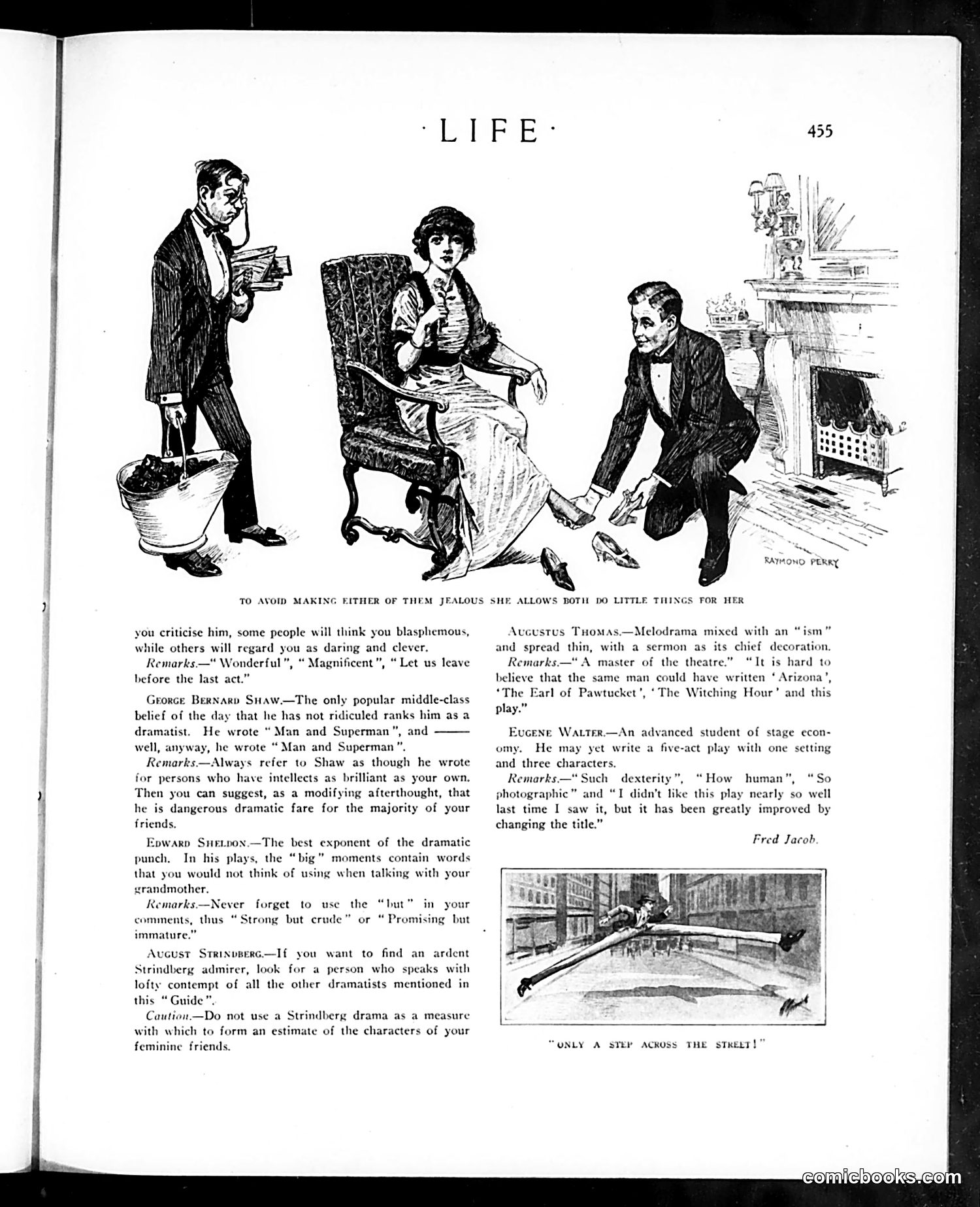
This page satirizes how to discuss contemporary playwrights while appearing sophisticated. The cartoon (by Raymond Perry) depicts a woman accepting small favors from two men simultaneously—the visual metaphor for the page's theme: how to flatter both rivals without appearing to favor either. The text mocks theatrical pretension by offering "guides" to praising famous dramatists (Shaw, Sheldon, Strindberg, Thomas, Walter) while revealing nothing genuine about them. Readers are advised to use vague praise ("Wonderful," "Magnificent"), affect intellectual superiority, and selectively quote obscure references. The humor targets Edwardian-era theater culture: the snobbery surrounding serious drama, the pressure to appear cultured by praising playwrights one may not understand, and the hypocrisy of public opinion. The second illustration shows someone crossing a street—likely illustrating a dramatic moment from one of the works discussed. This reflects early 1900s concerns about middlebrow cultural posturing and the gap between authentic appreciation and performative sophistication.
📄 Transcribed text from this page (OCR, searchable)
Machine-transcribed from the original scan — historical spelling and the odd misread are preserved.
RATMOND PERRY TO AVOID MAKING EITHER OF THEM JEALOUS SHE ALLOWS BOTH DO LITTLE THINGS FOR HER you criticise him, some people will think you blasphemous, while others will regard you as daring and clever, Remarks.—* Wonderful”, “ Magnificent”, “ Let us leave before the last act.” Grorce Bernarv SHAW.—The only popular middle-class belief of the day that he has not ridiculed ranks him as a dramati: He wrote “ Man and Superman”, and well, anyway, he wrote “Man and Superman”. Remarks—Always refer to Shaw as though he wrote for persons who have intellects as brilliant as your own. Then you can suggest, as a modifying afterthought, that he is dangerous dramatic fare for the majority of your friends, Epwarp Snetnox.—The best exponent of the dramatic punch, In his plays, the “big” moments contain words that you would not think of using when talking with your grandmother. Remarks—Never forget to use the “but” in your comments, thus “Strong but crude” or “ Promising but immature.” Avcust SrrinvperG.—If you want to find an ardent Strindberg admirer, look for a person who sp s with lofty contempt of all the other dramatists mentioned in this “ Guide”. Caution.—Do not use a Strindberg drama as a measure with which to form an estimate of the characters of your feminine friends. —Melodrama mixed with an “ism” ha sermon as its chief decoration. “Tt is hard to Aucustus Tuomas and spread thin, w Remarks.—"“ A master of the theat believe that the same man could have written ‘Arizona’, ‘The Earl of Pawtucket’, ‘The Witching Hour’ and this play.” Eucene Watter.—An advanced student of stage econ- omy. He may yet write a five-act play with one setting and three characters. Remarks —" Such dexterity”, “How human", “So photographic” and “I didn't like this play nearly so well last time I saw it, but it has been greatly improved by changing the title.” Fred Jacob “UNLY A STEP ACROSS THE STREET!”