
A complete issue · 56 pages · 1913
Life — November 6, 1913
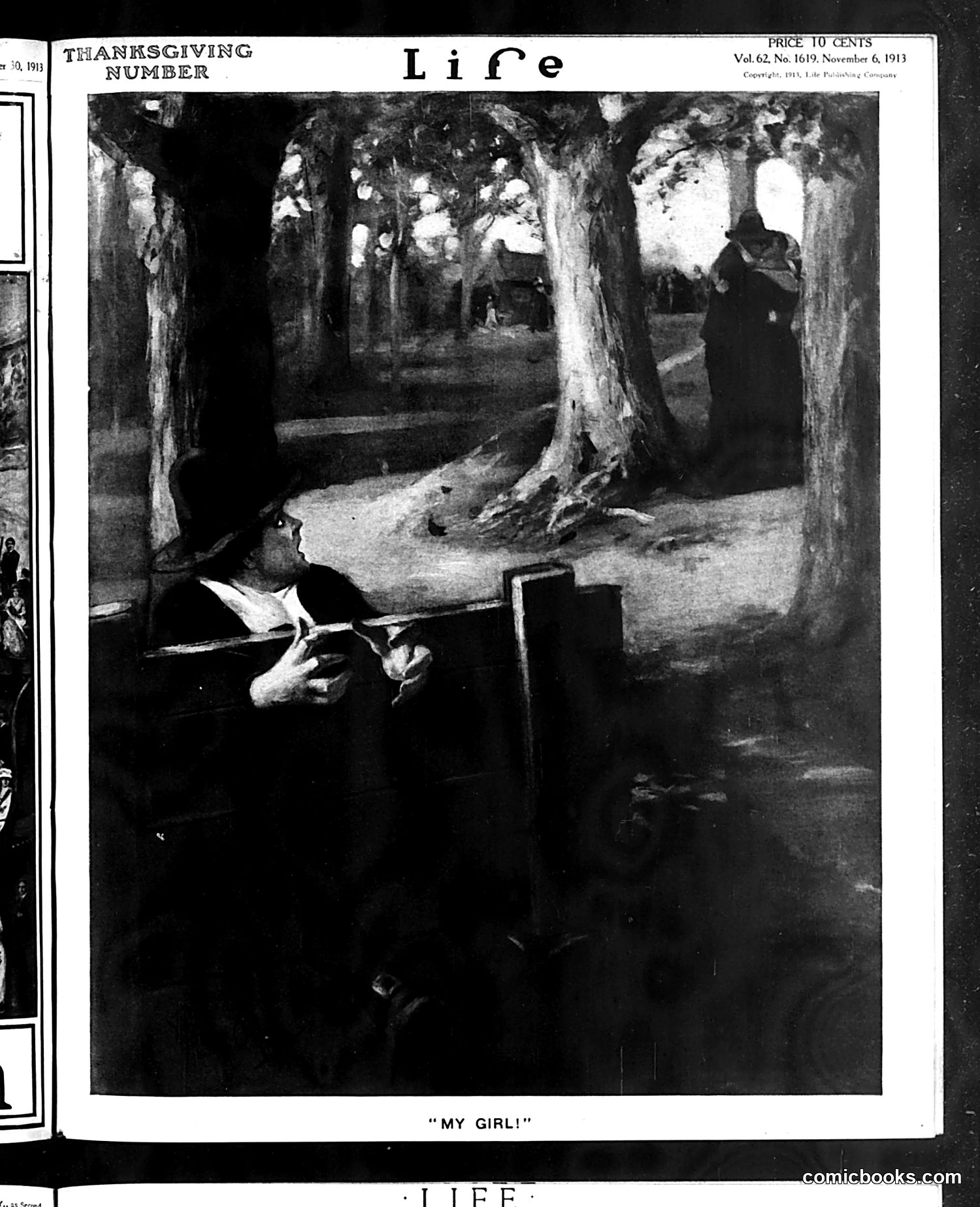
This appears to be a romantic or comedic illustration rather than political satire. The image shows a man in dark clothing seated in the foreground, gazing toward a woman standing in a tree-lined path in the background. The title "My Girl!" suggests a sentimental or humorous take on courtship or romance. Given the Thanksgiving issue context and early 1900s style, this likely represents a nostalgic or idealized vision of romance—possibly satirizing sentimental notions of love, or perhaps commenting on the distance (literal and figurative) in romantic relationships. The composition's theatrical quality suggests it may be illustrating a popular story or song from the period, though without additional context, the specific reference remains unclear.
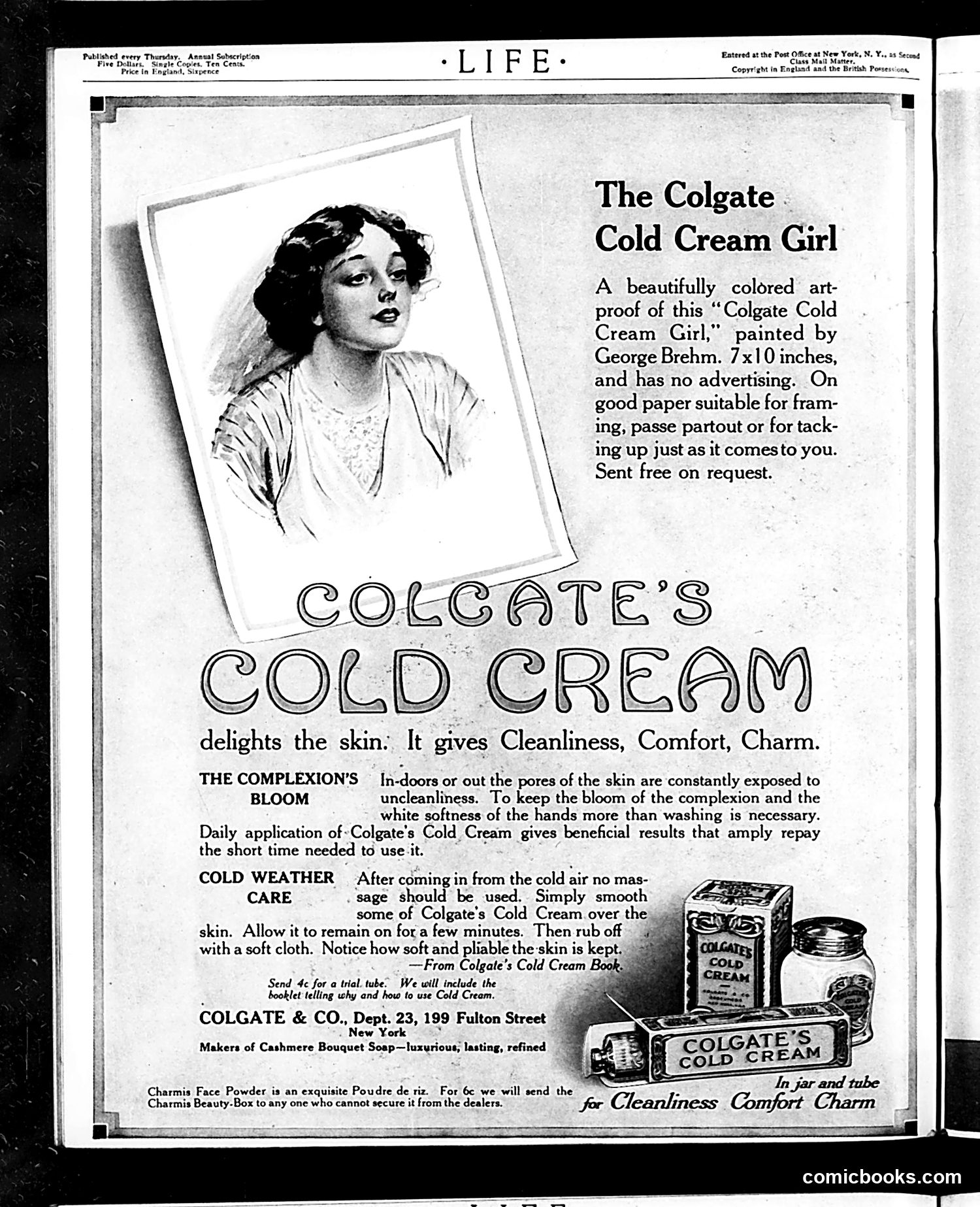
This page is primarily a **cosmetics advertisement**, not satire or political commentary. It advertises Colgate's Cold Cream, a skincare product. The main image is a portrait of a young woman labeled "The Colgate Cold Cream Girl," painted by artist George Brehm. The advertisement emphasizes the product's benefits for skin care, particularly for "Cleanliness, Comfort, Charm." The text includes sections on "The Complexion's Bloom" and "Cold Weather Care," offering skincare advice and promoting daily use of the product. At the bottom, Colgate & Co. offers a trial tube for 4¢, along with their other product line (Cashmere Bouquet Soap). There is no political or satirical content on this page—it is straightforward vintage advertising from what appears to be an early 20th-century publication.
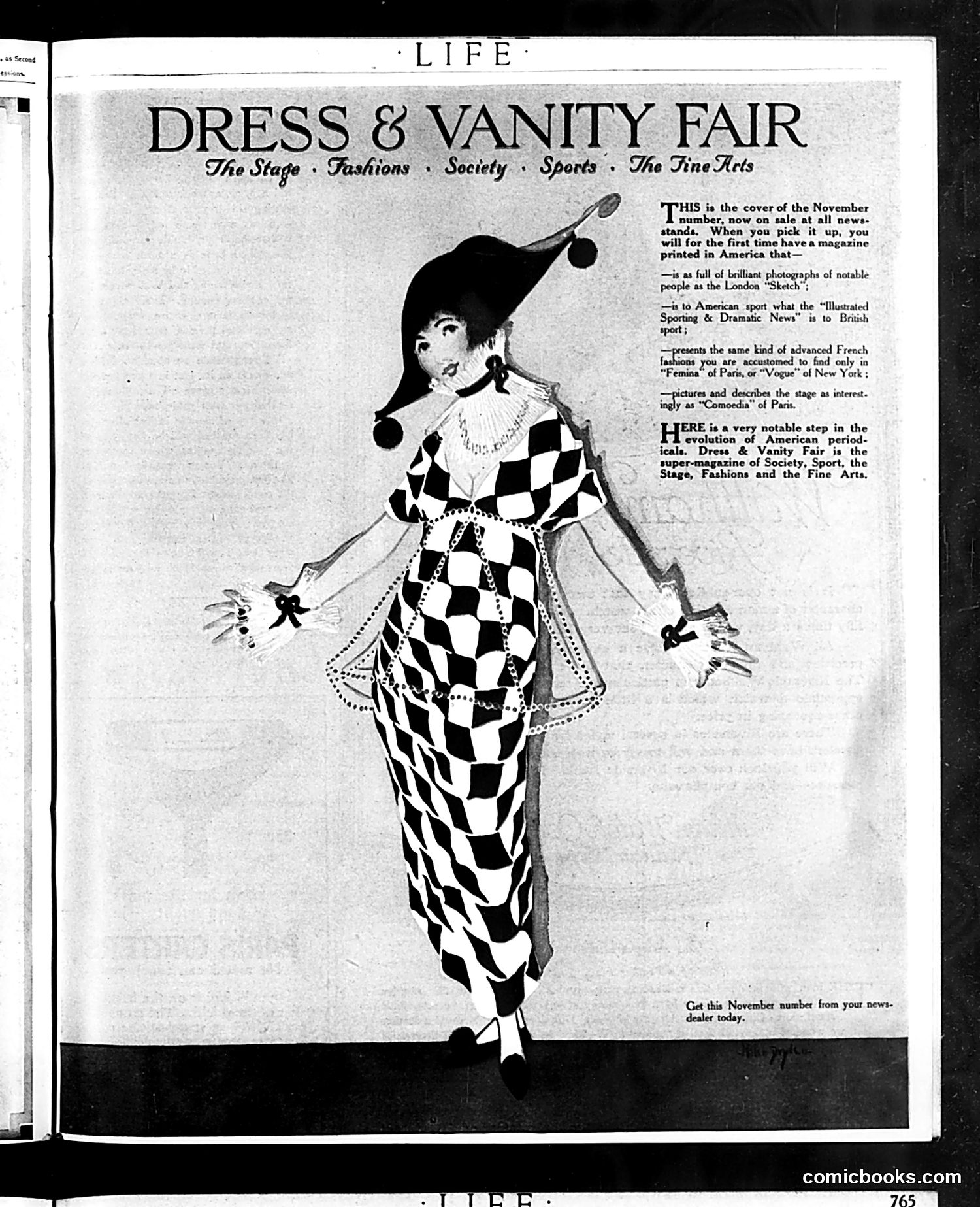
This page announces the November debut of *Dress & Vanity Fair*, described as "the first time have a magazine printed in America" combining Society, Fashion, Sports, Stage, and Fine Arts content. The illustration shows a jester or harlequin figure in diamond-patterned clothing with a distinctive pointed hat and theatrical pose—a visual metaphor for entertainment and style. The jester costume suggests the magazine will blend theatrical whimsy with fashion reporting. The text claims this represents "a very notable step in the evolution of American periodicals," positioning it as an ambitious new venture combining previously separate editorial categories. The jester imagery reinforces the lighthearted, entertaining tone the magazine intends to adopt rather than solemn journalism.
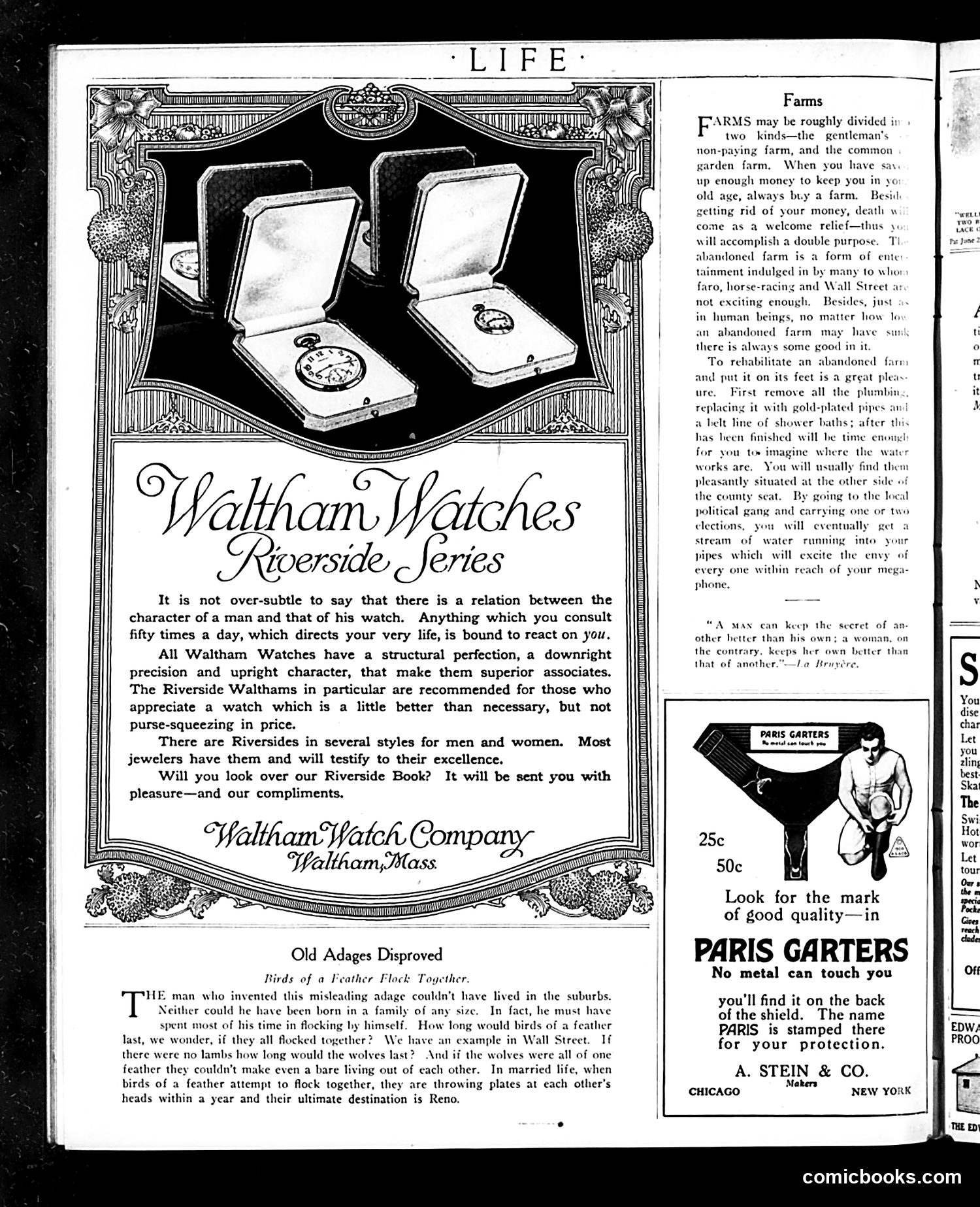
This page is primarily **advertising, not satire**. The dominant content consists of two full advertisements: 1. **Waltham Watches** (top, left): A luxury watch company ad emphasizing that a man's character reflects his watch choice. It appeals to aspirational consumers seeking quality timepieces. 2. **Paris Garters** (right): An advertisement for men's garters, emphasizing quality and featuring a manufacturer's mark for authenticity. The small section titled "Old Adages Disproved" appears to be humorous filler text about birds of a feather, but it's not political satire—merely light editorial content filling space between advertisements. This reflects Life magazine's business model: satirical/humorous writing interspersed with advertisements targeting middle and upper-class male readers.
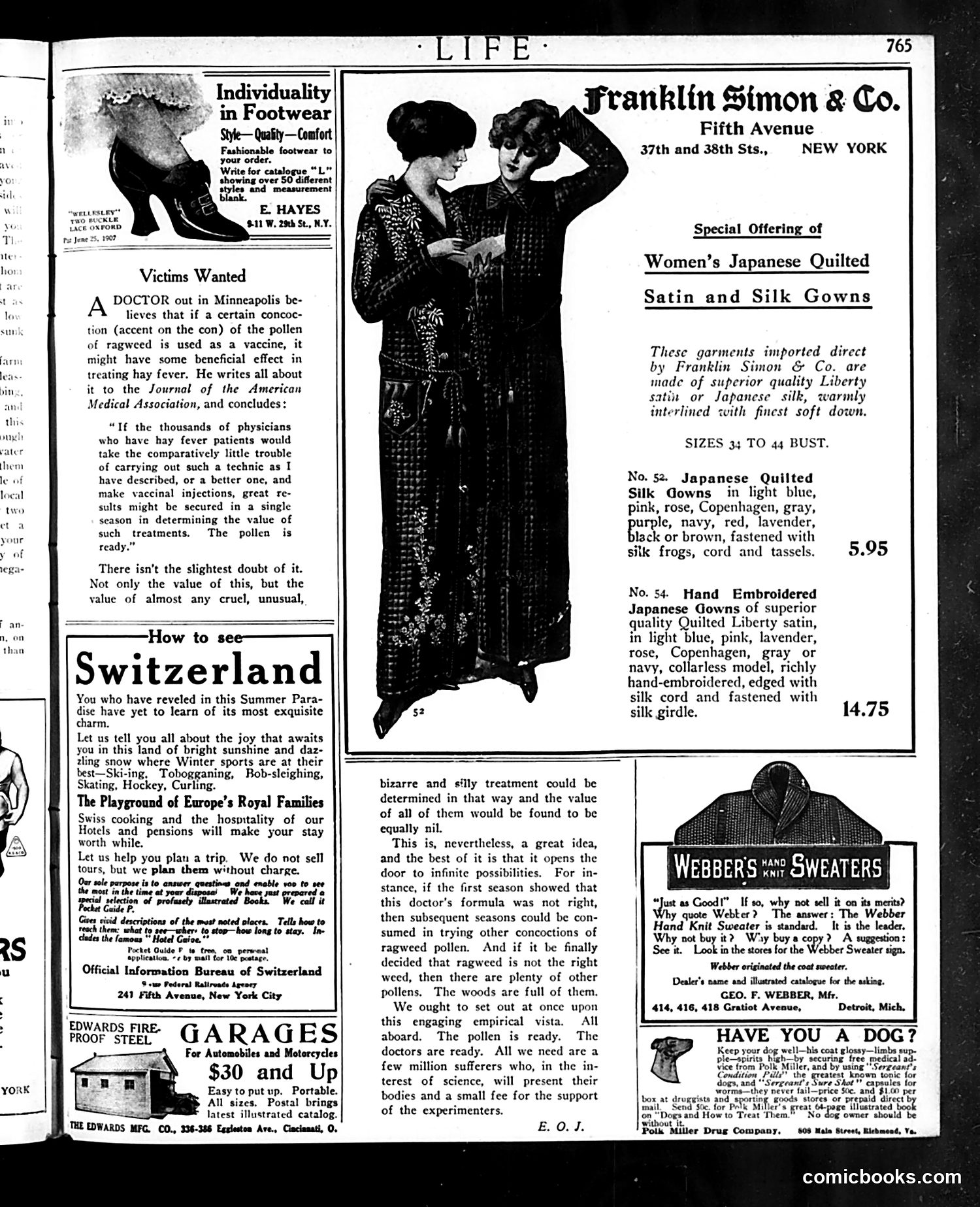
This page is primarily **advertising**, not satire or political cartoon content. The main visual element shows two women modeling Japanese quilted silk and satin gowns from Franklin Simon & Co., a Fifth Avenue department store. The advertisement emphasizes imported luxury fabrics and hand-embroidered details, priced at $5.95-$14.75. The left column contains a medical item titled "Victims Wanted"—a doctor seeking patients to test ragweed pollen as a potential hay fever vaccine. This appears to be genuine medical news rather than satire. Other advertisements include Swiss tourism, Webber's Hand Knit Sweaters, Edwards Fireproof Steel garages, and a dog medicine product. The page reflects 1920s consumer culture and medical experimentation practices rather than containing political commentary.
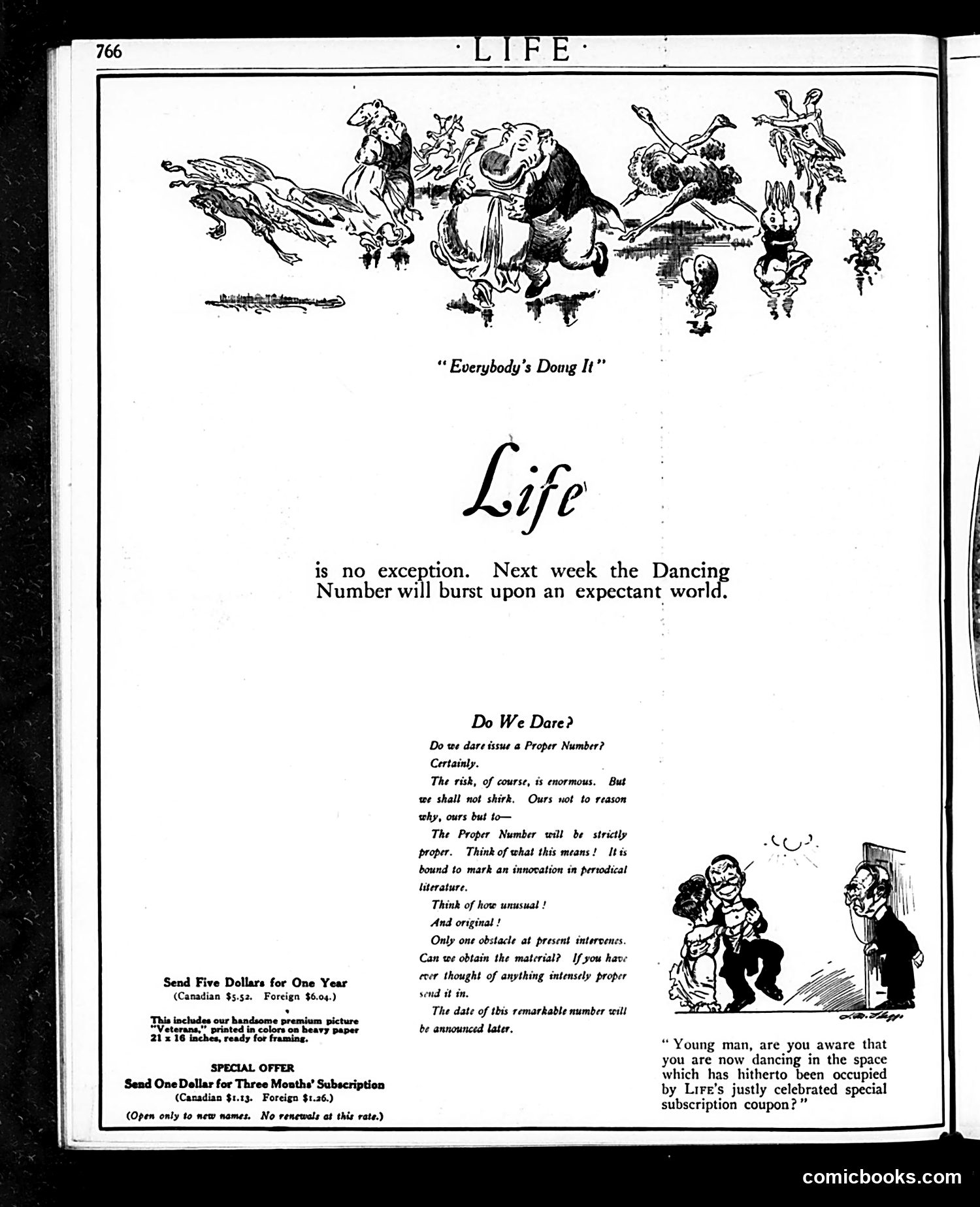
This page is primarily **advertising and promotional content** for *Life* magazine subscriptions, not political satire. The top illustration titled "Everybody's Doing It" shows various figures engaged in activities—likely contemporary social trends or fads of the era. Without clearer detail, the specific references are unclear. The main text promotes an upcoming "Dancing Number" issue and encourages subscriptions. The "Do We Dare?" section announces a forthcoming "Proper Number" described as "strictly proper" yet "innovative" and "original"—suggesting *Life*'s characteristic blend of respectability and edgy humor. The bottom cartoon depicts a young man being questioned about dancing, referencing the magazine's apparent focus on dance as a contemporary social phenomenon worth satirizing or celebrating. The page emphasizes subscription rates and a special offer rather than delivering substantive political commentary.
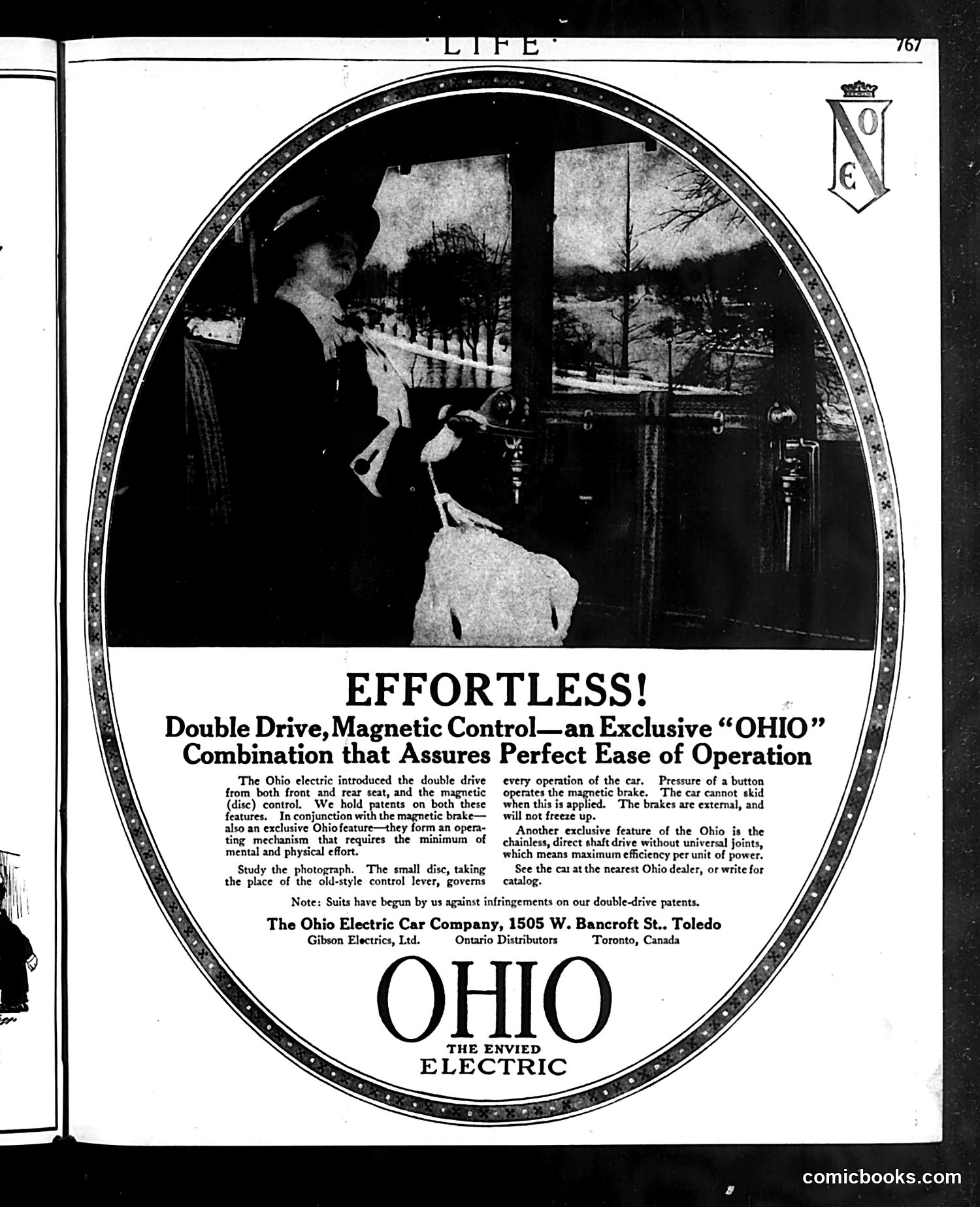
This is primarily a **product advertisement**, not political satire. It promotes the Ohio Electric Car, manufactured by The Ohio Electric Car Company in Toledo. The ad emphasizes "effortless" operation through two features: a "Double Drive" system and "Magnetic Control." The photograph shows a woman operating the vehicle, highlighting ease of use—a key selling point for early electric automobiles, which required no hand-cranking like gasoline cars. The ad targets affluent buyers, particularly women, by stressing convenience. The "magnetic brake" and "chainless, direct shaft drive" are presented as exclusive Ohio features ensuring "perfect ease of operation." This reflects the early 1900s context when electric vehicles competed with gasoline cars, and manufacturers marketed them as sophisticated, user-friendly alternatives.
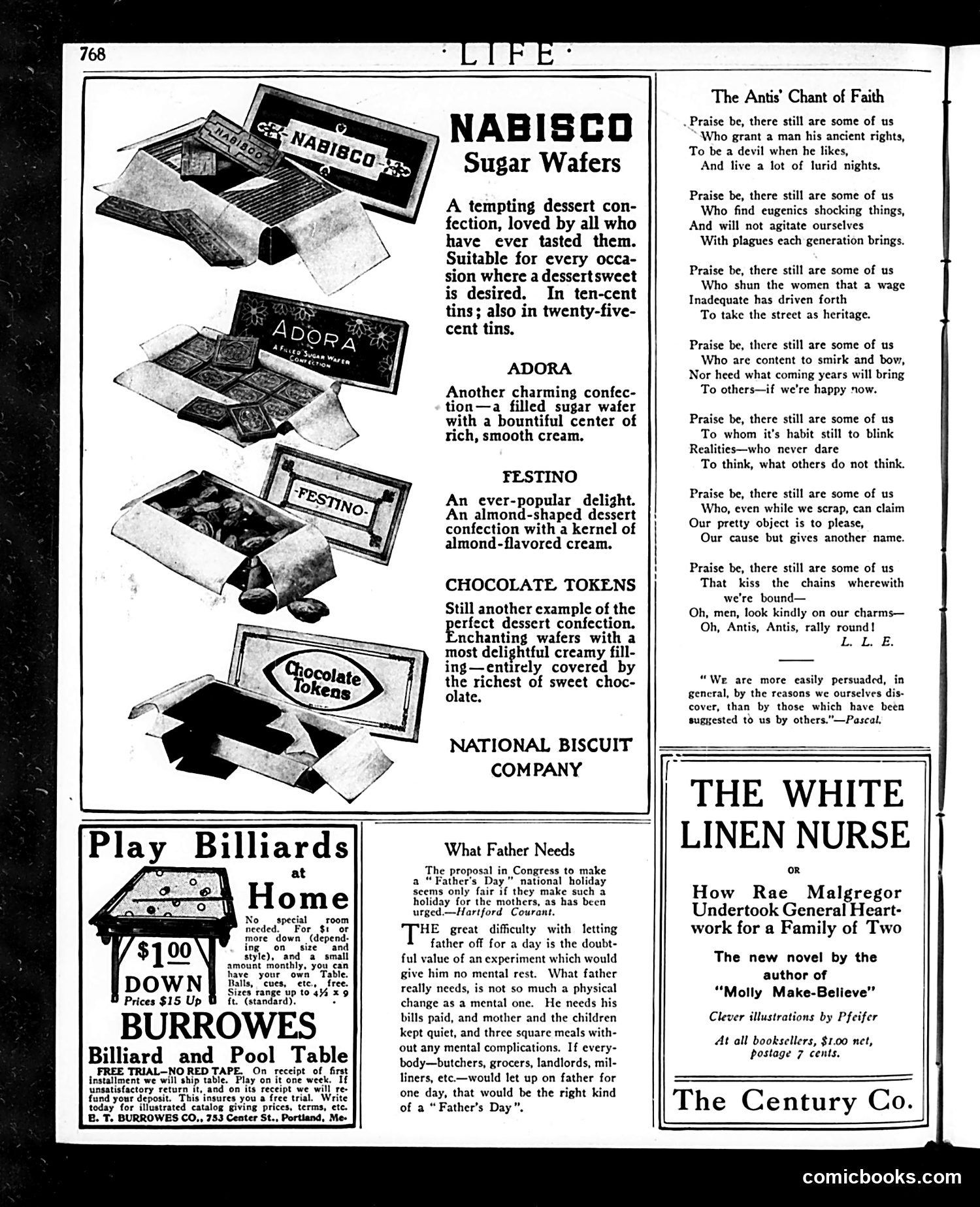
This page is primarily **advertising and miscellaneous content**, not political satire. The left side features dessert confections (Nabisco Sugar Wafers, Adora, Festino, Chocolate Tokens) and a billiards table advertisement. The right side contains "The Ants' Chant of Faith"—a poem using ants as metaphors for social acceptance and complacency. It appears to satirize those who passively accept injustice: people who "shun the women that a wage inadequate has driven forth / To take the street as heritage," or those who avoid thinking about uncomfortable realities. The poem mocks apathy and social complicity rather than celebrating ant virtues, suggesting resignation to exploitation is unworthy of praise. Below is an advertisement for a novel, *The White Linen Nurse*.
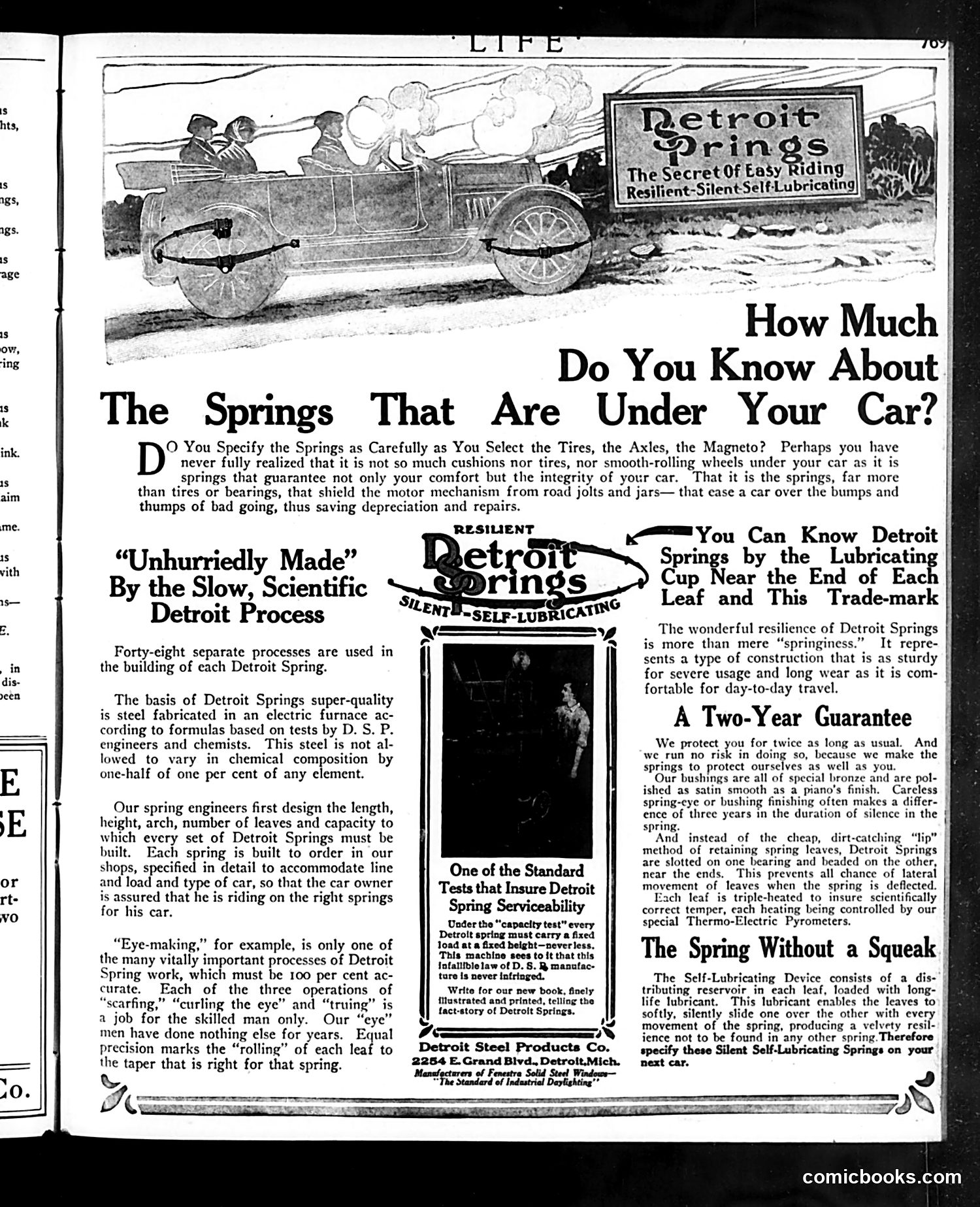
This page is **primarily an advertisement**, not satirical content. It promotes Detroit Springs, a car suspension component manufactured by Detroit Steel Products Co. The large illustration at top shows an early automobile with passengers enjoying a smooth ride, establishing the product's appeal. The advertisement emphasizes that Detroit Springs are carefully engineered (using "48 separate processes") and include a "Silent Self-Lubricating" feature—a selling point for the era. Key claims include a two-year guarantee (unusually long for the time) and technical superiority through precision manufacturing. The "eye-making" process and leaf-design are highlighted as distinctive features. There is **no political satire** here—this is straightforward commercial marketing targeting car owners concerned with comfort and vehicle durability during the early automotive age.
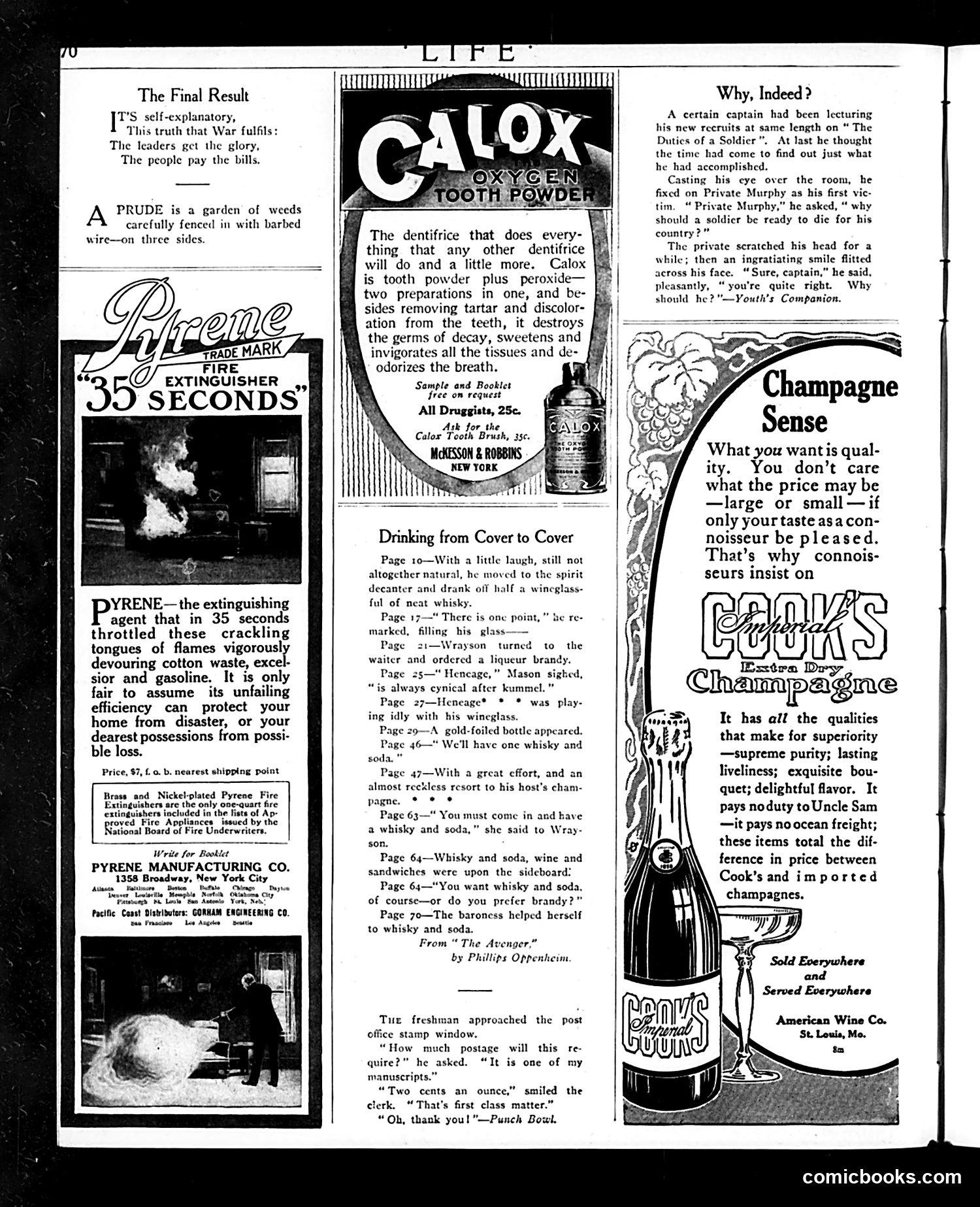
This page is primarily **advertising** interspersed with short literary excerpts. The advertisements include: - **Pyrene Fire Extinguisher** ("35 Seconds"): promoting a fire-suppression product - **Calox Oxygen Tooth Powder**: a dentifrice claiming to remove tartar and fight decay - **Cook's Champagne**: emphasizing quality and imported status The text sections are brief fictional excerpts, including "Why, Indeed?" (a humorous military anecdote about a soldier's duties) and "Drinking from Cover to Cover" (apparently serialized fiction involving whisky, wine, and social situations). **No political cartoons appear on this page.** The content reflects early 20th-century consumer culture and light entertainment rather than satire or political commentary.
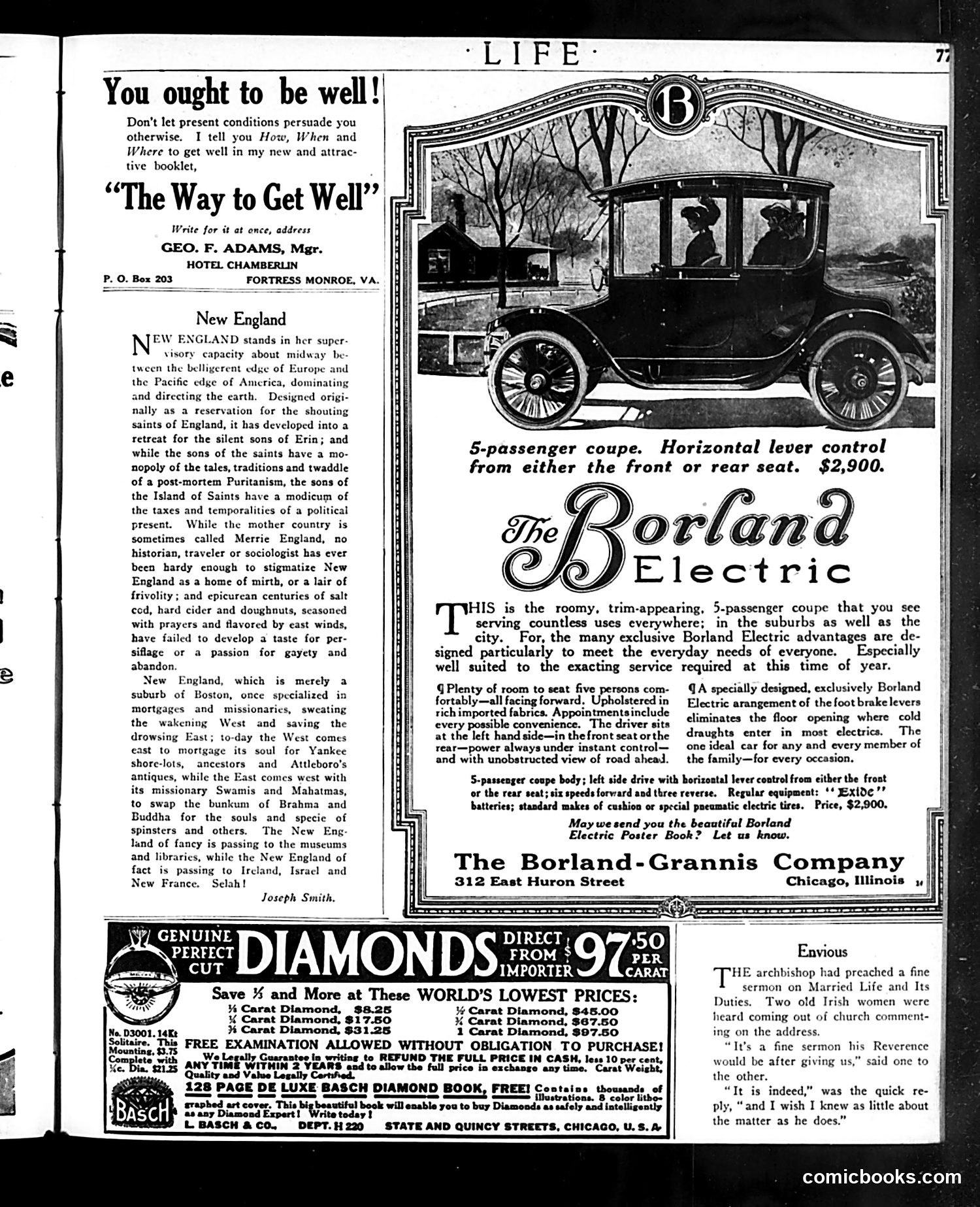
This page is primarily **advertising and editorial content** rather than political satire or comics. The main elements are: 1. **"You ought to be well!"** - A health booklet advertisement from Hotel Chamberlain in Fortress Monroe, Virginia 2. **"New England"** - An essay by Joseph Smith celebrating New England's cultural and historical significance, describing its role in American development 3. **Borland Electric automobile ad** - A 5-passenger coupe priced at $2,900, emphasizing its practical design and foot-brake technology 4. **Diamond and Busch jewelry advertisements** - Promoting direct-from-importer pricing 5. **"Envious"** - A brief anecdote about a church sermon on marriage duties The page reflects early 20th-century commercial and social values—promoting health resorts, automobiles, luxury goods, and traditional marriage—without satirical intent.
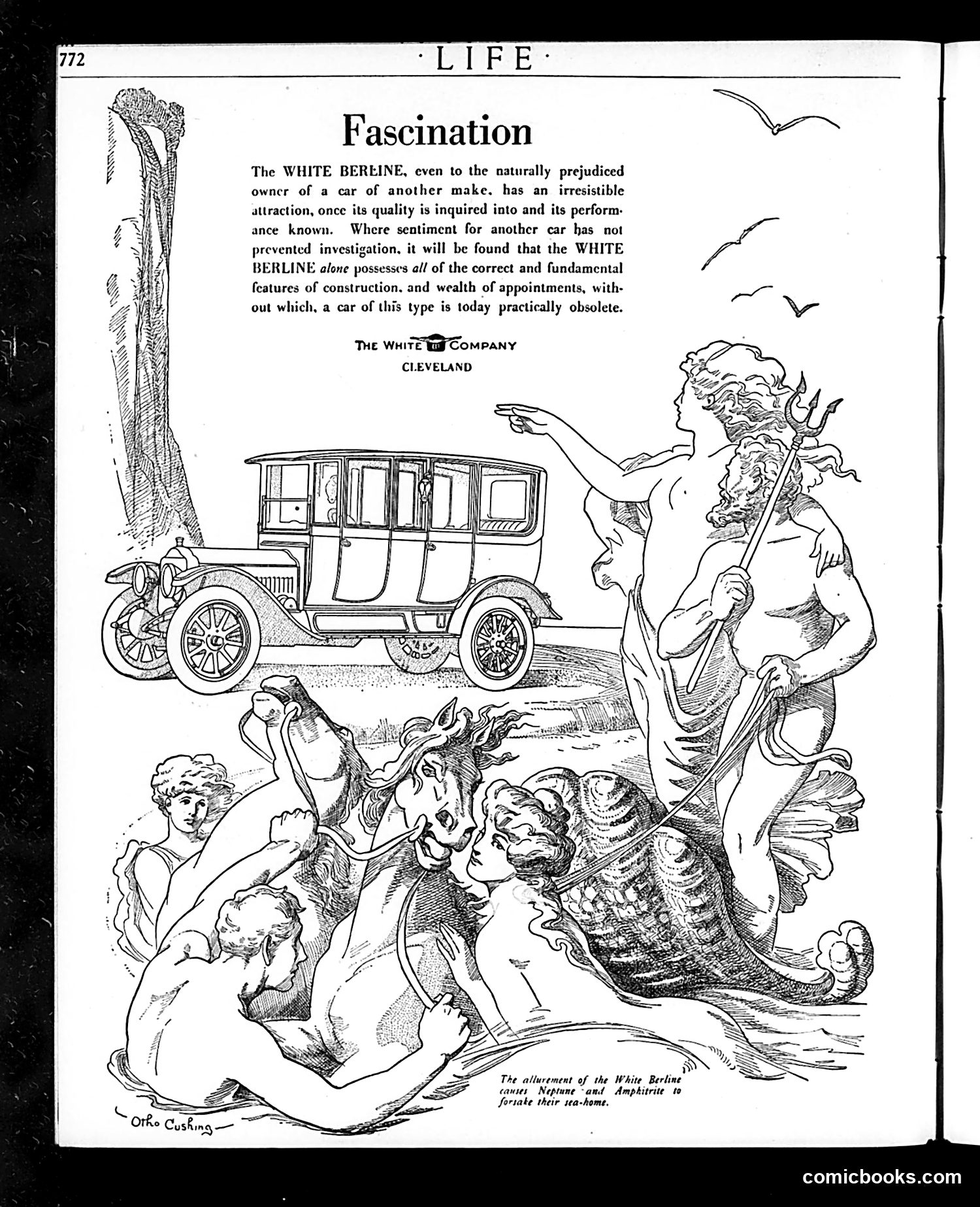
This is primarily a **car advertisement** for the White Berline automobile, made by the White Company in Cleveland. The ad claims the car possesses "all of the correct and fundamental features of construction, and wealth of appointments" and remains relevant despite competition. The illustration by Otke Cushing depicts mythological figures (Neptune and Amphitrite, labeled in the caption) seemingly enchanted or "fascinated" by the White Berline automobile. The satire suggests the car's appeal is so universal and irresistible that even ancient gods would be captivated by it—a humorous exaggeration meant to convey the vehicle's superior quality and desirability to potential buyers.
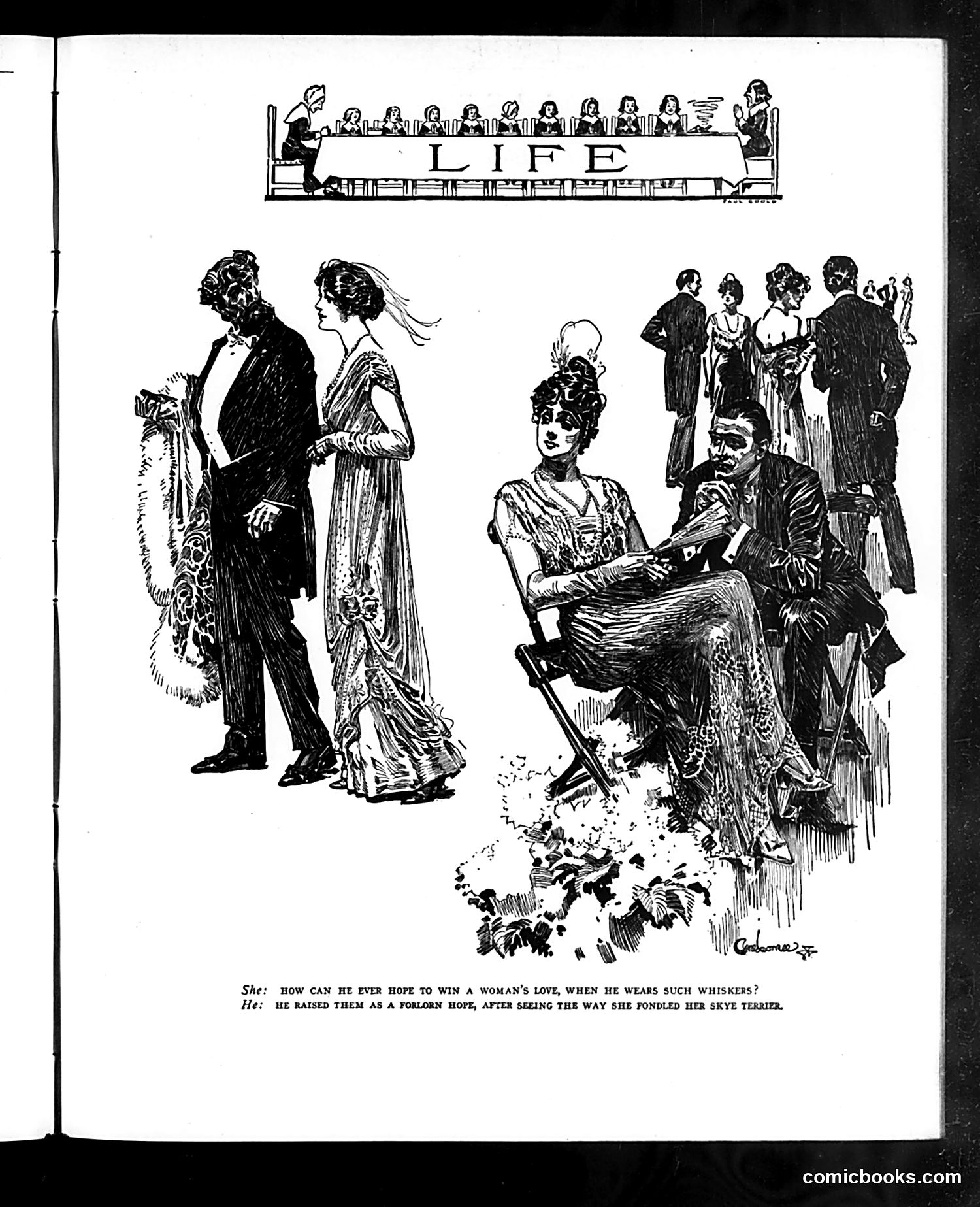
This page from *Life* magazine contains a single cartoon depicting a social scene at what appears to be an elegant gathering. The illustration shows a well-dressed man with prominent whiskers speaking to a woman, while other guests mingle in the background. The caption presents a humorous exchange: the woman questions how the man can hope to win a woman's love while sporting such whiskers. His response claims he raised them "as a forlorn hope, after seeing the way she fondled her Skye Terrier." The joke relies on early 20th-century dating humor—the man is ironically suggesting his facial hair mimics the texture of the woman's dog, implying that's what attracts her affection. It's a lighthearted jab at female preferences and masculine fashion vanity during this era.
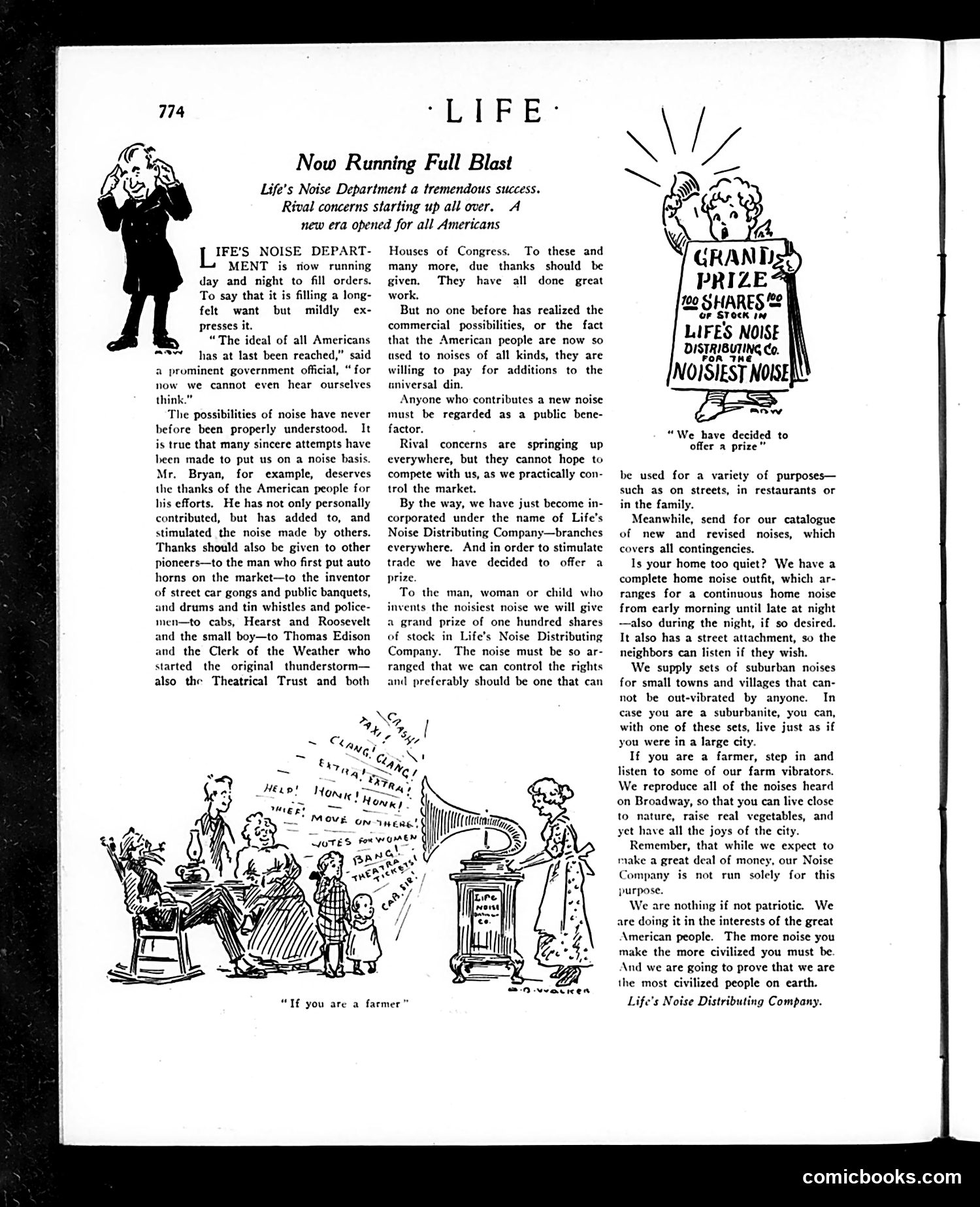
This satirical piece mocks the early 20th-century phenomenon of urban noise pollution. Life's "Noise Department" announces a fictional "Life's Noise Distributing Company" offering to sell noise to Americans—a absurdist inversion reflecting how Americans had become accustomed to constant racket. The cartoons depict the sources of complaint: street traffic, construction, domestic chaos. The satire works by praising noise as a marker of civilization and progress, sarcastically suggesting that "the more noise you make the more civilized you must be." The text references real figures like Bryan, Roosevelt, and Edison as noise contributors, mocking how even prominent Americans had normalized the problem. The ironic "grand prize" of 100 shares in a noise company underscores the joke: Americans have grown so habituated to noise they might actually value it commercially.
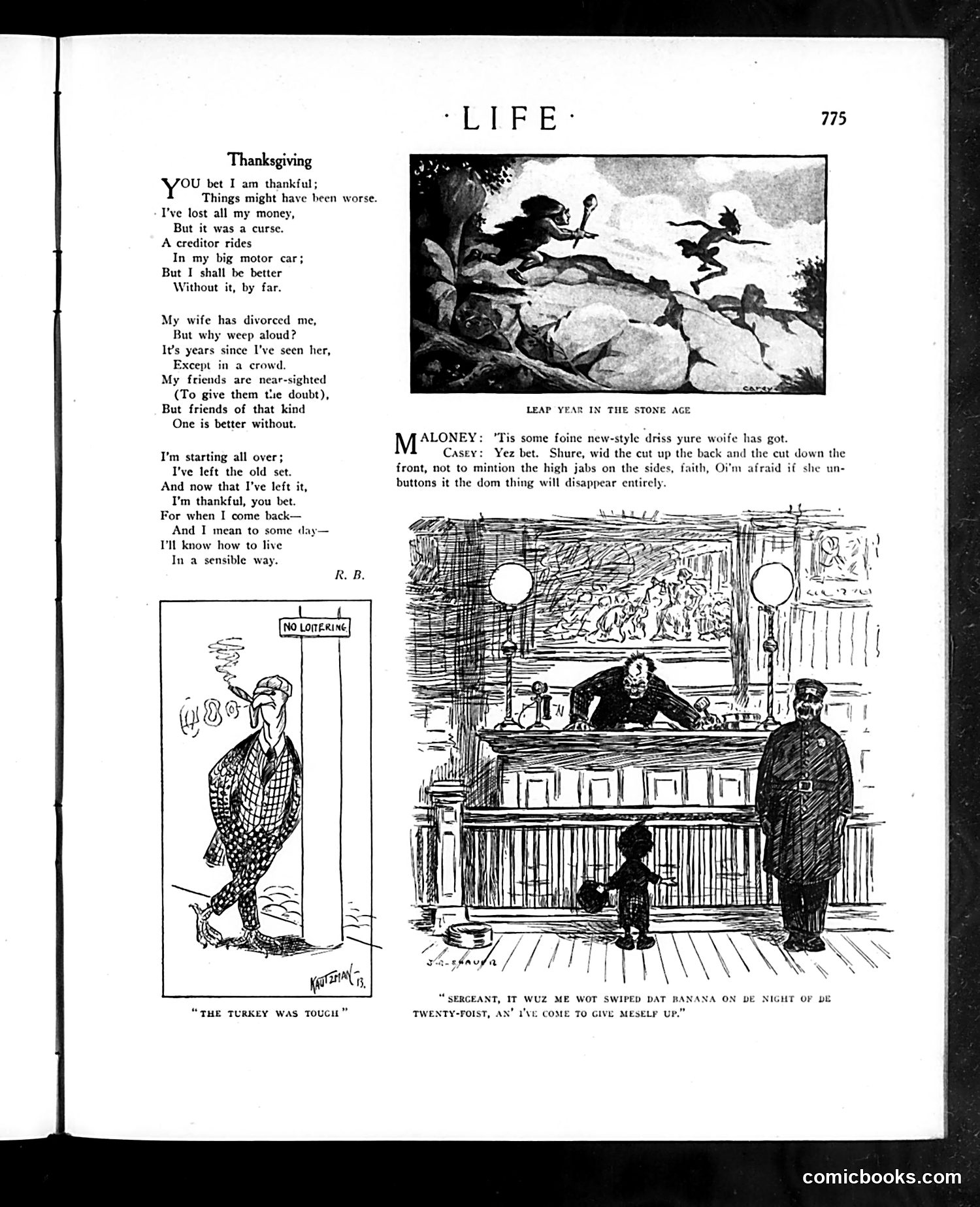
This page contains three separate satirical pieces: **"Thanksgiving" Poem (R.B.)**: A tongue-in-cheek gratitude list where the speaker counts blessings by listing misfortunes—lost money, repossessed car, divorce, and fair-weather friends—yet insists each loss is actually liberating. The satire critiques materialism and social pretense by suggesting financial ruin and social dissolution are preferable to their false comforts. **"Leap Year in the Stone Age"**: A single-panel cartoon showing cavemen, with a dialogue joke about a wife's new dress with strategic cuts that might cause it to disappear if unbuttoned—a mild double entendre about scanty clothing. **"The Turkey Was Tough"**: A courtroom scene where a character confesses to stealing a banana, with heavy dialect spelling suggesting working-class speech. The absurdist humor contrasts the formal legal setting with a trivial crime confession. The page exemplifies early 20th-century Life magazine's mix of social commentary and light humor targeting contemporary consumer culture and class distinctions.
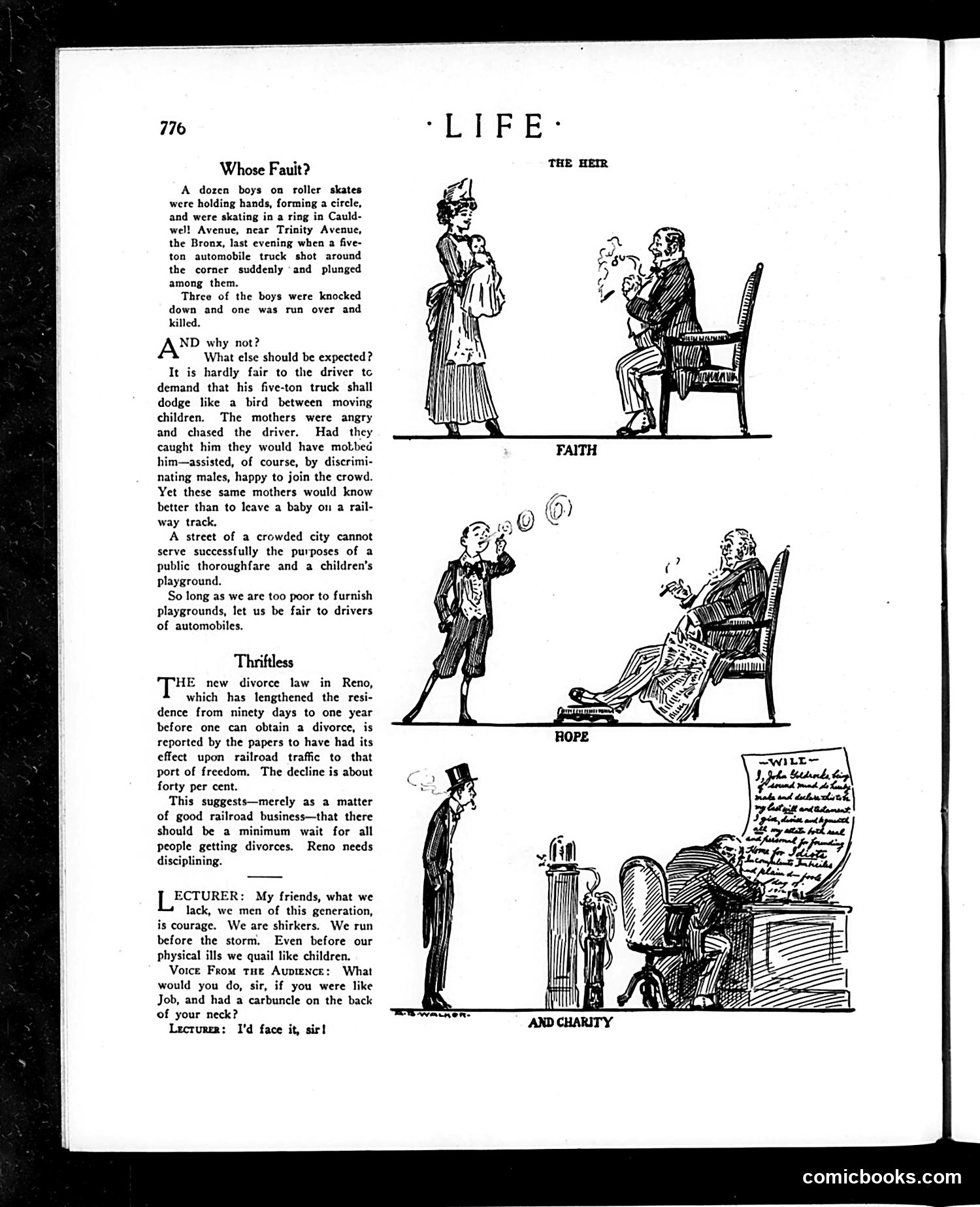
This 1920s *Life* magazine page contains three separate satirical pieces: **"Whose Fault?"** uses dark irony to critique urban negligence. After a child is killed by a truck among roller-skating children in the Bronx, the text sarcastically argues the truck driver shouldn't be blamed—rather, mothers are foolish for allowing children to play in streets. The satire exposes how society victim-blames and prioritizes traffic flow over child safety, while lacking public playgrounds. **"Thriftless"** mocks Nevada's Reno divorce law, which extended waiting periods from 90 days to one year. The text cynically suggests this is a "railroad business" problem since fewer divorces mean fewer people traveling to Reno, implying the railroad should lobby for faster divorces to boost traffic. **The Lecturer anecdote** is a joke about masculine bravado: a speaker claims men lack courage, but when challenged about handling a painful carbuncle (boil), he retreats to abstract "facing it" rather than admitting he'd actually suffer. The accompanying illustrations ("The Heir," "Faith," "Hope," "And Charity") appear to be unrelated decorative cartoons about human virtues and inheritance.
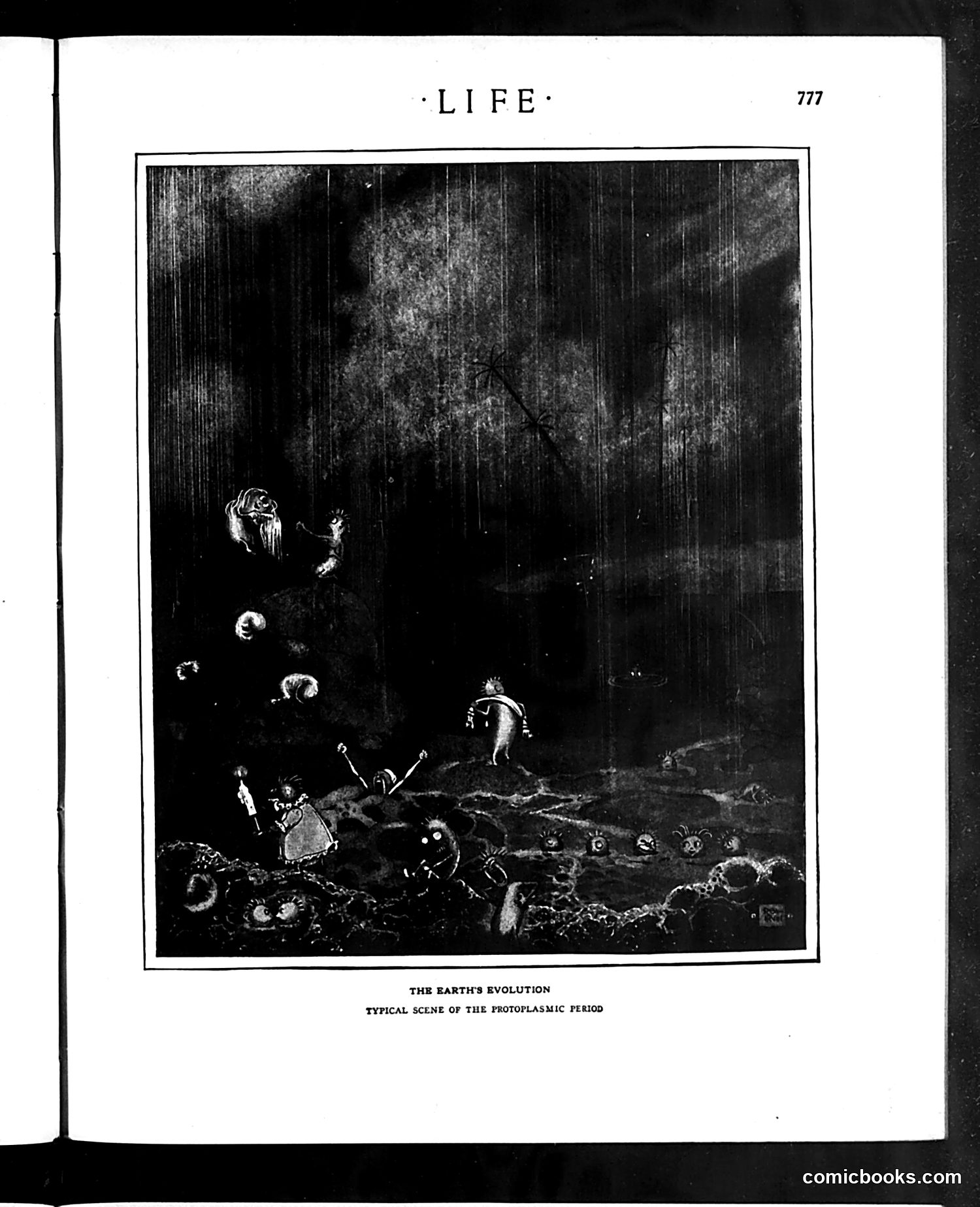
This illustration satirizes early evolutionary theory by depicting a whimsical, fantastical scene labeled "The Earth's Evolution" during the "Protoplasmic Period." The image shows primitive, blob-like creatures and humanoid figures in a dark, primordial landscape—apparently meant to represent life forms from Earth's earliest stages. The satire likely mocks both the scientific theories of evolution circulating in the late 19th/early 20th century and public fascination with prehistoric life. By rendering the "protoplasmic period" as an absurdist scene with oddly-shaped creatures, the cartoonist creates humor from the gap between scientific speculation about life's origins and public understanding—or the inherent strangeness of imagining such ancient, unknowable conditions. The exaggerated, grotesque forms emphasize how speculative and alien such reconstructions seemed to contemporary audiences.
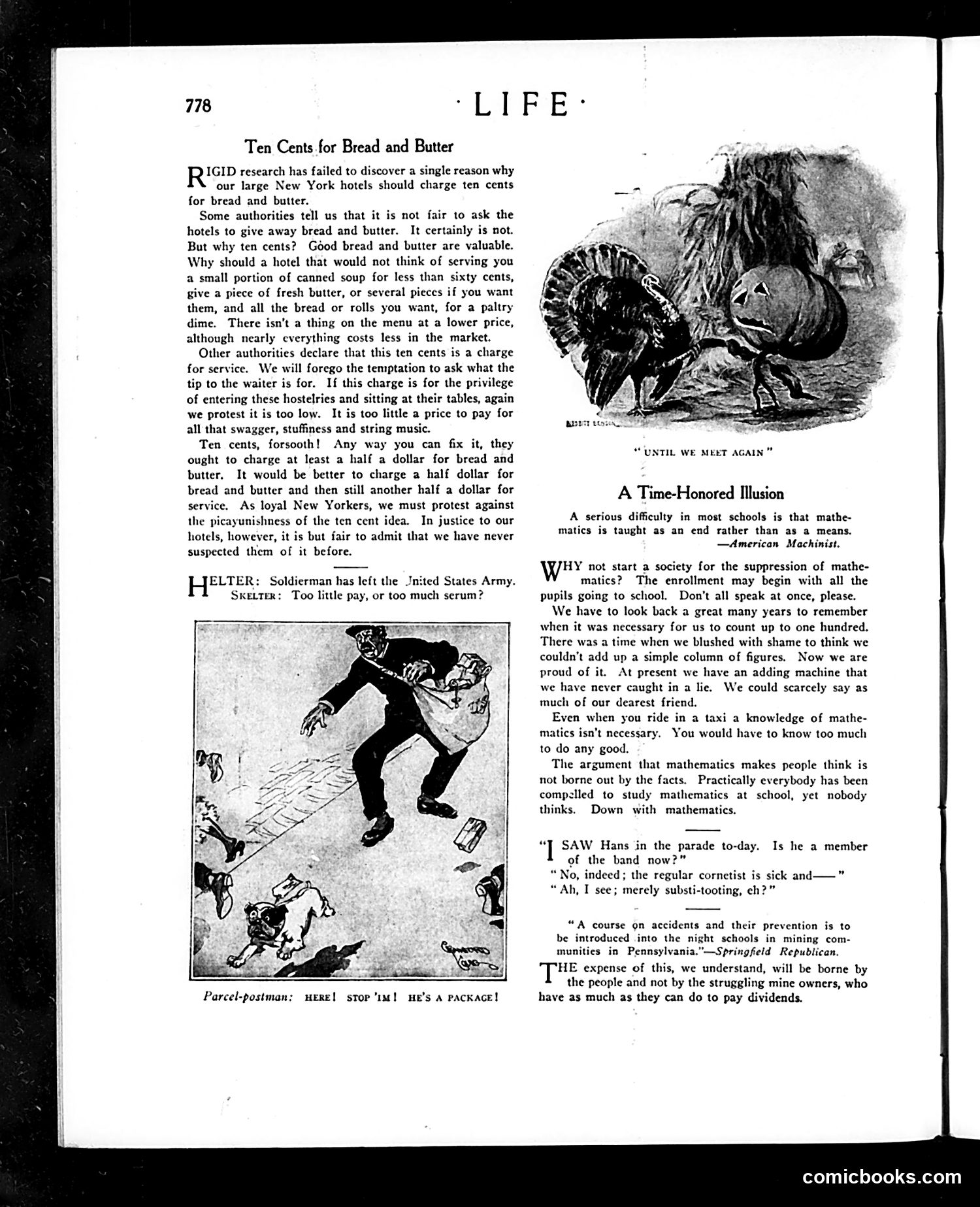
This page satirizes New York hotel pricing practices, specifically the seemingly arbitrary ten-cent charge for bread and butter—remarkably cheap compared to other menu items. Life's editors mock the hotels' logic: if bread and butter merit a charge, ten cents seems absurdly low given that soup costs sixty cents. The satire suggests hotels either should stop charging (admitting they give away provisions) or charge substantially more—perhaps fifty cents each for bread, butter, *and* service—to justify the "swagger, stiffness and string music" of dining in such establishments. The accompanying cartoons address unrelated topics: school mathematics education (mocking its impracticality in modern life) and military pay grievances. A parcel-post cartoon depicts a mail carrier struggling with an oversized package. The humor relies on early-20th-century reader familiarity with hotel dining customs and military service complaints.
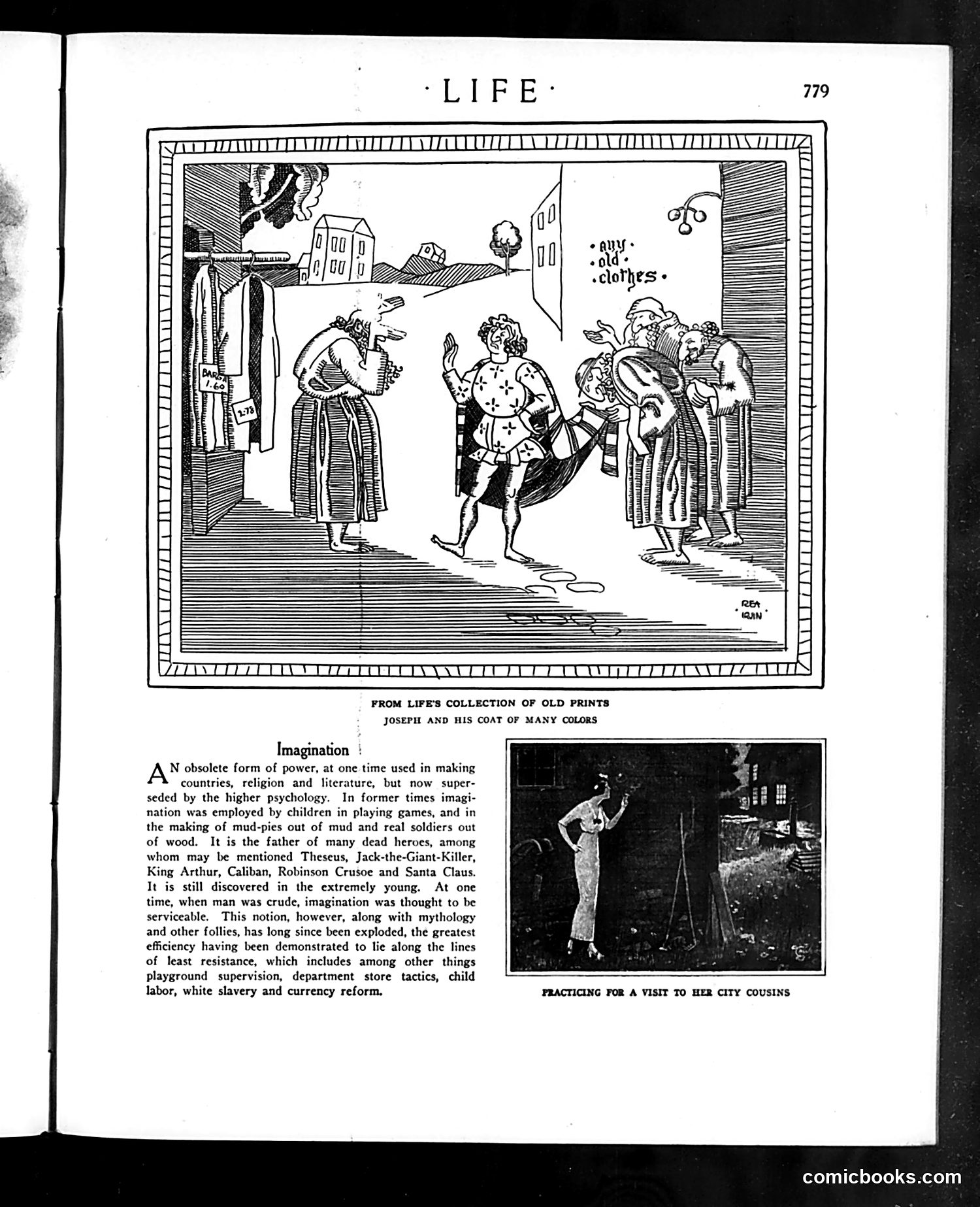
The page presents two distinct pieces: **Top Image**: A classical engraving titled "Joseph and His Coat of Many Colors," depicting the Biblical story of Joseph being sold into slavery by his brothers. This appears to be from Life's historical print collection. **Lower Text & Photo**: A satirical essay on "Imagination" that dismisses it as an "obsolete form of power" now replaced by modern "higher psychology." The piece argues that imagination—once essential for creating myths, heroes, and culture—has been superseded by practical efficiency and modern management tactics (playground supervision, department store methods, child labor regulations, etc.). The accompanying photograph shows a girl "practicing for a visit to her city cousins," likely illustrating how modern children lack imaginative play compared to previous generations. **The Satire's Point**: Life mocks contemporary society's rejection of imagination and creativity in favor of bureaucratic efficiency and utilitarian control—suggesting this represents cultural decline rather than progress.
This story satirizes utopian social reform movements popular in early 20th-century America. The unnamed female character represents an idealistic reformer who has adopted an elaborate system of social improvement "without going away from home." The satire targets several progressive conceits: she claims to study slums through reproduction rather than direct engagement; she learns about Europe through models and raised maps instead of travel; she practices "conservation of energy applied to knowledge." Most pointedly, the story mocks her circular logic about slums—she "uplifts" poor people out of poverty, then must constantly *replace* them with new poor to study, defeating the purpose of actual reform. The joke deepens with her rejection of traditional marriage for "partnership" and her casual surrender of her own child to communal care. The final reference to a "Messiah" suggests quasi-religious fervor underlying her scientific rhetoric. The story critiques reformers who substitute theory, models, and efficiency schemes for genuine human engagement and measurable social progress.
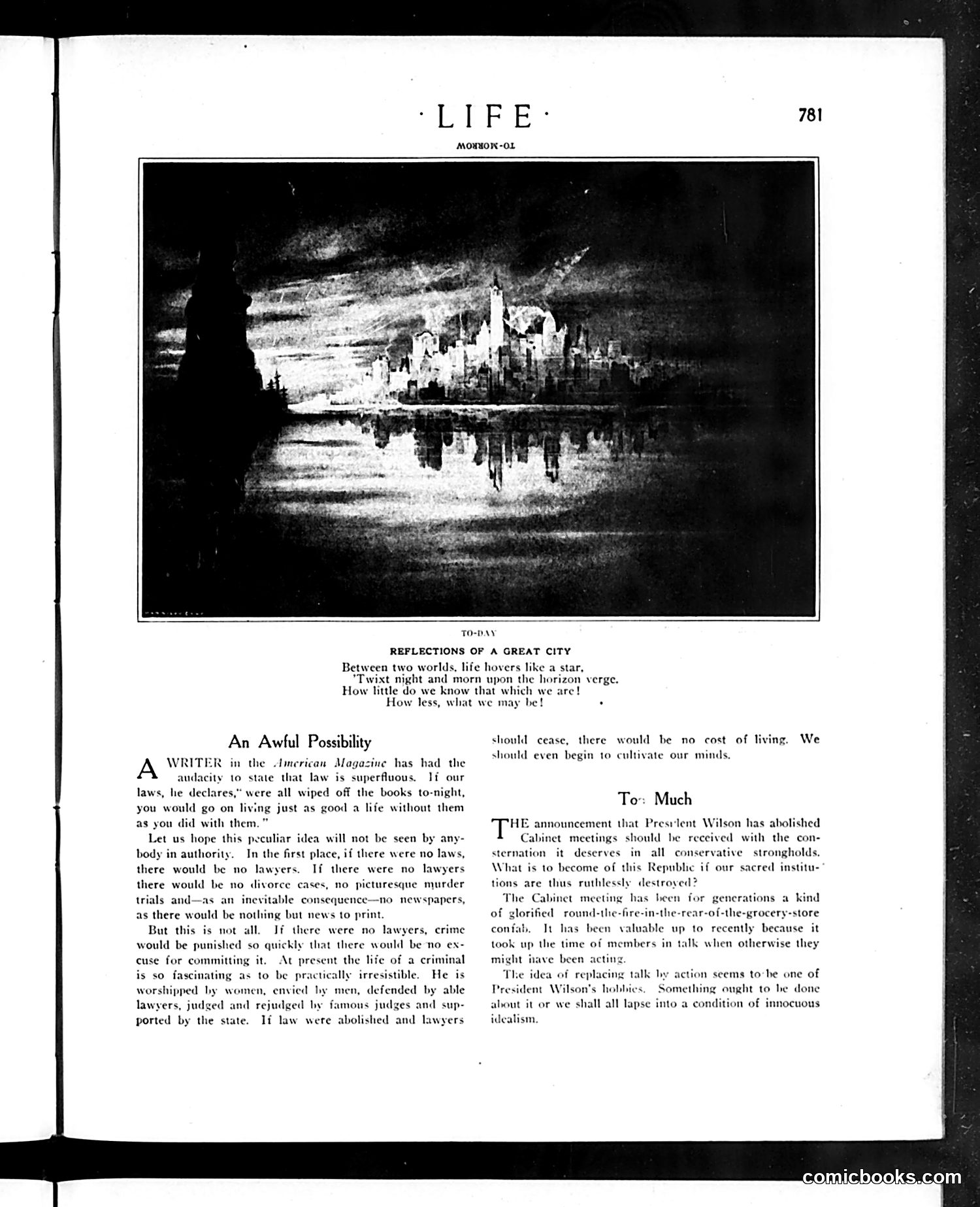
This page contains two satirical opinion pieces rather than traditional cartoons. **"An Awful Possibility"** mocks a writer from *American Magazine* who argued laws are unnecessary. Life's satirical response warns that abolishing laws would eliminate lawyers, divorce cases, and sensational murder trials—thus depriving newspapers of content. The piece darkly jokes that criminals currently enjoy celebrity status through legal proceedings; without lawyers, crime would be punished too quickly to be "fascinating." It concludes absurdly that without legal costs, people might actually cultivate their minds. **"Too Much"** criticizes President Wilson's decision to abolish Cabinet meetings. Life sarcastically laments this threatens the Republic, since Cabinet meetings historically served merely to keep officials talking rather than actually governing. The piece mocks Wilson's apparent preference for action over endless discussion as dangerous "innocuous idealism." Both pieces exemplify Life's irreverent style: using exaggeration and paradox to critique American institutions, legal systems, and political leadership through humor rather than direct argument.
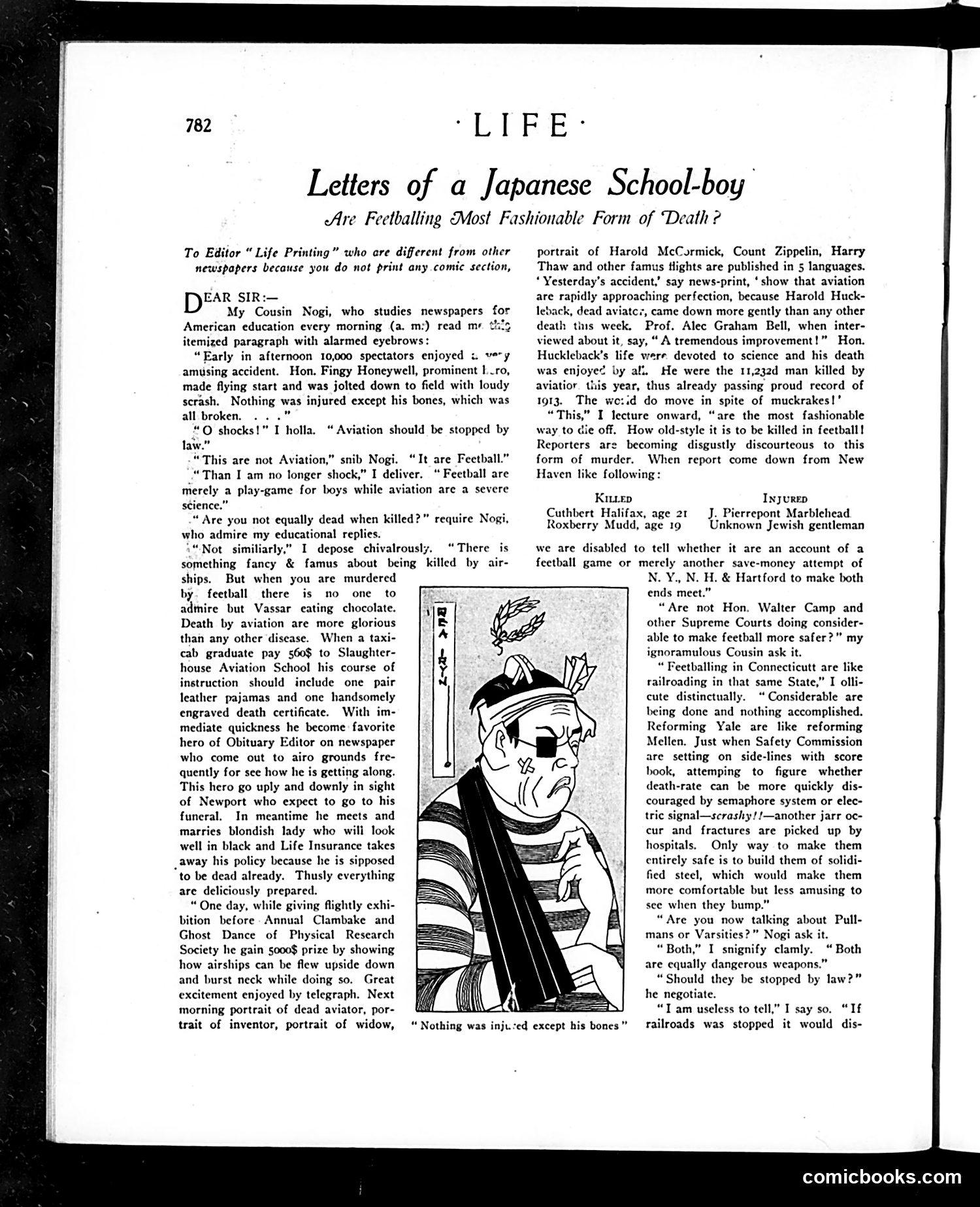
This satirical letter uses a Japanese school-boy correspondent's broken English to critique American football's danger. The piece compares deaths from football to aviation fatalities, arguing that aviation deaths receive glamorous newspaper coverage and make heroes of the deceased, while football deaths go unnoticed and unmourned. The humor works through absurdist exaggeration: the writer suggests aviators should receive "leather pajamas and handsomely engraved death certificates," and that newspapers eagerly cover aviation accidents while treating football injuries as mere statistics. The referenced figures—Harold McCormick, Count Zeppelin, Harry Thaw—were contemporary celebrities. The satire targets both American newspapers' sensationalism and college football's lax safety standards (Walter Camp was famous for football reform efforts). By adopting a foreigner's perspective, the author highlights what Americans had normalized: that football deaths were so routine they barely merited journalistic attention, let alone moral outrage.
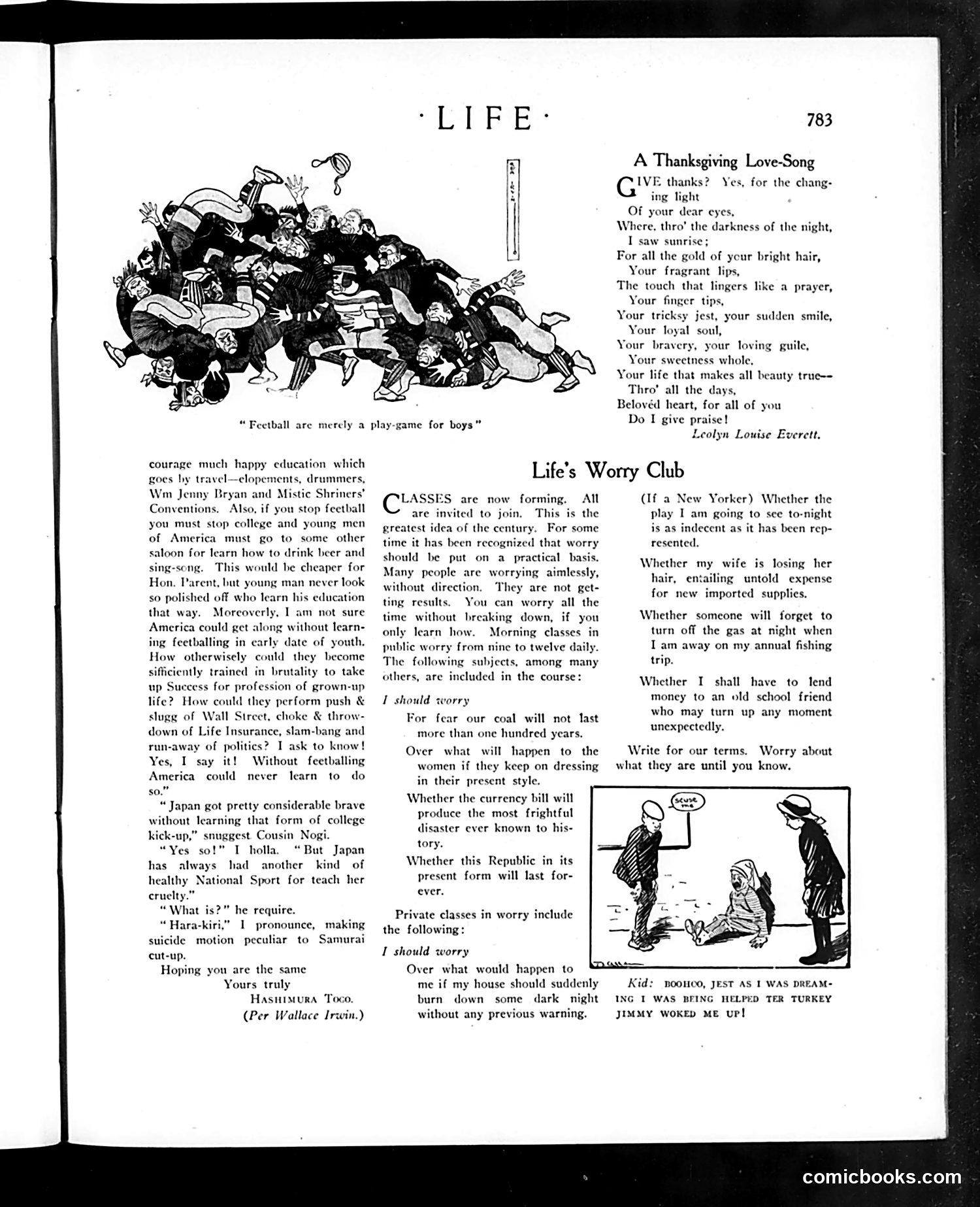
This page contains satirical pieces mocking early 1900s American anxieties and social practices. **"Feetball" Letter** (left column): A humorous complaint, likely written in a faux-immigrant dialect, defends American football as essential education. The writer argues football teaches brutality necessary for success in business ("Wall Street," "Life Insurance"). When a cousin suggests Japan succeeded without football, the writer counters that Japan had "hara-kiri" (ritual suicide) to instill toughness—a dark joke equating brutal sports with martial discipline. **"Life's Worry Club"** (right): Satire on the era's anxiety epidemic. The club offers organized worry classes, treating neurotic concern as a skill to be systematized and improved. Listed worries range from trivial (wife's hair loss) to absurd (whether a play is indecent), mocking both middle-class neurosis and the era's moral panic about theater. **Small cartoon** (bottom right): A child's innocent misunderstanding—mistaking being "helped to turkey" (served food) for literal physical assistance, interrupting his dream. The page satirizes American attitudes toward education, masculinity, and urban anxiety.
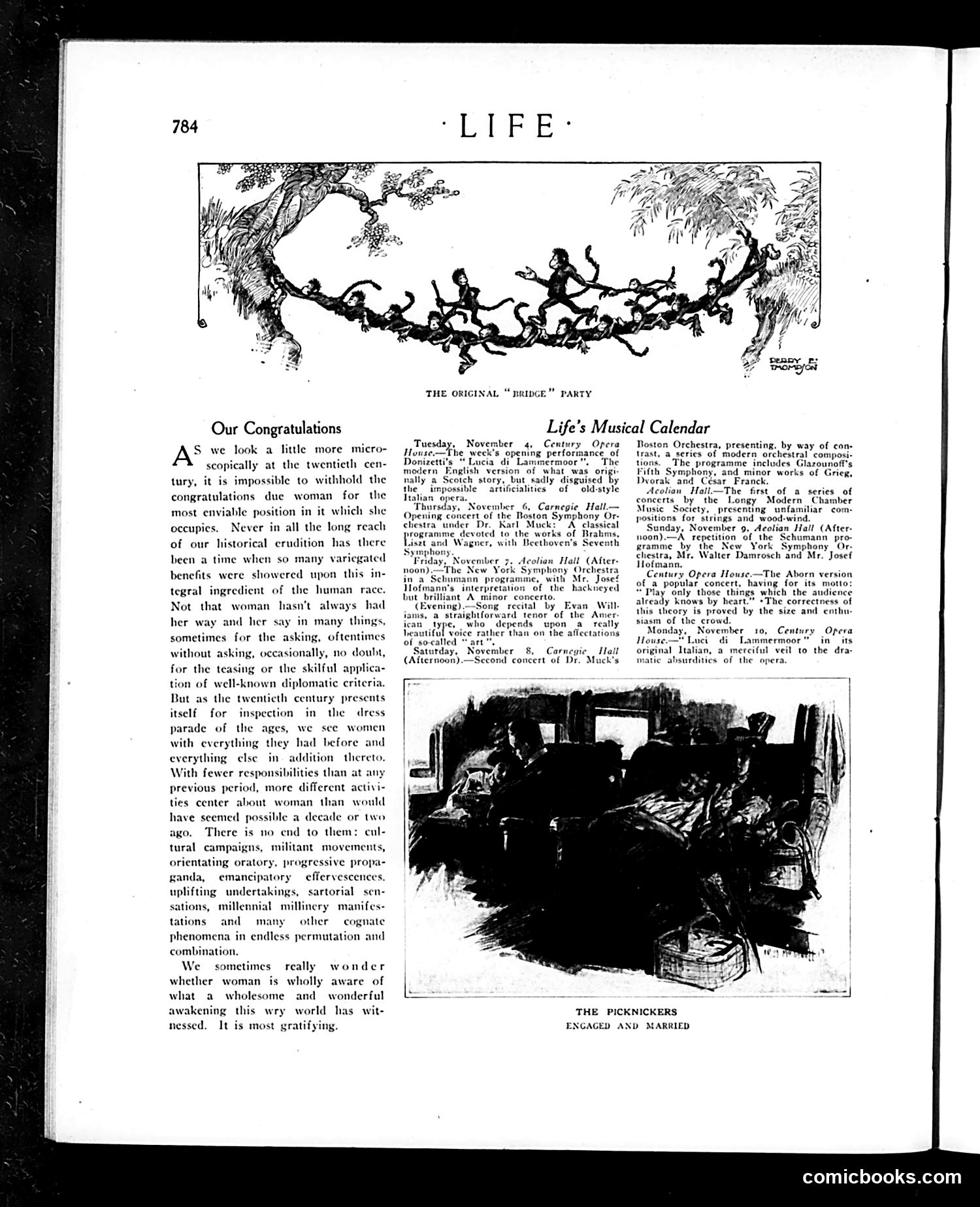
This page contains two distinct elements: **"Our Congratulations" Editorial**: A satirical essay congratulating women on their improved twentieth-century status. The author praises women's expanded opportunities—cultural campaigns, political movements, educational pursuits—while maintaining a patronizing tone. The satire lies in the backhanded nature of the compliment: women are praised for having "fewer responsibilities than at any previous period" while juggling more activities, suggesting they've gained busy-work rather than genuine power or equality. **Illustrations**: The top image shows monkeys swinging on a vine labeled "The Original 'Bridge' Party"—likely mocking the popular card game bridge as frivolous entertainment. The lower image, captioned "The Picknickers: Engaged and Married," appears to be a genre scene but its specific satirical point is unclear from the visible portion. **Musical Calendar**: Lists upcoming Boston concert performances for November, including opera and symphony offerings. The page reflects early-twentieth-century attitudes toward women's roles—ostensibly progressive while remaining fundamentally skeptical of female liberation.
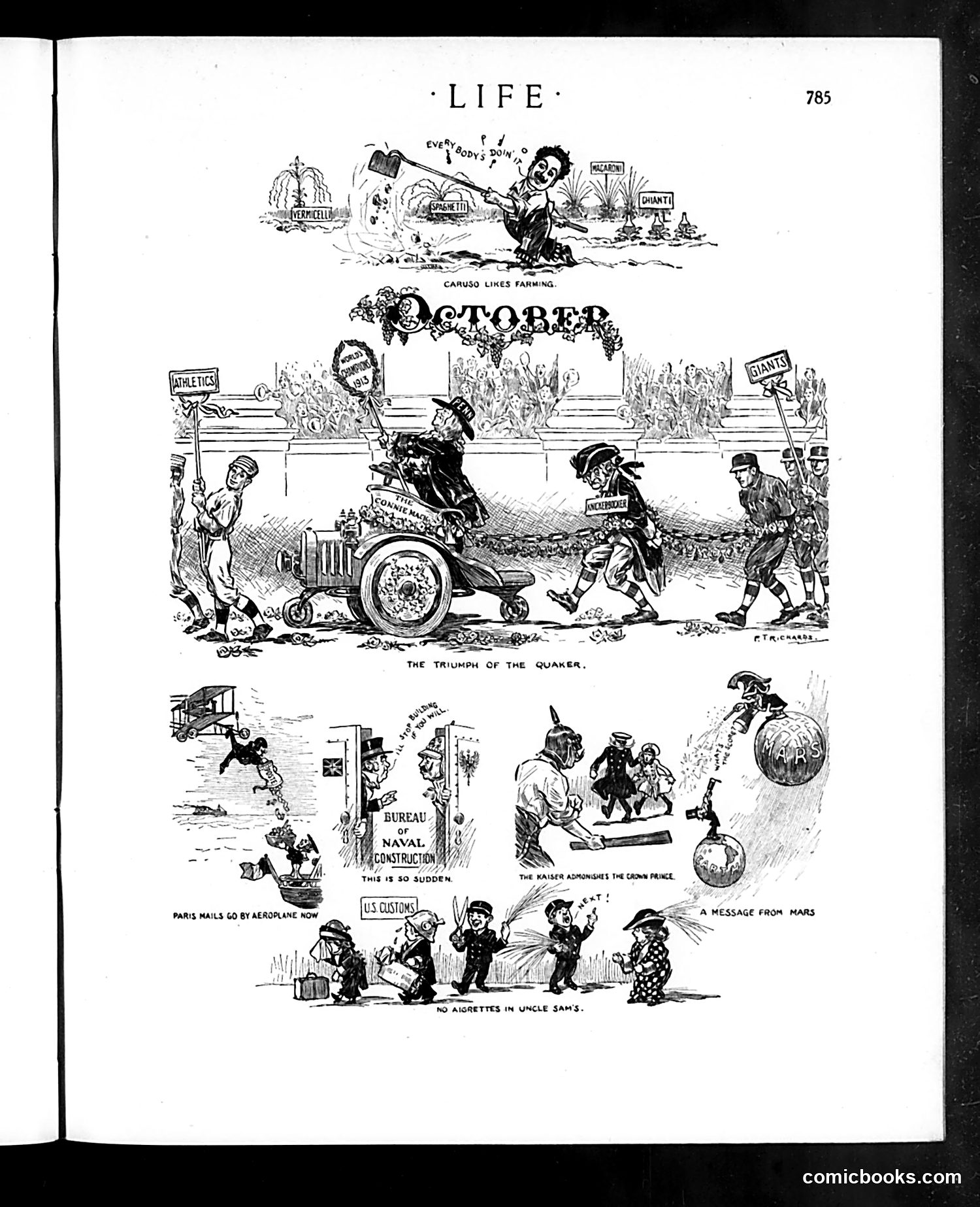
This page contains several satirical cartoons commenting on early 20th-century events: **"The Triumph of the Quaker"** depicts a vehicle labeled "Quaker" racing past "Athletics" and "Giants" signs, likely referencing the 1910 World Series. **"The Kaiser Admonishes the Crown Prince"** references German royalty, presumably commenting on Kaiser Wilhelm II's authority. **"Paris Mails Go by Aeroplane Now"** satirizes early aviation's impact on mail delivery. **"No Aigrettes in Uncle Sam's"** appears to mock regulations on feathered hat ornaments in America. The top cartoon references opera singer Enrico Caruso and farming. The cartoons employ anthropomorphic characters and exaggerated situations typical of Life's satirical style, blending contemporary technological advances with political commentary.
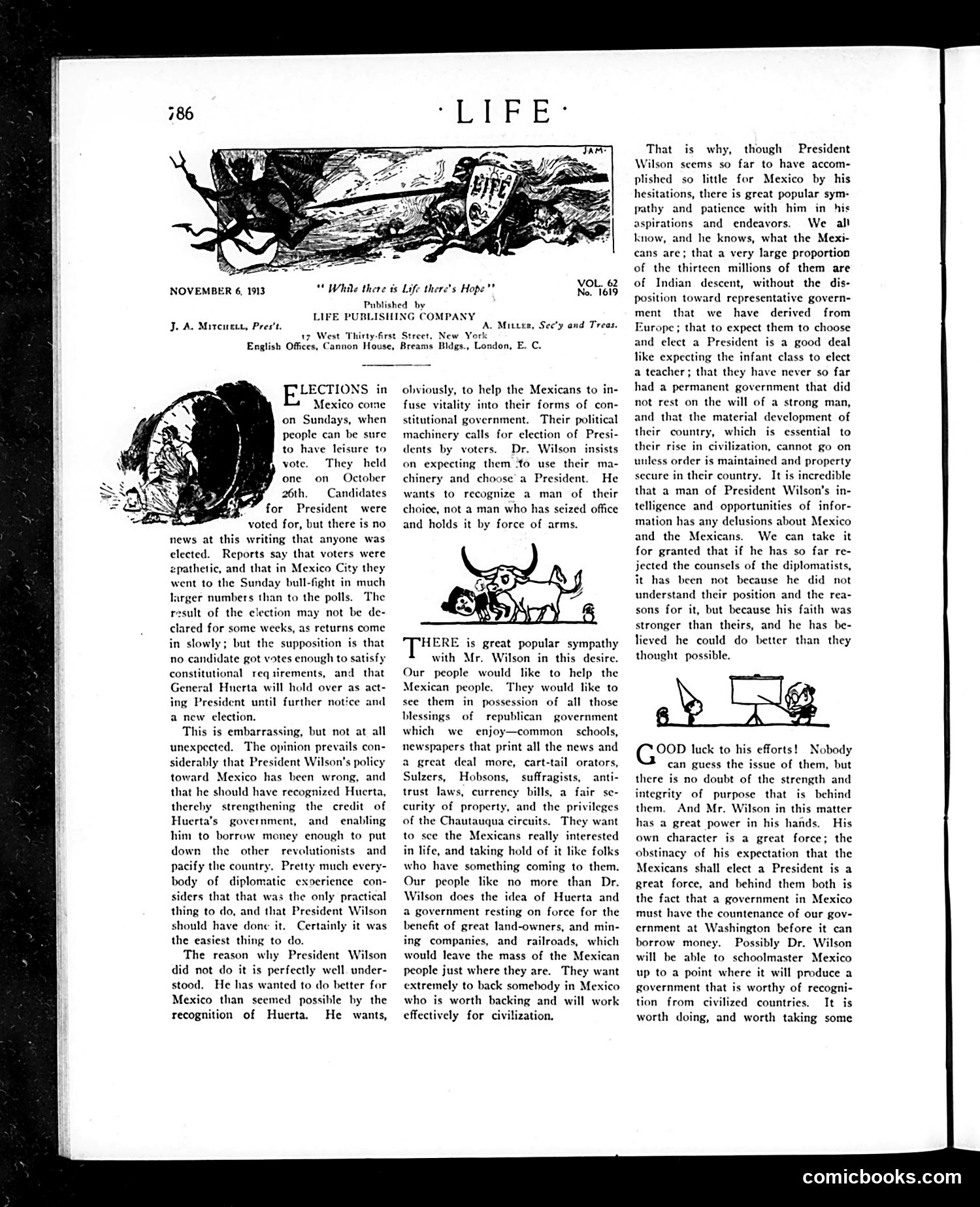
This editorial page discusses President Wilson's Mexico policy during the Mexican Revolution. The text explains Wilson's principled refusal to recognize General Huerta's military government, insisting instead that Mexico hold democratic elections. The cartoons illustrate the contradiction: the top image shows a dead or collapsed figure (likely representing Mexico or democratic hopes), while the lower cartoon depicts a bull—referencing Mexico's Sunday bullfights, which the text notes attracted more voters than the October 26th presidential election. The satire cuts both ways: the author sympathizes with Wilson's idealistic goals (supporting constitutional government over military strongmen) while gently mocking the naiveté of expecting Mexican citizens—described as largely of "Indian descent" without European democratic traditions—to function like American voters. The bullfight cartoon sardonically suggests Mexicans preferred entertainment to voting. The piece reflects Progressive Era American paternalism: support for Wilson's anti-imperialism mixed with racist assumptions about Mexican capacity for self-governance.
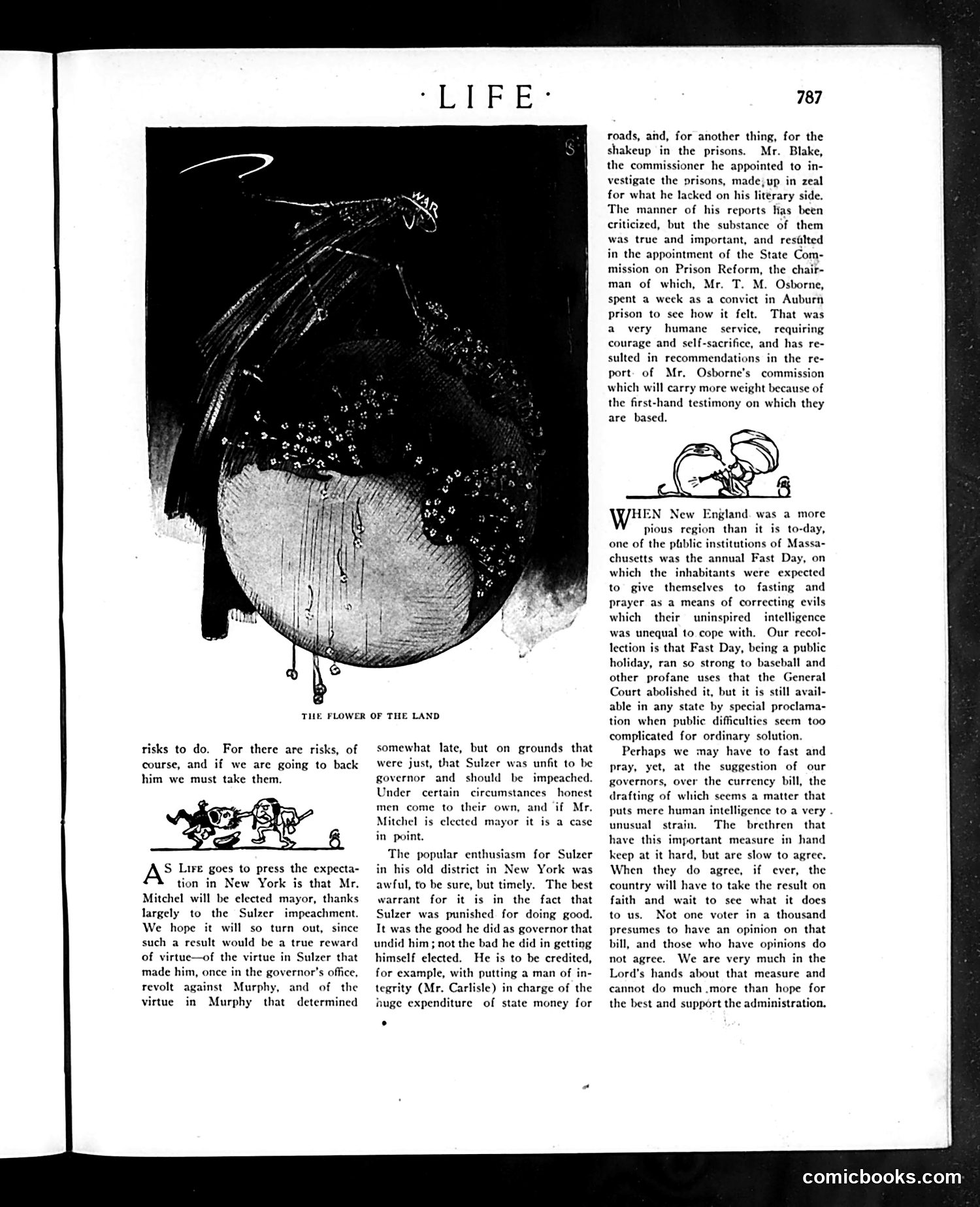
This page satirizes early 1910s New York politics. The text discusses Governor William Sulzer's impeachment and its effect on NYC mayoral candidate John Purroy Mitchel's election prospects. Life argues that Sulzer deserves credit for reform efforts—appointing honest officials to handle roads and prison oversight—despite his eventual downfall. The impeachment, the article suggests, ironically vindicated Sulzer by proving he was punished for *doing good*, not for corruption. The cartoon "The Flower of the Land" depicts a large spherical flower or head with a caricatured face, likely representing political leadership or the electorate itself—blooming despite flawed governance. The page concludes with ironic commentary comparing modern currency bill debates to obsolete Puritan "Fast Days," suggesting lawmakers are so confused they need prayer, not intelligence, to solve economic problems.
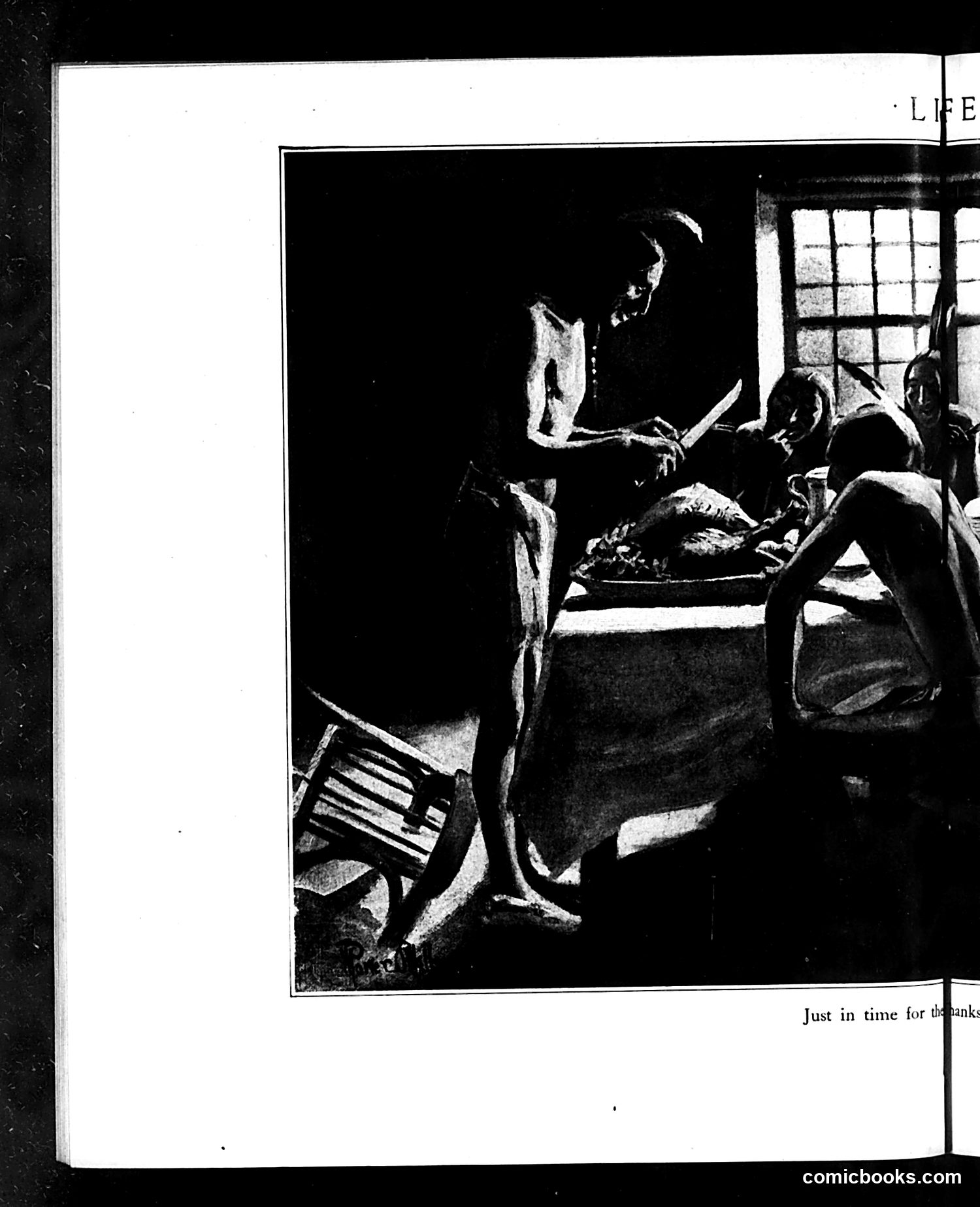
This appears to be a black and white illustration from *Life* magazine showing what looks like a domestic or institutional scene. The image depicts several figures gathered around a table near a window, with dramatic lighting characteristic of early-to-mid 20th century publication illustration. The partial caption reads "Just in time for th[e]anks[giving]," suggesting a holiday or seasonal theme. However, I cannot confidently identify the specific figures, caricatures, or political/social references from the image alone. The illustration's style and the magazine's satirical nature suggest social commentary, but without clearer details or complete caption text, I cannot accurately explain what specific event, public figures, or social situation is being satirized. More context would be needed for a reliable interpretation.
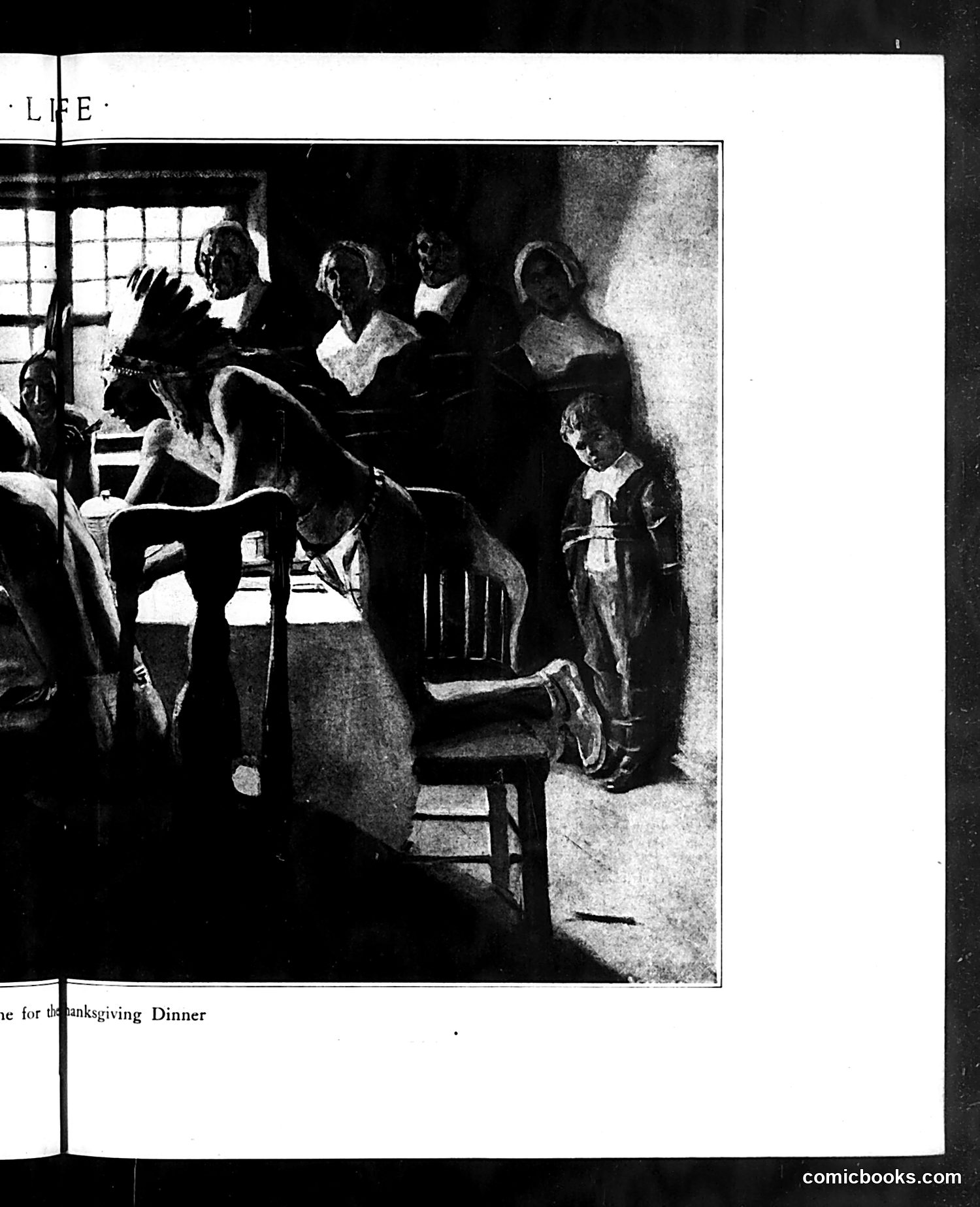
This page from *Life* magazine shows a black and white photograph depicting what appears to be a domestic scene with multiple figures gathered in a modest interior space. The caption reads "Preparing for the Thanksgiving Dinner." The image likely satirizes social conditions or class dynamics around holiday preparation, as was common in *Life*'s satirical commentary. However, the OCR text is too degraded to identify specific political figures or precise satirical targets. The composition suggests commentary on domestic labor or social hierarchy during holiday preparations, but without clearer text or additional context, the exact satirical point remains unclear. The photograph's style and composition suggest early-to-mid 20th century social commentary.
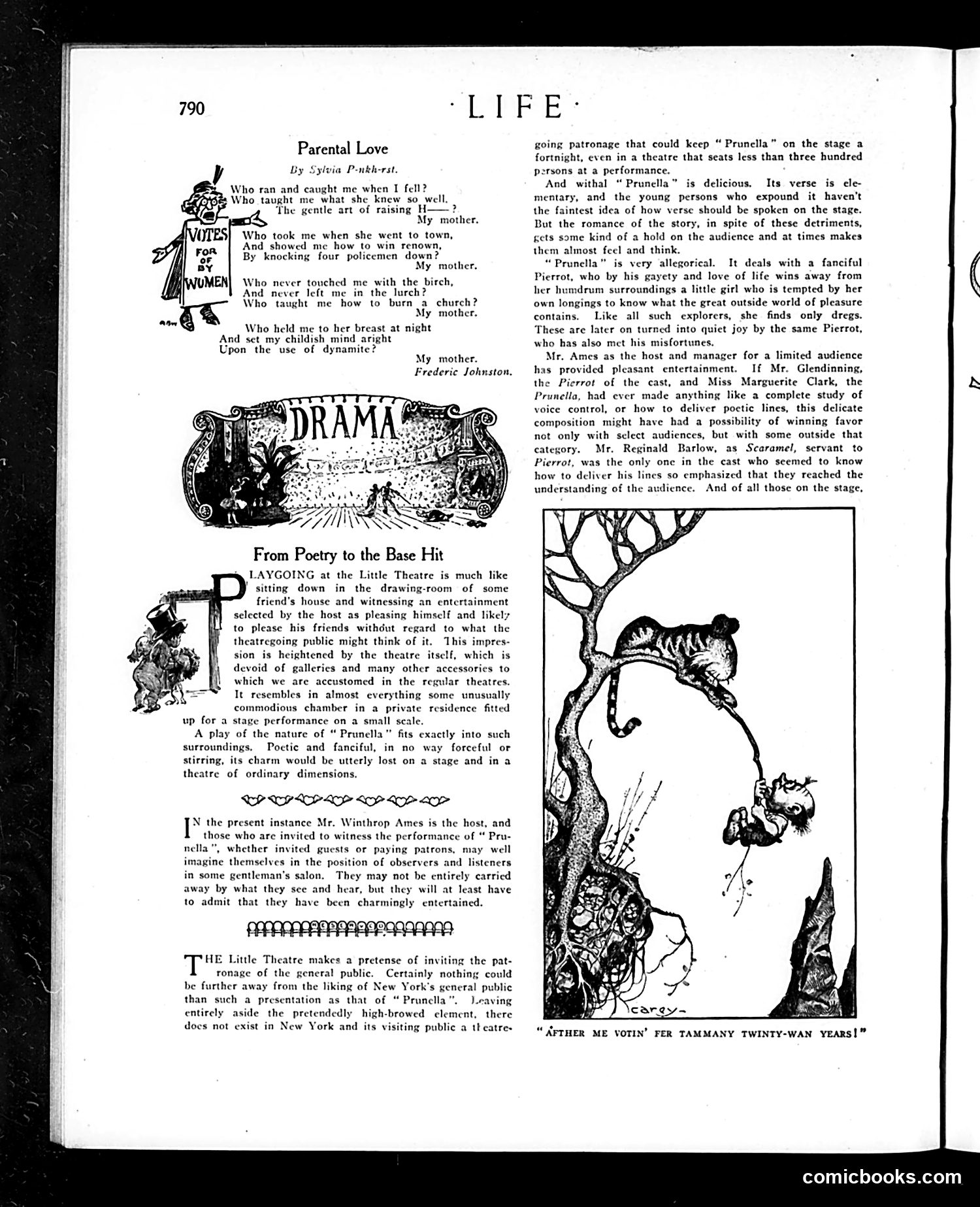
The poem "Parental Love" by Frederic Johnston is dark satire depicting a mother who teaches her child dangerous, illegal acts—knocking down policemen, burning churches, using dynamite. This appears to mock anarchist or radical ideology of the early 1900s, when such violence was a genuine social threat. The joke targets parents who indoctrinate children with extreme political views, presenting maternal affection twisted toward destructive ends. The accompanying theater review discusses a production of "Prunella" at the Little Theatre, critiquing its elite, exclusive appeal. The reviewer argues this poetic, allegorical play about a girl tempted by worldly pleasures—featuring actors with poor diction—cannot sustain public interest in New York. The satire suggests pretentious theater limited to small "gentleman's salon" audiences rather than accessible popular entertainment.
This *Life* magazine page (791) contains theatrical reviews rather than political cartoons. The substantive content discusses several Broadway productions: **Main Reviews:** - *Caesar and Cleopatra* (Bernard Shaw): Forbes-Robertson and Gertrude Elliott star in this comedic deconstruction of classical history, treating famous figures with "irreverence" - *The Girl and the Pennant*: A baseball-themed play credited to pitcher Christy Mathewson and playwright Rida Johnson Young. The reviewer notes it's crude but appeals to baseball fans unfamiliar with theater, including an implausible scene of a female club owner hosting a "pink tea" for players **The Satire:** The humor lies in mocking how theater caters to specific audiences—treating baseball fans as unsophisticated theater-goers willing to accept theatrical absurdities for sports content, while praising Shaw's intellectual irreverence toward classical subjects. The decorative header "CONFIDENTIAL GUIDE" with cherubs is ornamental, framing the theatrical listings below rather than providing satirical commentary.
This is a book review section titled "The Latest Books" from *Life* magazine's "Confidential Book Guide." The page discusses Anatole France's novel *The Opinions of Jerome Coignard*, using quotations from the book to frame a contemporary social debate. The reviewer uses the fictional Abbé Coignard's philosophical musings about reason versus emotion and feeling to comment on a current cultural moment: society's fierce debate over whether frank discussion of sexuality and "sex interest" in literature represents moral progress or degeneracy. The Abbé's wisdom—that feelings matter more than logical argument—becomes the reviewer's point: this debate cannot be "settled by a 'Q.E.D.'" but depends on how people emotionally react to these cultural changes. The remainder lists new book releases with brief critical comments, covering history, fiction, and social commentary typical of the era.
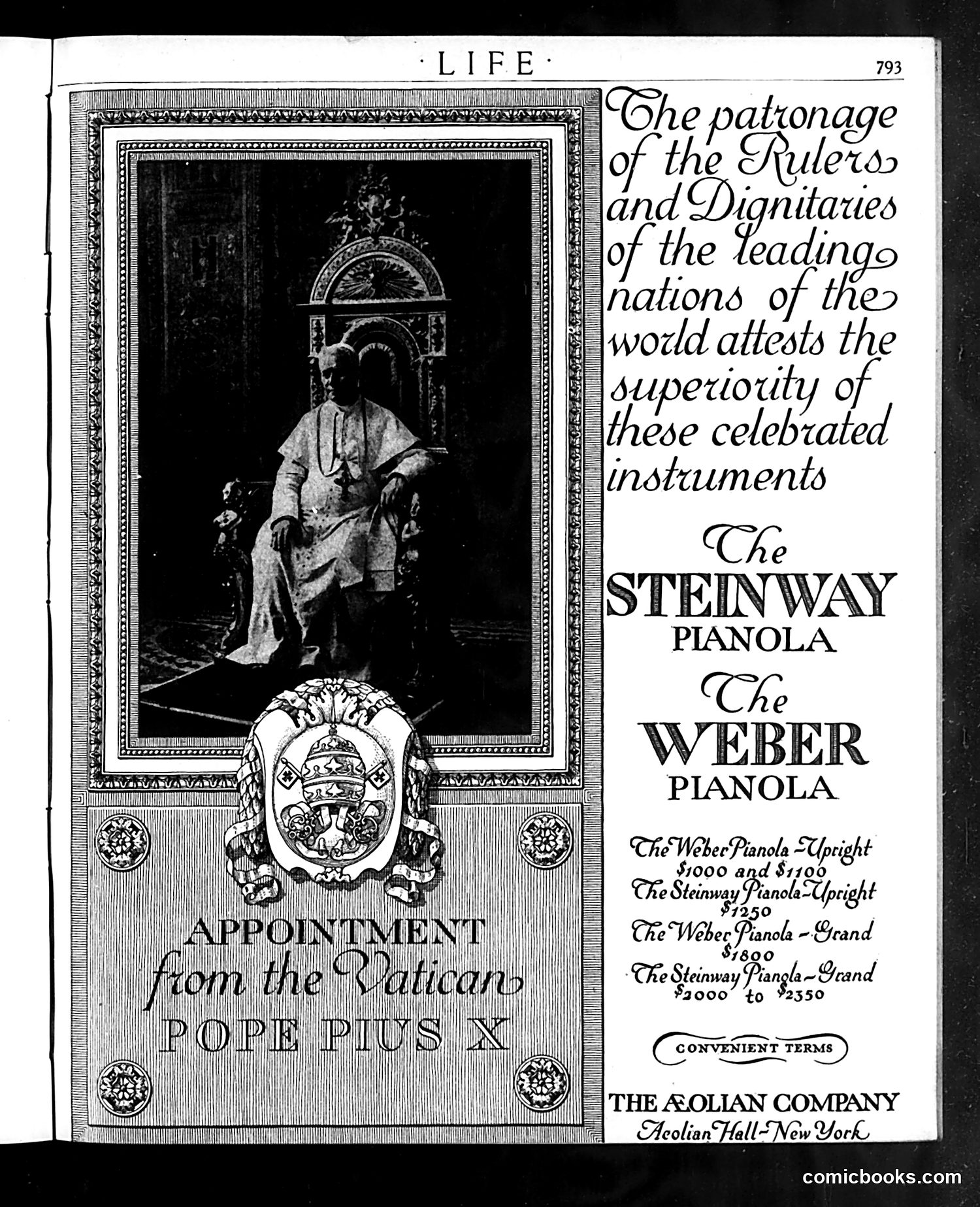
This is primarily a **piano advertisement**, not a political cartoon. The page features a formal portrait of a robed figure (likely a pope or high religious dignitary, given the ornate ecclesiastical architecture and "Appointment from the Vaticano / Pope Pius X" text) positioned above an elaborate coat of arms. The advertisement exploits this religious imagery to sell two piano brands—Steinway Pianola and Weber Pianola—by claiming that "the patronage of the Rulers and Dignitaries of the leading nations of the world attests the superiority of these celebrated instruments." The satire (if any) is gentle and implicit: the ad associates pianos with papal authority and world leadership, suggesting that owning one of these pianos signals refinement and elevated status. The copy uses the pope's endorsement as a selling tool, conflating spiritual authority with consumer goods—a common advertising strategy of the era that modern readers might find amusing in its earnest grandeur.
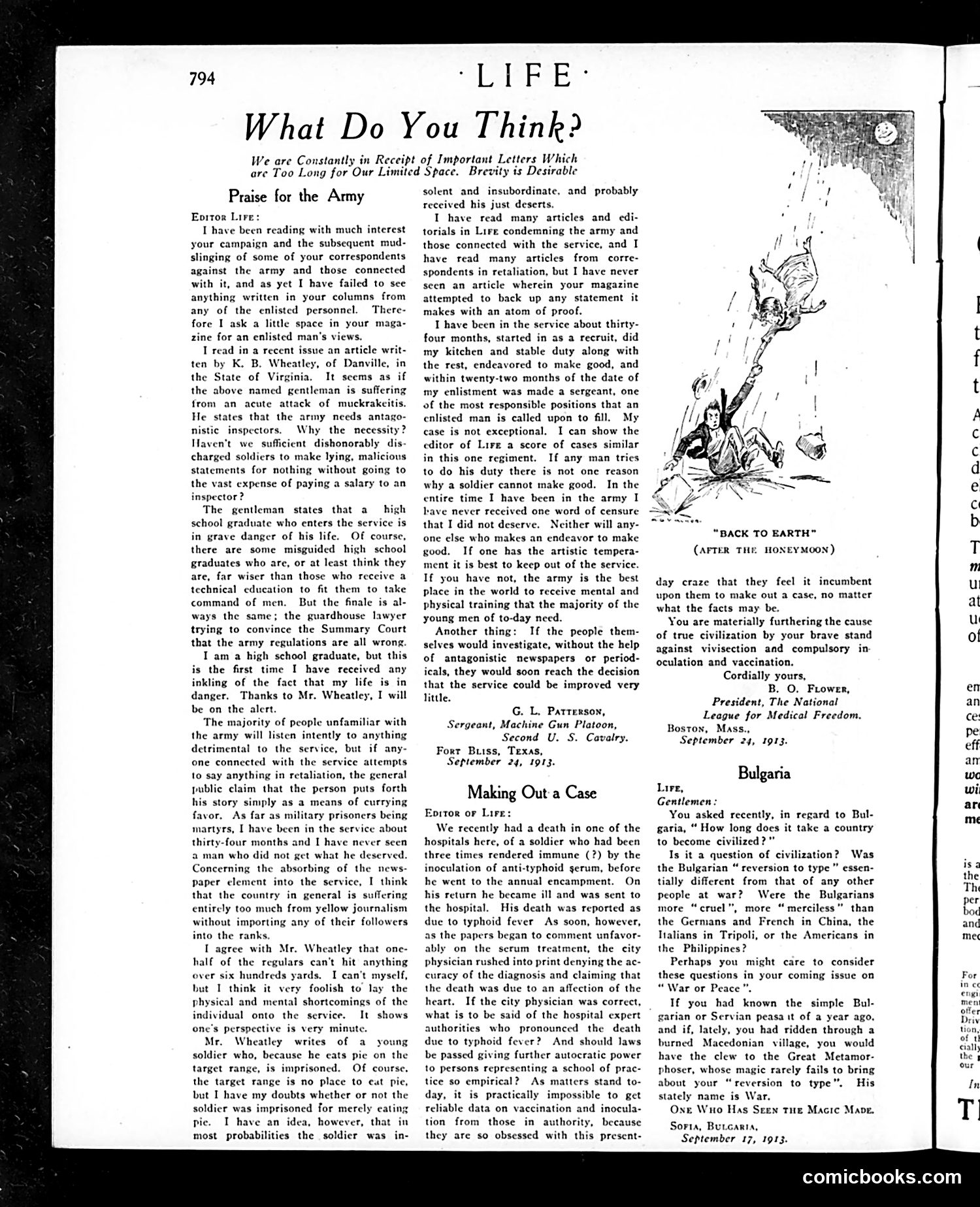
This page features readers' letters to *Life* magazine's "What Do You Think?" column, with a small cartoon titled "Back to Earth" showing a figure falling or tumbling. The dominant content is a spirited defense of the U.S. Army by an enlisted sergeant responding to prior published criticism. The writer, G. L. Patterson, challenges an earlier article by K. B. Wheatley condemning military conditions. Patterson argues that *Life* publishes anti-army critiques without evidence while dismissing pro-army responses as self-serving. He defends Army discipline, training, and merit-based advancement, citing his own rapid promotion as proof the system works. Below this is a separate letter about Bulgaria's civilization, referencing Balkan Wars violence. The page reflects early 20th-century debates over military reform and press responsibility—*Life's* satirical mission to expose institutional problems versus soldiers' claims that criticism was unfounded and demoralizing.
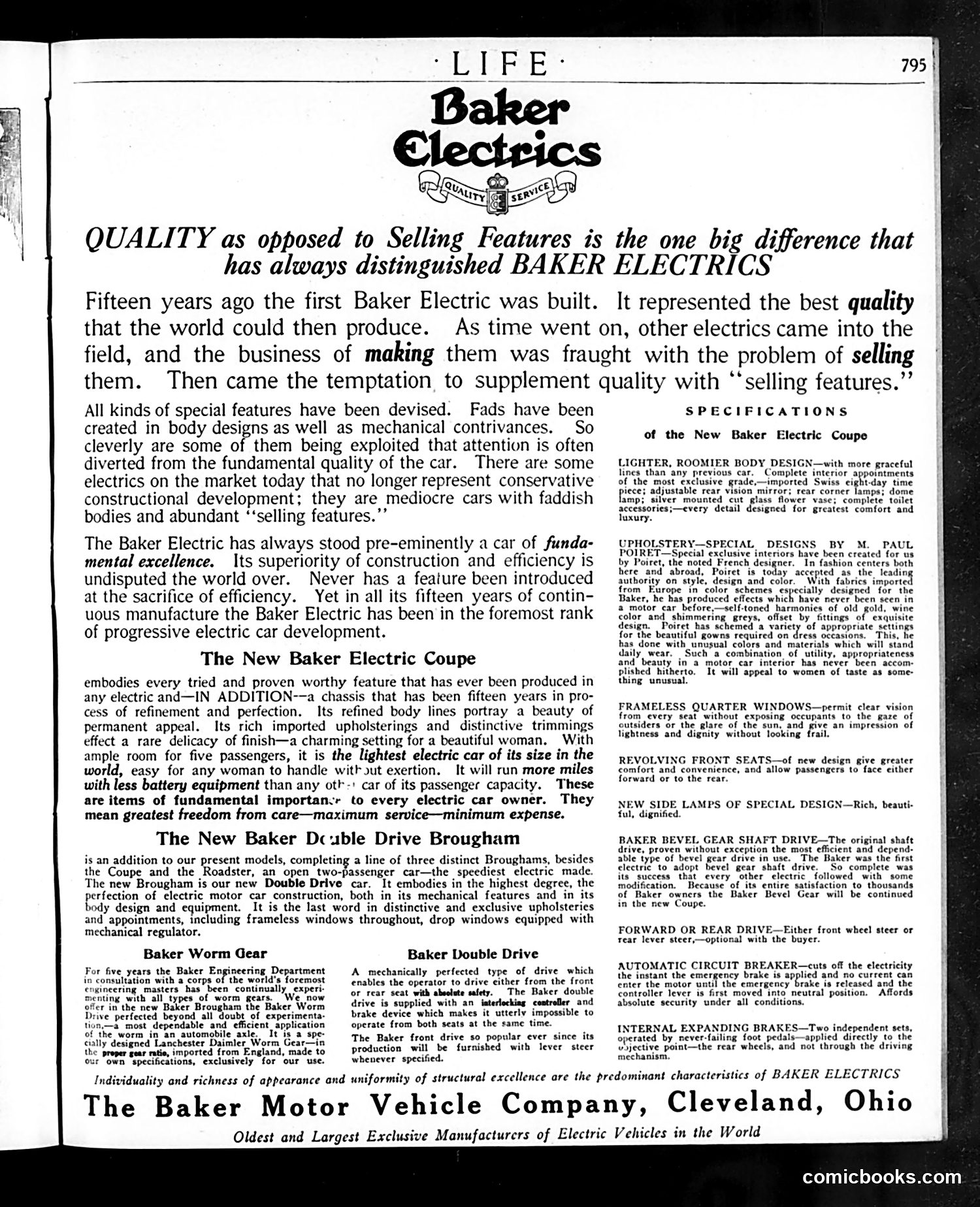
This is a **full-page advertisement**, not a cartoon or satirical piece. It promotes Baker Motor Vehicle Company's electric cars, headquartered in Cleveland, Ohio. The ad argues Baker's competitive advantage: emphasizing **quality and fundamental engineering excellence** over flashy "selling features" that competitors use. Baker claims that while rival electric car makers have added trendy body designs and mechanical gimmicks to boost sales, Baker has maintained conservative, efficient construction for fifteen years. The text criticizes competitors' "faddish bodies" and "selling features" that distract from actual quality—a subtle jab at rivals prioritizing marketing over substance. The ad describes three models (Coupe, Roadster, Double Drive Brougham) highlighting practical benefits: lighter weight, longer range, ease of handling for women drivers, and advanced features like the "Baker Worm Gear" and "Double Drive" system. This reflects early 1900s electric vehicle competition, when electric cars were viable alternatives to gasoline engines, particularly marketed toward affluent female drivers.
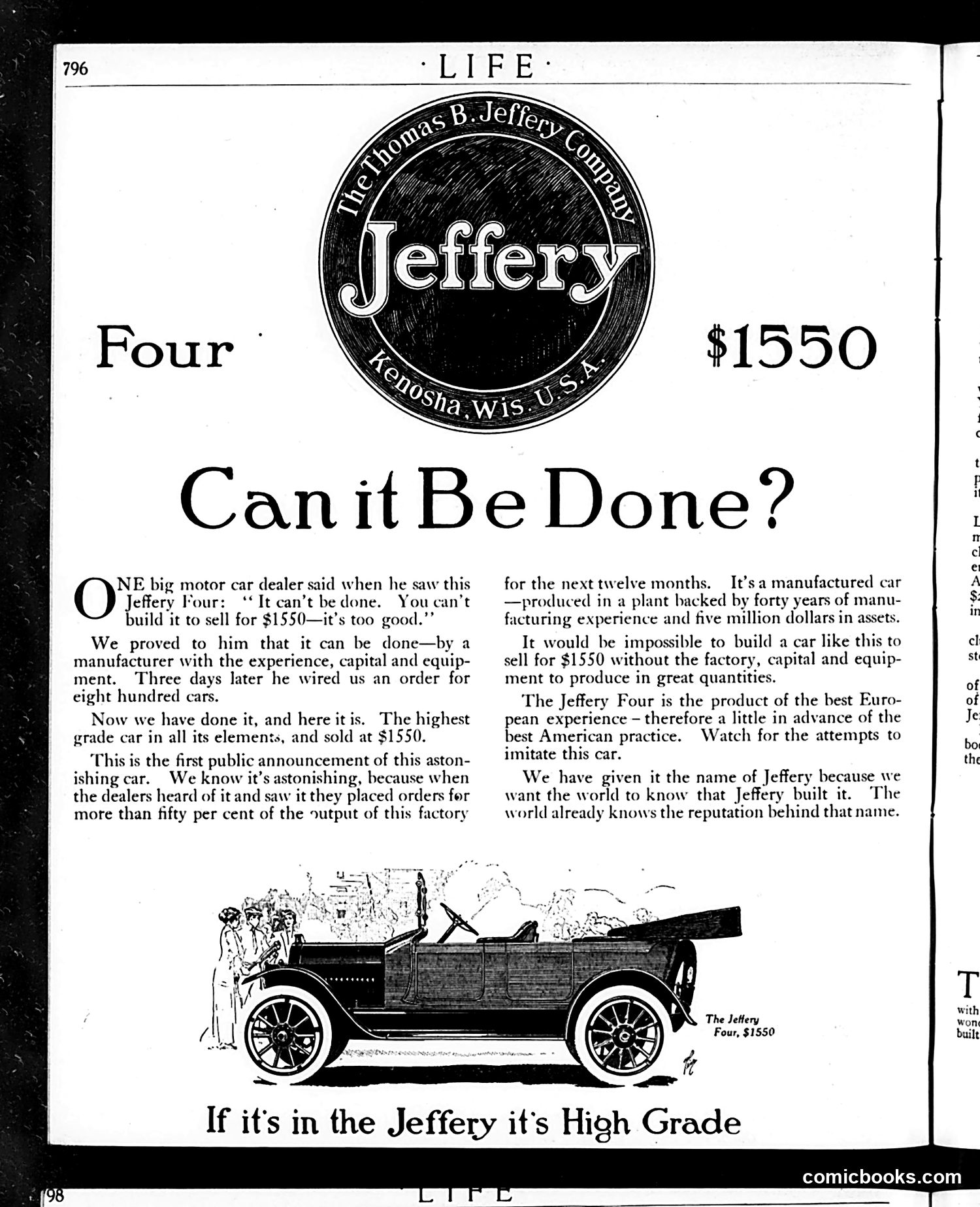
This is a **product advertisement**, not satire or political commentary. It promotes the Jeffery Four automobile manufactured by The Thomas B. Jeffery Company in Kenosha, Wisconsin. The ad addresses a specific market skepticism: a dealer claimed you couldn't build a quality car selling for $1,550. Jeffery responds by claiming they've done exactly that—proving it by reporting that dealers ordered over fifty percent of the factory's output within days of announcement. The pitch emphasizes: forty years of manufacturing experience, five million dollars in assets, European engineering combined with American practice, and quality components throughout. The illustration shows an open-air touring car with two elegantly-dressed occupants. This represents early automotive marketing (page 796 suggests early 20th century), when automobiles were still luxury goods and manufacturability at affordable prices was genuinely remarkable and competitive.
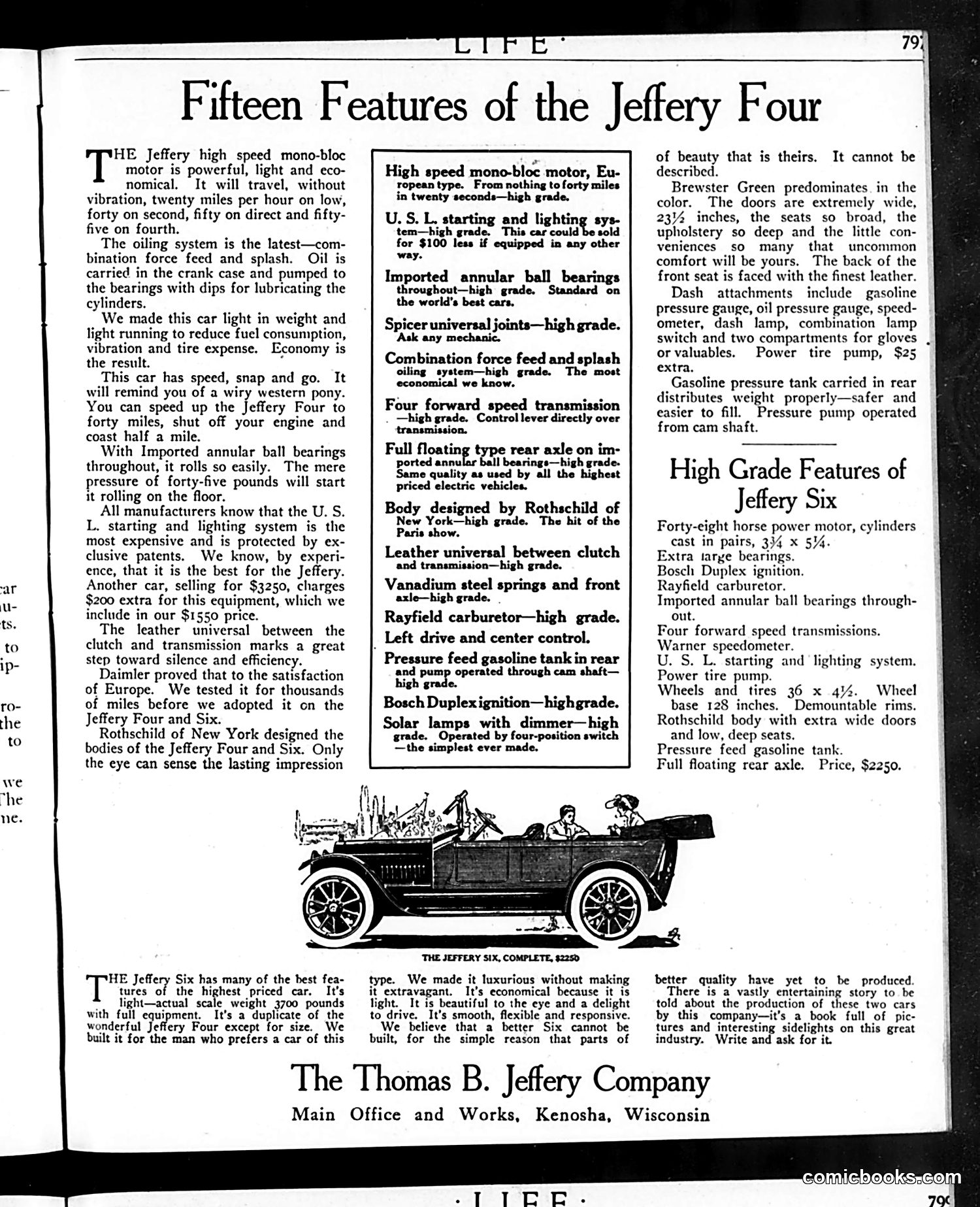
This is an automobile advertisement, not political satire. It appears from *Life* magazine (likely early 1900s) promoting the Jeffery Four and Six automobiles, manufactured by the Thomas B. Jeffery Company in Kenosha, Wisconsin. The ad emphasizes luxury features and technical specifications to appeal to affluent buyers—highlighting European-designed bodies, Brewster Green color, wide doors, and deep leather seats. The repeated phrase "high grade" signals exclusivity and quality. Notably, the ad boasts that the Jeffery includes a U.S. L. starting and lighting system for $1,550, while competitors charged an extra $200 for identical equipment—a value proposition for wealthy car buyers. The comparison to a "wiry western pony" evokes speed and reliability. There is no political cartoon or satire on this page—it's straightforward automotive marketing targeting the early automobile market's elite consumers.
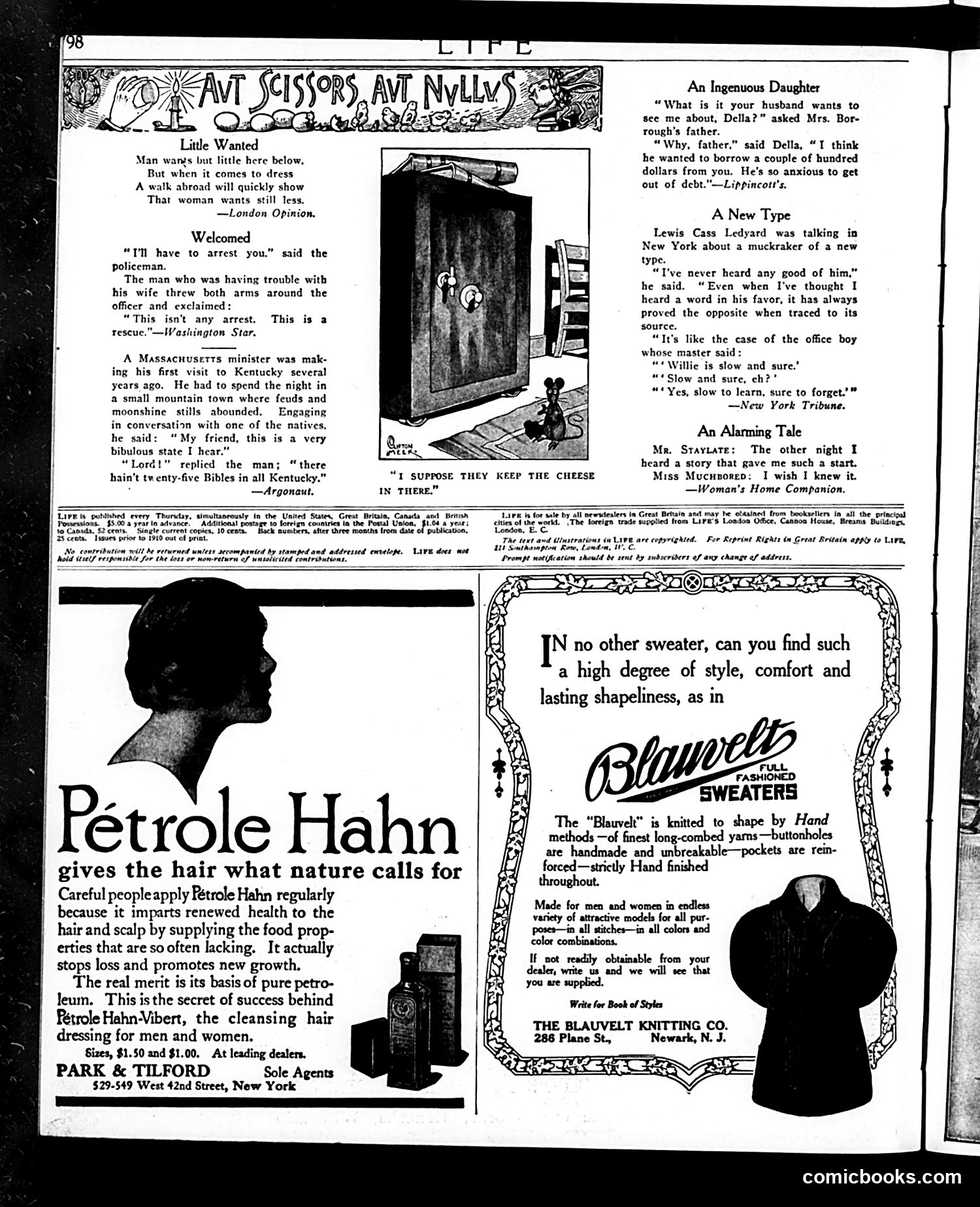
This page from *Life* magazine contains several brief humorous anecdotes typical of early 20th-century American satire, plus period advertisements. The jokes target familiar domestic and social situations: men's fashion choices, marital discord (a husband viewing arrest as "rescue" from his wife), regional stereotypes (a Massachusetts minister shocked by Kentucky's perceived lack of education—the native's misunderstanding of "bibulous" as relating to Bibles rather than drinking), and husband-borrowing money under false pretenses. The cartoon illustration (top center) shows a large safe or vault with a mouse, captioned "I SUPPOSE THEY KEEP THE CHEESE IN THERE"—a simple visual gag about a mouse's assumed priorities. The advertisements promote period grooming products (*Pétrole Hahn* hair dressing) and *Blauvel* hand-finished sweaters, emphasizing quality craftsmanship and respectability—typical appeals for that era's consumers. The page represents *Life*'s formula: light, safely conventional humor aimed at middle-class readers, interspersed with advertising.
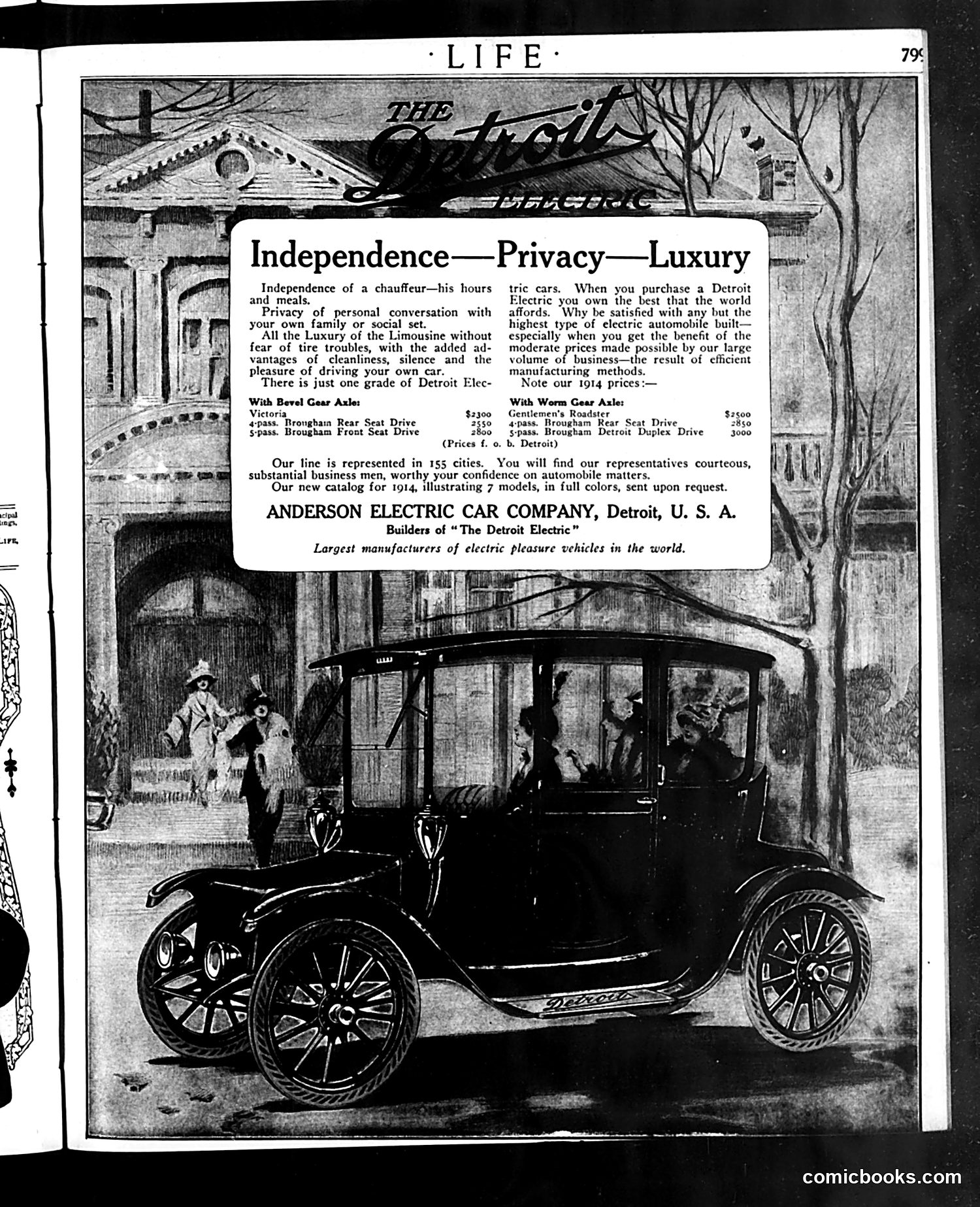
This is a **straight advertisement**, not satire or political cartoon. It promotes the Detroit Electric car for 1914, marketed to affluent buyers. The ad emphasizes three selling points—Independence, Privacy, and Luxury—appealing to wealthy consumers who could afford chauffeurs or limousines. The vehicle offers the comfort of a limousine without employing a driver, personal privacy for family conversations, and silent, clean electric operation (avoiding tire troubles and engine noise associated with gasoline cars). The illustration shows a well-dressed couple in an enclosed electric brougham outside an elegant neoclassical building, establishing the target demographic: upper-class Americans seeking personal transportation without servants. The pricing ($2,500-$3,000 in 1914 dollars) confirms this was luxury goods for the wealthy. The Anderson Electric Car Company was indeed a major manufacturer of electric vehicles before the gasoline engine became dominant post-1920s.
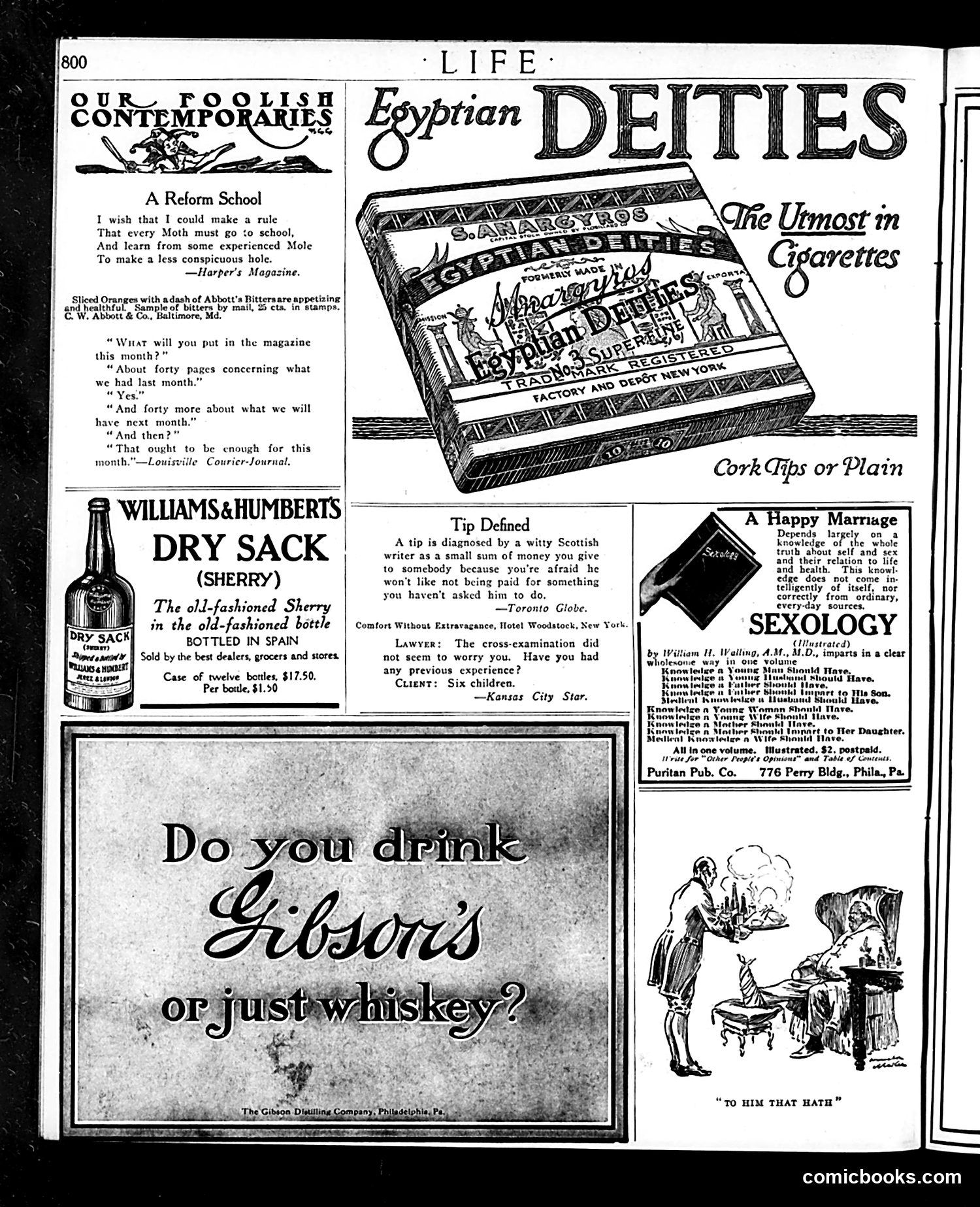
This page is primarily **advertising mixed with light satirical commentary**, typical of Life's format. The main satirical pieces are brief, witty one-liners: 1. **"A Reform School"** (Harper's Magazine quote): Mocks moths for making conspicuous holes—likely satirizing ineffectual reform efforts or absurd regulatory proposals. 2. **Magazine Content Joke** (Louisville Courier-Journal): Ridicules magazines for recycling content—saying they publish "forty pages" about last month, then forty more about next month. This critiques editorial laziness and repetitive publishing. 3. **"Tip Defined"** (Toronto Globe): Sardonically defines tipping as payment given out of social obligation/fear rather than actual service rendered—commentary on the emerging tipping culture's absurdity. 4. **Lawyer/Client Exchange**: A joke about a client with six children being unfazed by cross-examination—implying parental experience with interrogation makes courtroom questioning trivial. The page otherwise consists of **advertisements** for Egyptian Deities cigarettes, sherry, whiskey, and a sexual education book—reflecting early 20th-century consumer culture.
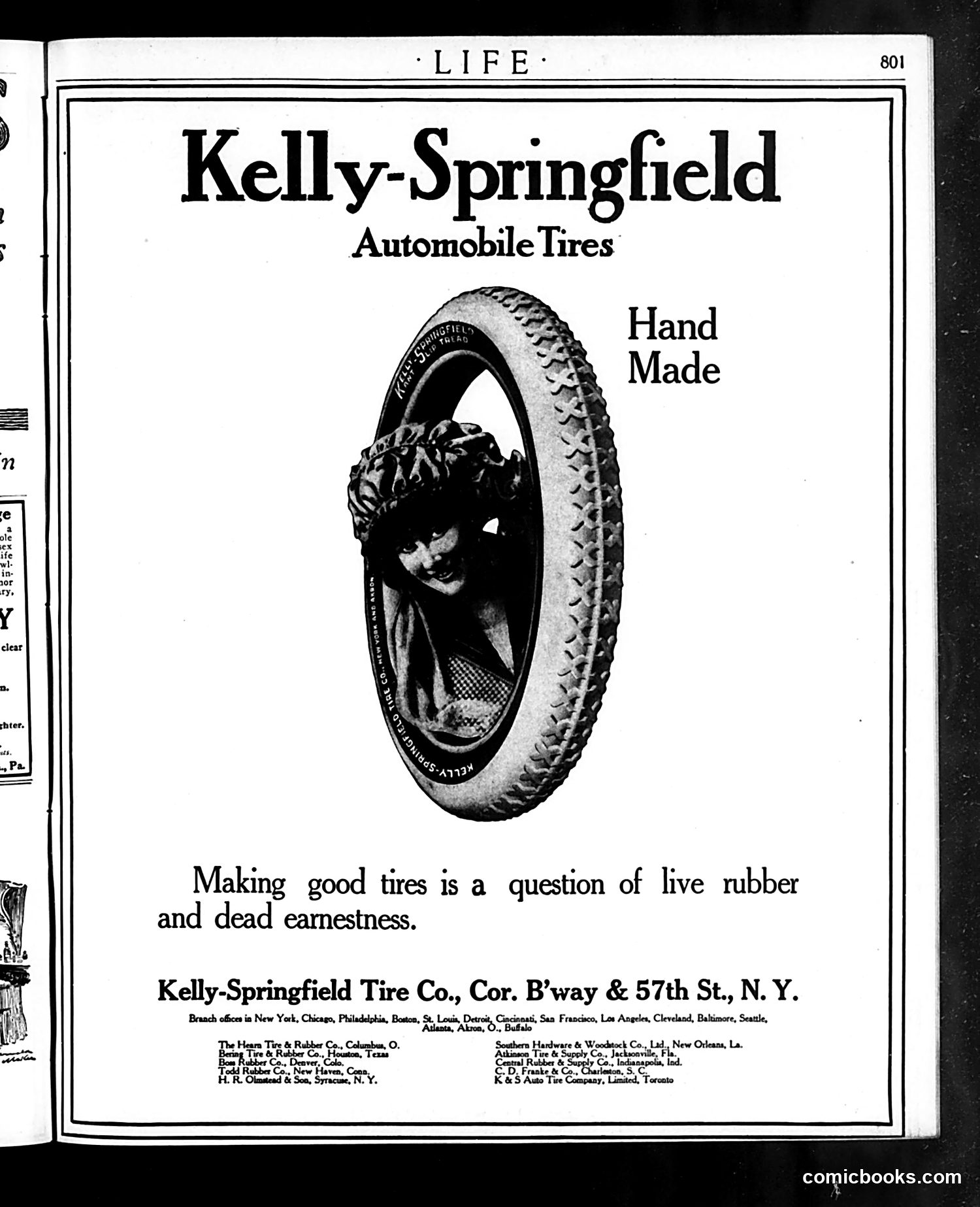
This is a **full-page advertisement**, not political satire. It promotes Kelly-Springfield automobile tires, a major American tire manufacturer of the early 20th century. The image shows a tire photographed head-on with a woman's face visible through the center opening—a visual pun suggesting the tire is attractive or appealing. The tagline "Hand Made" emphasizes quality craftsmanship. The accompanying text—"Making good tires is a question of live rubber and dead earnestness"—uses wordplay (contrasting "live" and "dead") to convey seriousness and reliability in manufacturing. The ad lists branch offices across major American cities, indicating the company's national reach. For modern readers, this represents the era when automobile ownership was growing and tire quality was a significant consumer concern.
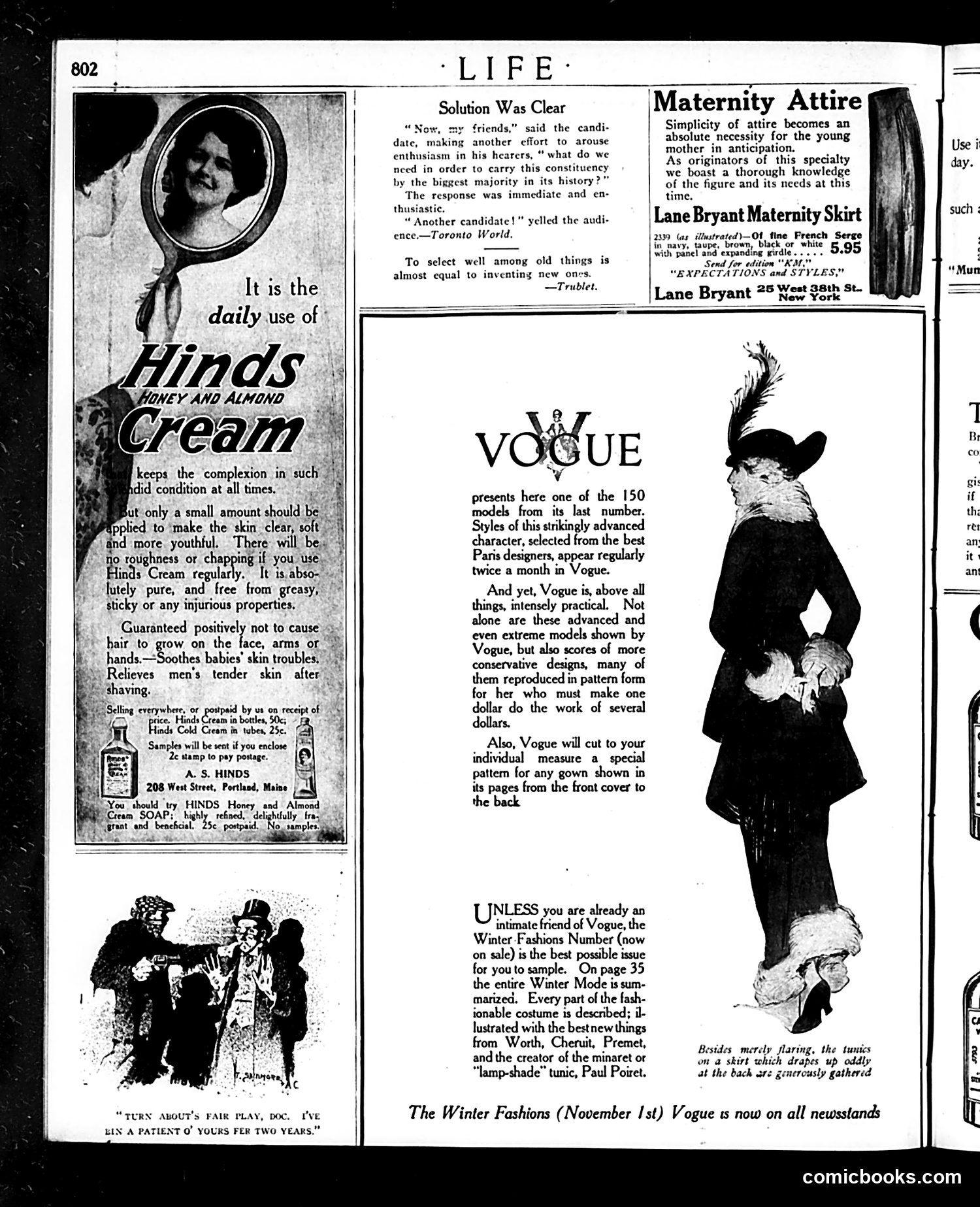
This page contains **primarily advertisements and editorial content**, not political cartoons. The main cartoon ("Turn About's Fair Play, Doc") is a brief joke: a doctor's long-time patient complains that the doctor has been his patient for two years—a role reversal joke suggesting the patient has been paying the doctor's bills and thus "treating" him financially. The "Solution Was Clear" text is political satire: a political candidate asks his audience what's needed to win the election with a huge majority. The crowd shouts back: "Another candidate!"—meaning the current candidate is so unpopular they'd prefer literally anyone else. This reflects period cynicism about politicians and electoral politics. The remaining content consists of advertisements for **Hinds Honey and Almond Cream** (a beauty product), **Lane Bryant maternity clothing**, and **Vogue magazine's Winter Fashions issue**—typical commercial pitches for the era.
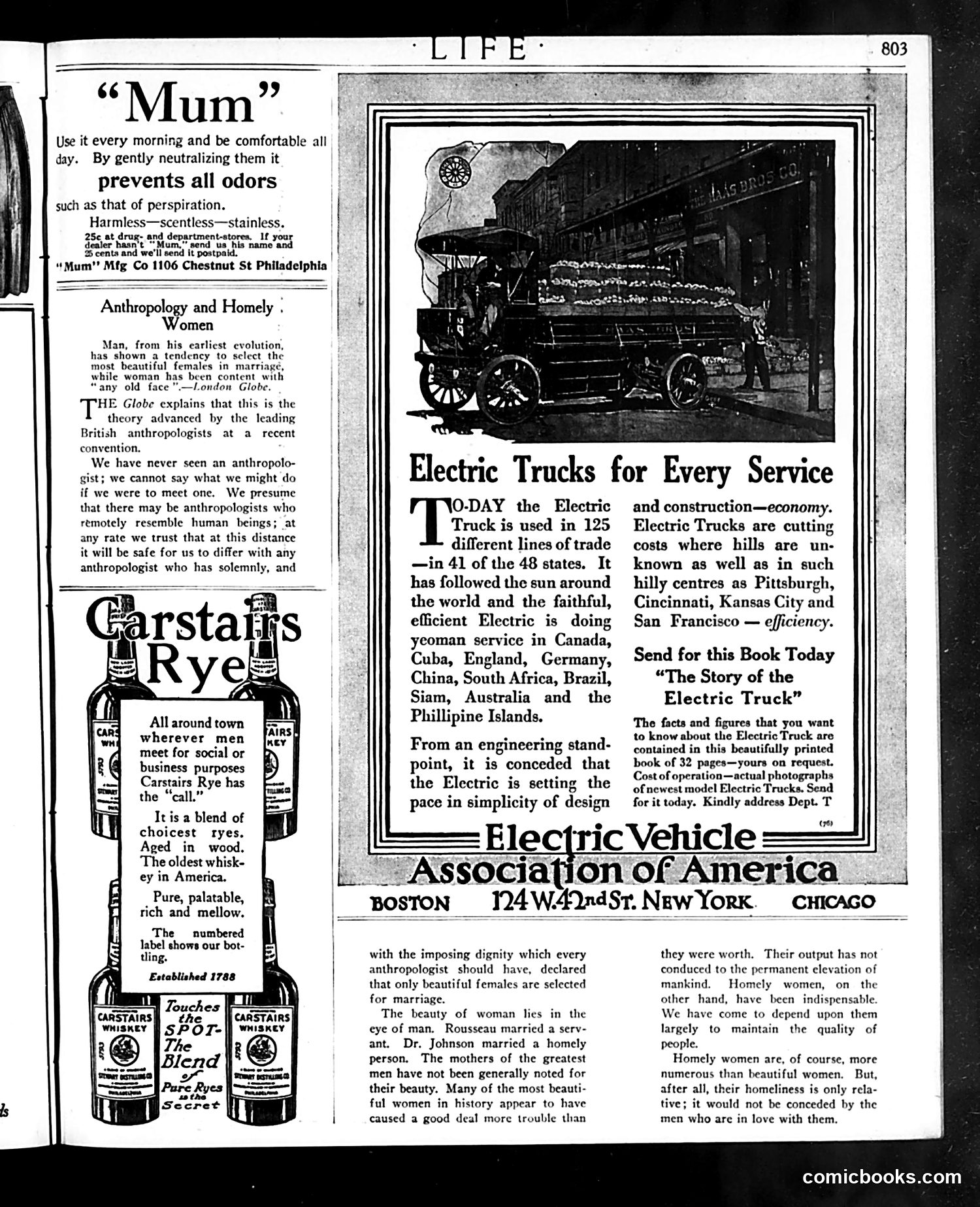
This page combines advertising with social satire. The main content is a humorous essay **debunking anthropological claims** about female beauty and marriage selection. British anthropologists had reportedly argued that men naturally select beautiful women for marriage while women accept "any old face." Life's editors mock this "solemnly" declared theory, countering with historical examples: Dr. Johnson married a homely servant; great men's mothers weren't noted for beauty; beautiful women throughout history caused "more trouble than they were worth." The satire's point: homely women have been indispensable to human progress and society, while beauty is subjective ("only relative") and matters less than character or capability. The piece implicitly critiques both the anthropologists' pseudo-scientific sexism and the cultural obsession with female appearance. The surrounding ads (Mum deodorant, Carstairs Rye whiskey, Electric Vehicles) are period advertisements unrelated to the satire.
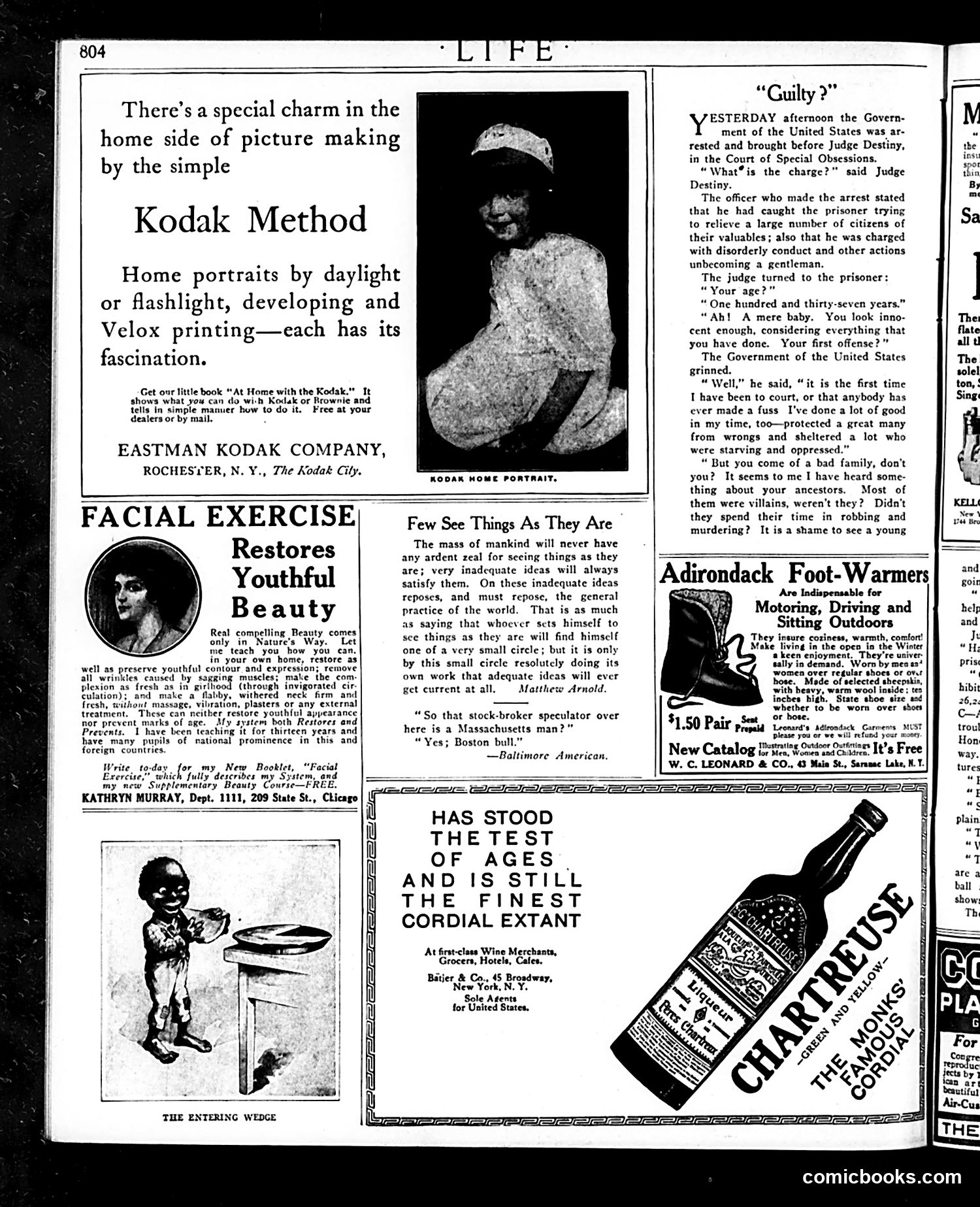
This page features a satirical cartoon titled **"Guilty?"** that personifies the U.S. Government as a defendant in court before Judge Destiny. The government is charged with attempting to rob citizens and disorderly conduct. The satire's point: Despite the government's defense that it has "protected a great many from wrongs," the judge condemns it for its ancestry—implying the nation was founded by villains engaged in "robbing and murdering." This appears to reference **historical wrongs**: likely the theft of Native American lands and slavery. The piece critiques American hypocrisy: the government claims moral authority while built on immoral foundations. The joke's dark humor lies in having the government admit its troubled origins while defending its current actions as benevolent. The rest of the page contains era-typical advertisements (Kodak cameras, facial exercise beauty treatments, foot-warmers) unrelated to the political cartoon.
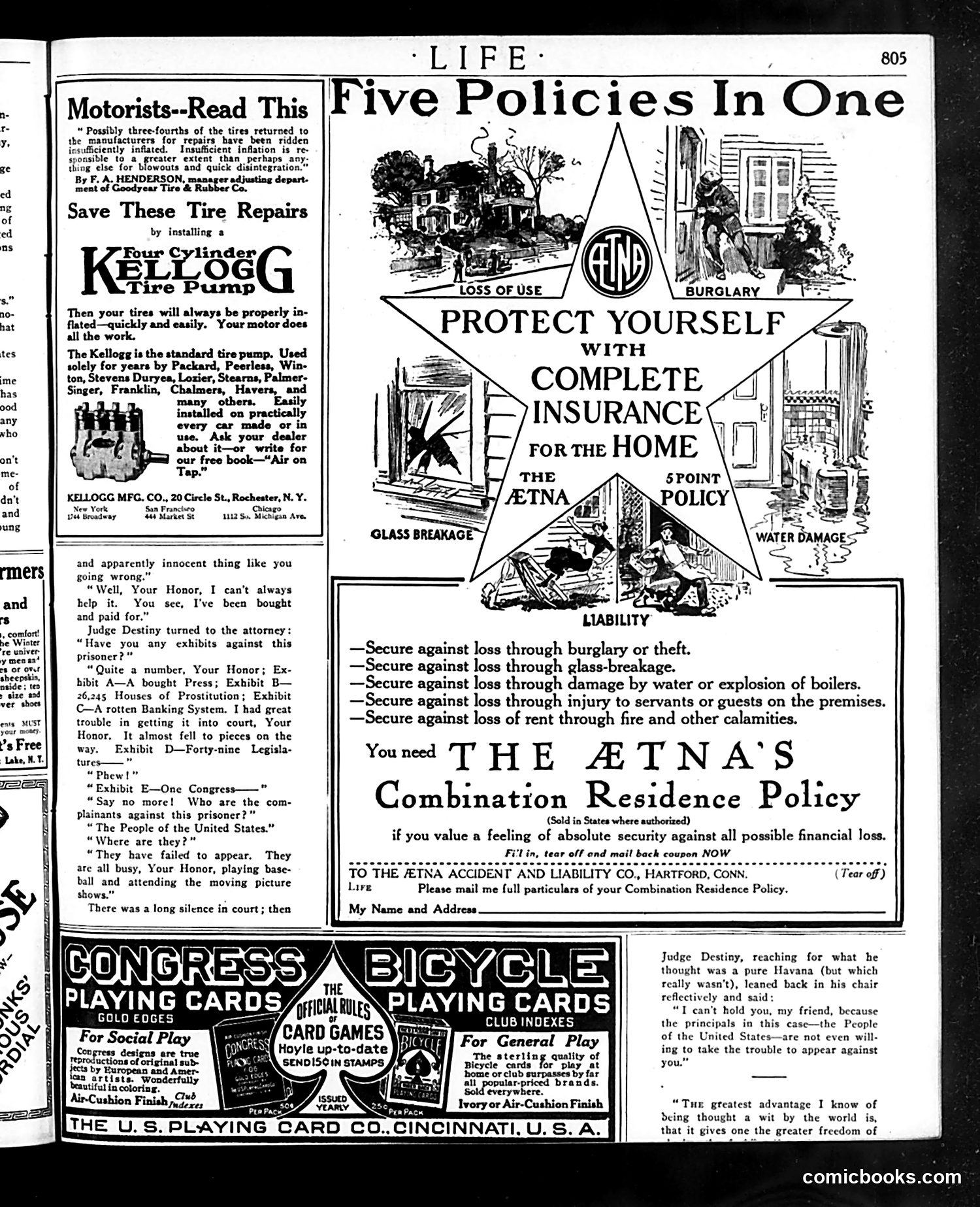
This page contains a satirical cartoon titled "Judge Destiny" (visible in the text) that appears to criticize American institutional corruption. The cartoon depicts a courtroom scene where "Corruption" is the defendant, charged by "The People of the United States." The satire's central point is cynical commentary on American society's failure to hold corruption accountable. The prosecutor presents exhibits including "a bought Press," "26,245 Houses of Prostitution," "a rotten Banking System," and "Forty-nine Legislatures"—cataloging systemic corruption across institutions. The punchline is darkly humorous: when the judge asks where "The People" are to testify against corruption, the answer is they're absent, "playing baseball and attending the moving picture shows"—too distracted by entertainment to participate in civic responsibility. The judge dismisses the case because the public won't show up. The surrounding advertisements (Aetna insurance, playing cards, tire pumps) are standard commercial content typical of Life magazine's layout during this era.
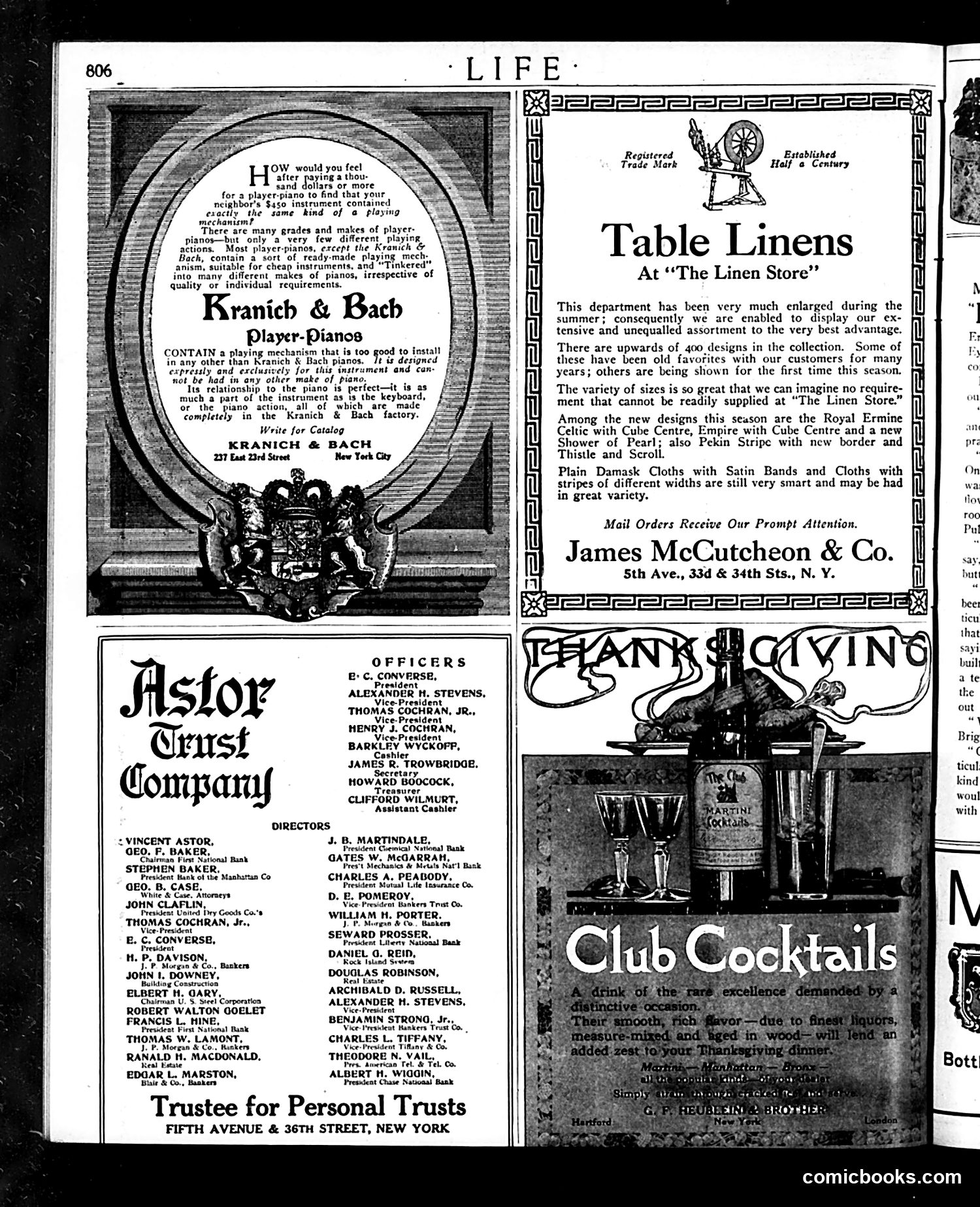
This page is primarily **advertising**, not satire or political commentary. The main content includes: 1. **Kranich & Bach Player-Piano ad**: Uses a humorous premise—a wealthy customer discovers their expensive $1,000 player-piano contains the same mechanism as a cheap $50 neighbor's model. The ad's joke argues that Kranich & Bach pianos are superior because they use custom-designed mechanisms *exclusively* for their instruments, unlike competitors who use generic, interchangeable parts. This is marketing satire targeting consumer anxieties about getting ripped off. 2. **Table Linens advertisement** from James McCutcheon & Co. announcing expanded inventory. 3. **Astor Trust Company** board listing and officer directory. 4. **Club Cocktails advertisement** promoting a premium drink product. The page reflects early 20th-century print advertising strategies: combining humor, prestige (listing prominent business leaders), and appeals to status-conscious consumers concerned about value and quality differentiation.
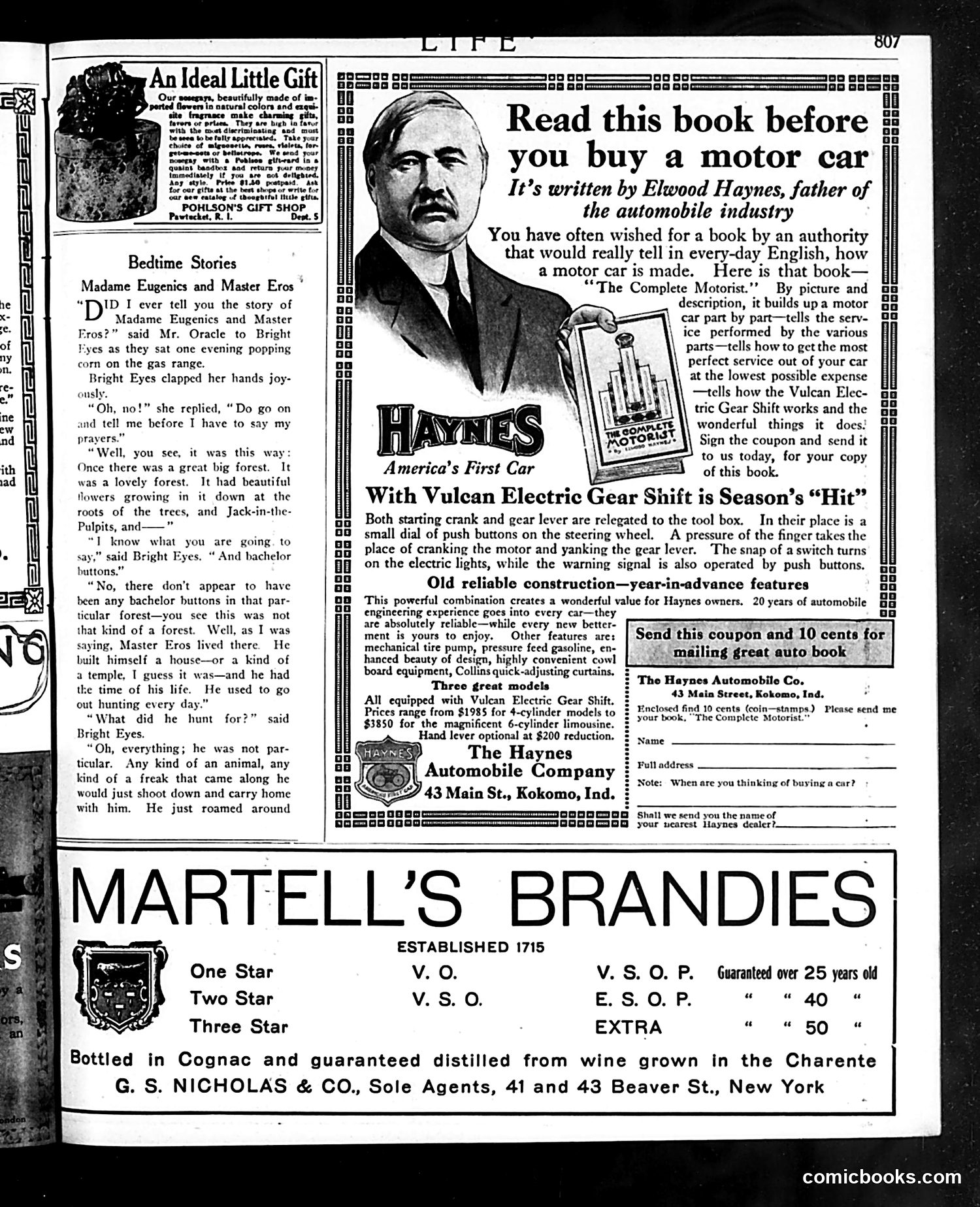
This page is primarily **advertising**, not satire or political commentary. The main content includes: 1. **"Bedtime Stories" column**: A whimsical fairy tale about "Madame Eugenics and Master Eros" hunting in a forest. This appears to be lighthearted children's fiction, likely referencing eugenics pseudoscience (popular early 20th century) and the mythological Eros in an abstract, allegorical way—though the satirical intent, if any, remains unclear from this excerpt alone. 2. **Haynes Automobile advertisement**: Features Elwood Haynes promoting "The Complete Motorist" book and Haynes automobiles with Vulcan Electric Gear Shift technology. This is straightforward product marketing, not satire. 3. **Martell's Brandies advertisement**: A liquor ad emphasizing age and quality. 4. **Gift shop and miscellaneous ads**: Standard commercial notices. The page functions as a typical Life magazine layout mixing light fiction with paid advertising—no apparent political cartoon or satirical commentary is present.
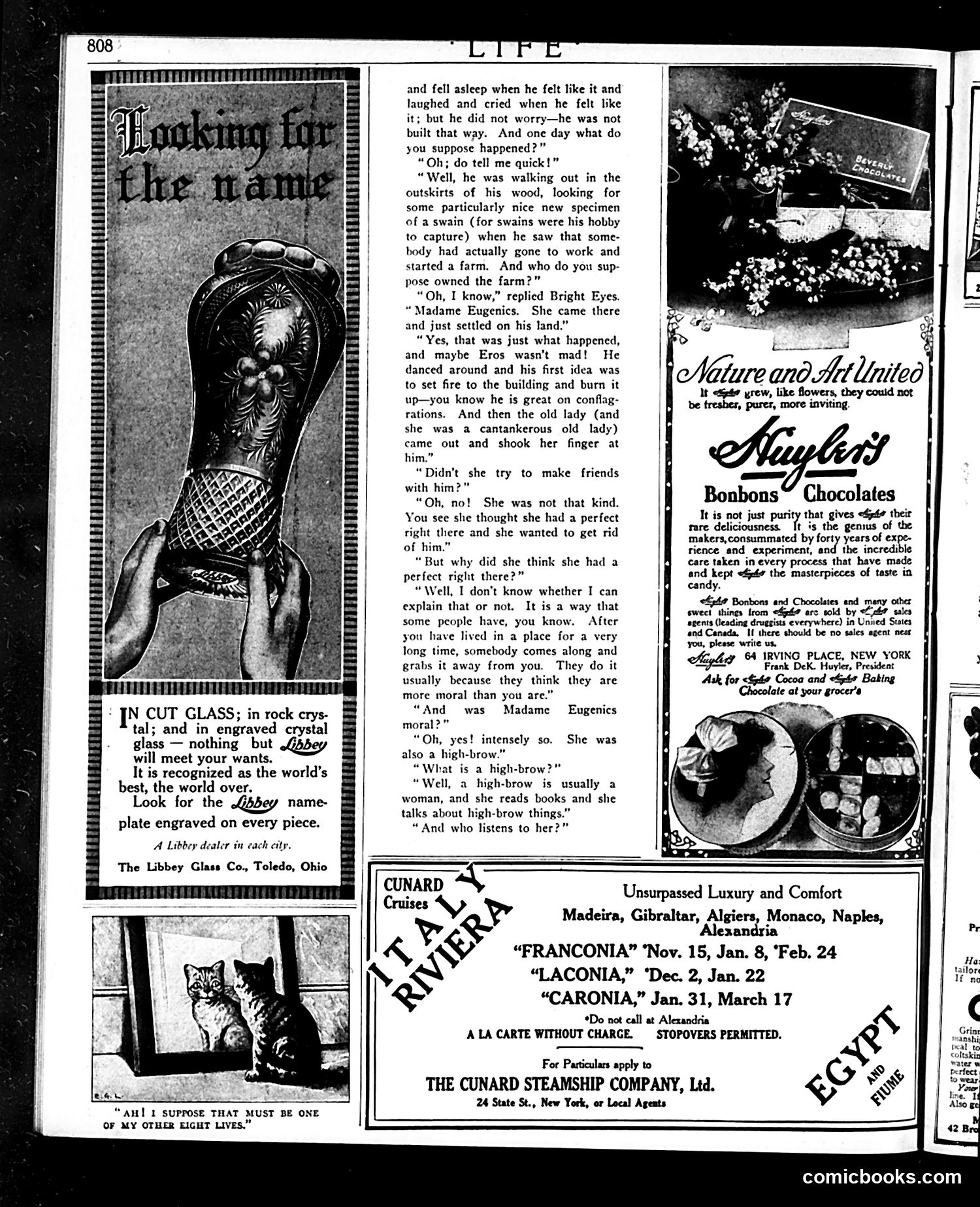
This page is primarily **advertising** rather than political satire. It contains: 1. **Libbey Glass ad** (left): Promotes cut glass and crystal glassware, emphasizing brand prestige and quality. 2. **A narrative story** (center): An allegorical tale featuring "Eros" (the god of love) encountering "Madame Eugenics" who has settled on his land. The story satirizes **eugenics ideology**—Madame Eugenics is portrayed as a self-righteous, intellectual "high-brow" woman who believes she has moral authority to displace Eros. This appears to mock eugenics advocates as pretentious busybodies imposing their ideology on others. 3. **Huyler's Bonbons advertisement** (right): Candy promotion emphasizing purity and craftsmanship. 4. **Cunard cruise line ad**: Advertises luxury Mediterranean voyages. 5. **Cat cartoon** (bottom left): A cat seeing its reflection, captioned about "eight lives"—a simple visual joke. The eugenics reference suggests this Life issue engages with early 20th-century social debates, though the treatment is more whimsical than sharply critical.
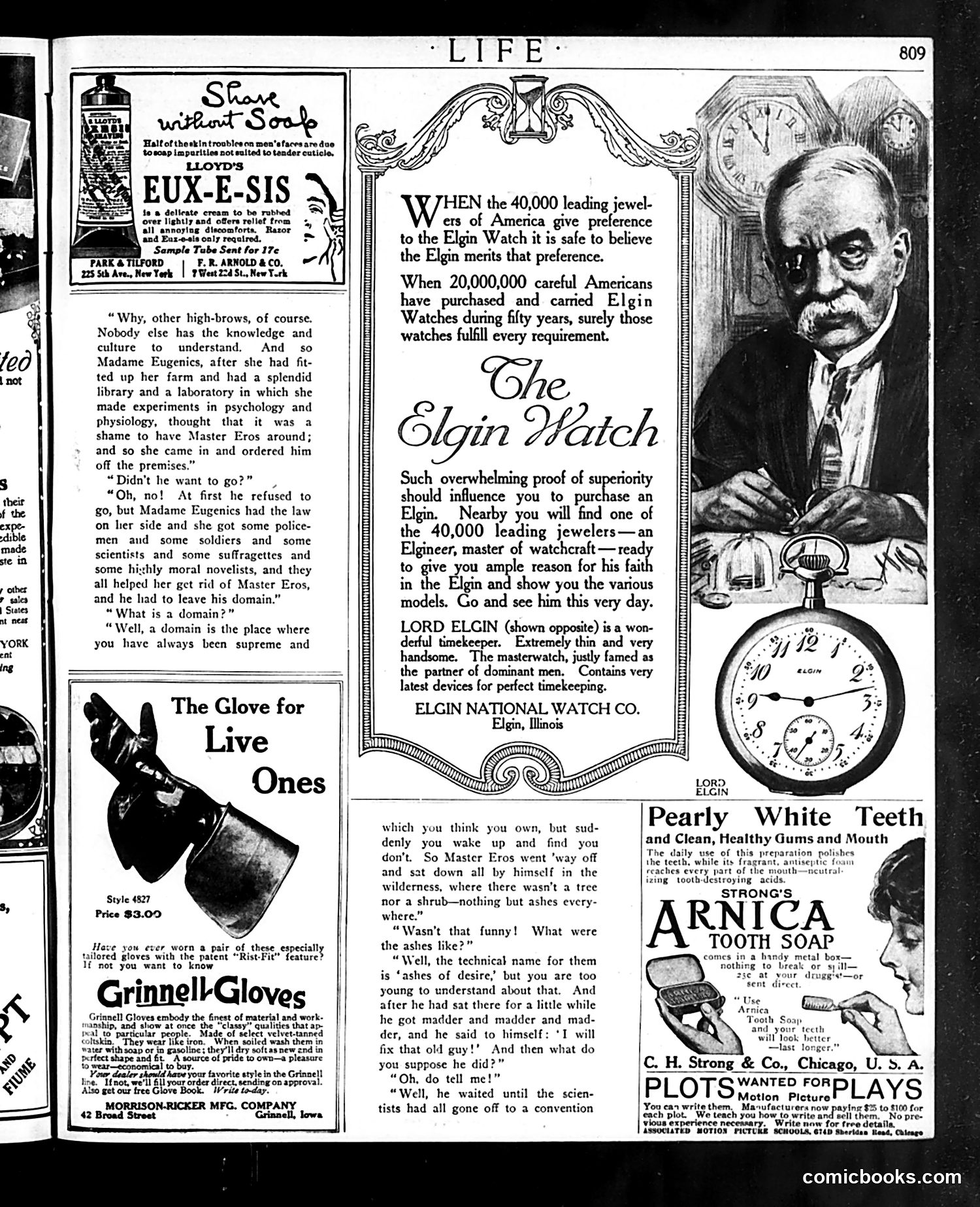
This page is primarily **advertisements** with one notable satirical narrative. The main content is a lengthy **story fragment** (left column) presenting a thinly-veiled critique of the **eugenics movement**. The tale describes "Madame Eugenics" banishing "Master Eros" (desire/sexuality) from her domain using police, soldiers, scientists, suffragettes, and "moral novelists." When Eros returns seeking revenge, the story implies desire will undermine eugenics ideology. This is **social satire**: early 20th-century eugenics advocates believed scientific control of reproduction would improve humanity. The author mocks this by personifying it as prudish authoritarianism that cannot suppress human nature. The reference to suffragettes suggests the author saw women's rights activism as allied with eugenics—a common conservative critique of the era. The remainder comprises typical period advertisements: watches, gloves, tooth soap, and skin cream—products marketed to the magazine's affluent readership. The page reflects anxieties about eugenics, sexuality, and women's social roles circa 1910s-1920s America.
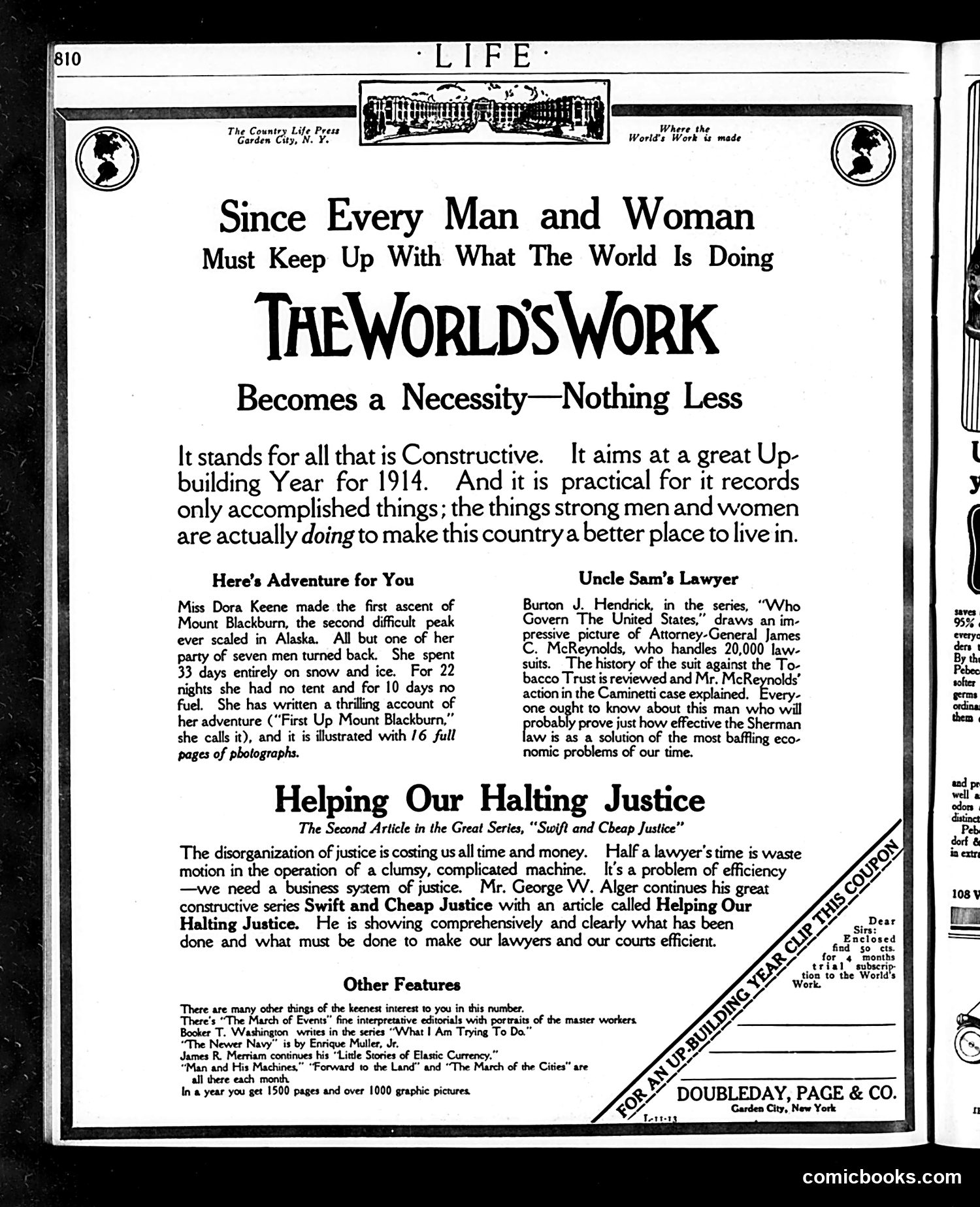
This is primarily an advertisement for *The World's Work* magazine, promoting its January 1914 issue. The page highlights three content features: 1. **"Here's Adventure for You"**: Profiles Dora Keene's mountaineering achievement—the first ascent of Mount Blackburn in Alaska, accomplished under extreme conditions. 2. **"Uncle Sam's Lawyer"**: Features Attorney General James C. McReynolds handling 20,000 lawsuits, particularly examining antitrust cases against the Tobacco Trust and the Sherman Act's effectiveness. 3. **"Helping Our Halting Justice"**: Part of a series on judicial reform, arguing that America's justice system is inefficient and needs business-like reorganization. The magazine positions itself as covering "constructive" accomplishments by "strong men and women" making America better. This reflects Progressive Era (1914) concerns with efficiency, reform, and practical achievement. The tone is earnest rather than satirical—this is marketing copy celebrating reform-minded journalism.
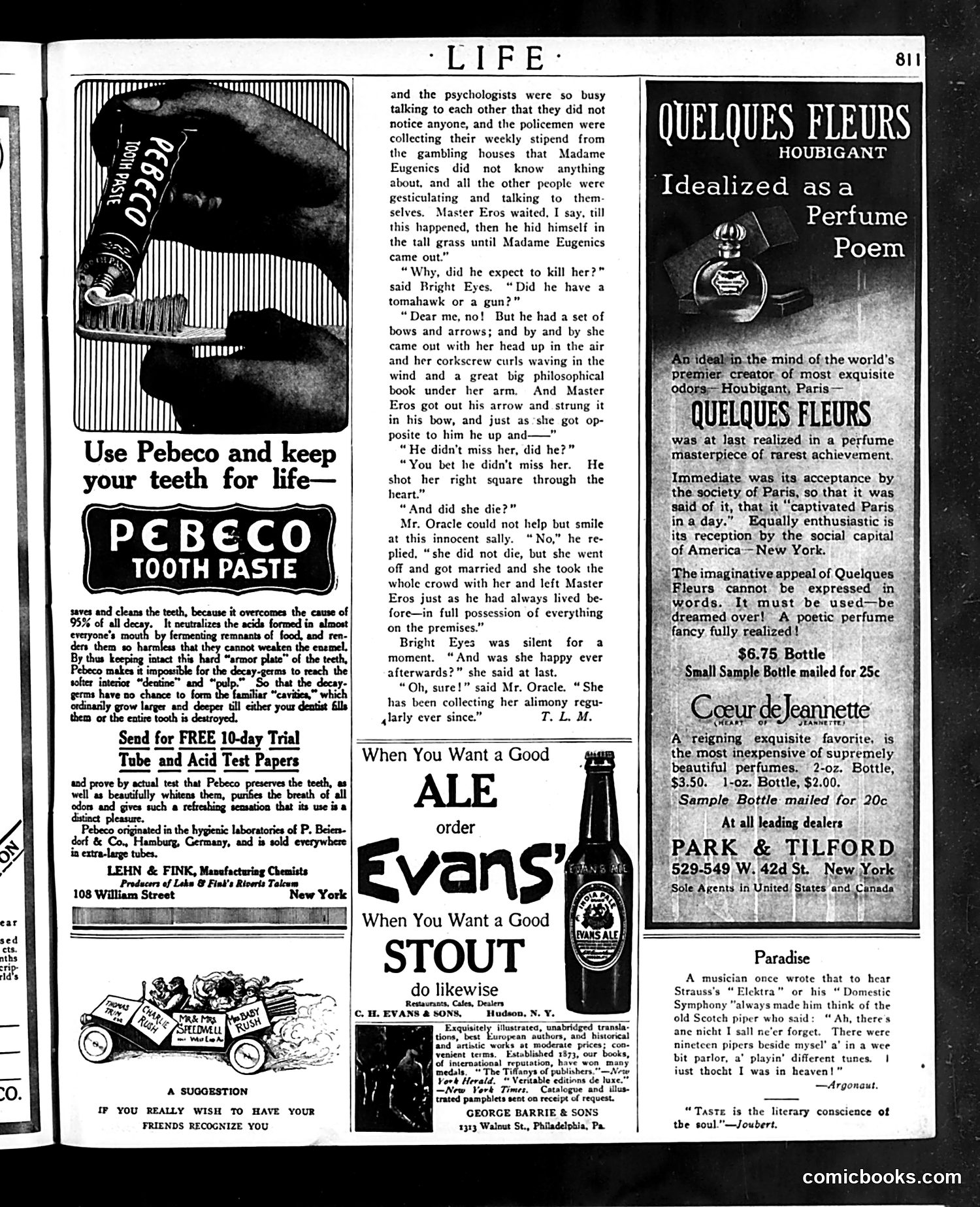
This page is primarily **advertising**, with a serialized story excerpt as filler content. The main narrative (OCR'd text) appears to be a fairy-tale allegory about "Master Eros" (the god of love) and "Madame Eugenics." The story satirizes early 20th-century obsessions with eugenics—the pseudoscientific movement promoting "genetic improvement." The tale mocks how Eros defeats eugenic ideology by shooting the woman through the heart with an arrow, causing her to marry and produce offspring anyway, thwarting eugenic goals. The punch line: despite eugenic ideals, love and procreation continue uncontrolled. **Advertisements include:** - **Pebeco Toothpaste** (dental hygiene) - **Evans' Ale and Stout** (beverages) - **Quelques Fleurs Houbigant** (French perfume, marketed as "poetic") - **Coeur de Jeannette** (perfume) - **Park & Tilford** (retailers) - **George Barrie & Sons** (book publishers) The perfume ads emphasize European sophistication and exclusivity—appealing to aspirational American consumers of the 1920s era.
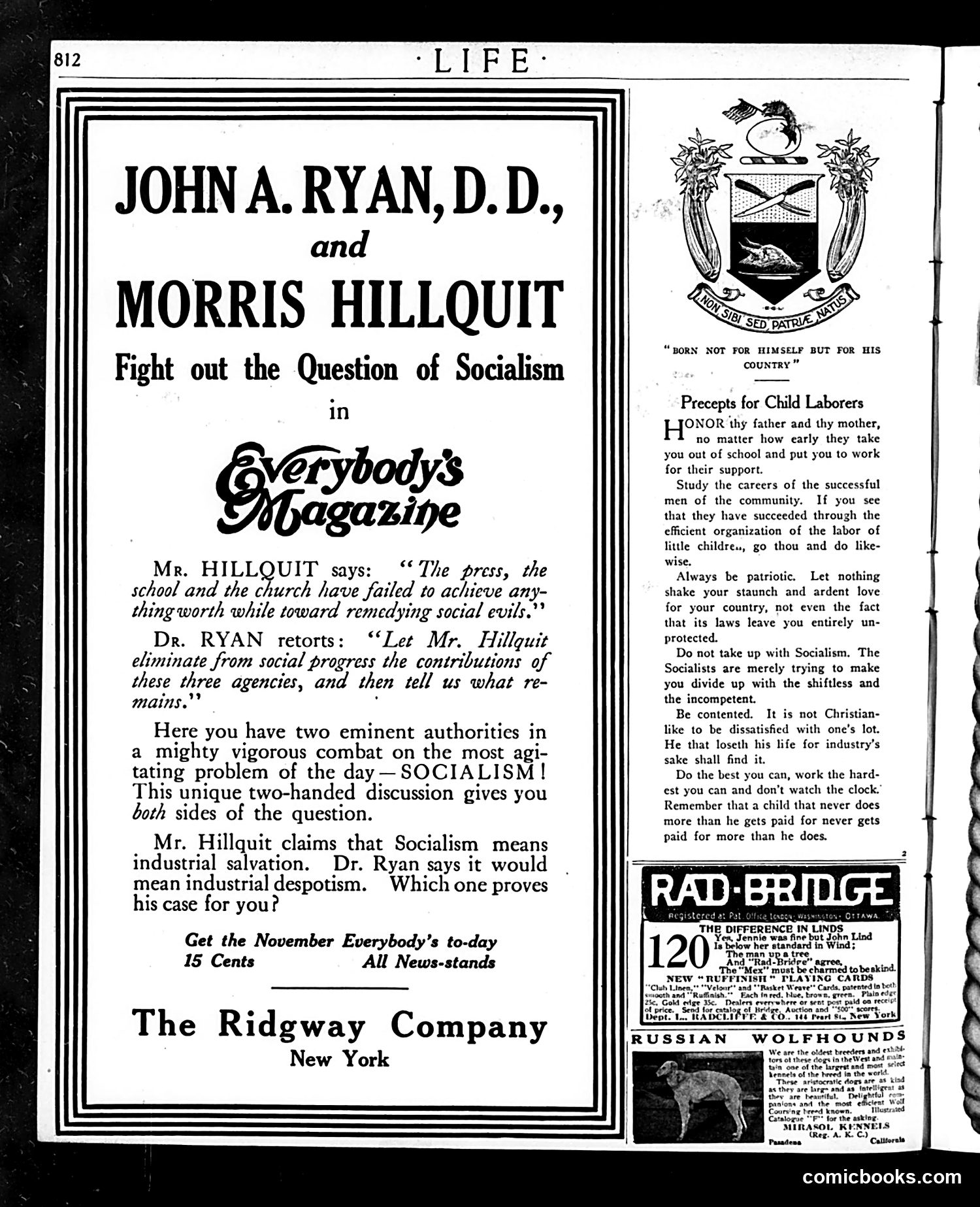
This page presents a **debate advertisement** rather than a cartoon. It promotes an upcoming article in *Everybody's Magazine* featuring a public intellectual debate between **John A. Ryan** (a Catholic priest and social reformer, marked "D.D." for Doctor of Divinity) and **Morris Hillquit** (a prominent Socialist politician and labor advocate). The satire appears on the **right side**: "Precepts for Child Laborers" cynically mocks anti-Socialist, pro-capitalist arguments by presenting them as cruel advice to working children. It sarcastically urges child laborers to accept exploitation, avoid unions, and trust that industrial success rewards the hardworking—while tacitly acknowledging that child labor laws offer no protection. This reflects early 20th-century debates over **Socialism versus capitalism**, with the page advertising a high-profile clash between a religious conservative (Ryan) and a Socialist (Hillquit) over whether industrial reform should come through faith-based institutions or revolutionary economic change. The cynical "precepts" implicitly endorse the Socialist critique of capitalism's inhumanity toward children.
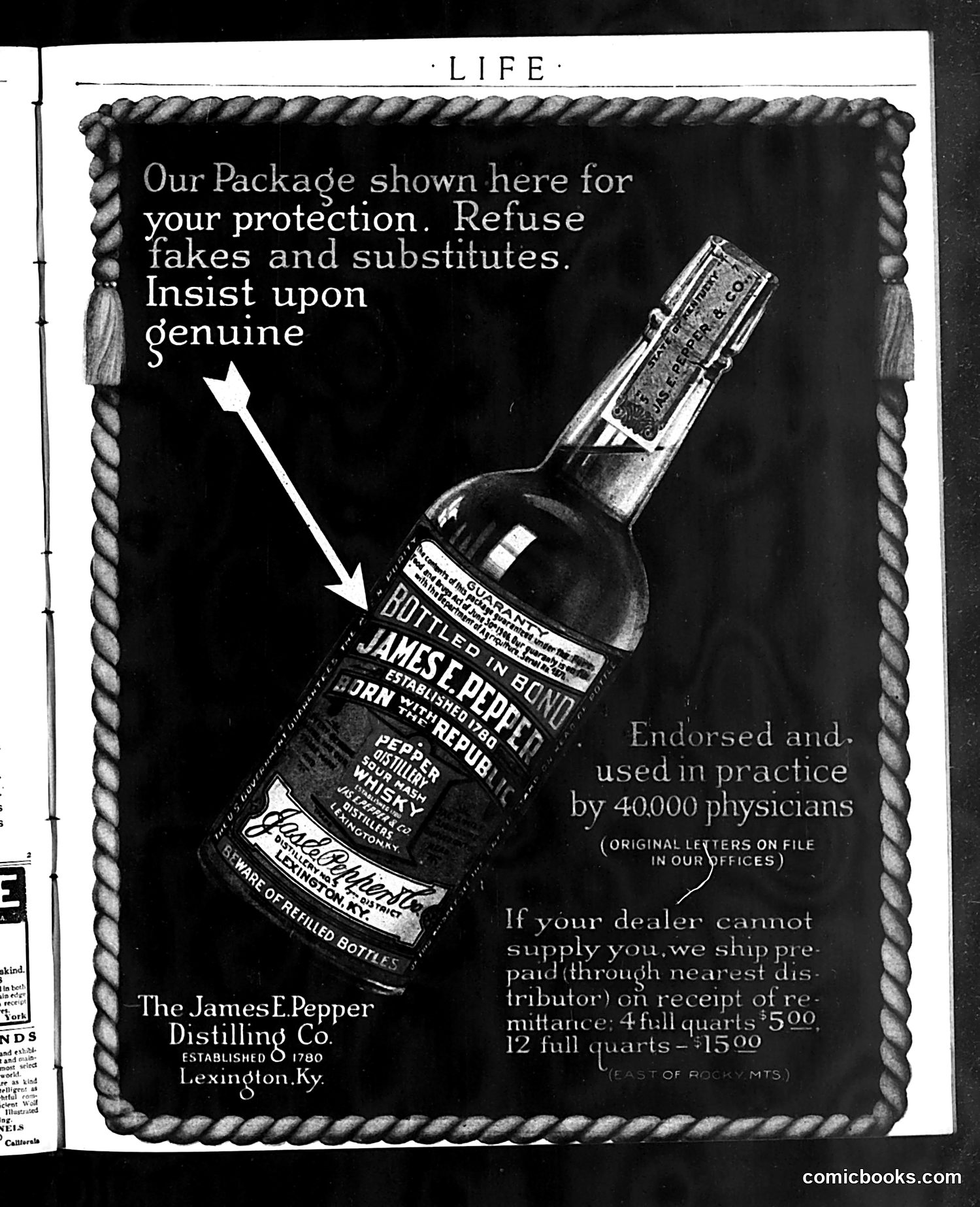
This is a **product advertisement**, not political satire. It promotes James E. Pepper whiskey, a Kentucky distillery product established in 1780. The ad addresses concerns about **counterfeit liquor**—a significant problem during this era (likely early 1900s). It emphasizes authenticity by showing the genuine bottle's distinctive labeling and warning consumers to "refuse fakes and substitutes." The credibility appeal relies on claiming endorsement by "40,000 physicians" with "original letters on file"—reflecting the period when alcohol was marketed as medicinal. The rope-bordered frame suggests legitimacy and protection. The pricing structure (4 quarts for $5.00, 12 for $15.00) and direct-shipment offer indicate this addressed distribution challenges, possibly related to emerging Prohibition-era concerns about obtaining genuine spirits. This reflects **early-20th-century consumer culture**: brand loyalty advertising, authenticity anxieties, and whiskey as a respectable product with medical authority behind it.
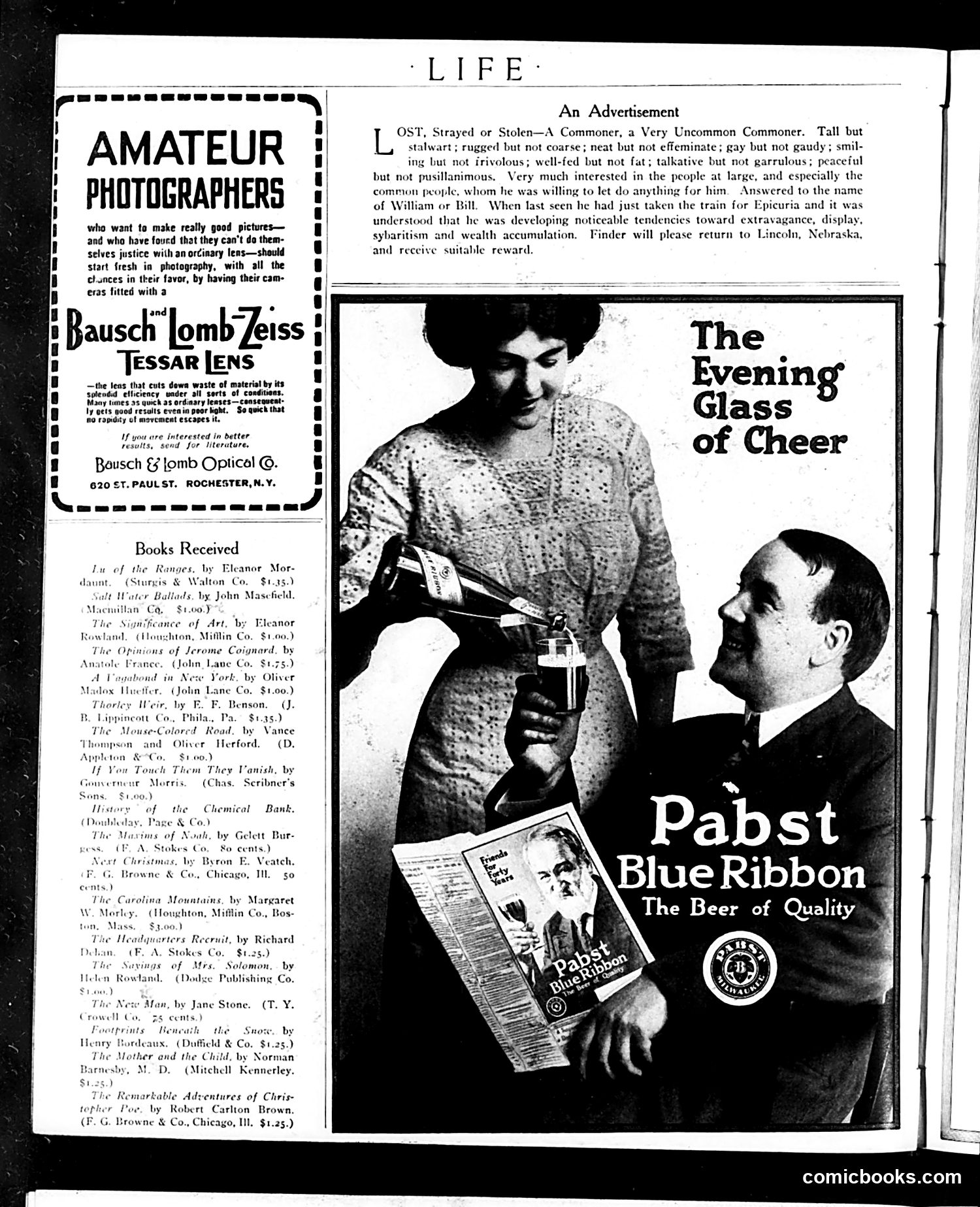
This page contains primarily **advertisements and book listings**, not political satire. The main content includes: **The "Lost Person" Ad:** A humorous classified advertisement describing a missing "Commoner" named William or Bill—likely a satirical jab at populist politics or a common everyman figure. The description parodies "lost pet" notices, suggesting this ordinary person developed aristocratic tastes ("extravagance, display, sybaritism") after heading to "Epicuria" (a fictional place of excess). The joke critiques materialism or the corruption of simple folk through wealth. **Commercial Ads:** The Bausch & Lomb camera lens advertisement and Pabst Blue Ribbon beer advertisement dominate visually, typical of Life magazine's revenue model. **Book Reviews:** A standard listing of recently published books. The page reflects early 20th-century American consumer culture and gentle social commentary through advertising rather than explicit political cartooning.
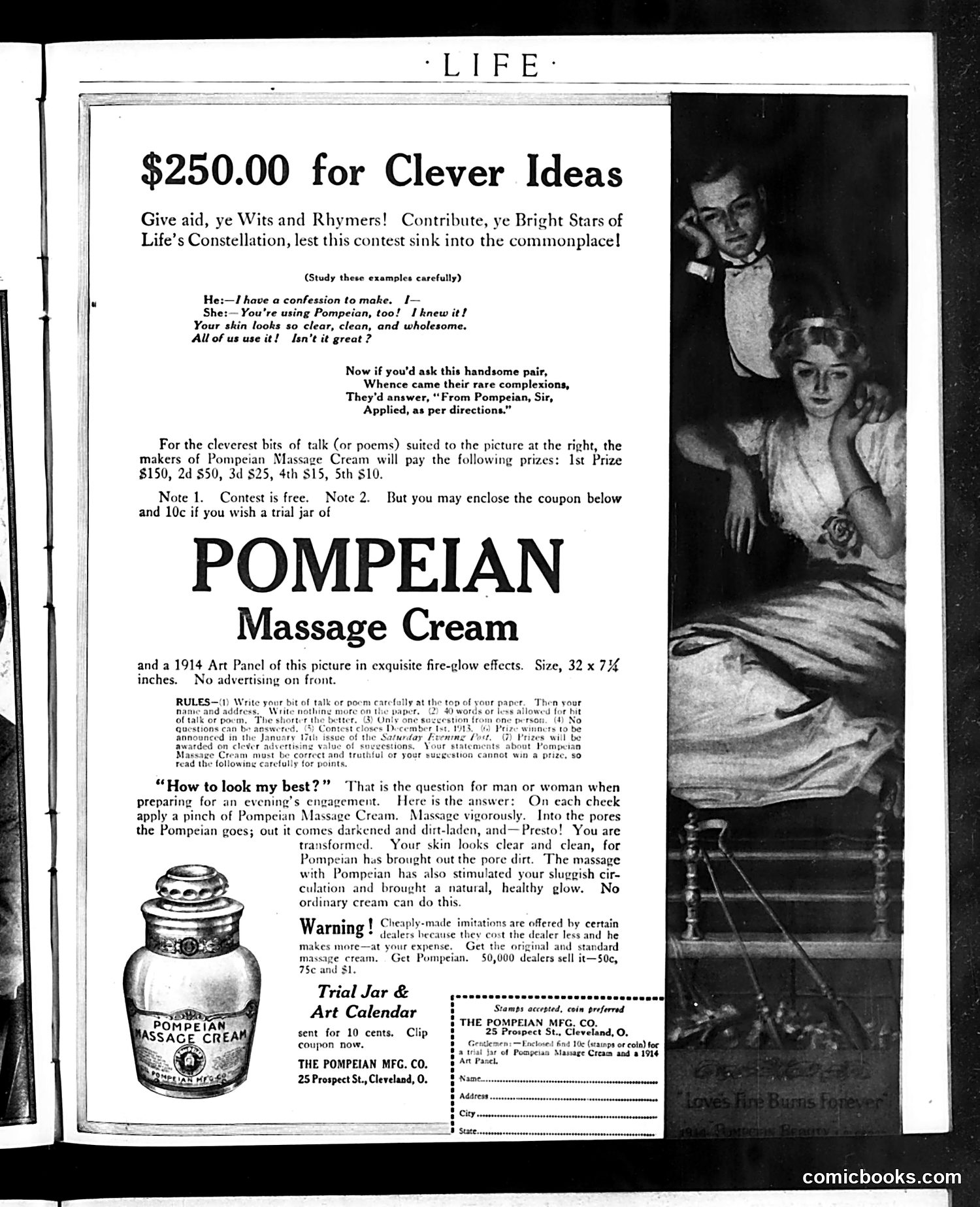
This is primarily a **beauty product advertisement disguised as a contest**, not a political cartoon. Life magazine invited readers to submit witty dialogue or poems matching the photographs of an attractive couple, offering cash prizes ($150 first place down to $10 fifth place). The "joke" being promoted: a couple with clear, healthy skin attributes their complexion to Pompeian Massage Cream. The advertisement claims the cream works by massaging out pore dirt and stimulating circulation, producing a natural "glow." For modern readers, the satire lies in the **absurd advertising premise**—the notion that a cream could dramatically transform skin appearance, and that Life's readers should compete to write clever pitches *for the advertiser*. The contest essentially recruits unpaid copywriters while maintaining the magazine's satirical facade. The "Warning" section acknowledges counterfeit products existed, a common problem in early 20th-century patent medicines and beauty products with minimal regulation.
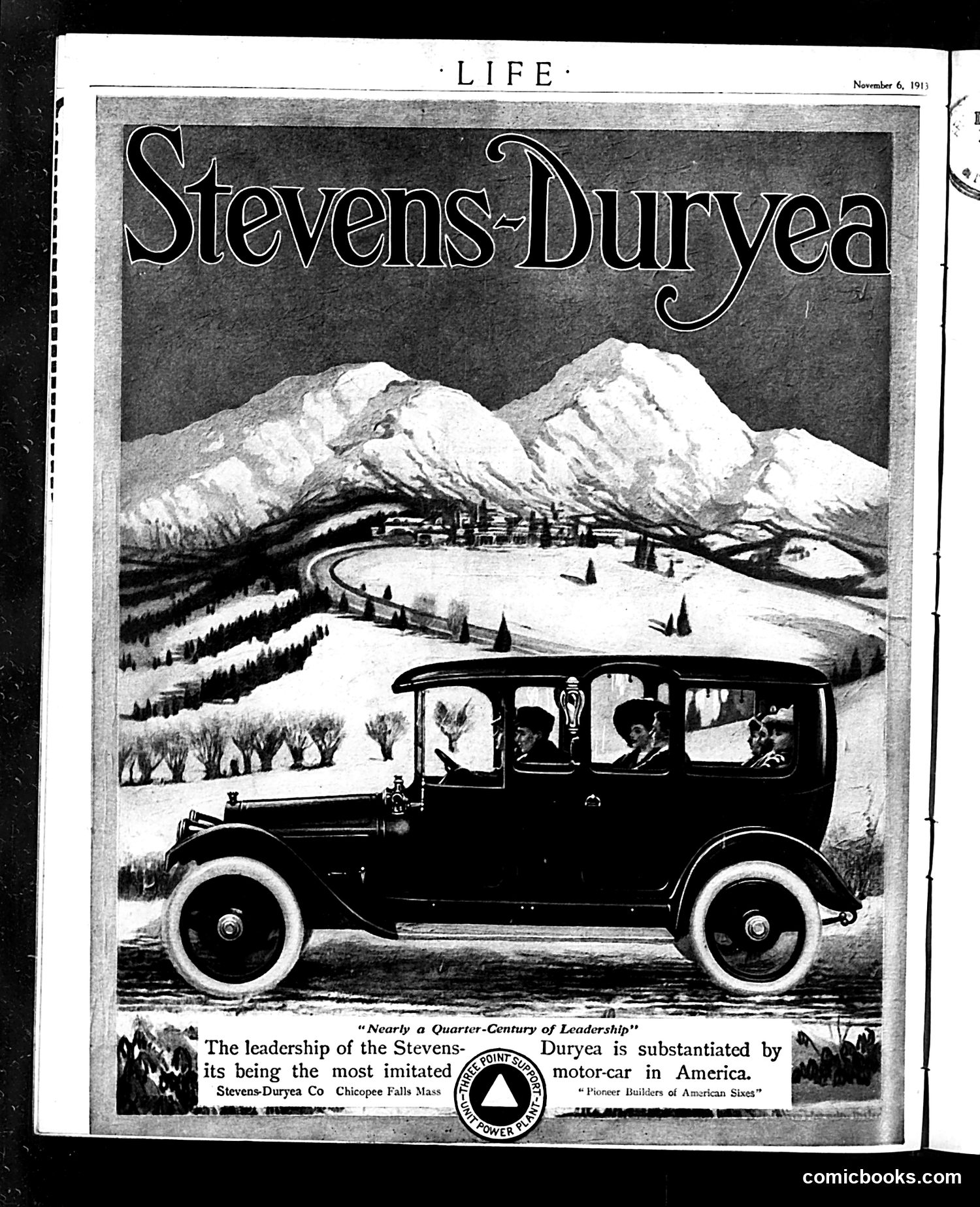
This is a **product advertisement**, not political satire. It promotes the Stevens-Duryea automobile, claiming "nearly a quarter-century of leadership" and asserting it's "the most imitated motor-car in America." The image shows a luxury touring car filled with passengers, set against a dramatic snowy mountain landscape—likely appealing to aspirational buyers by suggesting the vehicle's reliability for scenic travel and adventure. The tagline "Pioneer Builders of American Sixes" references the six-cylinder engine, then a premium feature. The company was based in Chicopee Falls, Massachusetts. The claim that it's "most imitated" is a boast about its market dominance and desirability—competitors supposedly copied its design, implying quality and leadership in automotive innovation during the early automobile era.