
Life, 1913-11-06 · page 31 of 56
Life — November 6, 1913 — page 31: what you’re looking at
What you’re looking at
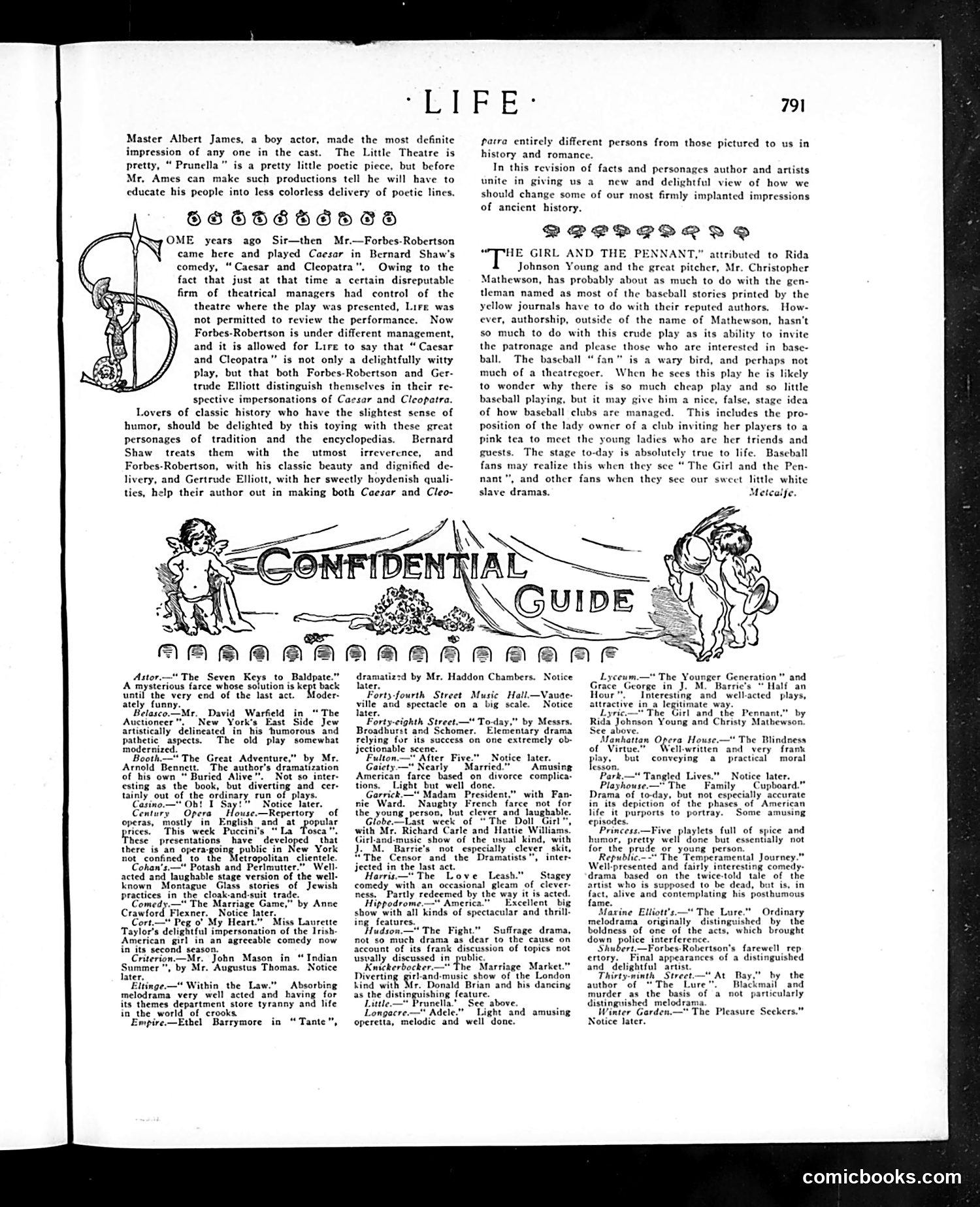
This *Life* magazine page (791) contains theatrical reviews rather than political cartoons. The substantive content discusses several Broadway productions: **Main Reviews:** - *Caesar and Cleopatra* (Bernard Shaw): Forbes-Robertson and Gertrude Elliott star in this comedic deconstruction of classical history, treating famous figures with "irreverence" - *The Girl and the Pennant*: A baseball-themed play credited to pitcher Christy Mathewson and playwright Rida Johnson Young. The reviewer notes it's crude but appeals to baseball fans unfamiliar with theater, including an implausible scene of a female club owner hosting a "pink tea" for players **The Satire:** The humor lies in mocking how theater caters to specific audiences—treating baseball fans as unsophisticated theater-goers willing to accept theatrical absurdities for sports content, while praising Shaw's intellectual irreverence toward classical subjects. The decorative header "CONFIDENTIAL GUIDE" with cherubs is ornamental, framing the theatrical listings below rather than providing satirical commentary.
📄 Transcribed text from this page (OCR, searchable)
Machine-transcribed from the original scan — historical spelling and the odd misread are preserved.
Sl ELH eyes Master Albert James, a boy actor, made the most definite impression of any one in the cast. The Little Theatre is pretty, “ Prunella” is a pretty little poctic piece, but before Mr, Ames can make such productions tell he will have to educate his people into less colorless delivery of poetic lines. ORG BORGO RCROROROMO) NY OME years ago Sir—then Mr.—Forbes-Robertson came here and played Caesar in Bernard Shaw's comedy, “Caesar and Cleopatra”. Owing to the fact that just at that time a certain disreputable firm of theatrical managers had control of the theatre where the play was presented, Lire was not permitted to review the performance. Now Forbes-Robertson is under different management, and it is allowed for Lire to say that “ Caesar and Cleopatra” is not only a delightfully witty play, but that both Forbes-Robertson and Ger- trude Elliott distinguish themselves in their re- spective impersonations of Caesar and Cleopatra. Lovers of classic history who have the slightest sense of humor, should be delighted by this toying with these great personages of tradition and the encyclopedias. Bernard Shaw treats them with the utmost irreverence, and Forbes-Robertson, with his classic beauty and dignified de- livery, and Gertrude Elliott, with her swectly hoydenish quali- 791 patra entirely different persons from those pictured to us in history and romance. In this revision of facts and personages author and artists unite in giving us a new and delightful view of how we should change some of our most firmly implanted impressions of ancient history. @VPFP*QRKS “THE GIRL AND THE PENNANT,” attributed to Rida Johnson Young and the great pitcher, Mr. Christopher Mathewson, has probably about as much to do with the gen- tleman named as most of the bascball stories printed by the yellow journals have to do with their reputed authors, How- ever, authorship, outside of the name of Mathewson, hasn't so much to do with this crude play as its ability to invite the patronage and please those who are interested in base- ball. The baseball “fan” is a wary bird, and perhaps not much of a theatregoer. When he sces this play he is likely to wonder why there is so much cheap play and so little baseball playing, but it may give him a nice, false, stage idea of how baseball clubs are managed. This includes the pro- position of the lady owner of a club inviting her players to a pink tea to meet the young ladies who are her triends and guests. The sta -day is absolutely true to life. Baseball fans may realize this when they sce “ The Girl and the Pen- nant”, and other fans when they see our sweet little white ties, help their author out in making both Caesar and Cleo- Astor.—" The Seven Keys to Baldpate.” A mysterious farce whose solution is kept back until the very end of the last act. Moder- ately funny. Belasco.—Mr. David Warfield in “The Auctioneer". New York's East Side Jew artistically delineated in his ‘humorous and pathetic aspects. The old play somewhat modernize Booth.— The Great Adventure,” by Mr. Arnold Bennett. The author's dramatization of his own “ Buried Alive”. Not so inter- esting as the book, but diverting and cer- tainly out of the ordinary run of plays. Casino.—"* Ob! I Say!" Notice later. Century Opera House.—Repertory | of operas, mostly in) English and at popular prices. This week Puccini's “La Tosca”. hese. presentations have developed that there is_an opera-going public in New York hot confined to the Metropolitan chentele Cohan’s.—" Potash and Perlmutter.” Well- acted and laughable stage version of the well- known Montague Glass stories of Jewish practices in the cloak-and-suit trade. Comedy.— The Marriage Game,” by Anne Crawford Flexner. | Notice later. Cort,—" Peg o' My Heart.” Miss Laurette Taylor's delightful impersonation of the Irish- American girl in an agreeable comedy now in its second season. Criterion—Mr. John Mason in “Indian Summer”, by Mr. ‘Augustus Thomas. Notice jater. Eliinge-—“ Within the Law.” Absorbing melodrama very well acted and having for its themes department store tyranny and life in the world of crooks Empire—Ethel Barrymore in “ Tante”, slave dramas. dramatized by Mr. Haddon Chambers. Notice later. Forty-fourth Street ville and spectacle on a big scale. later. Forty-cighth Street.— To-day,” by Messrs. Broadhurst and Schomer. Elementary drama relying for its success on one extremely ob- jectionable scene. Fulton.—" After Five." Notice later. _ Gaicty—* Nearly Married.” Amusing American farce based on divorce complica: tions, Light but well done. Garrick —"* Madam President,” with Fan- nie Ward. Naughty French farce not for the young person, but clever and laughable. Globe.—Last week of “The Doll Girl”, with Mr. Richard Carle and Hattie Williams. Girl-and-music show of the usual kind, with ‘M. Barrie’s not especially clever sk “The Censor and the Dramatists”, inter jected in the last act. Harris.—" The Love Leash.” Stagey comedy with an occasional gleam of clever- ness, Partly redeemed by the way it is acted. Hippodrome.—" America.” Excellent big show with all kinds of spectacular and thrill- ing, features, ‘ Judson.—* The Fight.” Suffrage drama, not so much drama as dear to the cause on account of its frank discussion of topics not usvally discussed in public. Knickerbocker—" The Marriage Market.” Diverting girl-and-music show of the London Lind with Mr. Donald Brian and his dancing as the distinguishing feature. ttle.—" Prunella” See above. Longacre.—" Adele.” Light and amusing operetta, melodic and well done. Music Hall.—Vauae- Notice Metcalfe. Lyceum.—" The Younger Generation" and Grace, George in J. M. Barrie’s “Half an Hour". Interesting and well-acted plays, attractive in_a legitimate way. Lyric.—" The Girl and the Pennant,” by Rida Johnson Young and Christy Mathewson, See above. Manhattan Opera House.—" The Blindness of Virtue.” Well-written and very frank play, but conveying a practical moral Jesson Park.—" Tangled Lives.” Notice later. Playhouse.—" The Family Cupboard. rama of to-day, but not especially accurate in its depiction of the phases of American life it purports to portray. Some amusing episodes, Princess.—Five playlets full of spice and humor, pretty well done but essentially not for the prude or young person Republic.--"* The Temperamental Journey.” Well:presented and fairly interesting comedy: drama based on the twice-told tale of the artist who is supposed to be dead, but is, in fact, alive and contemplating his posthumous fame. Marine Elliott's" The Lure." Ordinary melodrama originally distinguished by the boldness of one of the acts, which brought down police interference. ‘Shubert-—-Forbes- Robertson's farewell rep ertory. Final appearances of a distinguished and delightful artist Thirty-ninth Street.—" At author of “The Lure murder as the basis of distinguished melodrama. Winter Garden.—" The Pleasure Seekers.” Notice later. Ray." by the Blackmail and not particularly comicbooks.com