
Life, 1913-11-06 · page 18 of 56
Life — November 6, 1913 — page 18: what you’re looking at
What you’re looking at
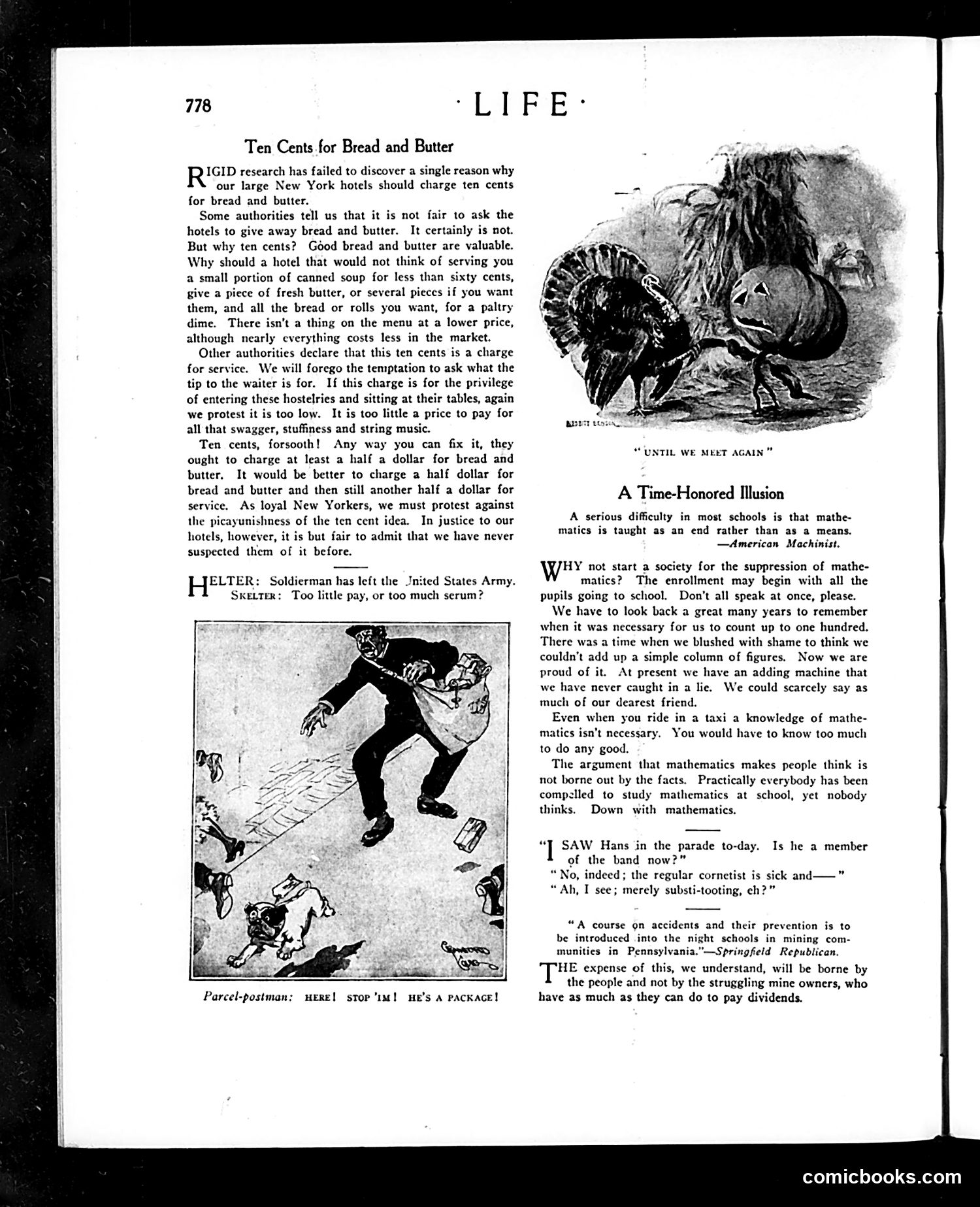
This page satirizes New York hotel pricing practices, specifically the seemingly arbitrary ten-cent charge for bread and butter—remarkably cheap compared to other menu items. Life's editors mock the hotels' logic: if bread and butter merit a charge, ten cents seems absurdly low given that soup costs sixty cents. The satire suggests hotels either should stop charging (admitting they give away provisions) or charge substantially more—perhaps fifty cents each for bread, butter, *and* service—to justify the "swagger, stiffness and string music" of dining in such establishments. The accompanying cartoons address unrelated topics: school mathematics education (mocking its impracticality in modern life) and military pay grievances. A parcel-post cartoon depicts a mail carrier struggling with an oversized package. The humor relies on early-20th-century reader familiarity with hotel dining customs and military service complaints.
📄 Transcribed text from this page (OCR, searchable)
Machine-transcribed from the original scan — historical spelling and the odd misread are preserved.
778 “LIFE: Ten Cents.for Bread and Butter IGID research has failed to discover a single reason why our large New York hotels should charge ten cents for bread and butter. Some authorities tell us that it is not fair to ask the hotels to give away bread and butter. It certainly is not. But why ten cents? Good bread and butter are valuable. Why should a hotel that would not think of serving you a small portion of canned soup for less than sixty cents, give a piece of fresh butter, or several pieces if you want them, and all the bread or rolls you want, for a paltry dime. There isn’t a thing on the menu at a lower price, although nearly everything costs less in the market. Other authorities declare that this ten cents is a charge for service. We will forego the temptation to ask what the tip to the waiter is for. If this charge is for the privilege of entering these hostelries and sitting at their tables, again we protest it is too low. It is too little a price to pay for all that swagger, stuffiness and string music. Ten cents, forsooth! Any way you can fix it, they ought to charge at least a half a dollar for bread and butter. It would be better to charge a half dollar for bread and butter and then still another half a dollar for A Time-Honored Illusion service. As loyal New Yorkers, we must protest against the picayunishness of the ten cent idea. In justice to our hotels, however, it is but fair to admit that we have never suspected them of it before. BEET tO TIL WE MEET AGAIN” A serious difficulty in most schools is that mathe- matics is taught as an end rather than as a means. —American Machinist. HY not start a society for the suppression of mathe- ELTER: Soldierman has left the Jnited States Army. matics? The enrollment may begin with all the Sketter: Too little pay, or too much serum? pupils going to school. Don't all speak at once, please. We have to look back a great many years to remember when it was necessary for us to count up to one hundred. There was a time when we blushed with shame to think we couldn't add up a simple column of figures. Now we are proud of it. At present we have an adding machine that we have never caught in a lie. We could scarcely say as much of our dearest friend, Even when you ride in a taxi a knowledge of mathe- matics isn't necessary. You would have to know too much to do any good. The argument that mathematics makes people think is not borne out by the facts. Practically everybody has been compelled to study mathematics at school, yet nobody thinks. Down with mathematics. “] SAW Hans jn the parade to-day. Is he a member of the band now?” “No, indeed; the regular cornetist is sick and——” “Ah, I see; merely substi-tooting, eh?” “A course on accidents and their prev. be introduced into the night schools in mi munities in Pennsylvania."—Springfeld Republican. HE expense of this, we understand, will be borne by the people and not by the struggling mine owners, who Parcel-postman; were! stop ’im! He's A PACKAGE! have as much as they can do to pay dividends. comicbooks.com